Fine Dining · Korea
Mosu
"Where Korean memory and French technique meet at the fire — Ahn Sung-jae's cooking asks you to rediscover ingredients you thought you already knew."

1—1 / 41
Mosu was my first Michelin three-star restaurant in Korea, and the path to it was not direct. Since the Michelin Guide Seoul launched, the city's three-star designation had belonged to two longstanding addresses: La Yeon and Gaon. Both had been on a list of intended visits for years. Neither had happened, through timing, circumstance, and, if I am honest, a degree of inertia. When Mosu emerged as a third three-star in the 2023 Guide, announced in October 2022, it became the reason to move.
The larger frame: I had visited my first Michelin one-star in New York in April 2017, at 23, the week before I entered mandatory military service in Korea. It took 2,238 days from that meal to arrive here. That gap is not a complaint; it is context. I came to Mosu with a particular kind of anticipation, one that had been accumulating for years rather than weeks.
Sung Anh, the chef, has since become a household name in Korea through his role as a judge on Culinary Class Wars, the Netflix series that brought Korean fine dining into mainstream cultural visibility. Before Seoul, he had built his career through US kitchens: Urasawa in Los Angeles, then The French Laundry and Benu in San Francisco, where he opened the original Mosu in 2016 and earned a Michelin star before relocating to Seoul in 2017. At the time of my visit in May 2023, that Korean chapter on television was still ahead of him. What came through that evening was a different kind of presence: a chef absorbed in his work, at a restaurant that had just received its third star, still in the middle of becoming what it would be.
Mosu was then located in Itaewon, occupying the entire second floor of its building, unusual for a restaurant of this ambition in a city where fine dining clusters in Gangnam. The dining room felt immediate: the kitchen was close, the light was good, and the sense was of a place that had thought carefully about how a meal should feel before it considered what it should taste like. My seat was positioned directly in front of the kitchen pass, which turned out to be the best seat in the room, not for the performance, but for the attentiveness it invited.


2—4 / 41
Dinner begins at 6:30. During a short break mid-course, I went upstairs and found the second floor still empty, the later sitting not yet arrived. Light was coming through the latticed windows at an angle that had nothing to do with the interior design and everything to do with the hour: warm, directional, falling across the empty room in a way that the space appeared to have been designed around. Whether it had been or not, the effect was the same.


6—9 / 41
The course is one. The pairing offers five glasses or seven; I chose five. The first was a Benoit Lahaye Champagne made by natural methods, a producer I had not encountered before. Its precision was not what the description had led me to expect, and that surprise recalibrated expectations for what followed.
There is a tendency in fine dining wine programmes to interpret more glasses as better service. The result is often dilution: many pairings spread thin across eight or nine glasses, each technically acceptable, none leaving a clear impression. Mosu's five-glass programme worked differently. Each glass had a reason, and the sommelier had established what that reason was before the question was asked.


10—11 / 41
The meal opens with six amuse-bouche. The sequence is worth describing in full, because it establishes the kitchen's logic before the main courses are reached.
First: a single prawn on seaweed-wrapped potato. An obvious pairing, and obviously correct; the saline brightness of the prawn against the earthier base required no effort. The dish has been on the restaurant's menu for years, and tasting it, the reason it remained became immediately clear.

12—12 / 41
Second: meringue topped with kelp jam and vegetables. The concept was interesting, the execution clean. Kelp is not a flavour I reach for naturally, and it registered here with more presence than I wanted.
13—13 / 41
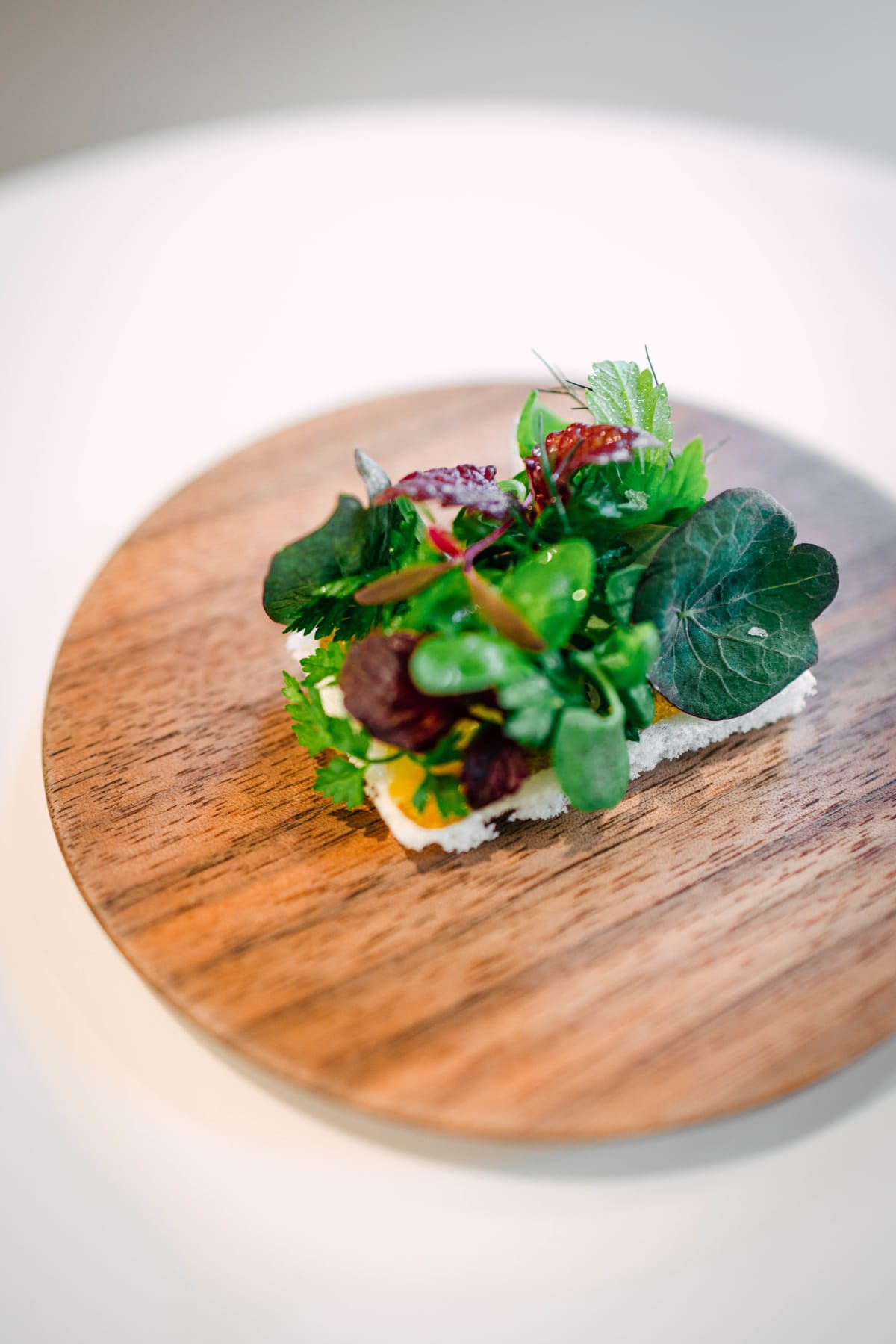
Third, and the most significant of the six: a bite of deodeok root. I had carried a standing prejudice against deodeok as an ingredient, knowing it primarily as bitter and astringent. A sauce beneath the piece, whose composition I could not identify, had resolved that sharpness into something approaching sweetness. Whatever standing prejudice I had held against deodeok did not survive the mouthful.

14—14 / 41
Fourth: carrots, tomatoes, and eggplant, dried and grilled, finished with olive oil. The flavour pointed European; the visual idiom was Korean, the arrangement recalling dried namul in a way that felt deliberate. The quiet doubling of two references in a single small plate.

15—15 / 41
Fifth: Hanwoo beef tartare topped with caviar. Caviar reveals the cook. Used carelessly, it reads as brine and expense. Used well, it amplifies whatever surrounds it. Here it amplified. The tartare was the vehicle; the combination was the point. Caviar appears twice in the course, and the consistency of approach across both instances is itself a statement.

16—16 / 41
Sixth: the abalone taco, with gamtae seaweed, lime, and abalone cooked to a texture that was firm without resistance. A dish that has been on the menu long enough to qualify as a signature and justifies that status.

17—17 / 41
Caviar reveals the cook. Used carelessly, it reads as brine and expense. Used well, it amplifies whatever surrounds it.
After the amuse-bouche, a course of sesame-infused tofu arrived, its texture unexpectedly taut and dense. Inside, sea urchin. The quality was good, the portion generous, served in a light soy-based broth with wasabi. A measured transition from the concentration of the opening sequence to what came next.


19—20 / 41
A Dewazakura five-year aged sake arrived alongside, the second pairing of the evening. This was the one glass of the five I found less convincing. Aged sake introduces a particular quality, somewhere between earthiness and ferment, that sits at odds with what I value most in the style: the clean sweetness and clarity of a sake bottled closer to its production date. The pairing was logical against the tofu's own depth. The wine itself was not for me.

18—18 / 41
Between the tofu course and what followed, a course arrived unannounced. The sommelier described it as a hidden course: an ice cream made from sourdough bread, served over balsamic vinegar, olive oil, and quinoa. The sourness of the vinegar, the richness of the oil, the resistance of the grain against the cold. A combination that looks improbable on paper and makes complete sense in the mouth.

22—22 / 41
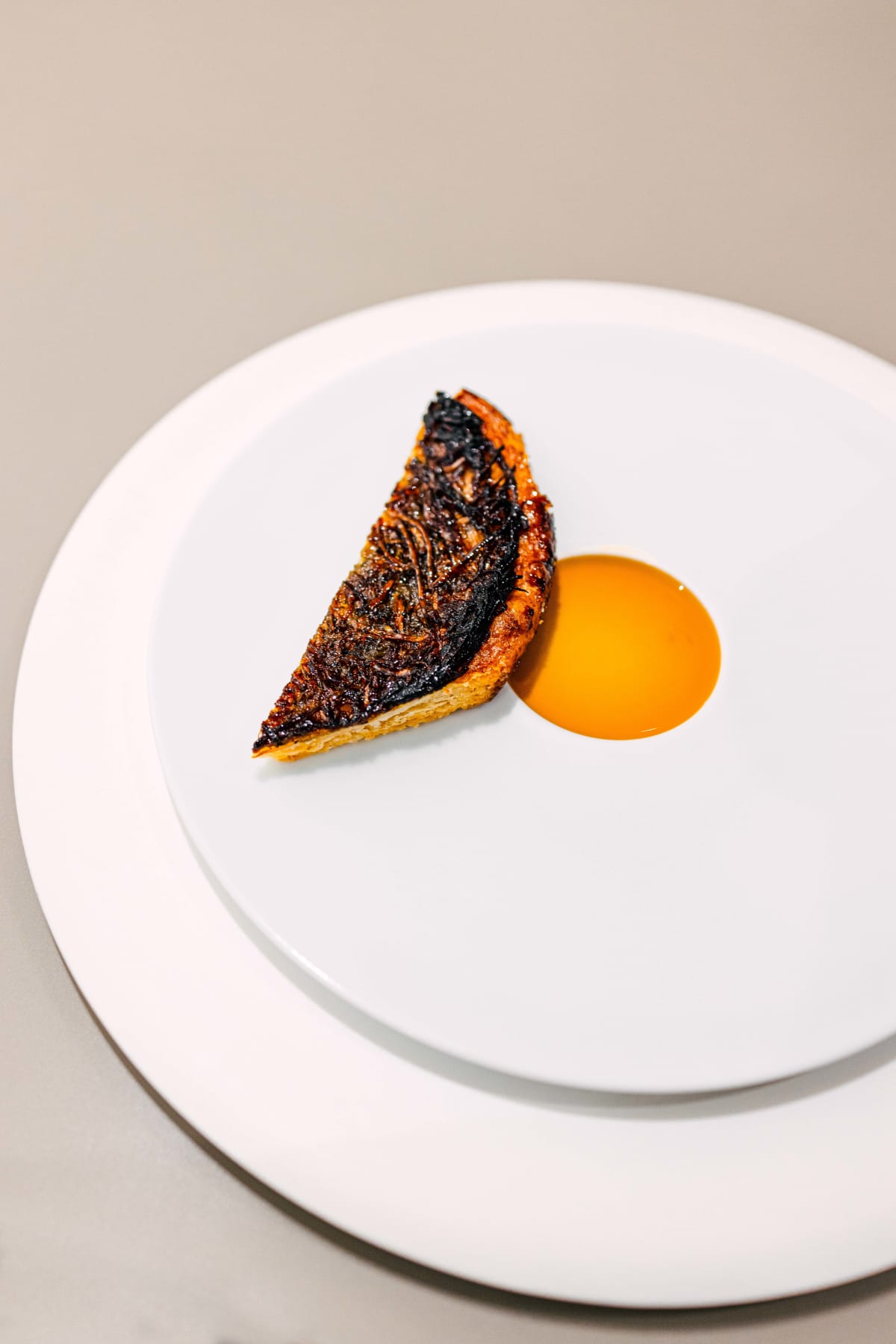
The burdock pie that arrived between courses was the one sequence in the meal where the kitchen's intelligence felt slightly disconnected. The form was interesting: a whole pie constructed around burdock, presented intact before being divided and served. But it sat awkwardly in the flow, adjacent to nothing before or after it with obvious intention. The accompanying skin-juice sauce, which was meant to contribute something, was so dominated by the pie's own texture and flavour that I finished the course without fully registering what the sauce was supposed to be. The one moment of the evening that felt unresolved.

21—27 / 41
The okdom that followed was a correction of sorts. Red tile fish, cooked with a precision that made me think about what fish cookery at its best can achieve. No overcooking, no resistance, the flesh retaining every quality the fish had before it met heat. Baechu-sok arrived alongside it, which the staff clarified was not the common baechu but a distinct genus within the same plant family: a small detail, offered without ceremony, that rewarded the brief pause it required.


23—24 / 41
The badal crab that followed was less impactful than the okdom, which I note not as a criticism of the dish but because the okdom had set a standard that was difficult to follow. Snow crab meat in a creamy sauce with namul greens, the flavour quietly salted and well-constructed. Caviar arrived on top: the second appearance of the ingredient in the course. By this point, the caviar was a confirmation rather than a surprise, and the consistency of approach across both instances remained a statement.

26—26 / 41
Famille Cordier's Pouilly-Loché 2019 paired alongside: a white with an oily texture well suited to the richness of the crab and sauce. Against the evening's other wines, it passed more quietly. The later pairings were stronger.

25—25 / 41
The course that defined the evening was the acorn noodles, smoked over half-burned wood embers and finished at the table with shaved white summer truffle. The kitchen's open hearth and the stacked firewood visible throughout the room are not decorative. This dish explains them. The combination recalled a tagliarini with truffle, and the reference was deliberate, but the flavour was entirely its own: smoky and earthy, the truffle adding weight rather than fragrance. The winter version uses black truffle. That remains a reason to return.


28—29 / 41
This was the busiest point in the kitchen's evening. From the counter seat directly in front of the pass, the concentration in the room was visible: in the team's movement, and in Sung Anh himself, whose attention during service was of a different quality than the warmth he showed between courses. To photograph a chef in a quiet moment is straightforward. To photograph one at full concentration, with a full kitchen behind him, requires the kitchen to forget you are there. That happened briefly, and the photographs that came from it are among the better records of the evening.

30—30 / 41
Pierre Gonon's Saint-Joseph 2019 arrived alongside: a northern Rhône Syrah, dense and precise, its finish matching both the acorn noodles and the Hanwoo that followed with equal ease. Among the evening's wines, this was the one I spoke about most afterward. A wine worth finding outside the pairing context.

31—31 / 41
At the point of the red wine service, there was a gesture from the sommelier that I will not describe in detail. Three-star service is frequently precise. It is less frequently generous in the way that has nothing to do with what appears on the bill. This was the latter.
Three-star service is frequently precise. It is less frequently generous in the way that has nothing to do with what appears on the bill.
The final main course paired Hanwoo beef with clam, a combination I had not previously encountered. The softness of the beef and the firmer resistance of the clam were complementary in texture, more logical than they first appeared. My mild reservation is one I hold about Korean fine dining more broadly: in a world of diverse proteins, the near-universal reliance on Hanwoo narrows the vocabulary. The best French restaurants offer a choice of meat; there is no reason the best Korean ones could not do the same. The observation belongs to the category, not this kitchen.

32—32 / 41
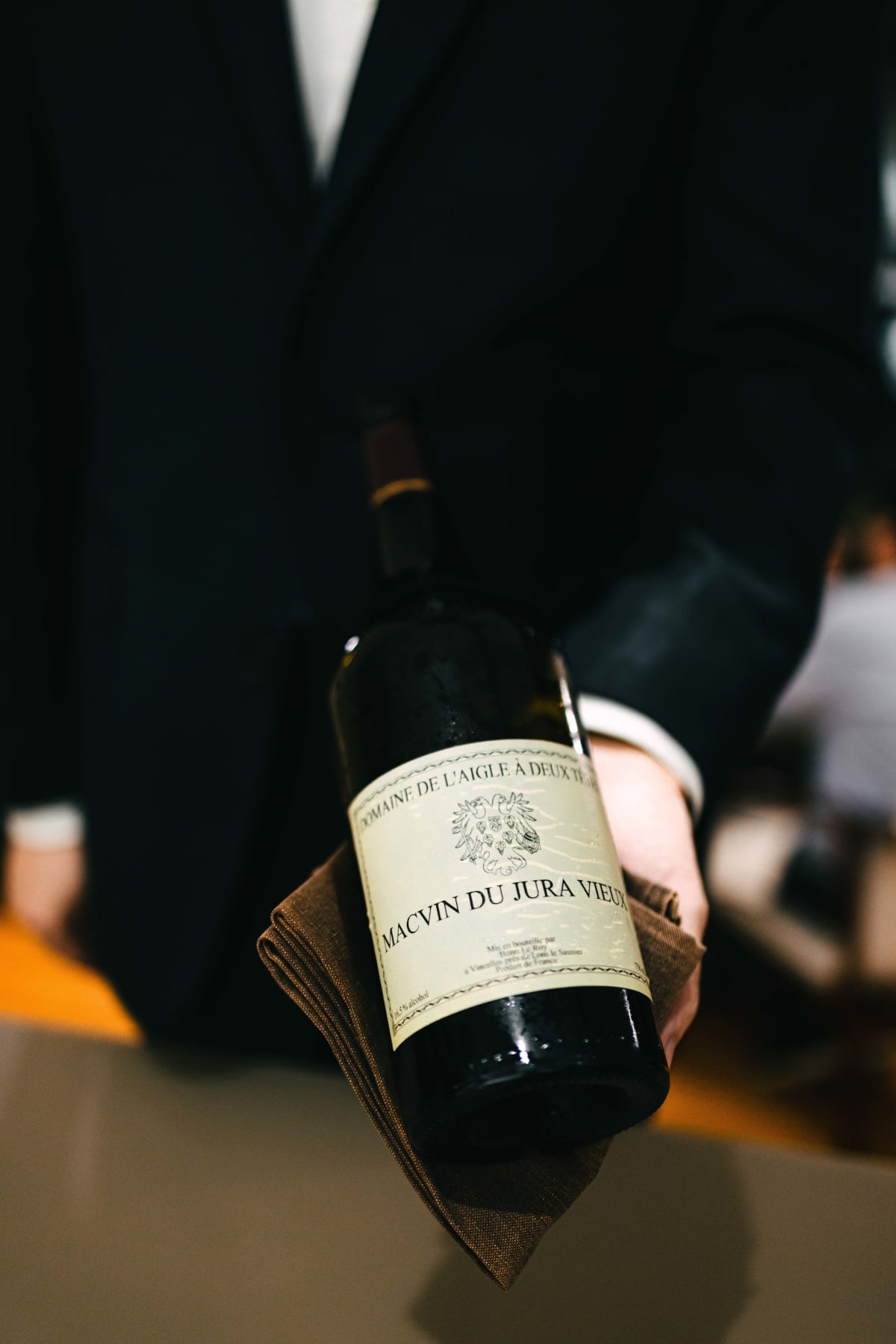
The dessert sequence opened with a sorbet made from chamoe, the small Korean melon whose flavour sits somewhere between honeydew and white peach. A clean, precise start. Macvin du Jura arrived alongside: a vin de liqueur from the Jura whose production sits outside what wine usually means, made from unfermented grape must combined with marc brandy before fermentation can begin. The sommelier described it correctly as occupying an ambiguous category. There is something particular about encountering a preparation that resists easy classification at the close of a long evening. It extended the conversation rather than ending it.


33—35 / 41
Two further desserts followed before the last. A rice cake cultivated with beneficial bacteria, its surface covered in fine white growth, the texture somewhere between a traditional sulttteok and something harder to place. Alongside it, a choux filled with kelp jam: technically interesting, and unusual in the way that Mosu's relationship with kelp throughout the evening was unusual. Kelp is not a flavour I reach for naturally. I was honest with myself twice on that point.


36—37 / 41
The final dessert was caramel ice cream topped with roasted green onion and onion, caramelised to a fine powder and folded through. It overturned everything I had thought about the dessert sequence up to that point. The combination should not work. It worked completely.


38—41 / 41
The 2023 Seoul guide's decision to award Mosu a third star placed Ahn Sung-jae alongside La Yeon and Gaon, the restaurants that had held that distinction in the city for some time. The comparison is accurate in rank and misleading in kind. La Yeon and Gaon are both built outward from Korean culinary tradition; where they modernise, they do so as an extension of inherited form. Ahn arrived from the opposite direction. His formation ran through Urasawa in Los Angeles and Benu in San Francisco, and he turned both instruments toward Korean ingredients. The result is not a modernised Korean kitchen but a kitchen that treats Korean ingredients as materials worth isolating and testing. That logic is what Asia's 50 Best recognised when it placed Mosu at #15 and named it Korea's Best Restaurant in 2023.
Have a question about this restaurant, or want to share your own experience?
Send a message