Fine Dining · Tokyo · Japan / April 2024 / Michelin ★★★ (removed 2019, membership only) · Tabelog Gold (2024) · Asia's 50 Best #25 (2019) · La Liste #2 (2023)
Sushi Saito
"The shari makes the sushi. At Saito, every piece of neta is a lens, and the rice beneath it brings the image into focus."
Section 1·Outside the Guide
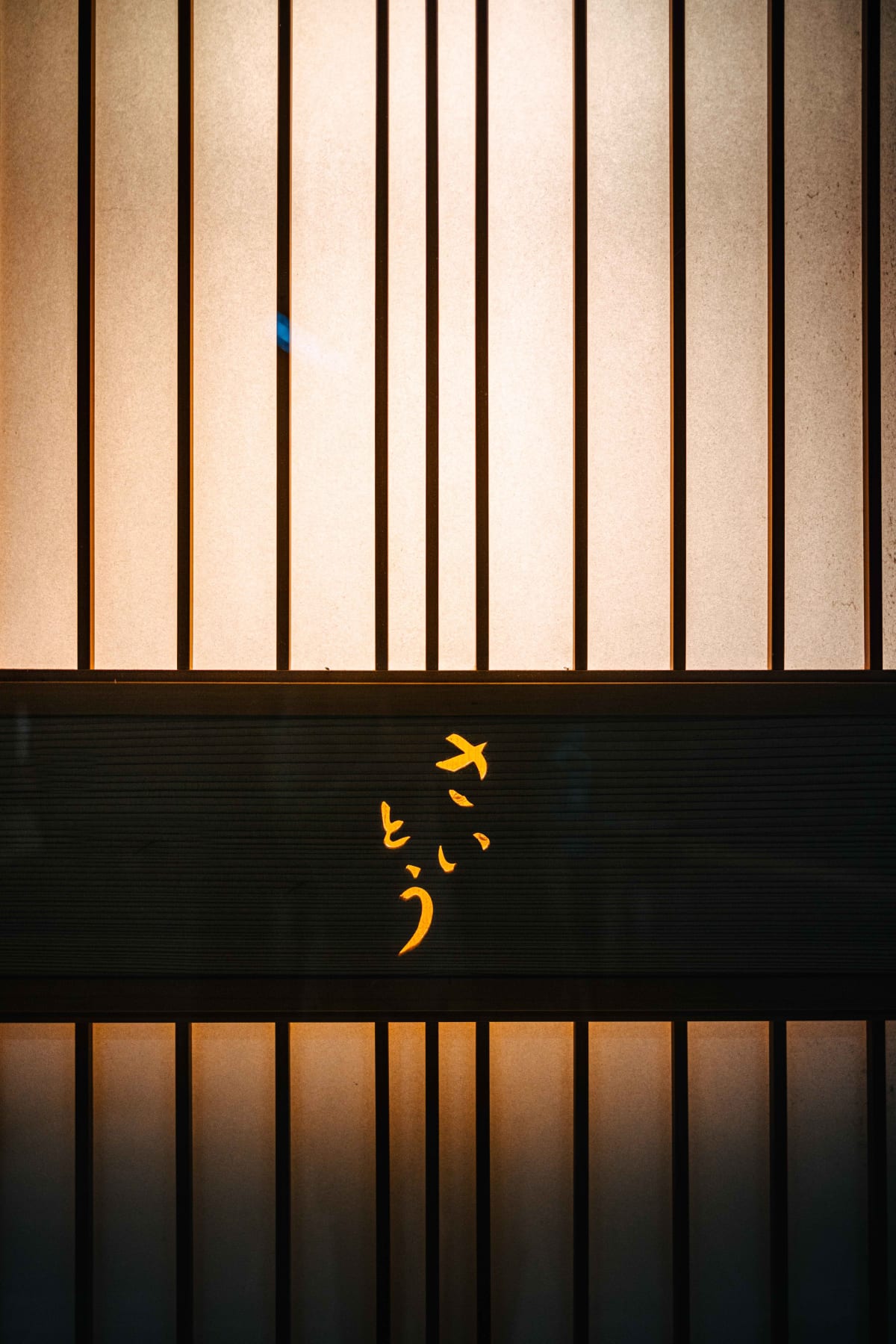
Sushi Saito is located in the ARK Hills South Tower in Roppongi, a building that gives no outward sign of what happens inside. The main counter seats ten, arranged in a single line facing Chef Takashi Saito, who trained under Shinji Kanasaka before striking out independently and receiving three Michelin stars with the 2009 Tokyo guide. In 2019, the restaurant withdrew from the guide entirely: the volume of public reservation requests had grown incompatible with the terms on which Saito-san was willing to work. This is not a small thing to do, and the restaurant has not suffered for it.
The evening I visited was a private dinner organised for guests from five countries, a group assembled specifically for the occasion. The kind of evening that does not happen by accident.
Section 2·Two Magnums
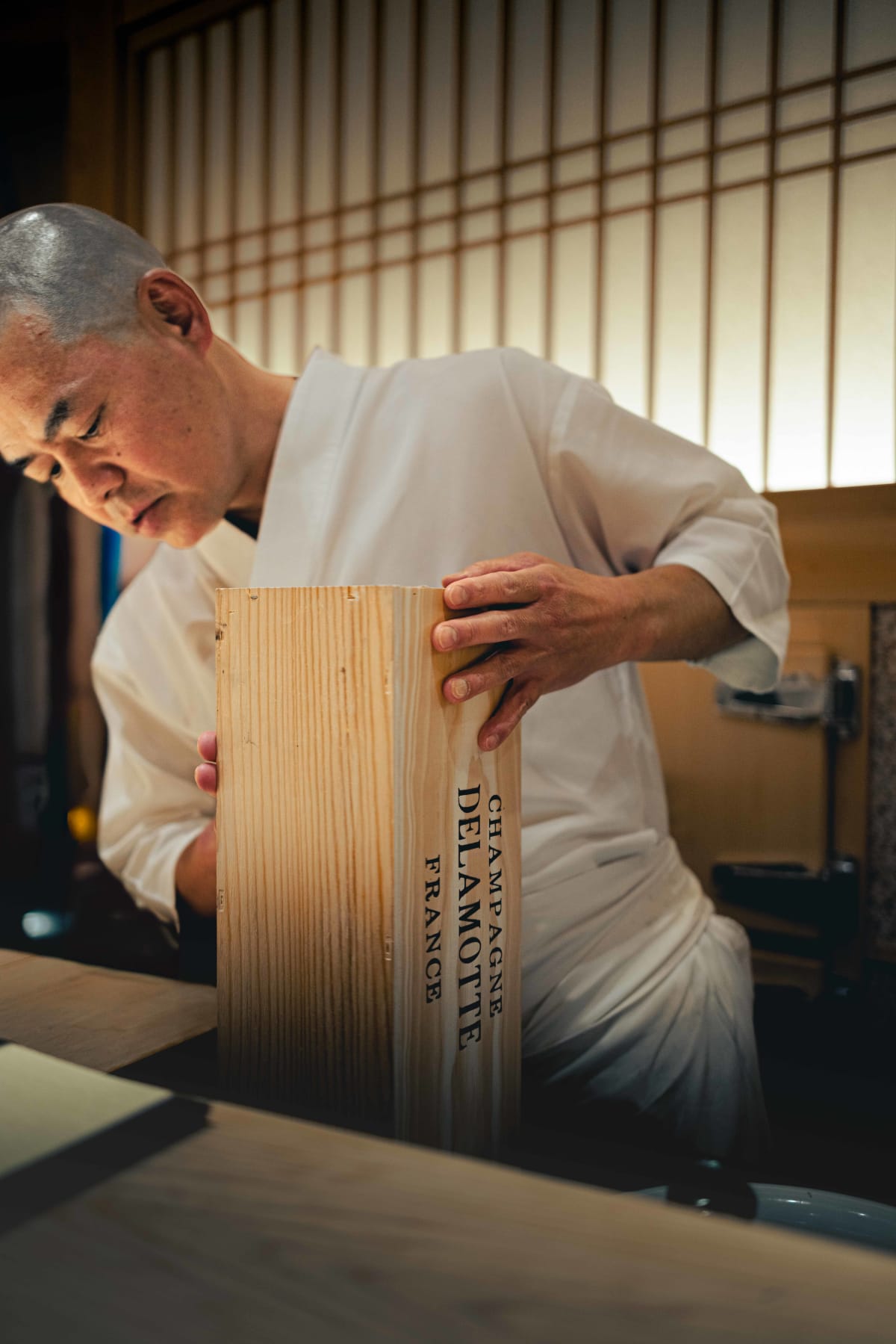
Saito-san emerged carrying a case himself. Inside were two magnums: Delamotte 1970 and Delamotte 1964, both between fifty-four and sixty years old. How they had been sourced, and in what conditions they had spent those decades, was left pleasantly unanswered.


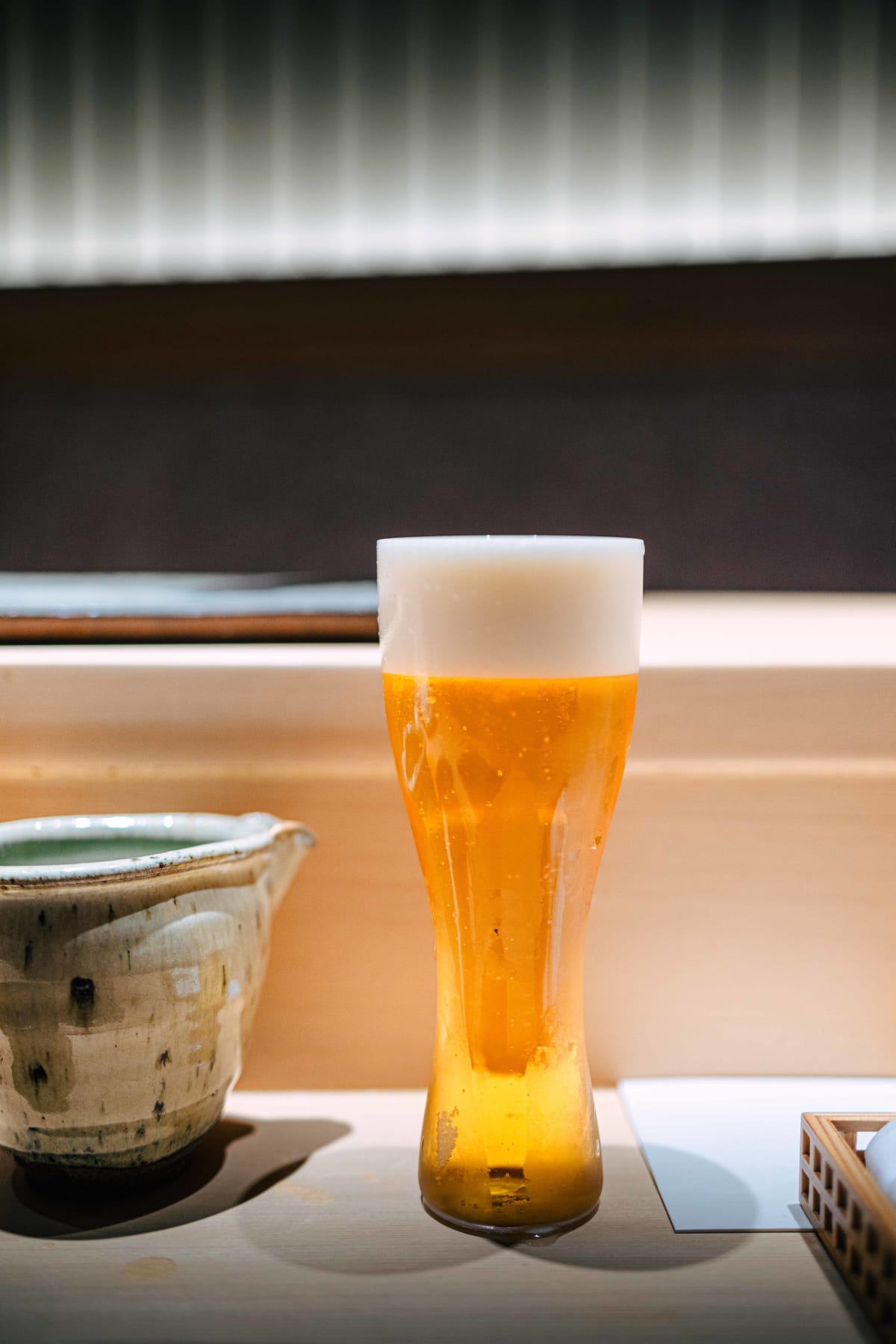
The 1970 was opened first. The mousse was still present, which at sixty years is not guaranteed; the oxidative notes had settled into the wine rather than overtaking it, and the nose carried a preserved richness that most wines do not survive to produce. We drank it while Saito-san completed his mise en place, and the combination of setting, company, and glass produced the particular elevated quality that some evenings have before the food even begins.

The 1964 followed midway through the tsumami. By comparison it had faded, the fruit receded, the wine lacking the presence of the 1970. Both were, by any reasonable standard, extraordinary. The point of the comparison was available only because both were open in the same sitting.

Section 3·Before the Board
The tsumami sequence opened with shirauo. Japanese icefish is typically a small creature; the specimens that evening were large enough to register as unusual before they reached the palate. A light acidic sauce beneath them did its work without complication.

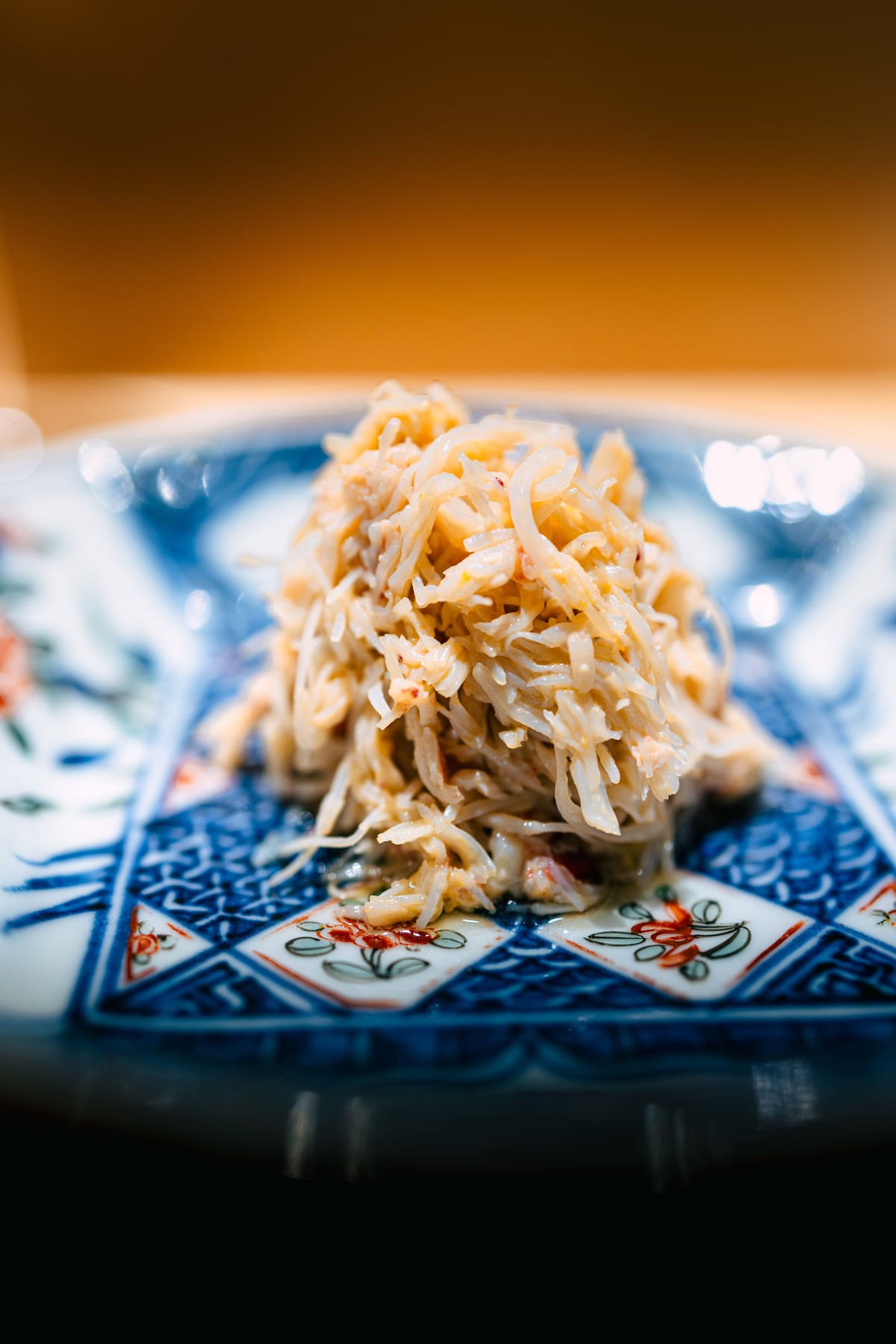
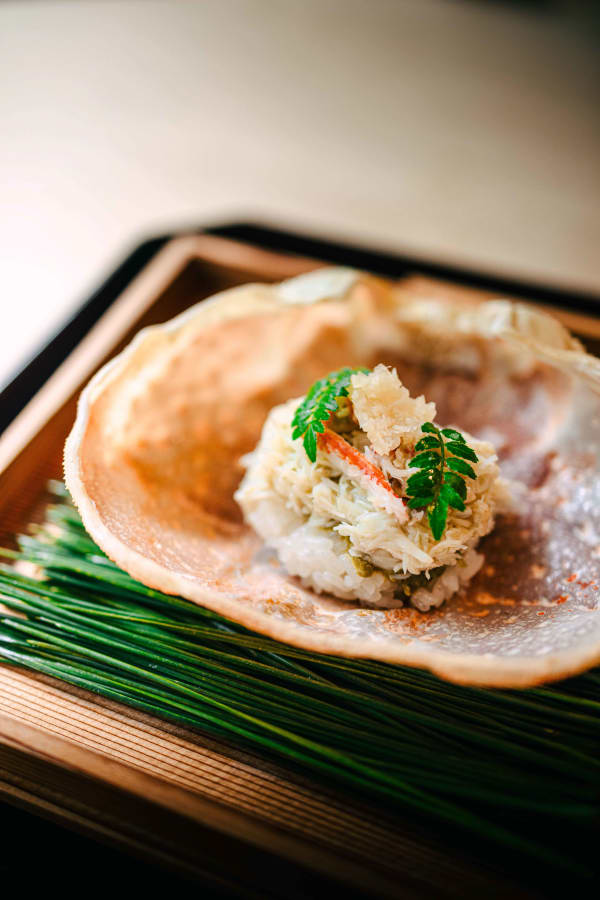
Pre-extracted crab meat came next, cold and cleanly arranged. Then a single umeboshi, served alone, which produced in everyone at the counter the same involuntary response that concentrated sourness reliably induces. The degree of acidity in a properly aged umeboshi of this quality is not easy to describe without experiencing it; suffice to say the mouth's reaction was total and immediate. For non-Japanese palates encountering this for the first time, the experience may sit closer to challenge than to pleasure.

Hotaru-ika followed, firefly squid on a skewer, passed by Saito-san directly to each guest. The flesh was tender, the interior liqueur-like in its concentration, and against the Delamotte the pairing required no explanation.


Then ko-mochi yari-ika: young spear squid carrying its own eggs, served in a thin sauce with a quiet acidity. This was the first of my two best tsumami of the evening. The texture of the squid, at once firm and yielding, and the small dense presence of the roe against the clean sauce produced a combination I have thought about many times since. Squid is a material Japan handles better than anywhere else I have eaten it, and this was a precise illustration of why.


Tai shirako, red sea bream milt, arrived next with green citrus, likely sudachi. Rendered to just past the point of rawness, its creamy richness offset by the citrus acidity. Restrained, and it did not overstay itself.

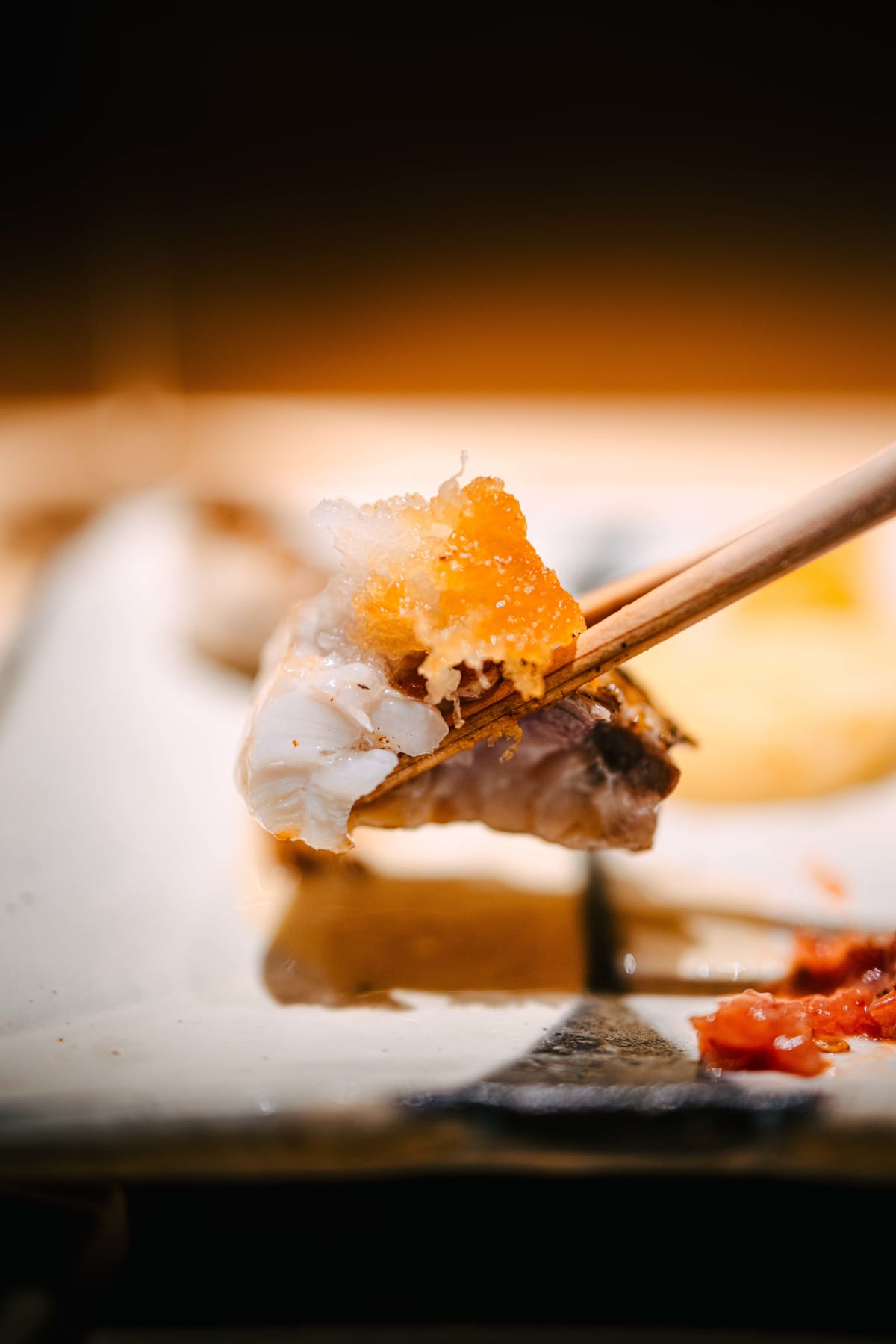
The other tsumami best came last: nodoguro, grilled. I am not generally drawn to grilled fish in a sushi course, preferring neta closer to its raw state. The black-throated seaperch is different. The fat content applied to heat produced a richness that fell short of heaviness, and the accompaniments of grated daikon and umeboshi cut through precisely when needed. The kind of dish that revises a standing preference.


Section 4·The Board
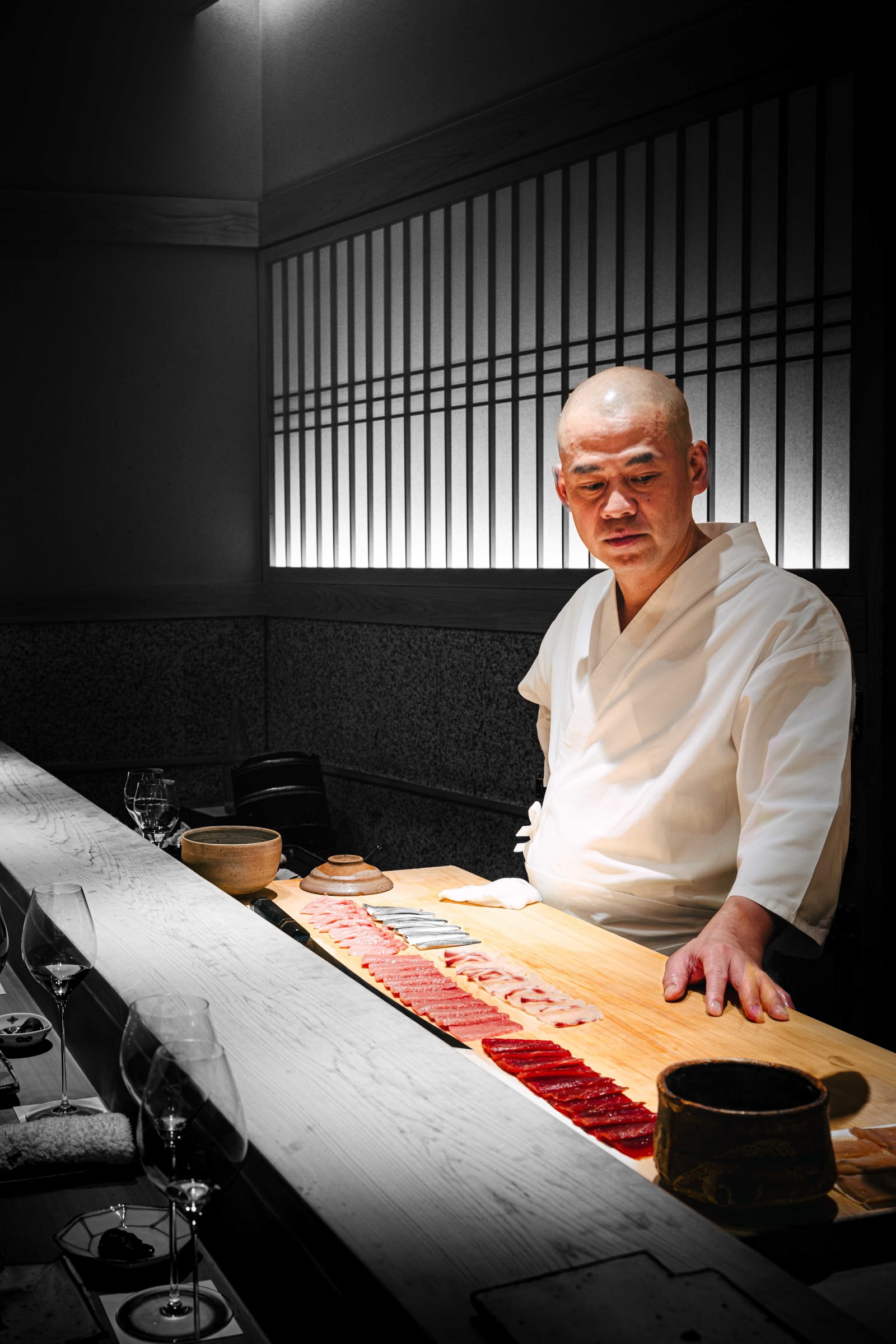
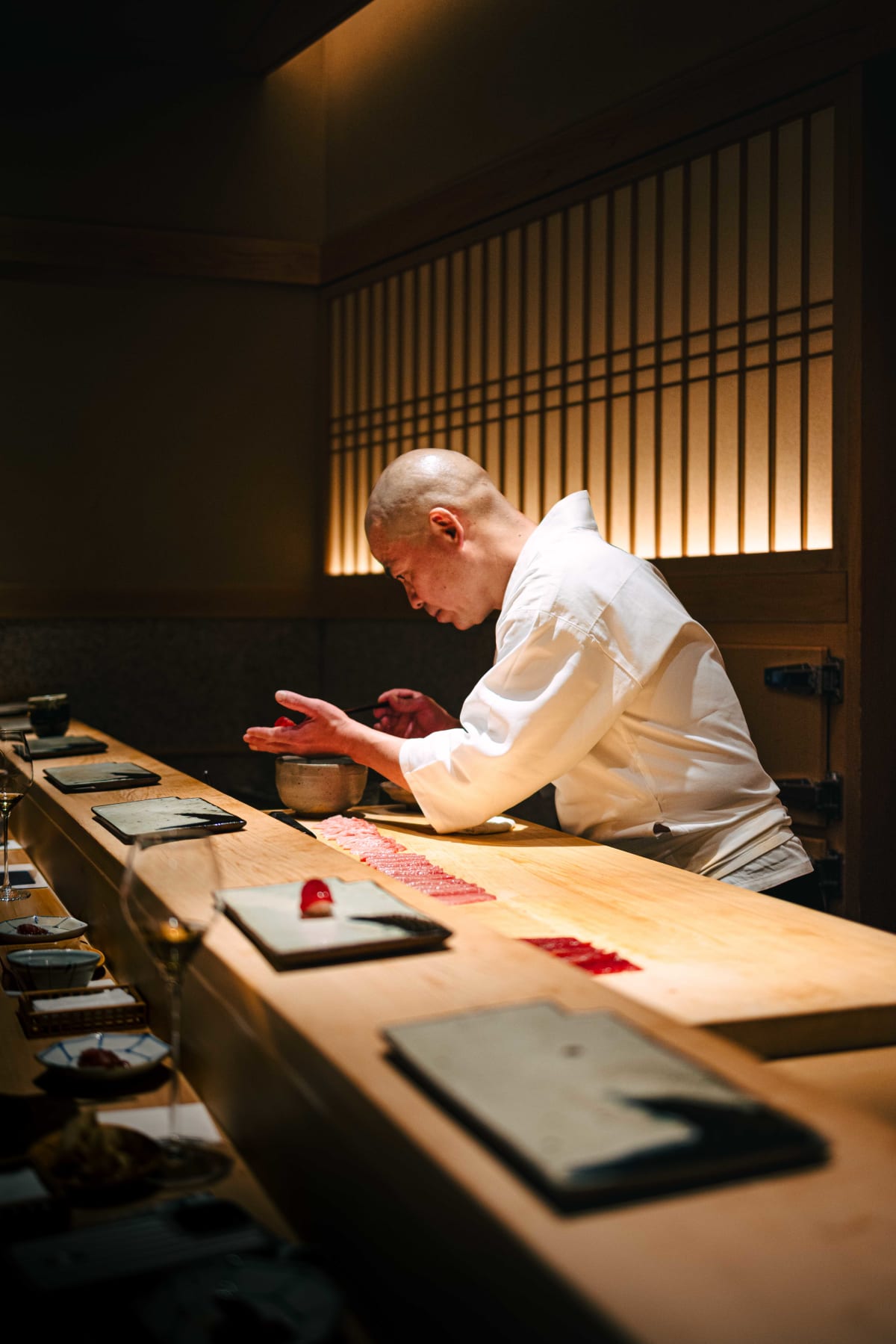
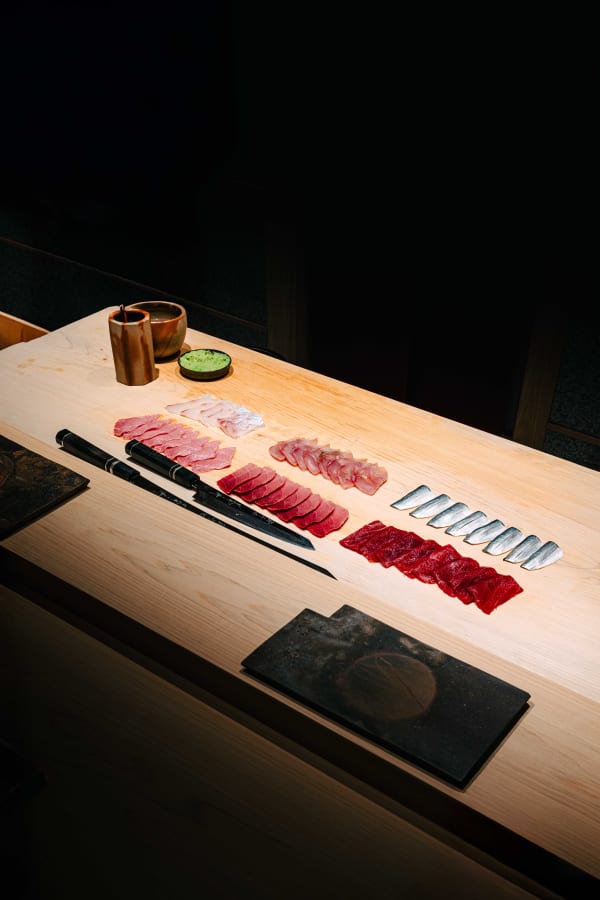
Before the nigiri began, Saito-san laid the neta across the wooden board in a single line: the full sequence of the evening made visible at once. This practice has become a signature of the Saito lineage and the counters it has seeded across Asia. Seeing it here, at the source, the gesture carried a weight that inherited versions do not quite replicate. The fish was in better condition, the arrangement more deliberate, and the fact of origination rather than adaptation was legible in a way that is difficult to articulate but easy to feel.
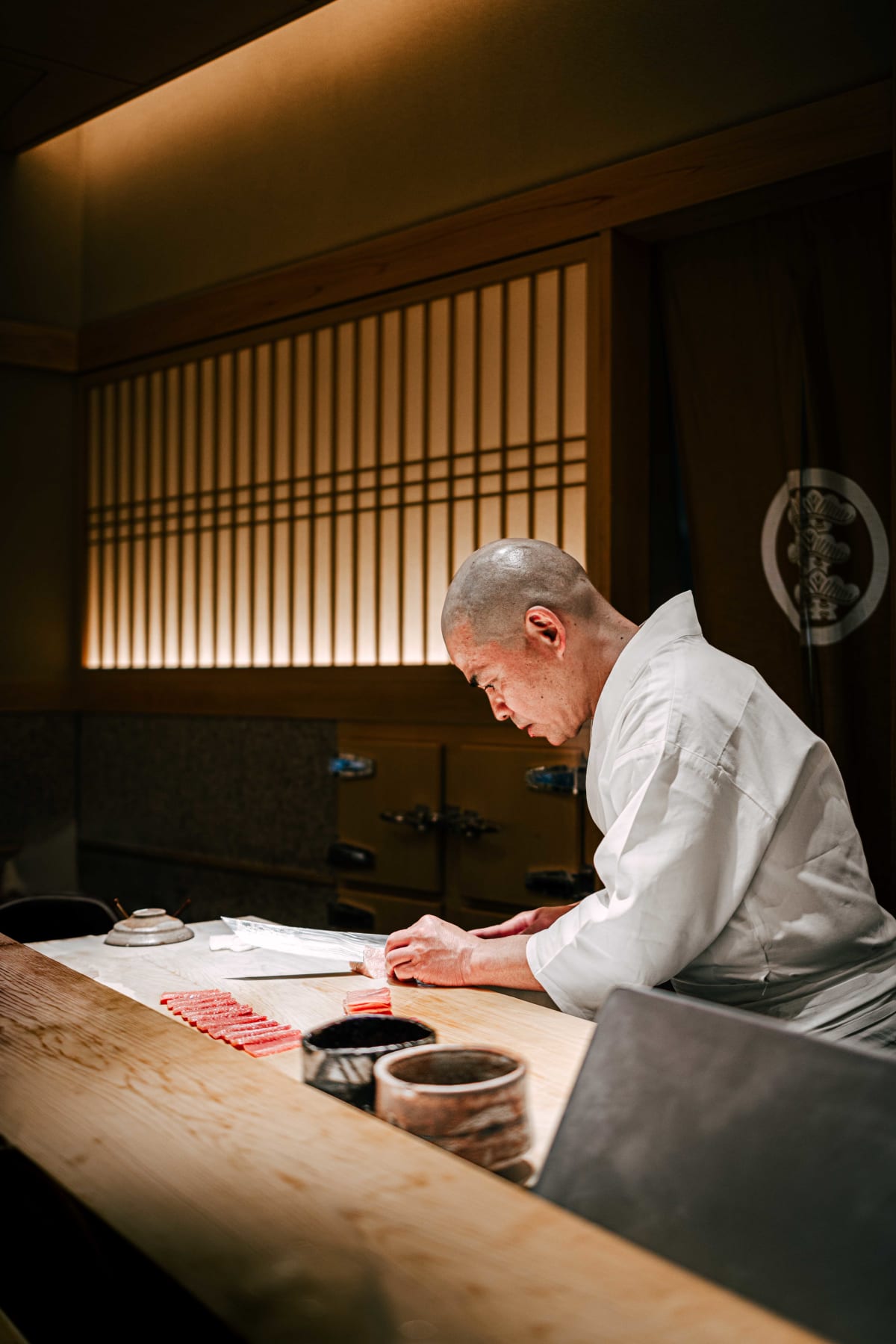
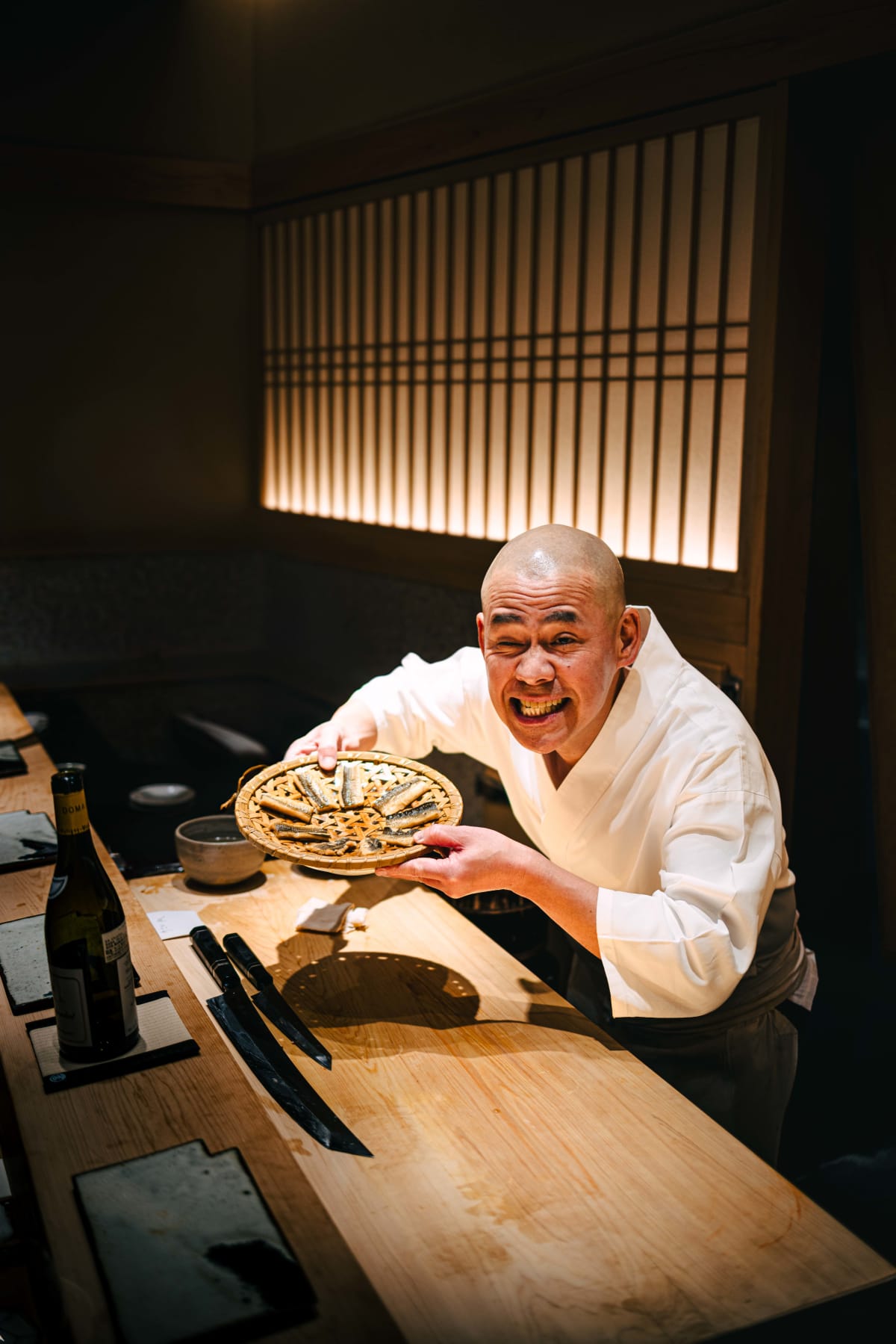
Saito-san's character during service is worth describing at length. Between pieces, he moved down the counter asking each guest where they had come from, responding with warmth and specificity. He had visited Seoul shortly before our dinner, and for the Korean guests at the counter this produced an unexpectedly detailed exchange: restaurant names, dishes discussed, the kind of opinion that belongs to someone who eats with the same attention he brings to his own work.

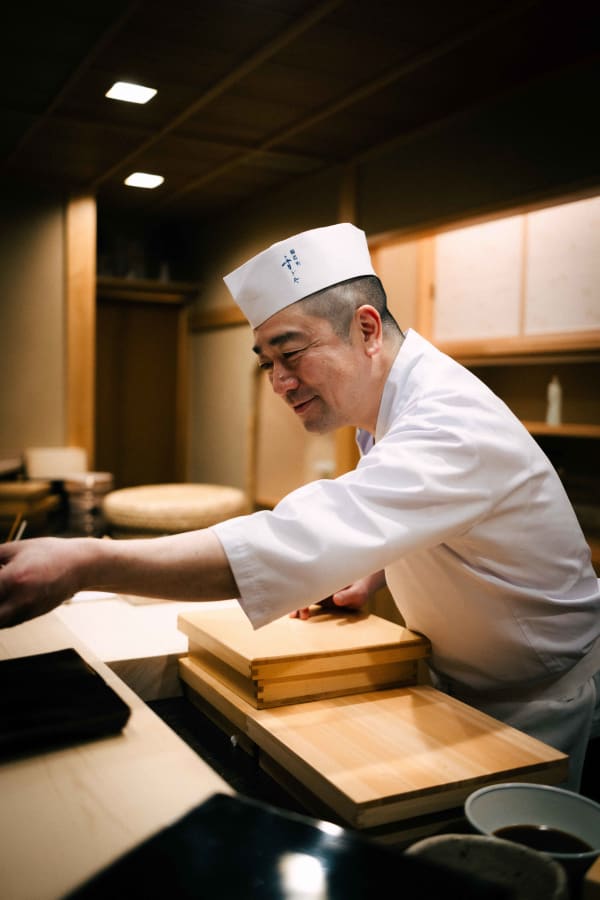
At the moment of making a piece, something shifted: the laughter left his face entirely, his movements became contained and precise, and the counter fell quiet. This happened every time, without exception. The contrast was not performative. It was simply what the work required, and he gave it that. Mid-course, he set down the Champagne he had been drinking with us and continued the rest of the evening with water. The evening was for the guests, but the standard remained the standard.

The evening was for the guests, but the standard remained the standard.
Section 5·The Shari
The nigiri began with tai. Before arriving I had been told by someone who had eaten here before: photograph quickly, eat immediately. The reason became clear from the first piece. The shari is served warm, and the temperature differential between rice and neta has a defined window during which it functions fully. Eating the tai within seconds of its being placed in front of me, I understood what distinguished this from every other sushi counter I had visited. The rice dissolved at a rate calibrated to the fish. The seasoning was present without announcing itself. The warmth carried the aroma upward in a way that cooler rice suppresses entirely.

Hamachi followed, then kohada. The pattern established by the first piece held.


The middle section, three tuna preparations, was the one moment where the meal briefly plateaued. The tuna was technically correct and lacked the acidity and intensity I have found at other high-level Tokyo counters. Against the standard set by every other piece that evening, it registered as the one gap in the sequence.


What followed erased it. Sumi-ika, cut finely enough that its texture was a new thing: not uniform softness but a deliberate quality that multiplied the surface area against the palate. Kuruma-ebi, the prawn that appears at every serious sushi counter in Tokyo, here tasting like the version against which all others are measured. And then sakura masu, cherry salmon in its April season, which was the piece of the evening. The seasonal fat content, its aromatic quality at this particular time of year, and the rice temperature produced a combination that drew a moment of shared acknowledgement at the counter, unprompted, from more than one person. I edited the photograph three months later; looking at it, the flavour returned precisely.




The closing sequence moved through torigai (cockle), uni, and anago. The uni was sweet and of excellent quality, as it reliably is at counters of this level in Japan; in that context, excellence becomes the baseline rather than the peak. Unagi and maki closed the course. No supplementary pieces are offered: the meal ends when the programme ends.




Section 6·One Precise Lens
The shari is the reason. There is a principle in Japanese sushi culture that the meal is, above all else, a conversation about rice. At Sushi Saito, this principle is not an abstraction; it is the organising logic of every piece on the board. The neta is exceptional throughout. What the rice does is function as a more precise lens through which each ingredient becomes legible: not by complementing it from beneath, but by dissolving at a rate and temperature that releases whatever is specific to that fish at that particular moment.
The clearest illustration was the kuruma-ebi. The tiger prawn is a fixture at every serious sushi counter in Tokyo, familiar enough that its impact can seem predetermined. At this counter, it tasted like the version against which all others are measured, not because the prawn itself was categorically superior, but because the rice made its specific qualities visible in a way that a different temperature, a different rate of dissolution, or a slightly heavier seasoning would have obscured. What the rice does, consistently, across every piece, is bring the ingredient into sharper focus. A familiar presence seen through a more precise lens becomes, in effect, a new one.
A familiar presence seen through a more precise lens becomes, in effect, a new one.
Section 7·Two Bottles
Near the end of the meal, Saito-san opened a bottle he had chosen himself: Domaine Drouhin-Laroze Bonnes-Mares Grand Cru 2002. A gift to the table, not a sale. In many years of eating at sushi counters of this level in Japan, I have encountered chefs who waive a beer charge, or occasionally the cost of a tokkuri of sake. A bottle of aged Burgundy grand cru, opened without announcement and poured for the table without expectation of reciprocity, belongs to a different category entirely.

The wine had aged twenty-two years. The fruit intensity remained, the tannins fully resolved, the temperature slightly cool in a way that made no difference to how quickly it disappeared. It closed an evening that had been justifying itself for three hours, and it did so with a quality of generosity that is not easy to forget.


Our group had arrived with a bottle of our own: Ilyeop Pyeonju (一葉片舟), a traditional Korean distilled spirit produced at Nongam Jongtaek, a household in Andong with a six-hundred-year lineage. Made from rice with the estate's own nuruk through a process requiring months of fermentation and aging, it is difficult to source even within Korea. Bringing a Korean spirit to a Tokyo sushi counter is a particular kind of gesture: an offering that carries a culture across, rather than into, the cuisine being served. When Saito-san received it, his first response was to suggest, with some theatricality, that it be opened immediately. The exchange was brief and warm, and it produced the particular easy quality that belongs specifically to a counter where the chef and the guests remain in direct, sustained contact for the entire duration of the meal. There are restaurants where the kitchen and the dining room are separate worlds. Sushi Saito's counter is not that kind of place.
Section 8·What Restraint Did
Sushi Saito's course ends when it ends, with no supplementary pieces offered and no mechanism for extending it. The constraint is editorial as much as logistical. The shari's restrained seasoning means the palate arrives at the close without the fatigue that heavier seasoning tends to produce. The finish is clean. What this also produces, given what the rice makes possible, is a clear awareness of what a longer programme at the same standard would have offered. The case for an expanded piece count, at whatever premium that required, is one I would make without hesitation.
I have eaten sushi at many counters in Tokyo. None has taught me more about what rice is capable of than this one.
Sushi Saito left the Michelin guide in 2019, and since then the restaurant has operated outside the conventional architecture of international recognition. Its reputation has moved through a different channel: the chefs trained under Saito-san who have opened outposts of their own across Asia. The work done at the counter in Roppongi is not contained by that counter. It travels, reinterpreted and re-located, through hands shaped in the same tradition. What I ate in April 2024 was not only a meal but a reference point, one I have since used to measure every other sushi counter I have sat at.
Have a question about this restaurant, or want to share your own experience?
Send a message