Fine Dining · Barcelona · Spain / October 2025 / Michelin ★★★ · World's 50 Best #1 (2024)
Disfrutar The Living Table
"elBulli's heirs, and the rare immersive table where the cooking always leads"

Section 1·The Soil of Barcelona, and the Heirs of elBulli
When the conversation turns to the restaurants that have left the deepest mark on the history of gastronomy and dining, one name is impossible to leave out: elBulli, the restaurant that opened an entirely new horizon in gastronomy. Set on the Costa Brava in Catalonia, it took apart the rules of a fine dining world centred on classical French cooking and, in their place, established molecular gastronomy, the experimental tasting menu, and a laboratory-style culture of R&D, completely changing the way chefs around the world think.
Sadly, elBulli closed its doors in 2011, so I had no way to experience it directly. On this trip through Spain, however, I was able to experience, if only indirectly, the aftershock elBulli left on global gastronomy. That place was Disfrutar, the restaurant that has climbed to No.1 on the World's 50 Best Restaurants (2024). In particular, I was able to experience The Living Table: the secretive, almost monumental space hidden underground that can be booked only when four or more guests gather. I want to call it the culmination of this trip, its crowning touch. According to the restaurant that evening, our party was only the second Korean group ever to experience it.
Because everyone judges flavour by a different standard, there was no consensus on which restaurant was the best. But I tend to reward the experience of all five senses taken together, and to give extra credit to new techniques and creative combinations over tried-and-true pairings, as long as the essence of flavour stays intact. By that measure, I want to name Disfrutar the finest place of this entire trip. The Living Table, I would say, has risen beyond the realm of gastronomy and into the territory of a total work of art.
The Living Table, I would say, has risen beyond the realm of gastronomy and into the territory of a total work of art.
There are many keywords one could use to explain Disfrutar, but the city of Barcelona itself becomes an essential backdrop for understanding the restaurant. With the Mediterranean at its doorstep and a long history as a centre of trade, Barcelona has naturally absorbed influences from Italy, southern France, the Middle East, and North Africa into its food culture. To the north, the Pyrenees and the plains supply a constant stream of meat, dairy, and vegetables; to the south, the Mediterranean does the same for seafood. Add to this an early wave of industrialisation that grew a dining-out culture well ahead of its time, and the flourishing of Gaudí and modern art on top of that. Disfrutar stands at the very front line of the Barcelona gastronomy that all these elements, stirred together, have produced.
To tell the story of Disfrutar, you cannot really begin without elBulli. As you prepare for a gastronomic trip through Spain, you keep running into the phrase "opened by an elBulli alumnus." The three chefs who lead Disfrutar today, Oriol Castro, Mateu Casañas, and Eduard Xatruch, all came out of elBulli's core creative team. From the late 1990s until elBulli closed in 2011, these three stood at the centre of every experiment, every thought experiment, and every new technique, opening the age of molecular gastronomy alongside Ferran Adrià.
Even after elBulli closed, research remained at the centre of their work. Through the elBulli Foundation and the Bullipedia project, they carried on the work of organising the experiments they had once attempted in the restaurant into concepts and written records. In short, they belong to the type one might call "people who research cooking." This is why every plate they put out is built as if it were posing a question. Why does this texture have to be this way? Why am I being made to eat this ingredient at this temperature, in this order? Their dishes naturally prompt those questions as you eat.
But research alone does not fill the stomach. The desire to meet guests directly, in their own way, kept growing, and the first restaurant born of that desire was Compartir. True to its name, which means "to share together," it is a relatively casual modern Mediterranean restaurant: a place that steps back a little from the radical experiments of the elBulli years, yet still presents refined, deft dishes in a format meant to be shared among several people. Here, the three reacquainted themselves with the practical rhythm of cooking for and serving real guests.
Once Compartir was firmly established, they turned to the plan they had wanted to pursue all along: to build, in the heart of Barcelona, "a restaurant focused on research and experiment, standing at the very front line of avant-garde gastronomy." And so, in 2014, Disfrutar opened across from the Mercat del Ninot in Barcelona's Eixample district. As its name, Spanish for "to enjoy, to savour," suggests, the space was designed from the start as "a vehicle for bringing the results of their research to guests in the most enjoyable way possible." The story of the interior is fairly symbolic, too. The entrance side carries a colourful, playful mood drawn from the iron structure of the Mercat del Ninot opposite and from ceramic tones that call to mind Joan Miró. Then, passing through the kitchen and into the inner main dining room, you arrive at a bright, calm finish that evokes the houses of a Mediterranean seaside village. The very contrast in tone between the playful entrance and the serene dining room is already a narrative in itself.
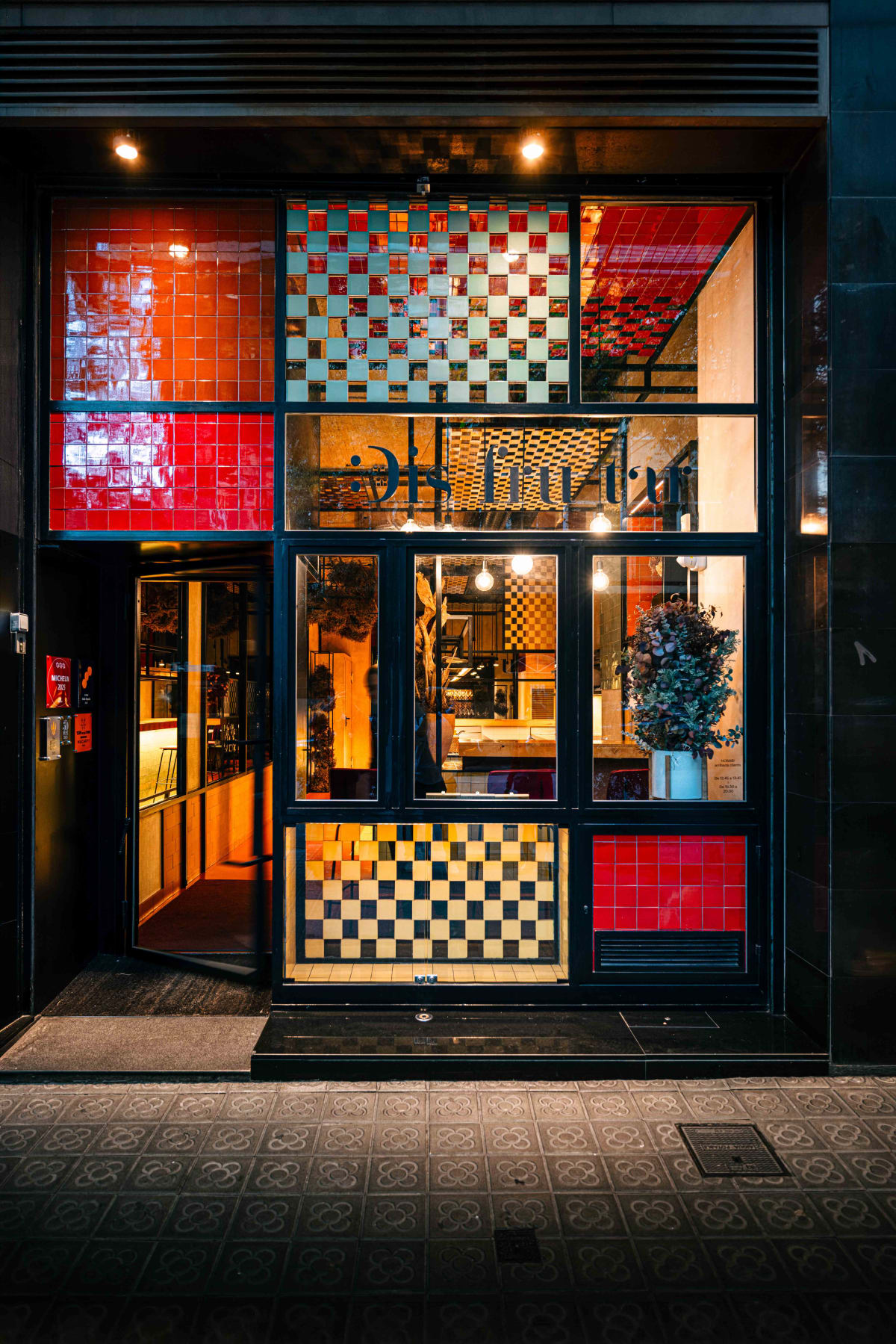
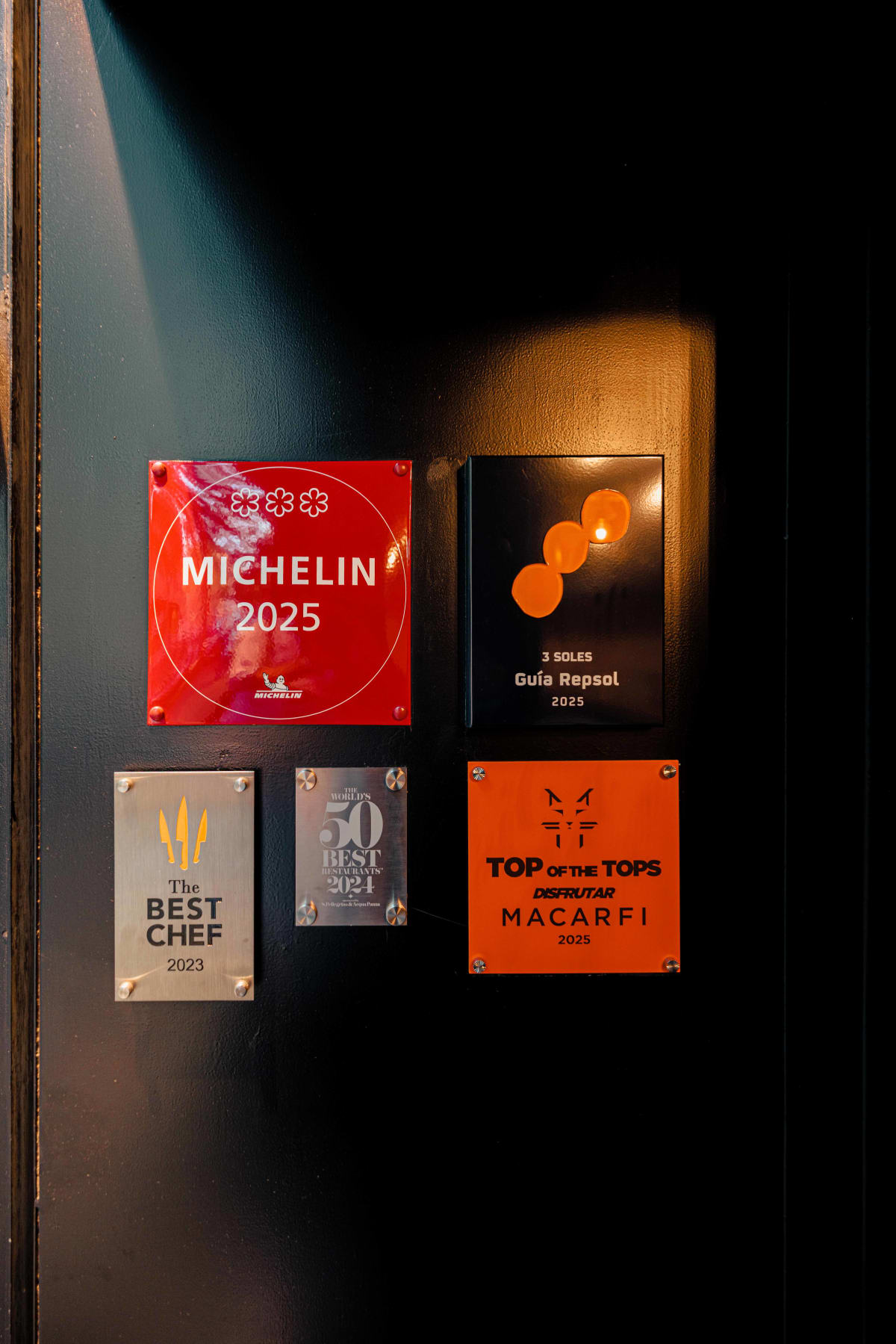
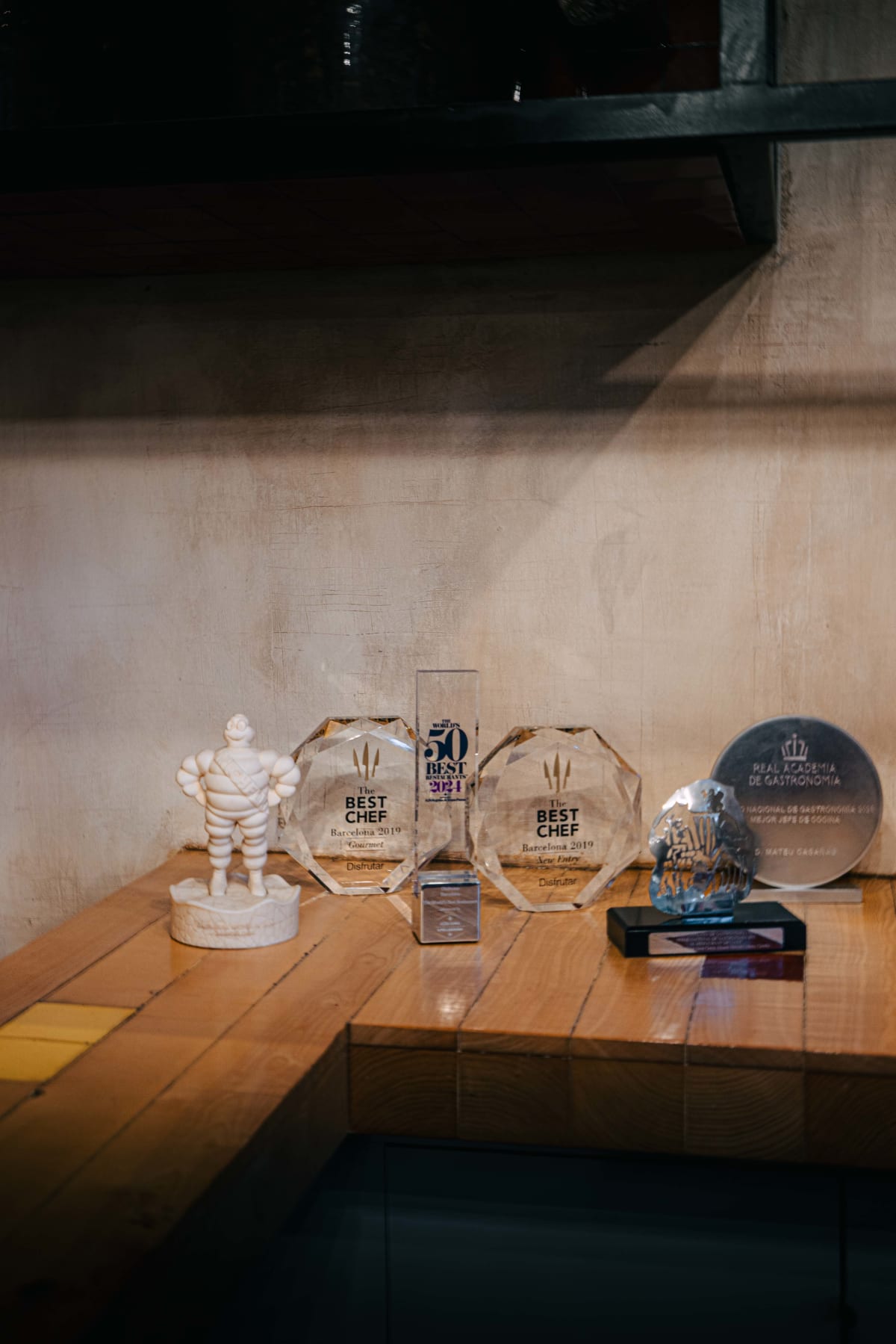
And in a little under ten years, Disfrutar has seized both three Michelin stars (★★★) and the No.1 spot on the World's 50 Best (2024), rising to become the restaurant that symbolises the post-elBulli generation. Once it carried a label along the lines of "a new restaurant made by Ferran Adrià's disciples." That has inverted. It now reads closer to "the chefs who built Disfrutar also happened to come through elBulli."
Section 2·Three Chefs, and a Single Standard: the Essence of Flavour
Another keyword for understanding Disfrutar is the fact that there are three chefs. Most fine-dining restaurants are defined by the personality of a single chef. Disfrutar, by contrast, was built around three equal co-chefs, with no obvious central figure. This structure itself shifts Disfrutar's character considerably. It feels less like watching a solo artist than like watching a band formed by three members, each playing a different instrument.
Oriol Castro was born in Barcelona and received his formal training at the Joviat culinary school and at Barcelona's confectionery guild school. He went on to build experience at La Torre del Remei and Via Veneto, among others, and passed through the Martín Berasategui restaurant as well, absorbing both classical French-based technique and modern Spanish cooking. At elBulli he began as a pastry intern and eventually became one of the core leaders of the creative team. At Disfrutar today, he functions as something of the conceptual brain behind the menu structure and overall direction of R&D.
Mateu Casañas is from Roses, near Girona. Because his parents ran a restaurant, he grew up moving naturally between kitchen and dining room from a very young age, and his first hands-on experience began at the family restaurant as well. He later joined elBulli, where he worked through nearly every position in the kitchen and went on to take part in the creative team and the elBulli Foundation projects. His background in hotel dining and more classical restaurants gives him what is often called the finest sense of balance and harmony of the three.
Eduard Xatruch comes from Vila-seca, near Tarragona, and trained at the culinary school in Cambrils. He widened his range training at some of Europe's finest restaurants, including Quim Font, L'Oustau de Baumanière (which we also visited), and Arzak, and then worked as a chef de partie at elBulli before likewise becoming a core member of the creative team. Having passed through stints not only in pastry and fine dining but also at creative restaurants such as The Fat Duck and Le Calandre, he has particular strengths in creative cooking and technical research.
It is worth noting that these three did not simply pass through elBulli. Having joined between 1998 and 1999, they rose to co-head chef after Albert Adrià and Albert Raurich left in 2009, becoming the operational core that ran the entire elBulli kitchen; and even after the 2011 closure, they stayed by Ferran Adrià's side until November 2014, working together on Bullipedia. They are, in other words, the people who guarded elBulli's final chapter to the very end.
What the three have in common is that they all spent a long time inside "elBulli's laboratory," and that even afterward they look at cooking as an object of research. And yet, as the chefs themselves have said many times in interviews, they never let go of one standard: "in the end, every experiment comes down to a single question. Is this delicious, or is it not?" This philosophy is exactly the point that sets Disfrutar clearly apart from other experimental restaurants. I have been to a number of experimental restaurants myself, and Disfrutar is plainly a step or two above them in flavour. A restaurant with a single chef leans on that one person's genius, so the cooking can sometimes tilt to an extreme in one direction; Disfrutar, by contrast, runs on a system in which three people constantly test and twist one another's ideas, filtering out the ones that go too far and shoring up the ones that fall short, which gives it a relative stability.
Is this delicious, or is it not?
Section 3·Beyond the Cellar Wall: the Space of The Living Table
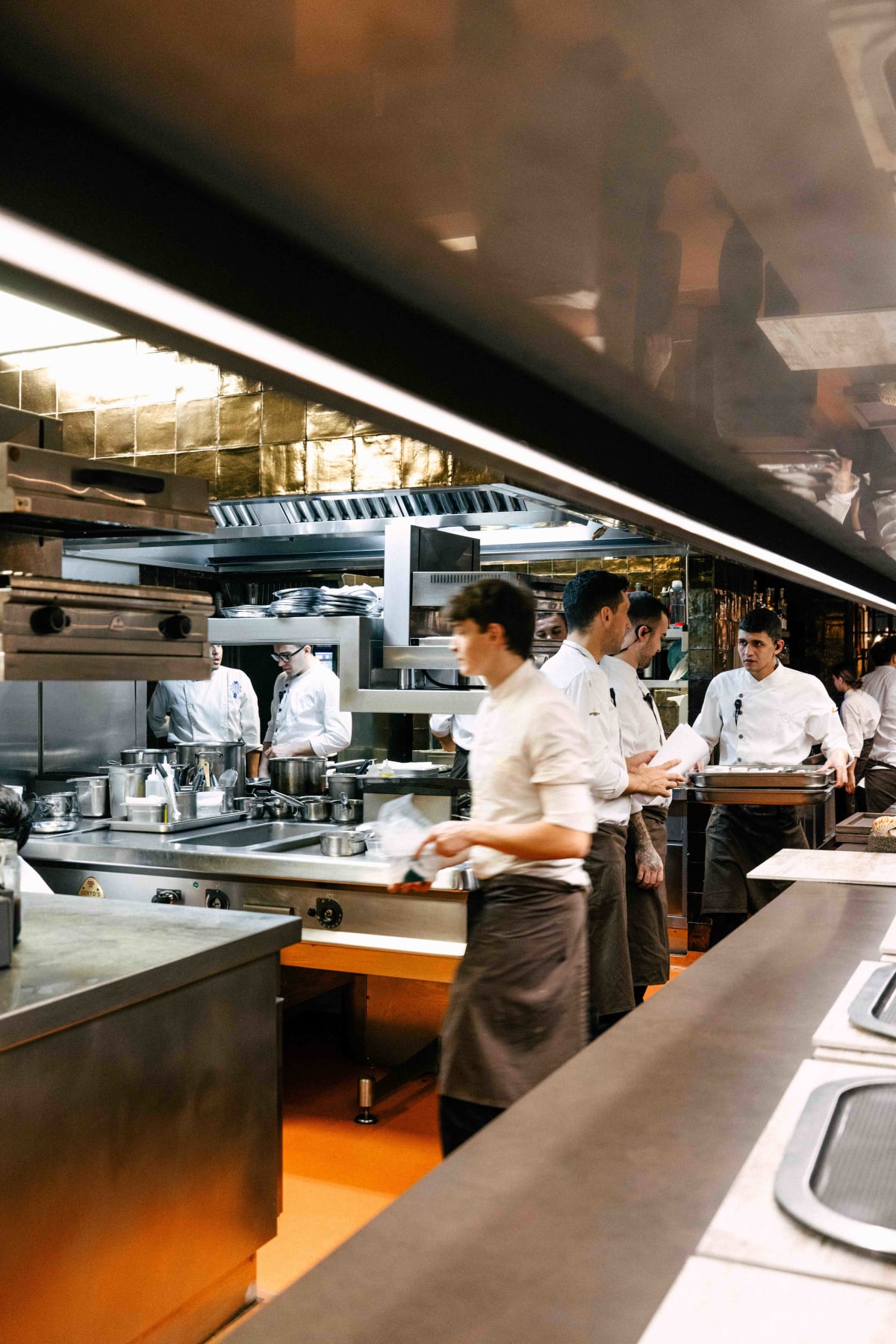
I arrived at Disfrutar about fifteen minutes before opening and waited to be let in. One thing that struck me was that staff members kept coming and going for their shifts through the same front door used by guests. It was almost surprising to see employees move so freely in and out of a three-Michelin-star restaurant. Counting stagiaires, the operation was large enough that the staff looked to number well over forty.
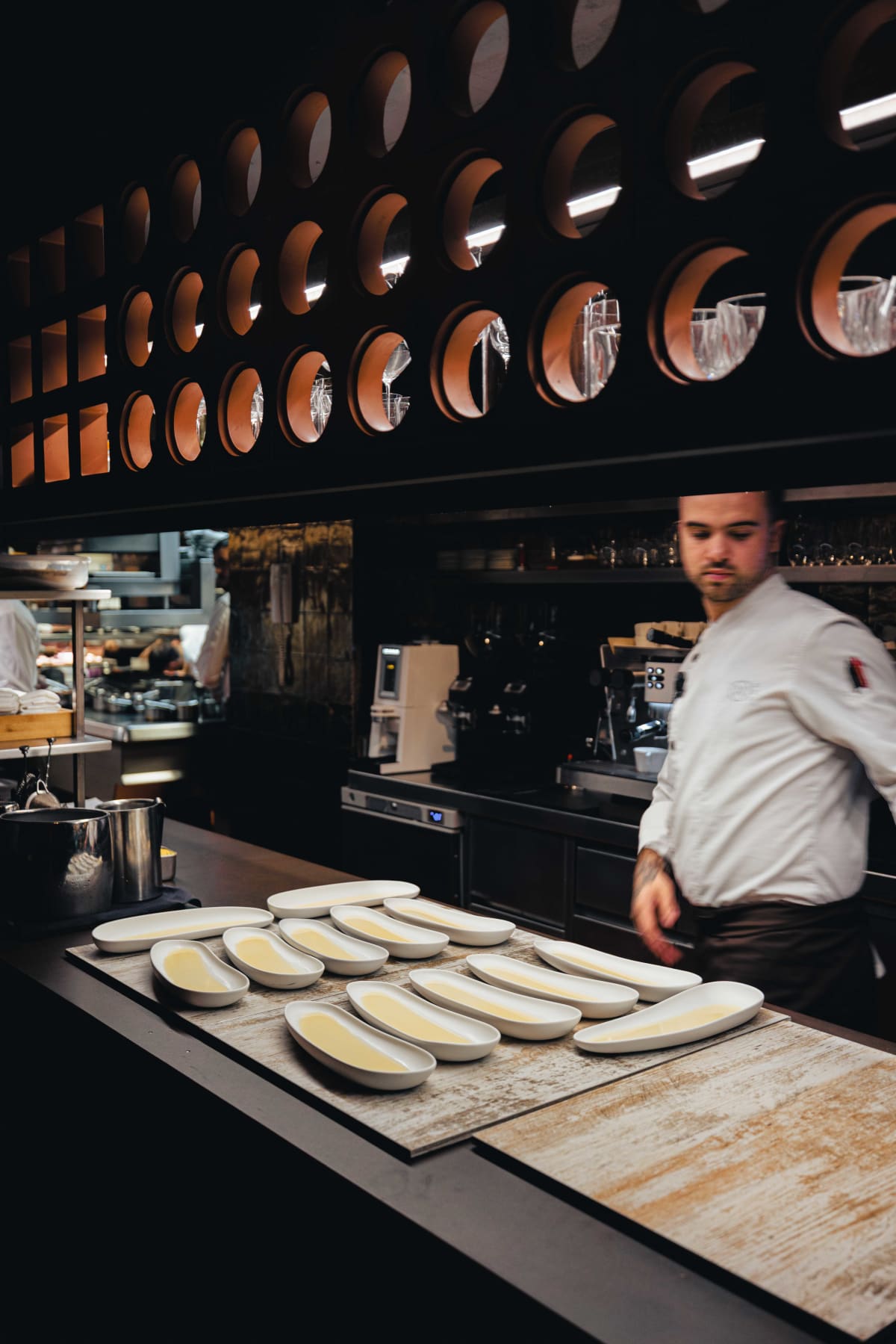
The dark, avant-garde space you first walk into was less a place to eat than a place for guests to wait and talk.
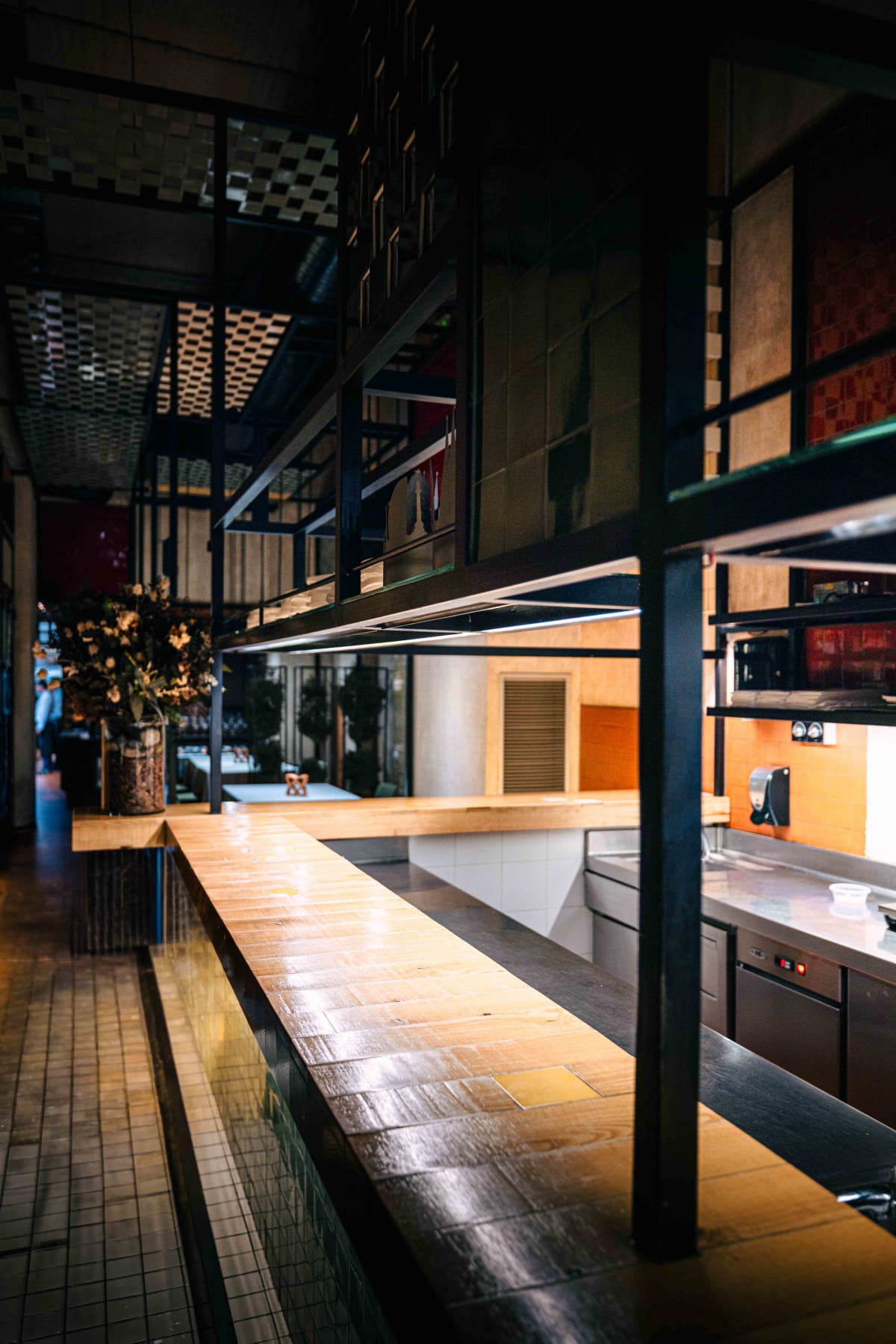
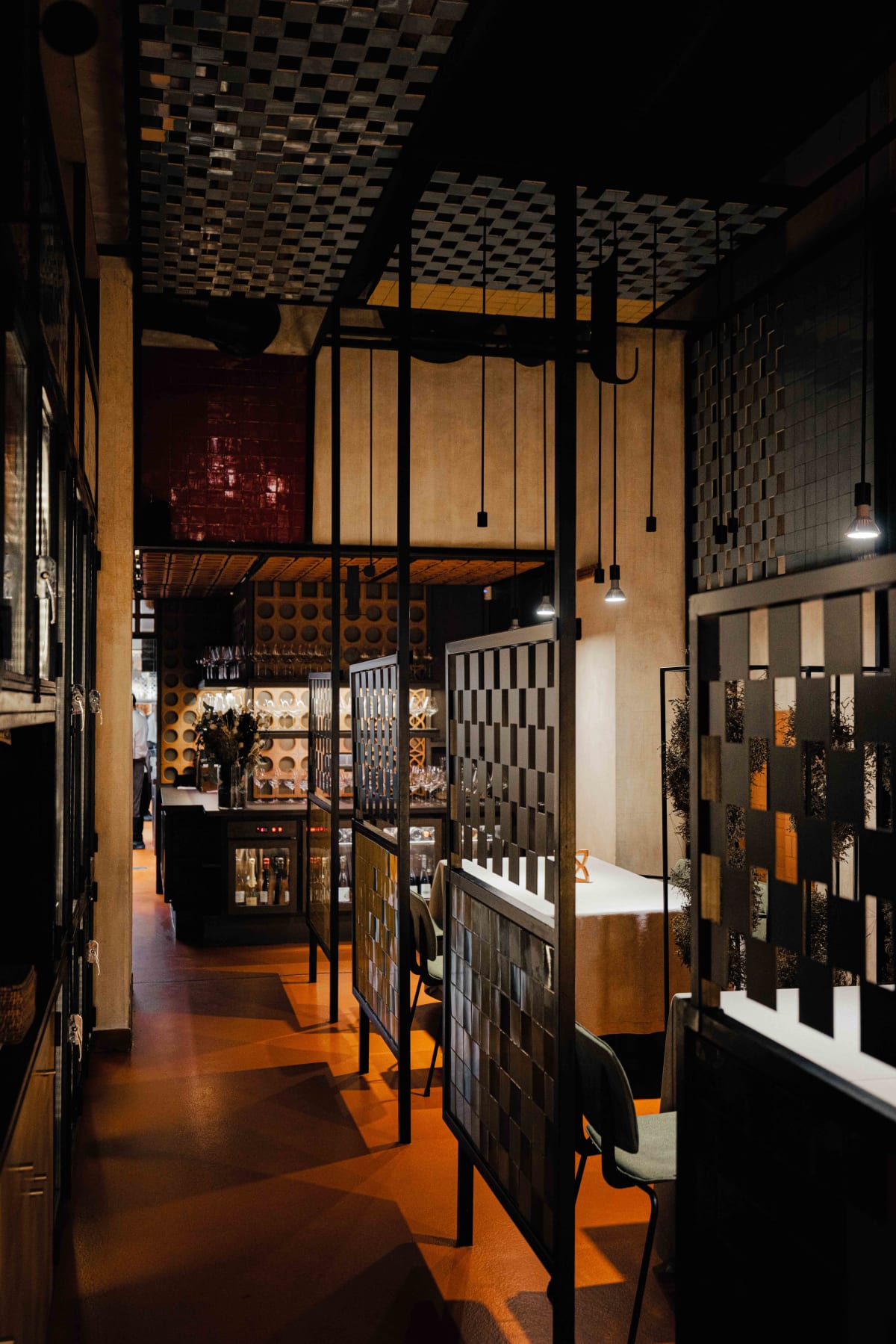
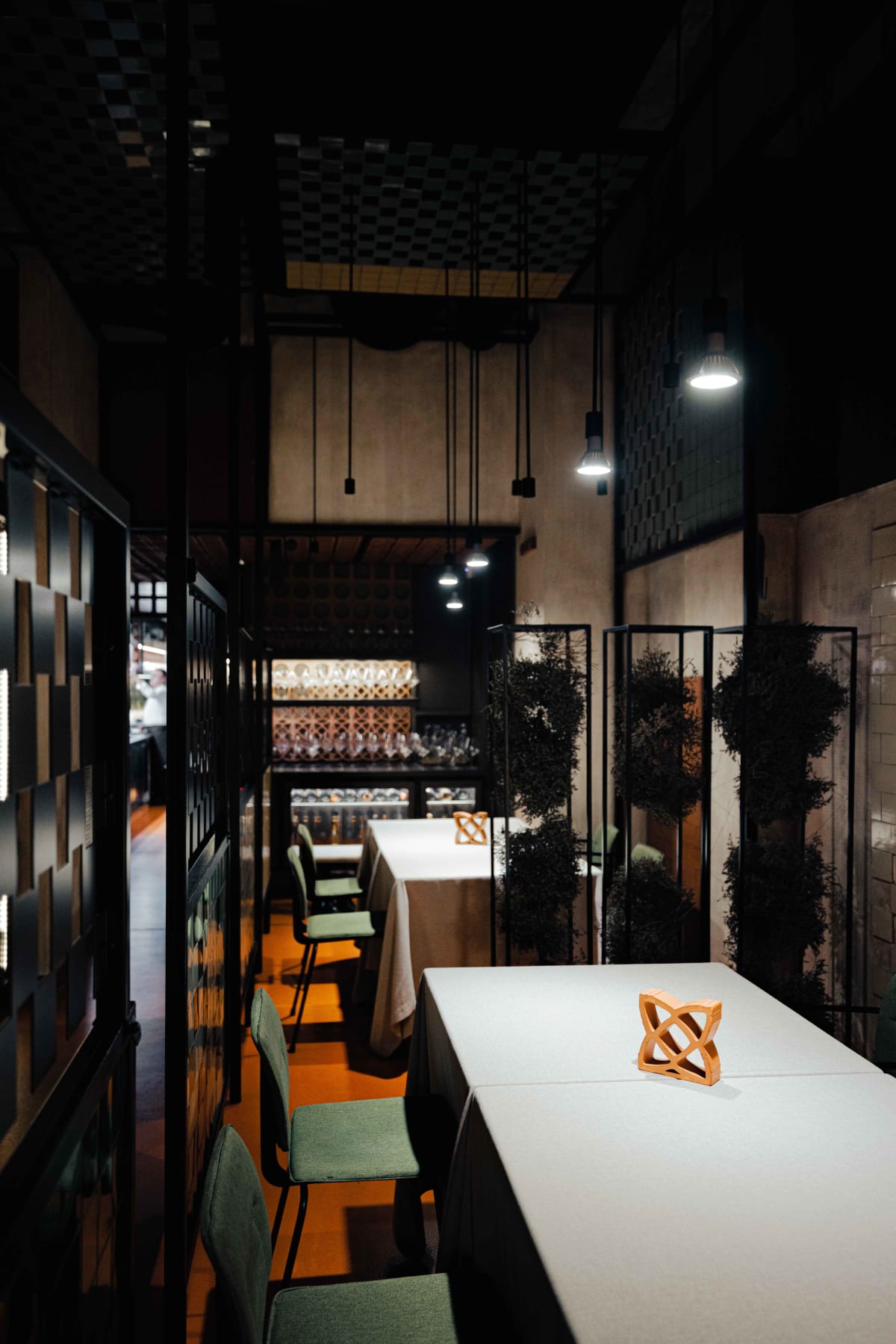
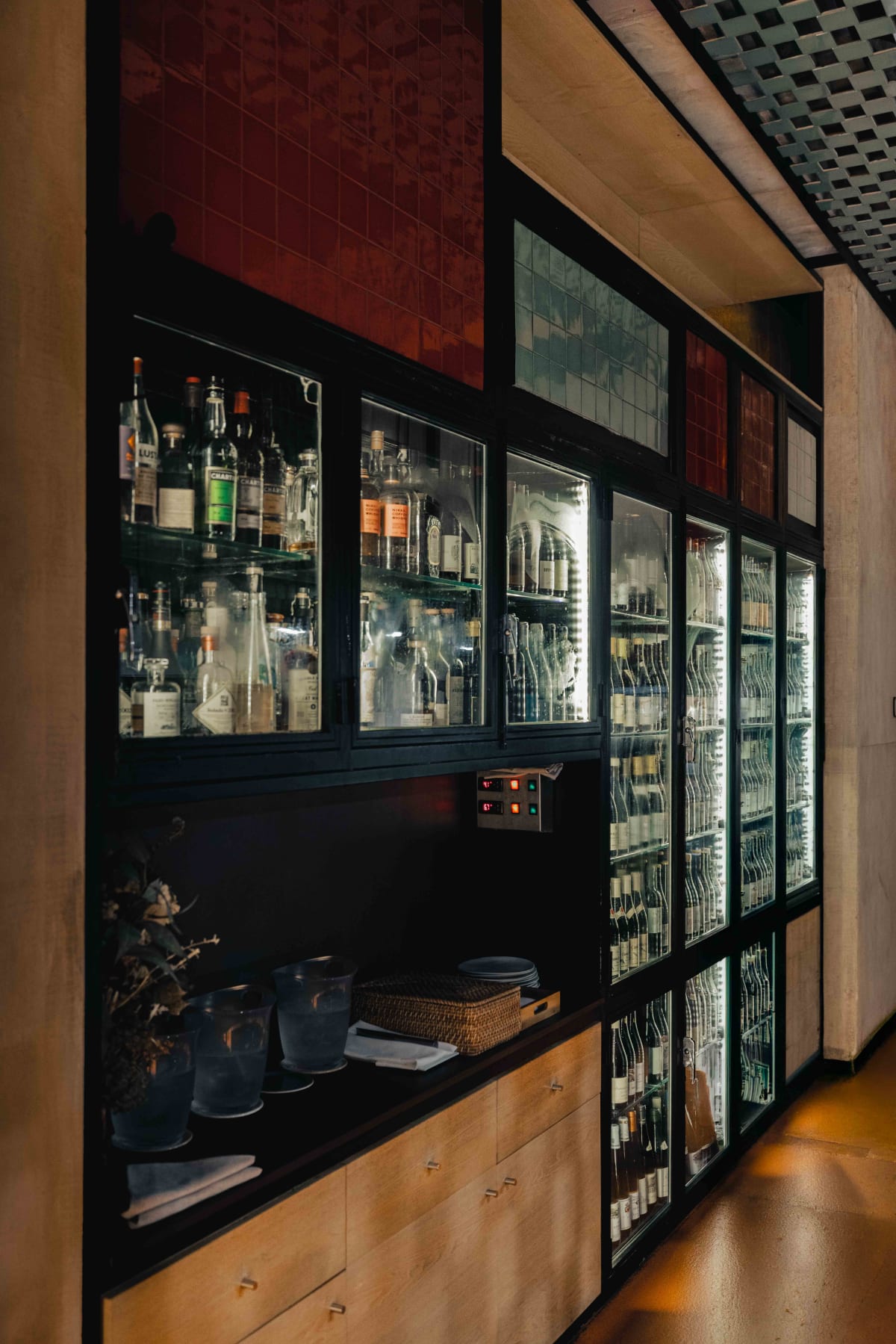
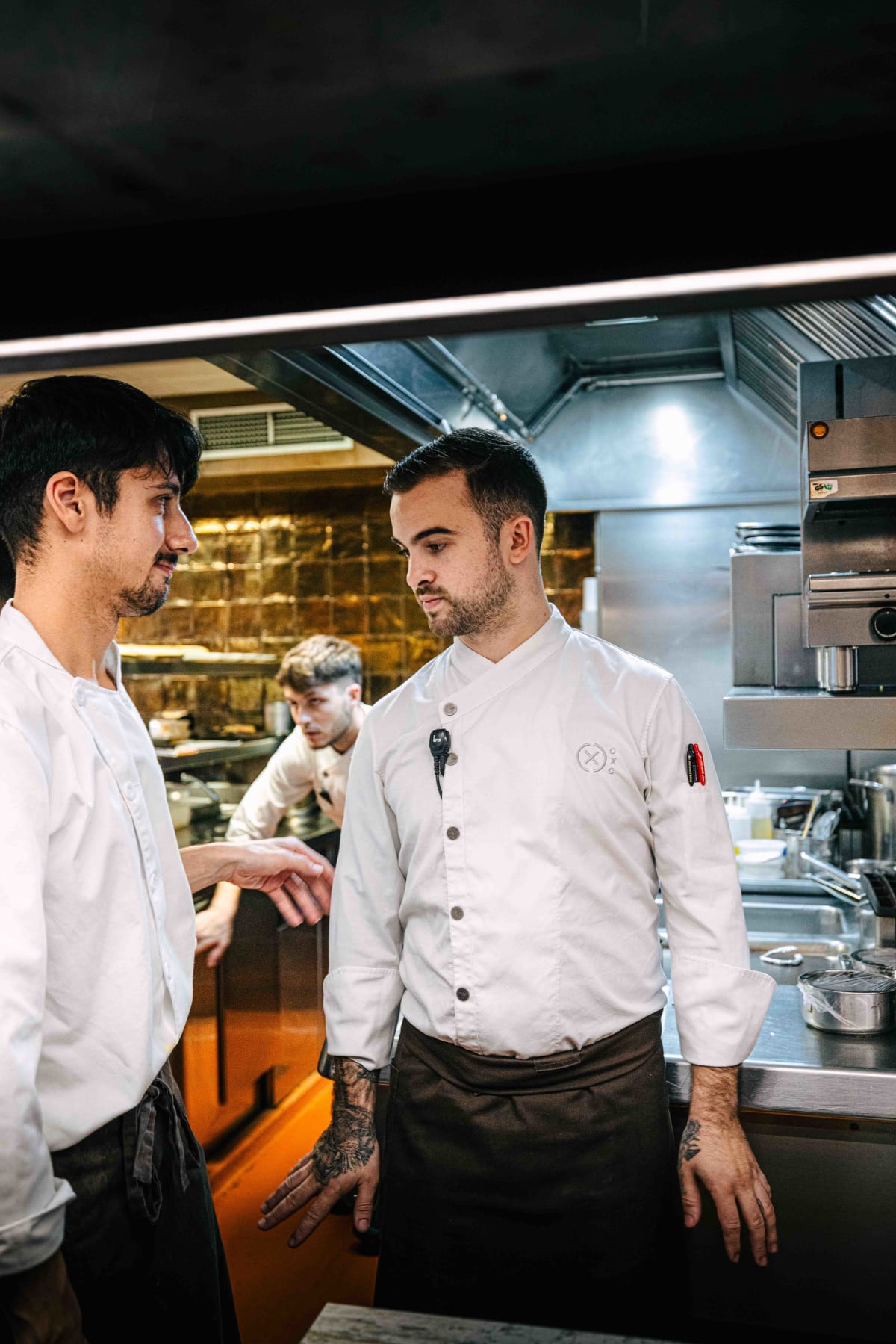
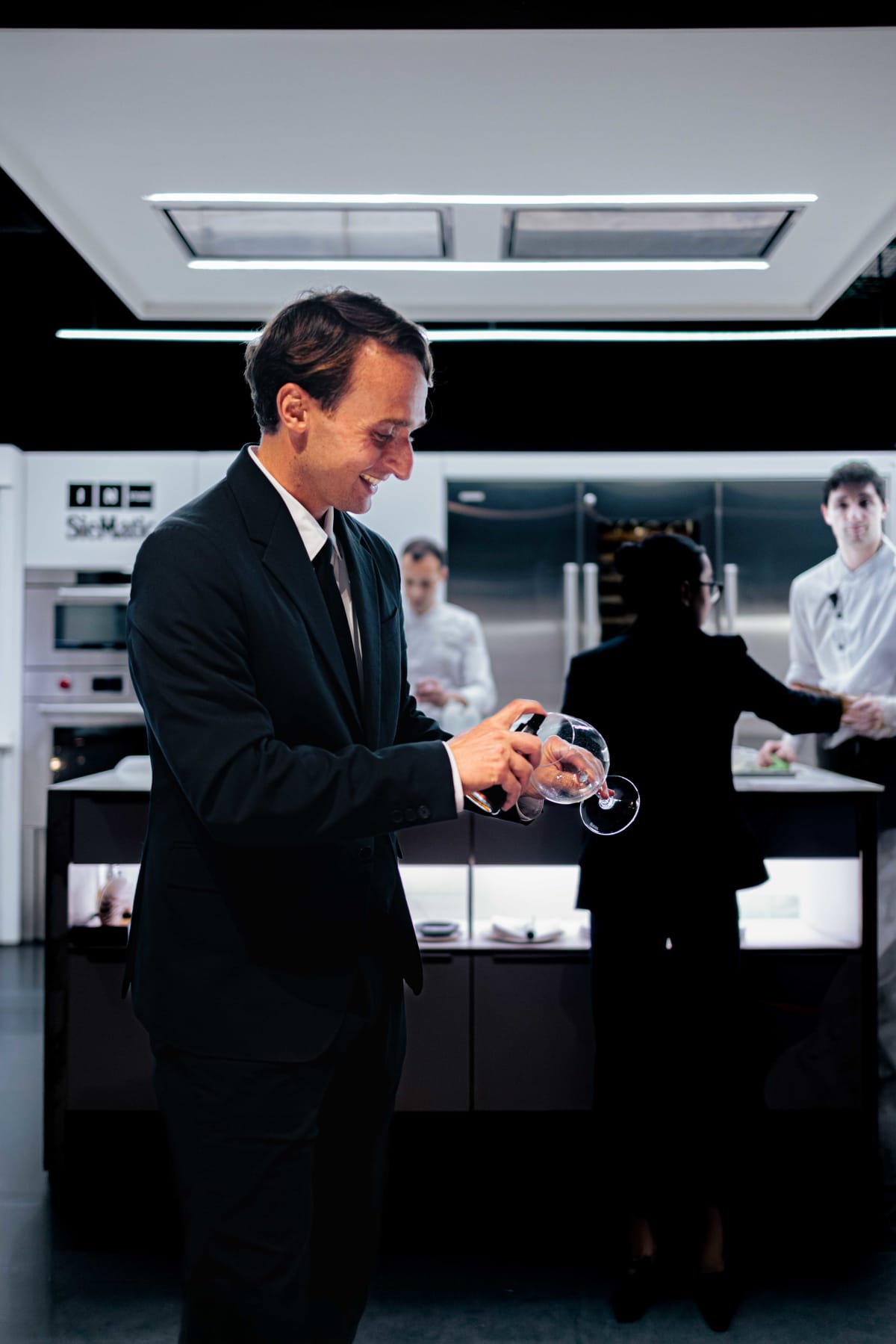
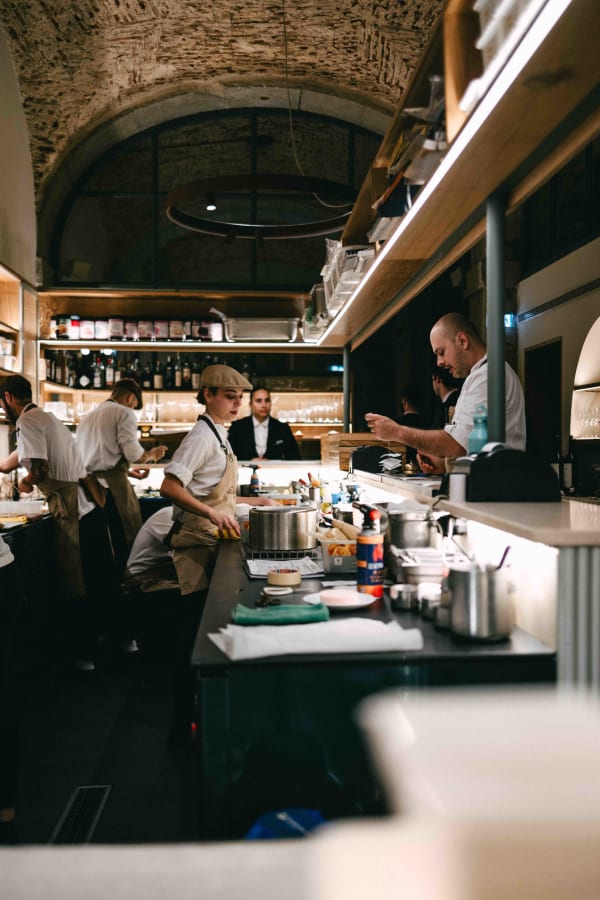
After a short wait here, we were guided through a kitchen tour and into the inner dining hall. The kitchen did not look especially long. Two of the three chefs, Oriol Castro and Eduard Xatruch, came out in person to welcome the guests.
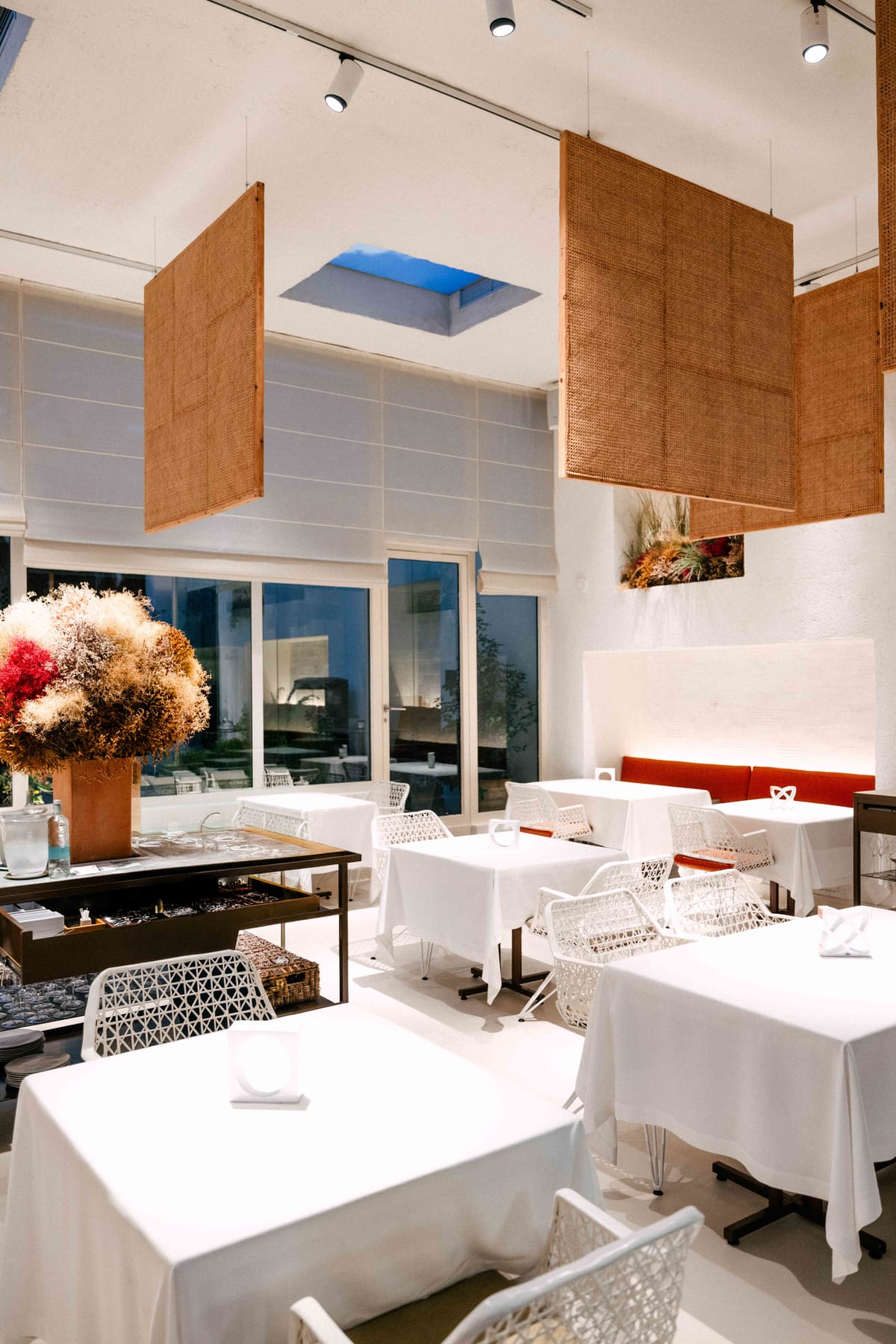
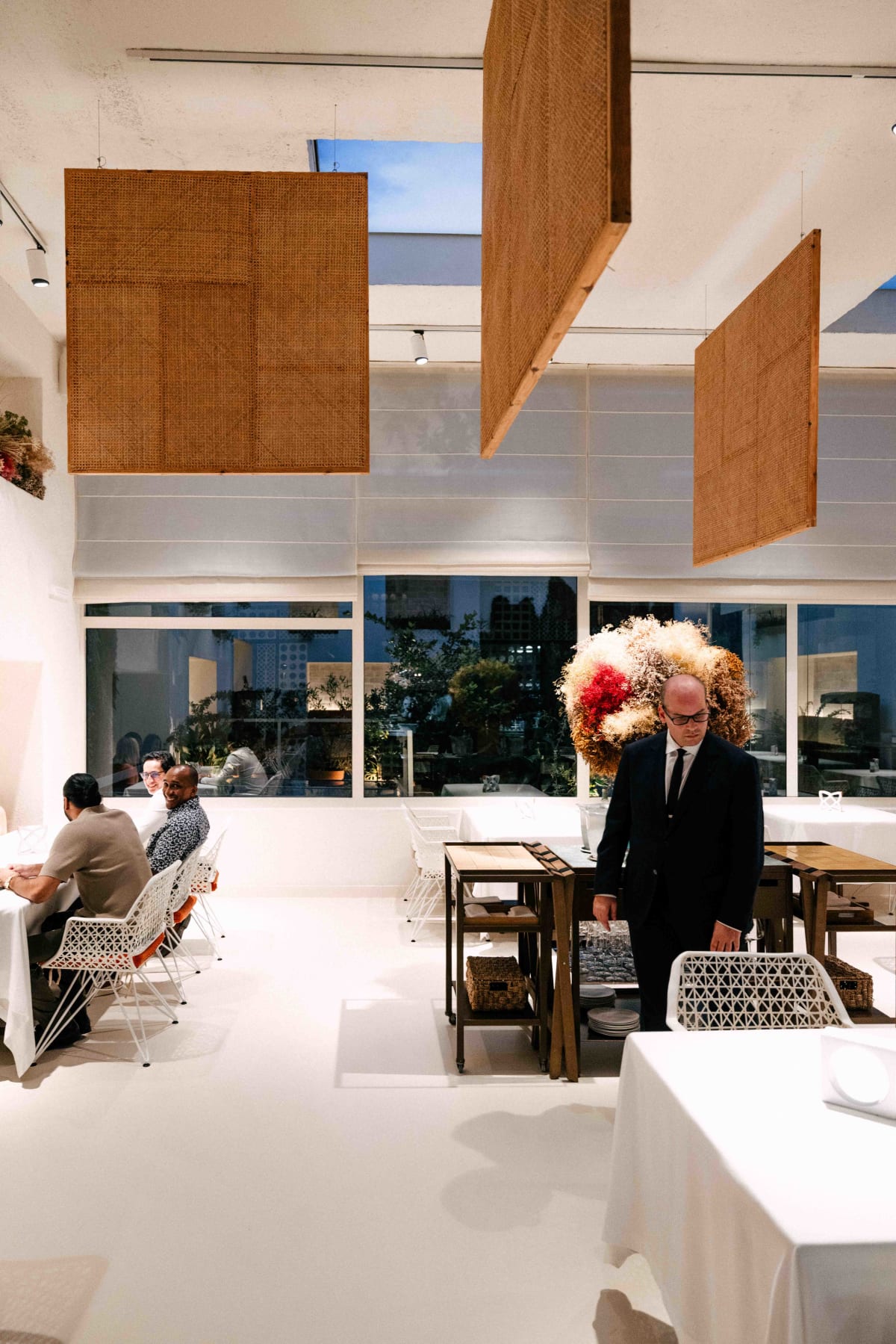
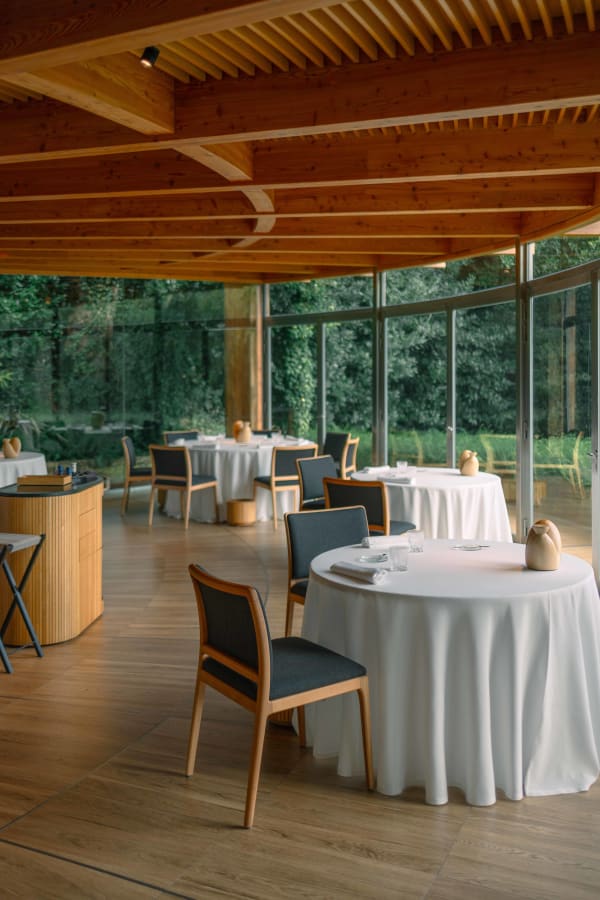
We also took a brief look at the inner main dining room, which, finished entirely in white tones and lit brightly, had a completely different atmosphere from the entrance. To be honest, it felt a little light, a little like a holiday resort, and it was not quite to my taste.
The Living Table is underground.
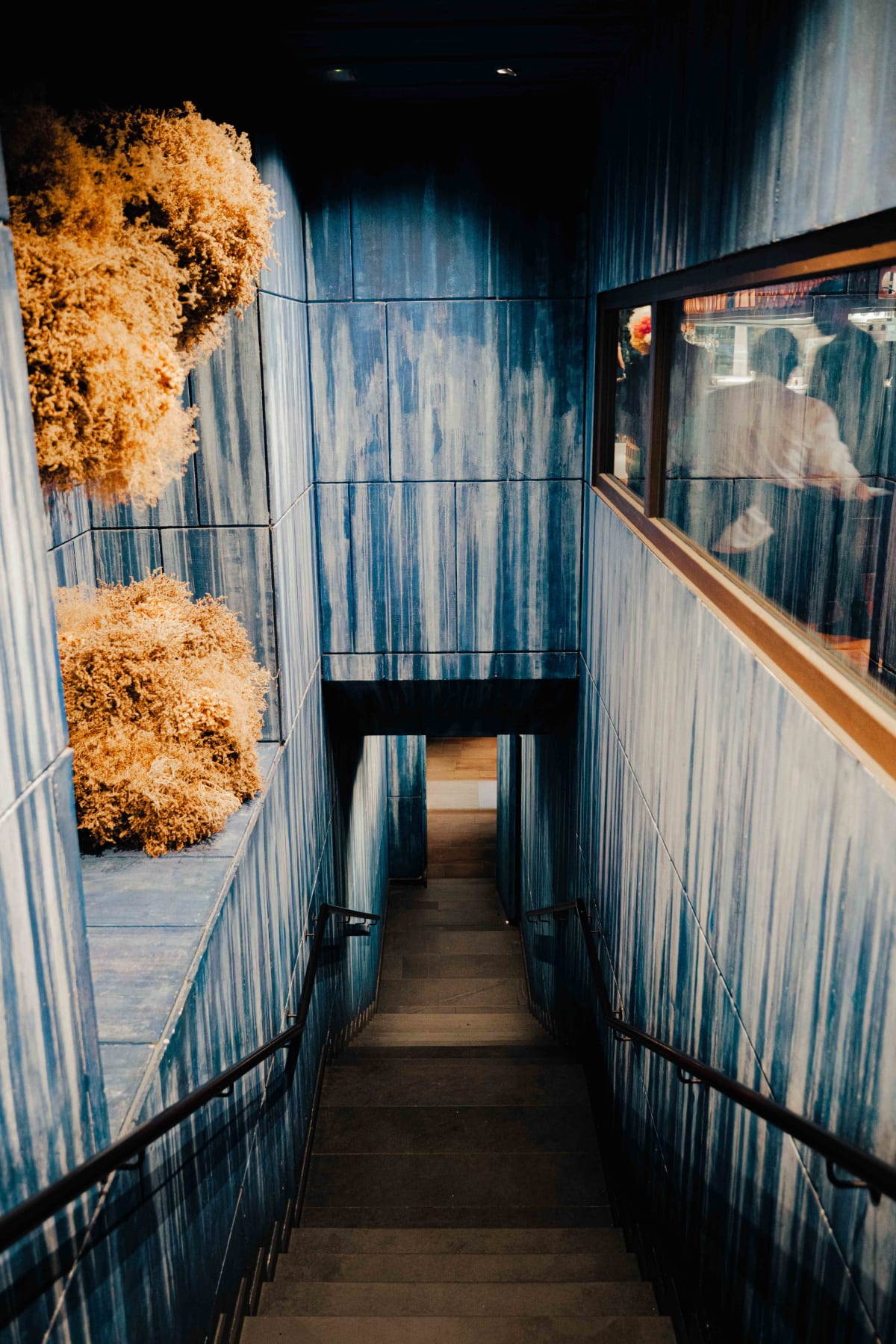
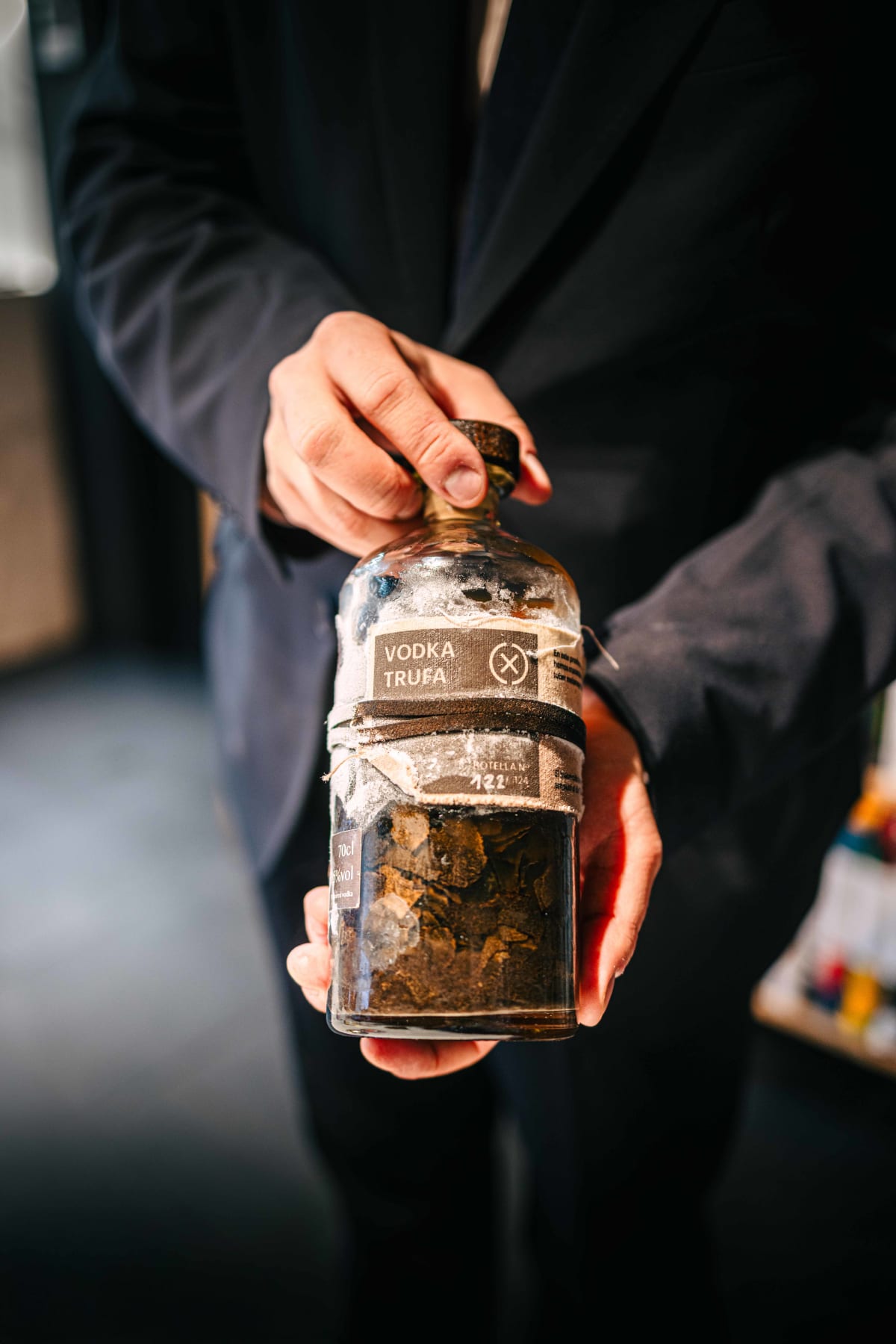
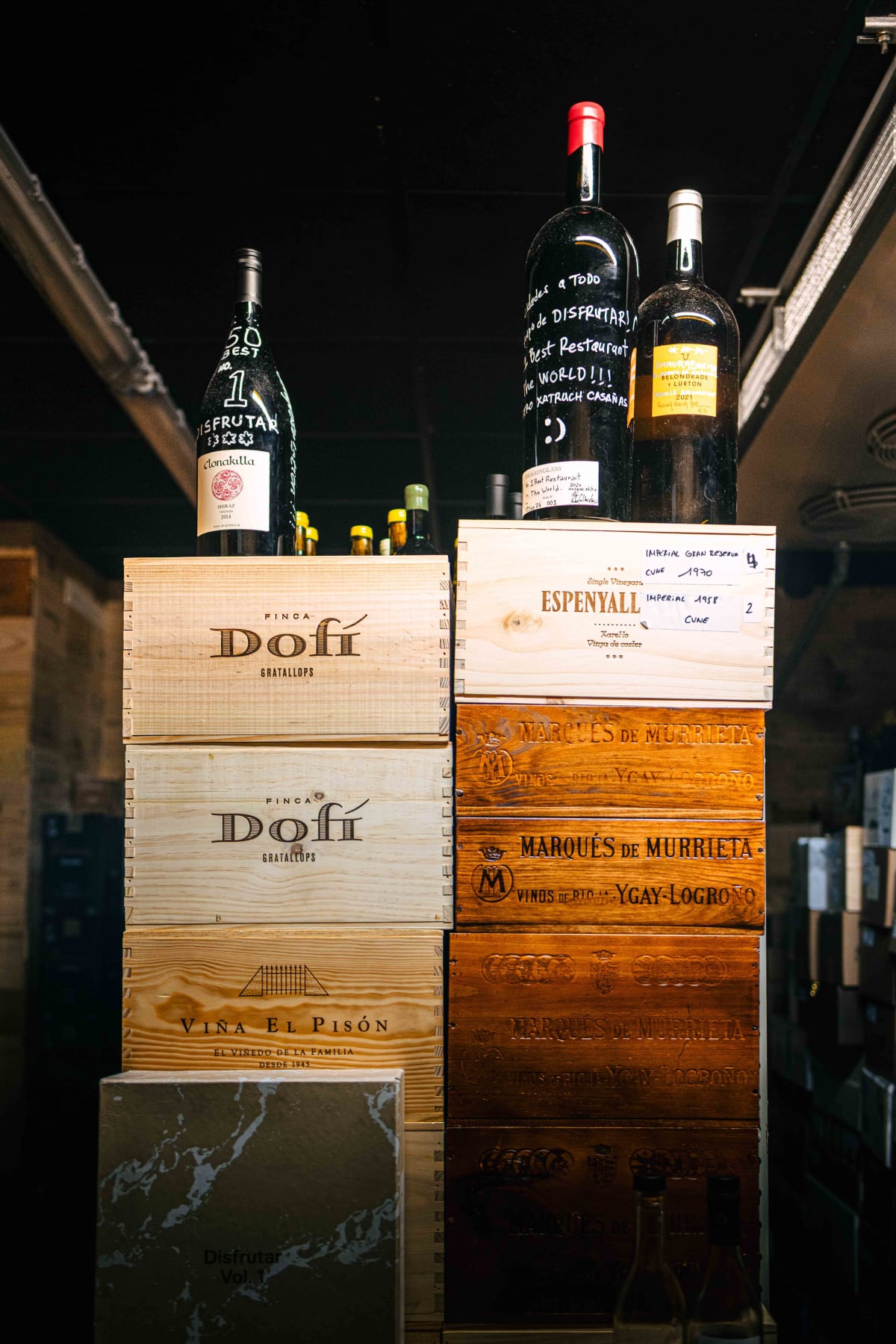
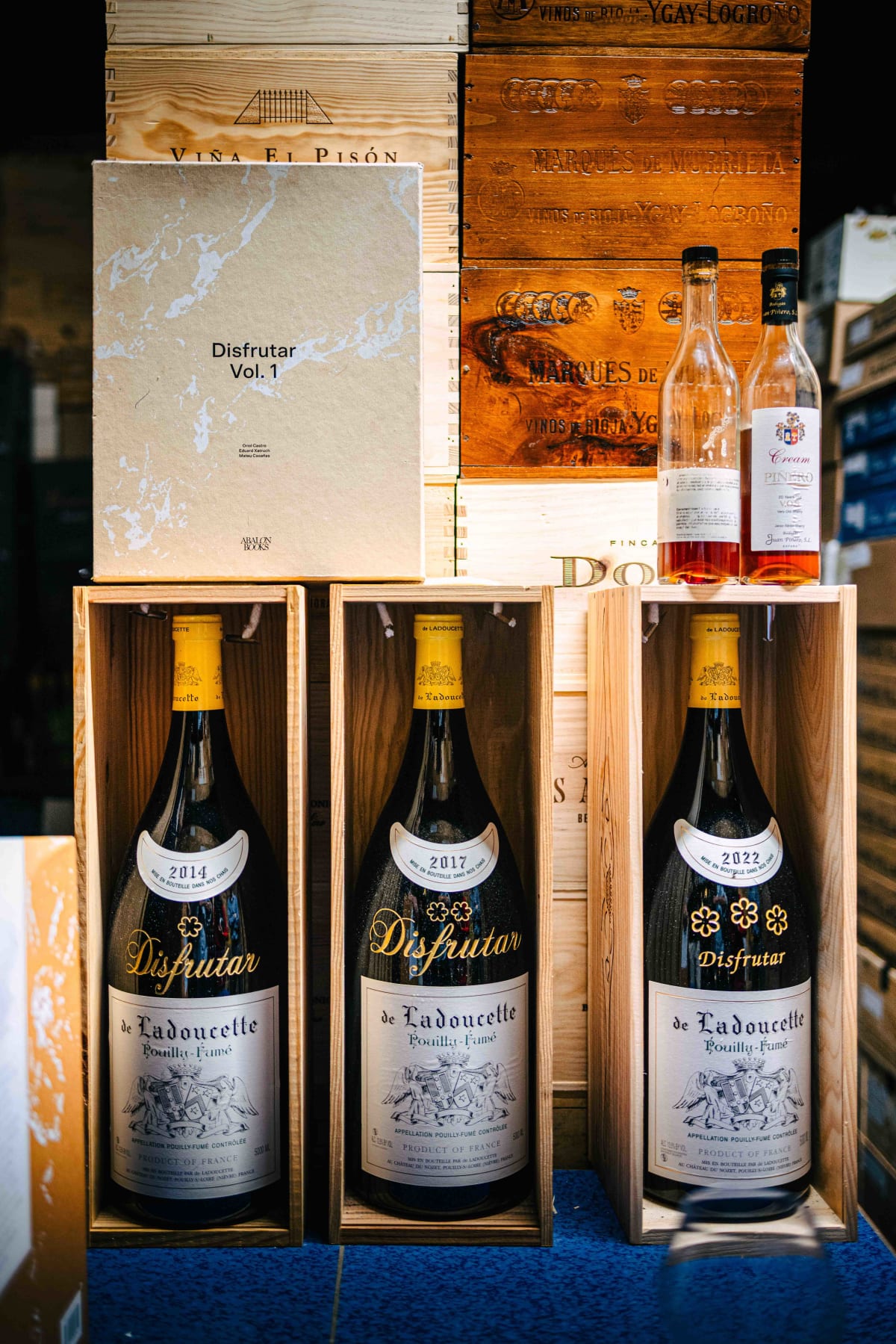
Going down to the basement, you find the restrooms, and beside them a display of Disfrutar's branded products. There was a gin made in collaboration with a distillery near Terrassa, the black-truffle-infused vodka that appears on the menu, and wines made in collaboration with wineries in Catalonia and Jerez, among others.
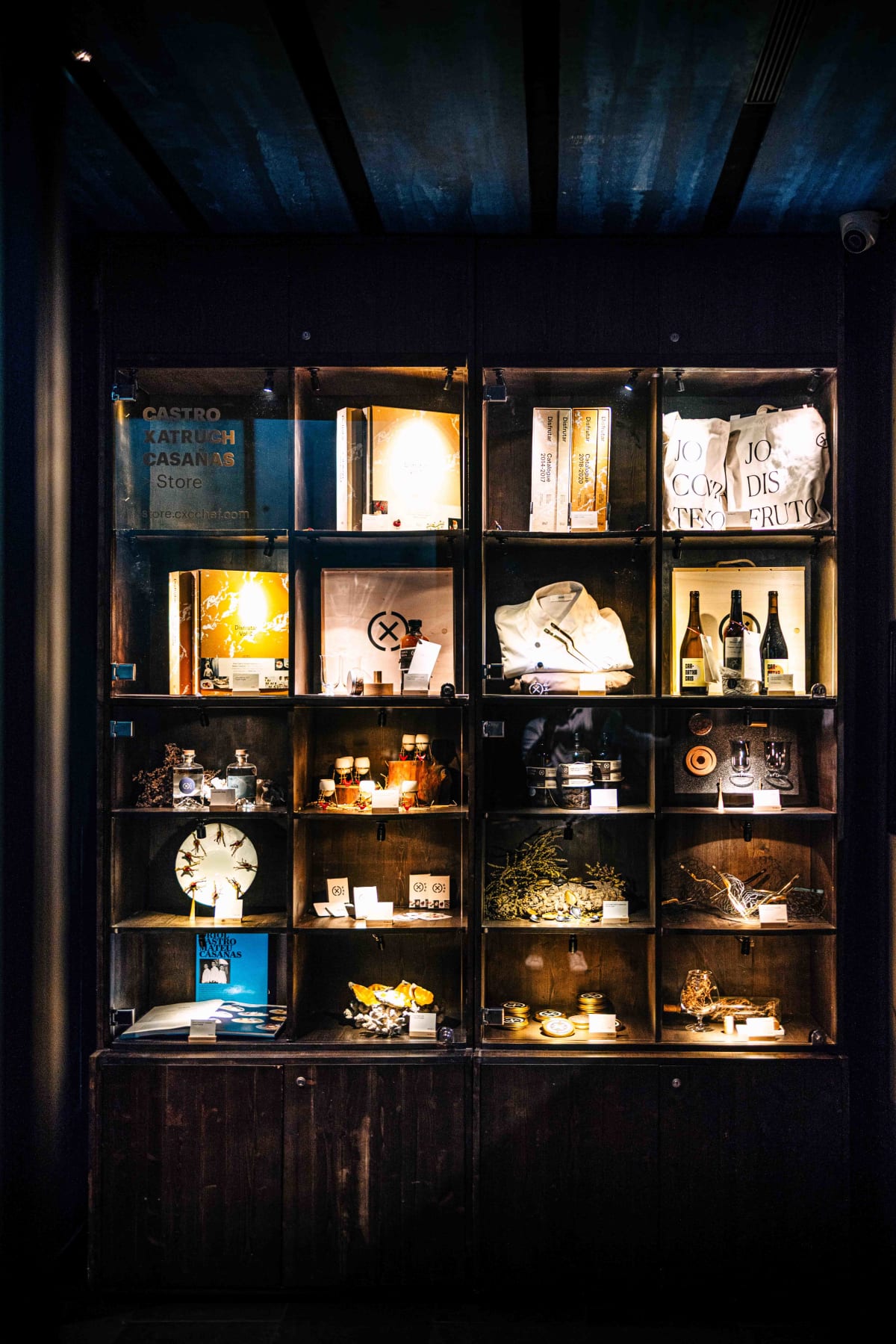
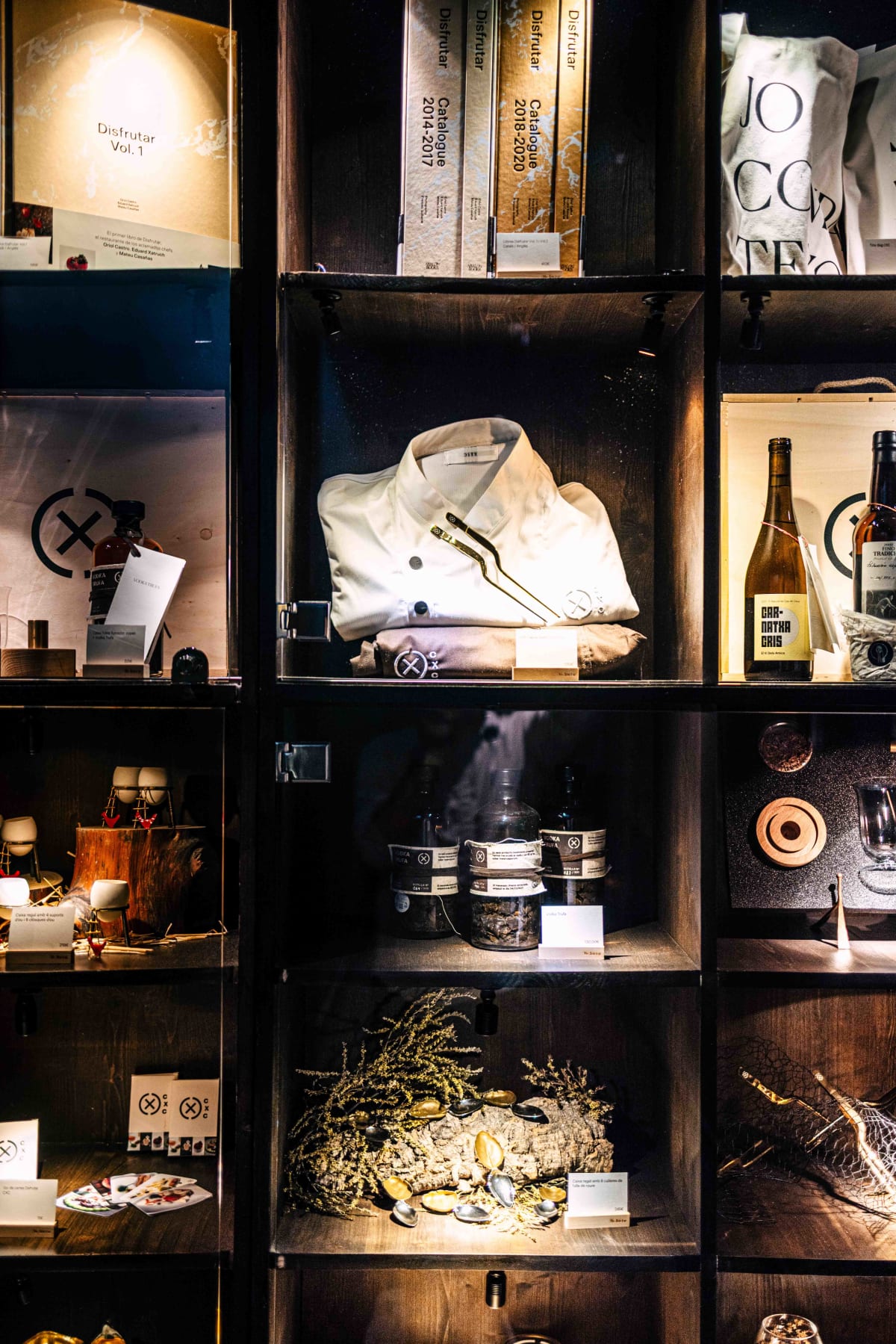
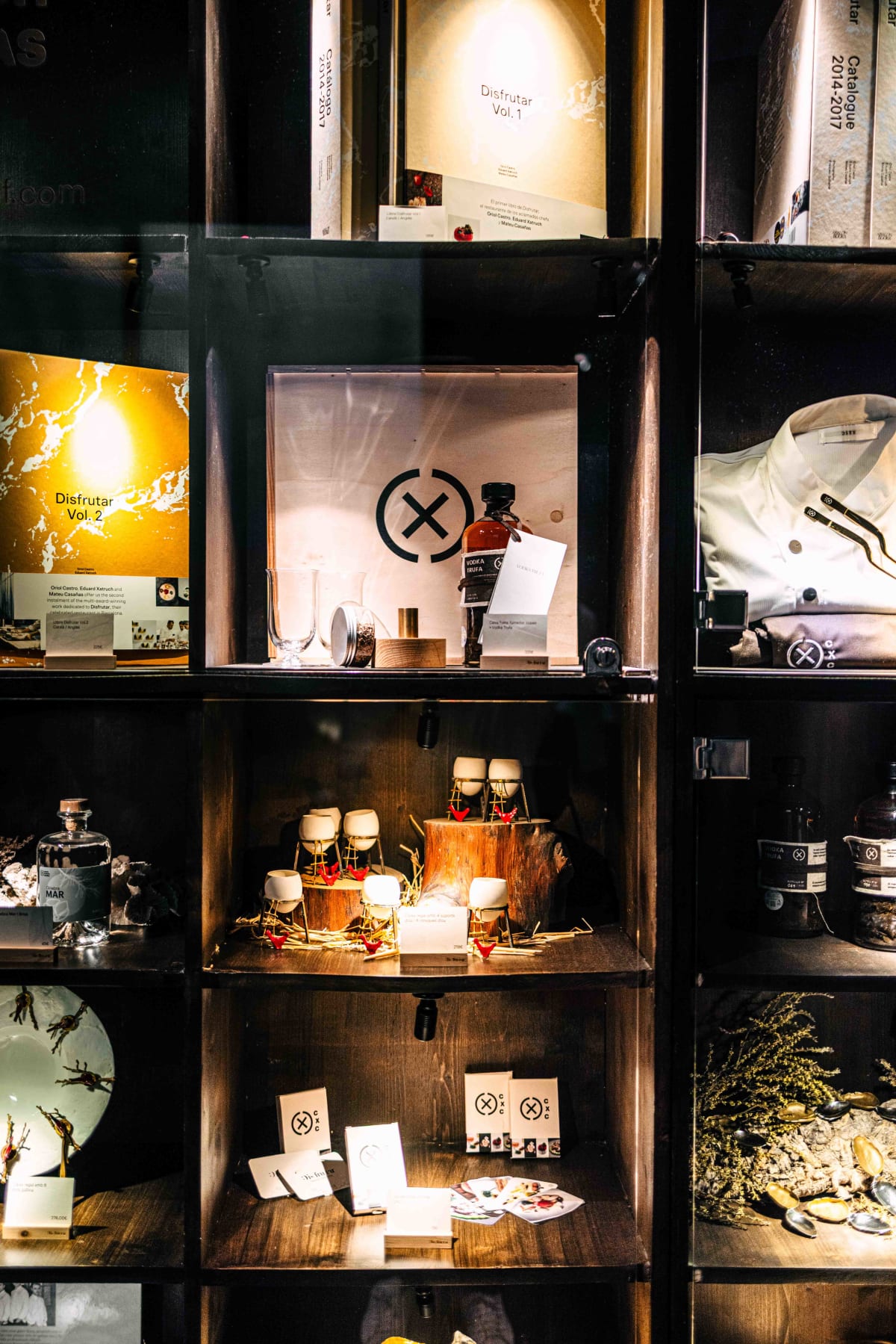
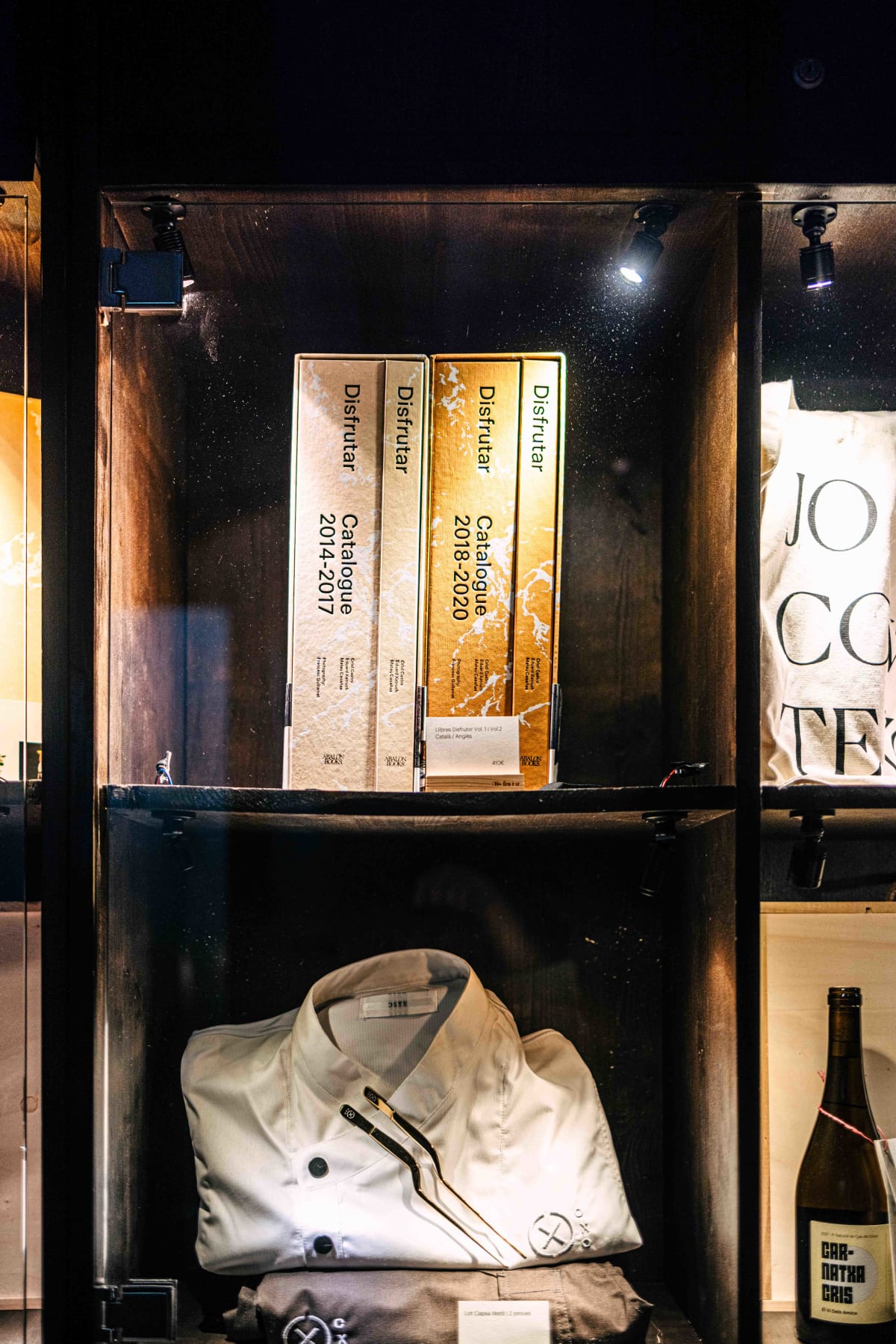
What impressed me most was the series of menu books Disfrutar has published. At the time of my visit there were volumes one and two; apparently a third has since been released. I thought about buying them as gifts for friends of mine who cook, but the weight and the cost were no small matter, so I did not.
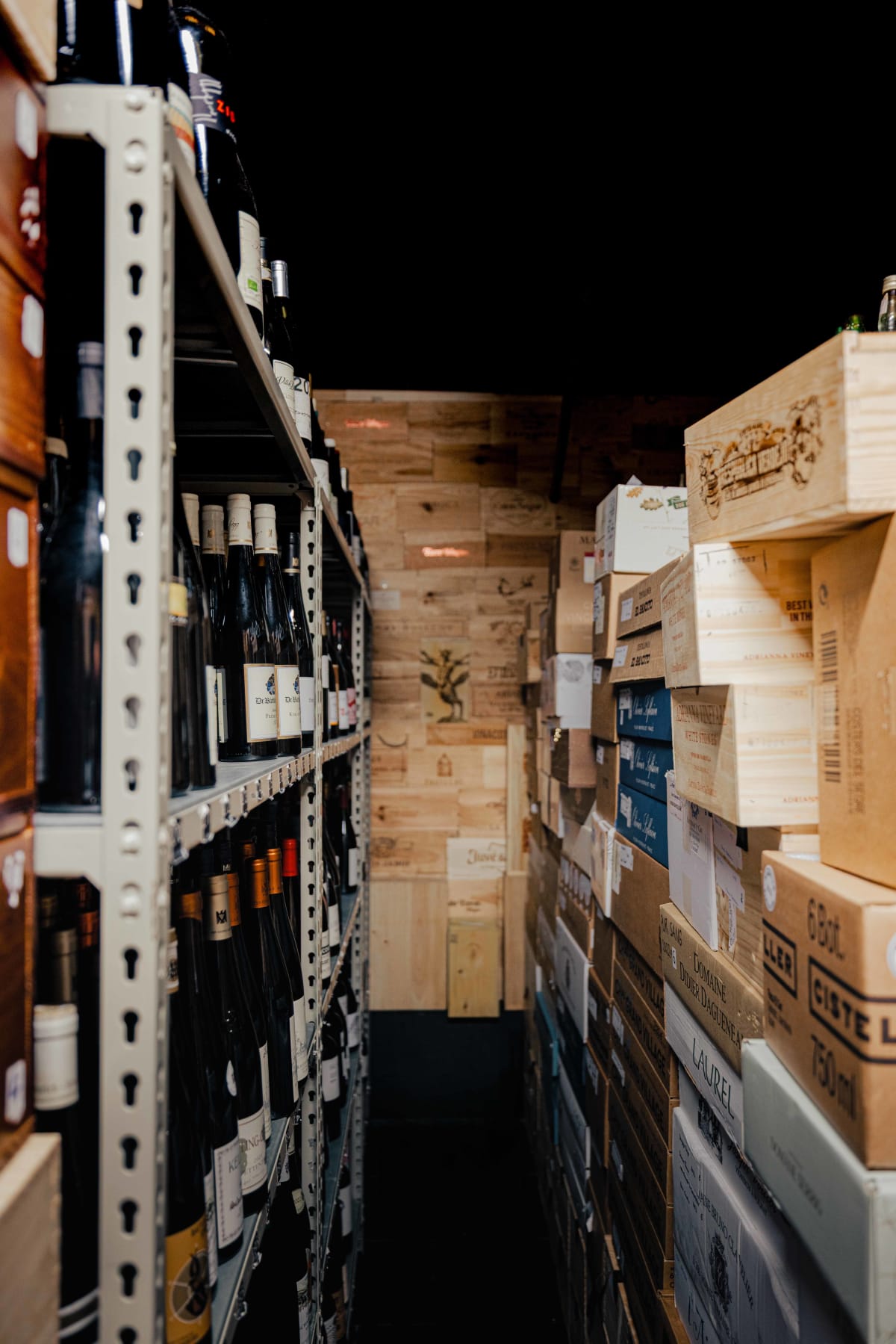
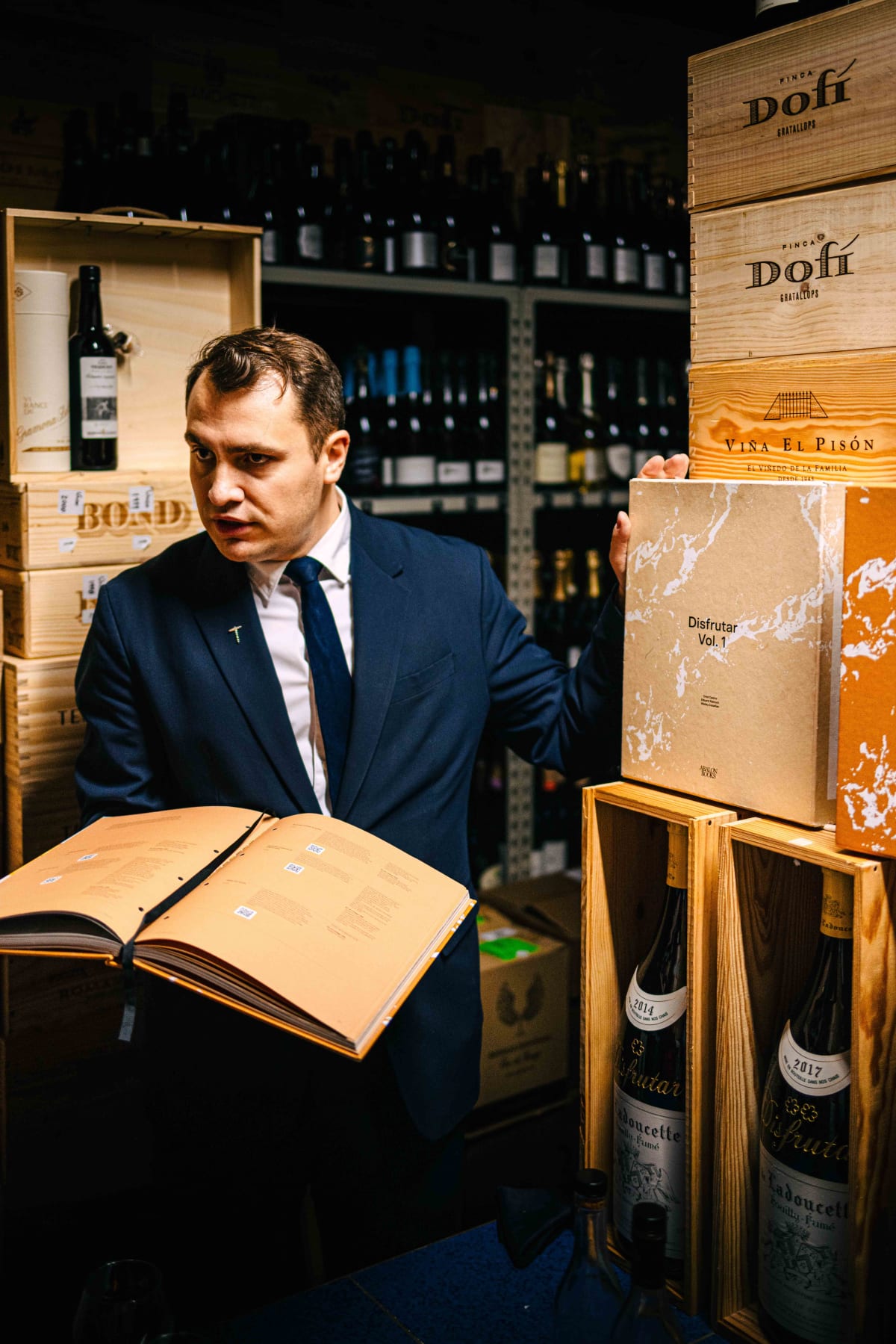
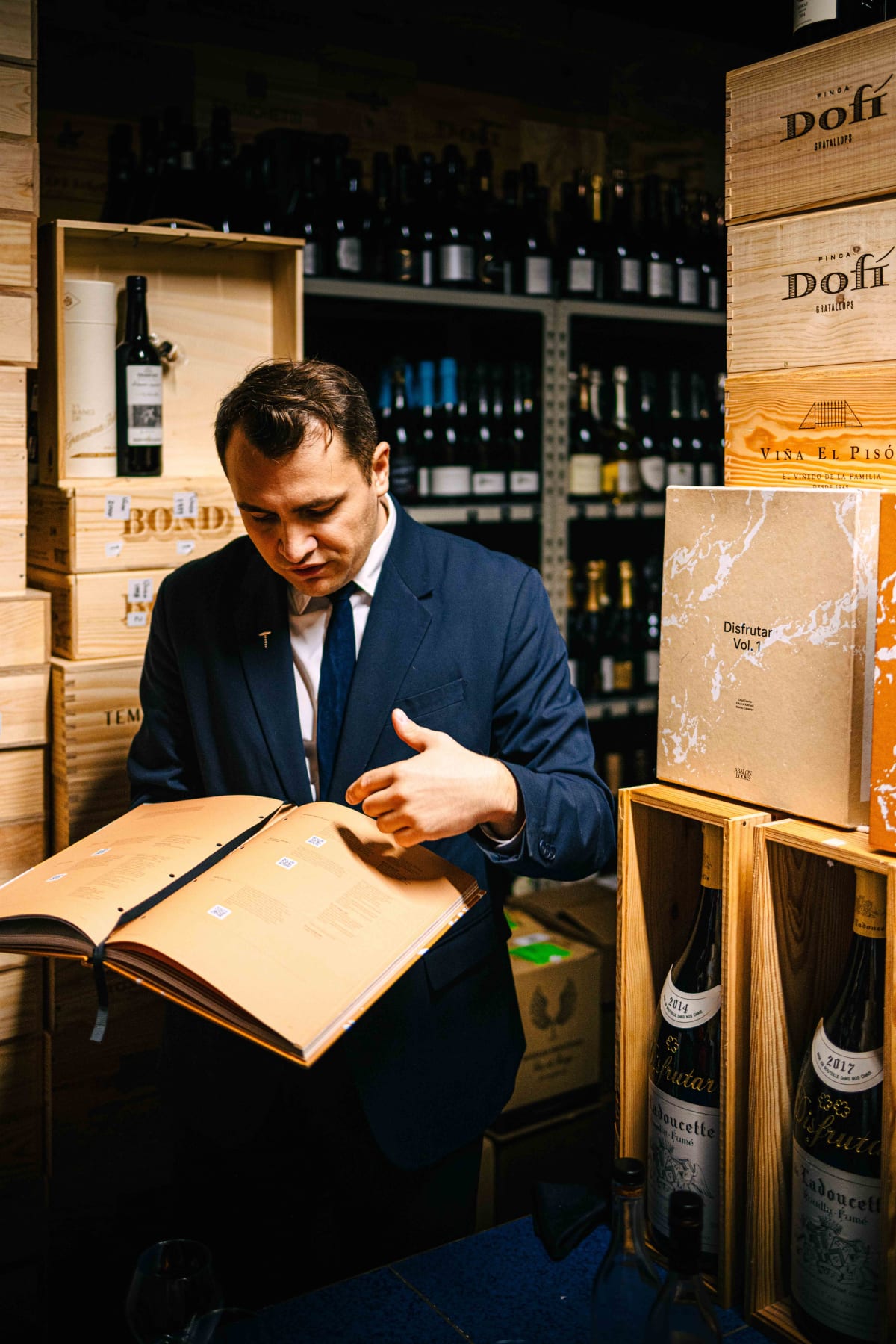
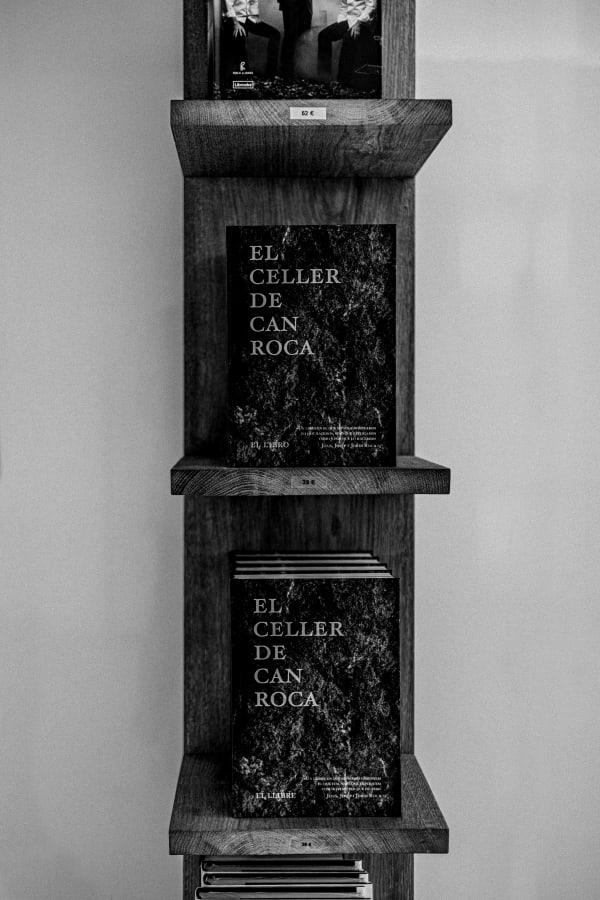
And yet, even down in the basement, The Living Table was still nowhere to be seen. The next step was a cellar tour. The cellar was densely packed and had a slightly timeworn feel. Its collection was not on the extraordinary scale of Baumanière, Can Roca, or La Tour d'Argent, but it still appeared to hold several thousand bottles. There were not only legendary Spanish wines such as Único but plenty of French ones too, including Domaine de la Romanée-Conti (DRC), wines from a wide range of regions around the world, and old vintages keeping their places under a layer of dust.
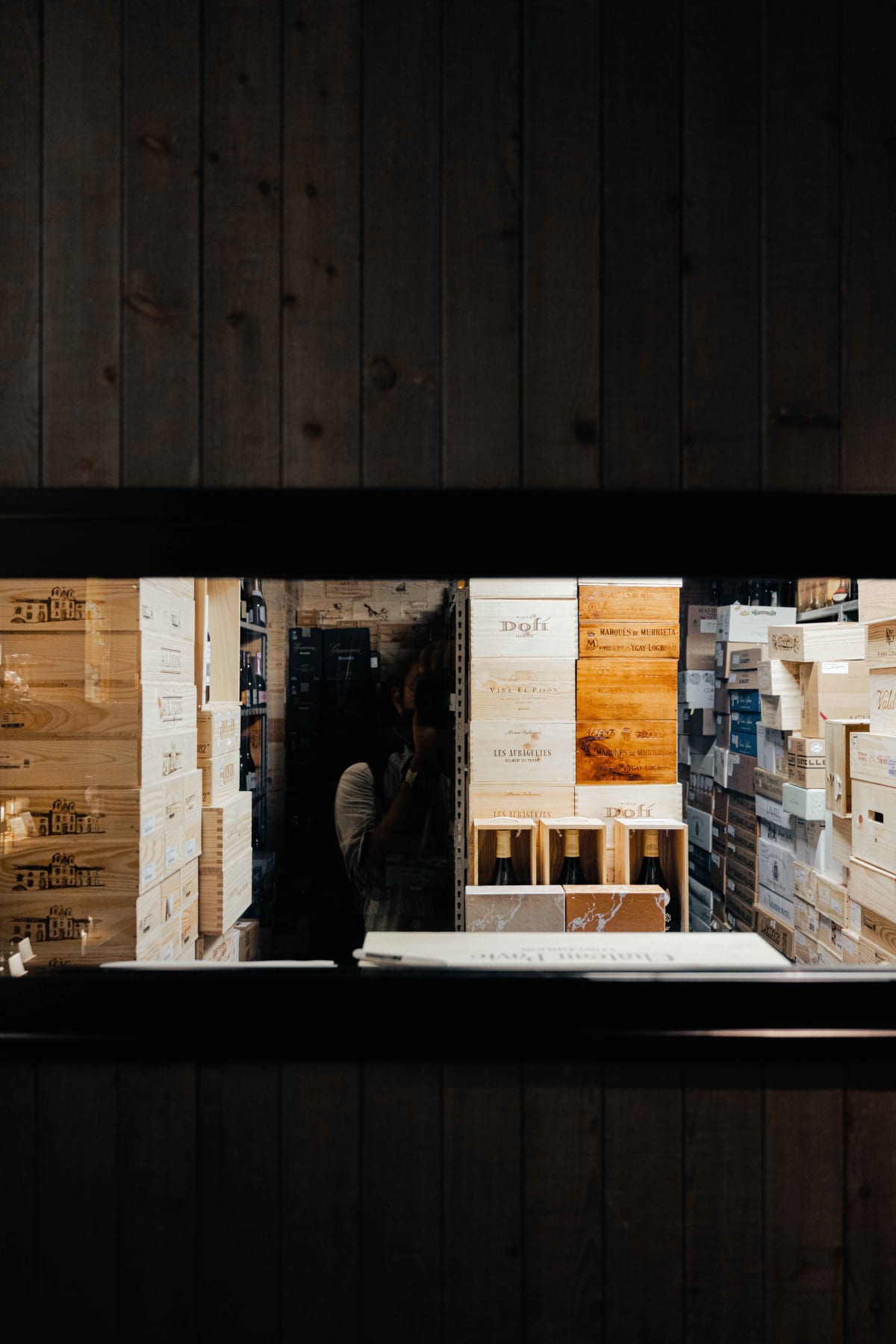
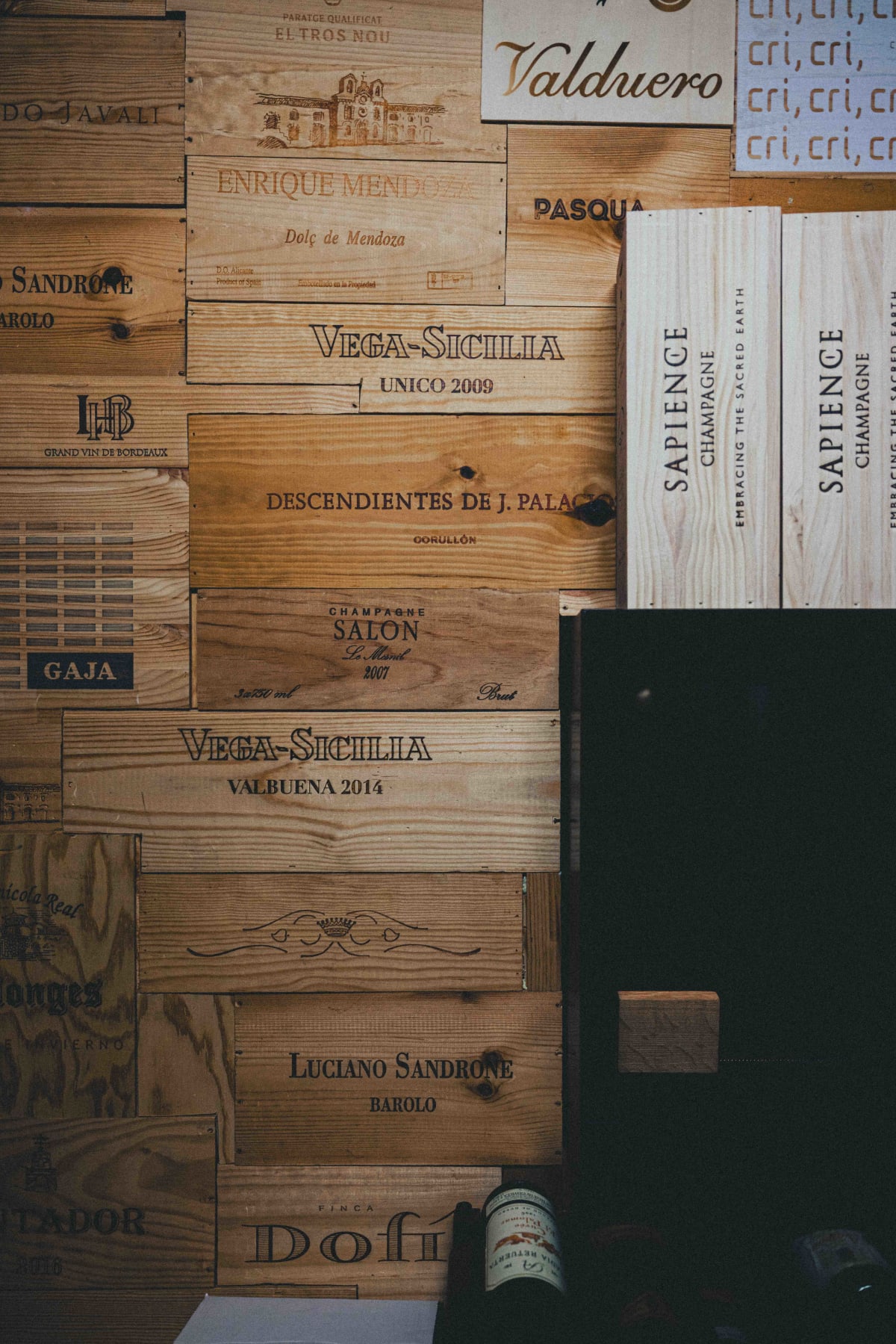
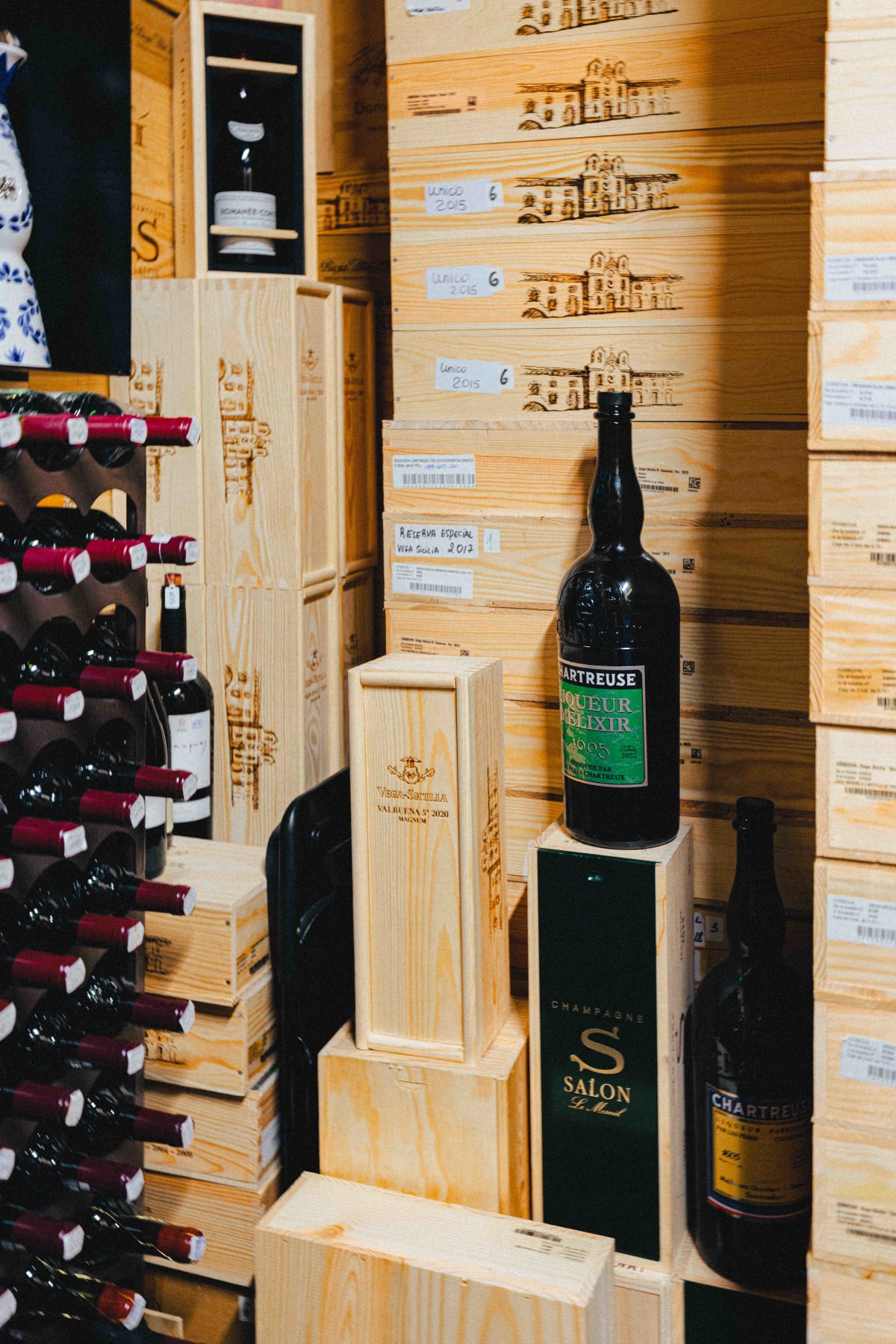
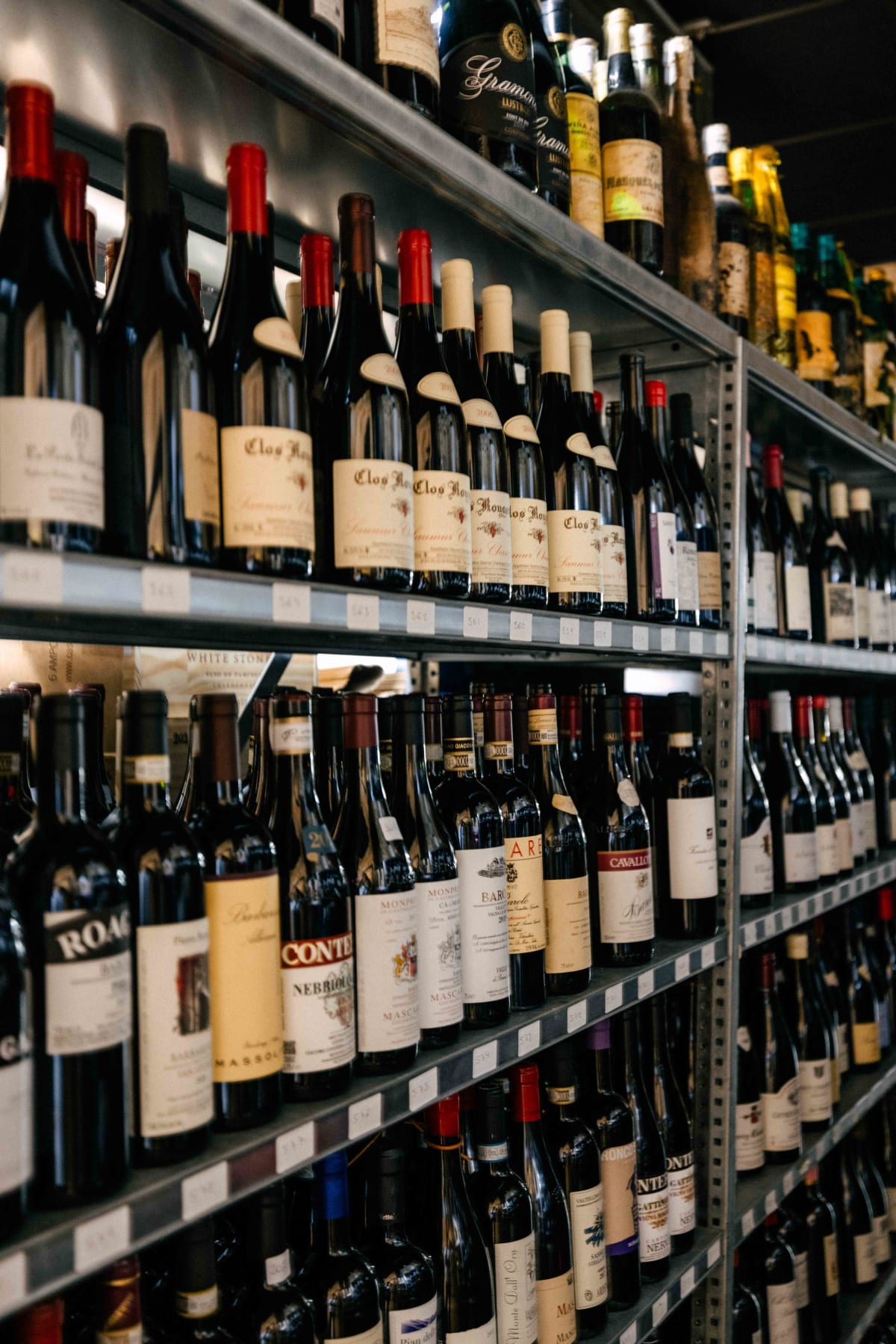
Then they walked over to a dark corner of the cellar and pushed on the wall, which, it turned out, was a door.
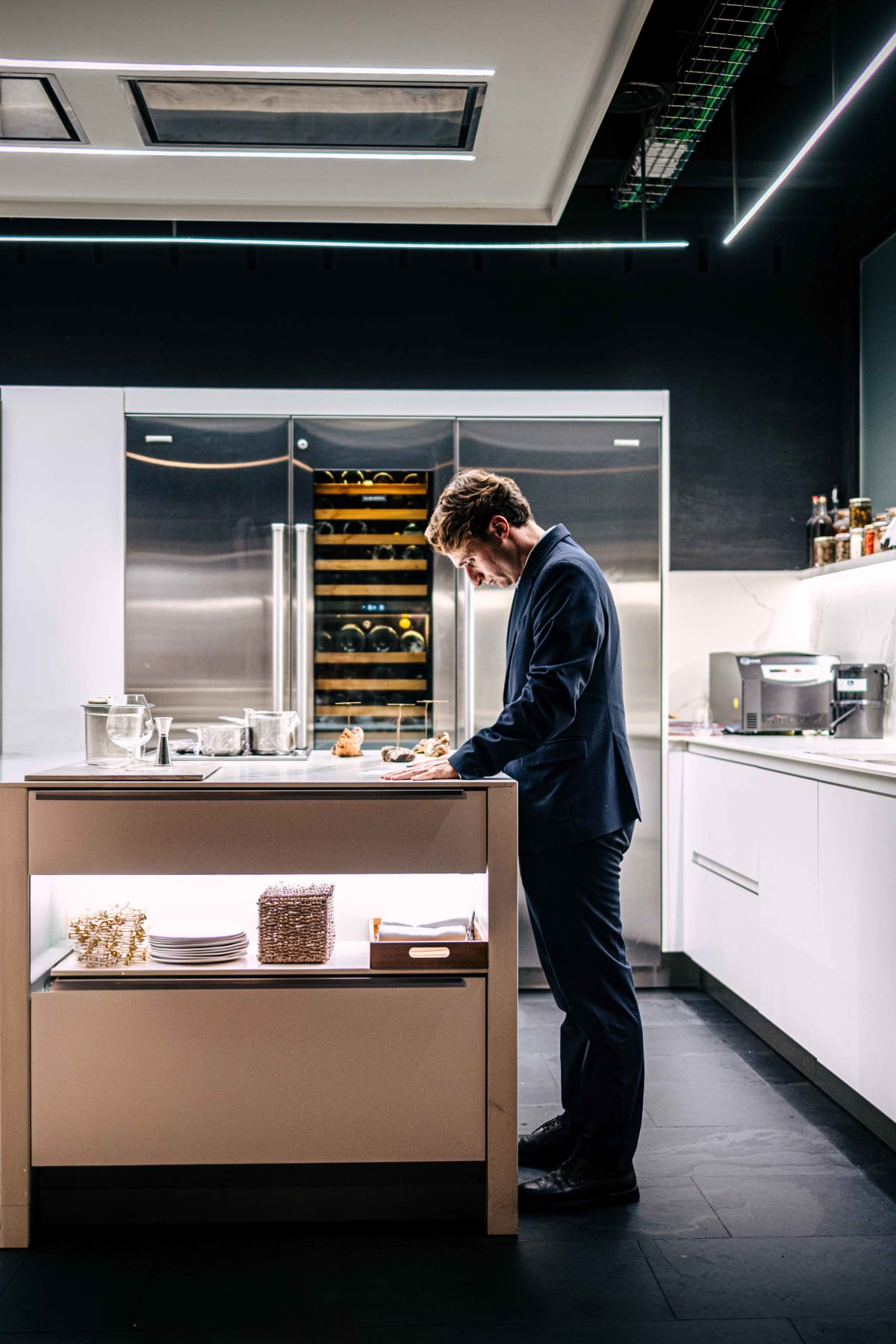
Behind it, a brightly lit space was revealed: The Living Table. The Living Table was truly a space for us and us alone. There was a single table, and right in front of it, in a kitchen that looked like a theatre stage, the chefs were preparing the food.
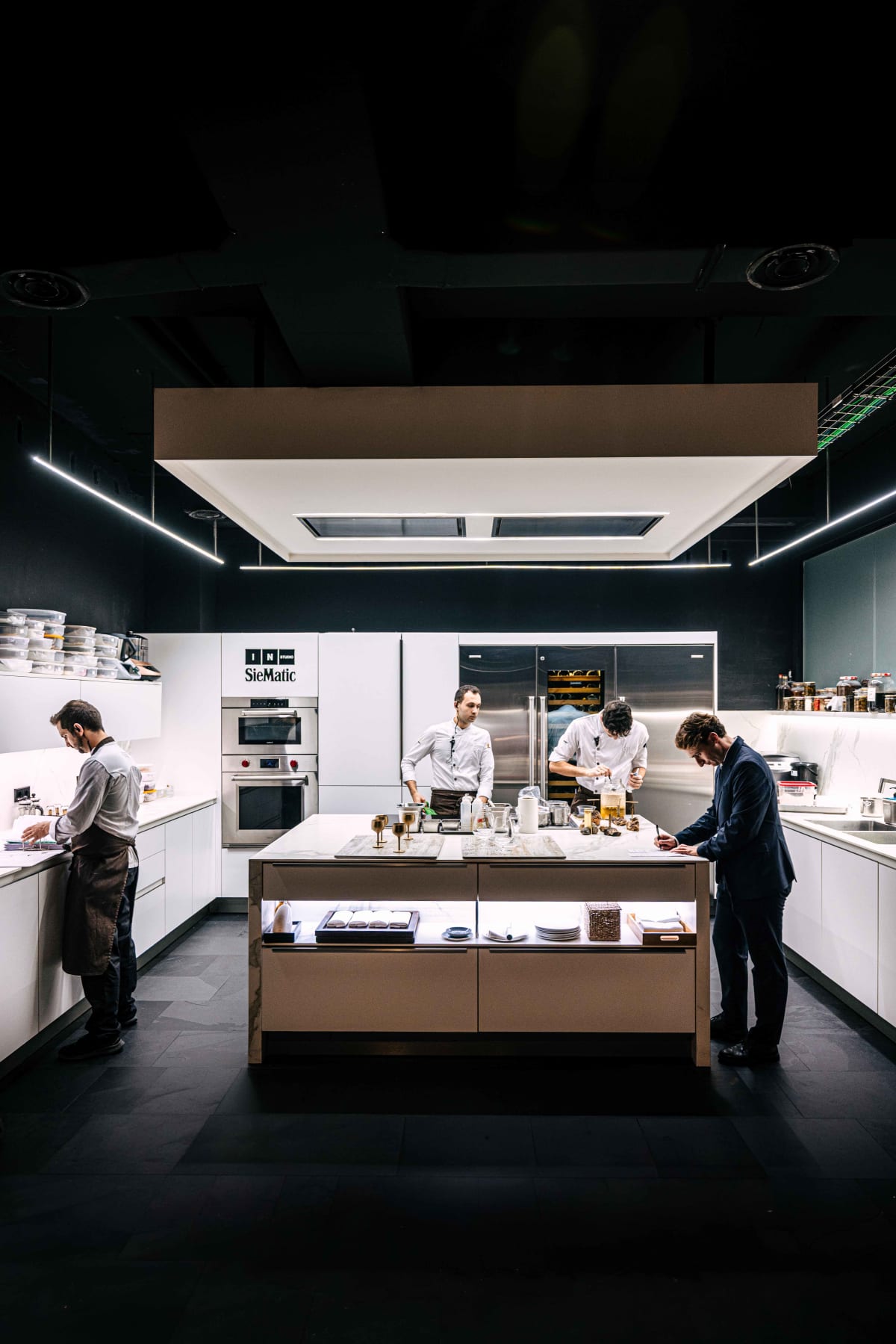
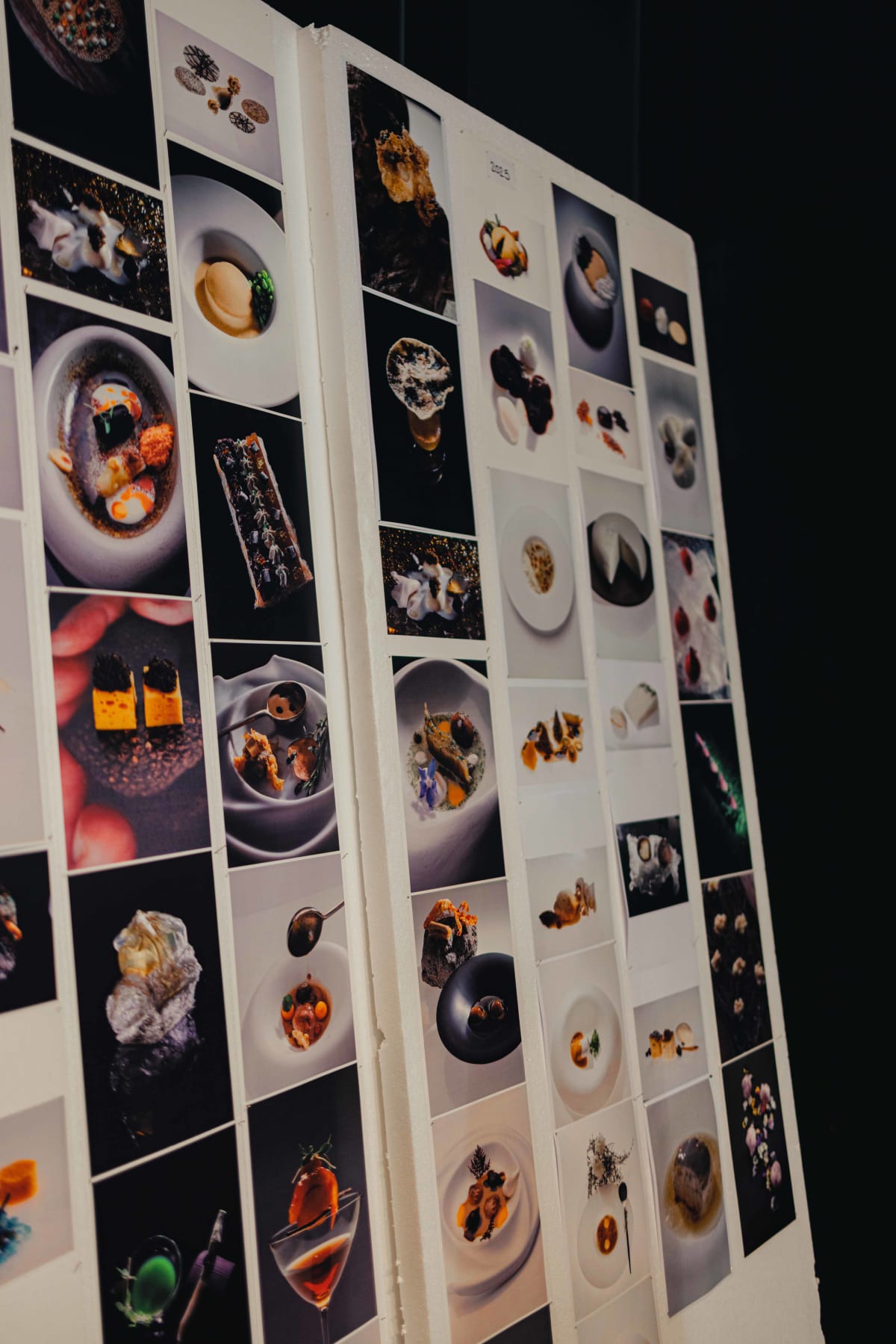
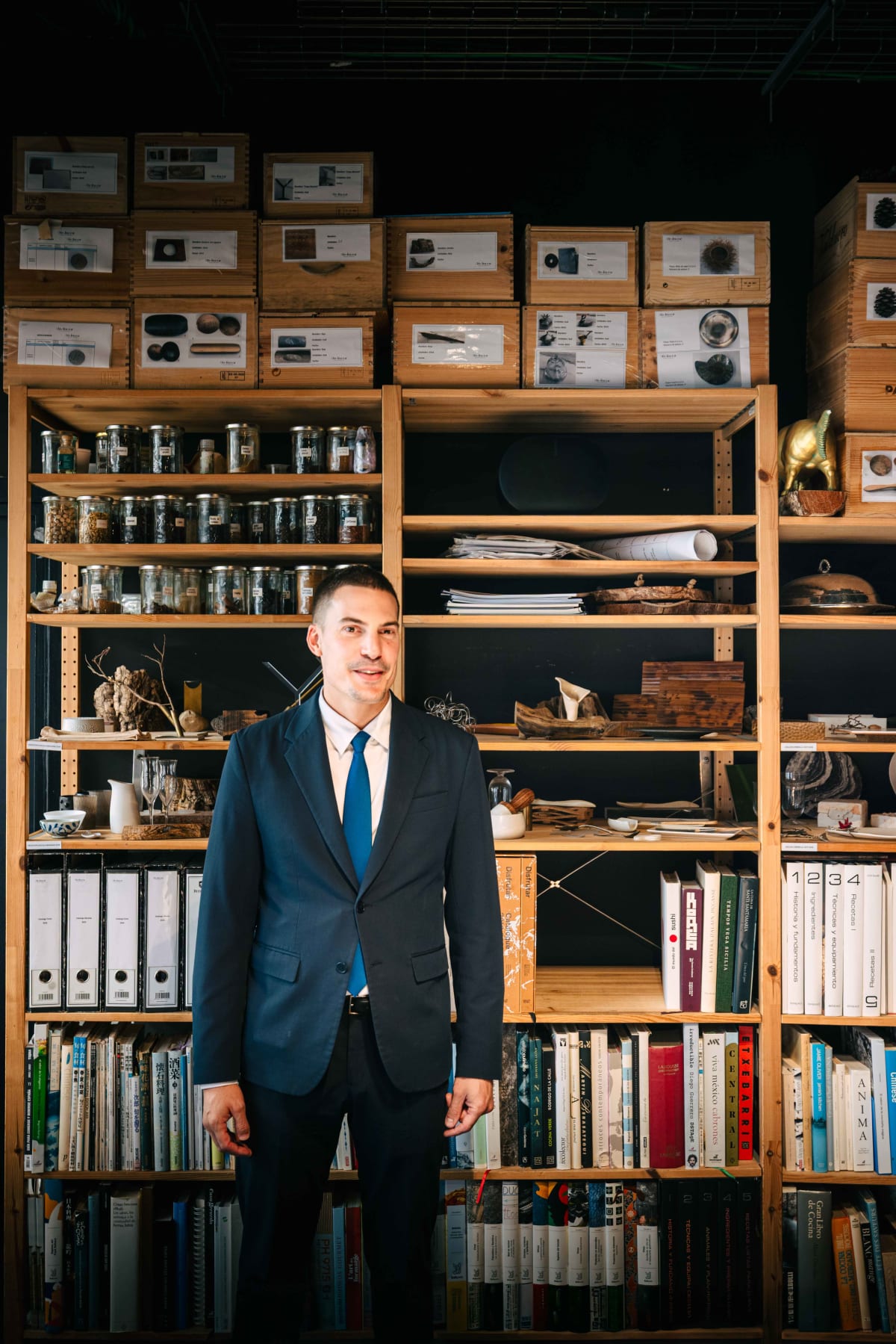
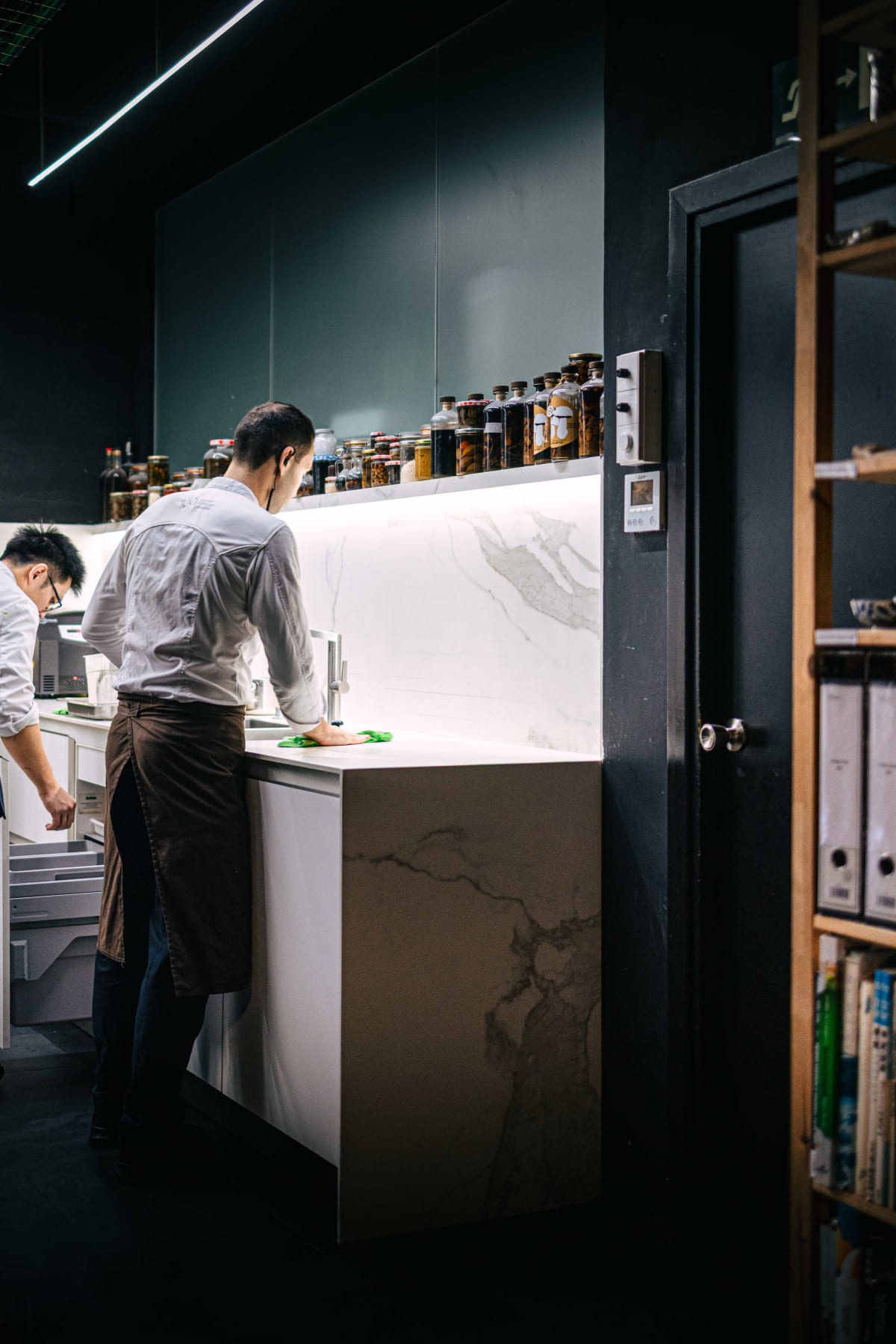
It did not seem that most of the cooking happened in this show kitchen. The main preparation appeared to take place in the kitchen behind it, with the chefs coming out to sauce, plate, and serve the dishes immediately. Around it sat various cookbooks, and behind it hung photographs of the dishes Disfrutar has researched and created over the years.
Unlike the ordinary dining room, The Living Table is itself one great structure, a stage. Built into its top are hidden drawers and lifts, sliding panels and lighting devices, so that the surface of the table keeps changing its face. A drawer suddenly opens from what had looked like an ordinary tabletop; a dessert rises from a place where moments earlier there had been nothing. Once the table stops being a flat board for plates and becomes part of the cooking itself, the guest is no longer watching the experience but inside it.
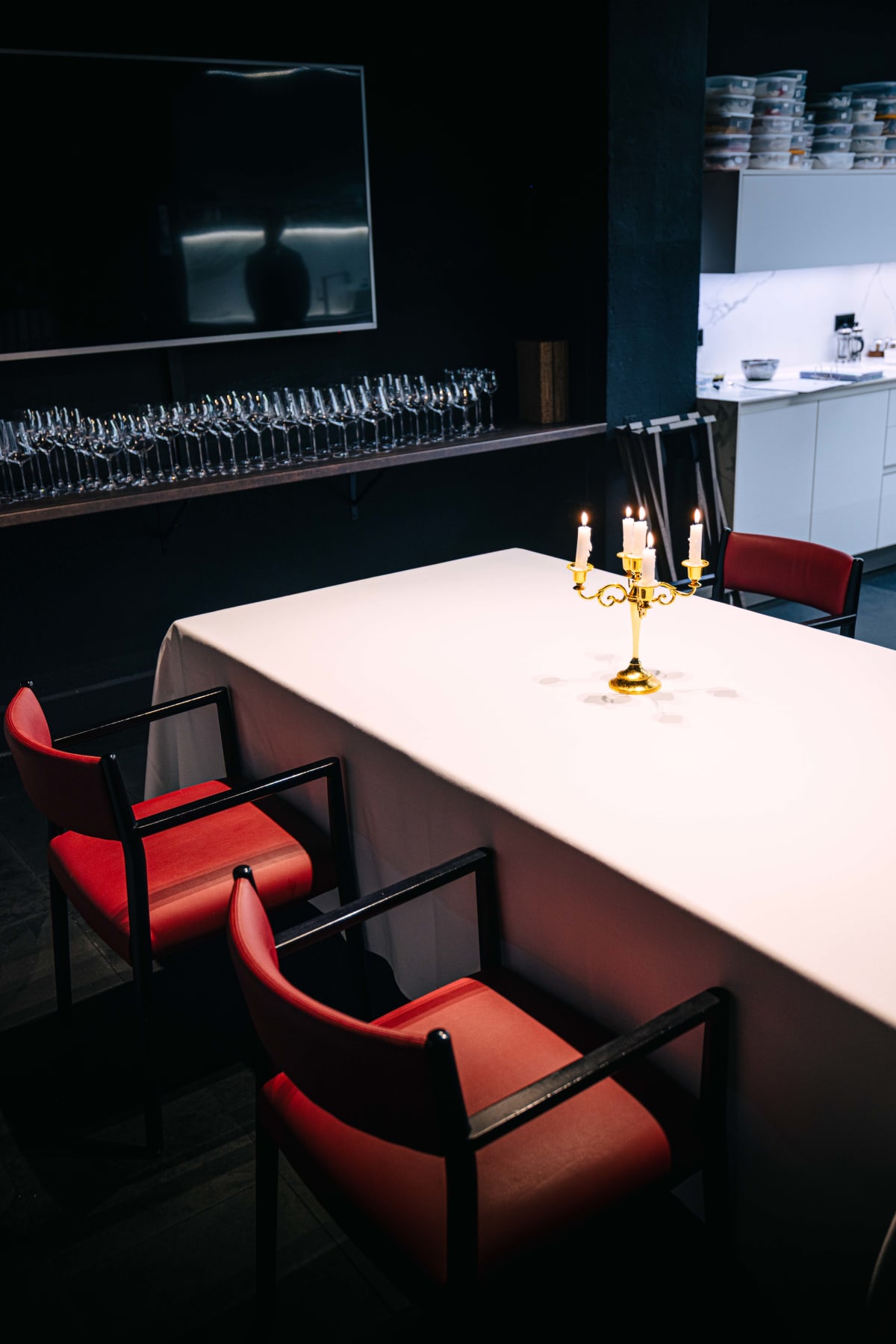
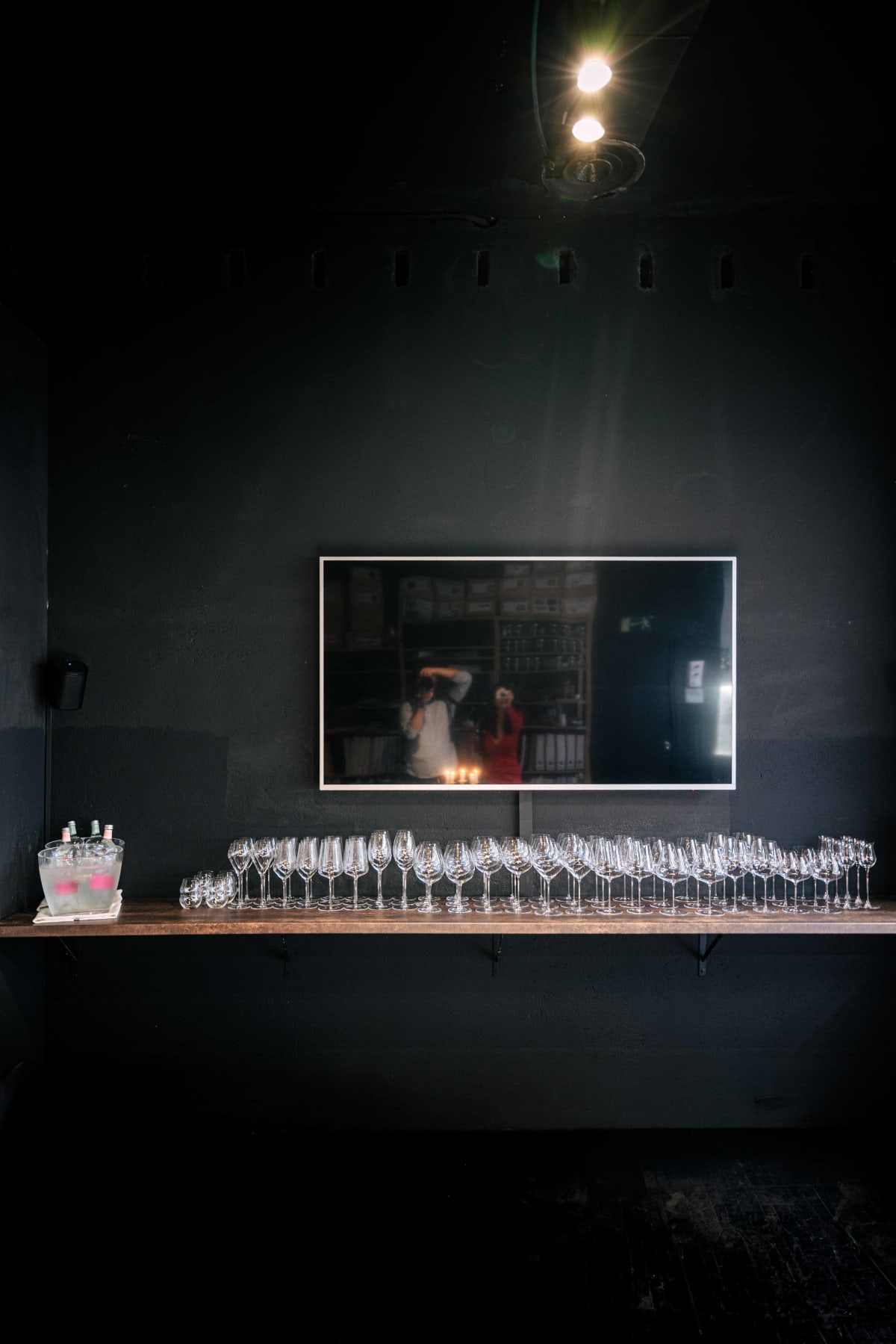
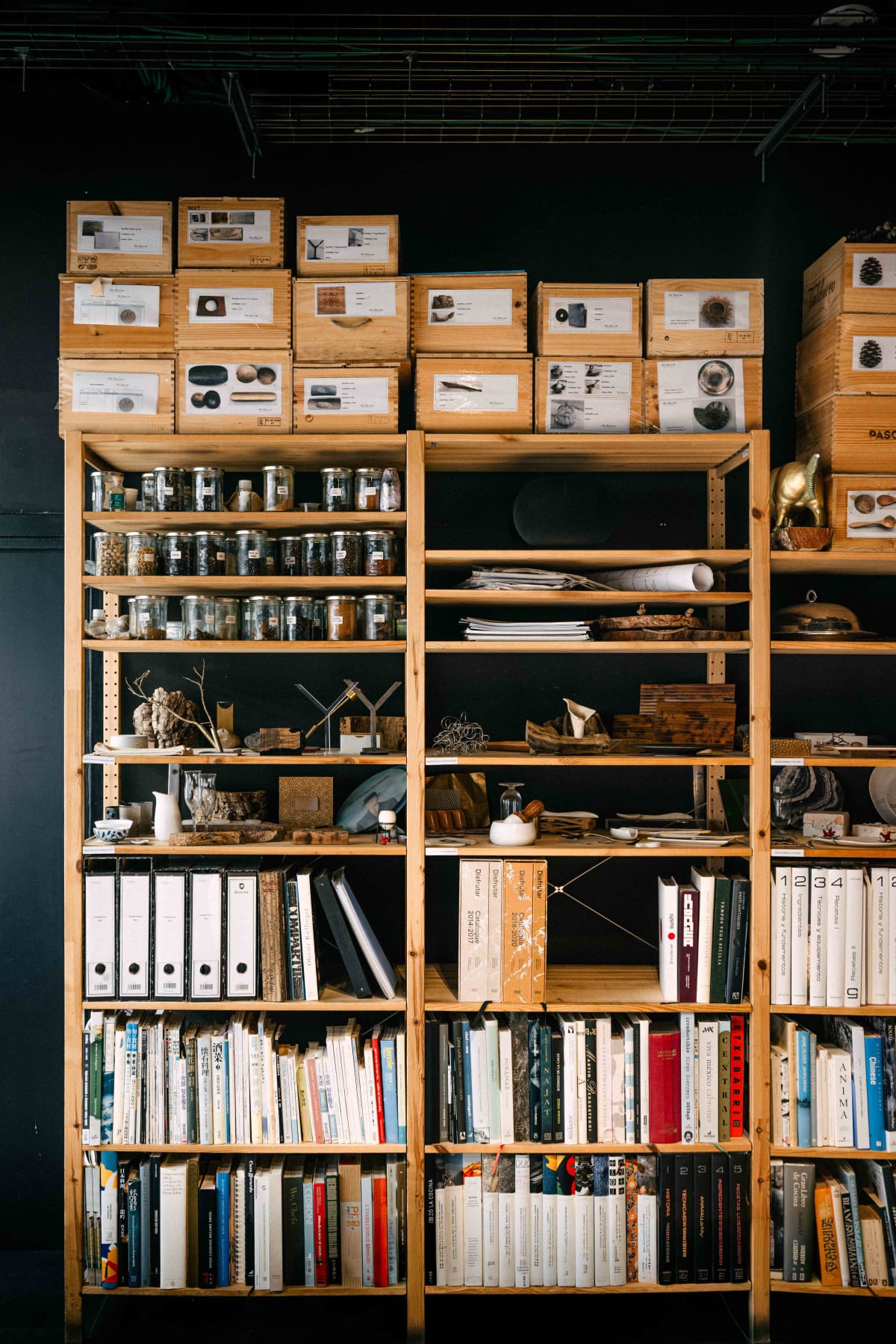
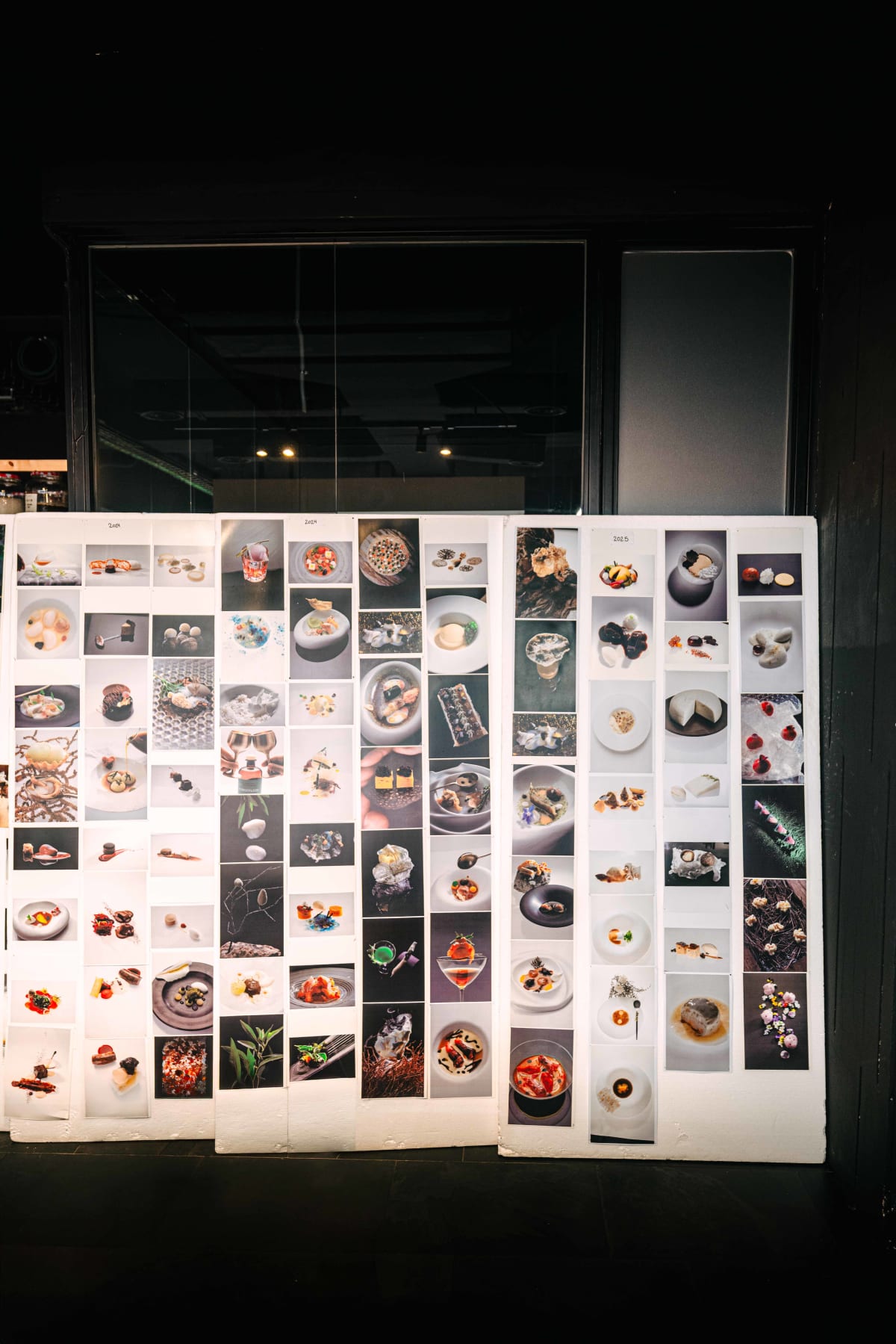
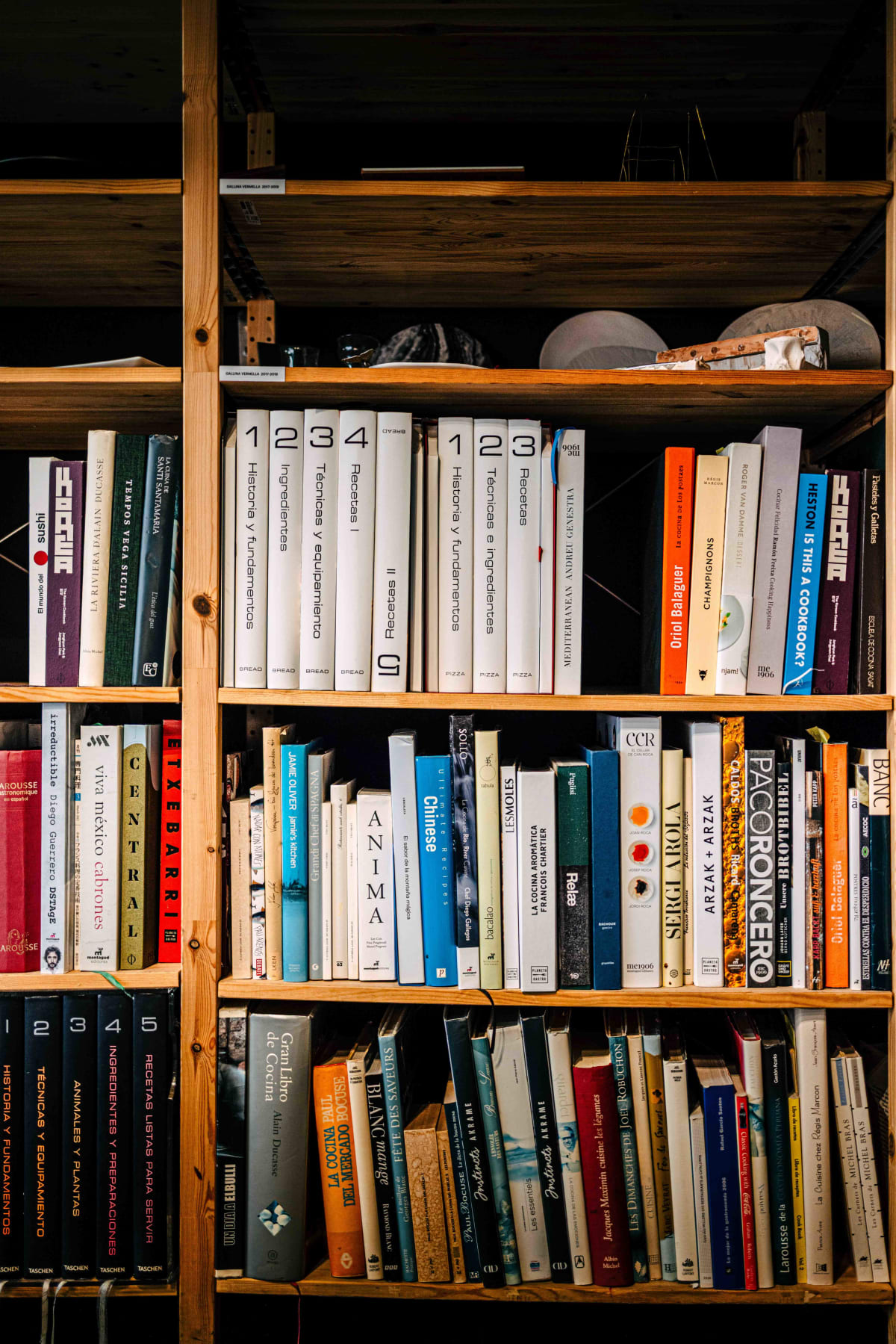
What is interesting is that none of these devices ends as a mere visual gimmick. Whatever emerges from a hidden drawer is always one of the bite-size dishes this restaurant has researched and developed, and the timing of the table's movements was locked precisely into the flow of the course, as if every member of staff had trained at it endlessly. Beyond that, as though you had stepped into a scene from a film, they play background music like a film score, and the lighting, too, is set just so, tuned to make the five senses respond as dramatically as possible. This is exactly why I have called this place a total work of art.
The main dining hall serves two courses currently in progress, but The Living Table runs only on a signature course that gathers up the whole history of Disfrutar. We moved from place to place at points along the way, turned on a TV to watch audiovisual material, and experienced some striking pairings. Considering that all of this comes to under 500 euros per person, it reads less as a product than as the restaurant's devotion and its willingness to share.
Section 4·Twenty-Four Courses, and What Lies Behind the Food
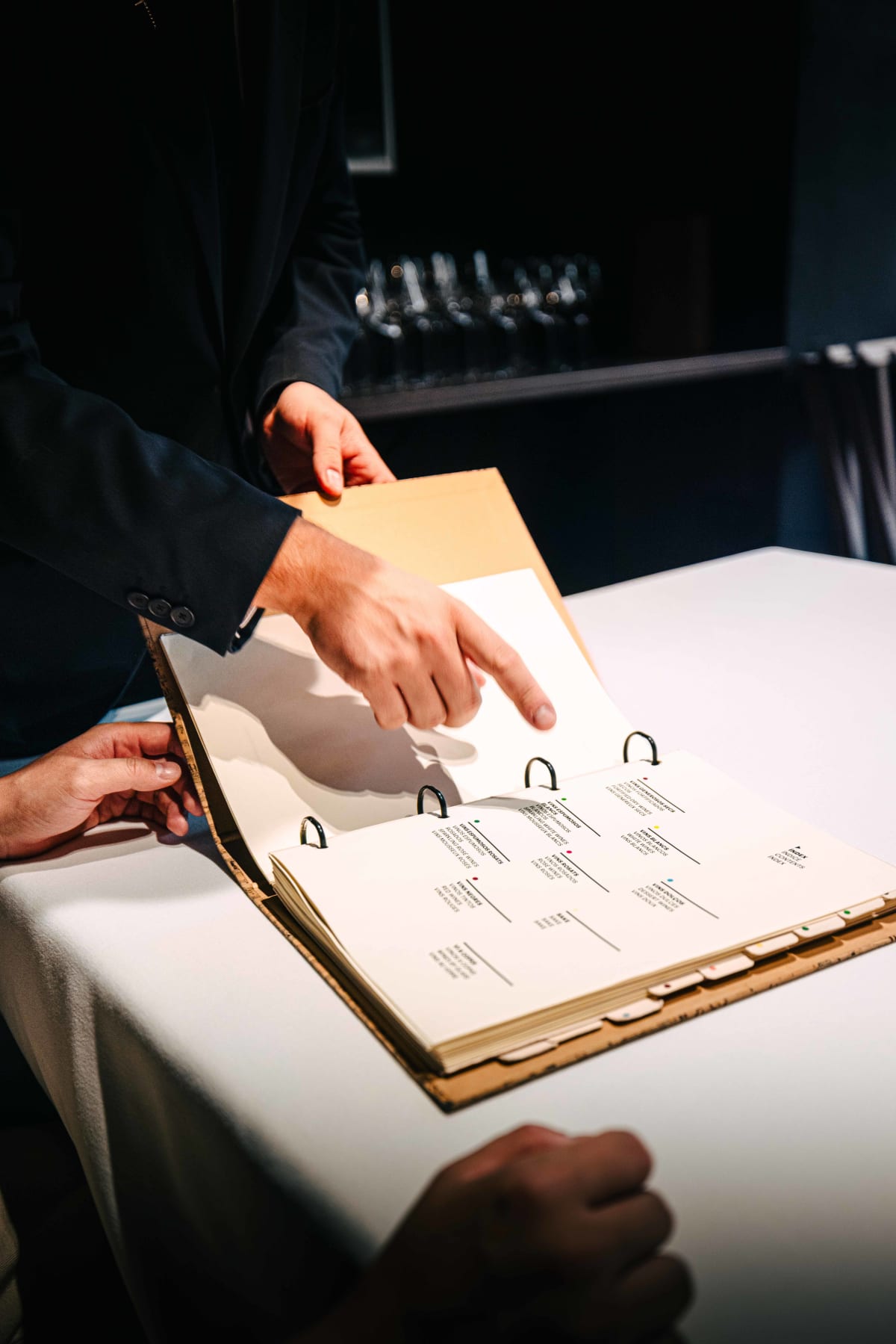
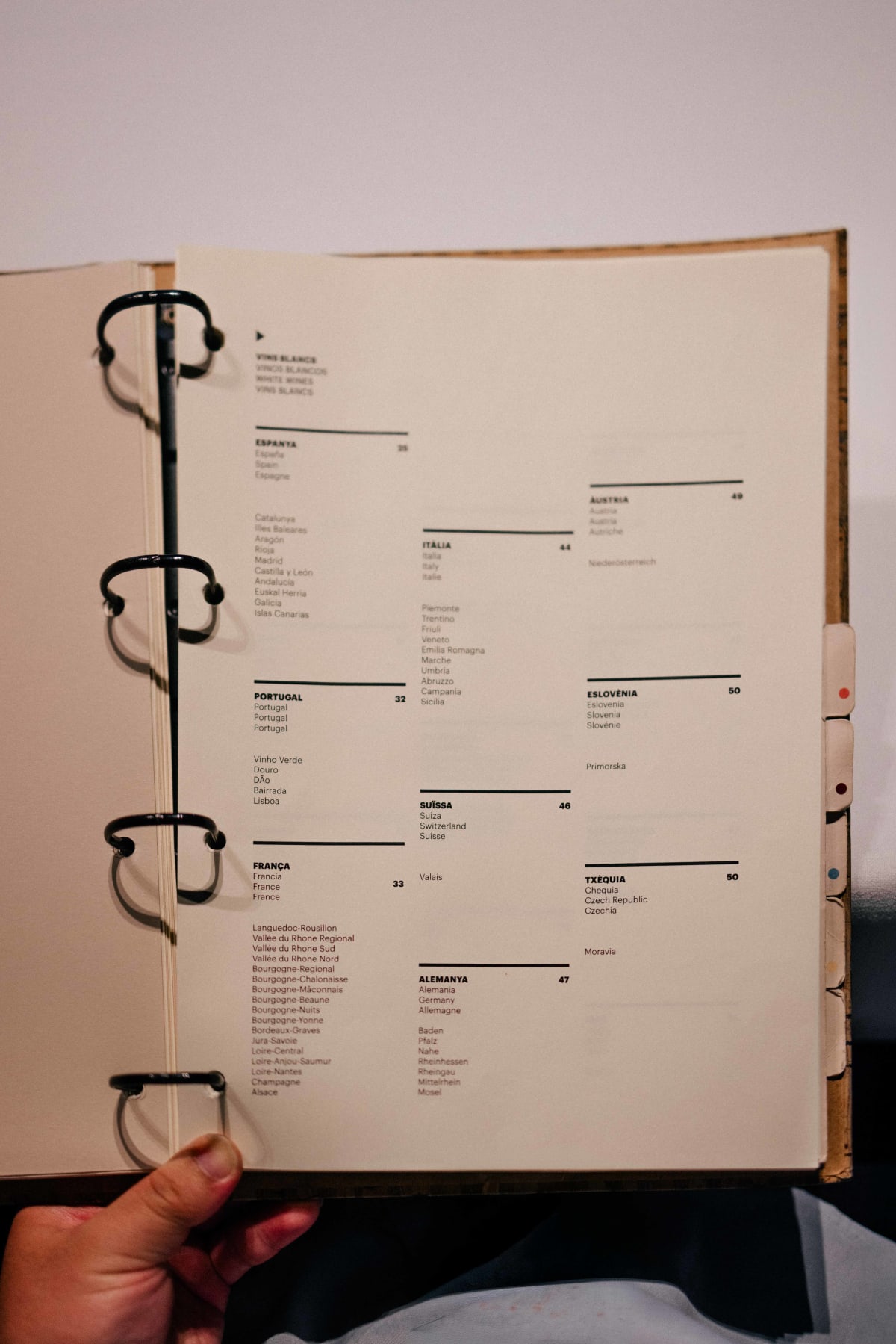
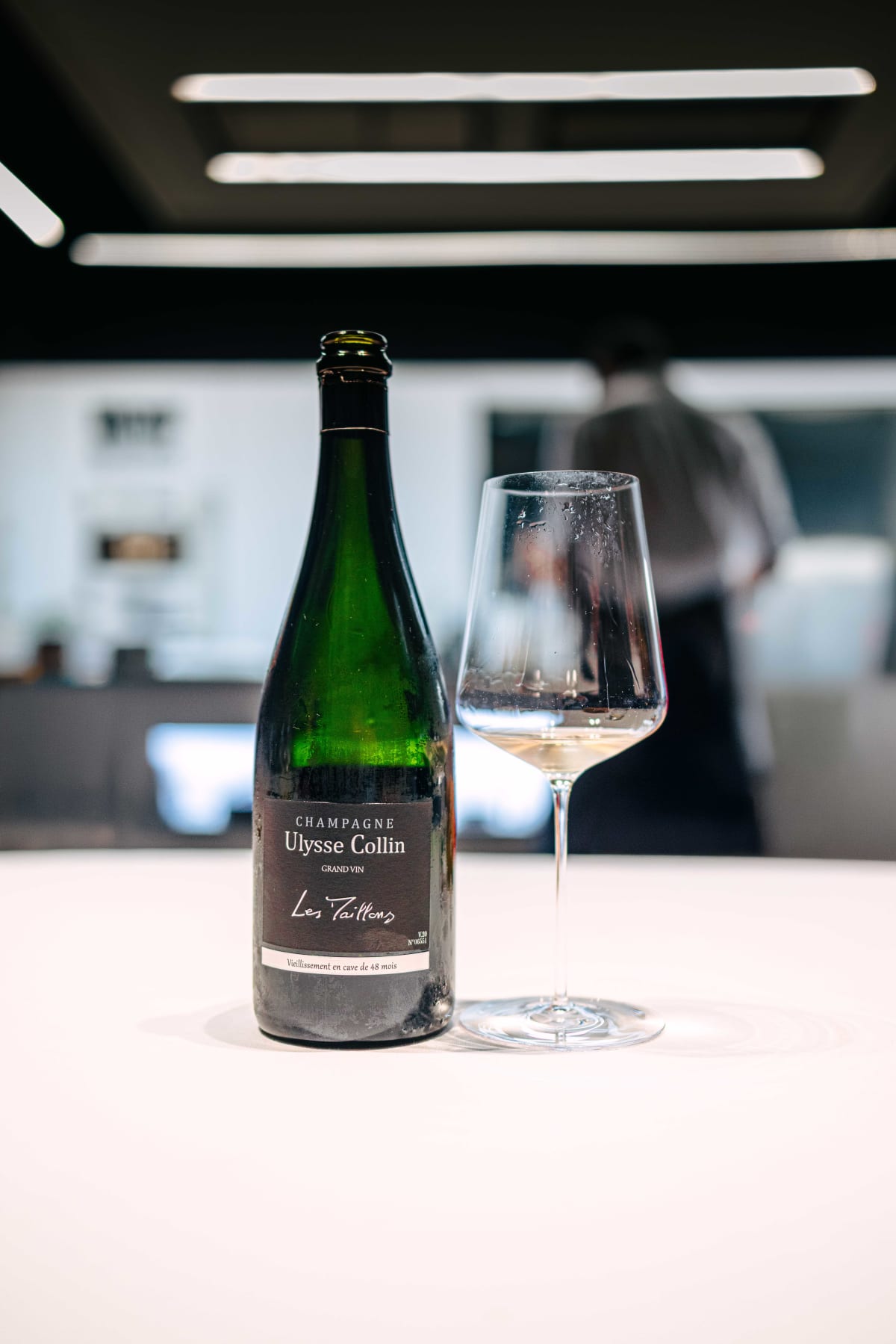
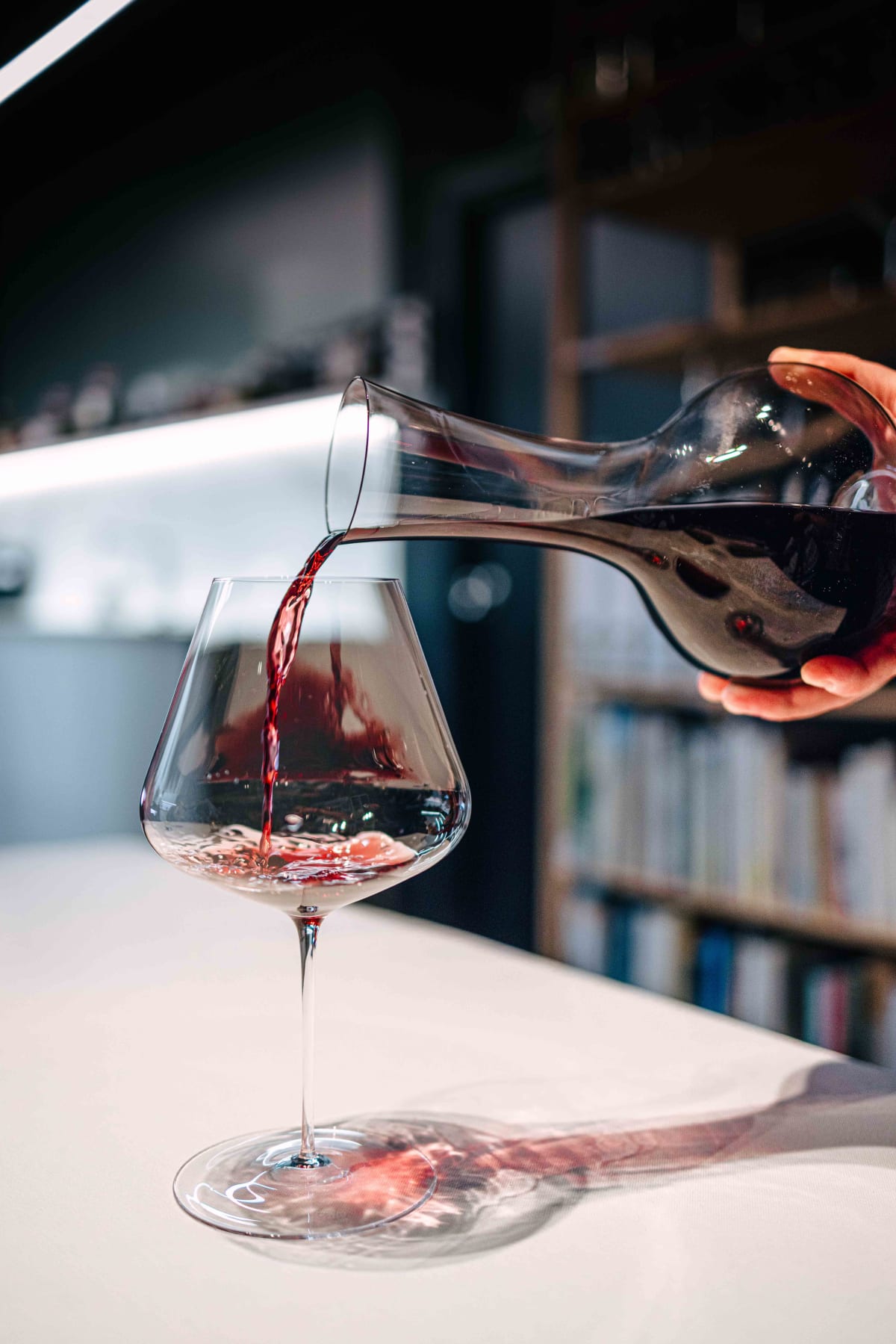
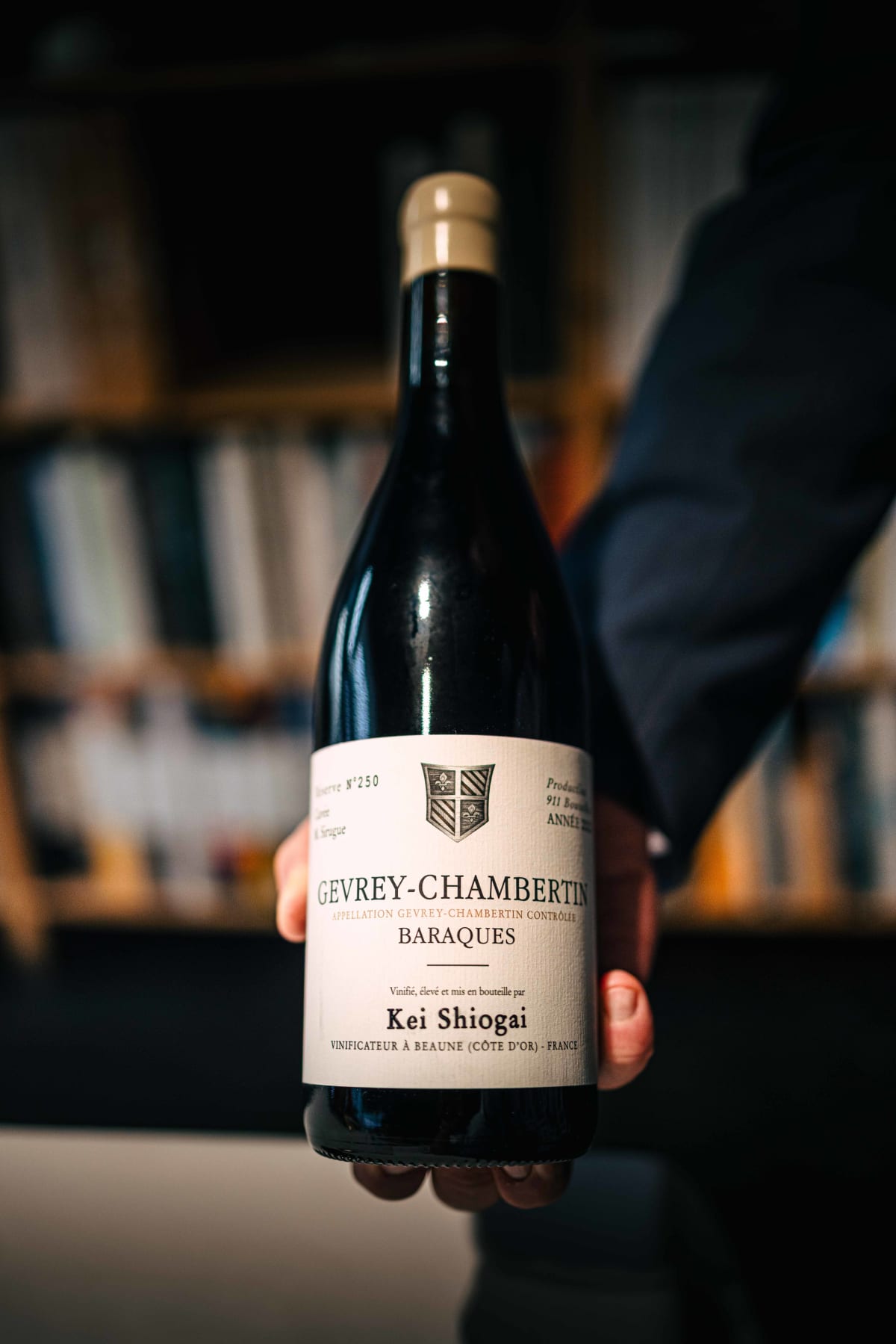
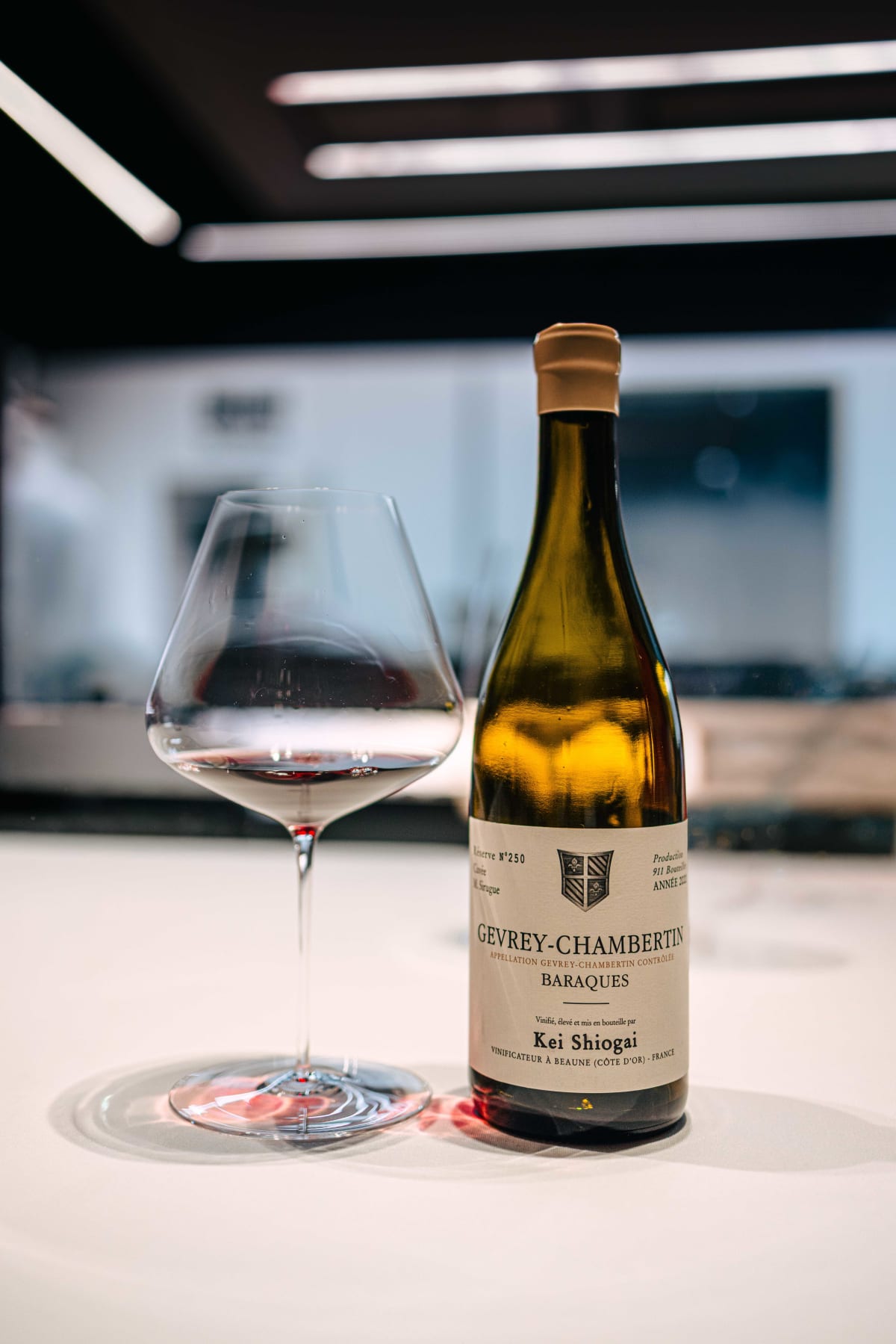
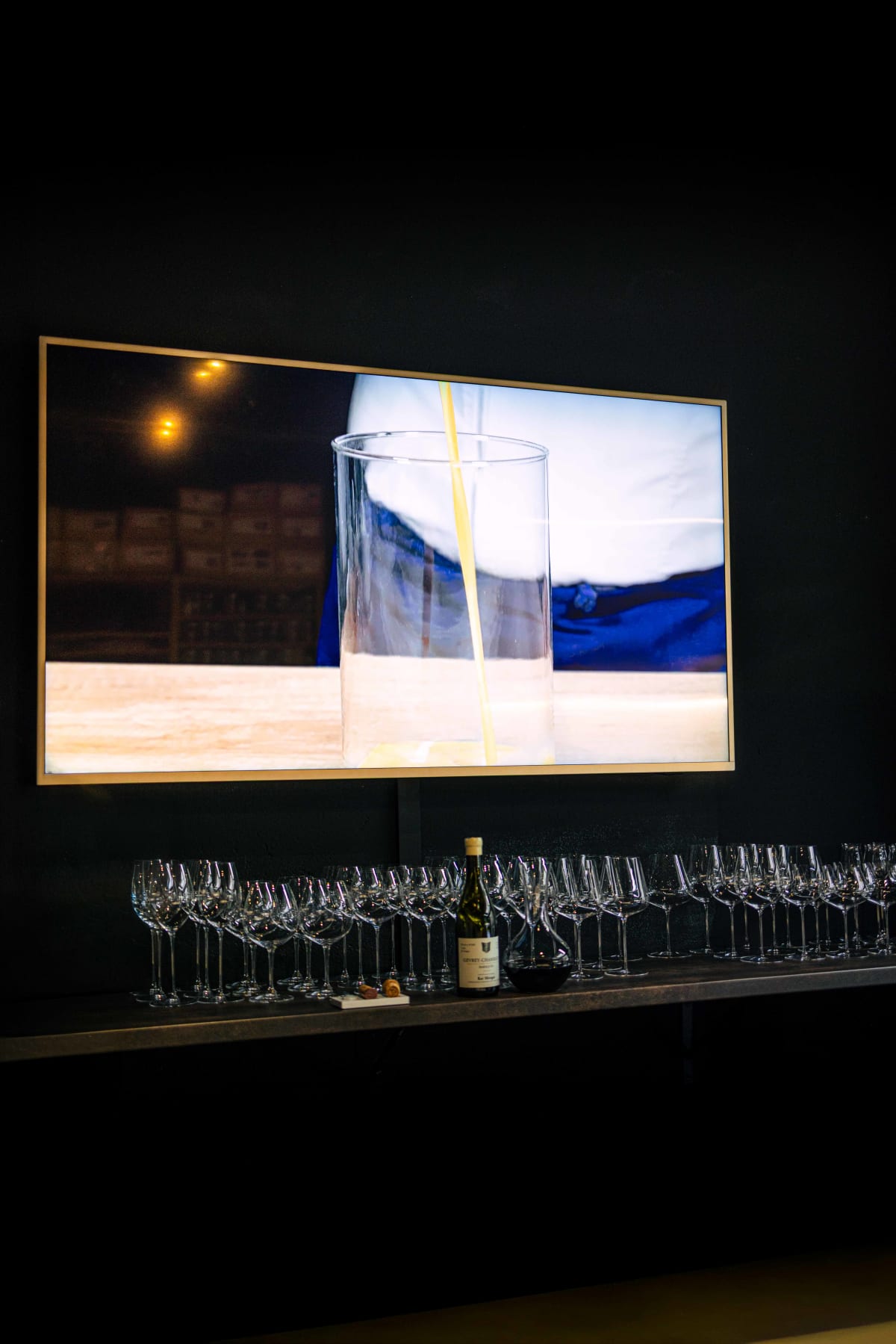
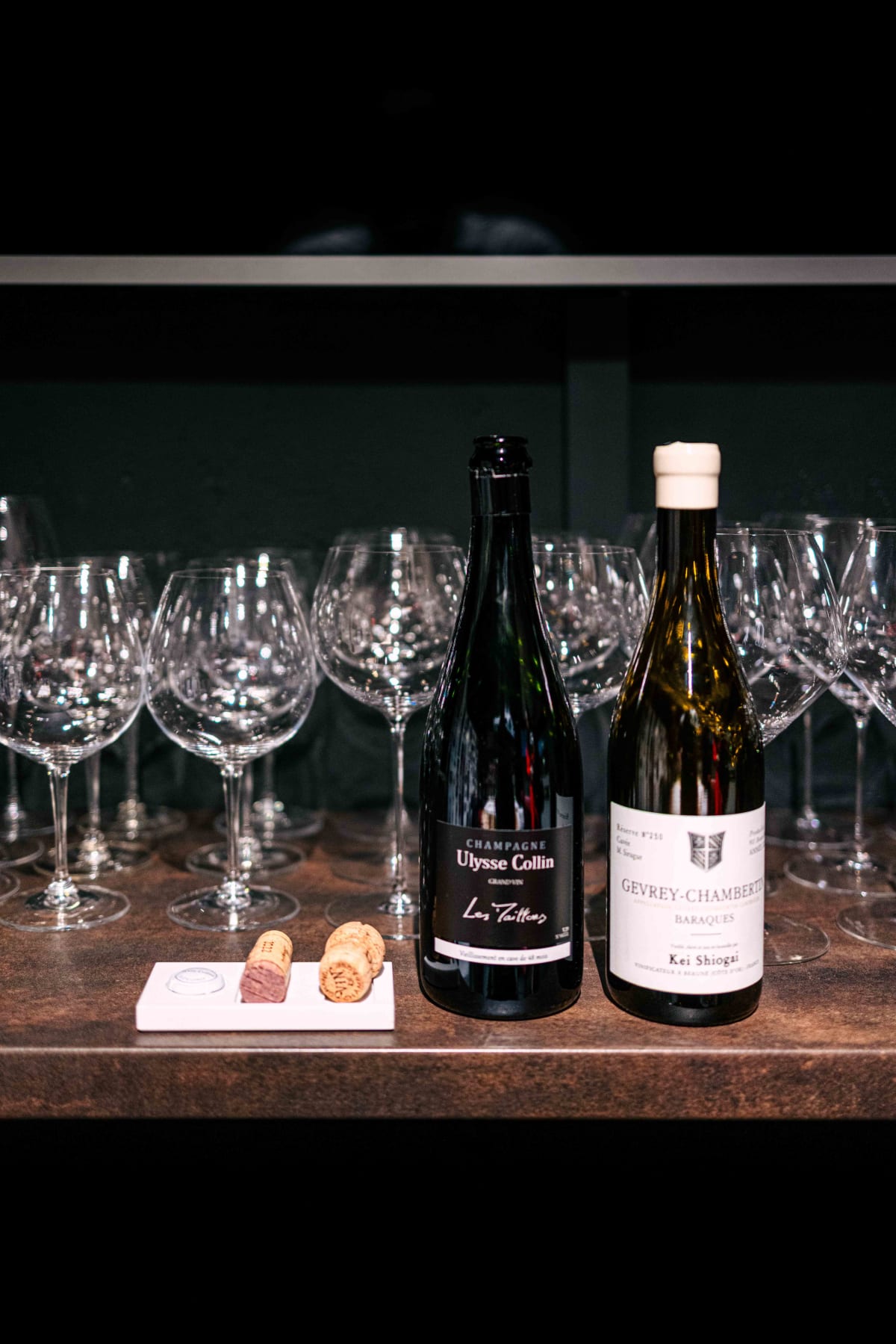
The wine list was not thick, but I was impressed by how it was laid out with stickers by country, which made it easy to navigate. That evening I drank, for Champagne, Ulysse Collin Les Maillons (aged 48 months), and for red, Kei Shiogai Gevrey-Chambertin "Barraques" 2022.

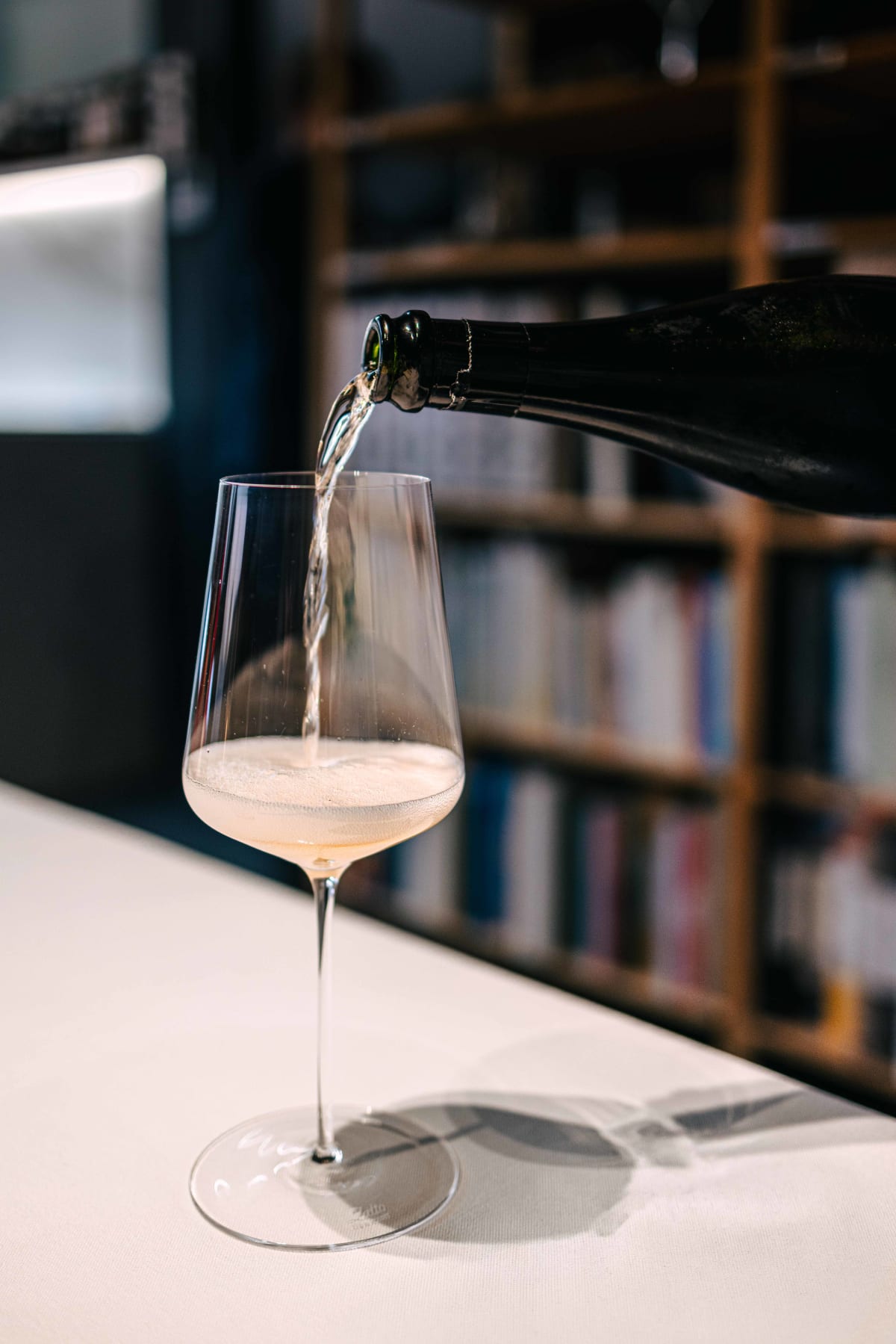
Ulysse Collin is a grower Champagne (RM) that Olivier Collin started in 2003, after reclaiming the family vineyards from a lease agreement with a large Champagne house. Built on the low-intervention winemaking he learned under Anselme Selosse, the house is counted among the leaders of the grower Champagne movement. Les Maillons is a plot in Barbonne-Fayel, in the Côte de Sézanne, where Pinot Noir planted in 1971 is grown on iron-rich clay and chalky soil. Facing east, the plot is known for holding on to acidity and freshness even at full ripeness; the wine is fermented slowly with natural yeast, aged mostly in the Burgundy barrels the house has long used, and finished as an extra brut with almost no dosage. That said, the nose was excellent, though the texture and the bead felt a little flat. That delicate, soft mousse is very much the style of a long-aged extra-brut grower Champagne, but it sits outside my own preference, which leans toward a bead that lands with more force on the palate.
Kei Shiogai, who is Japanese, studied winemaking in Beaune and Dijon before working with Philippe Pacalet, the renowned Gevrey-Chambertin domaine Armand Rousseau, and the celebrated white Burgundy producer Jean-Marc Roulot, and began making wine under his own name in 2020. He is one of the hottest rising stars in Burgundy. His is a micro-négociant approach, buying in grapes rather than growing them himself, but with low-intervention winemaking such as whole-cluster fermentation and minimal use of sulphur, he shapes a light, delicate, fragrant style that has developed a global cult following in a short time. He does not even release a photograph of his own face, which makes him all the more mysterious a figure. This Gevrey-Chambertin was a textbook Burgundy red, but my satisfaction did not run as high as its reputation had led me to expect. Being such a light, delicate style, the wine came across as somewhat buried beside Disfrutar's intense, layered courses. Even critics point out that his light touch can be overwhelmed in pairings with food, and I felt exactly that in person.
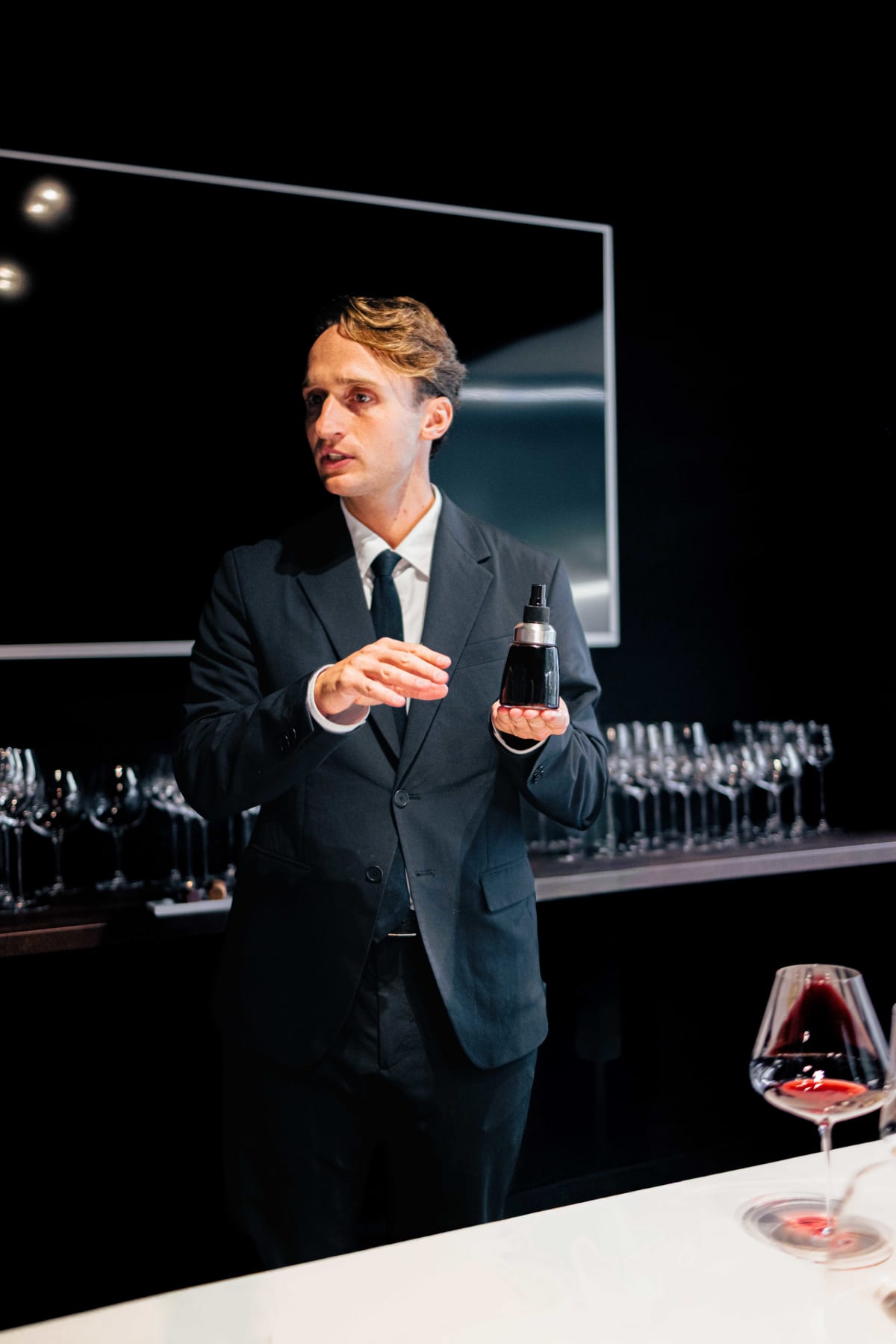
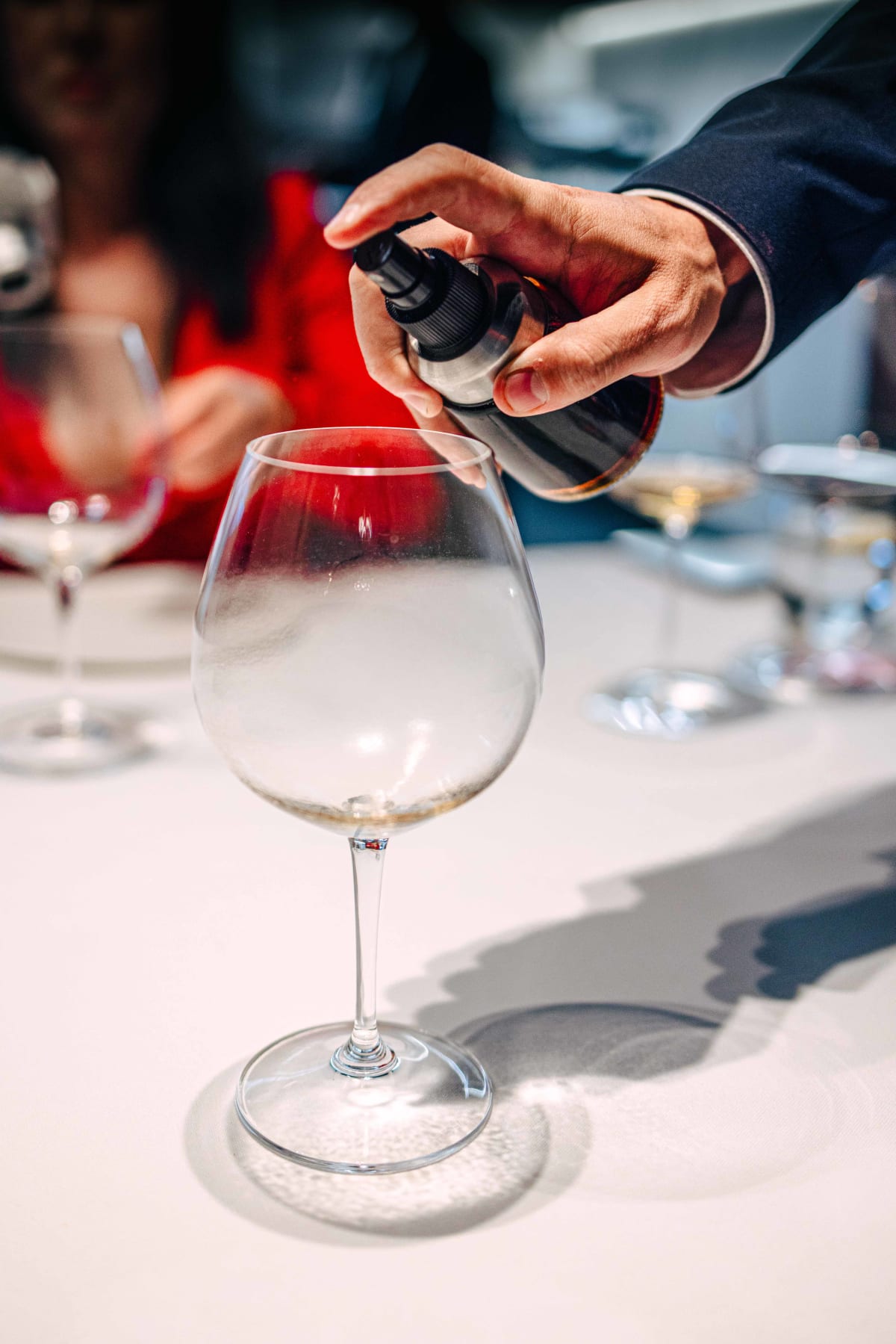
Before the full course began, the staff gave us a short briefing. Because the dishes are so many in number, they show real consideration for pace and rest: I found it striking that they ask you, if you would like to pause partway through, to let them know a course or two in advance. They then asked us to spread a "Hydraulic gel" over our hands, dripping the gel-like liquid from a conch-shaped vessel.
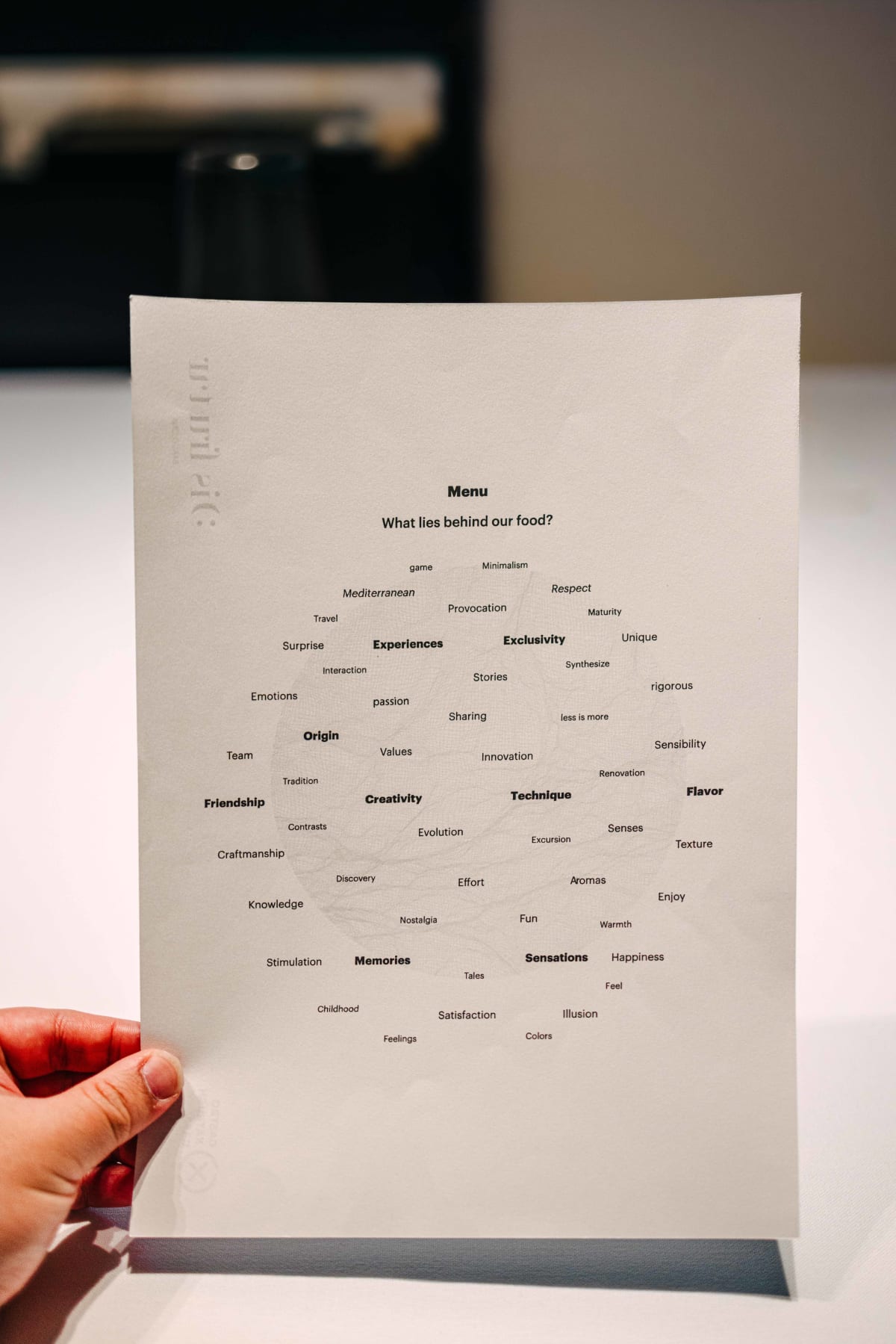
Before the cooking began in earnest, the restaurant handed us a sheet of paper. On it was the question "What lies behind our food?" It was their answer to what values, emotions, and attitudes go into the cooking, rather than to recipes or ingredients. It held words about emotion and sensation (Emotions, Feel, Happiness, Warmth), experience-centred language (Experiences, Interaction, Surprise, Game), words about creativity and research (Creativity, Innovation, Technique), language tied to minimalism (Minimalism, Less is more, Maturity), memory and narrative (Memories, Childhood, Nostalgia), and human connection (Team, Friendship, Sharing). One of the reasons I came to feel, while writing this account, that I absolutely want to return is the regret that I did not savour this kind of philosophical theme fully enough at the time.
Section 5·The First Flow: The Poetic Structure of the Single Bite
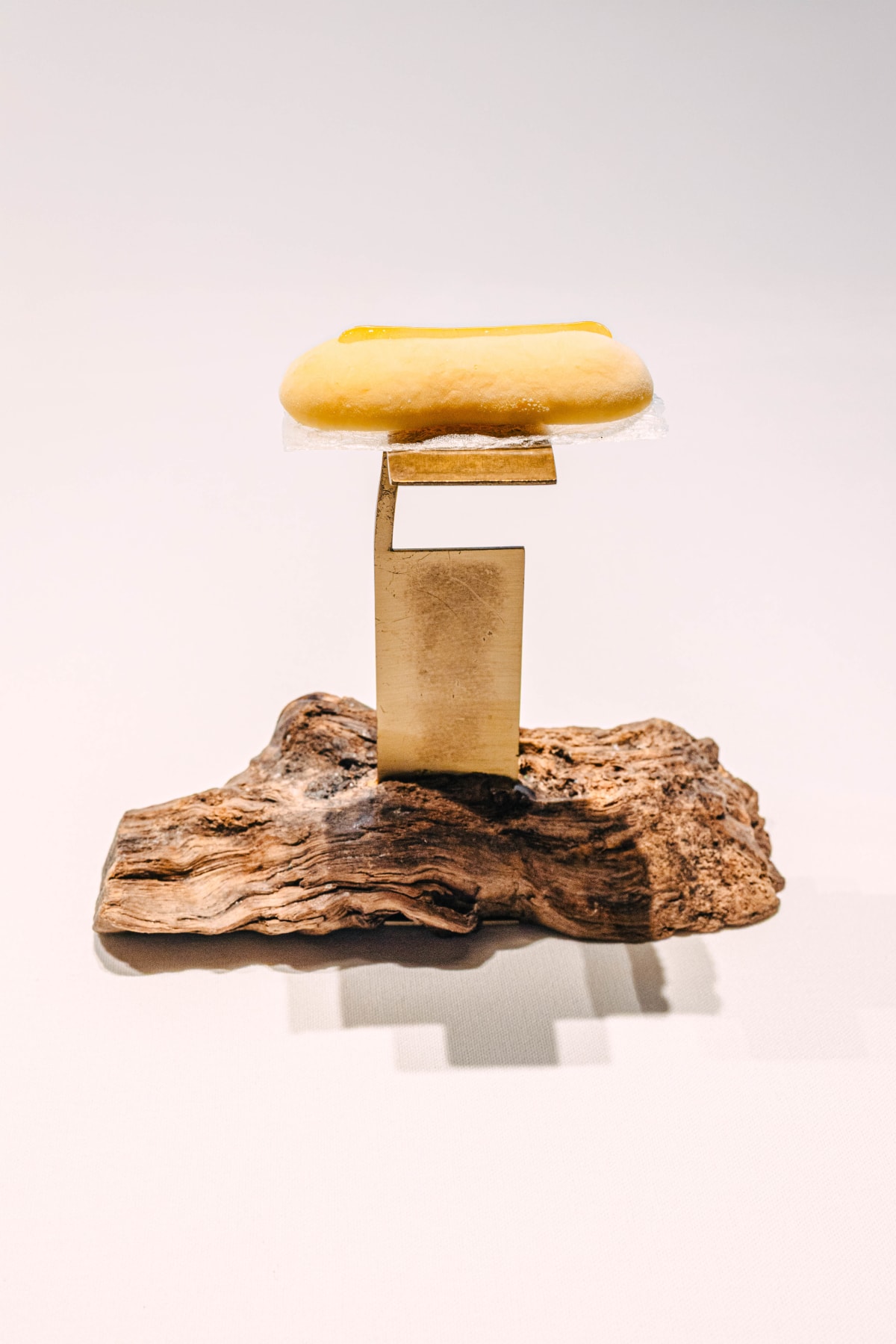
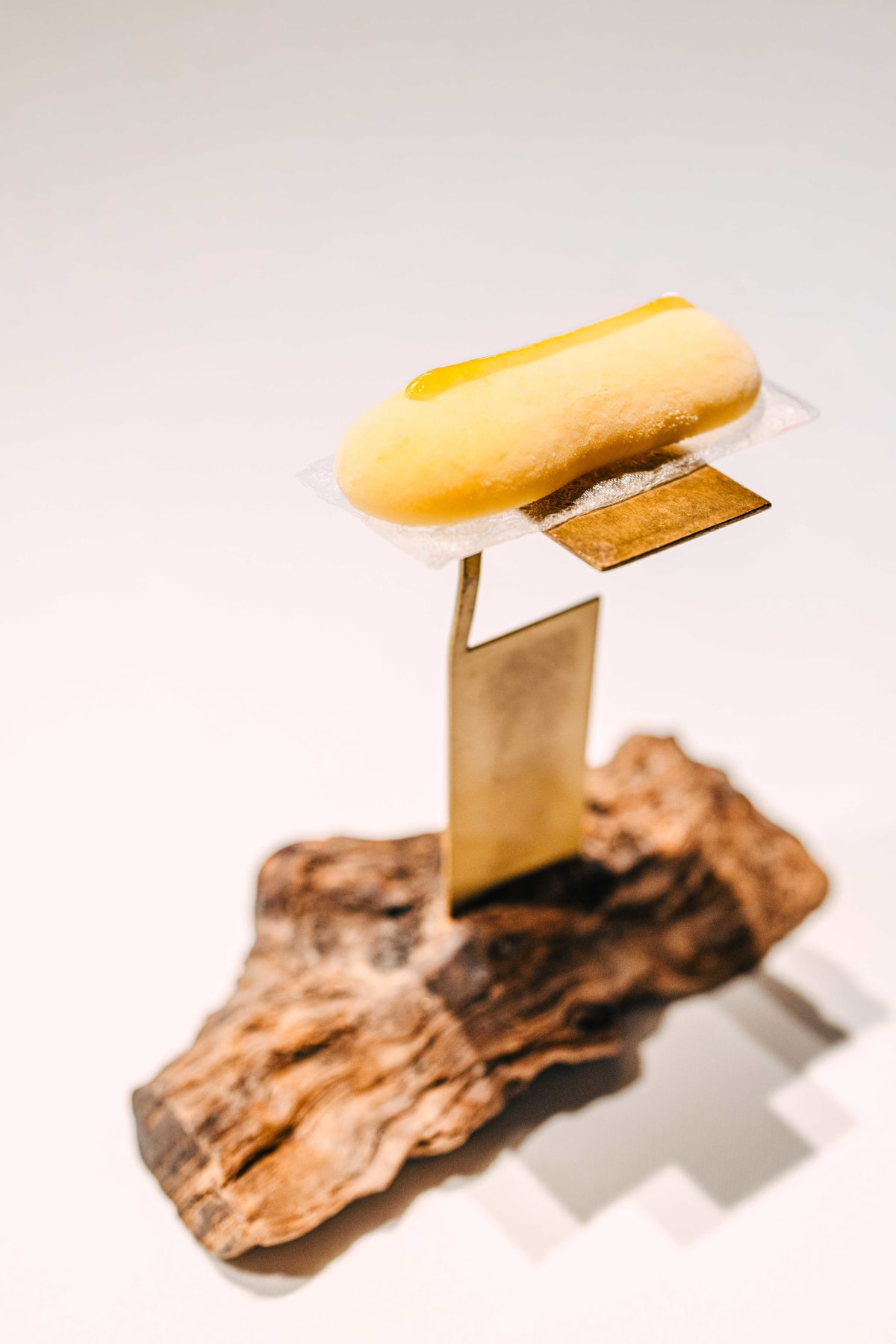
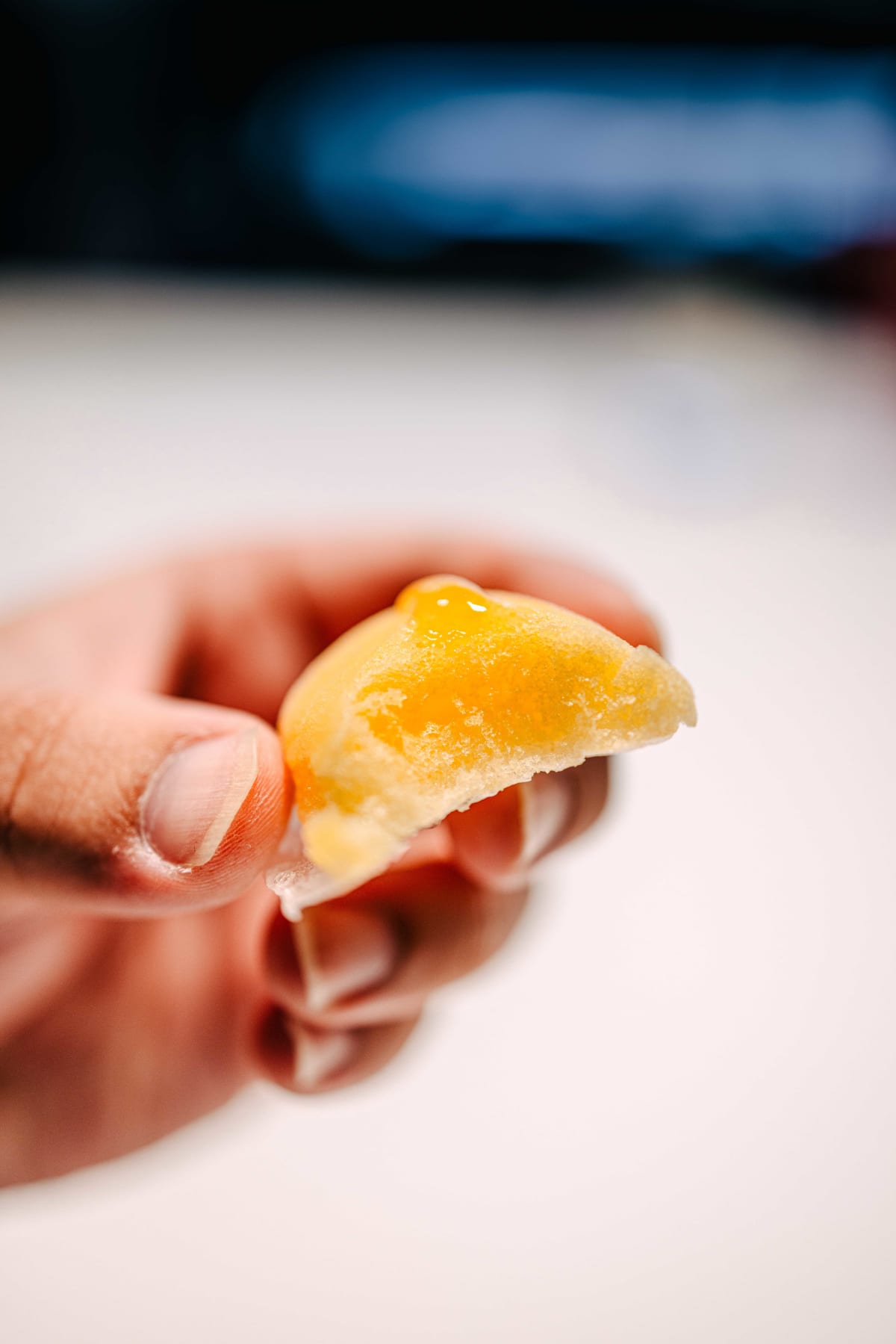
The first dish was the "Frozen passion fruit ladyfinger with rum (2016)." As many Spanish restaurants do, Disfrutar too has the habit of noting, beside each dish on the menu, the year it was developed. This was a cocktail served as a dessert you eat with your fingers, so the meal began in anything but an ordinary way. It was a frozen dessert shaped like a ladyfinger, made to be picked up and eaten by hand, and the moment it went into the mouth, the thin outer shell broke and it melted away softly. It was nothing at all like the sensation of ordinary ice cream. It felt like my first real step into the logic of molecular gastronomy.
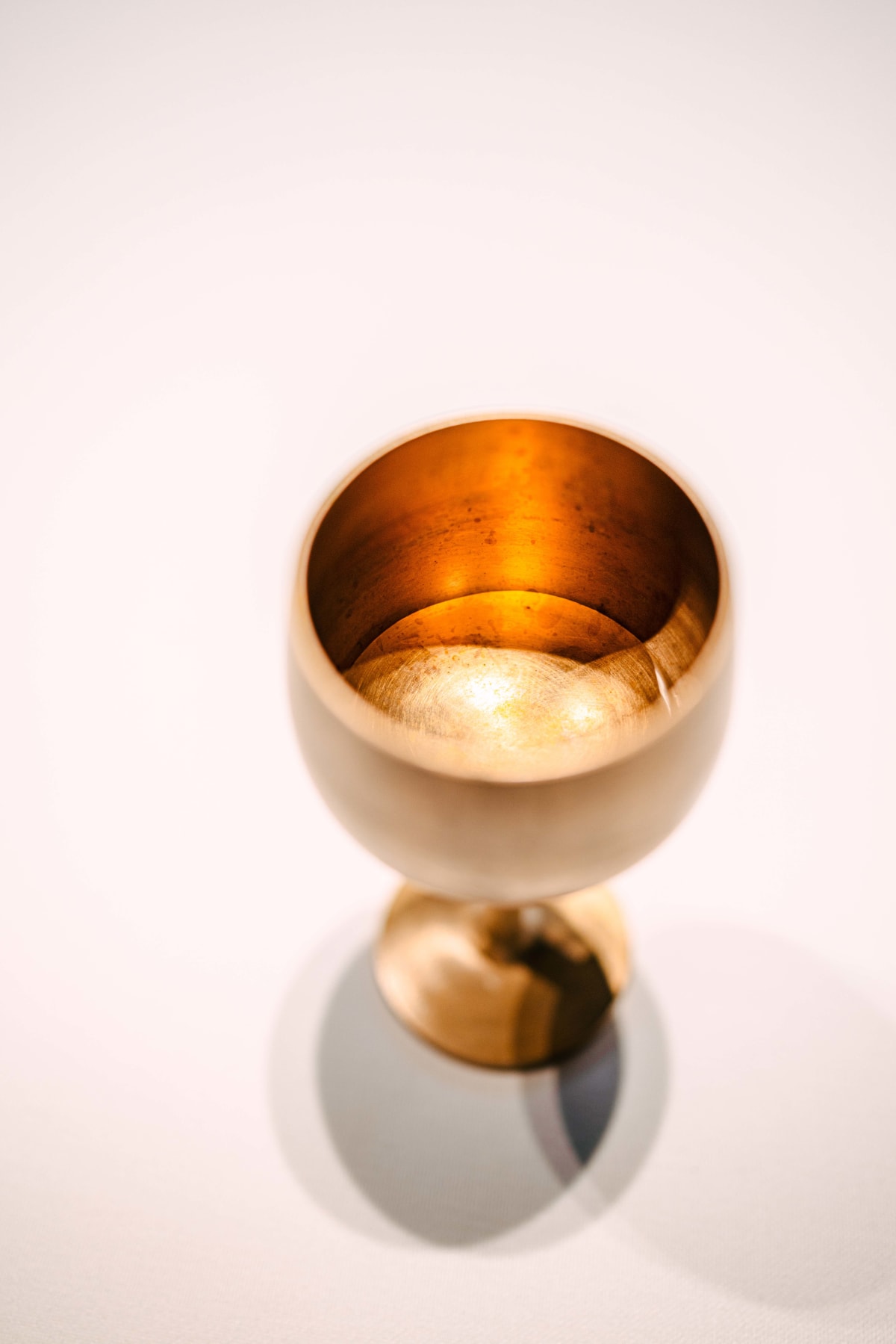
The second was a two-stage composition: "The Toast: Forestfloor distillate (2023)" and "Flavour concentration: sprouts (2023)." One is a glass of distilled spirit, the other a tasting experience of herbs. The spirit was introduced as "a distillate that wanted to become wine." At 17 to 18% ABV, far lower than a typical spirit, it gave off intensely earthy aromas of forest floor, soil, and moss.
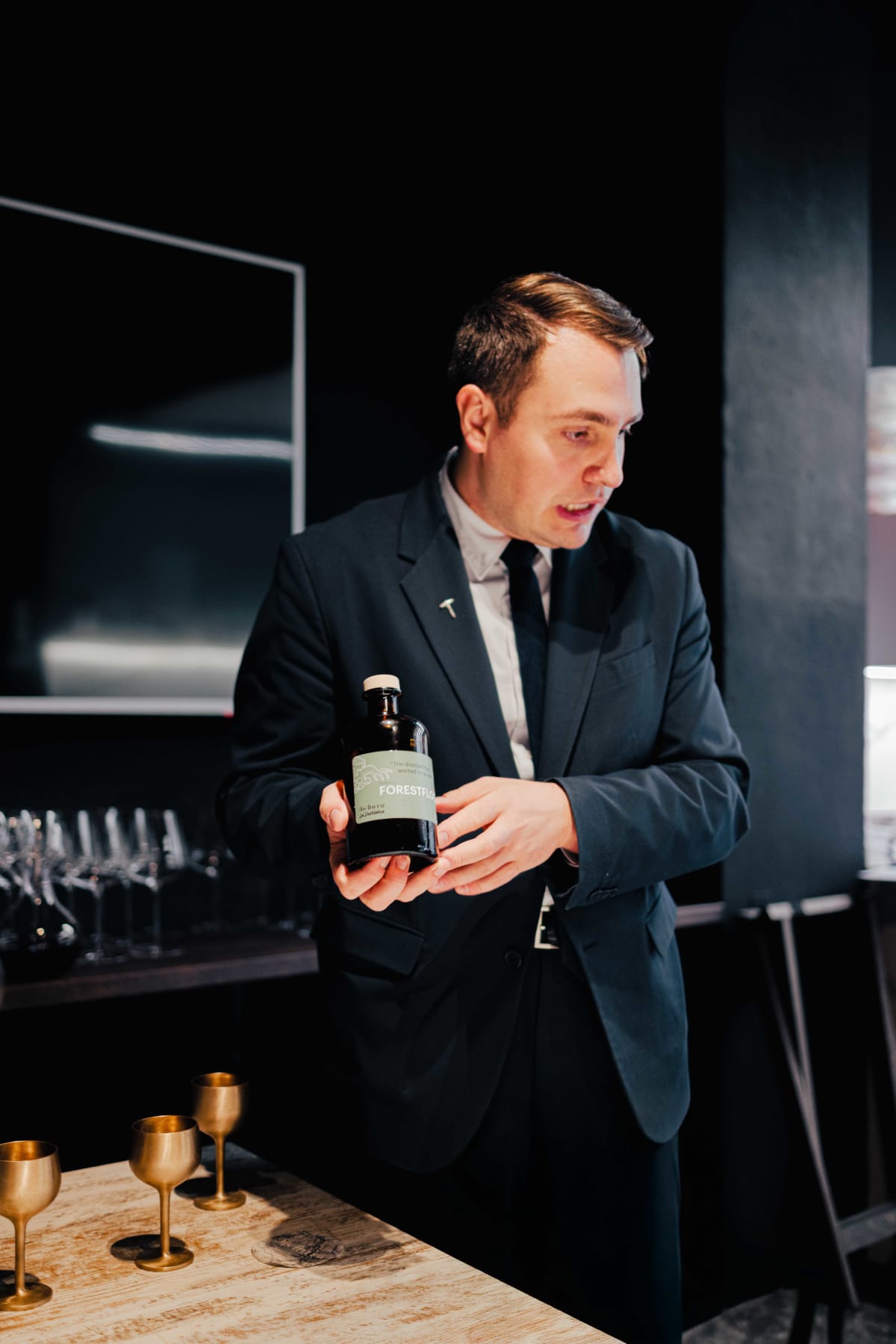
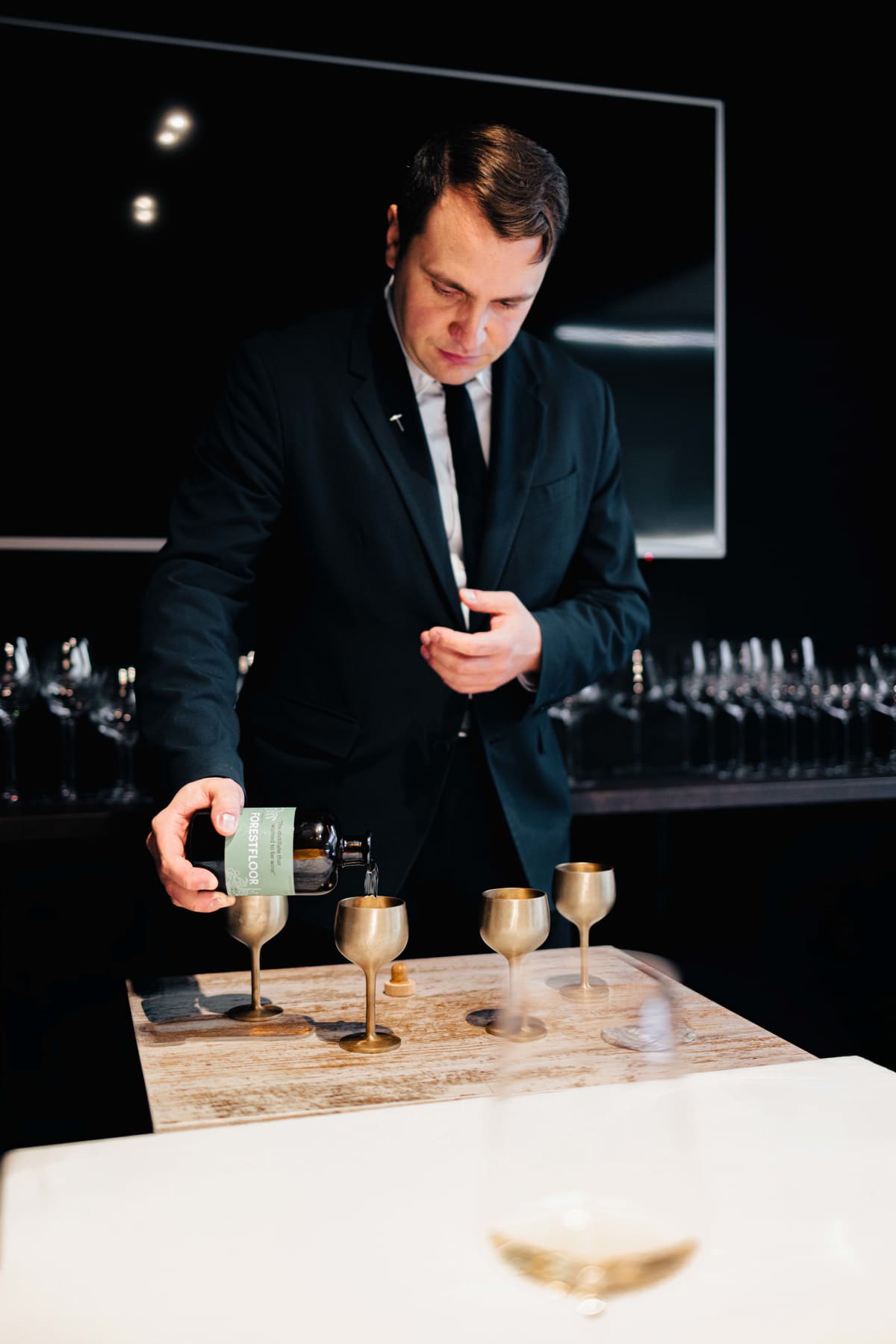
What was fun was that the server deliberately drew us into a toast, turning even sound into part of the gastronomic process.
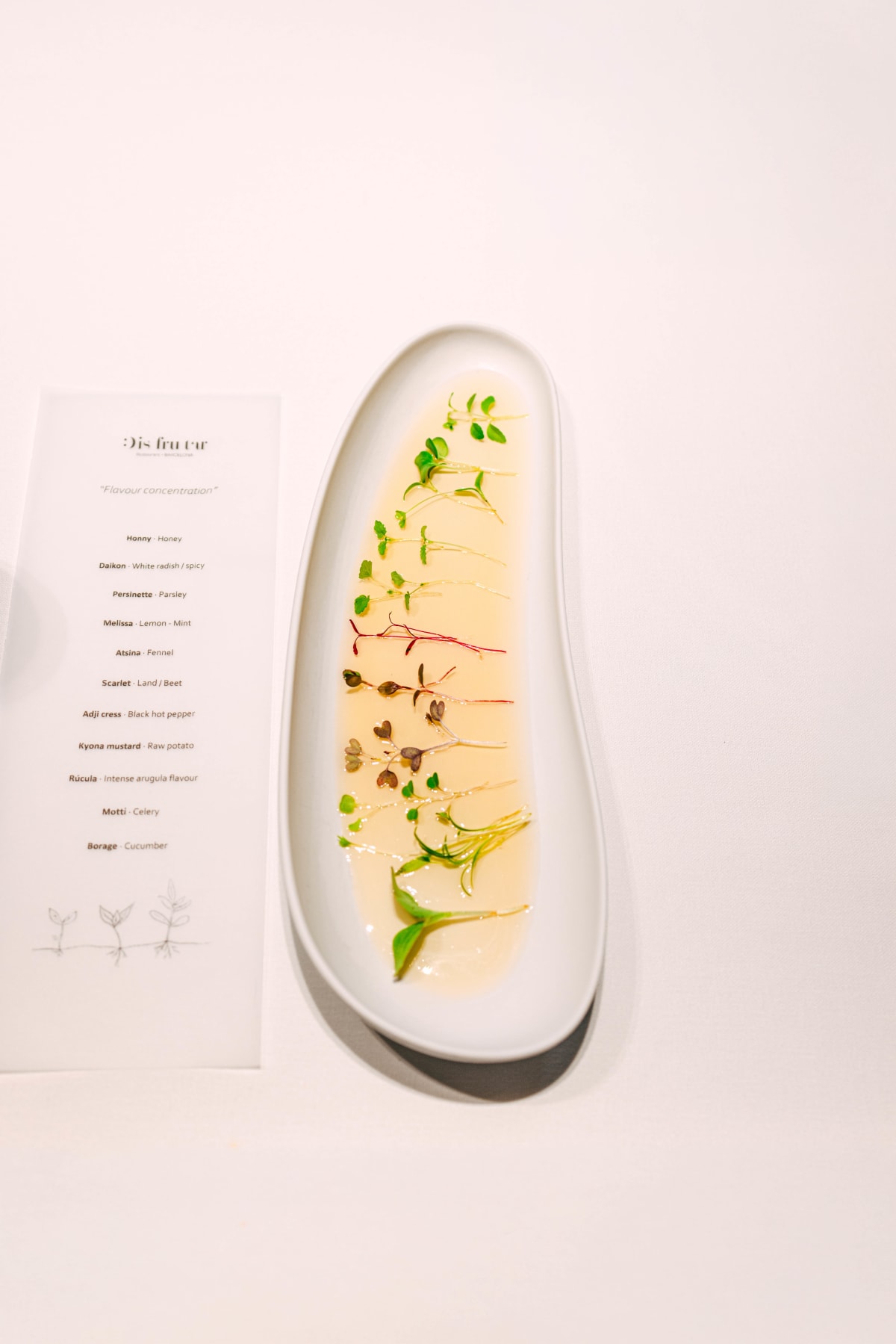
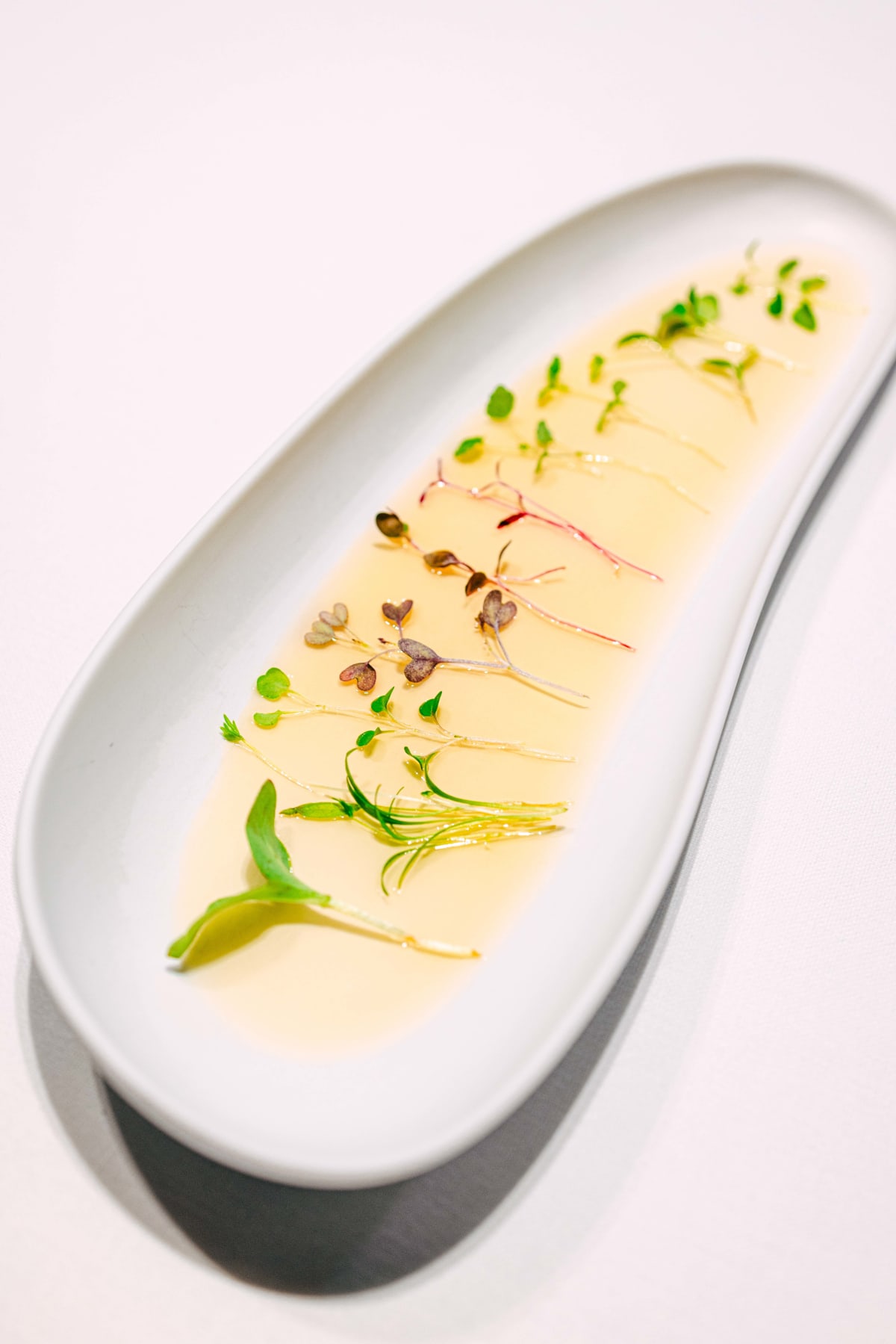
The dish that followed had nine kinds of herbs laid on top.
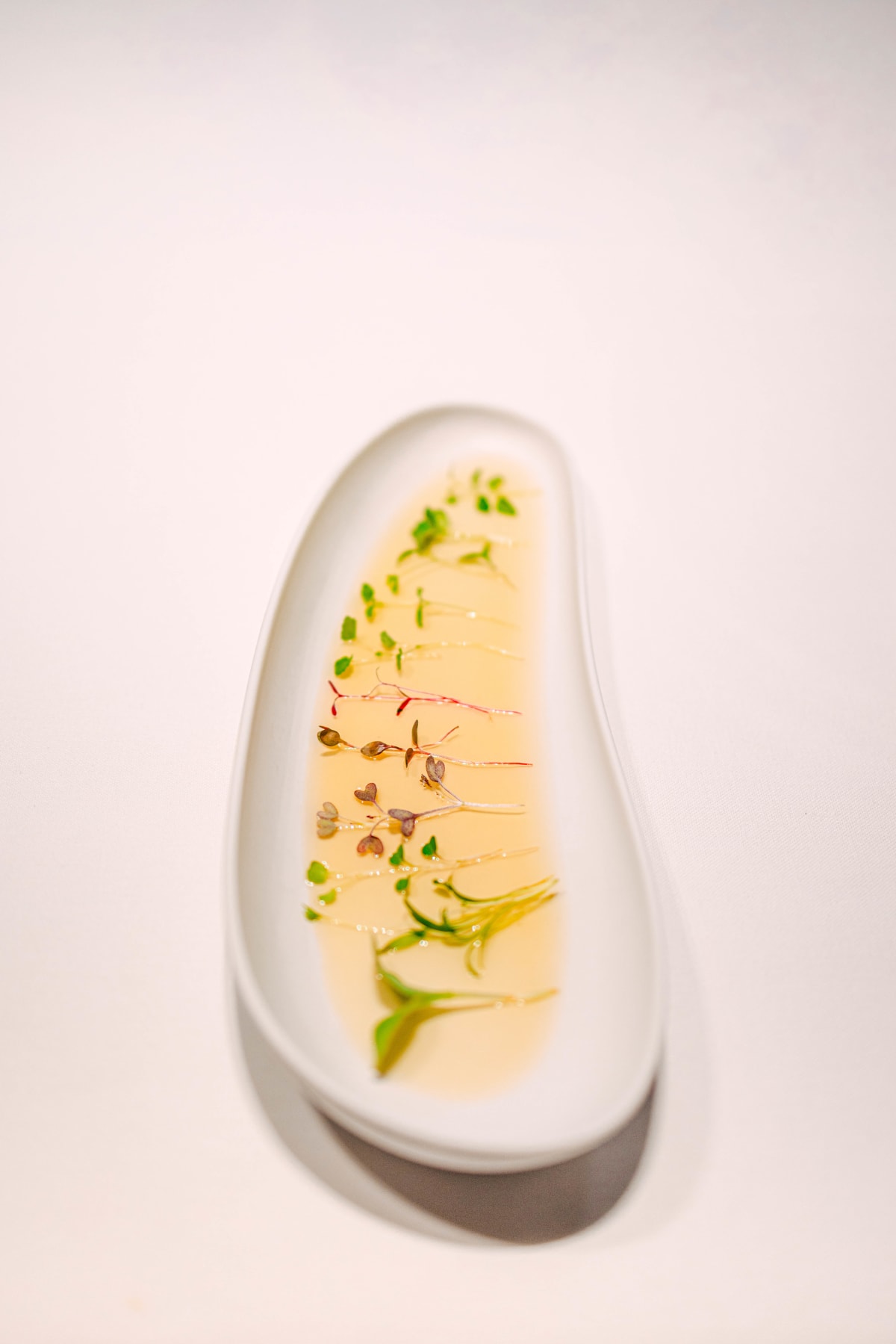
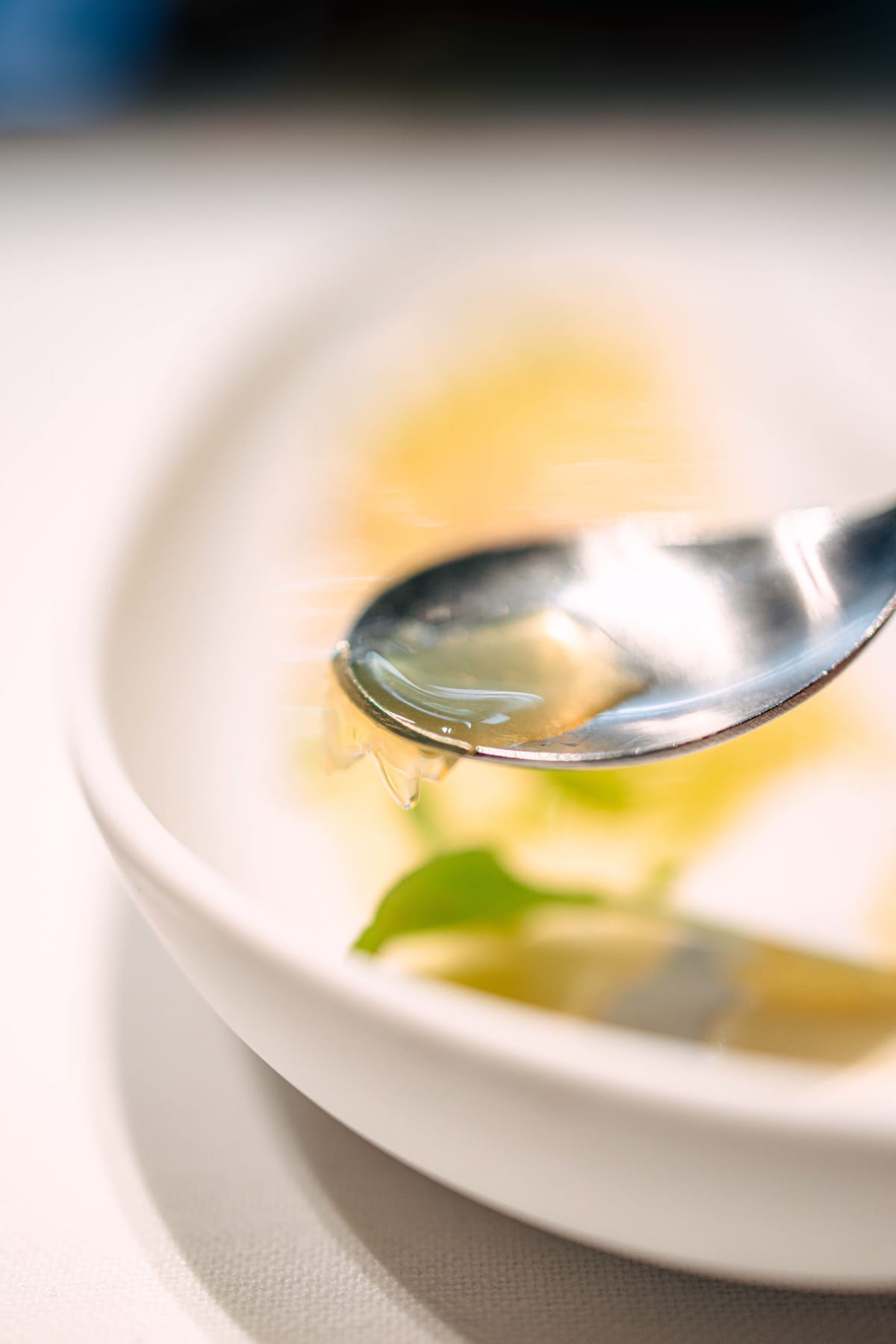
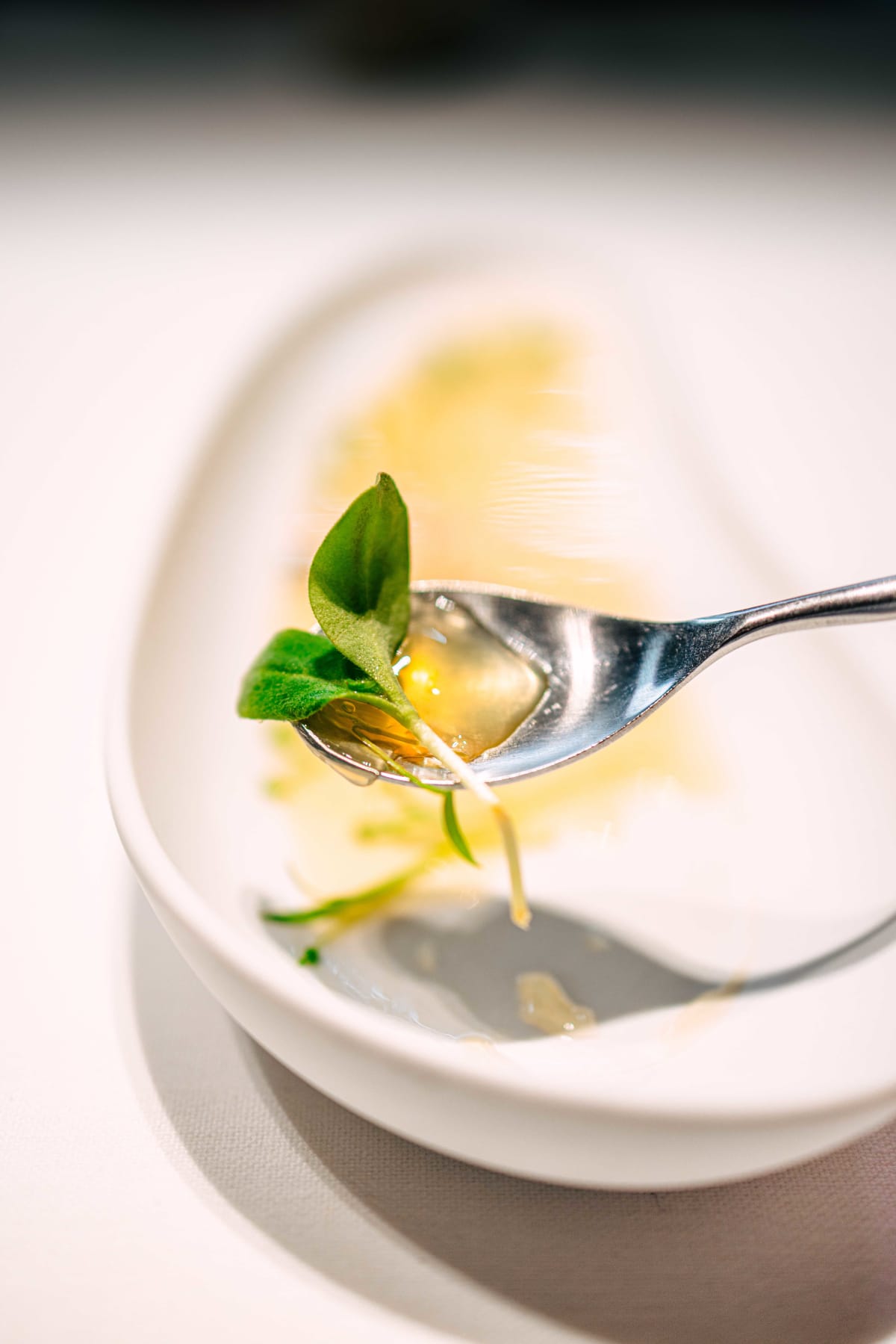
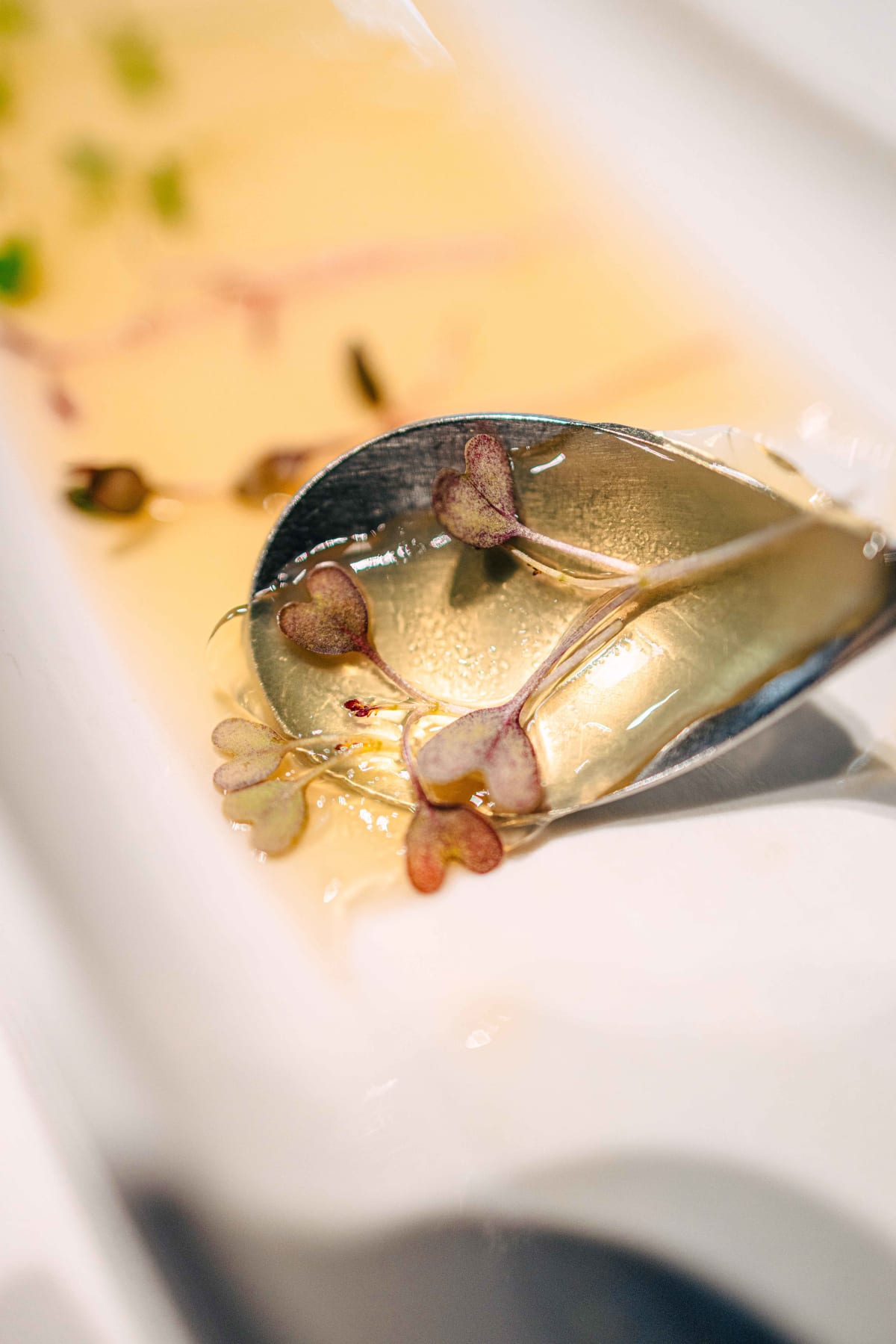
Nine herbs sat just as they were on a gelatin made from a lightly tart tomato broth, and it was almost like a palate-training game. Looking at a slip of paper with the herbs' names, I savoured them one by one, slowly. Motti tasted of celery, Rúcula of strong arugula, Kyona mustard of raw potato, Adji cress of black pepper, Melissa of lemon and mint, Atsina of fennel, Borage of cucumber, Daikon of spicy radish, and Honny of honey. I savoured them from the bottom upward, and the exclamations came of their own accord: "why is the Rúcula flavour this strong," "it is mustard, so how does it taste of potato," "this white radish makes no sense." It was a rare chance to experience the ingredients and their aromas at their most elemental.
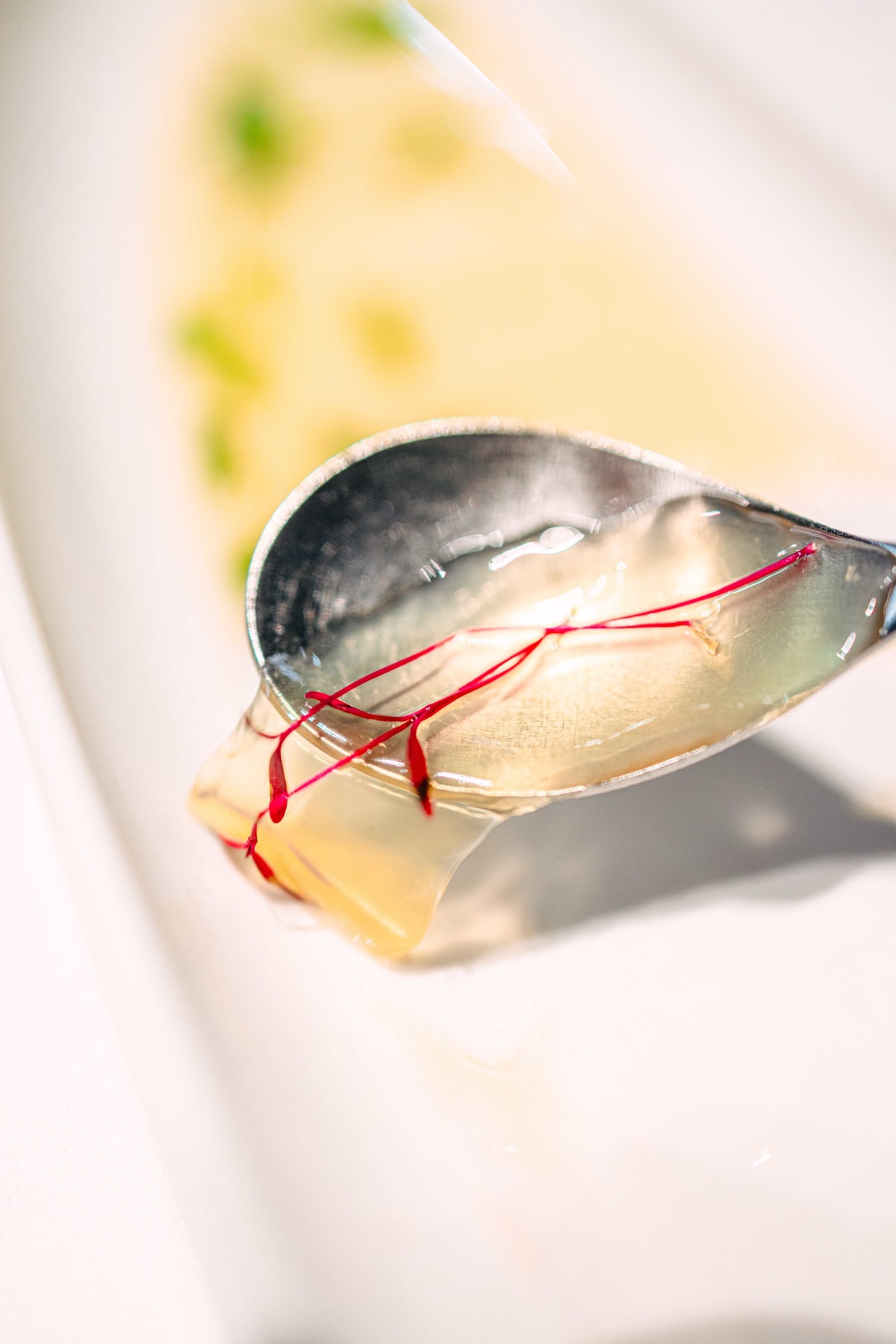
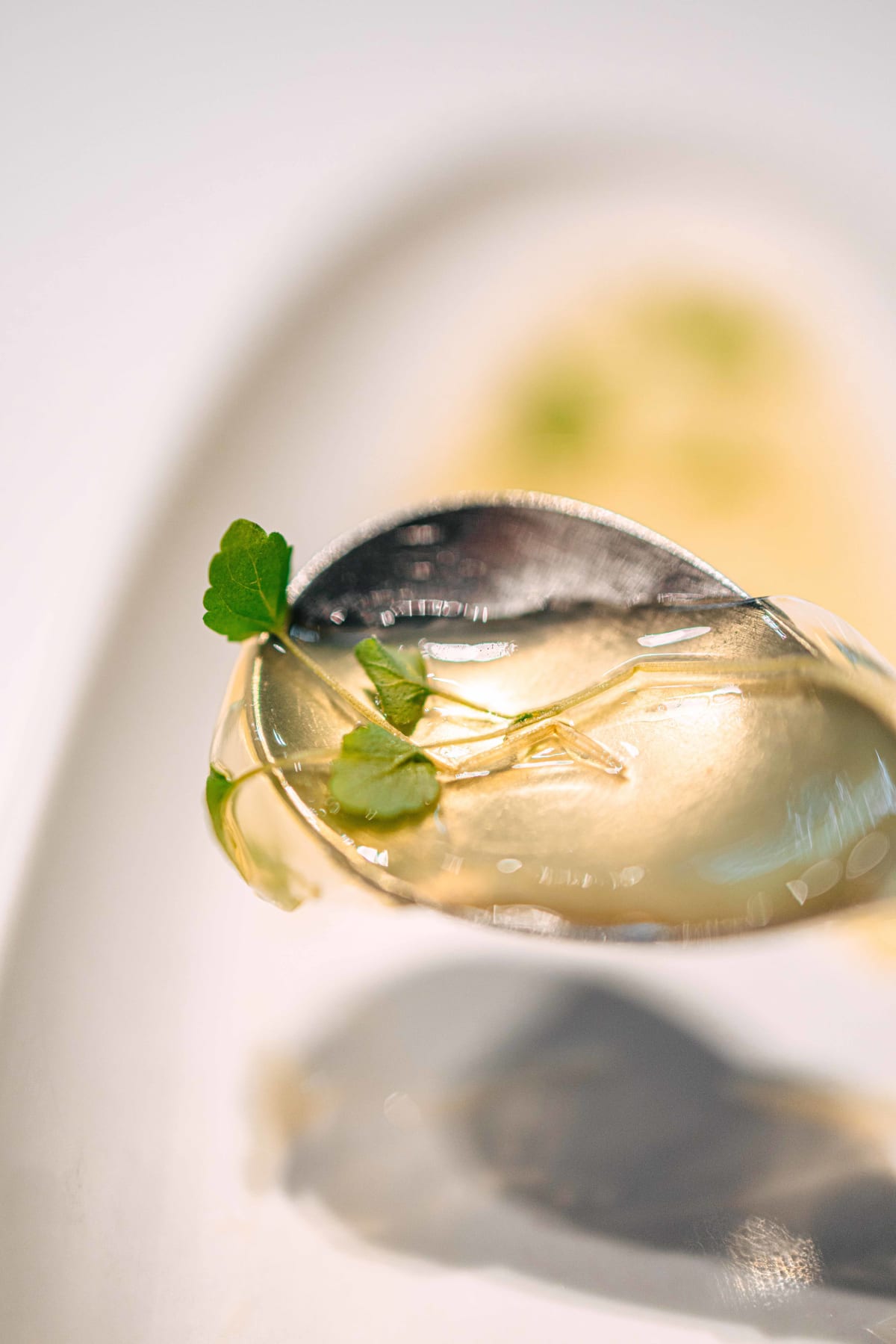
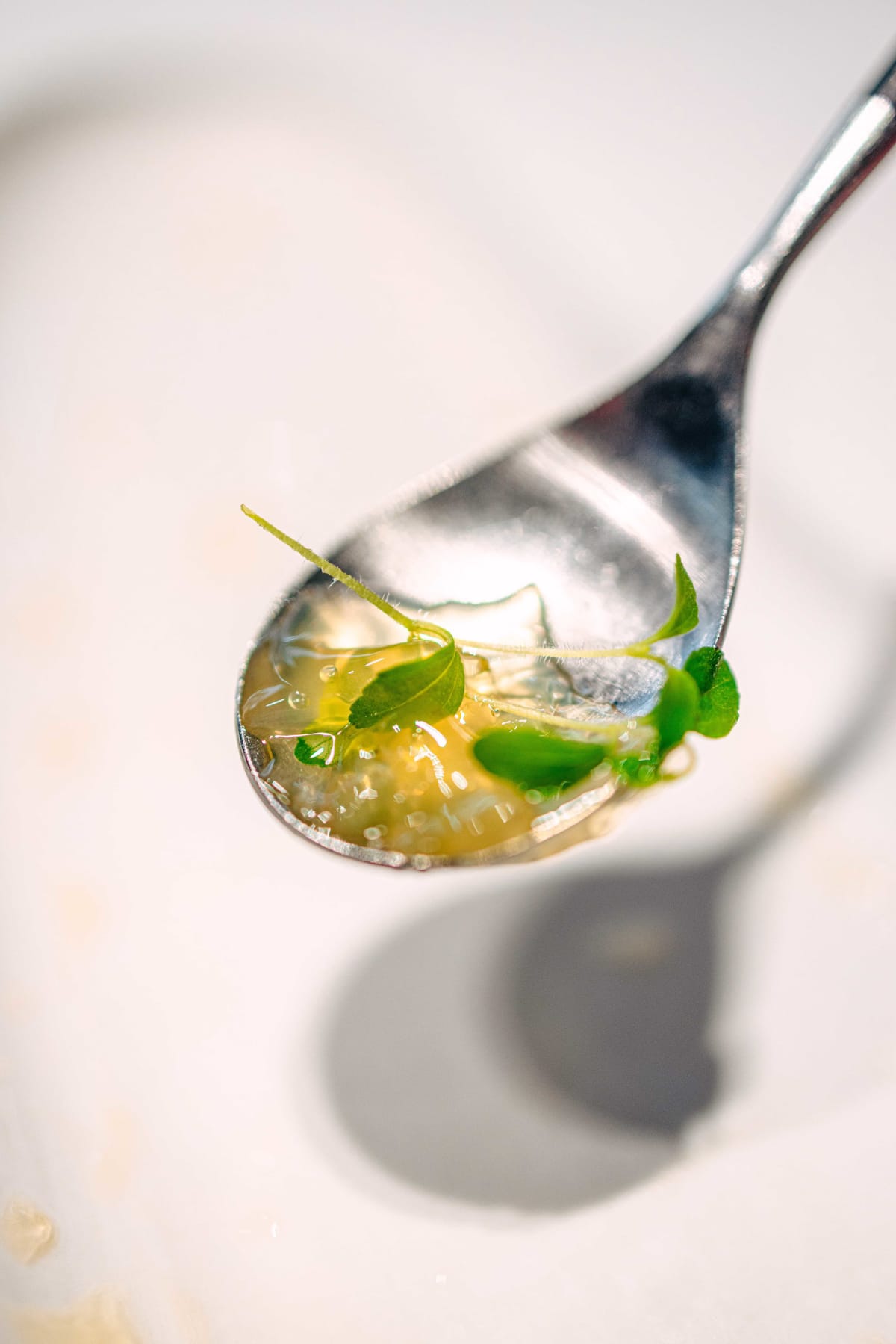
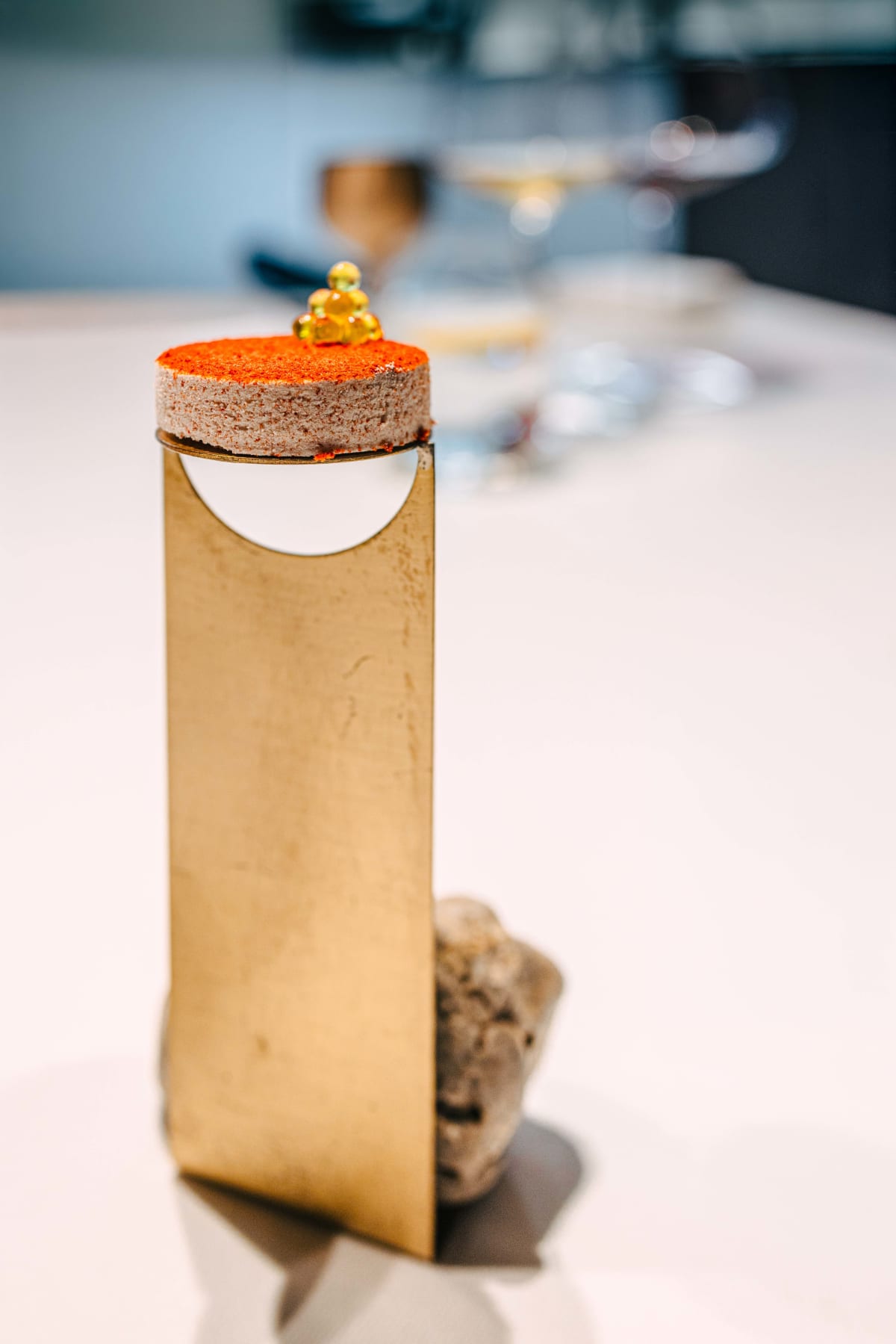
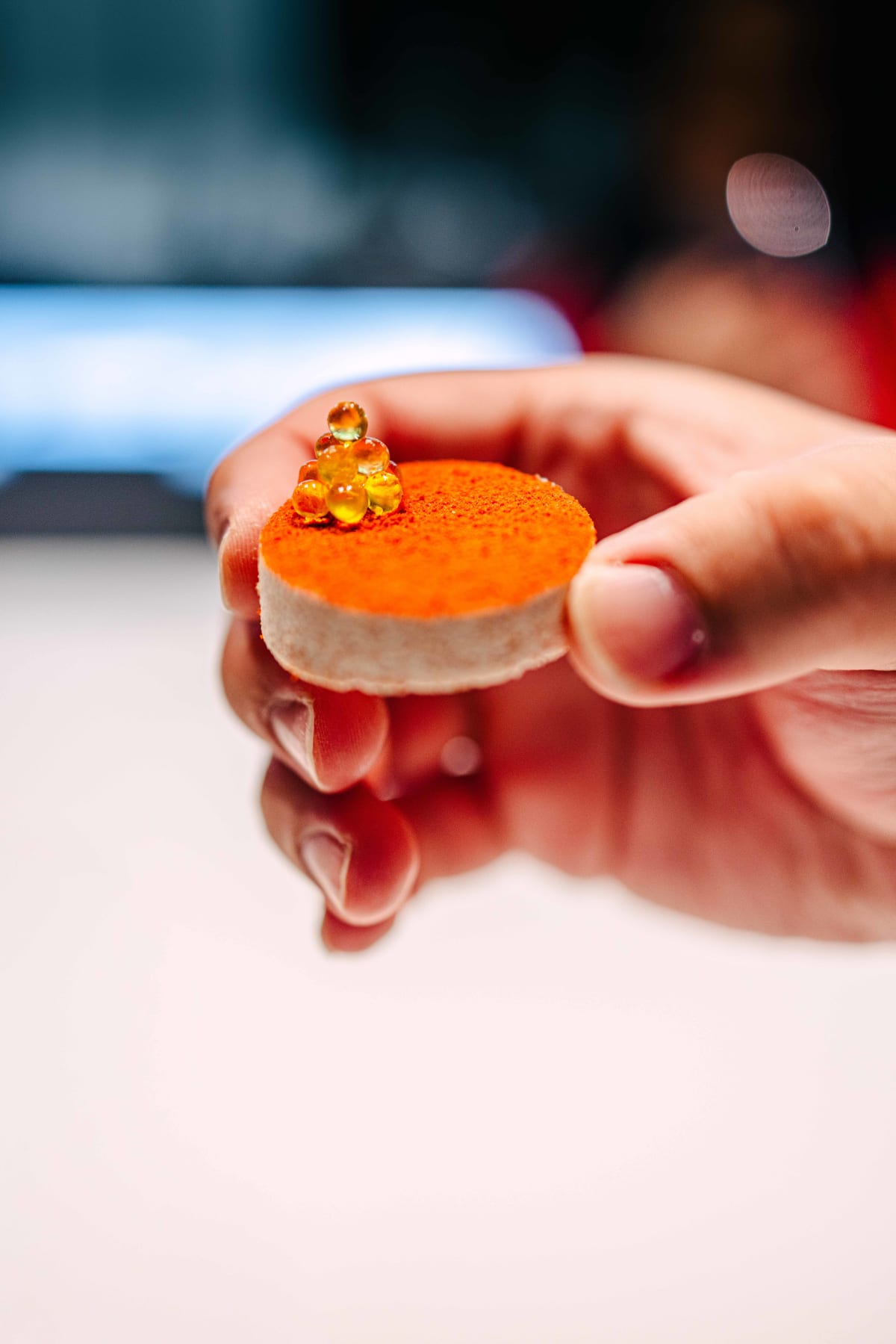
Third, "Liquid salad (2014)" and "Tomato polvorón and arbequina Caviaroil (2014)" came out at the same time. The standout of the two was the second bite. Polvorón is a traditional crumbly biscuit, or cookie, eaten in Spain during the Christmas season; usually almond-based, here it had been reimagined with dried tomato. On top went Caviaroil, that is, olive oil spherified to look like caviar. The moment I ate it, the thought came: "is a texture like this even possible?" It had the texture of cotton candy pressed firmly together, and it was a marvel how they had made such a texture out of tomato. The tomato and olive oil burst and melted away softly, spreading out, and the aftertaste was long and rich.
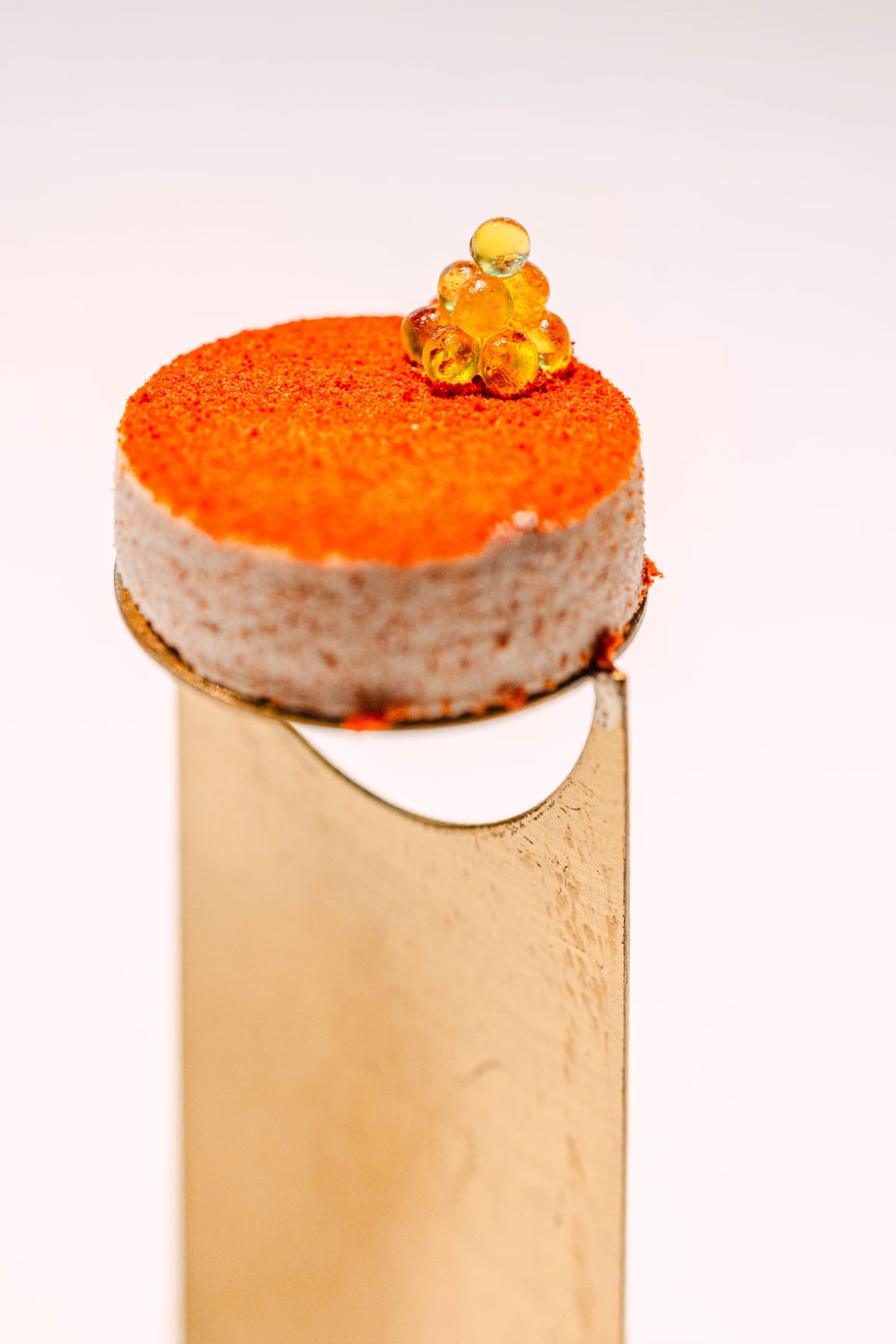
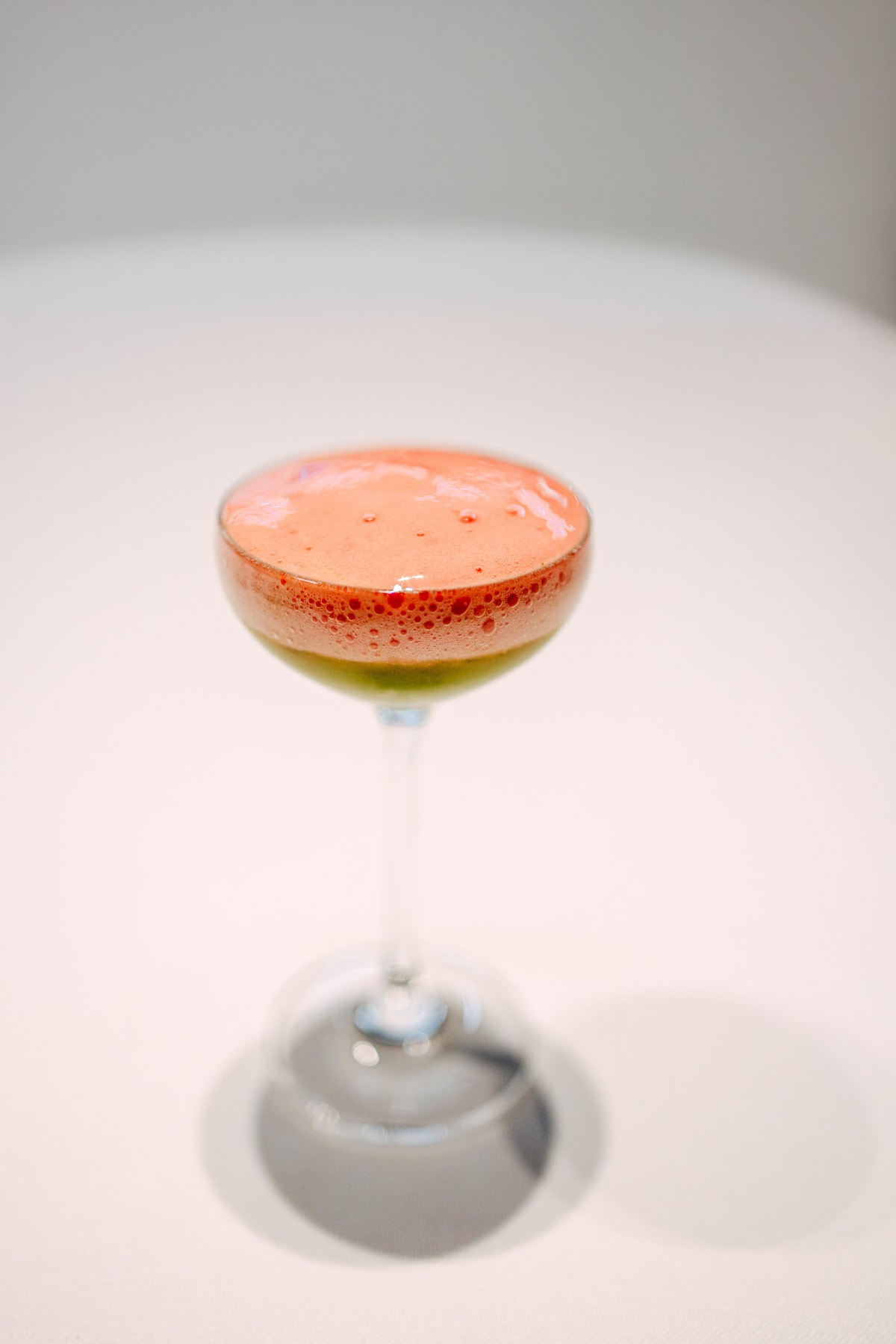
The liquid salad, on the other hand, was a salad you drink, with the feel of a healthy smoothie. It tasted like a drink my mother used to make in the morning, and to me it was no more than average.
Section 6·The Second Flow: Pairing as an Extension of the Cooking
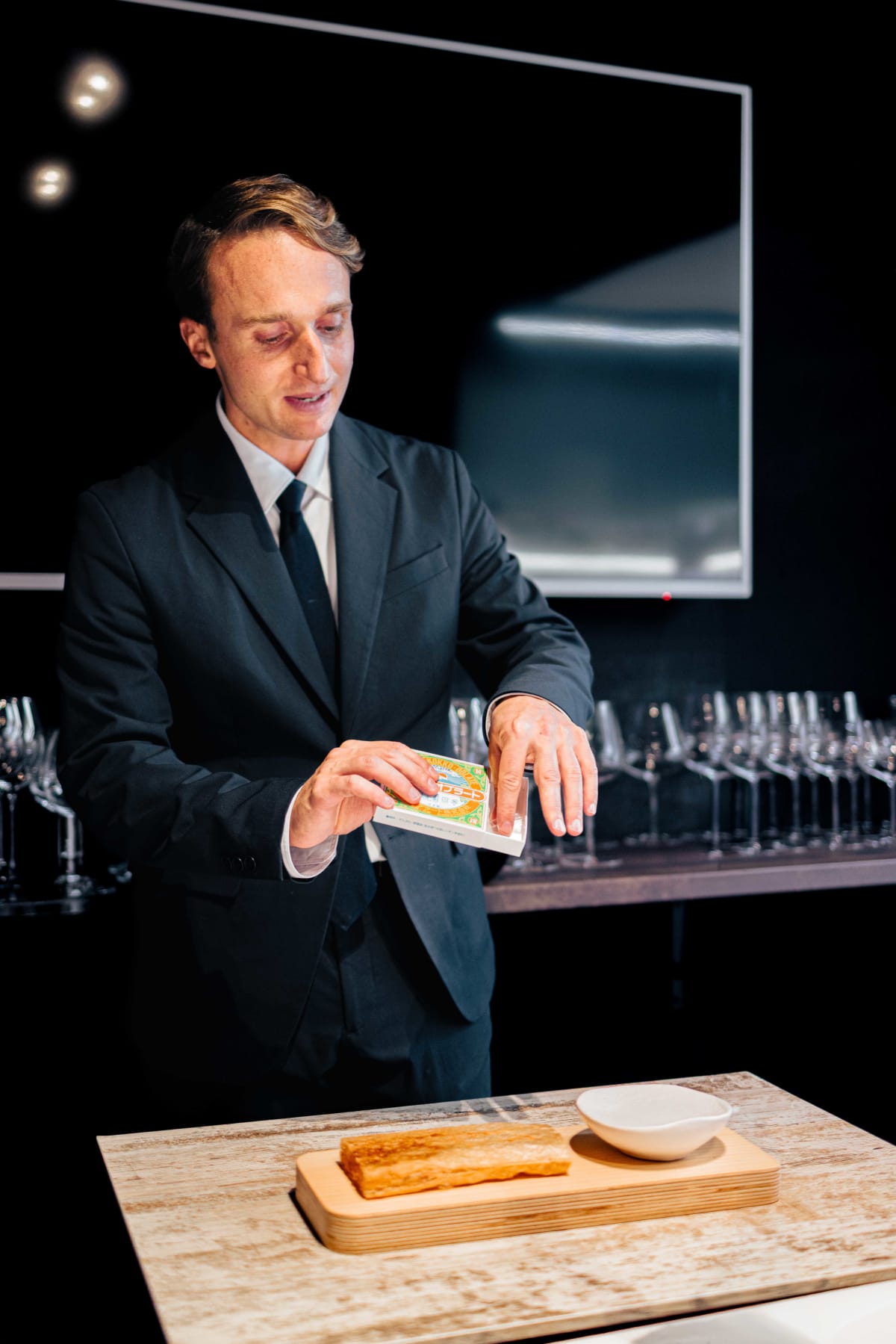
The fourth course came with a very special pairing: "Vodka/Truffle (2019)" and "Flourless coca bread with autumn truffle and burrata (2022)." The server came right beside us and poured the vodka tableside. It was here that I first fully understood how completely Disfrutar treats pairing as an extension of the cooking.
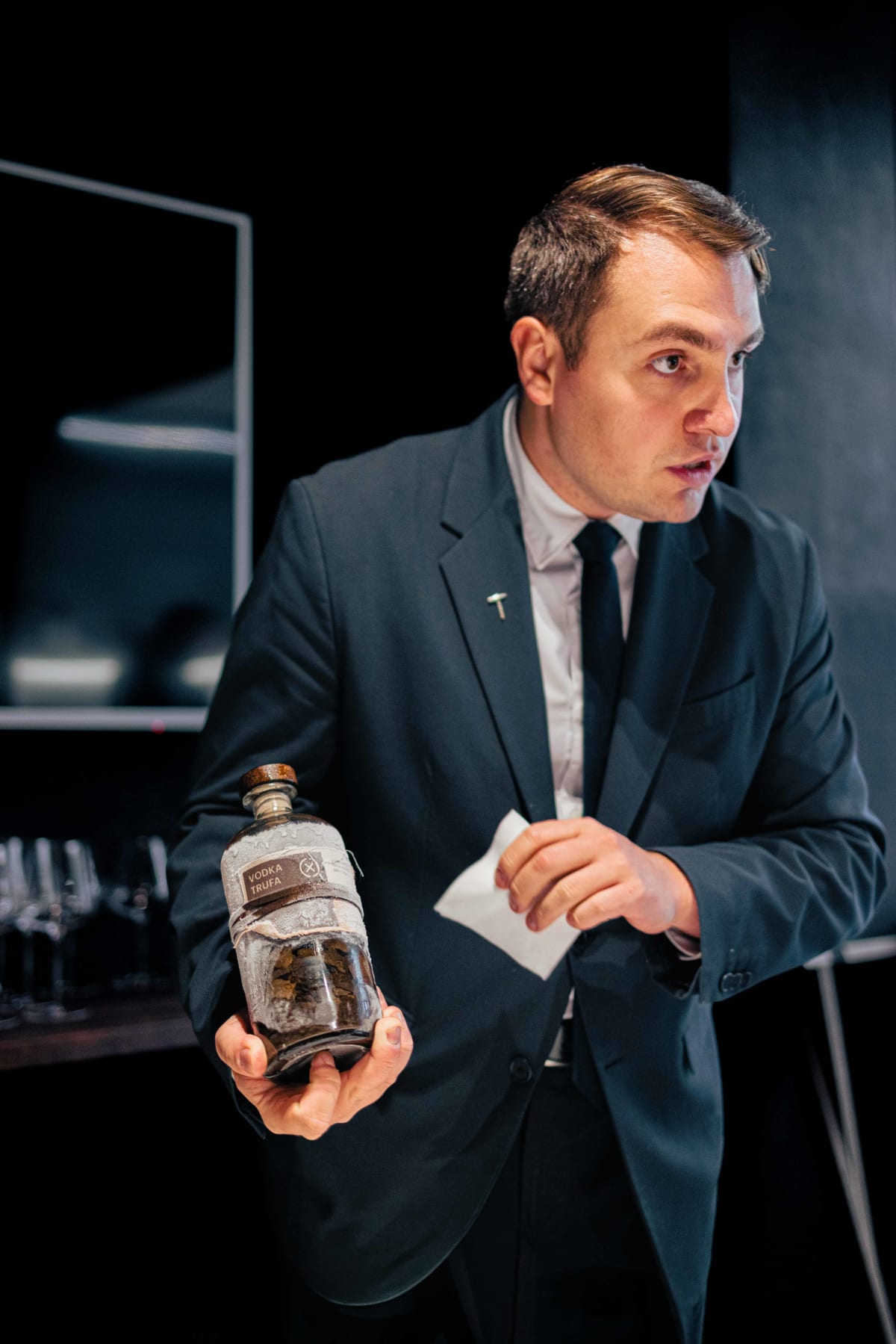
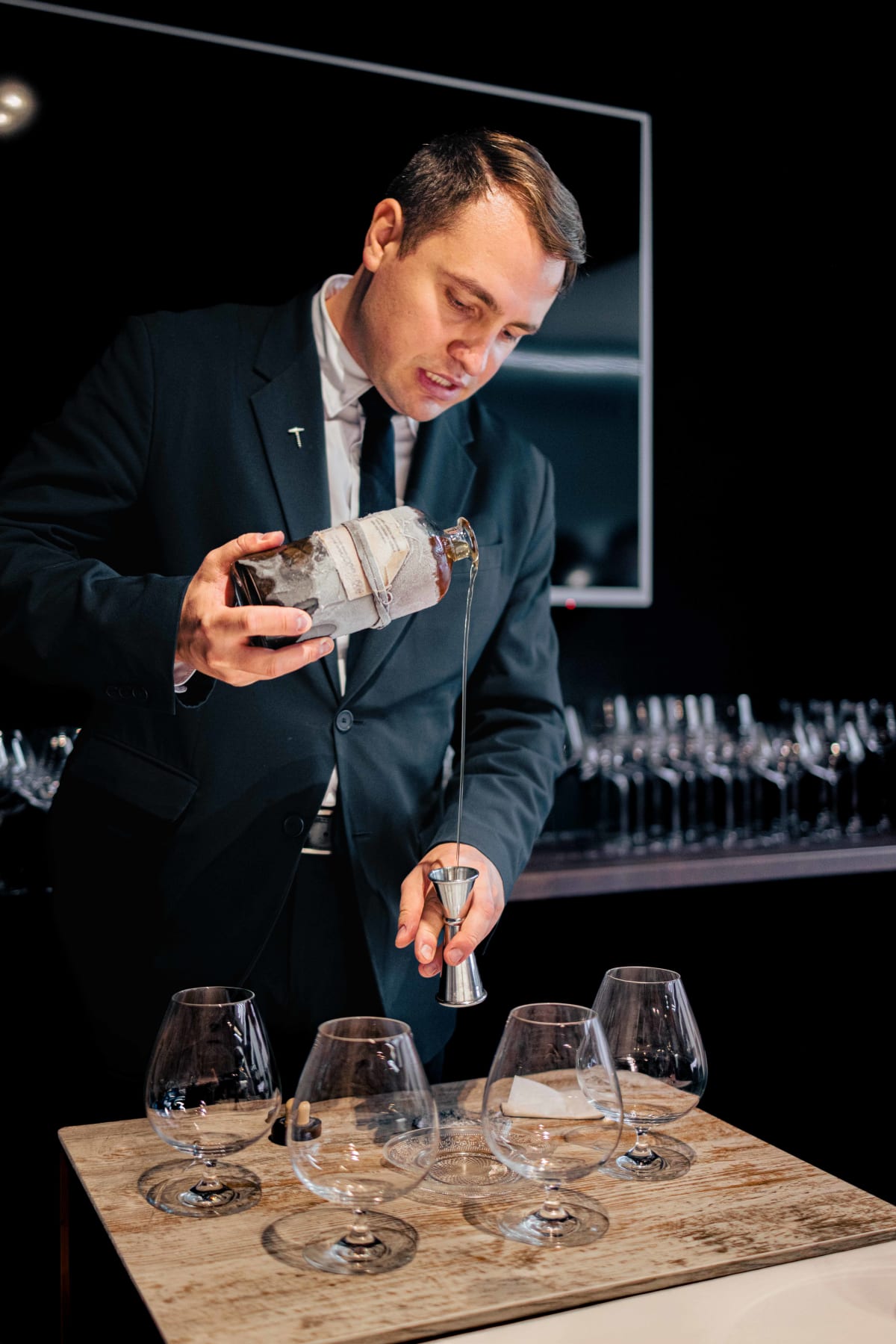
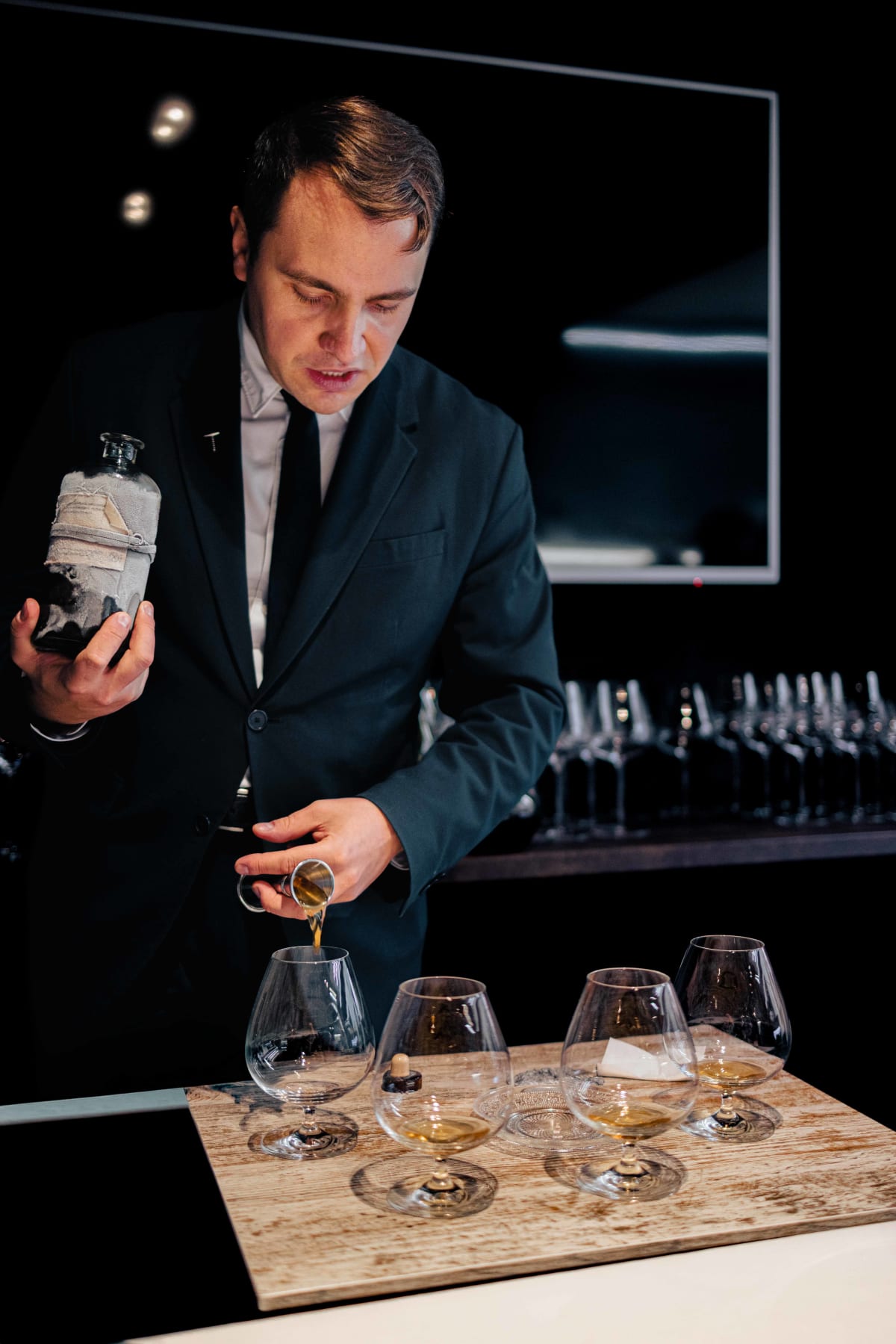
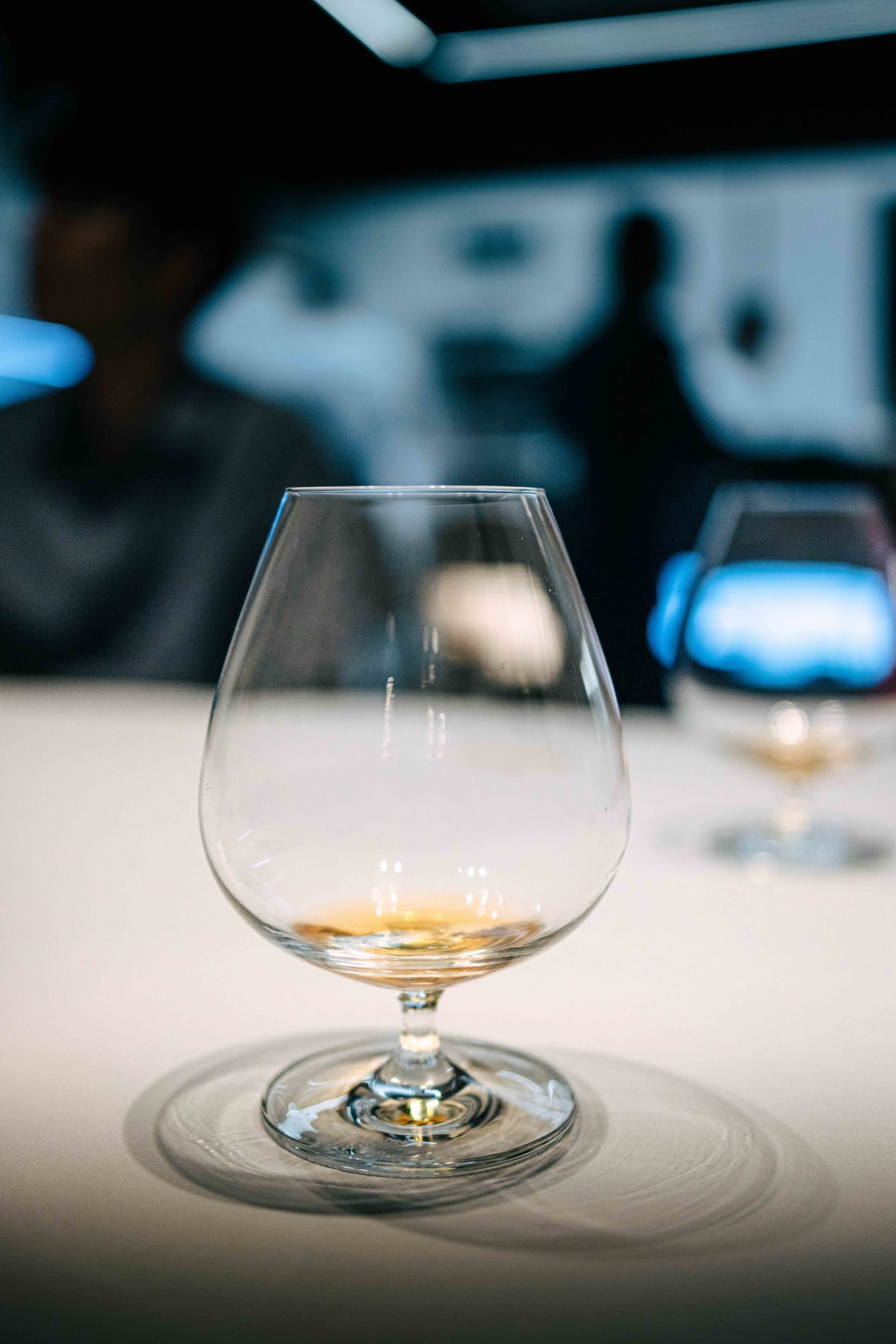
What came first was a black-truffle-infused vodka. Look at the bottle and you can see the truffle slices still inside it; they put in 80 grams of truffle per litre and steep it for at least six months. The reason the bottle is frosted over is that, just before serving, they put it in the freezer and serve it at an extreme low temperature. They said the impact of its 37.5% ABV is muted a little, letting the thick, oily texture and earthy aroma come forward instead. It was amusing, too, that the server urged us to "taste only a little and save most of it for the next dish." Vodka and caviar may be a classic Eastern European pairing, but the fact that they go so far as to distil a separate spirit to express it put them in a class that felt out of reach. The truffle-scented liqueur was highly unusual, and its aroma was deep.
The dish that followed was a flourless puff pastry.

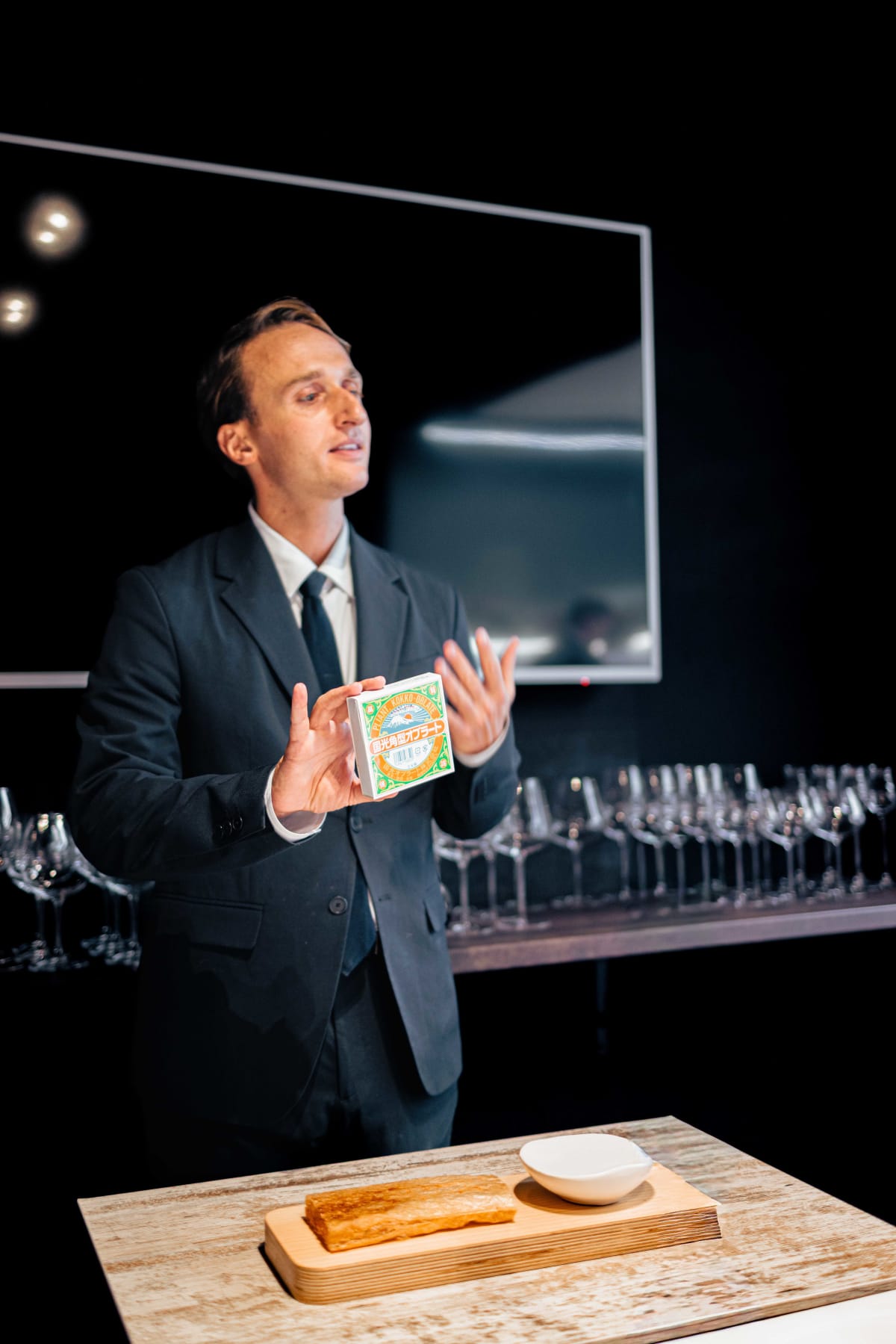
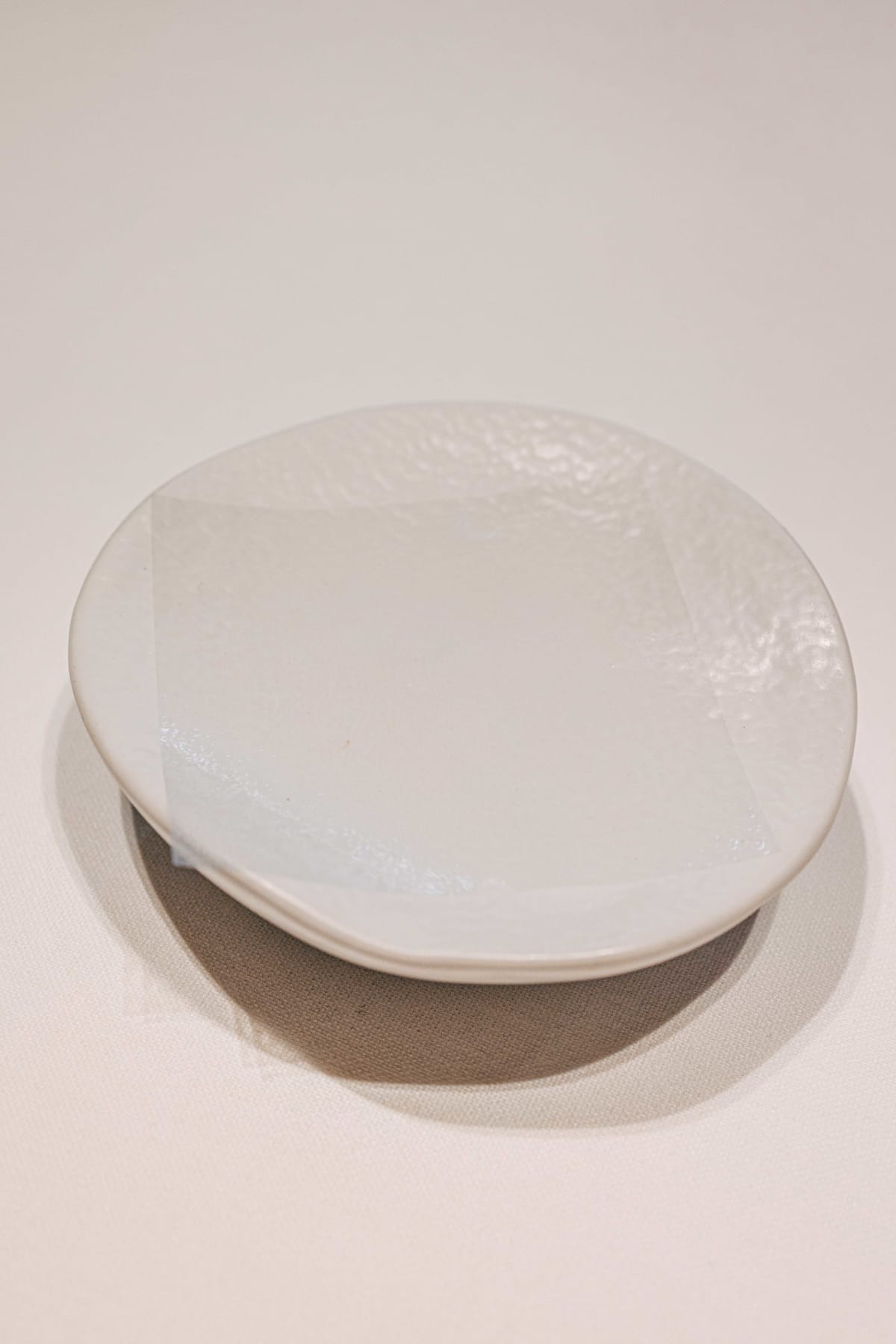
They said they layered eighteen sheets of Morishi, a transparent potato-starch sheet from Japan, soaking each one in fat and baking them. They had taken the very property of a sheet that vanishes within seconds at the mere touch of water and applied it directly to food. It was striking, too, that they set a single transparent leaf in the middle of the table on its own and told us to "taste it for yourself."
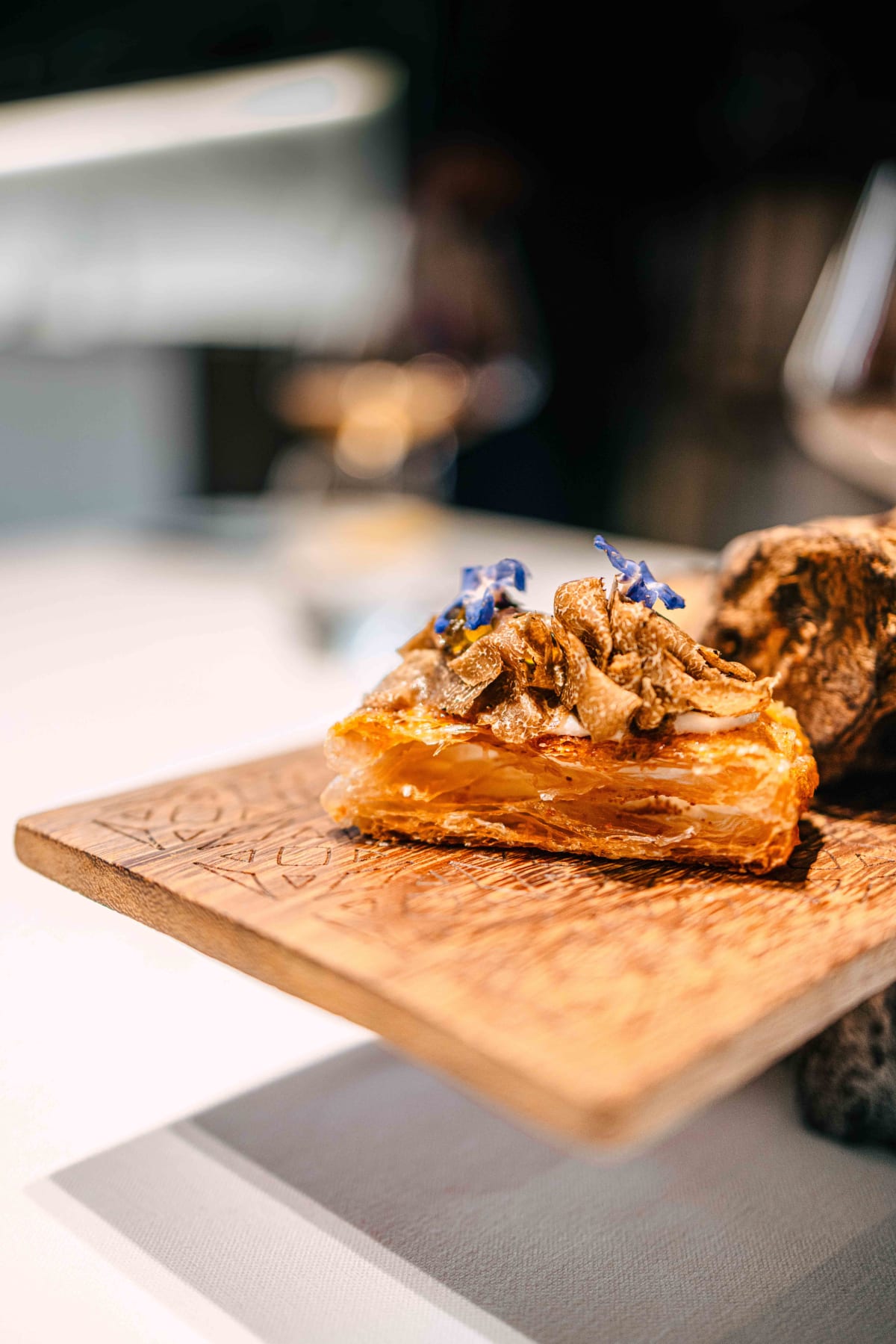
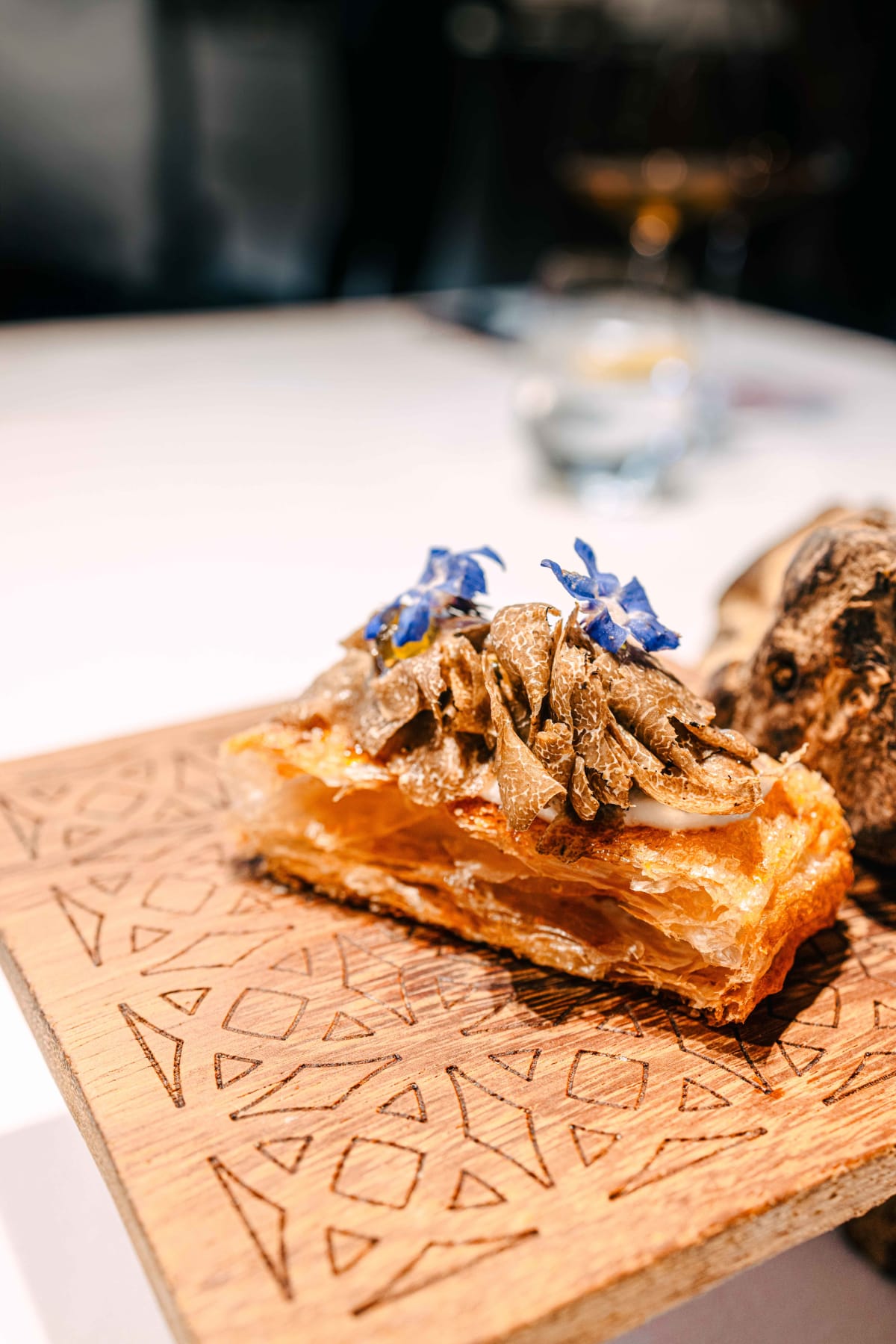
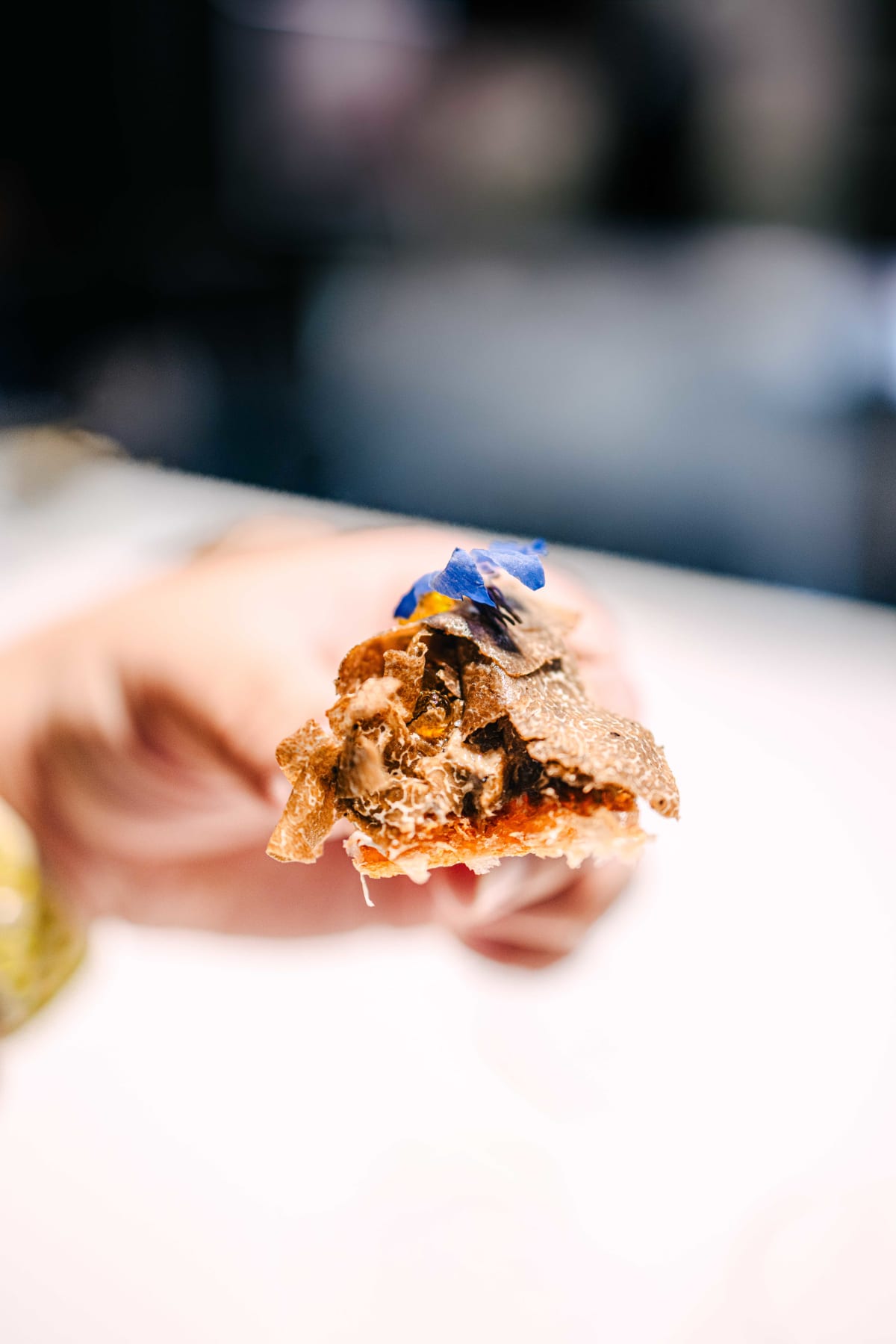
Originally it was a sheet used to wrap medicine so it could be swallowed easily, and the idea of converting that "disappearance" into texture to make a puff was remarkable. The instant I picked it up and ate it, the crispness "was there" and then immediately evaporated, and into that empty space the flavour of the burrata and the aroma of the black truffle remained all the more distinct.
And when I took a sip of the truffle vodka I had saved, it felt as though my whole palate were being wrapped in truffle. The very idea of presenting a single rare ingredient in two textures and two ways was excellent.
Fifth came a dish very simple in appearance: "Panchino filled with caviar (2016)."
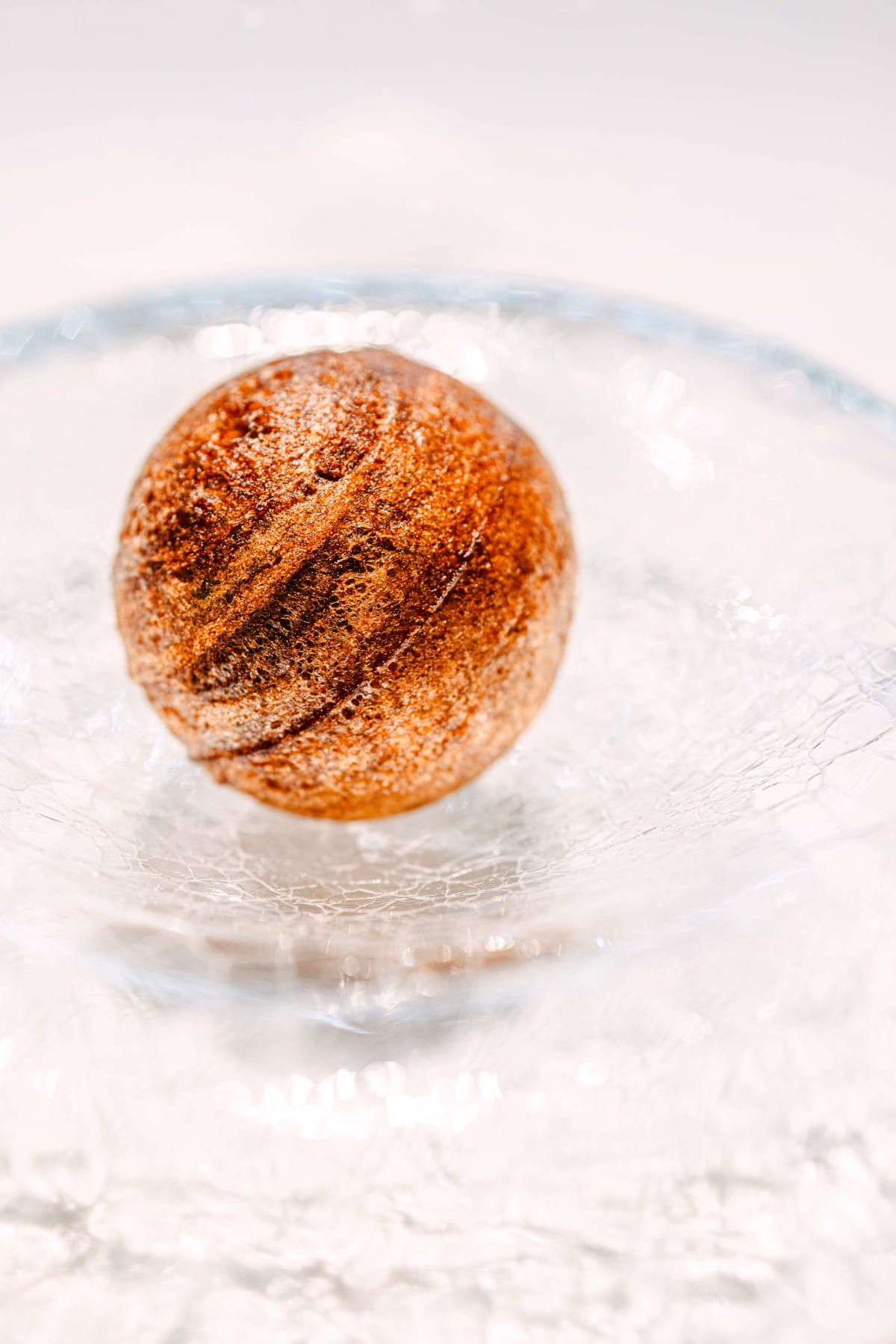
It is described as a Chinese-style bun, but it looked like a doughnut and was eaten by hand like one. It was made with an unfermented dough, and inside it held crème fraîche and caviar together. The one line I jotted down after eating it was that it was criminally good. The doughnut itself tasted superb, and it perfectly brought the charm of that classic pairing, caviar and crème fraîche, to life through the creative device of a Chinese doughnut. Right down to the way the umami, the richness, and the salinity of the caviar set the seasoning, it was perfect.
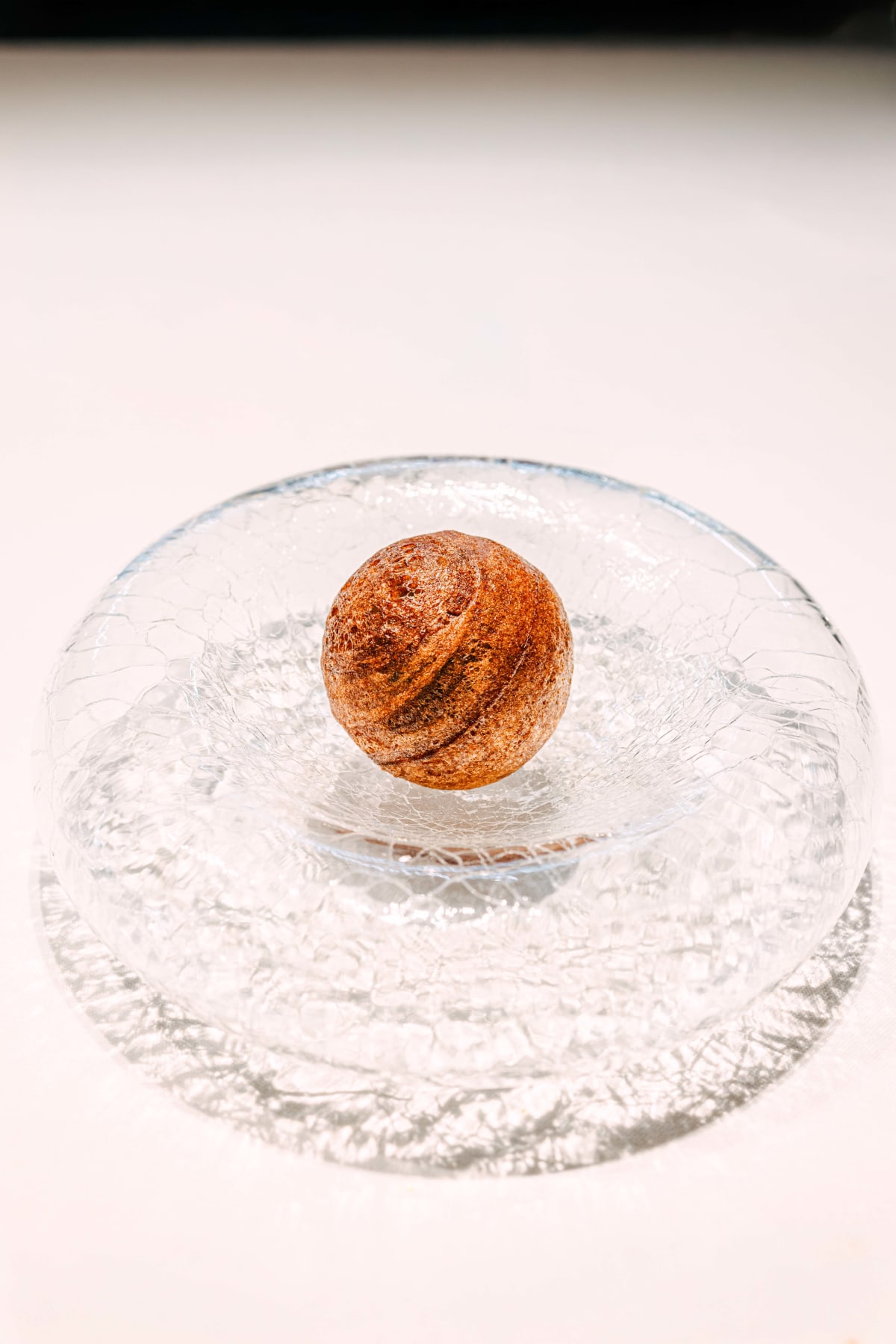
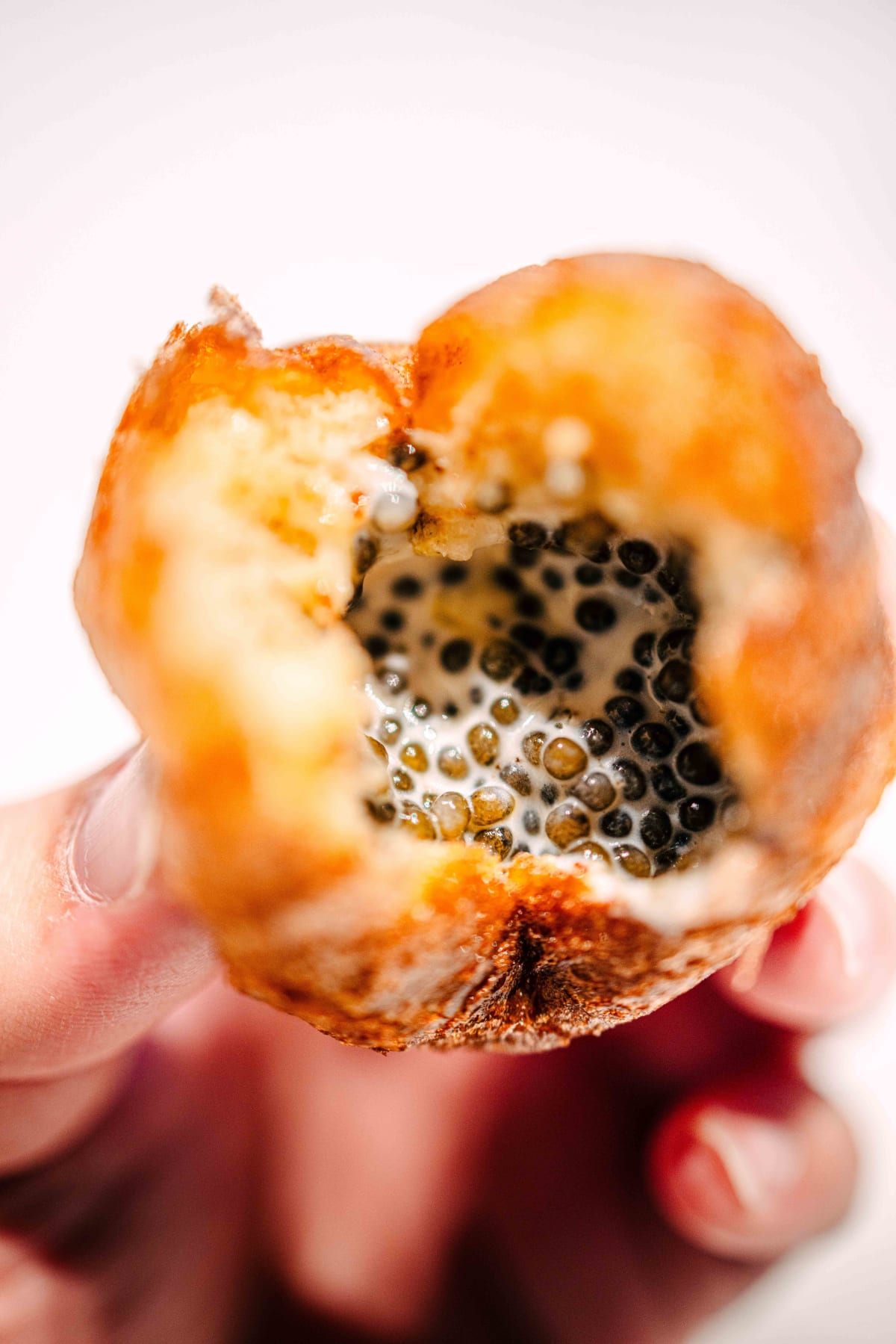
This dish came with yet another experiential device: they showed the making of it as audiovisual material. In the video, the chef stressed that "anyone can follow this, using only traditional ingredients." To solid ingredients such as flour, sugar, and salt they add eggs and butter to make a batter, mixing the two in stages until it reaches a texture closer to a "liquid dough." The key, however, is that there is no fermentation. Because fresh ingredients have to go inside, leavening it could make it collapse. The key, they explained, is to create the texture of a fermented dough without fermentation. They then spread the foam-like dough on the bottom, place crème fraîche and caviar on top, and cover it again with dough to build a sandwich-like structure. Last, they heat sunflower oil to 220 degrees and fry it for the ultra-short time of about 20 seconds. That brief frying time cooks the exterior almost instantly without overdoing it, while preserving the airy interior. The result is that the fluffiness of a leavened bread and the pleasure of a deep-fried doughnut arise at the same time.
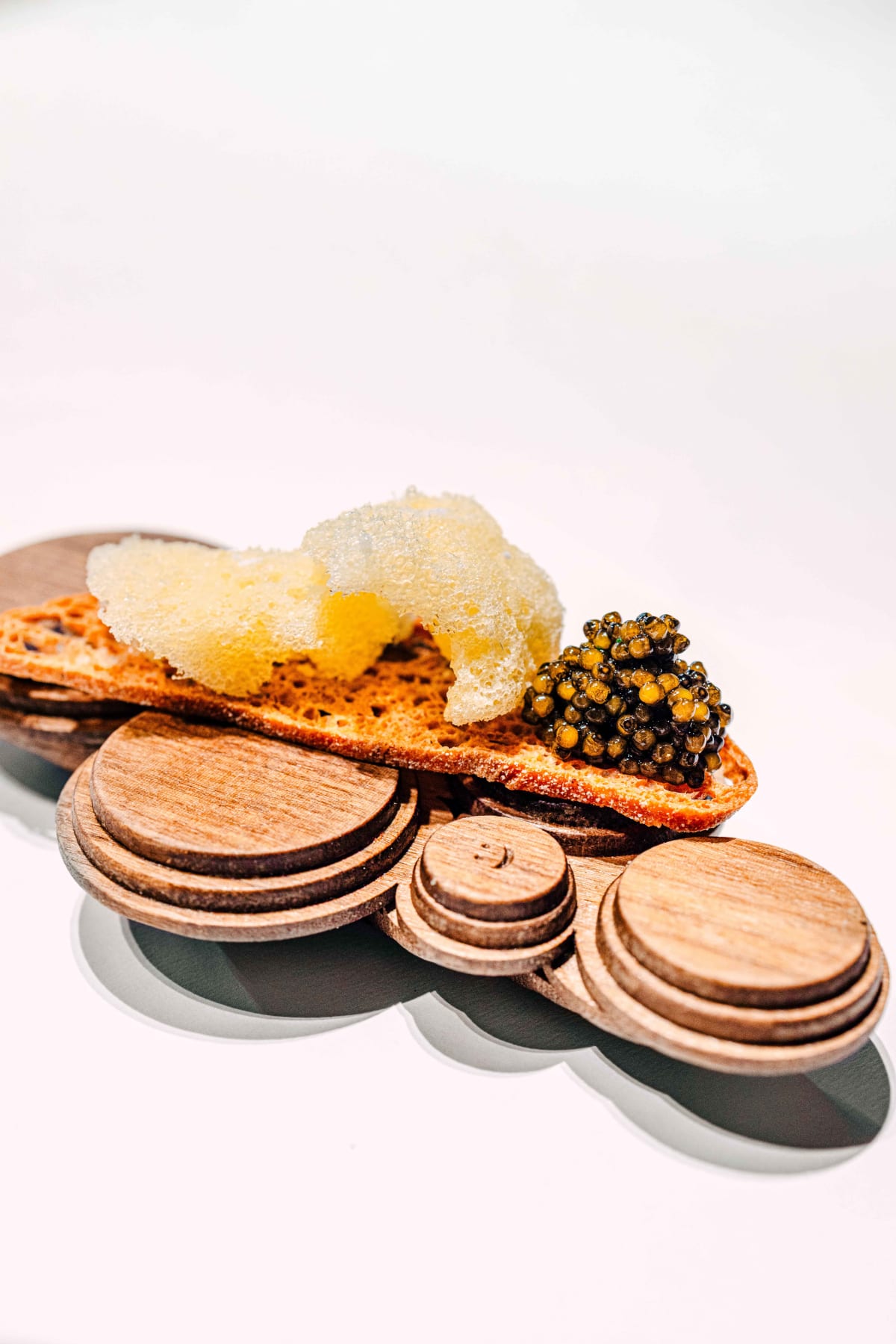
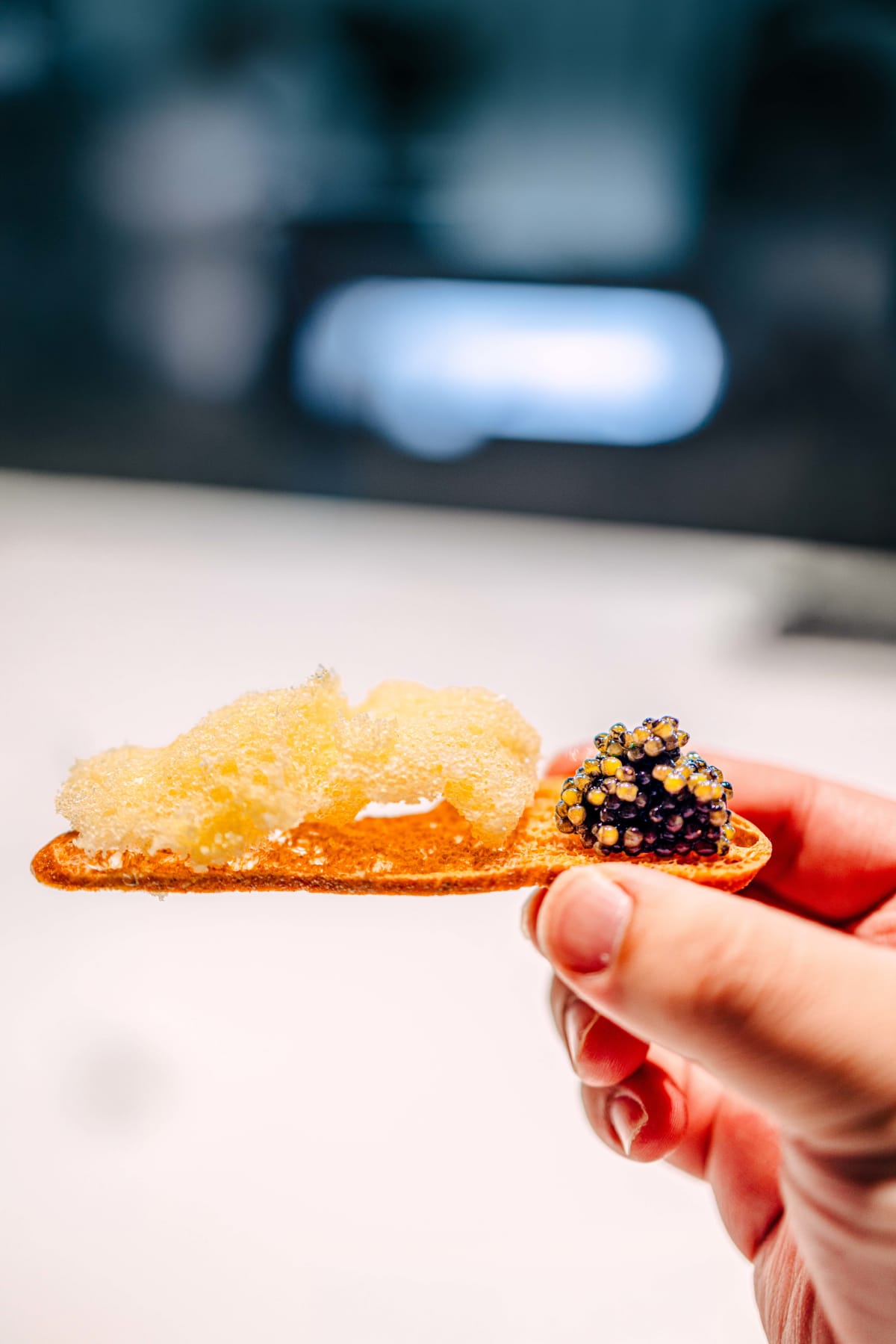
The sixth, "Solid bubbles of smoked butter with caviar (2020)," is a dish that turns smoked butter into foam and then freezes that foam into a "solid bubble."
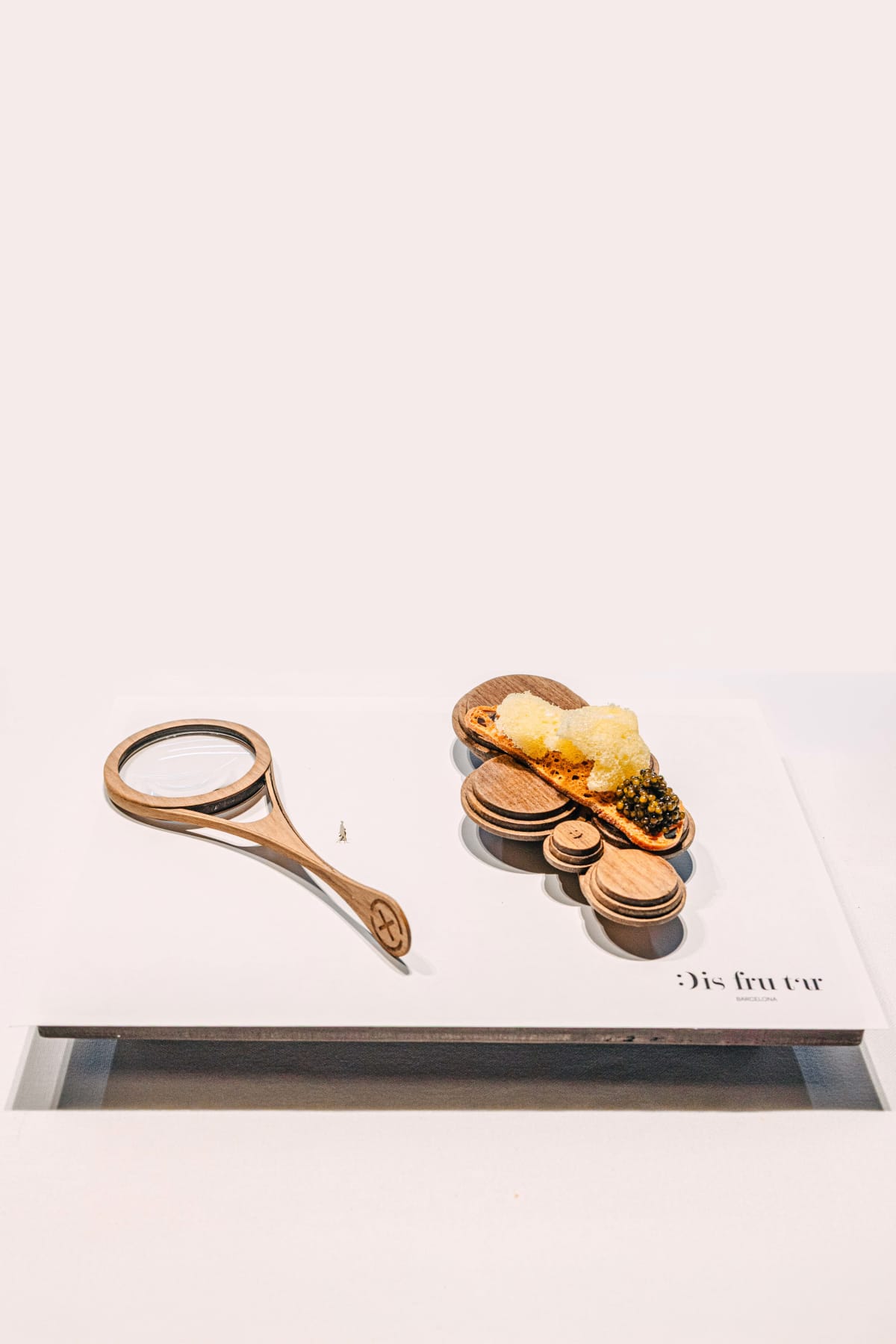
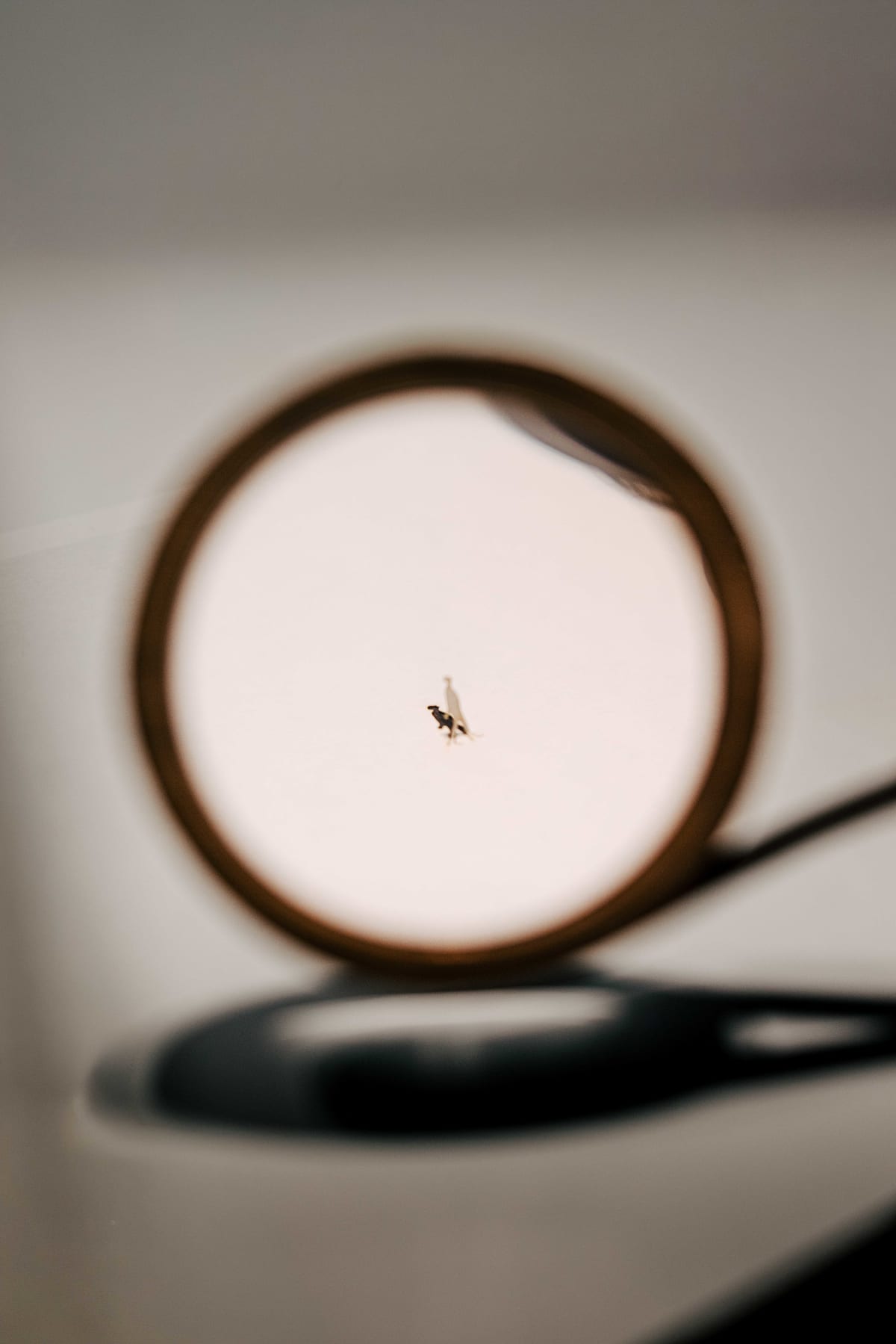
Using equipment like an aquarium oxygen pump, they puffed the butter up with air and froze it right away to make it like a solid bubble. Caviar was set on top, and it was served as a bite-size amuse-bouche. In other words, the dish reduces butter almost entirely to an exploration of texture, with caviar providing the final seasoning. The smoky flavour and the texture of the smoked butter were good, and eaten together with the caviar at the end, the balance, down to the gentle aroma and the salinity, was fine. What was fun was that to the left there was a magnifying glass and what looked like a small dot: a visual joke the staff introduced as a "little surprise" called the "Bubble chef." It was a staging in which you observe, through the magnifying glass, a tiny chef walking toward the bubble. It was a device with nothing to do with taste, but its humour and wit made me laugh once more.
Section 7·The Third Flow: An Explosion of the Sea, and an Expansion of Scent
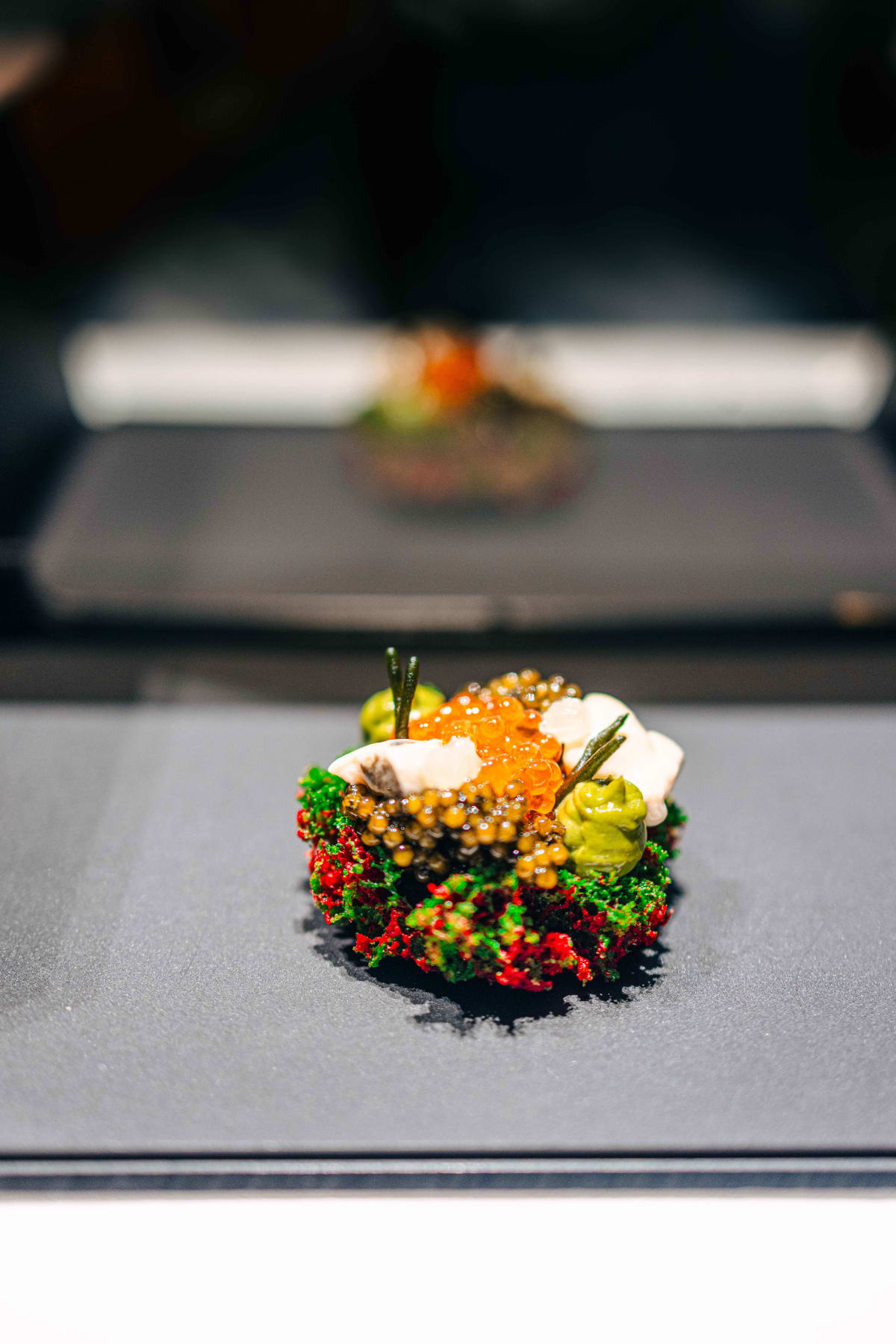
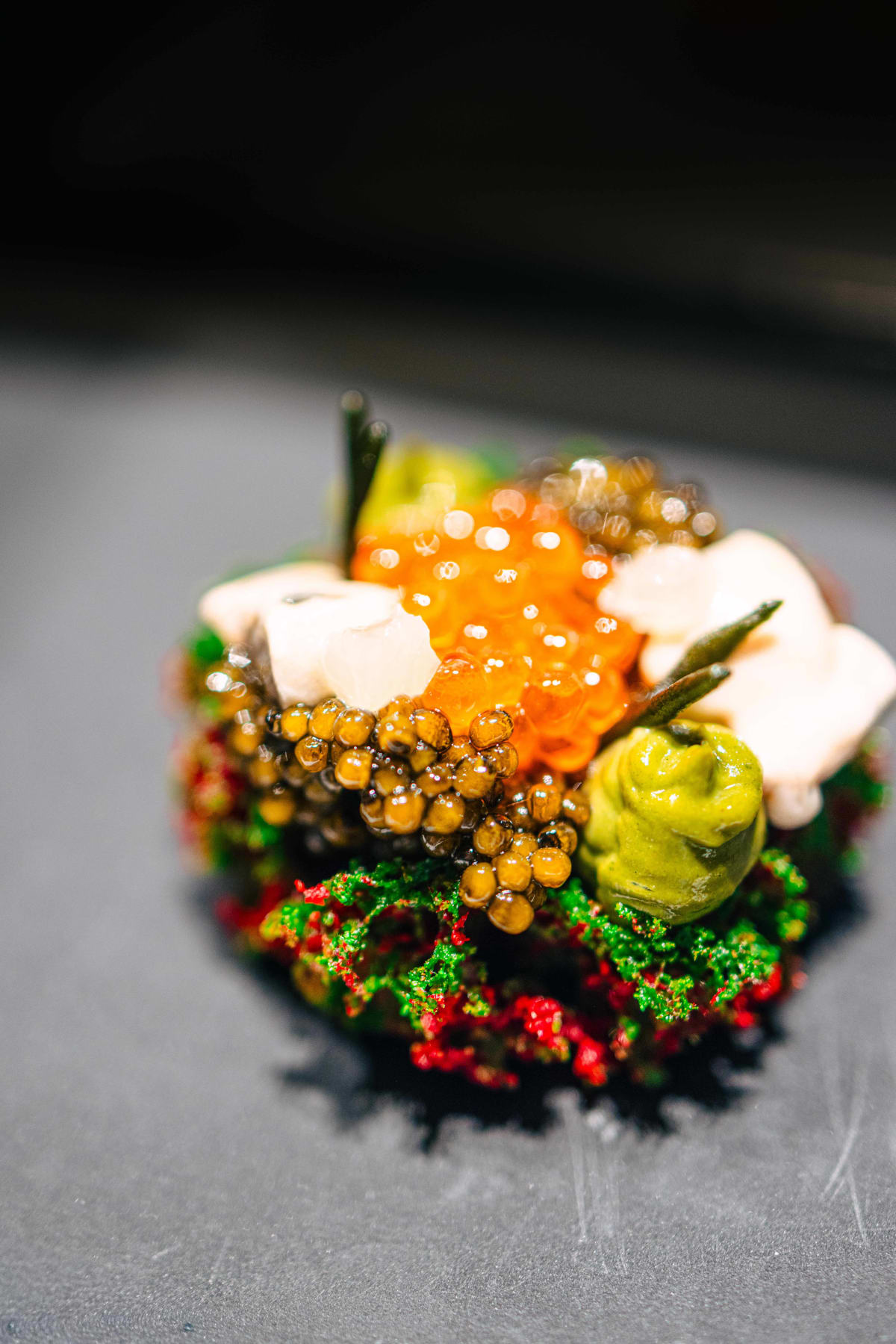
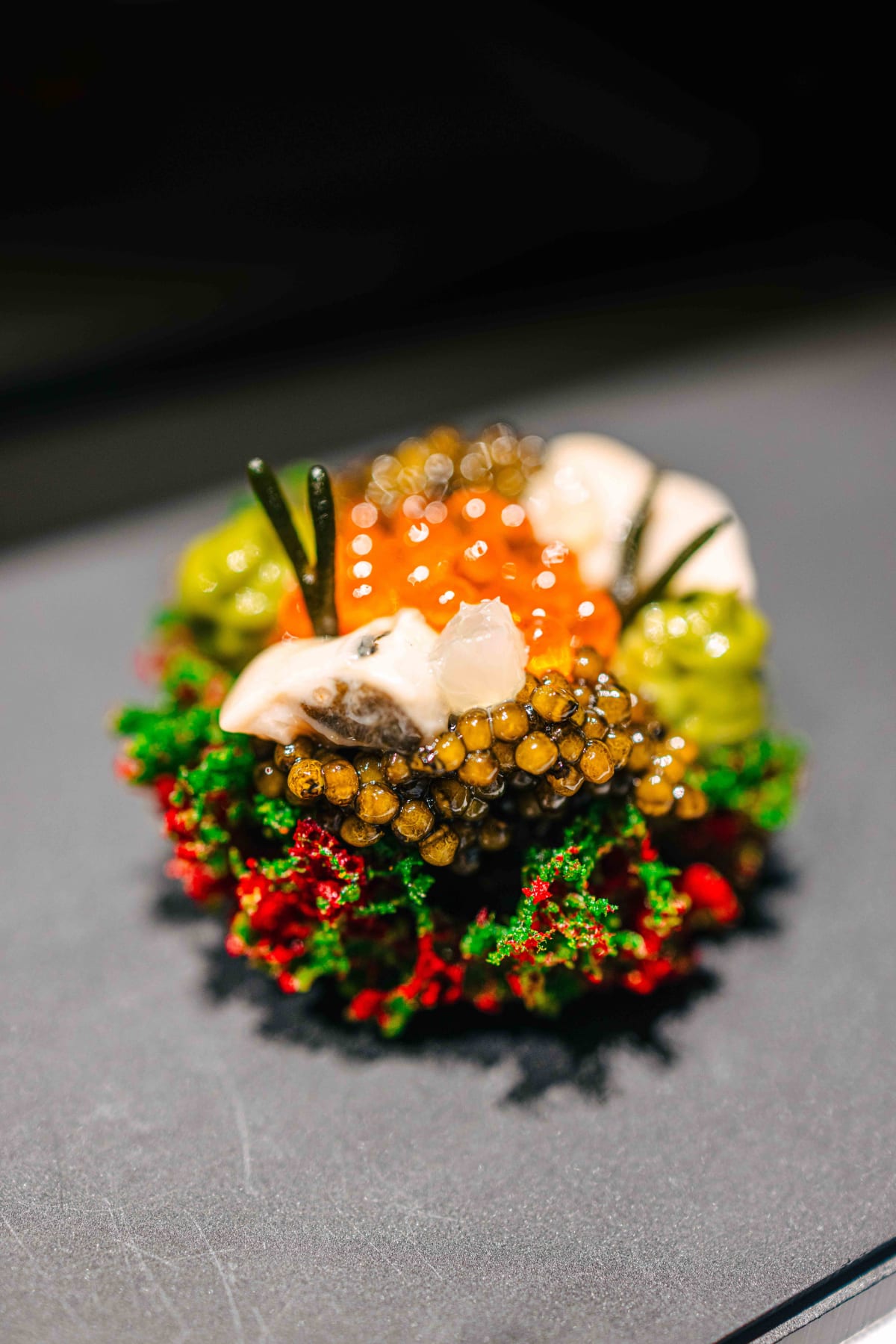
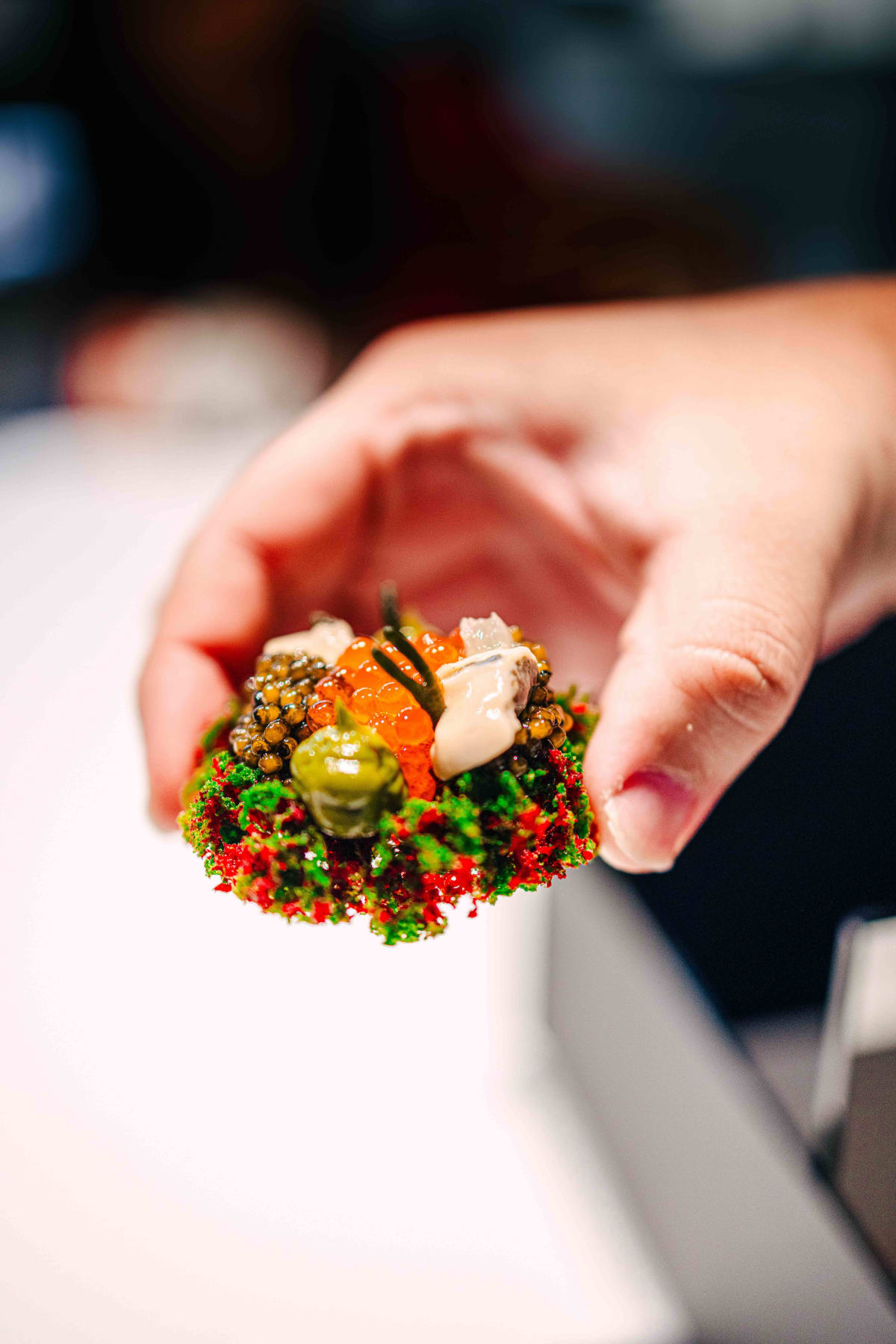
For the next dish, "Amaranth coral with caviar, oyster and codium emulsion (2023)," a staff member suddenly came over while we waited and stressed that we should sit comfortably but keep the distance and angle of our gaze fixed straight ahead. I wondered what was coming. Inside the black box was not simply a dish, but a crystal installation. It was a device in which you pick up, by hand, a coral-shaped crisp set behind the crystal. The base of the crisp that looks like coral beneath this dish is amaranth, put through a process that uses alcohol to create a crunchy texture. Caviar, oyster, ikura, and codium emulsion sat on top, creating an explosive concentration of marine flavours.
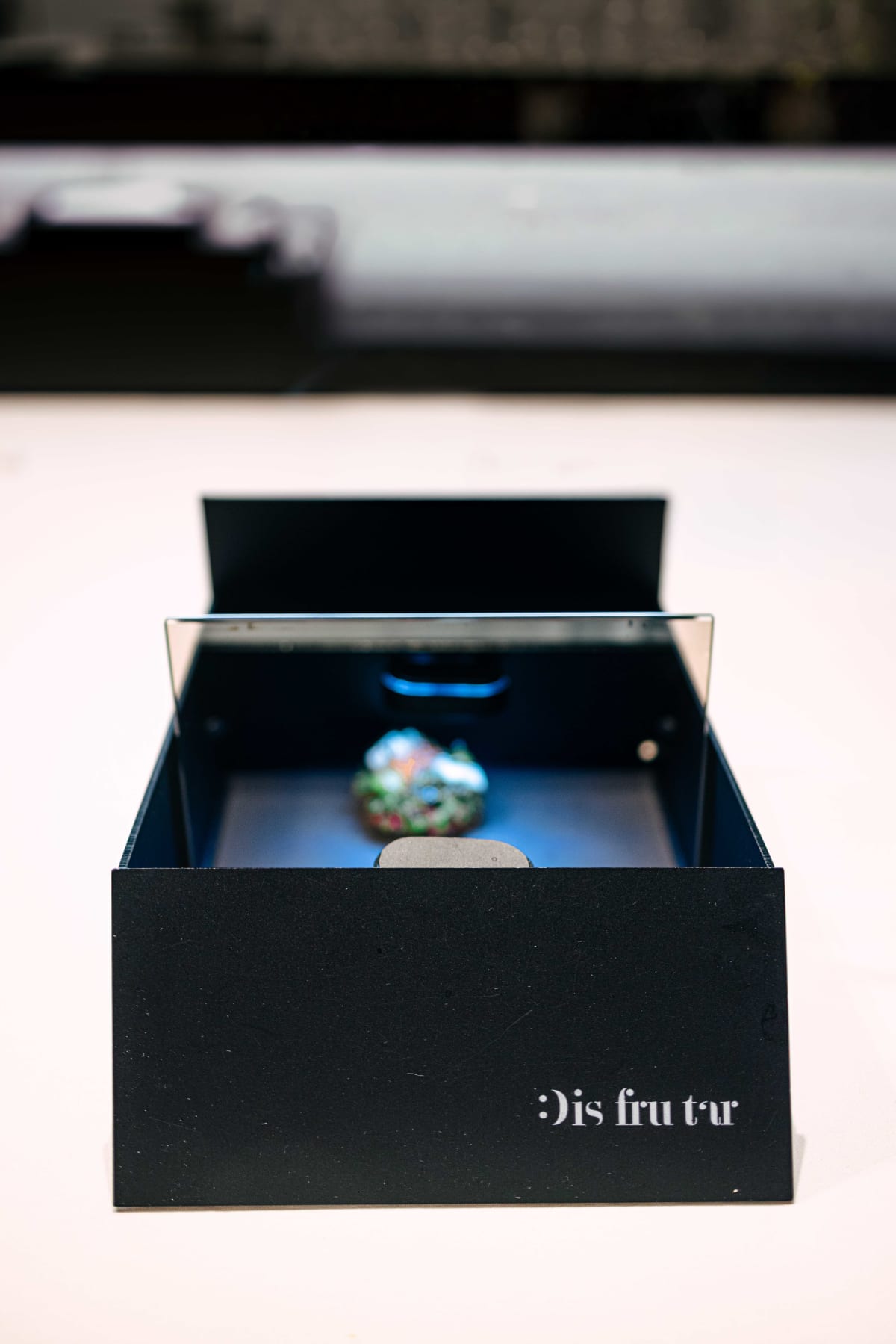
Once the box came out and a single bite-size dish was clearly visible behind the crystal, the server suggested we try an "imagination test" before eating. He asked us to imagine the coral flying toward us from the back of the box, and to picture the contrast before we tasted it: crunch underneath, an explosion above. So I reached my hand inside to eat it, but the dish that had plainly been before my eyes was not there. It was disorienting, but it turned out the dish was at the back, and the crystal had created an optical trick.
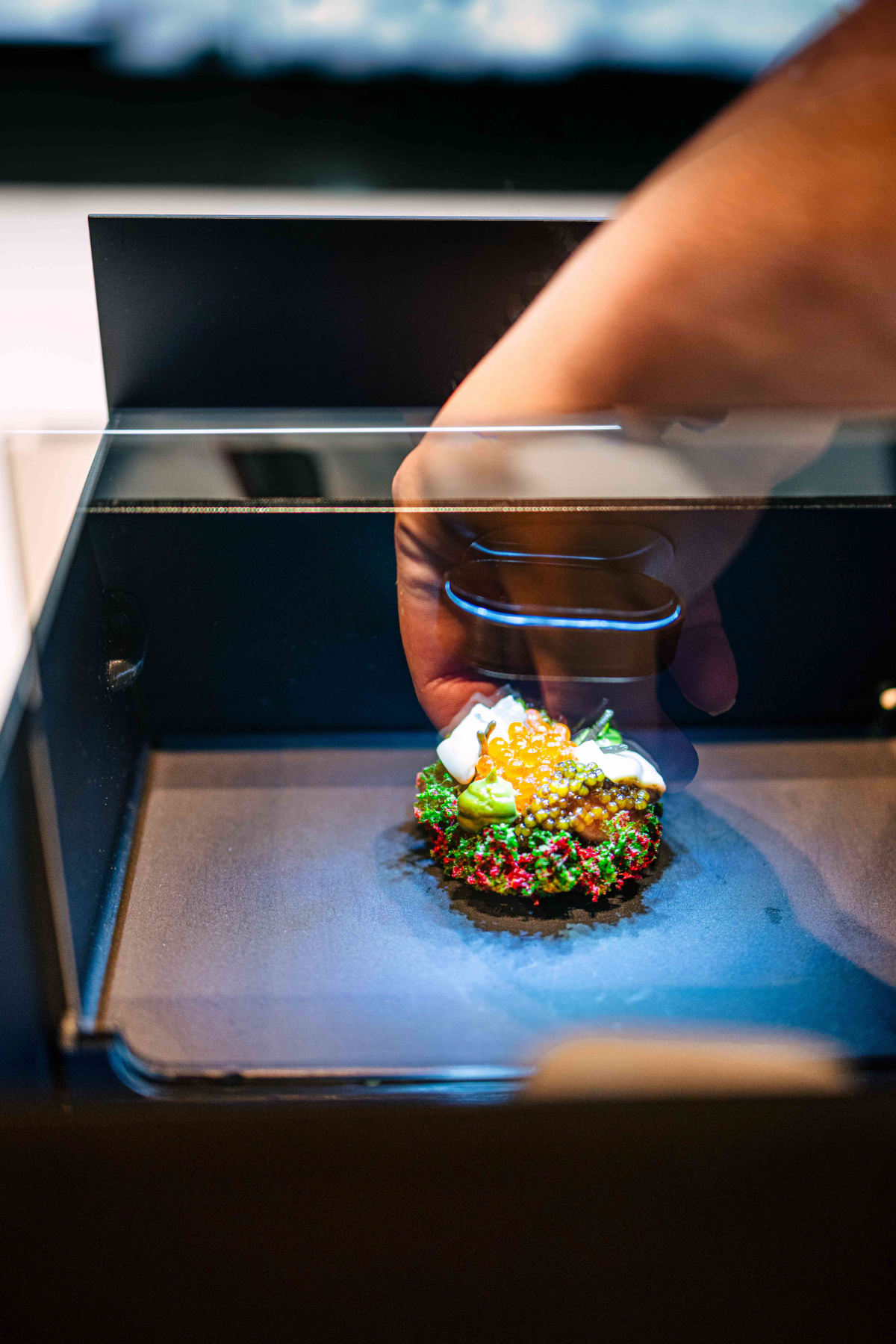
When I picked up the dish behind and put it in my mouth in one bite, the amaranth coral underneath shattered crisply first, and the caviar, oyster, and codium piled on top burst all at once, so that my mouth turned into "the sea" in an instant. Because of the codium, it also gave a taste like eating gim bugak, a crisp of fried laver, as the deep scent of seaweed, the richness of the oyster, and the umami of the caviar surged in all together. It was not just "seafood"; it really felt like eating the sea in a single bite. The phrase "an explosion of the sea in the mouth" was no exaggeration.
A pairing appears once more, and this time the pairing is anything but ordinary: it pairs a scent with the food. "Gazpacho sandwich with scented vinegar garnish (2016)" looks like bread on the outside but is in fact a tomato meringue. Using tomato, they make an airy, meringue-like shell with molecular gastronomy technique, and inside they freeze gazpacho, the cold Spanish tomato soup, in the form of a sorbet. This sandwich, too, had an astonishing texture, an astonishing way of melting in the mouth. Cotton candy is the most my language can manage, and it really did melt away softly. A similar dish had appeared at é by José Andrés in Las Vegas, another signature restaurant of an elBulli alumnus chef. The texture was similar, but Disfrutar's version was far superior in both concentration and clarity of flavour.
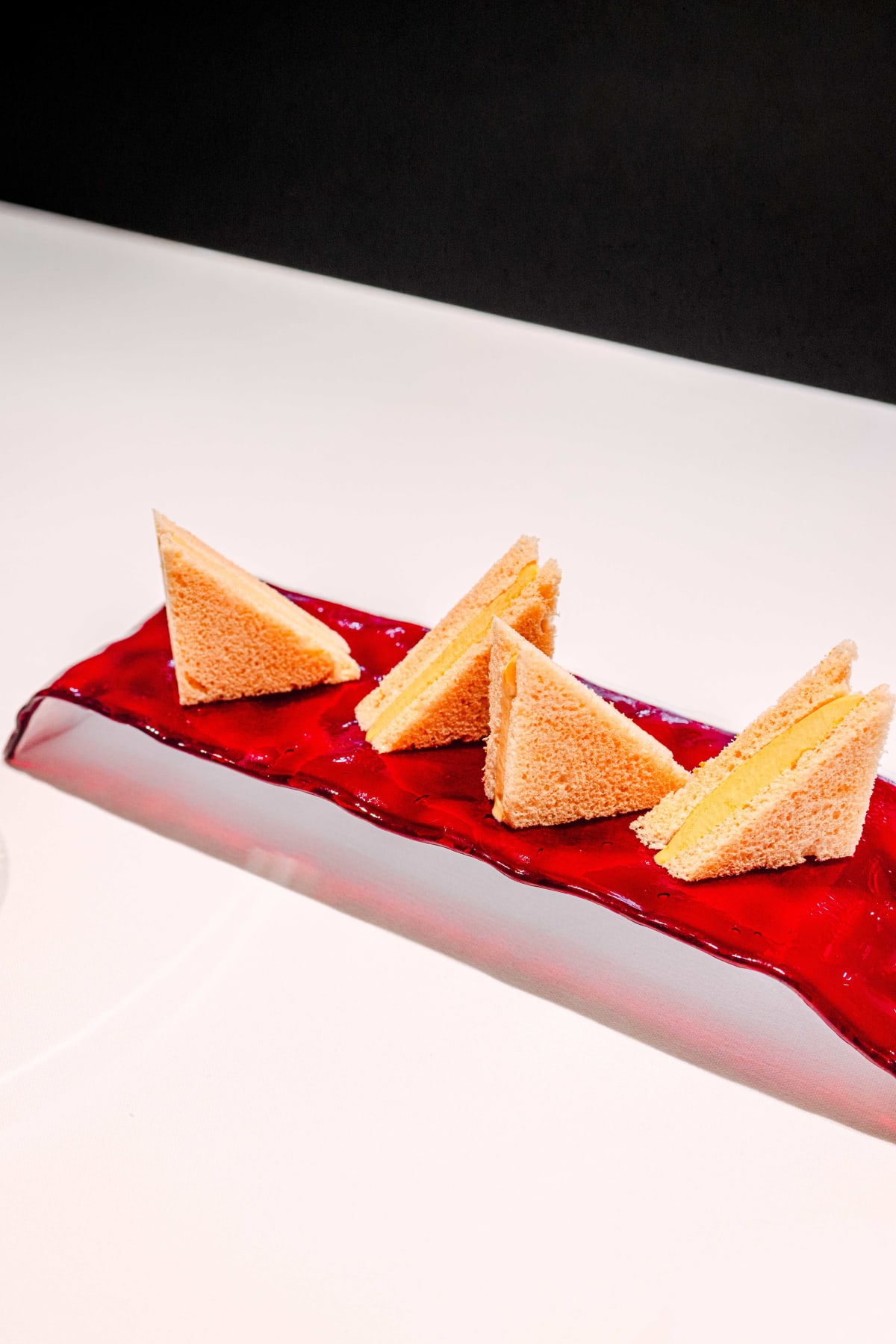
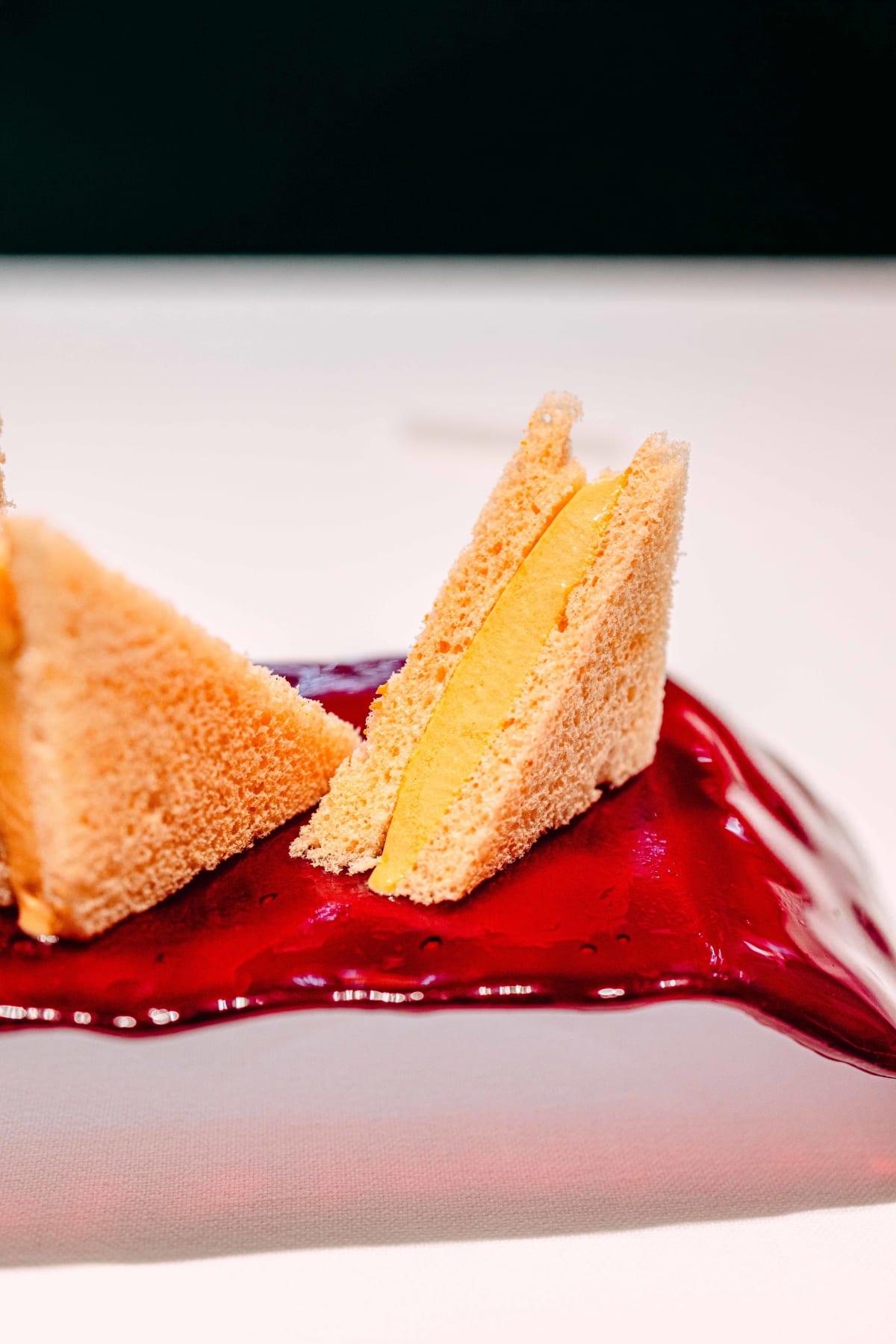
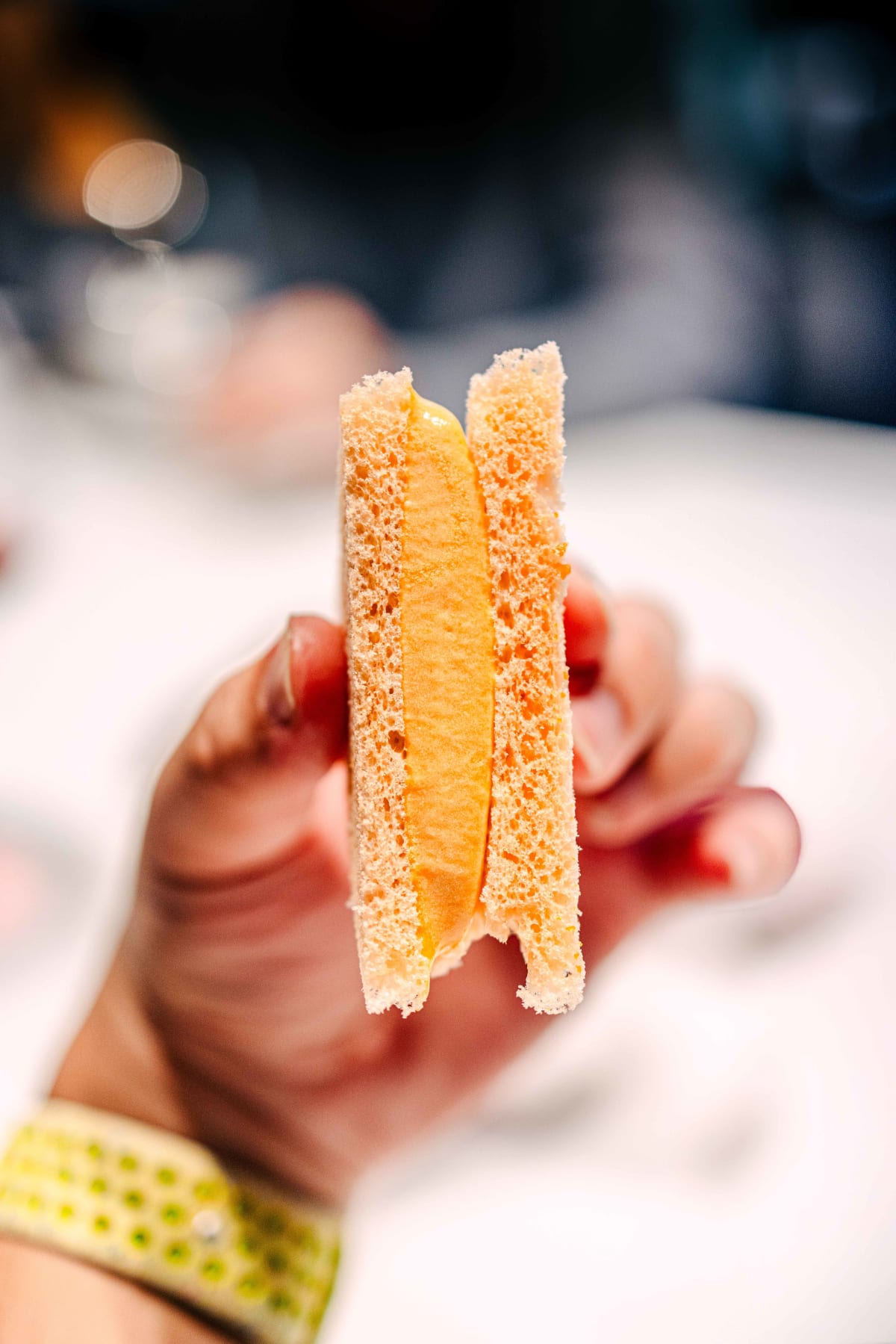
What came alongside it as the pairing was, of all things, vinegar. They pour a 25-year-aged traditional Spanish vinegar separately into a glass, and because the scent is so strong, they guide you to smell it slowly. In fact, if you bring your nose right into the glass, the scent is so sharp and intense it might set off a nosebleed. It was a scent strong enough to reach you from a distance. This device, expanding flavour through the sense of smell, was truly fresh.
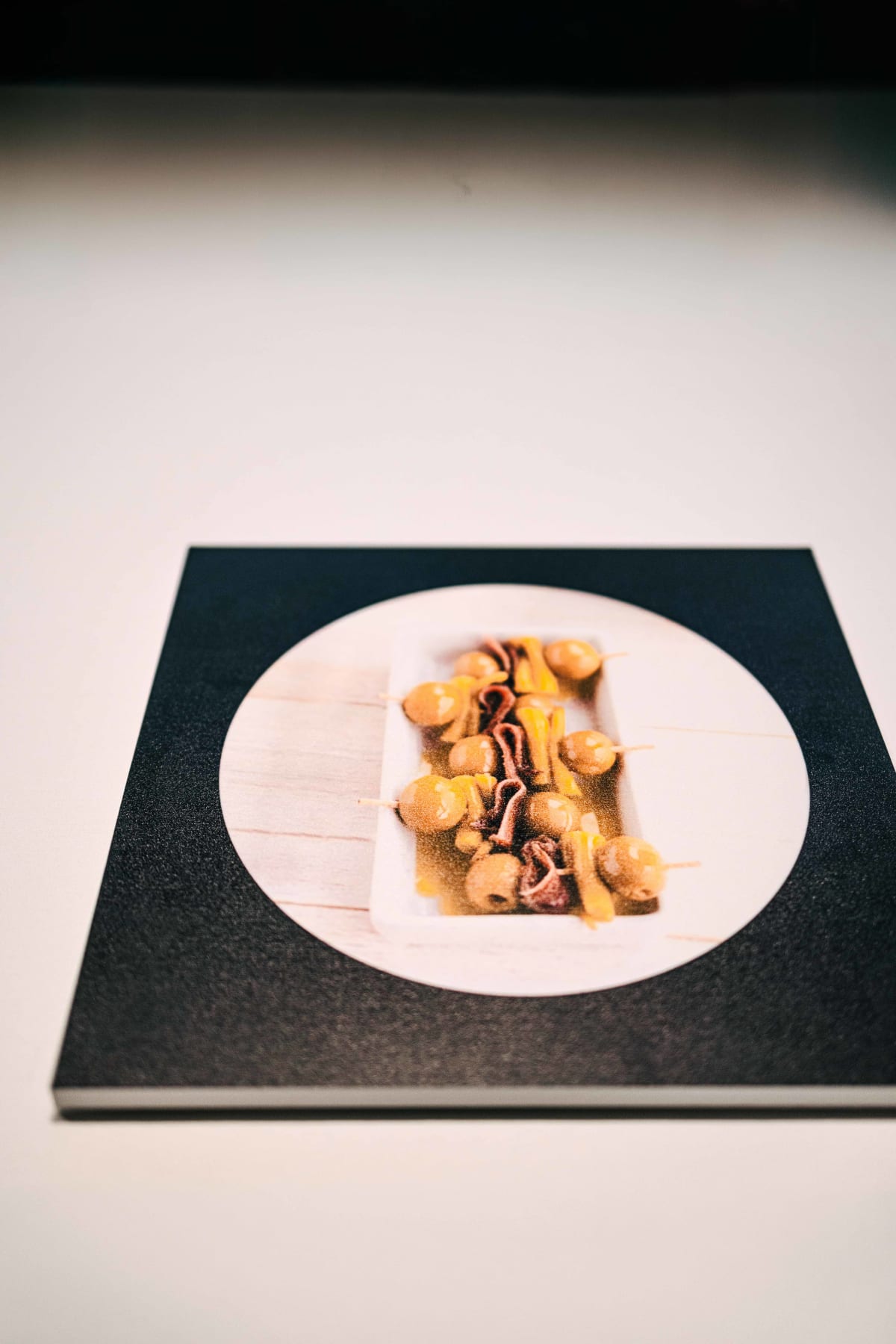
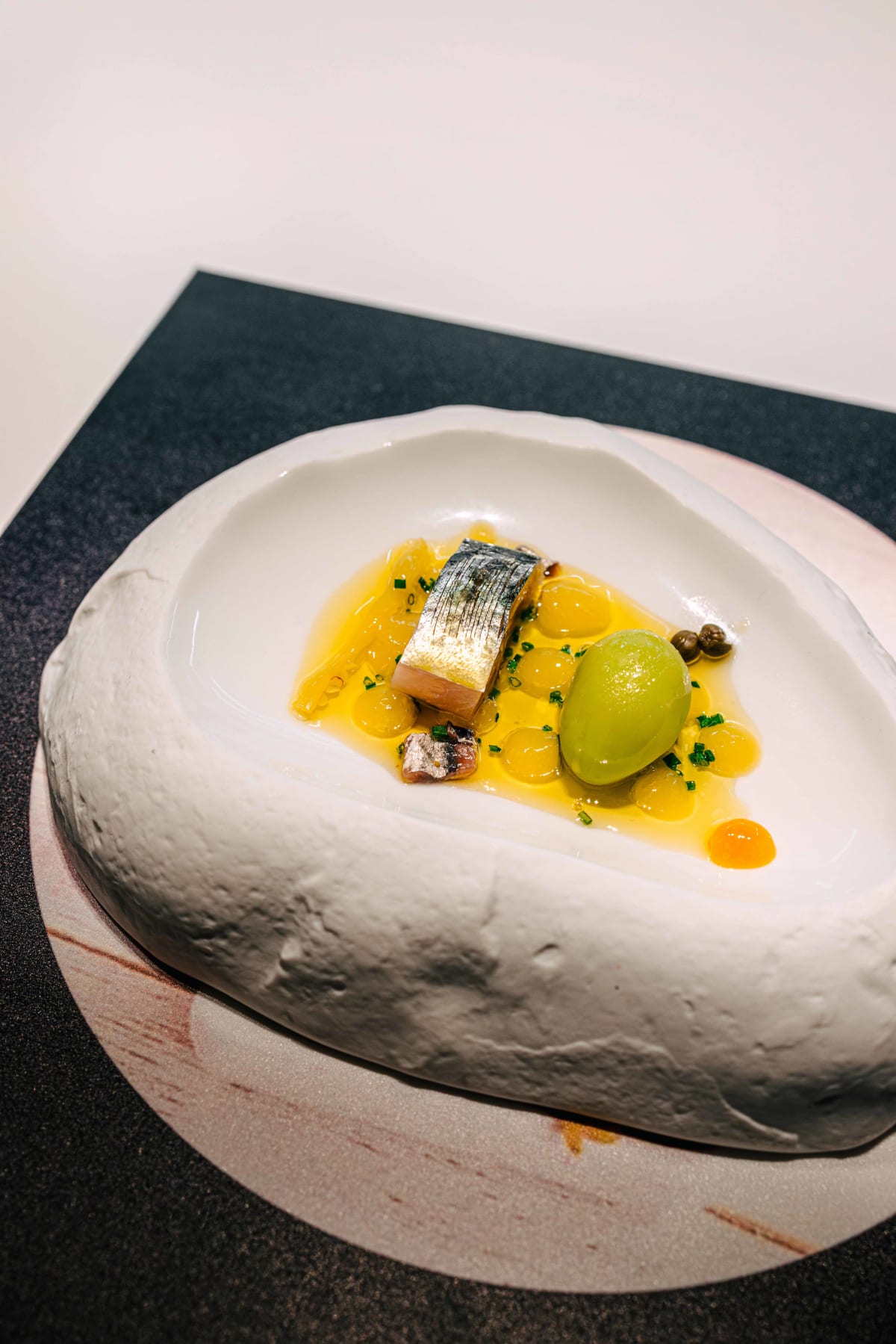
Next was "Disfrutar's Gilda with marinated mackerel (2017)." Before the dish came out, they brought an underplate, and on it was a photograph of the Gilda, the traditional pintxo of the Spanish Basque country. The server first explained that the pintxo is a classic Basque aperitif, and that the Gilda is a famous Basque pintxo whose basic composition of olive, anchovy, and pickled pepper brings saltiness, acidity, and richness into balance in a single bite: "a bite of the Basque country."
This dish is Disfrutar's reinterpretation of the Gilda. In place of the original anchovy went a large piece of cured mackerel, and they added an element that bursts with the acidity and aroma of something like passion fruit seeds. Small anchovies were also placed on either side.
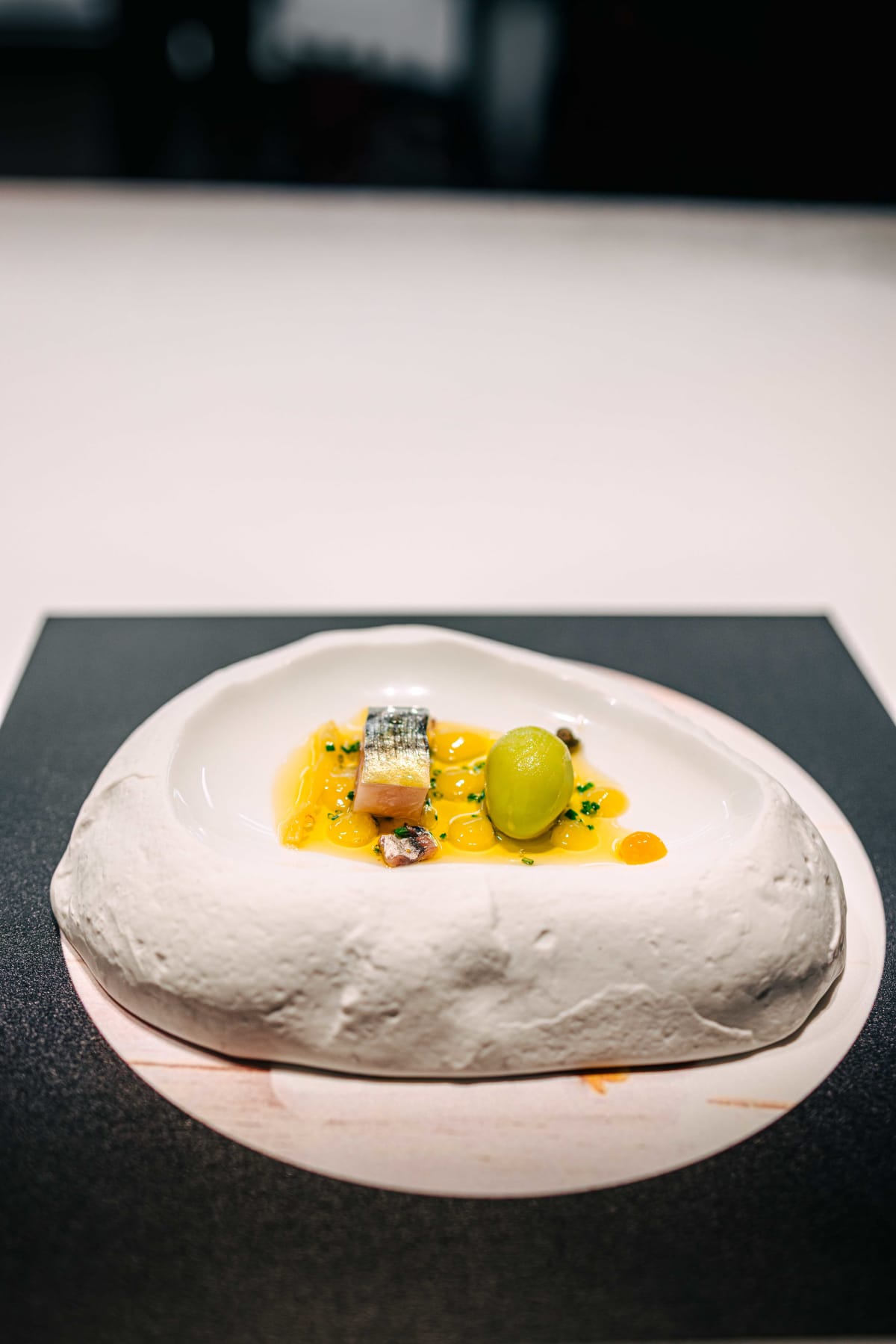
What was fun was the way they presented the olive in various forms.
On the right, they transformed a green olive into an olive-shaped candy, spherified like a chocolate, and the way this olive flavour burst like chocolate was astonishing. The olive aroma spread richly, yet it was neither too salty nor too sour, so the balance was good as well.
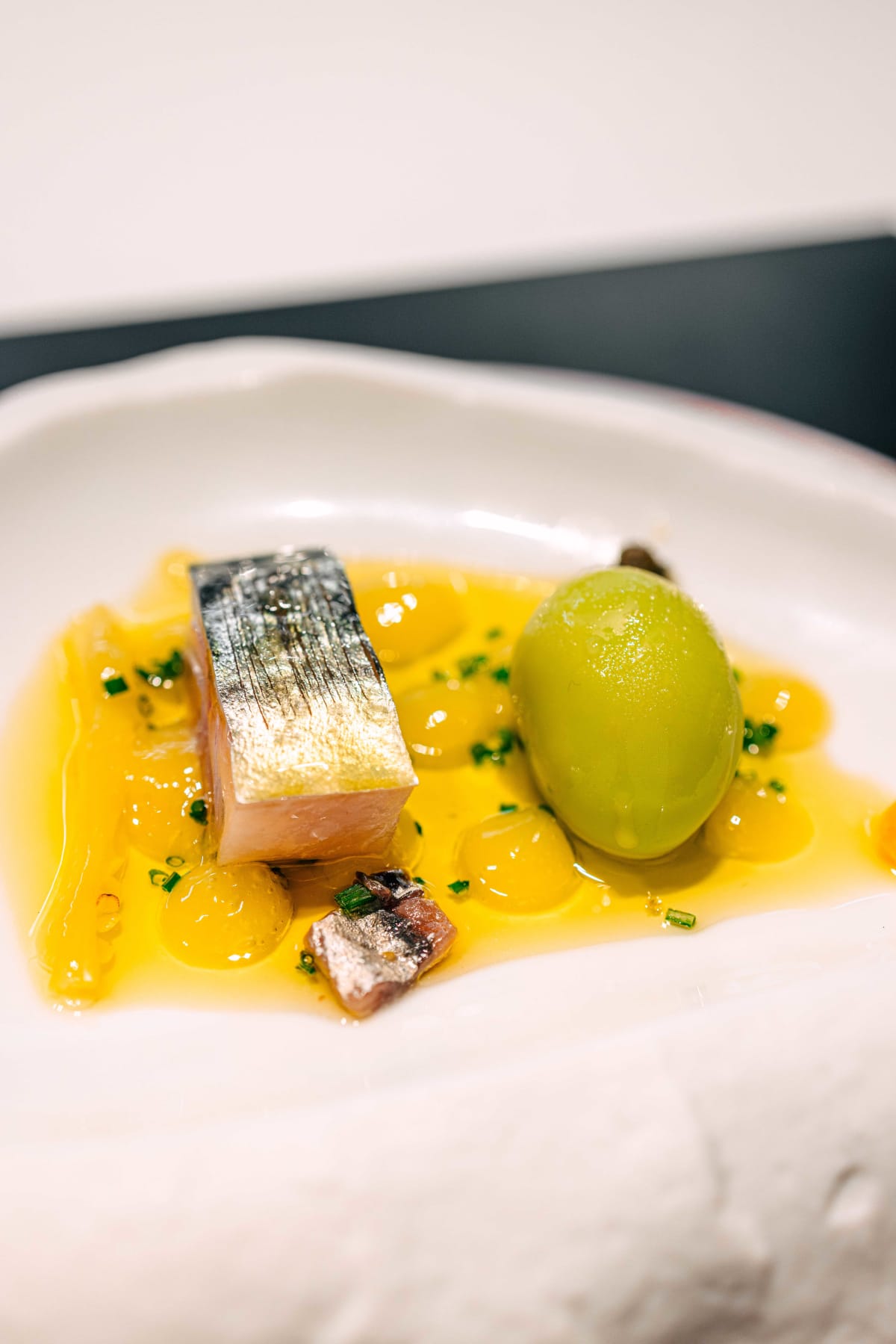
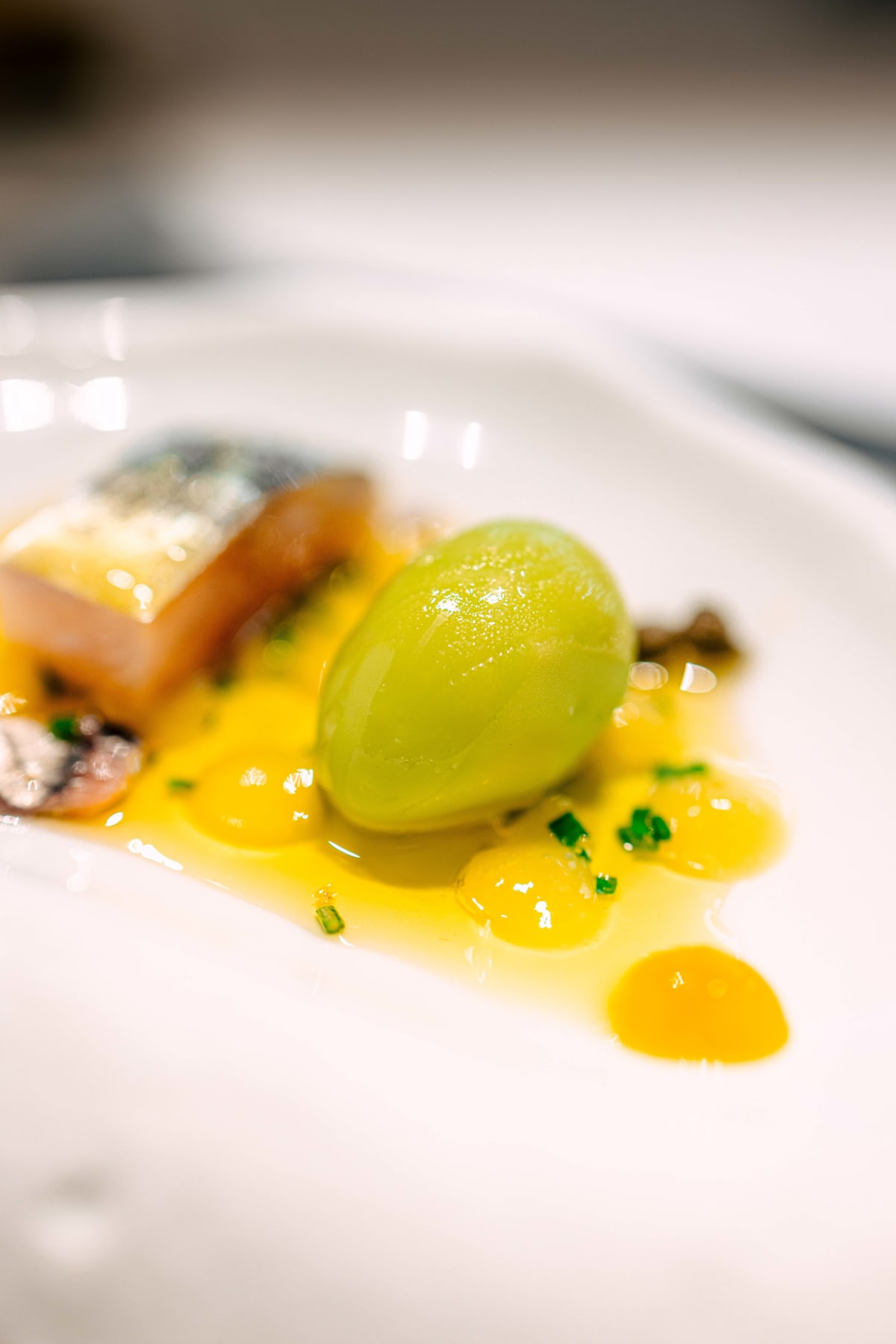
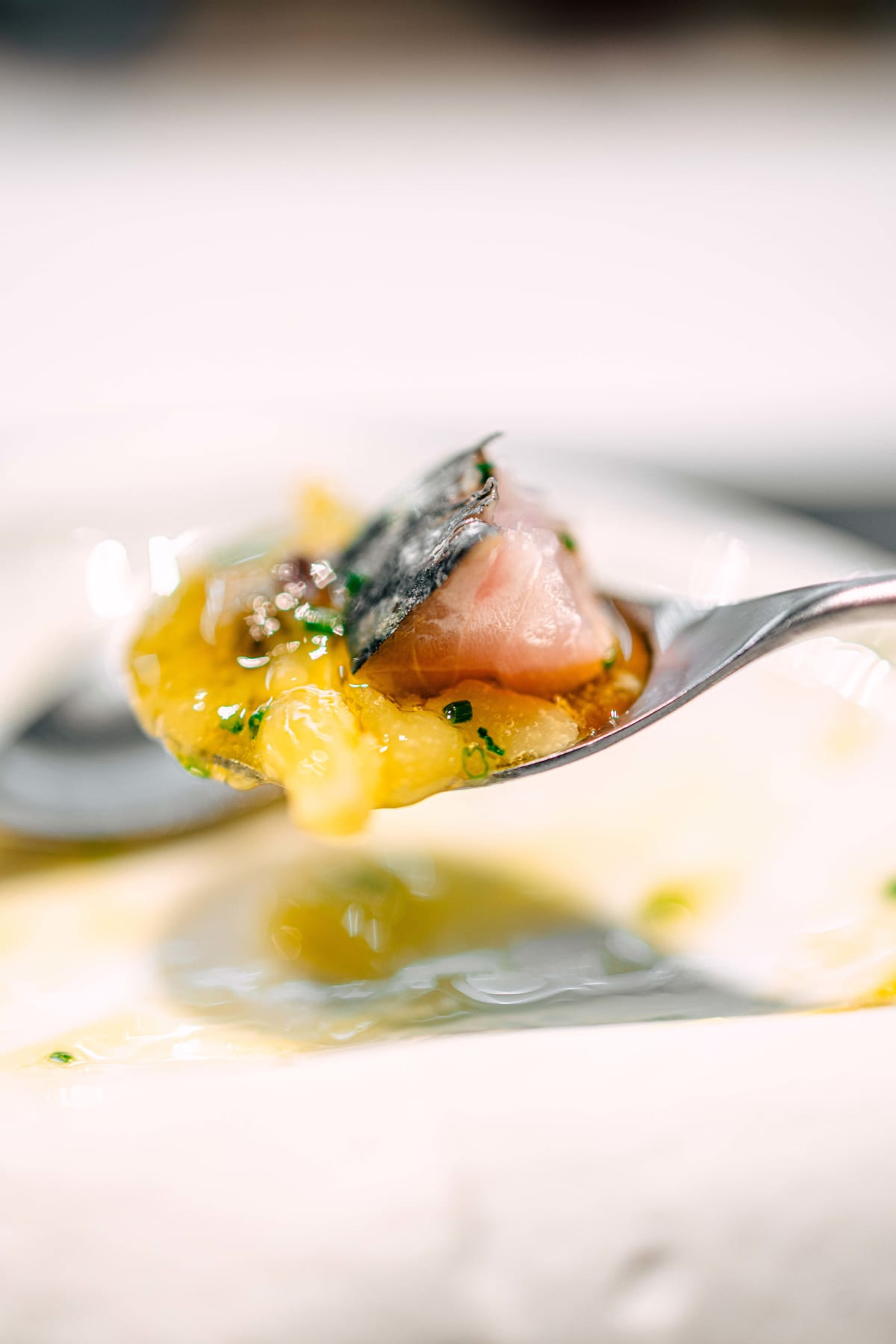
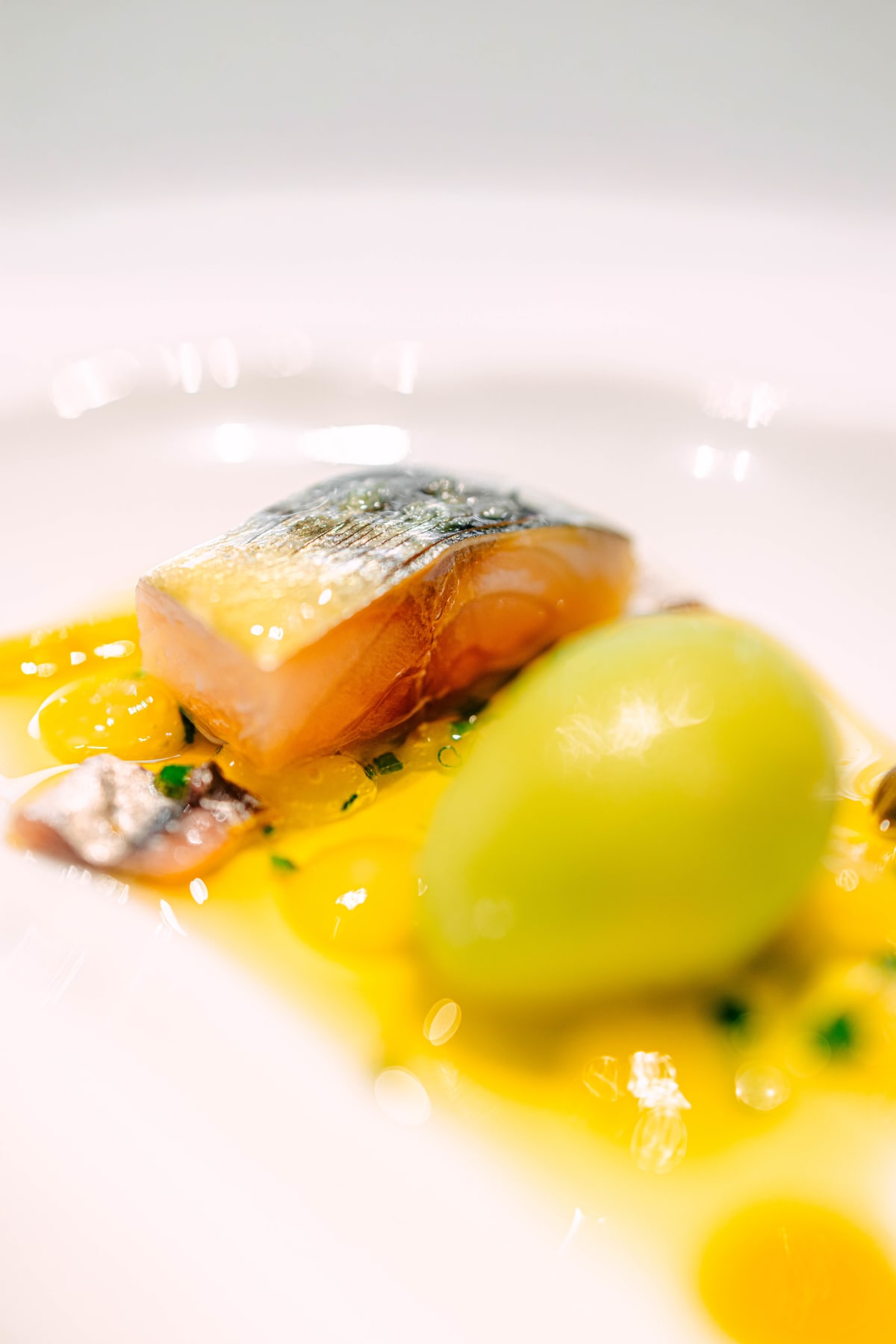
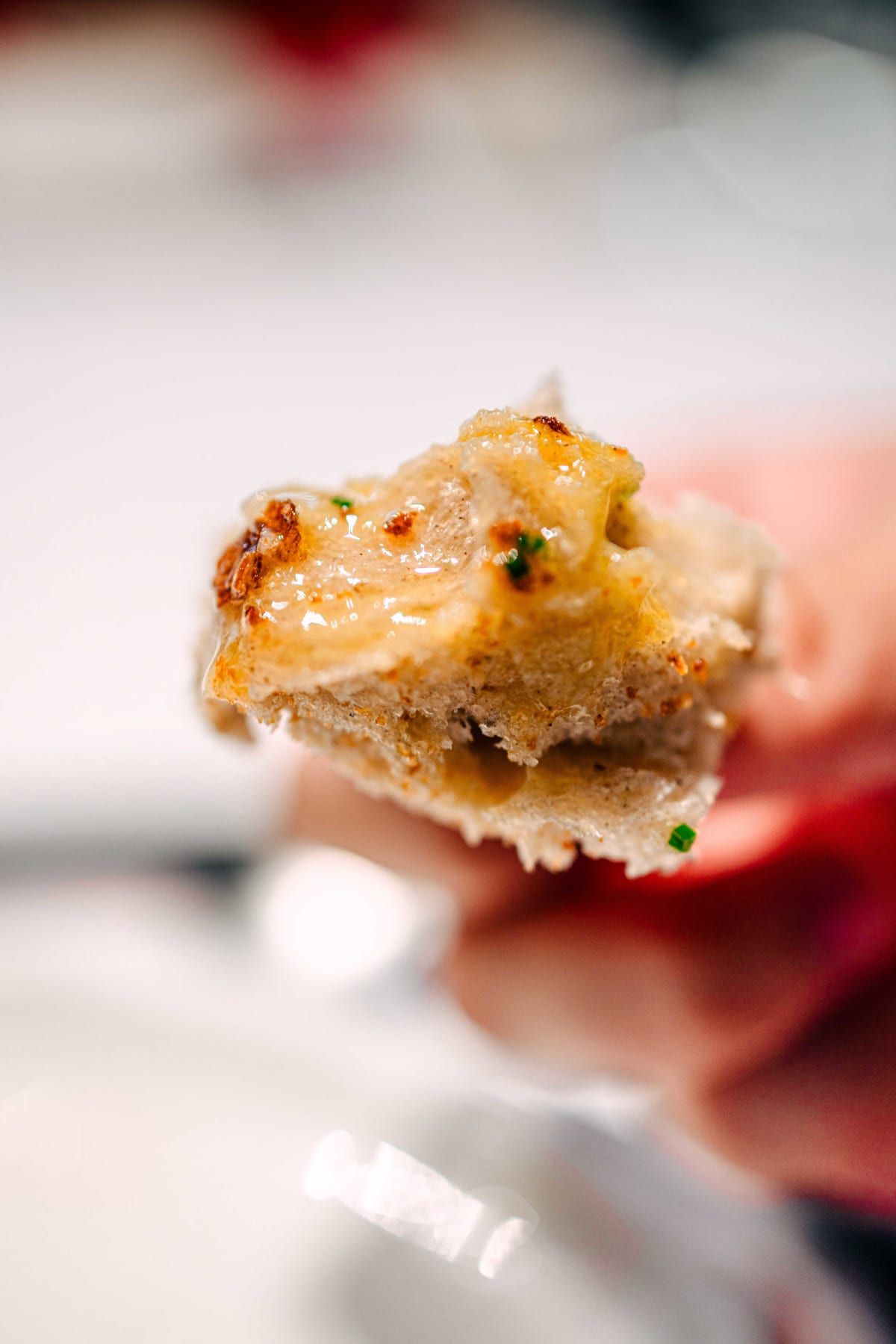
First I ate the mackerel, then the olive, then ate them with the sauces underneath, which were a caper-and-pickle jelly and an olive oil drizzle. The mackerel itself was fresh and delicious, while the different sauces added layer after layer of aroma and complexity. The olive oil sauce underneath, in particular, was thick as if emulsified, and spread on the bread served alongside it was delicious. There was a slight bitterness, though, and I am still not sure whether it added anything positive to the dish.
Section 8·The Fourth Flow: Starch, Egg, and the Deconstruction of Tradition
Next was, once again, a small bite: "Crunchy mushroom leaf (2021)." In a nest-like vessel sat a single small leaf-shaped cracker, and when I turned it over, various sauces clung to its underside.
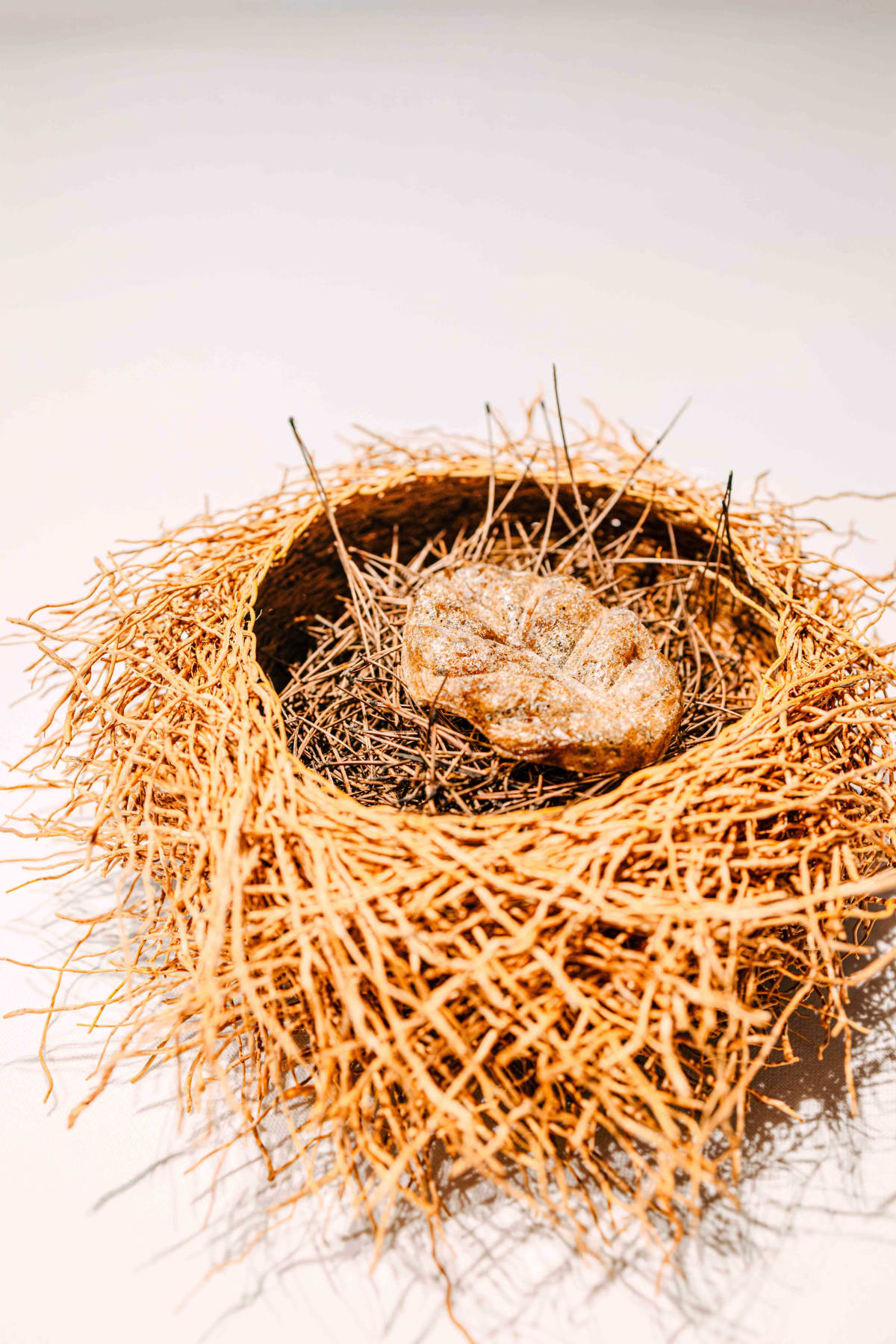
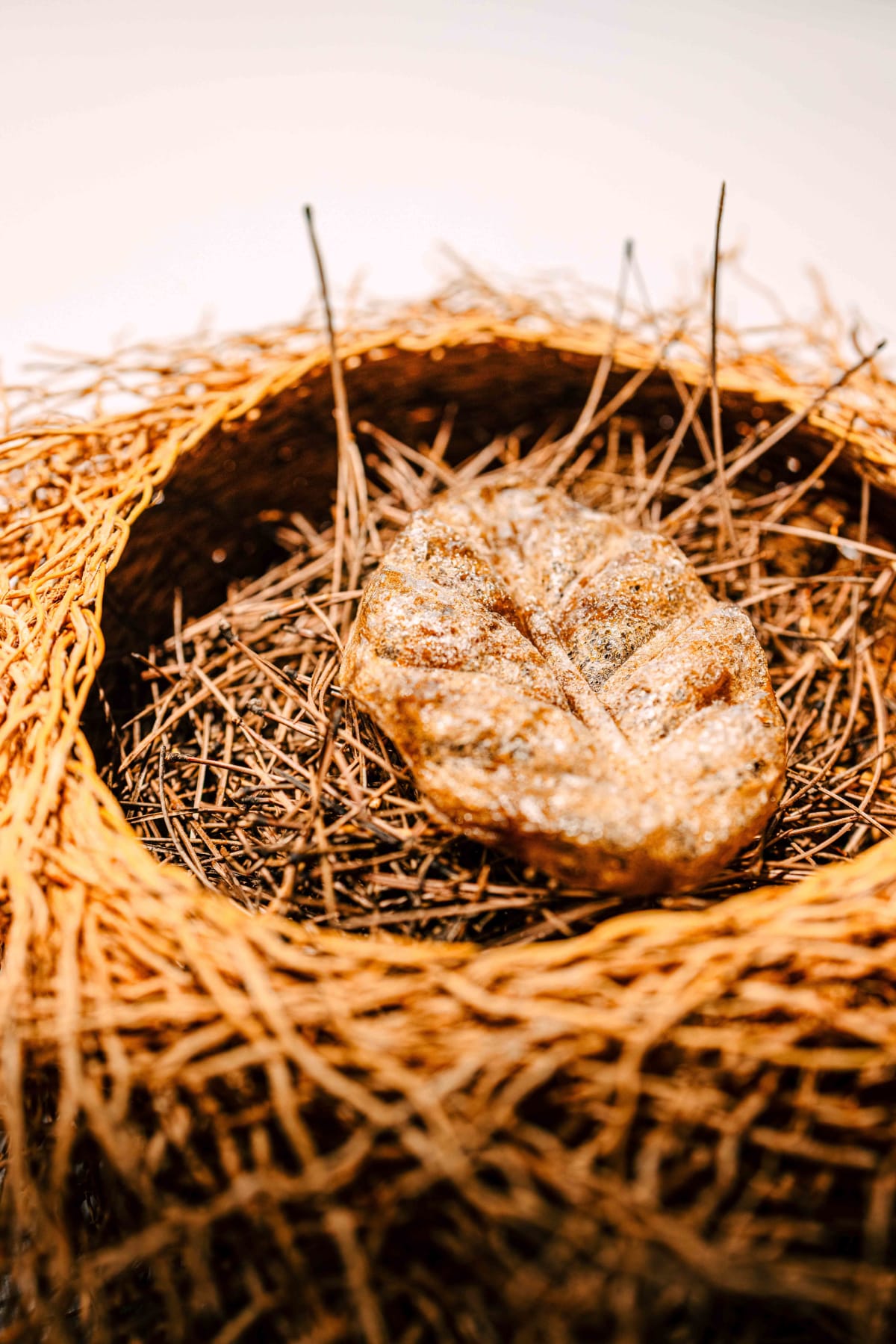
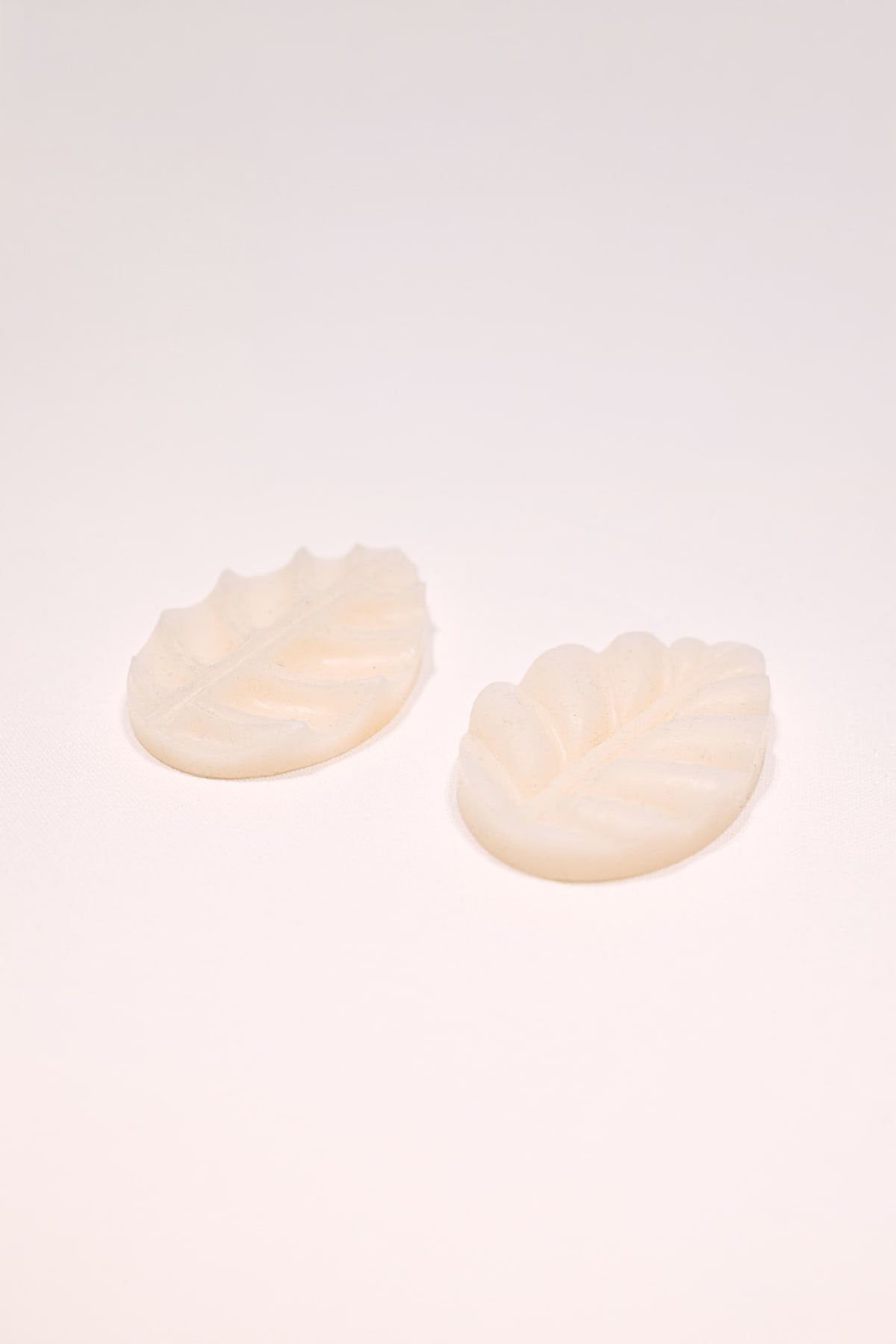
For this dish, they say, they mix mushroom soup into rice starch to make a very sticky, gelatin-like batter. They put this batter into a silicone mould, cover it, and microwave it for about three minutes, at which point the moisture leaves in an instant, the inside hollows out, and only the surface remains, forming an extremely thin, crisp shell. At the end, they finish it with a light brush of mushroom butter. The reason for using a microwave is to harness the rapid expansion and collapse that starch and moisture set off when they meet. The mushroom flavour was deep, which I liked. That said, because I had eaten so many dishes of remarkable character and creativity that day, the impact beyond the cracker texture and the mushroom flavour was relatively small.
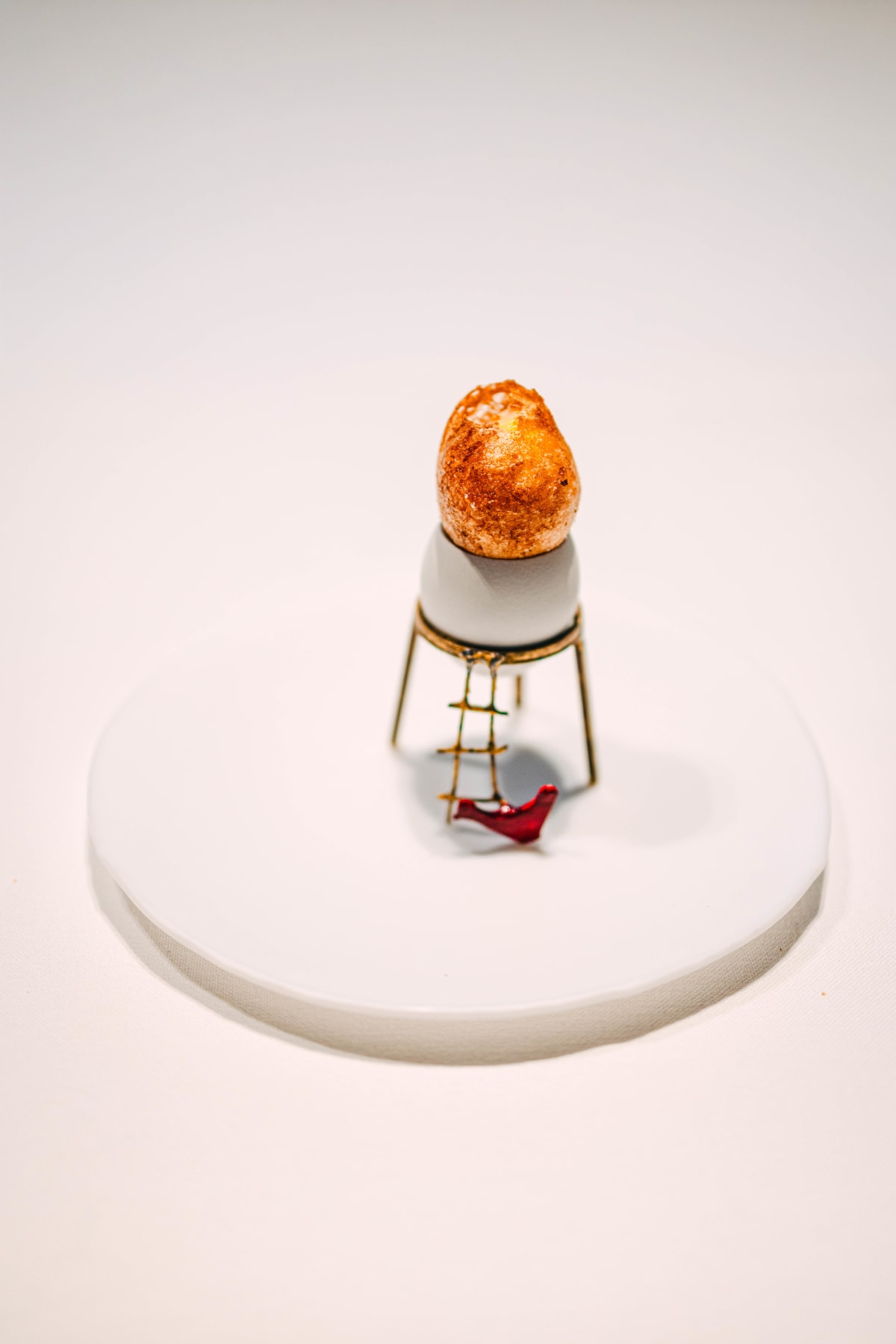
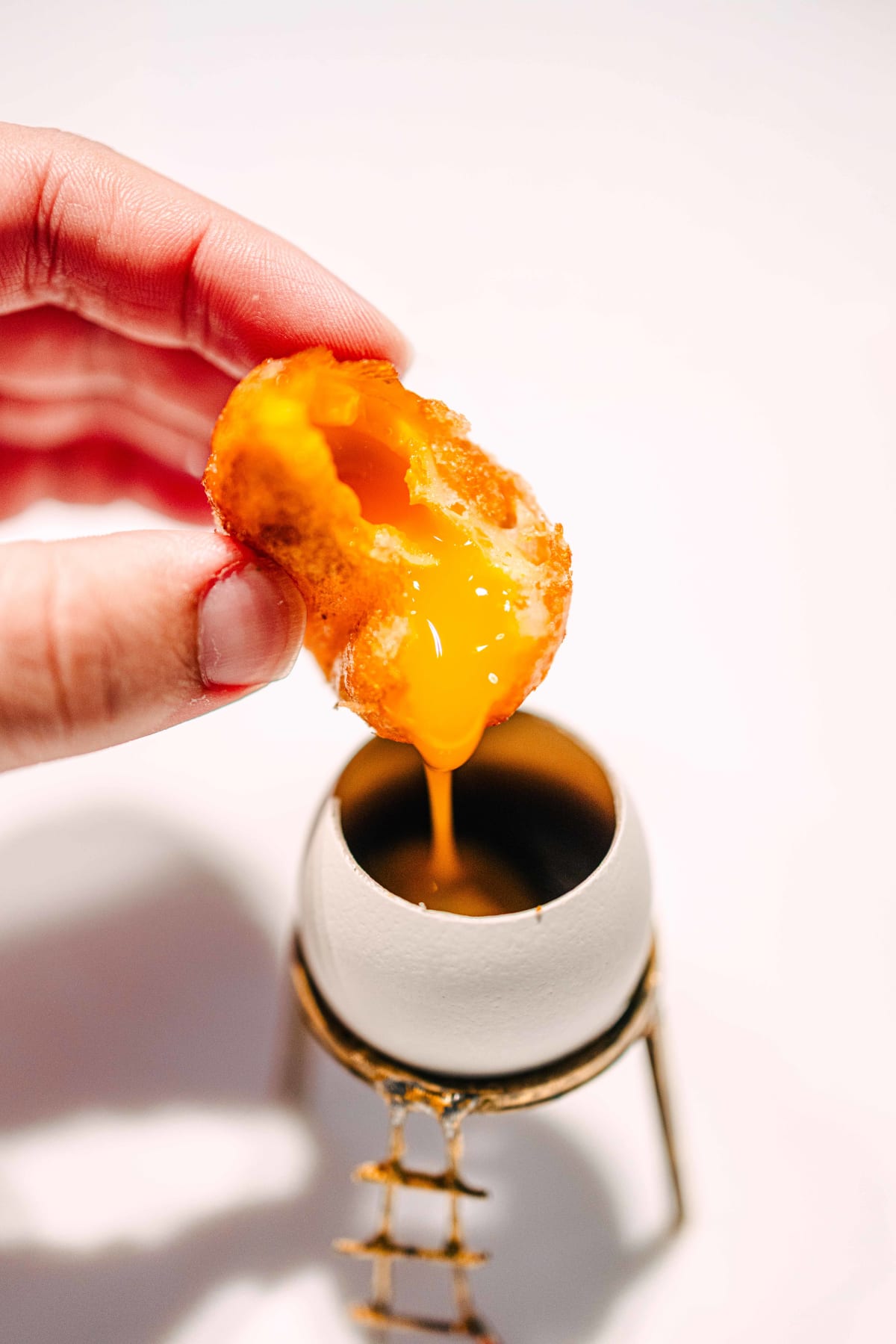
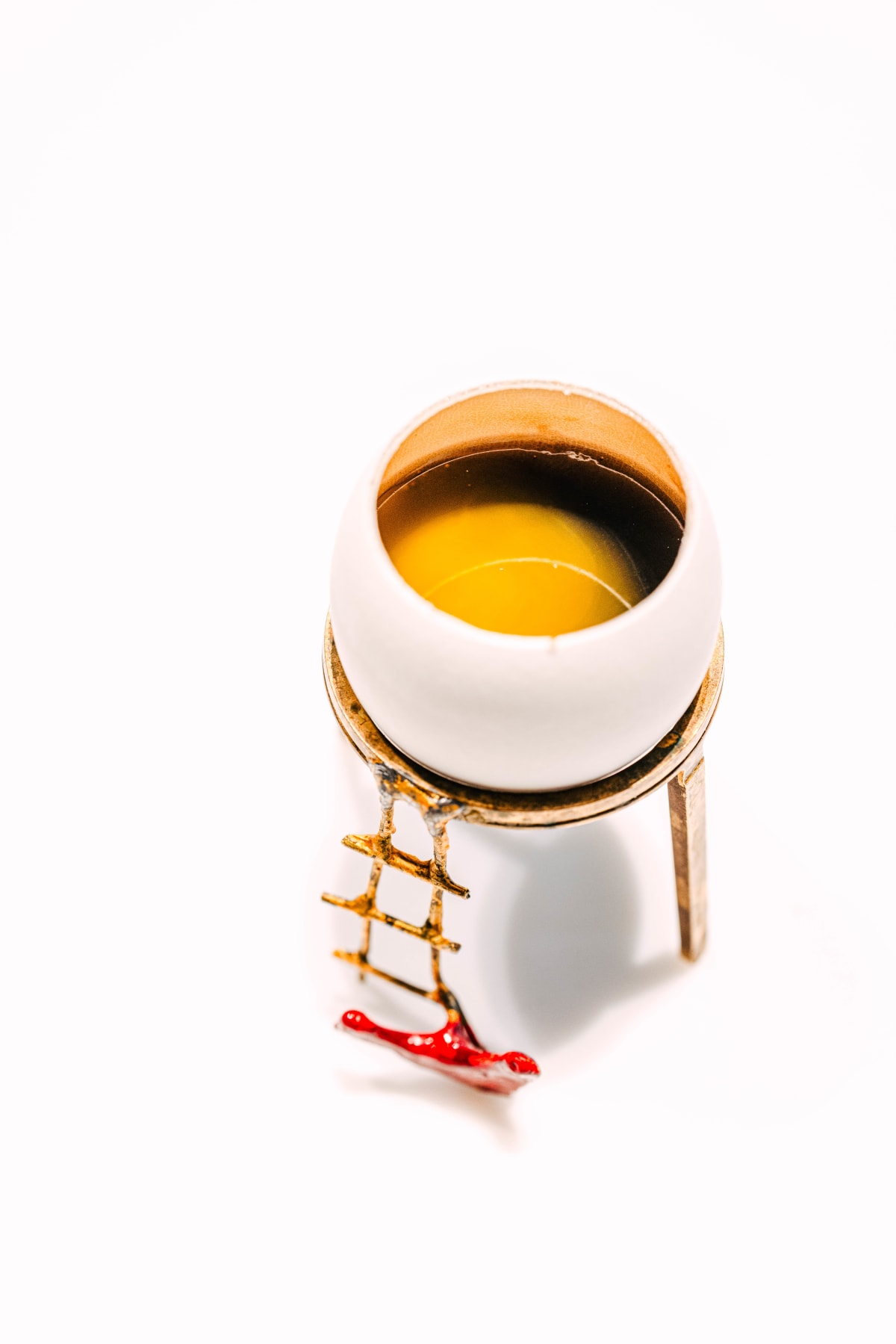
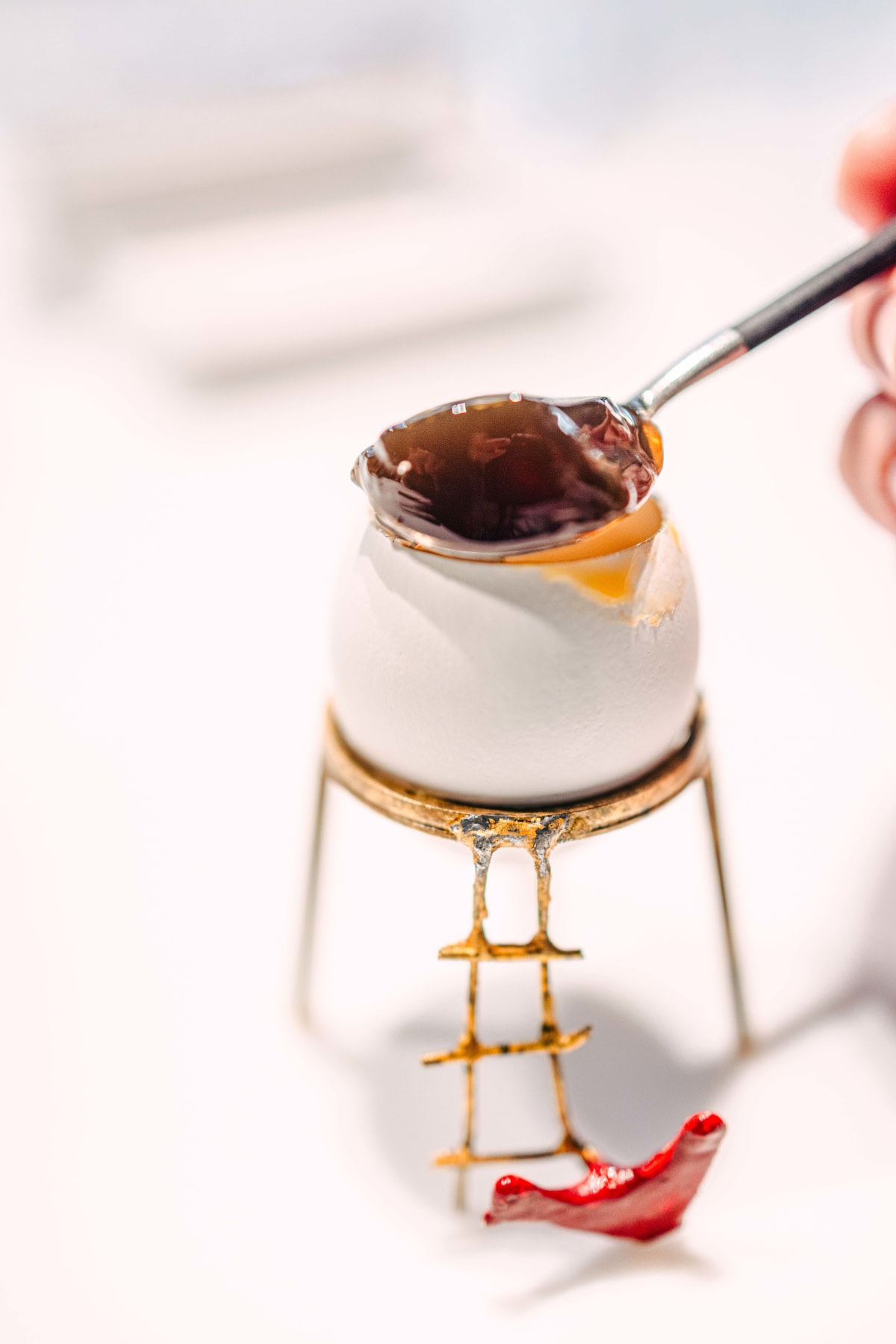
An early menu item developed in 2014, the year this restaurant opened, followed: "Crispy egg yolk with warm mushrooms gelatin (2014)."
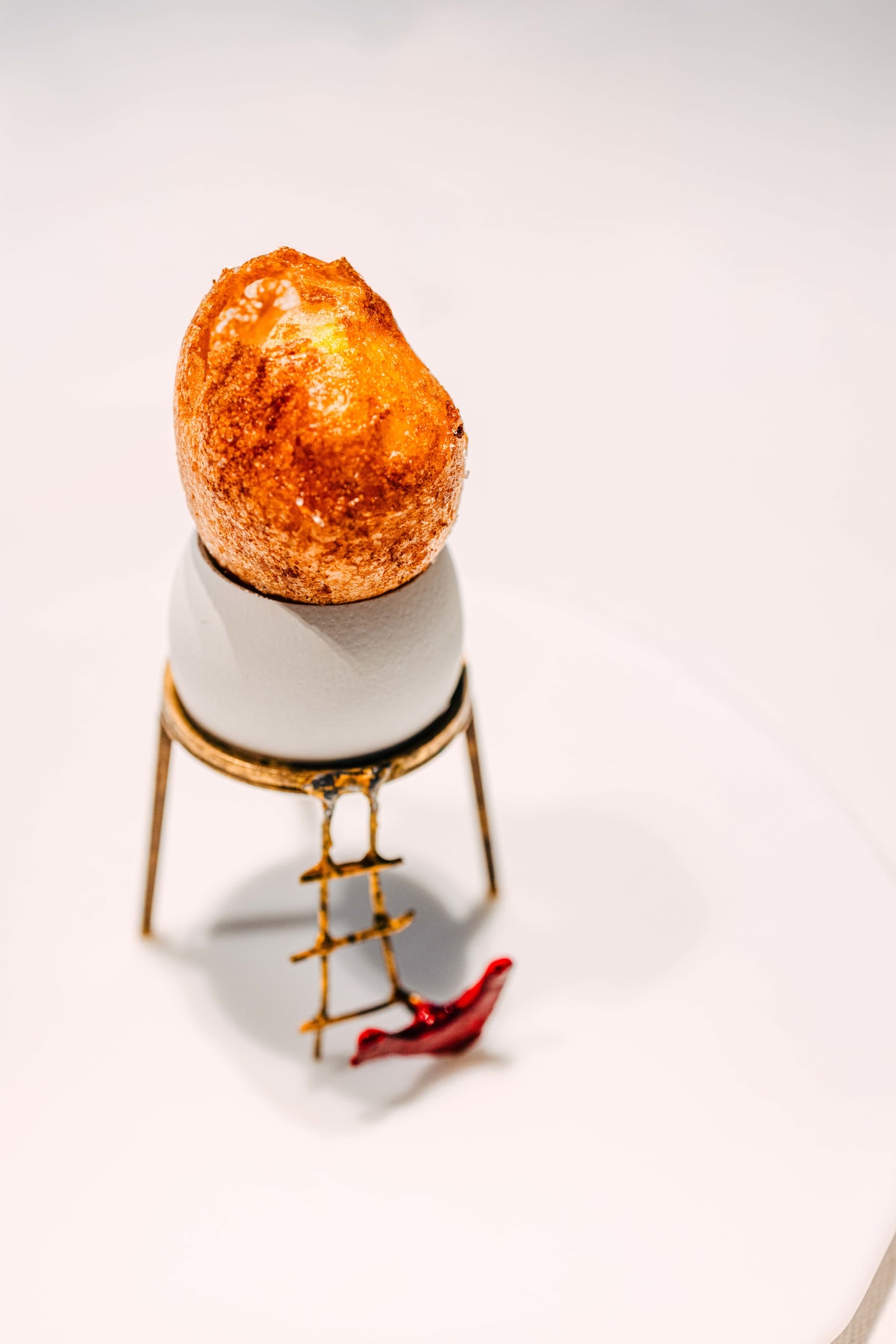
In an egg-shaped vessel, an egg-yolk tempura fried in its own membrane held the centre. Fried crisp on the outside while the yolk within remained liquid, it was something close to a poached egg. Inside the egg-shaped vessel there was warm mushroom jelly, served together. The server emphasised a three-step way of eating it. First, so the yolk inside can flow out, you take a small bite of the yolk tempura; then you spoon that liquid yolk back into the shell and mix it with the mushroom jelly outside; then you eat the yolk and the mushroom jelly together. When you take a bite of the tempura, the yolk bursts, and the texture of the tempura was excellent too; the mushroom jelly carried an outstanding, truffle-like flavour, and although the seasoning ran a touch high, it tasted truly good.
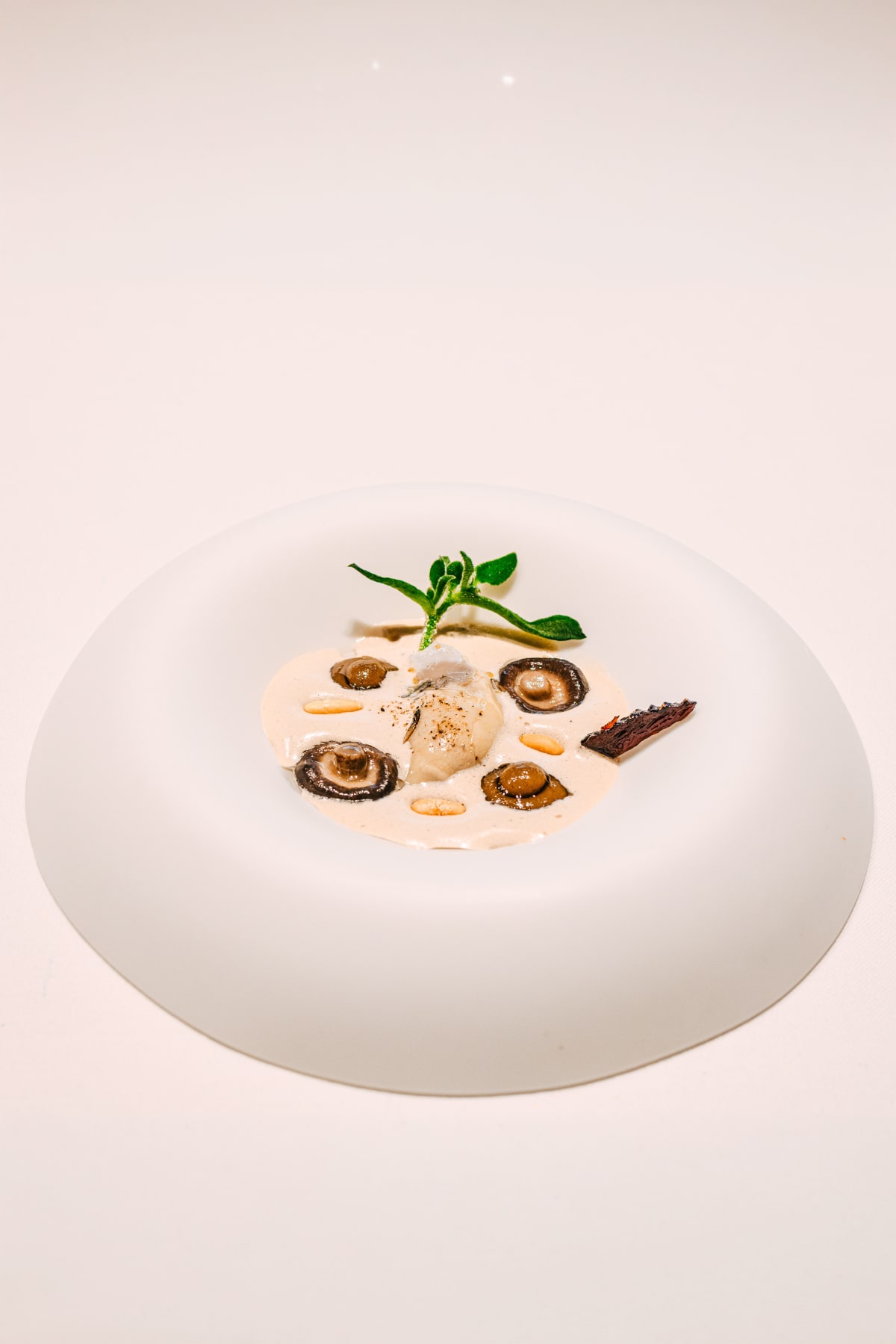
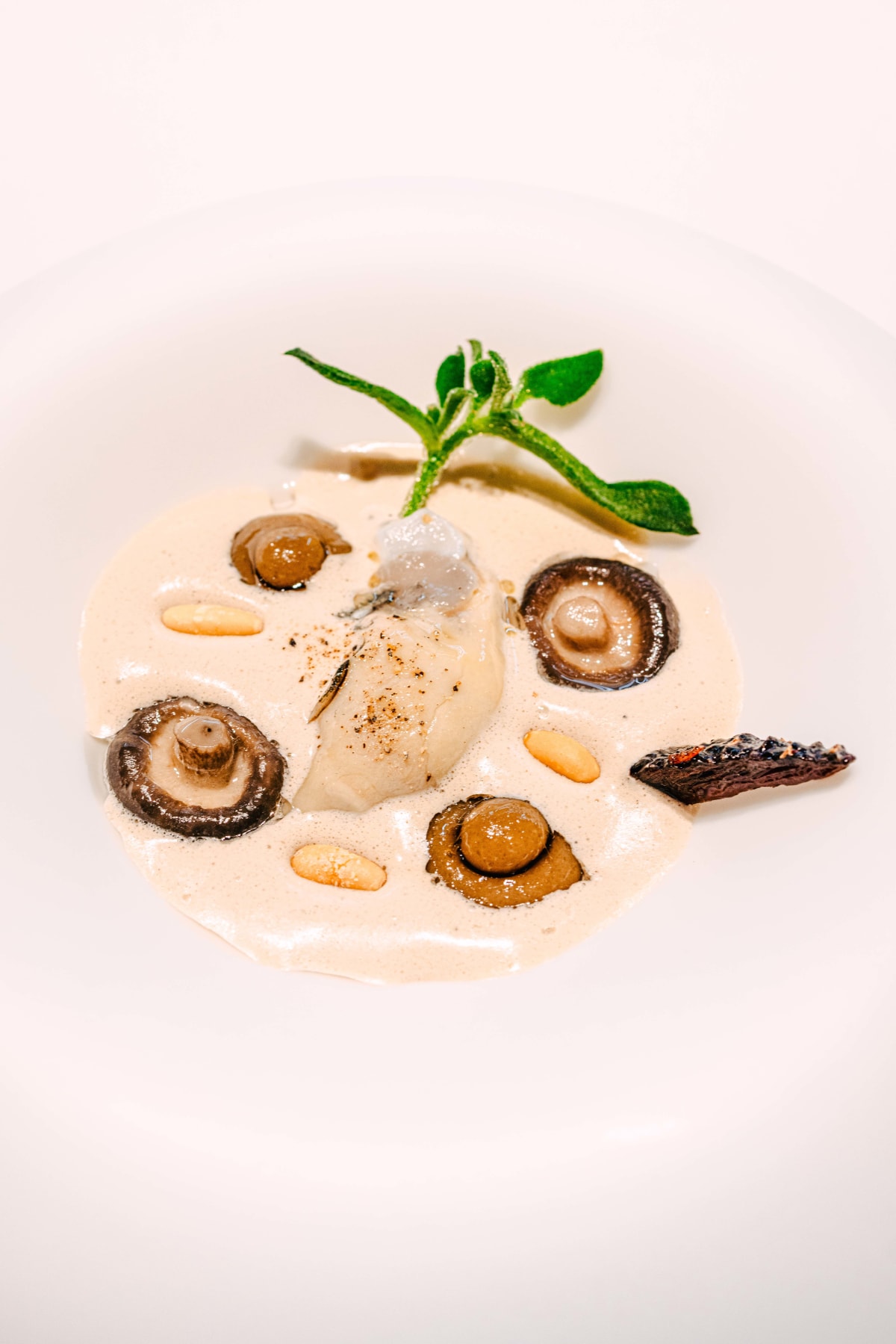
Yet another mushroom dish followed. "Marinated mushroom vinegar with oyster (2023)" was an uncommon pairing of mushroom and oyster. Before this dish came out, they brought over, once again, an extraordinary piece of machinery to show us. Mushroom vinegar goes into a bottle, and equipment pumps oxygen through it to mature and activate the vinegar rapidly.
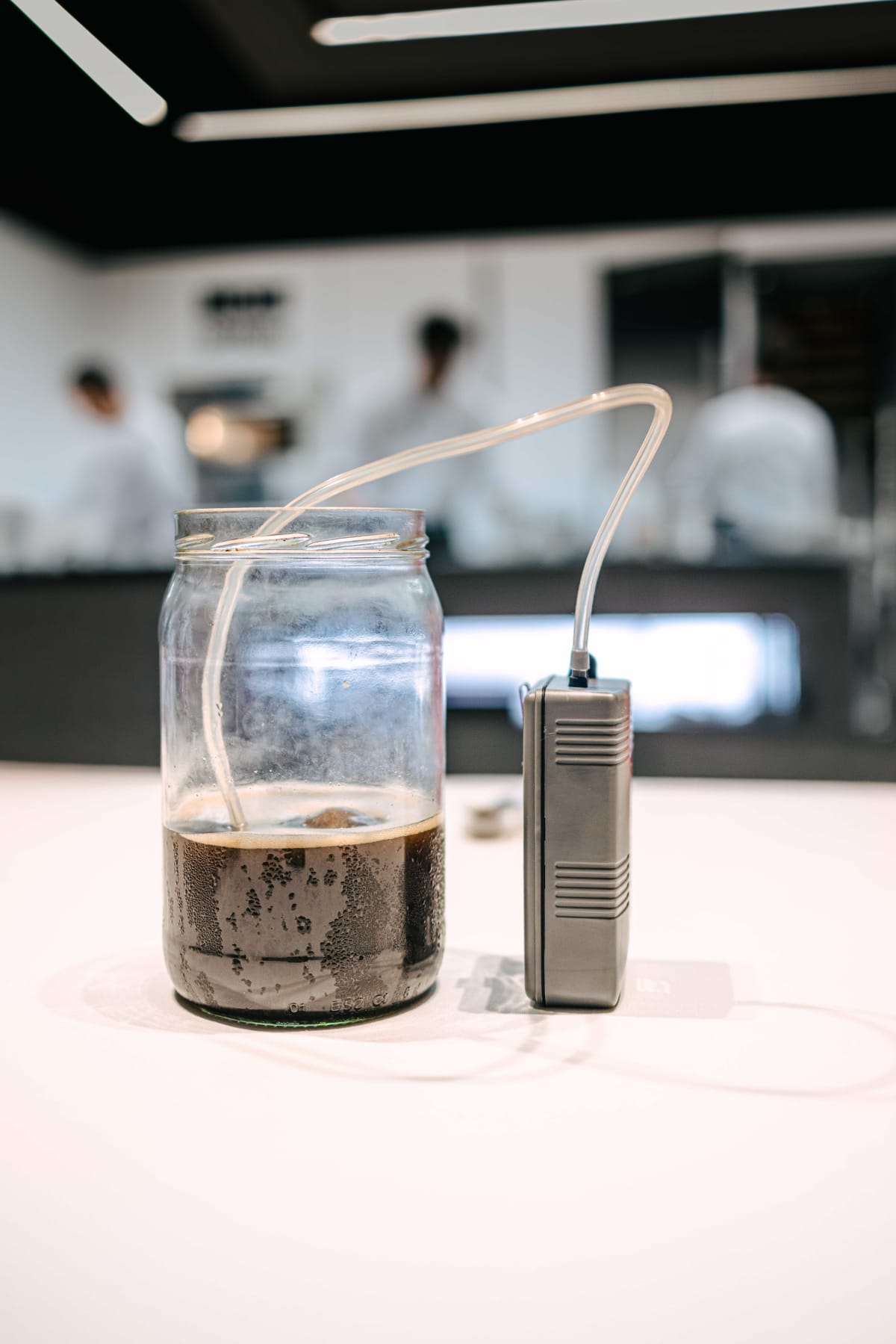
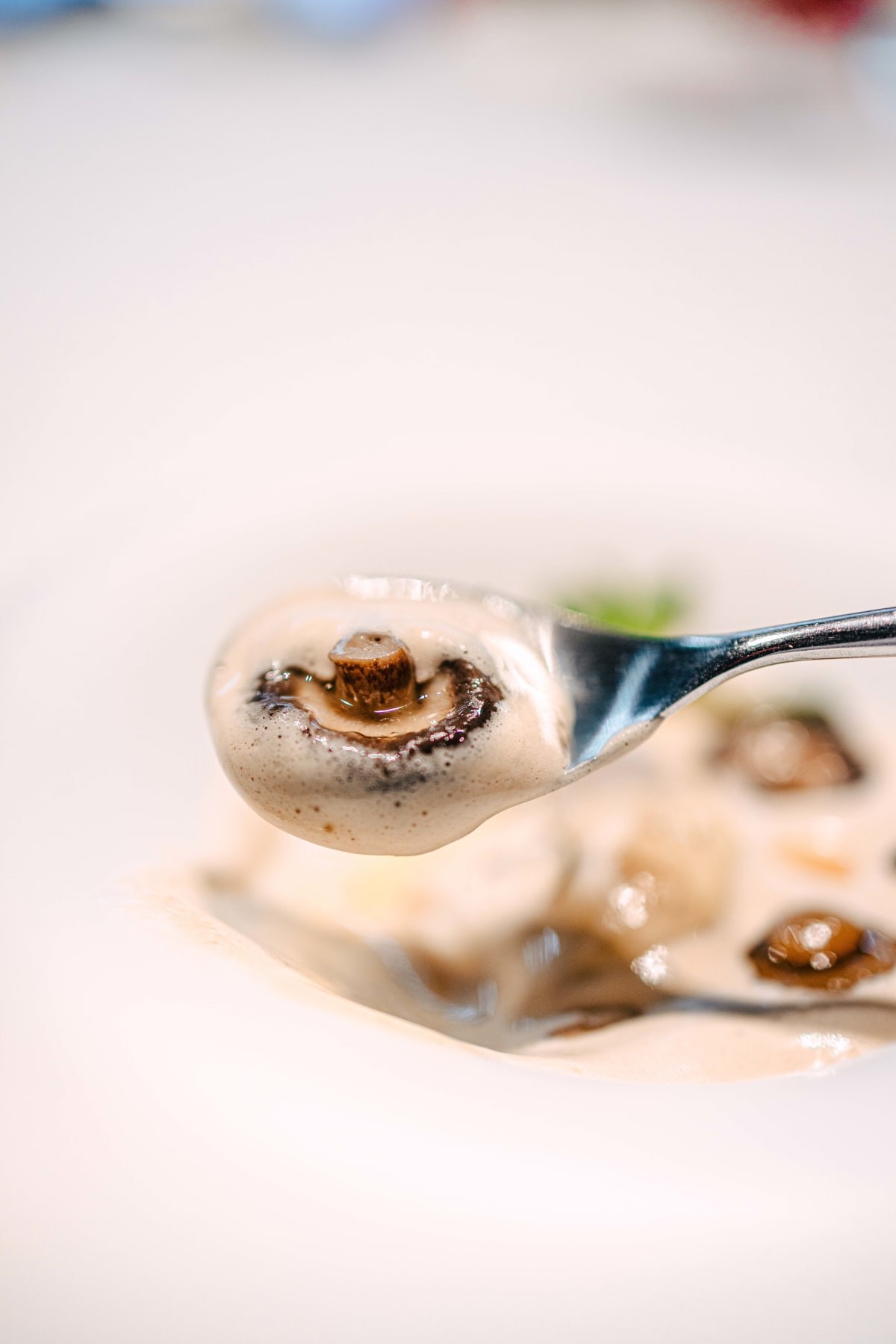
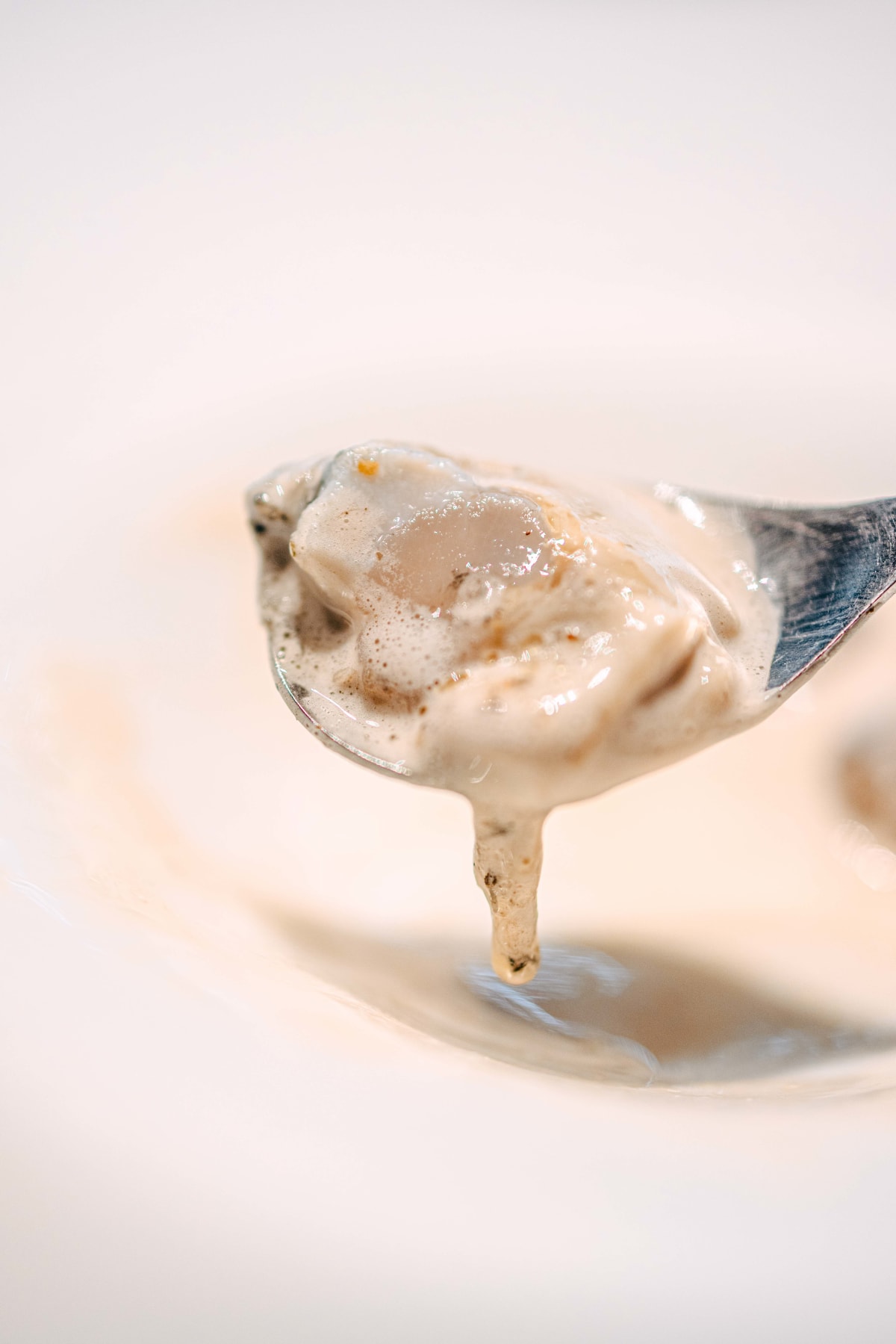
They introduced it as a device that brings a vinegar, which would traditionally take several months, up to a usable state in about fifteen days. The dish was shaped like a mushroom, with a mushroom jelly closer to pudding in texture, pine nuts, oyster, an ingredient that looked very much like shiitake, and ice plant. They seemed to have used the mushroom vinegar shown beforehand as a sauce, and perhaps for that reason the acidity was stronger than expected. By its look I thought a nutty character would dominate, but the acidity came first instead. Still, the acidity of the mushroom sauce made the combination with the oyster excellent, and the mushroom-shaped jelly also had an unusual texture.
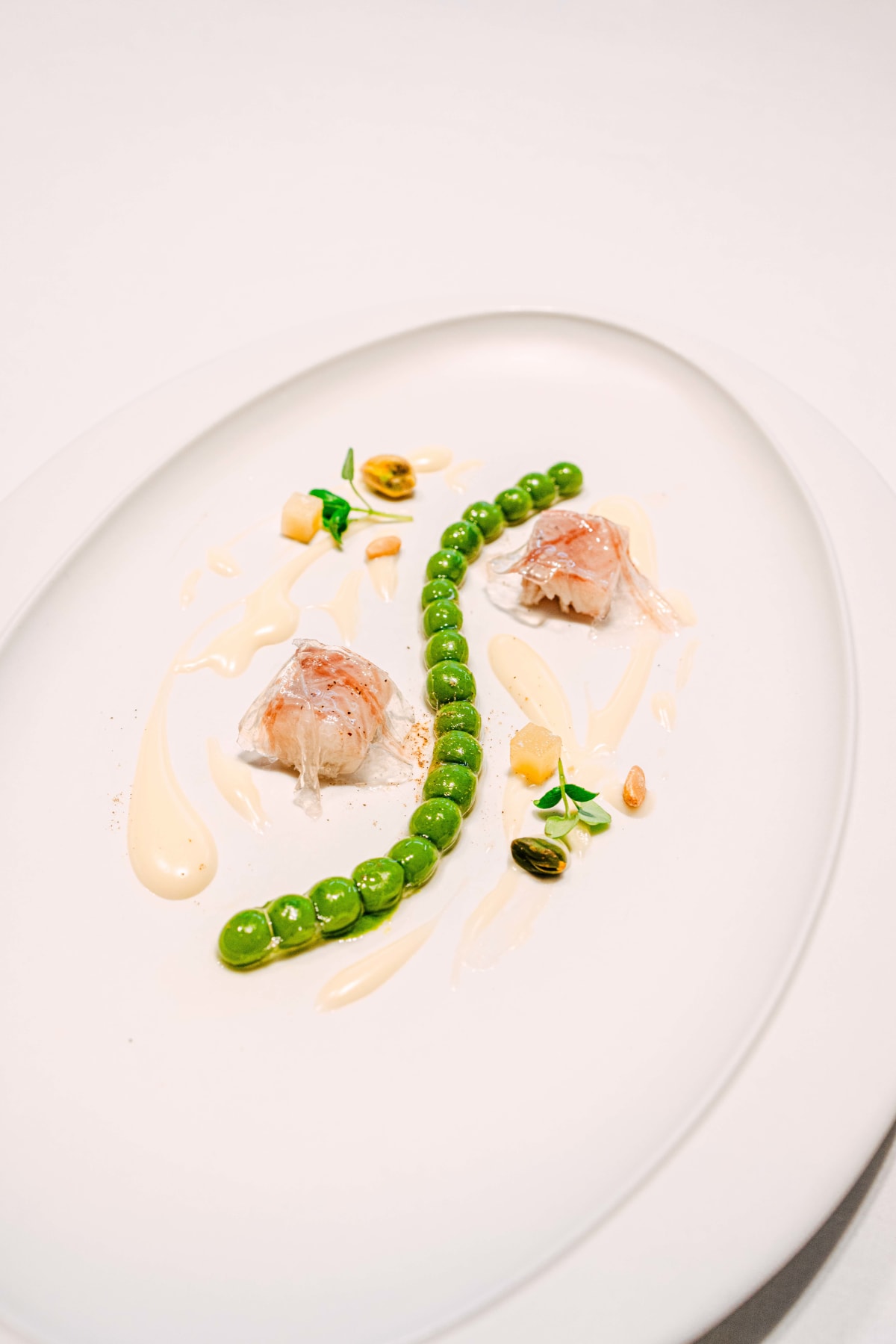
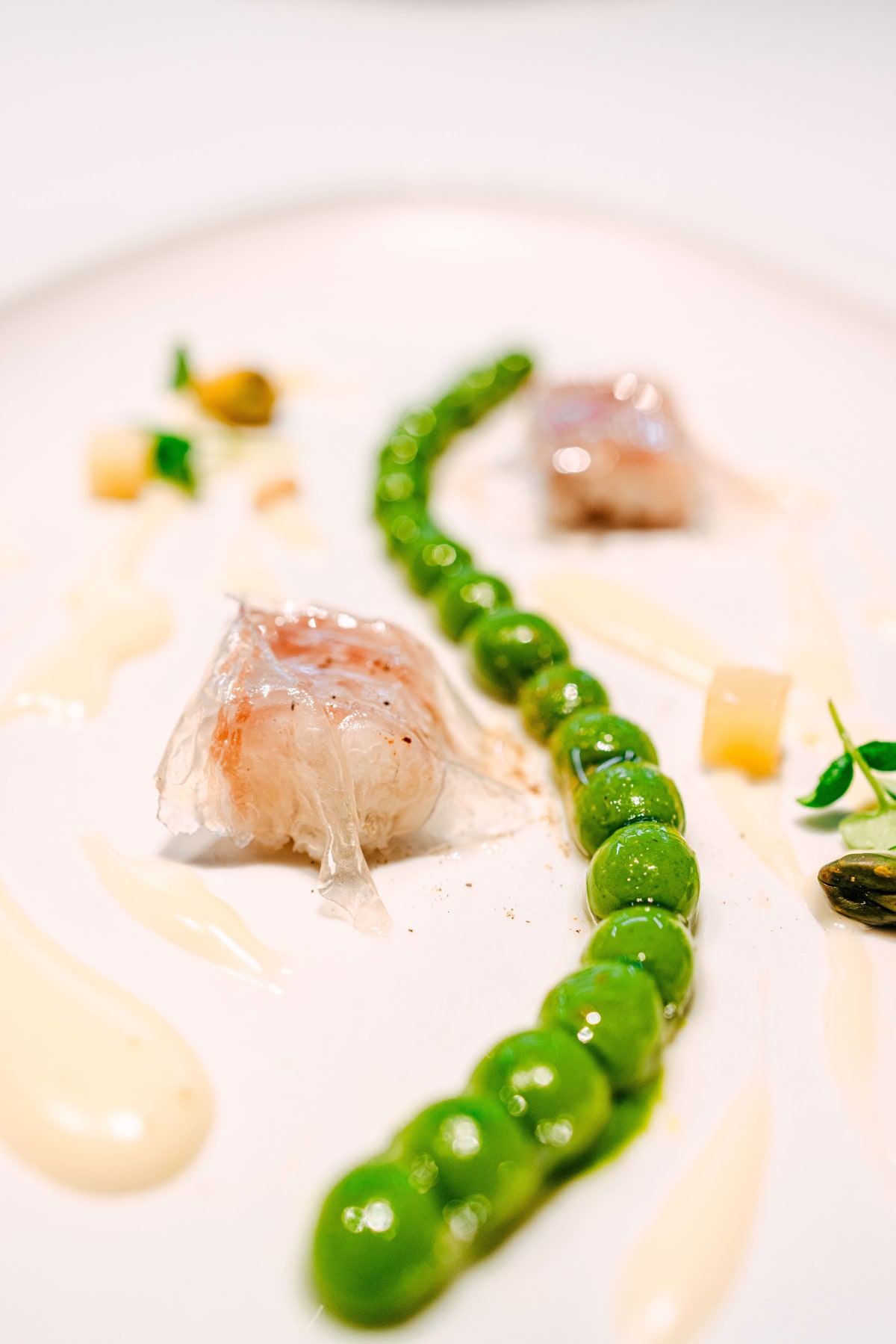
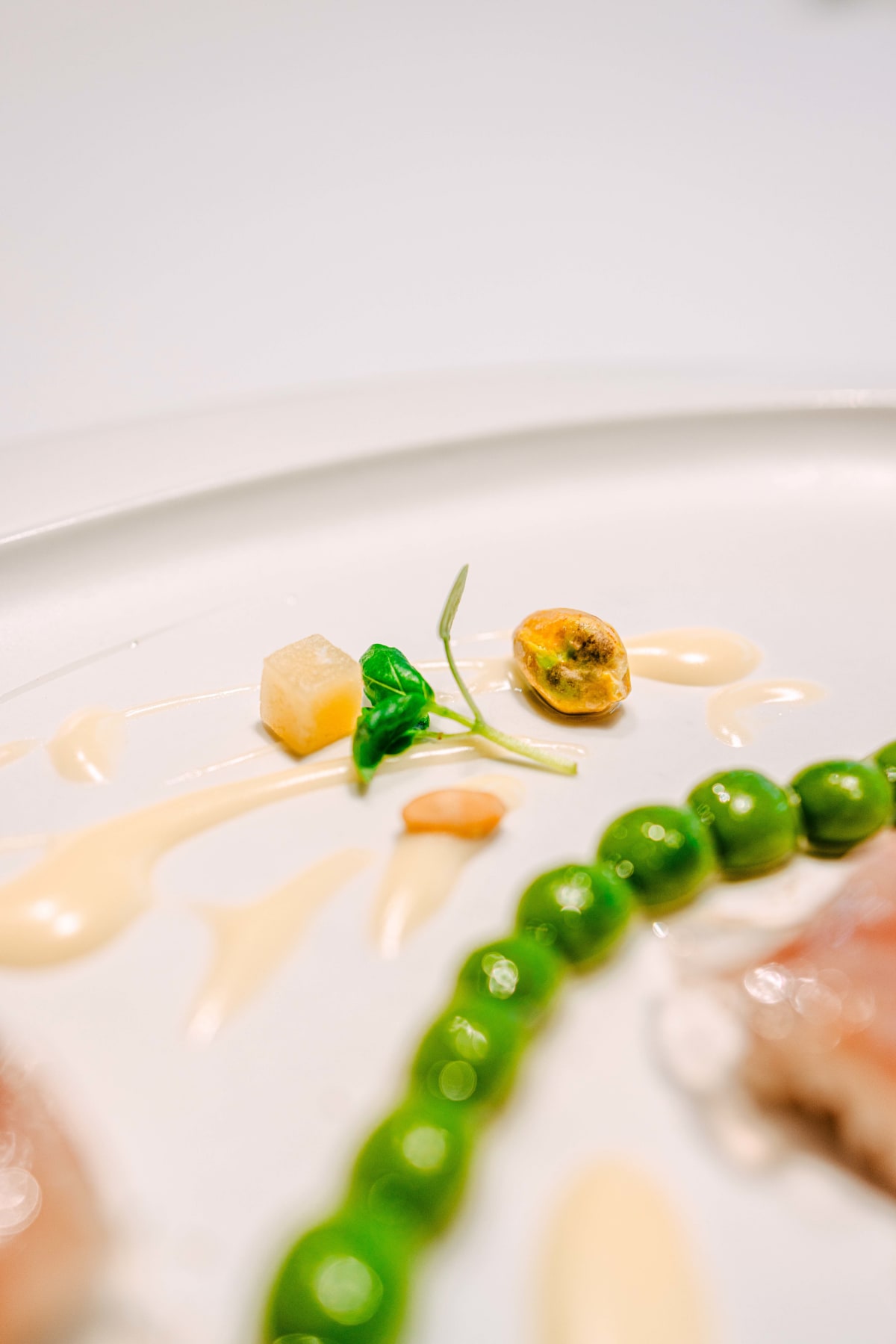
As the course passed its midpoint, it unfolded around proper dishes rather than amuse-bouche-like bites. "Multispherical pesto with pistachios and eel (2017)" was a plate with the varied components of French cuisine.
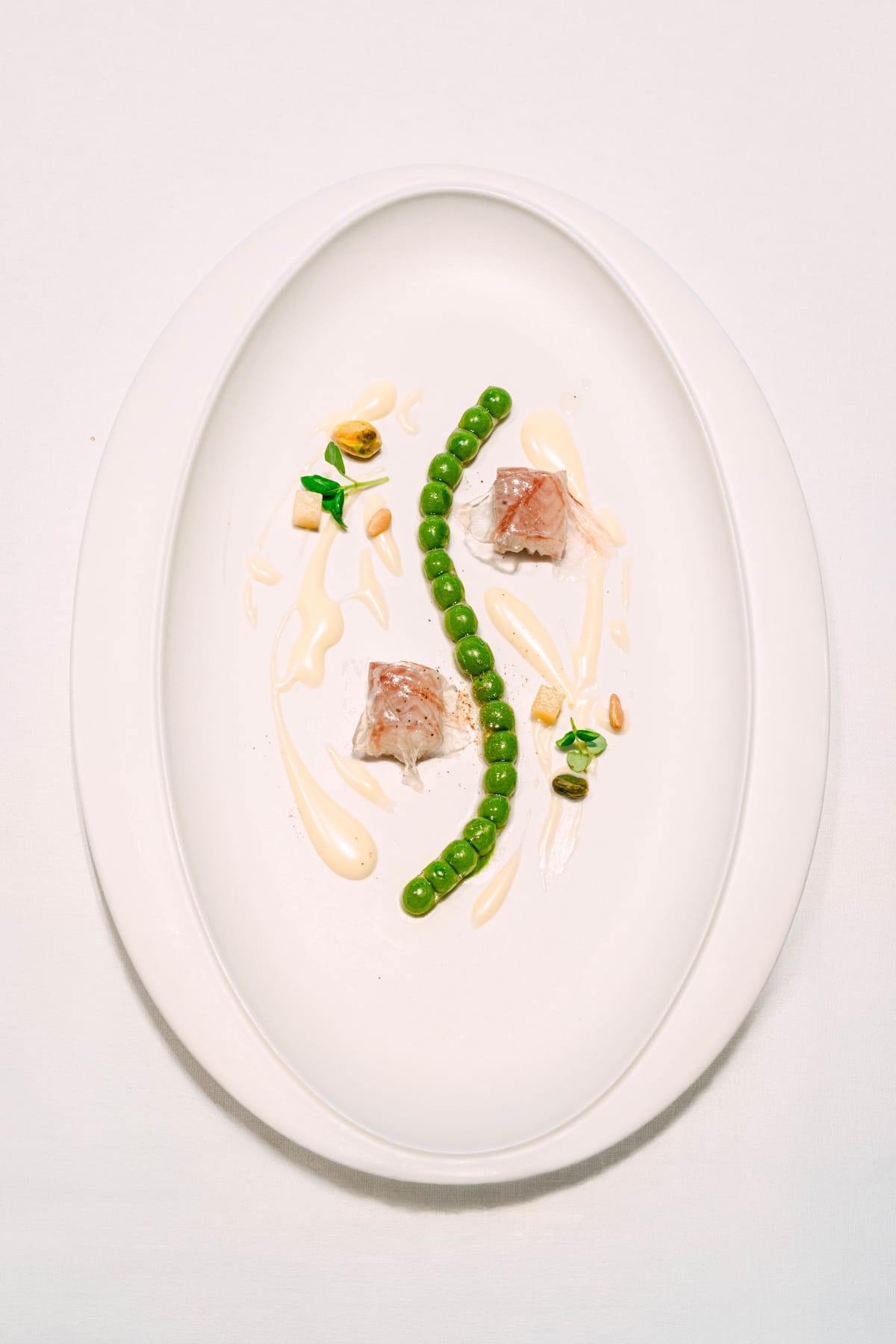
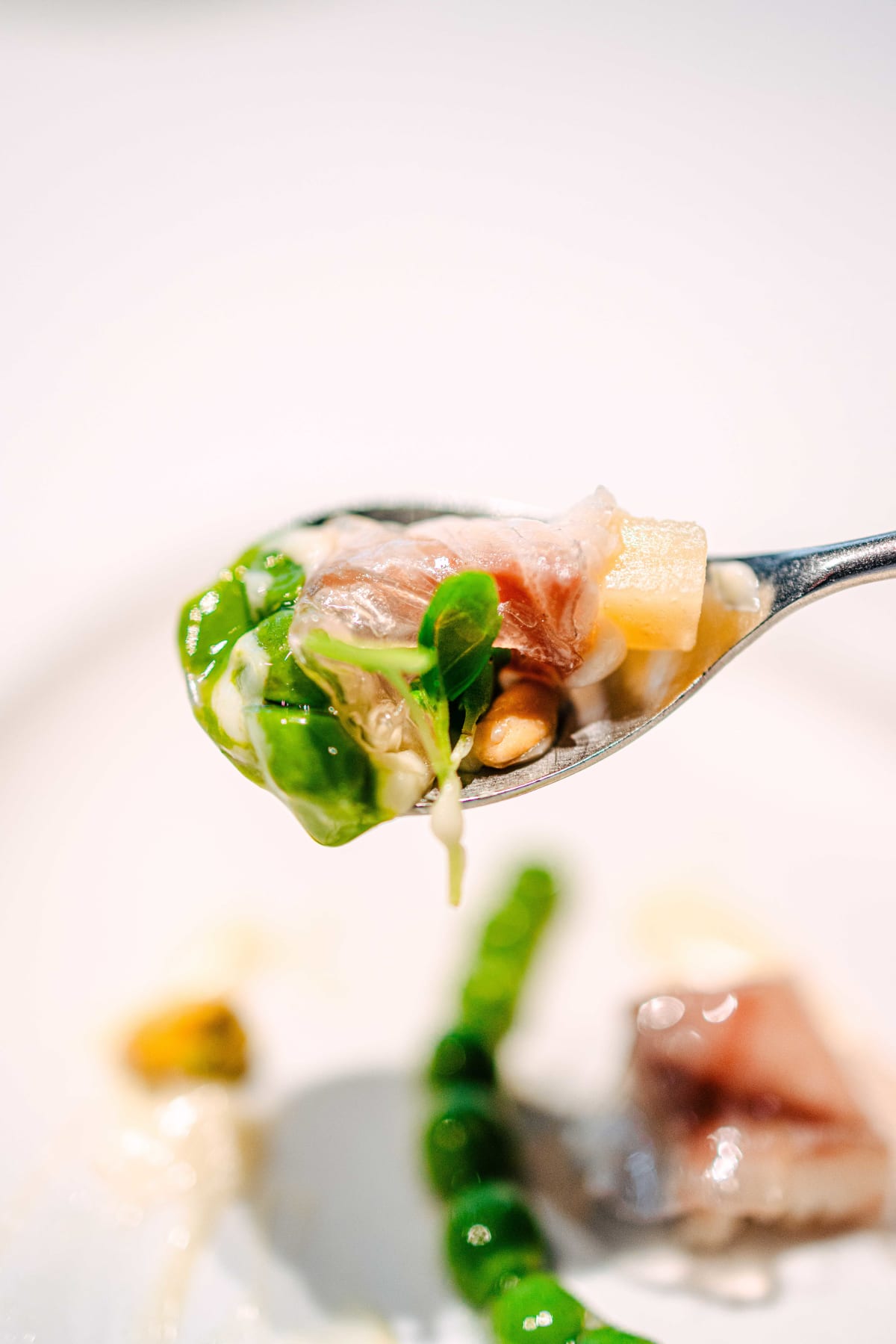
At the centre was smoked eel, the classical anchor of the dish. It was not simply eel but a composition with very thinly sliced pancetta, cured pork belly, laid on top. Beside it, a Parmigiano cheese sauce and pistachios were arranged like a painting. What caught the eye visually was a structure of peas packed densely in an S-shape down the middle, but it turned out these were not peas. The pesto sauce itself had been made with the multispherification technique. Basil pesto cream is enclosed within a very thin gelatin membrane and formed in a silicone mould, so that small spheres cling to one another to make a single shape. It was enough to make me say, "this is a sausage structure, isn't it, they have filled it with a stuffing." It was an original interpretation of the pairing between Italian-style pesto and Mediterranean smoked fish. The combination of eel, pancetta, and Parmigiano cheese was outstanding, and with a smoky, ham-and-cheese-like feel plus the firm texture of the fish, it was superb. The technique of joining the basil sauce into beads with a membrane was impressive too.
Section 9·The Fifth Flow: Tradition Reinterpreted, and the Gaps in Creativity
While waiting for the next dish, the server first showed us a transparent penne pasta noodle.
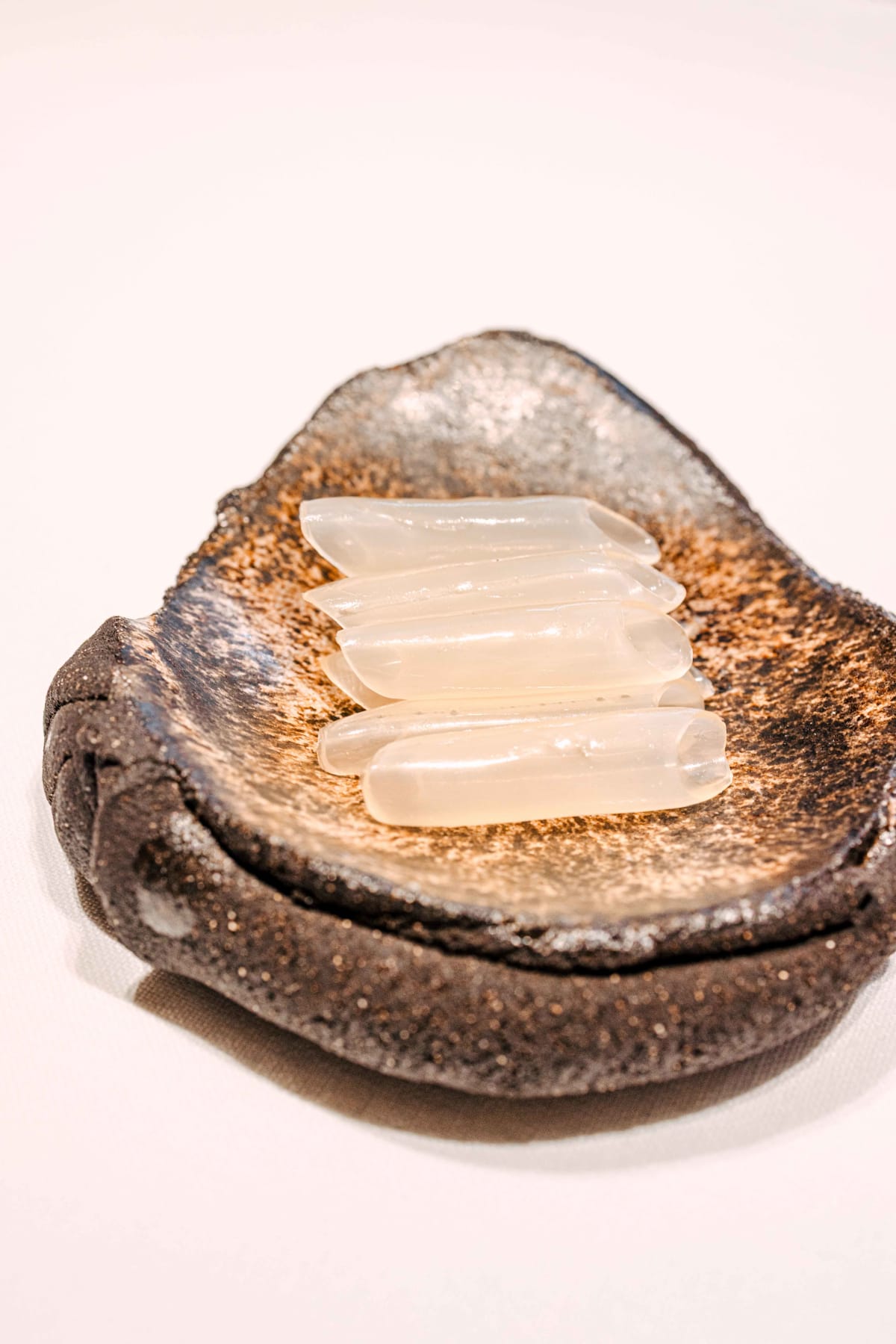
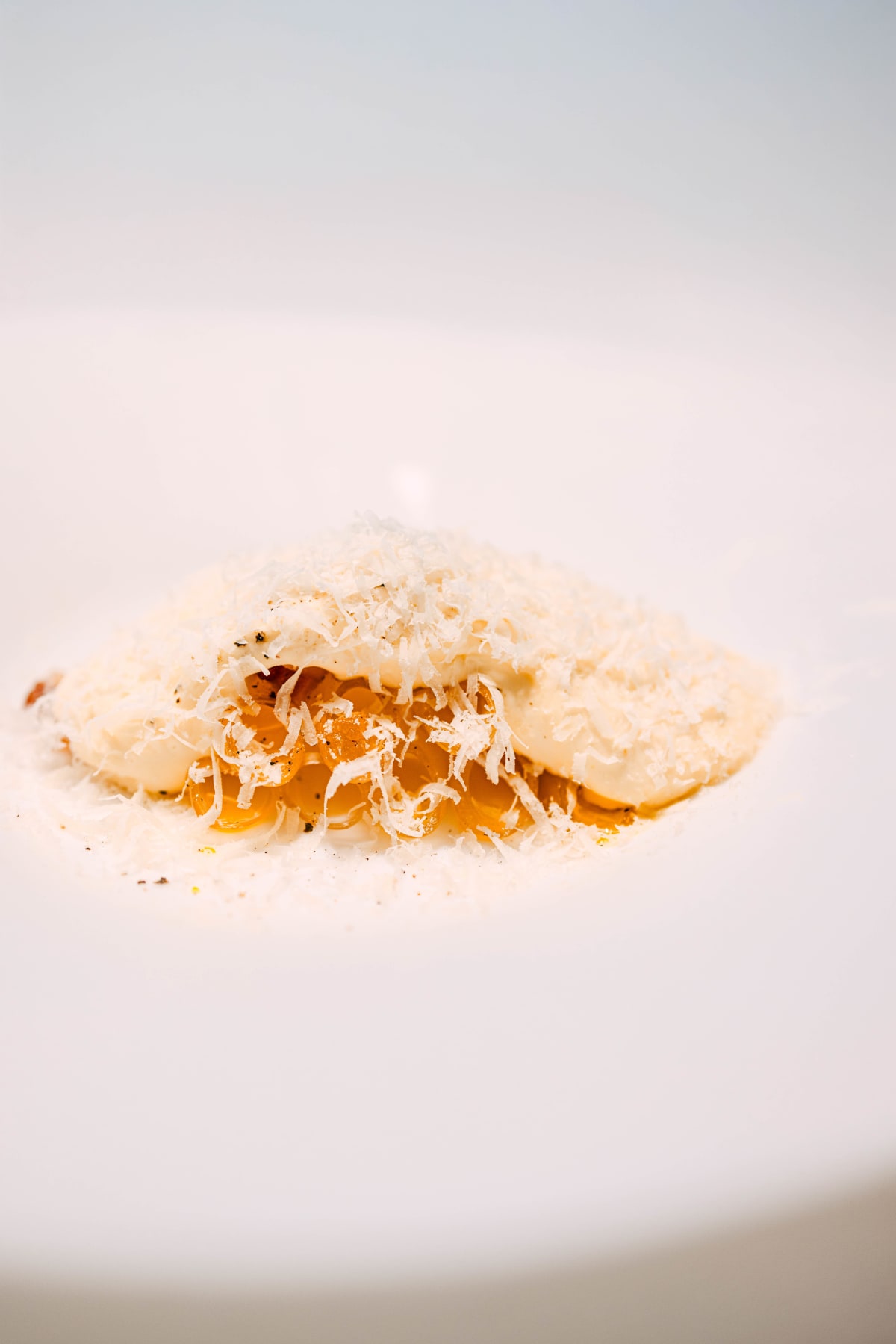
It turned out to be the completely transparent macaroni used in "Our macaroni alla carbonara (2014)." This was not a flour pasta but something made from 100 percent Ibérico ham soup, gelled so that a "solidified soup" takes the form of macaroni. As a result there was almost no sense of carbohydrate or body to the noodle, and the Ibérico fat felt like the protagonist. The server's emphasis was memorable: "we use only the original carbonara ingredients. But we do not reproduce the original carbonara." They used the existing carbonara ingredients of guanciale, Parmigiano cheese, and black pepper, and on top they poured a carbonara sauce made into a creamy espuma. Finally, just like a real carbonara, they finished it with cheese.
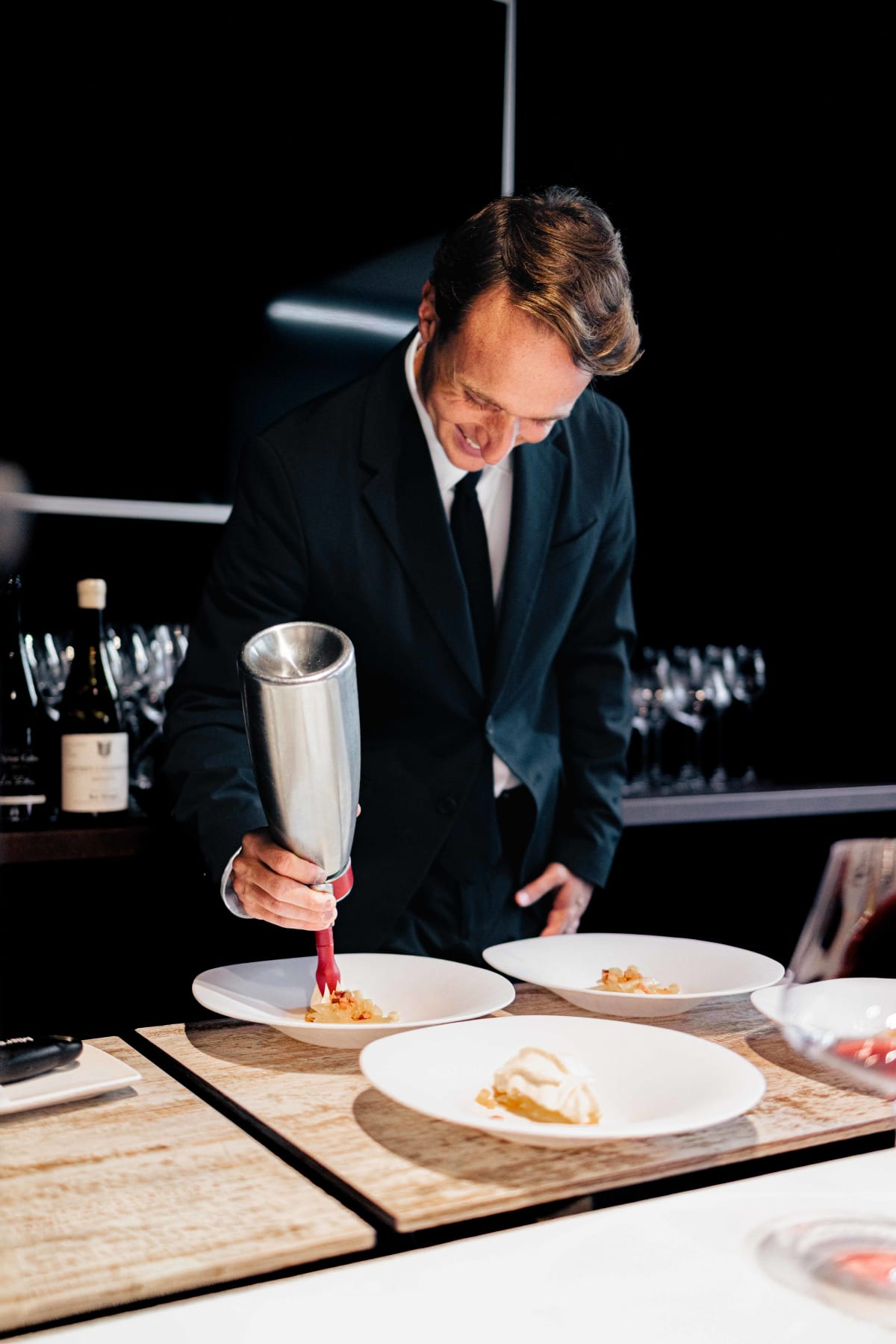
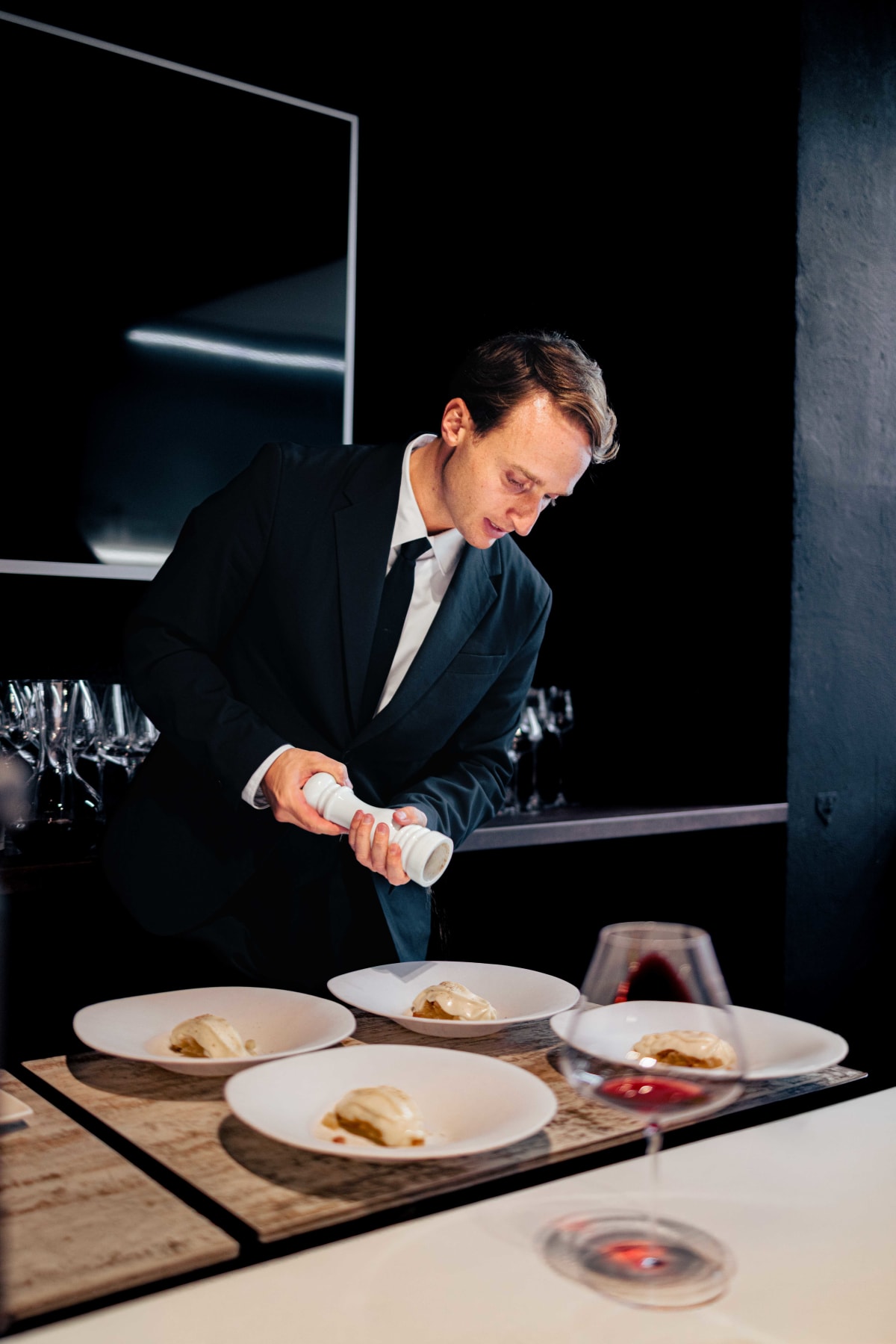
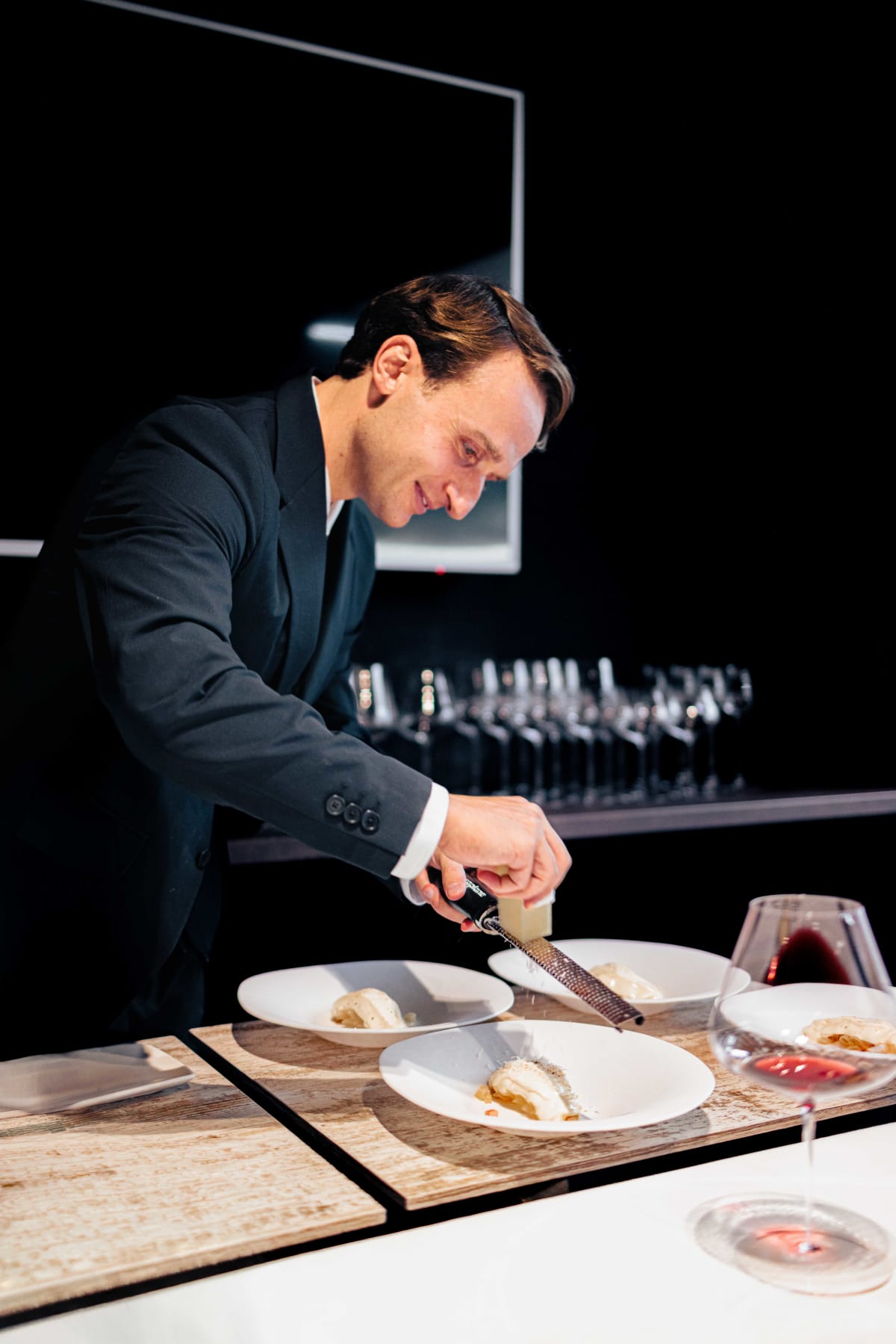
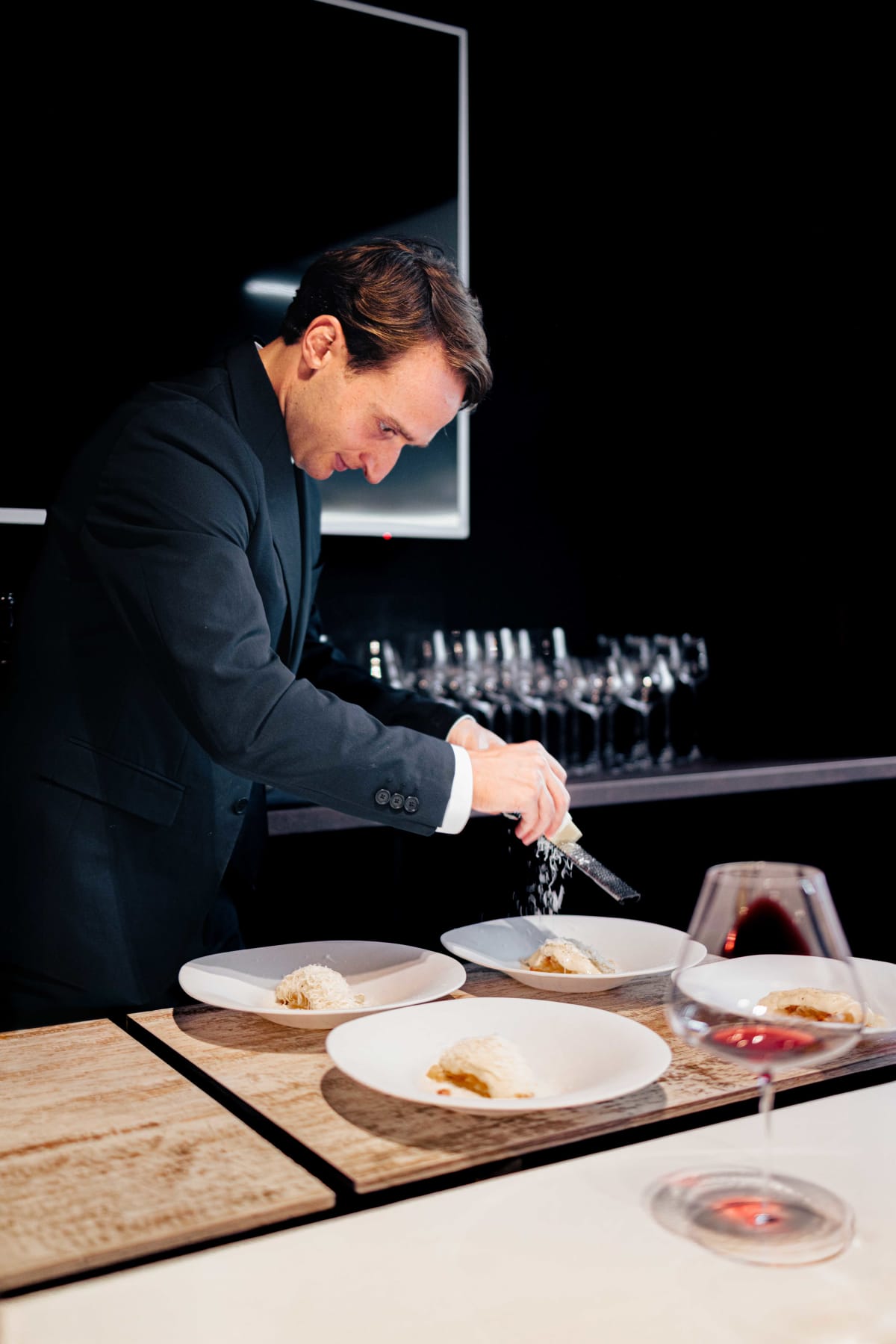
The important thing, they said, was not to mix it but to feel the layers one by one from the bottom up.
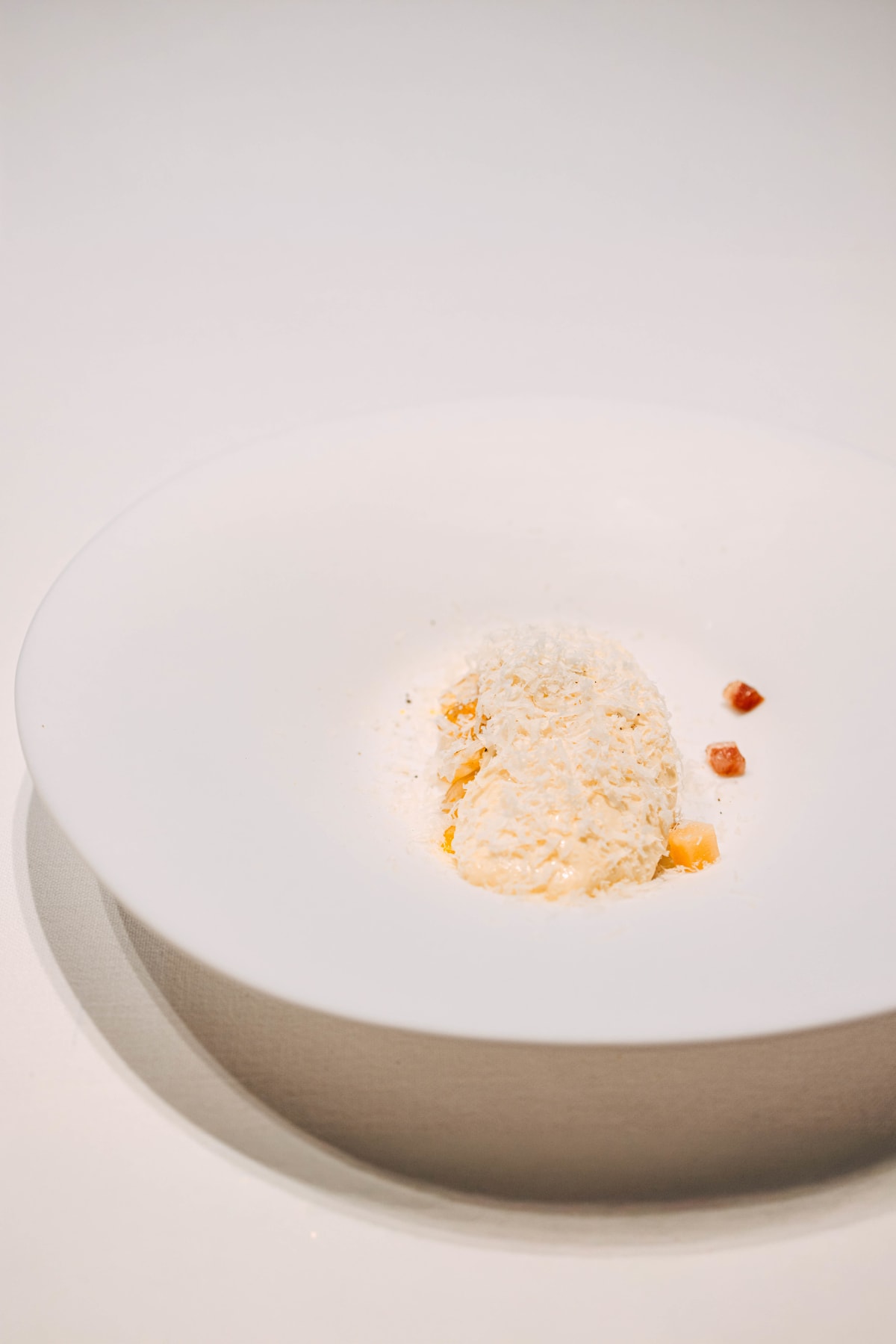
Personally, the noodle had a konjac-like texture with none of the satiety of a carbohydrate, which was a bit of a letdown. The espuma carbonara sauce had good cheese flavour, and with cheese cubes and guanciale inside the salinity was right too, but it lacked depth and weight. It is said to be a signature dish, but it did not match the big impact of the earlier courses. Still, it was an original and amusing dish. The server looking after us that day was Italian, so I asked "how is this pasta," and the answer was "no."
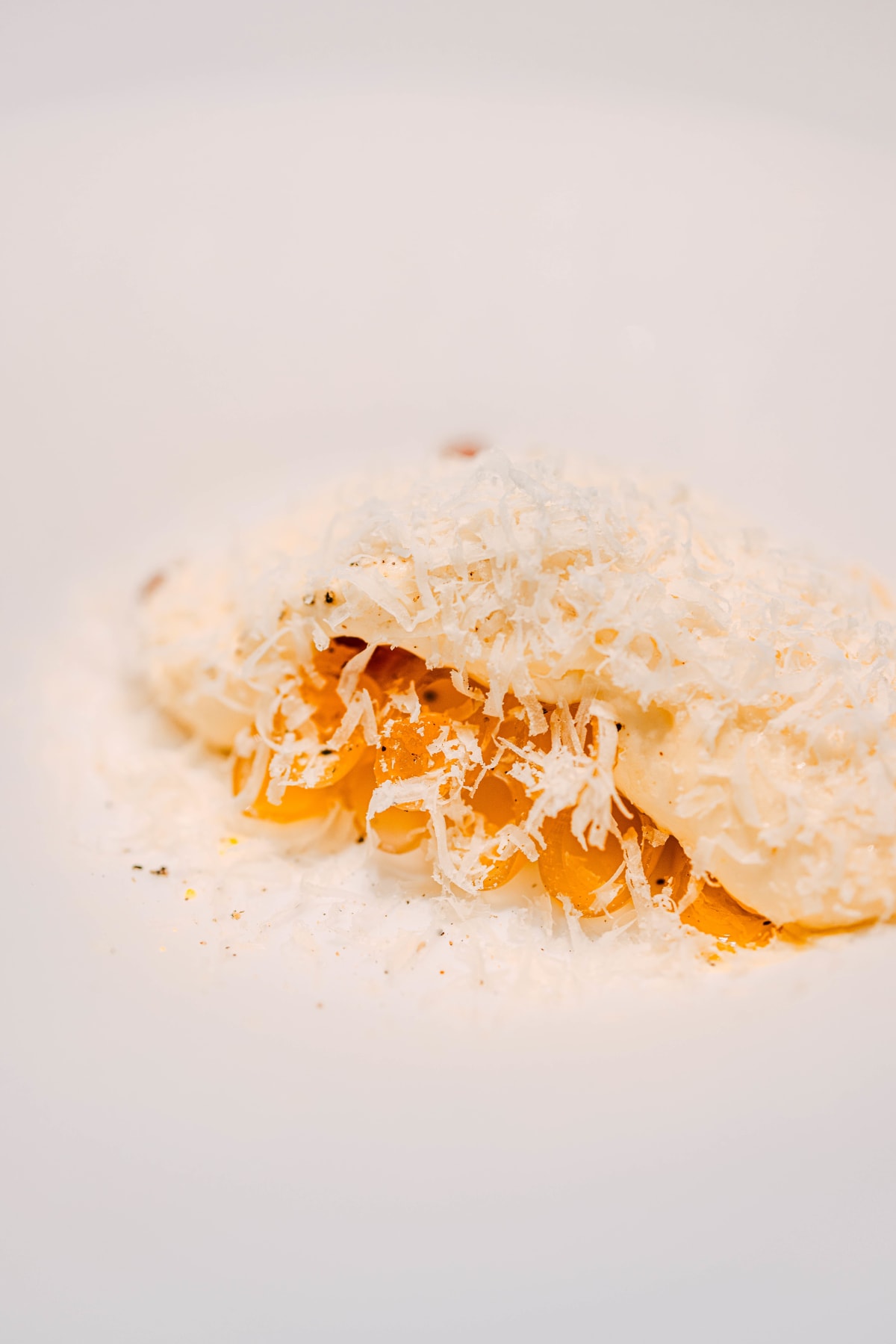
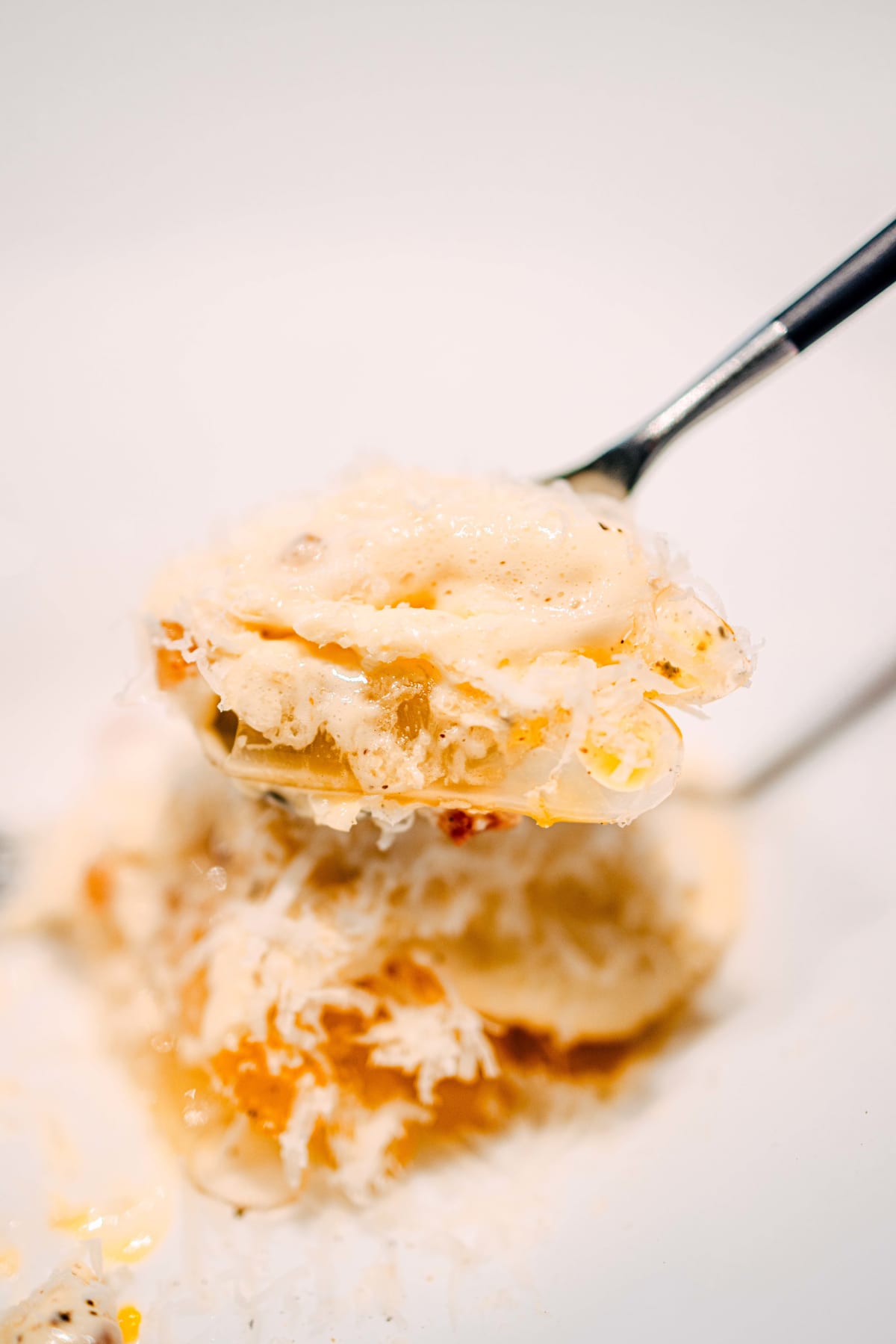
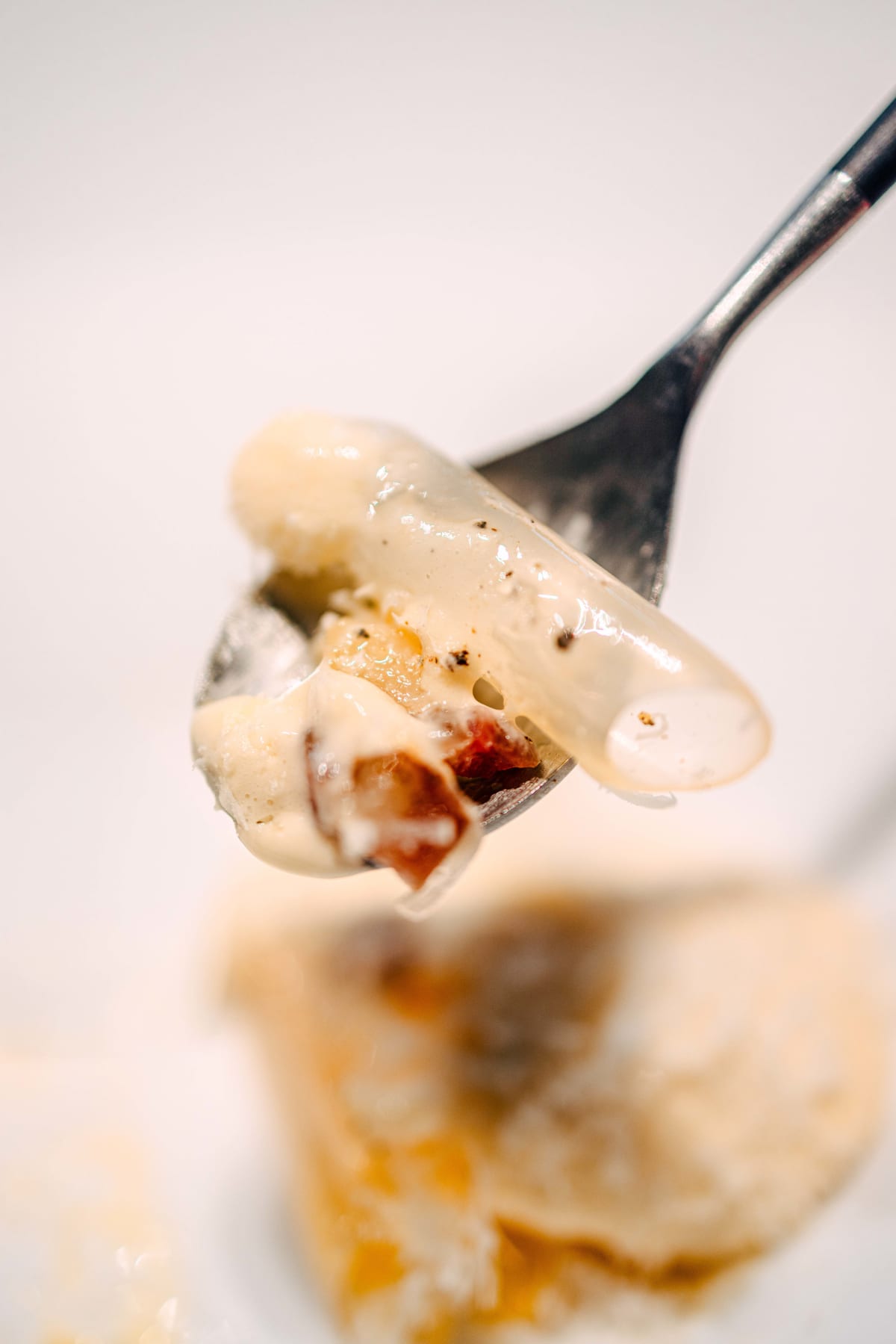
As the course moved into its latter half, fish dishes appeared: "Hake Suquet (2016)" and "Cappuccino Suquet (2016)."
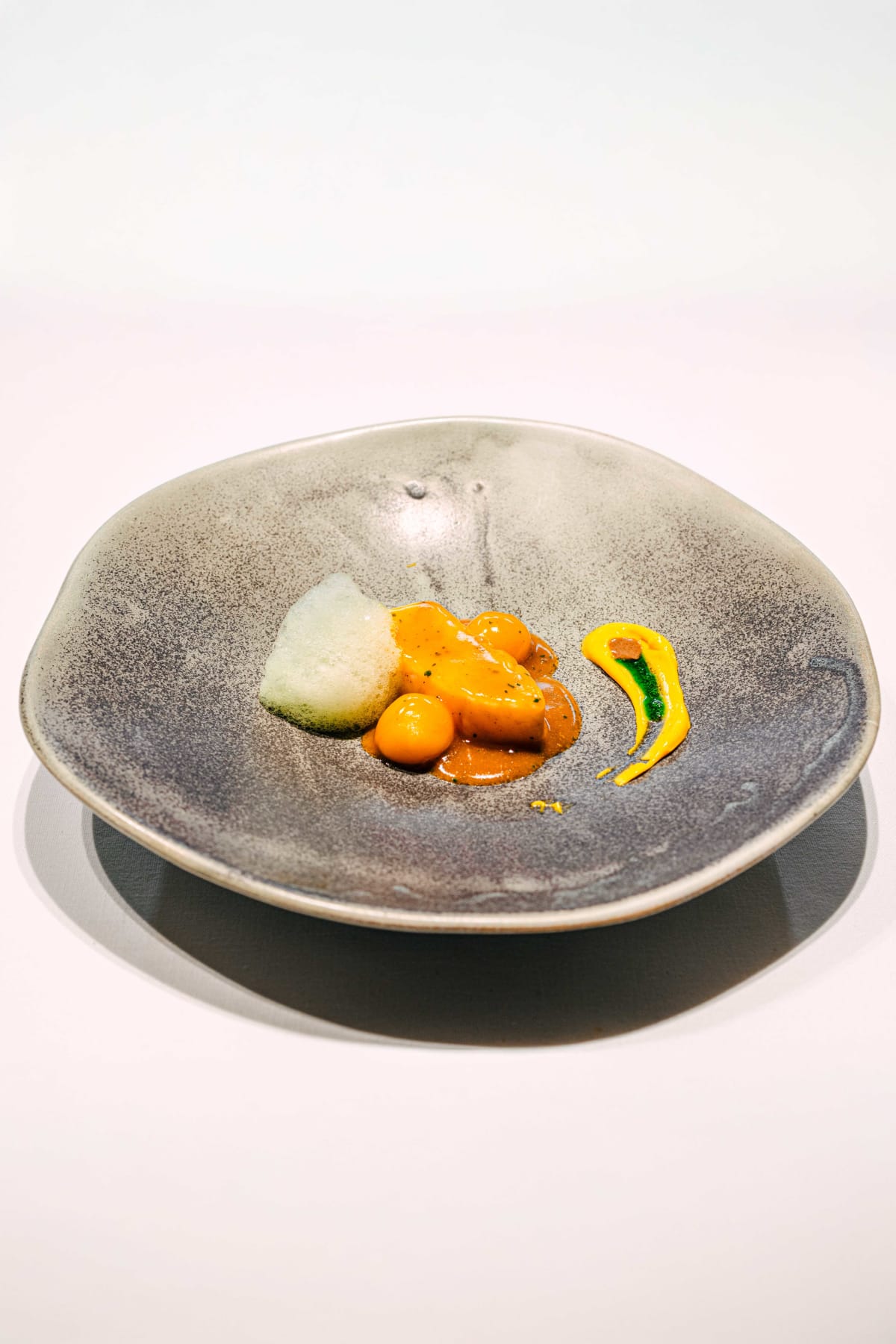
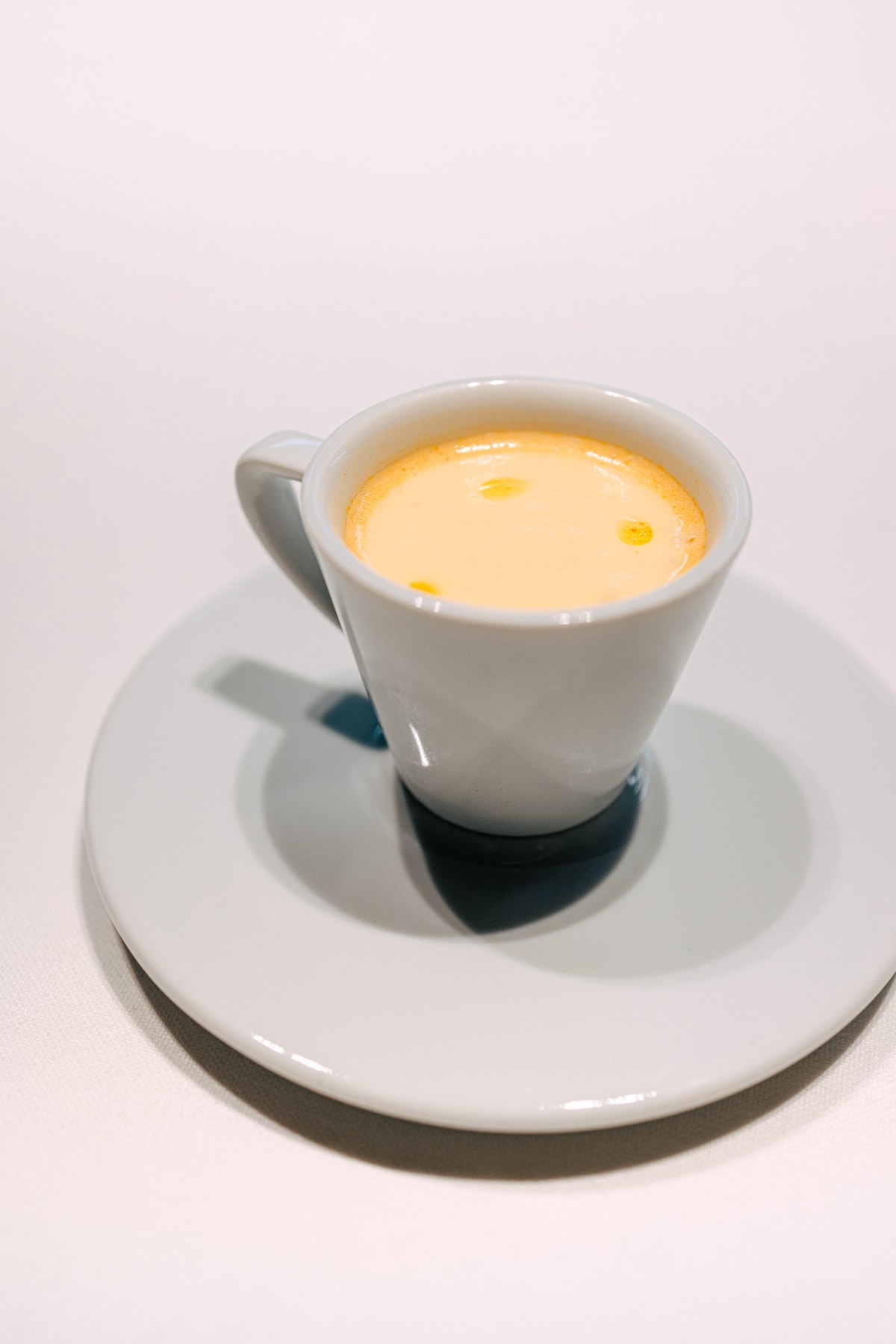
The dish itself had, for the first time in a while, a thoroughly normal appearance. Suquet is a traditional Catalan fisherman's fish stew, based on potato, garlic, saffron, aioli, and parsley. Disfrutar reconstructed this tradition without deconstructing it, changing only its form. For the main component they used hake, or merluza, which was extremely tender and appeared to have been gently cooked at a relatively low temperature. Served alongside it was a potato gnocchi made from real grated potato, which looked just like an actual potato, and the yellow sauce beside it was a saffron aioli, said to be a very important sauce in the traditional suquet. This dish was very, very good. To begin with, the cooking of the fish was truly excellent, to the point that it fell apart at a touch; the potato gnocchi was outstanding too; and right down to the saffron sauce, the overall balance and umami were truly superb. It was an insanely good dish.
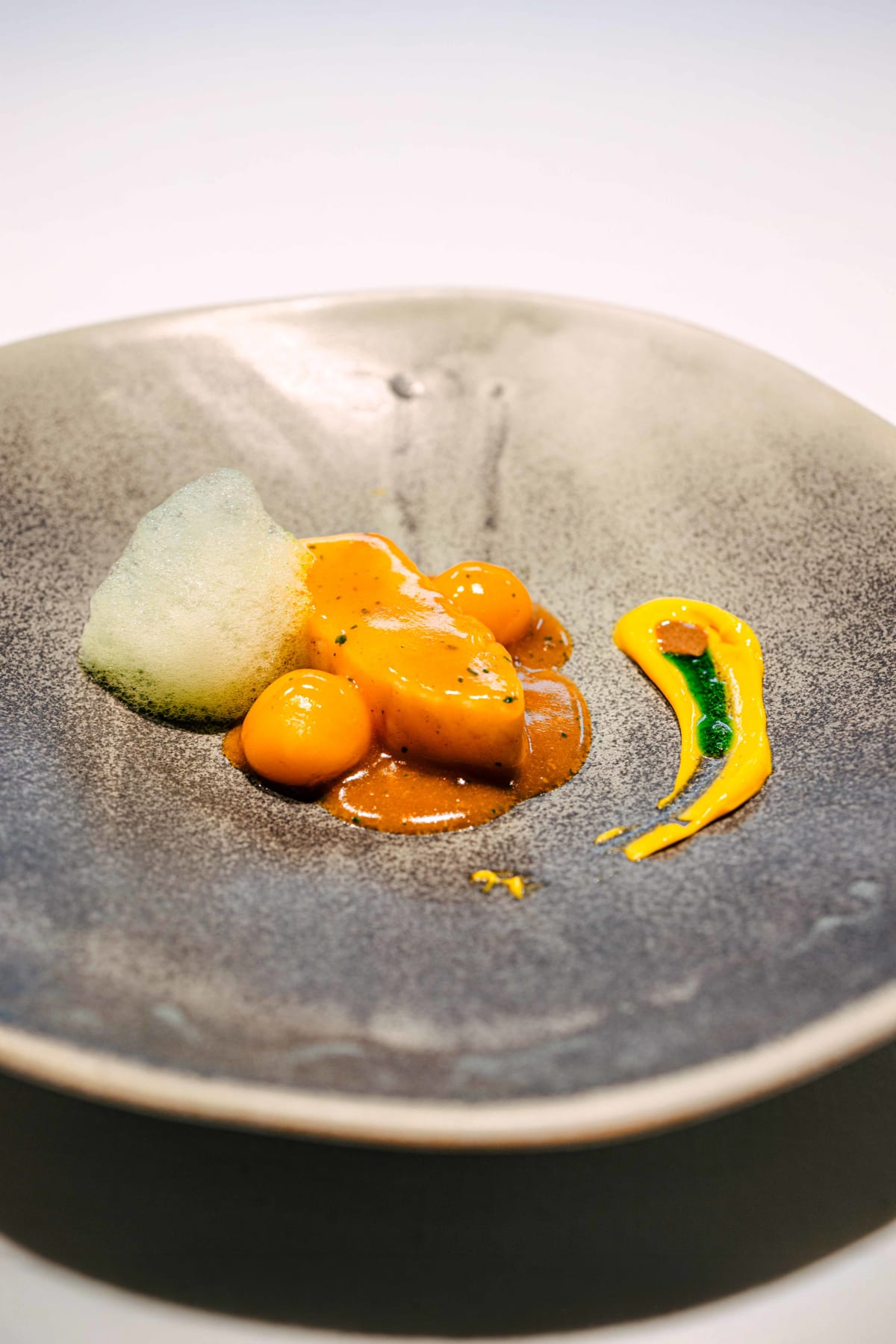
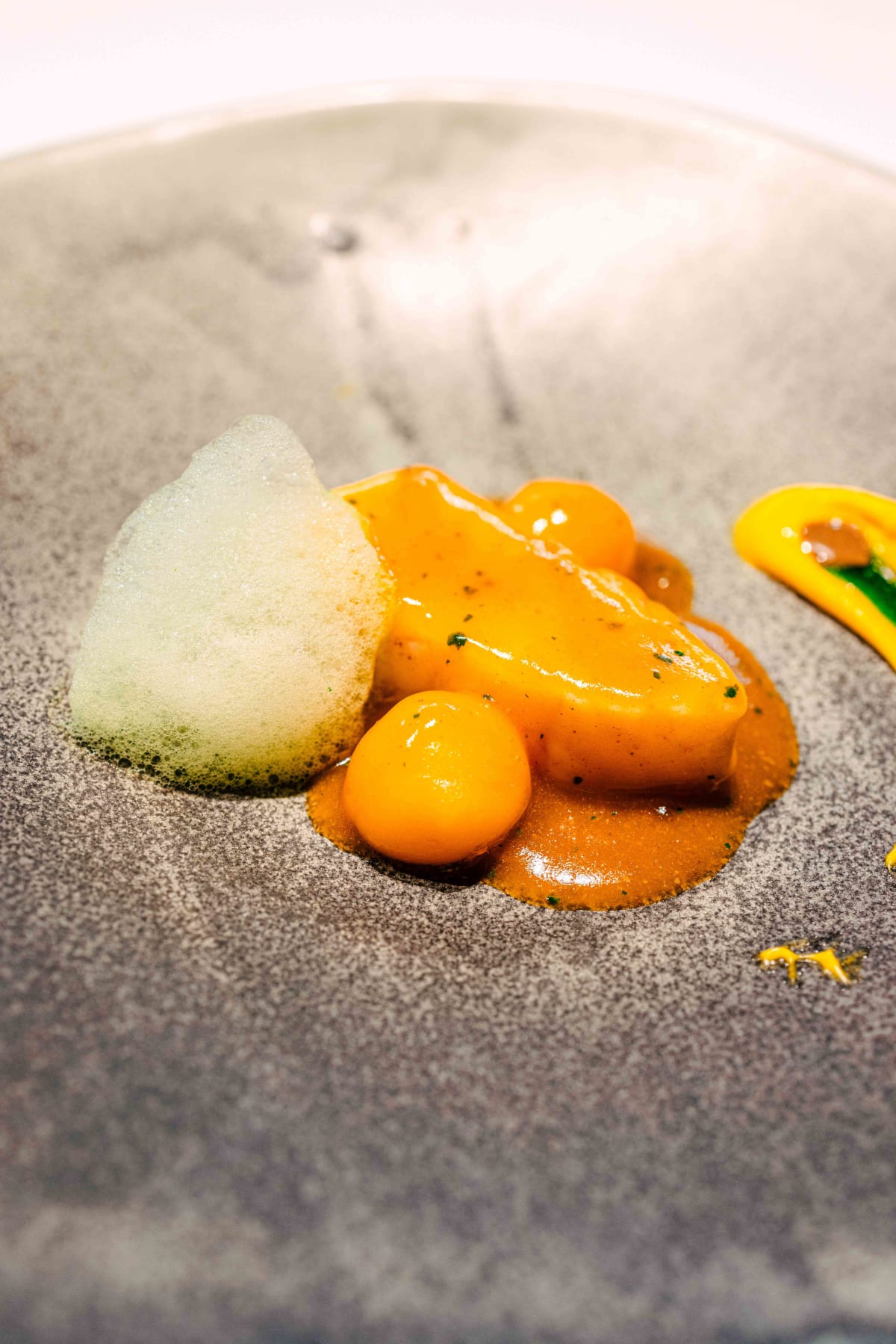
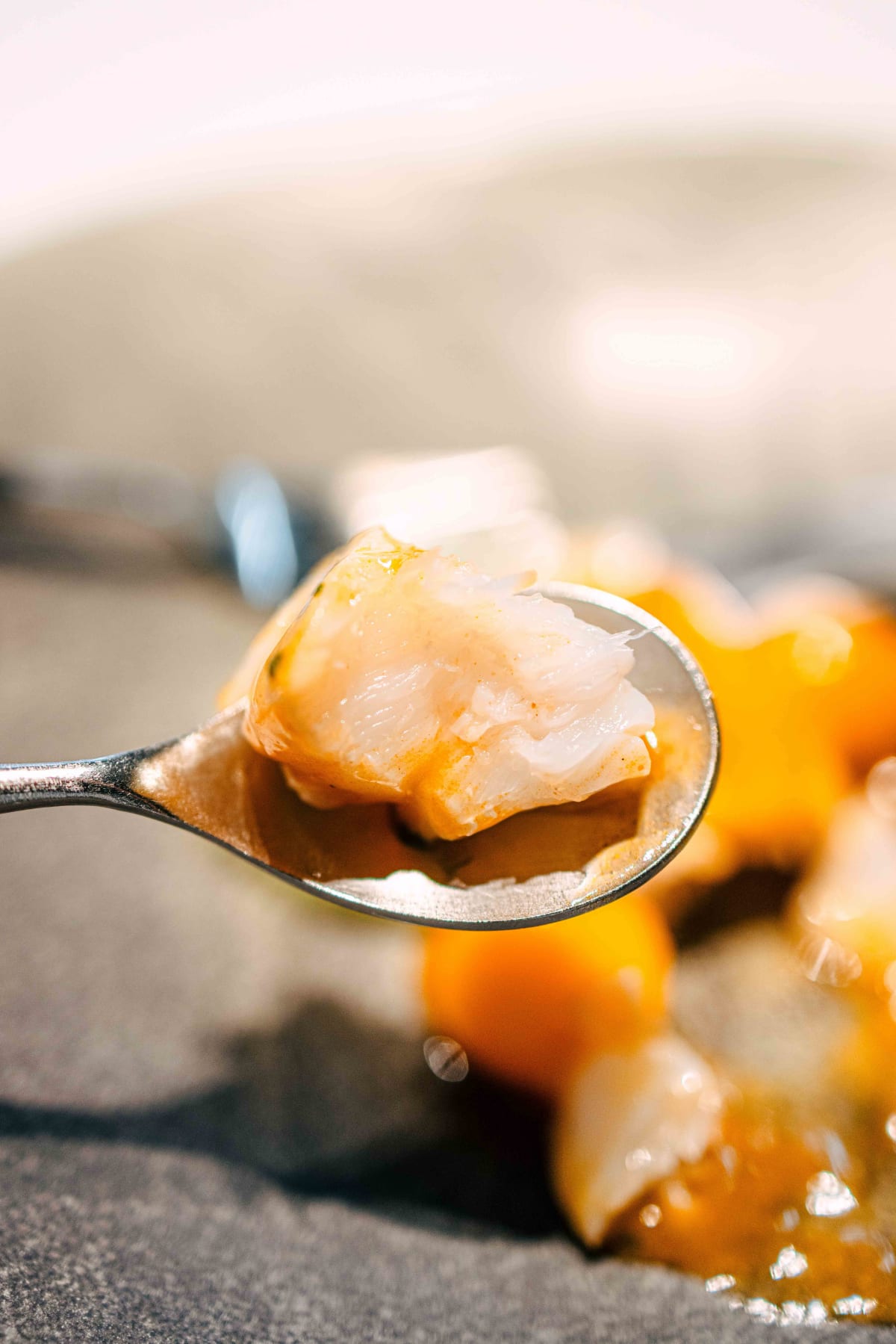
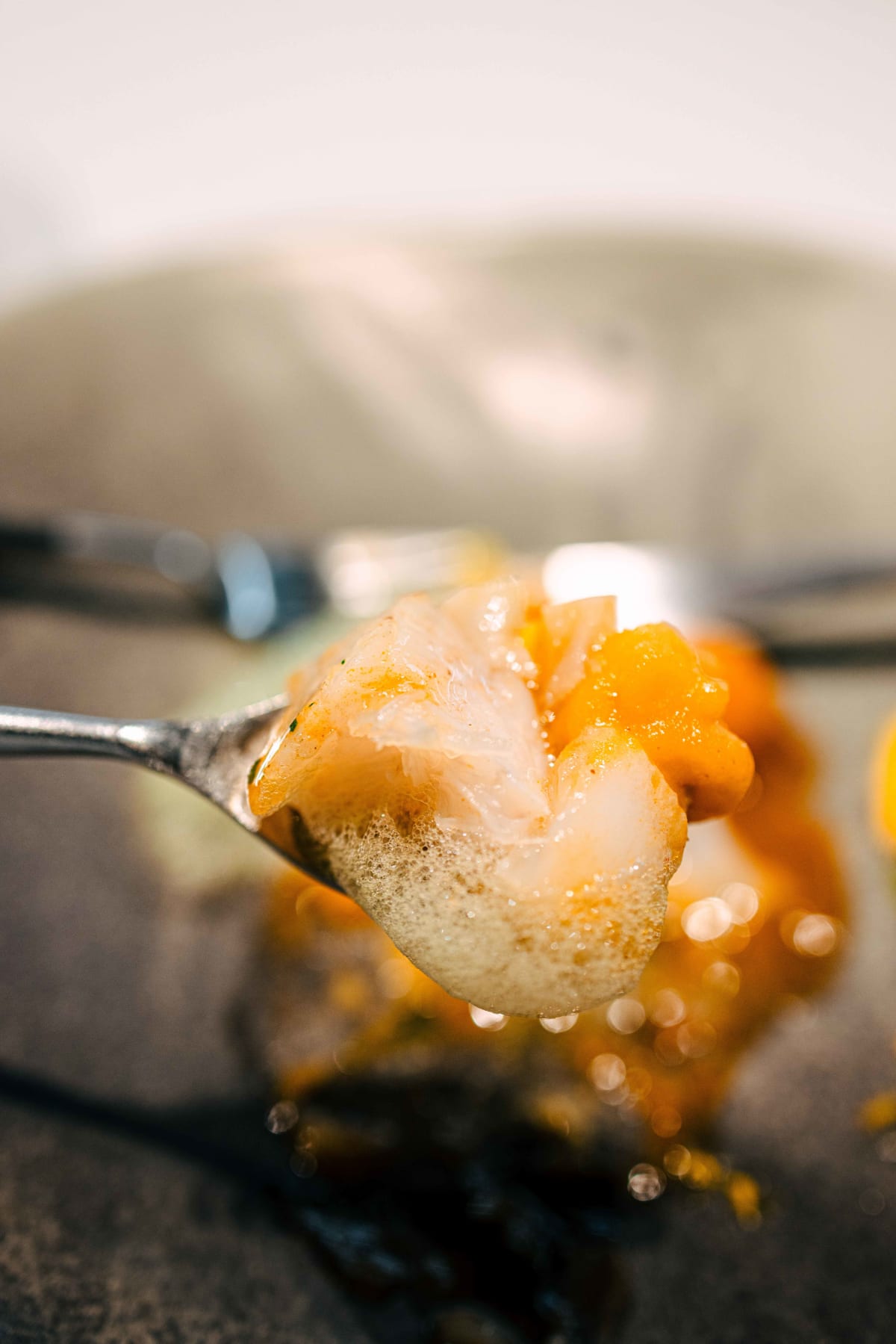
What came alongside in a cup was "Fake cappuccino: suquet," which looked just like a real cappuccino on the outside but was the suquet broth and potato made into a foam and put in a cup. This was good as well.
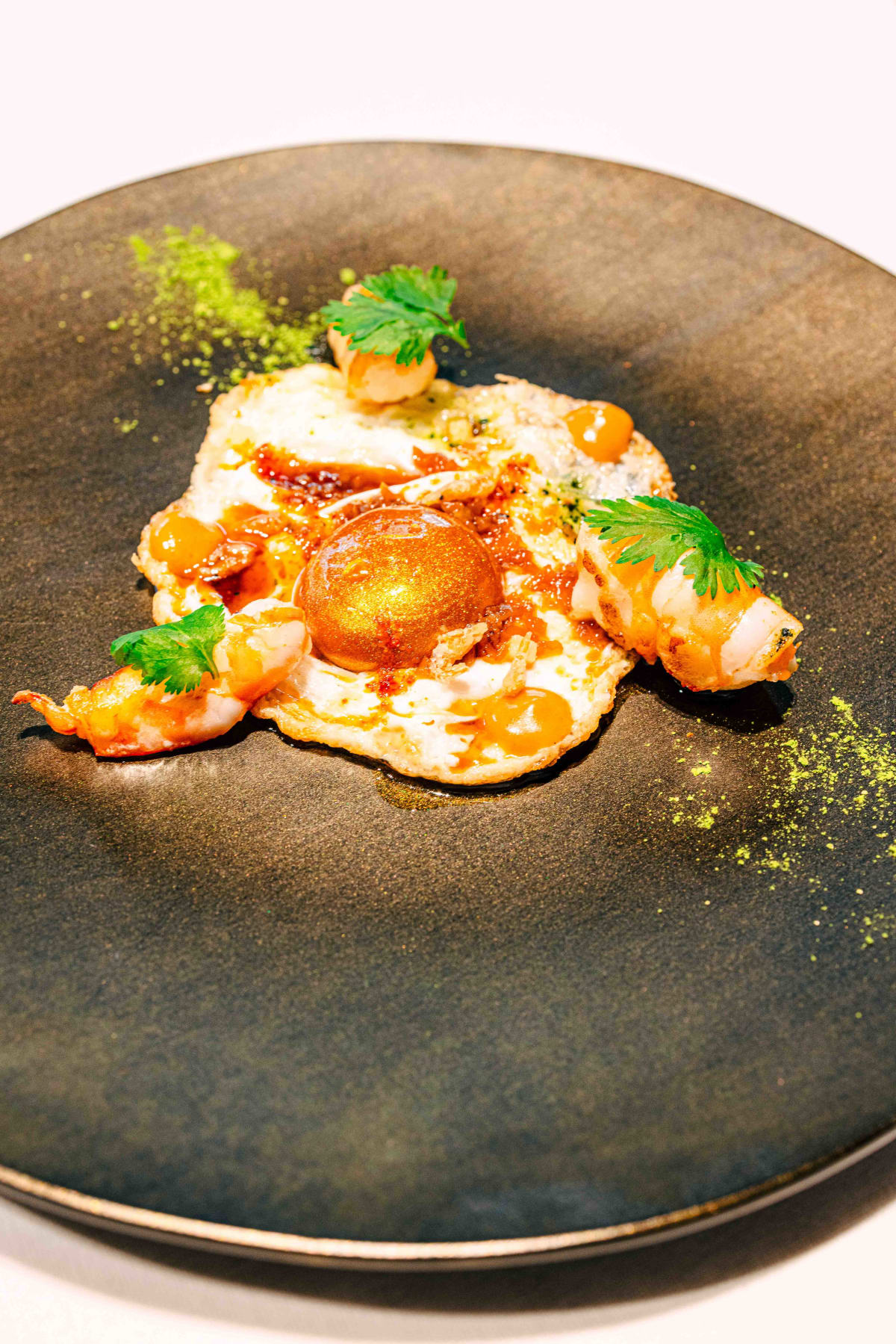
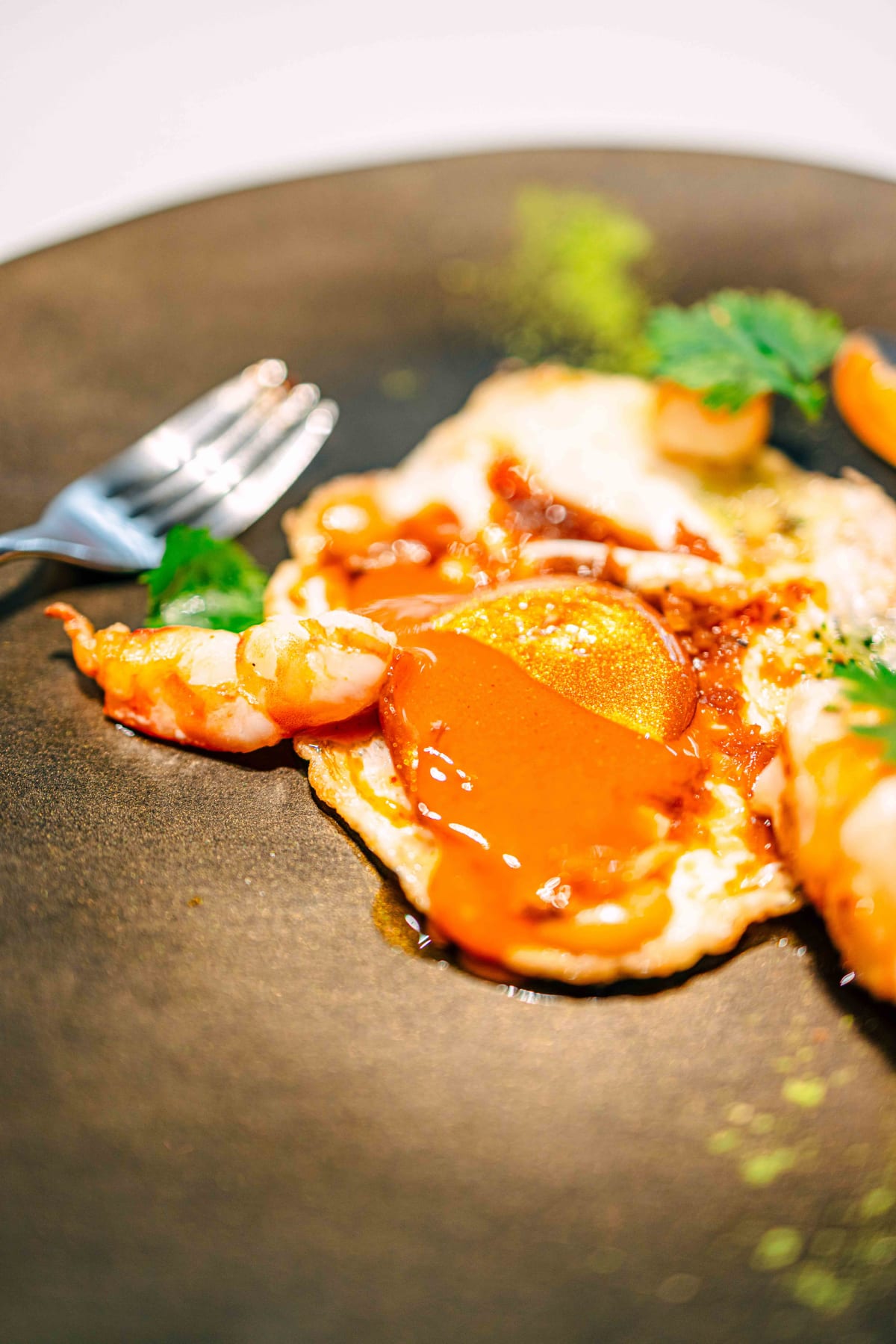
Egg had appeared quite often as an ingredient across the course, and in "The goose that laid the golden eggs: fried egg of crustacean (2022)," a fried egg finally showed up, though in a form where the yolk in the centre was painted gold.

The composition was a "golden egg yolk" and a large, very springy, perfectly cooked Carabinero prawn.
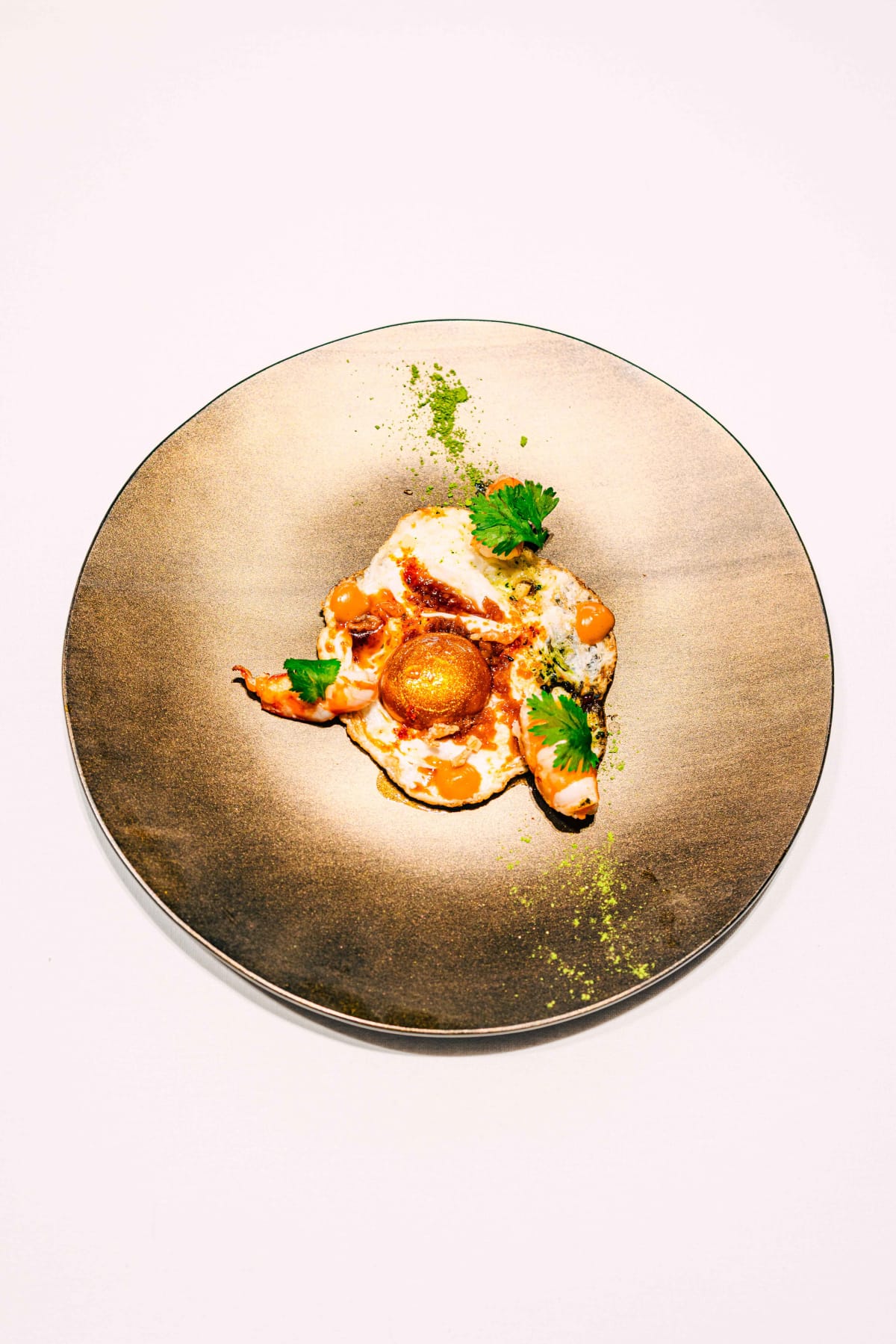
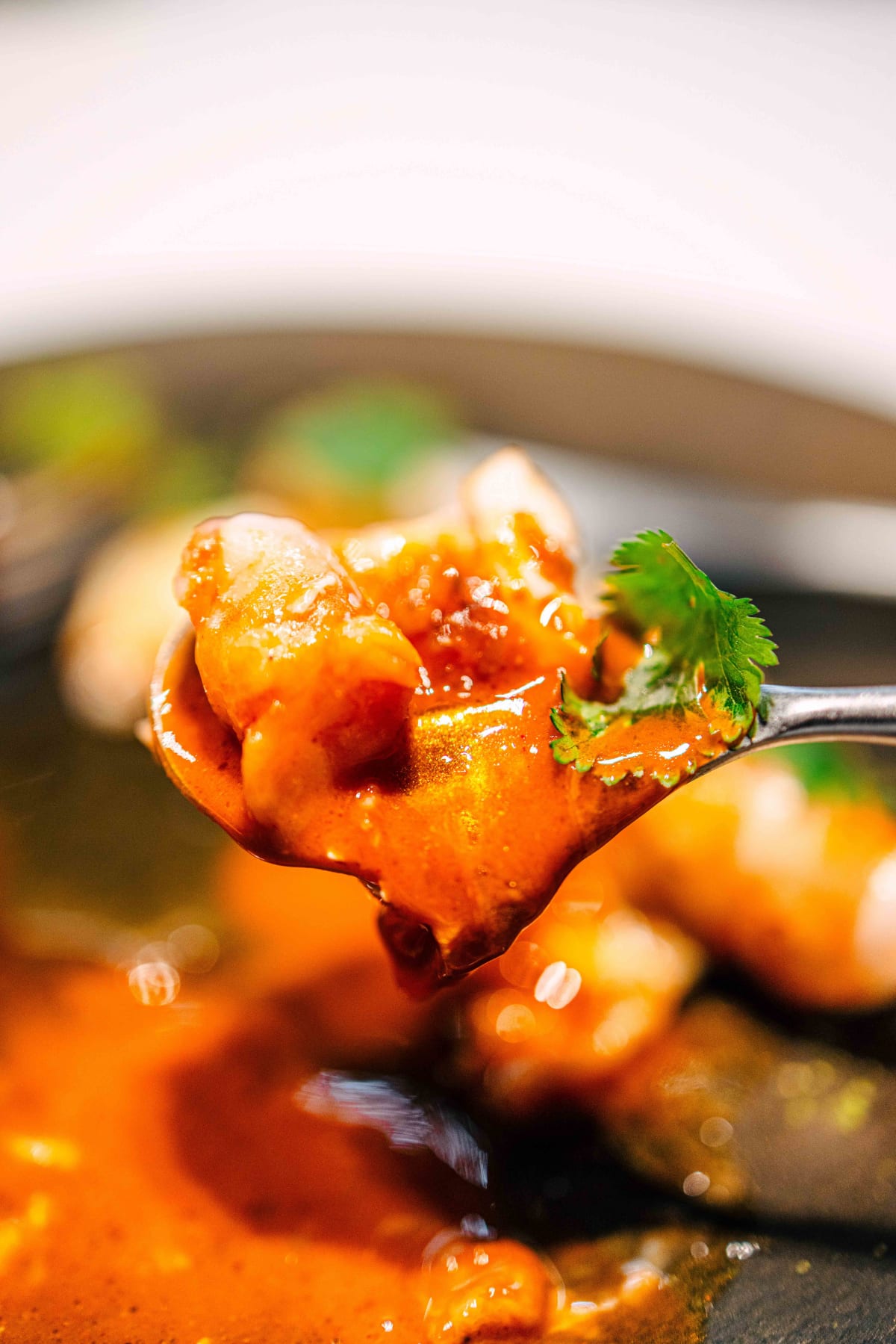
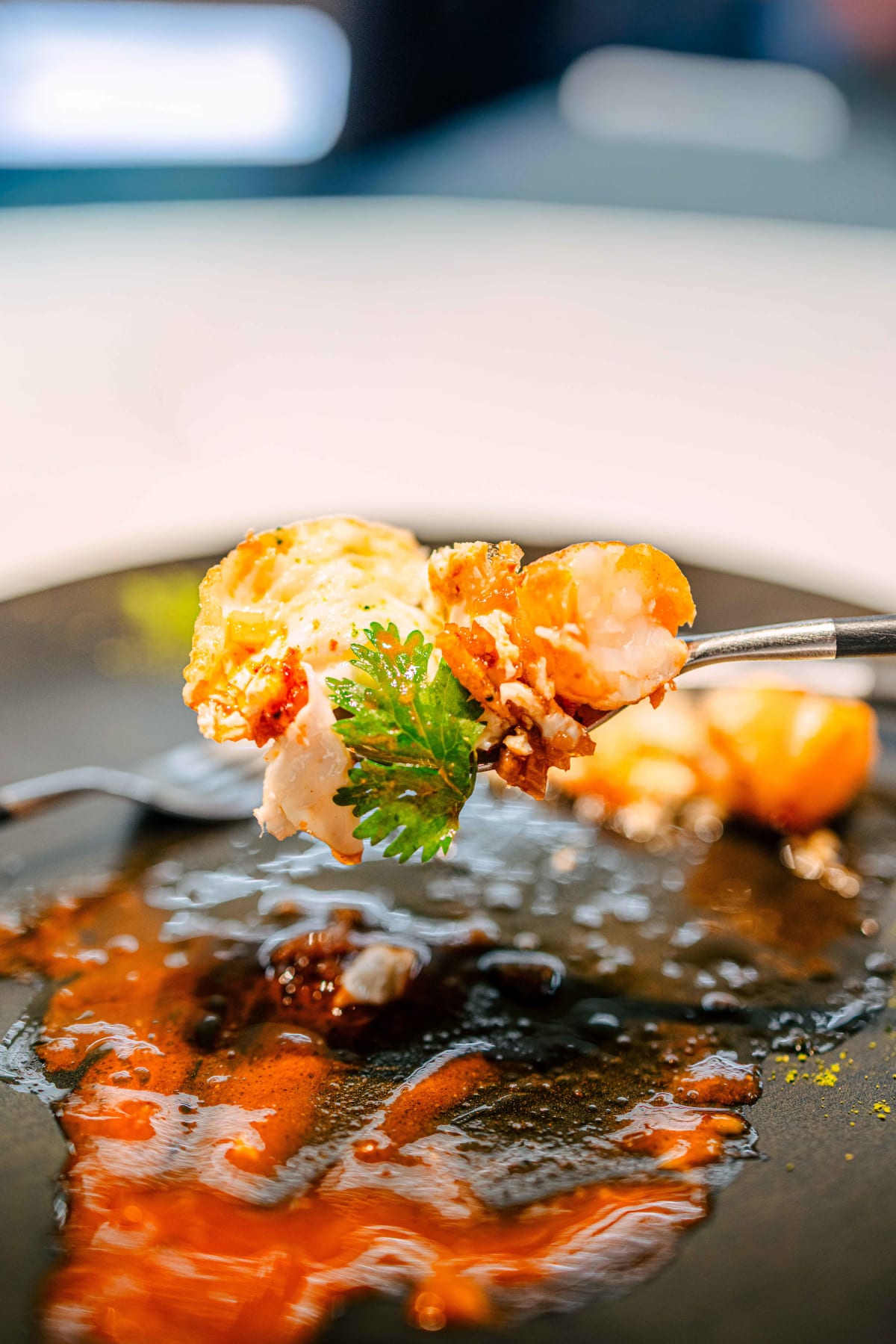
At a glance it looks like a simple fried-egg-and-prawn combination, but in fact the acidity and the aromatics were designed in a completely different direction from the earlier dishes. In particular, it was the one dish where a Thai or Chinese flavour profile, of the kind DiverXO works in, came through strongly. Personally, I was reminded of Singapore's chilli crab. On the egg there was a chilli crumb, and I tasted shishito, the pepper also known as kkwari-gochu, along with ginger and coriander. This golden yolk was truly excellent, and although the Carabinero prawn was slightly overcooked, the combination of the sauce inside the egg with ginger and coriander was really good. What was fun was the green powder scattered around the dish. I thought it was matcha powder, but it turned out to be a powder made from a combination of parsley and prawn.
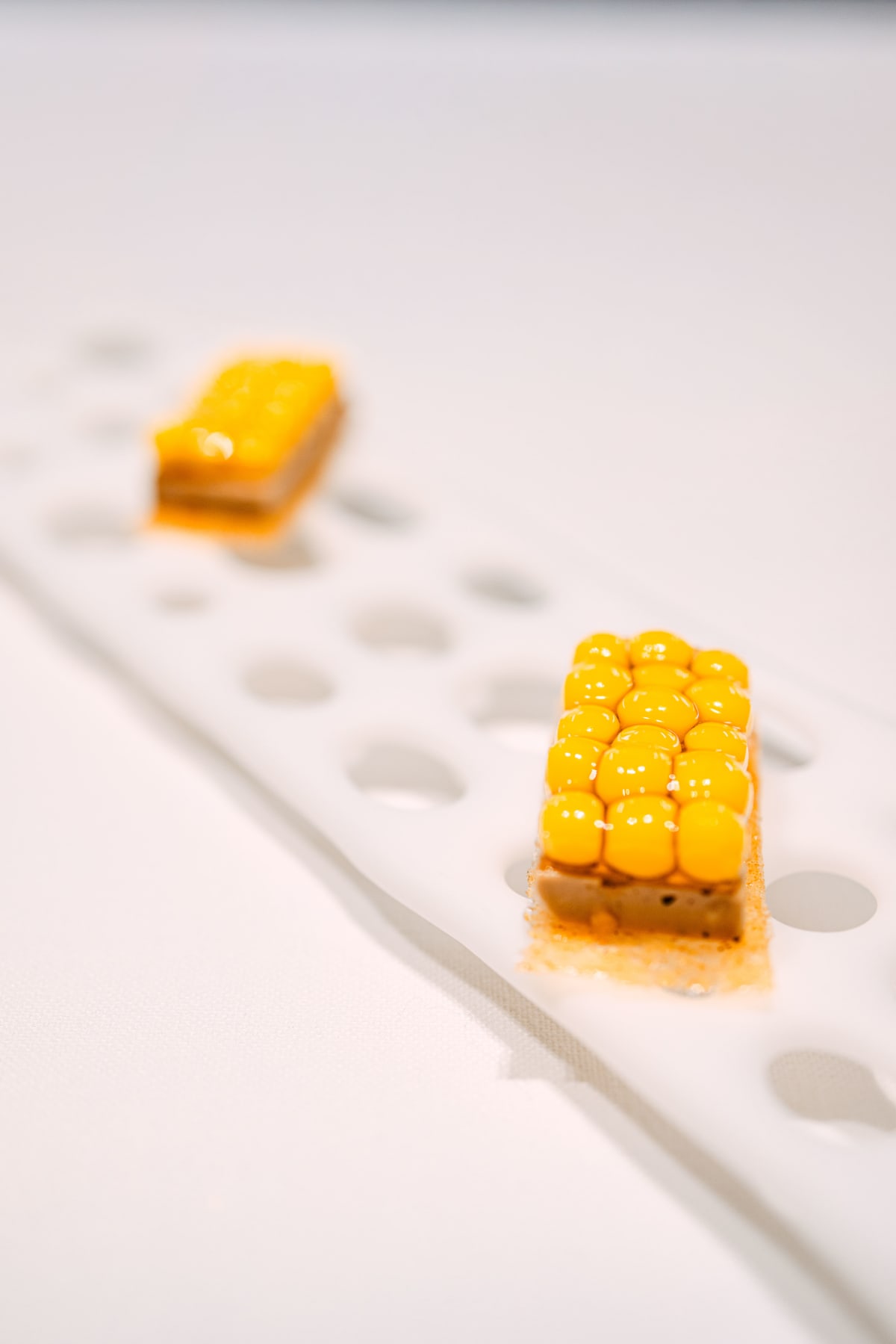
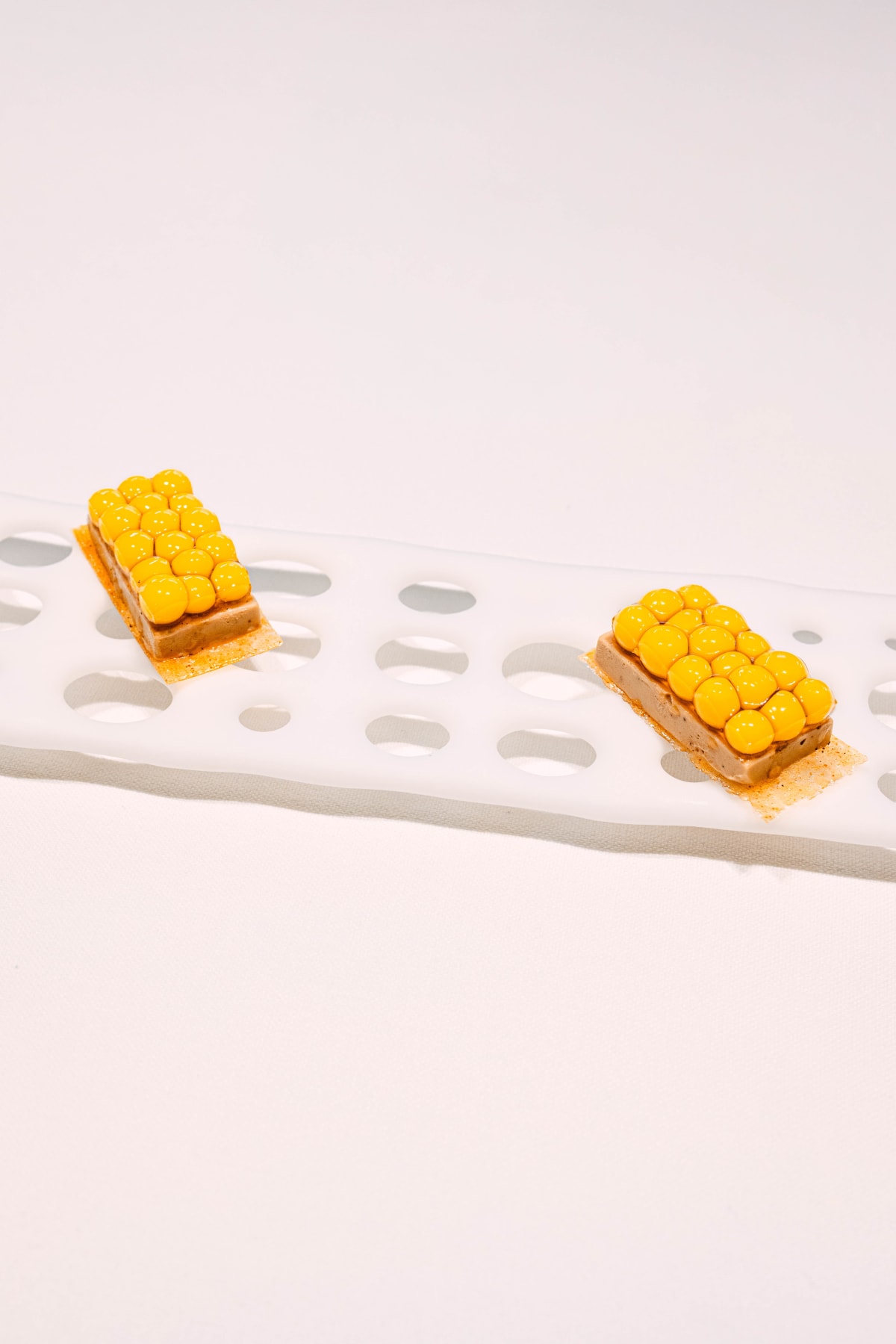
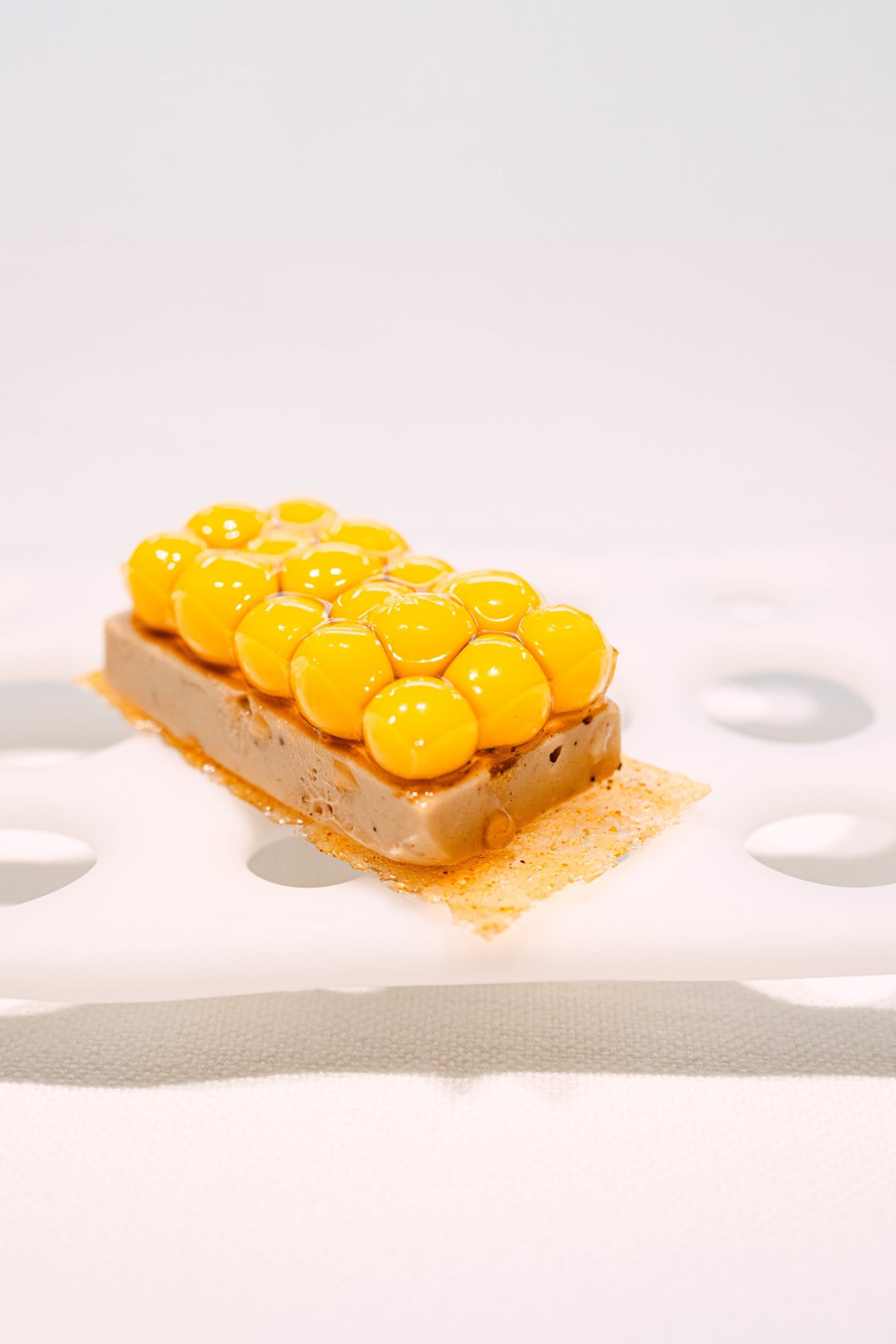
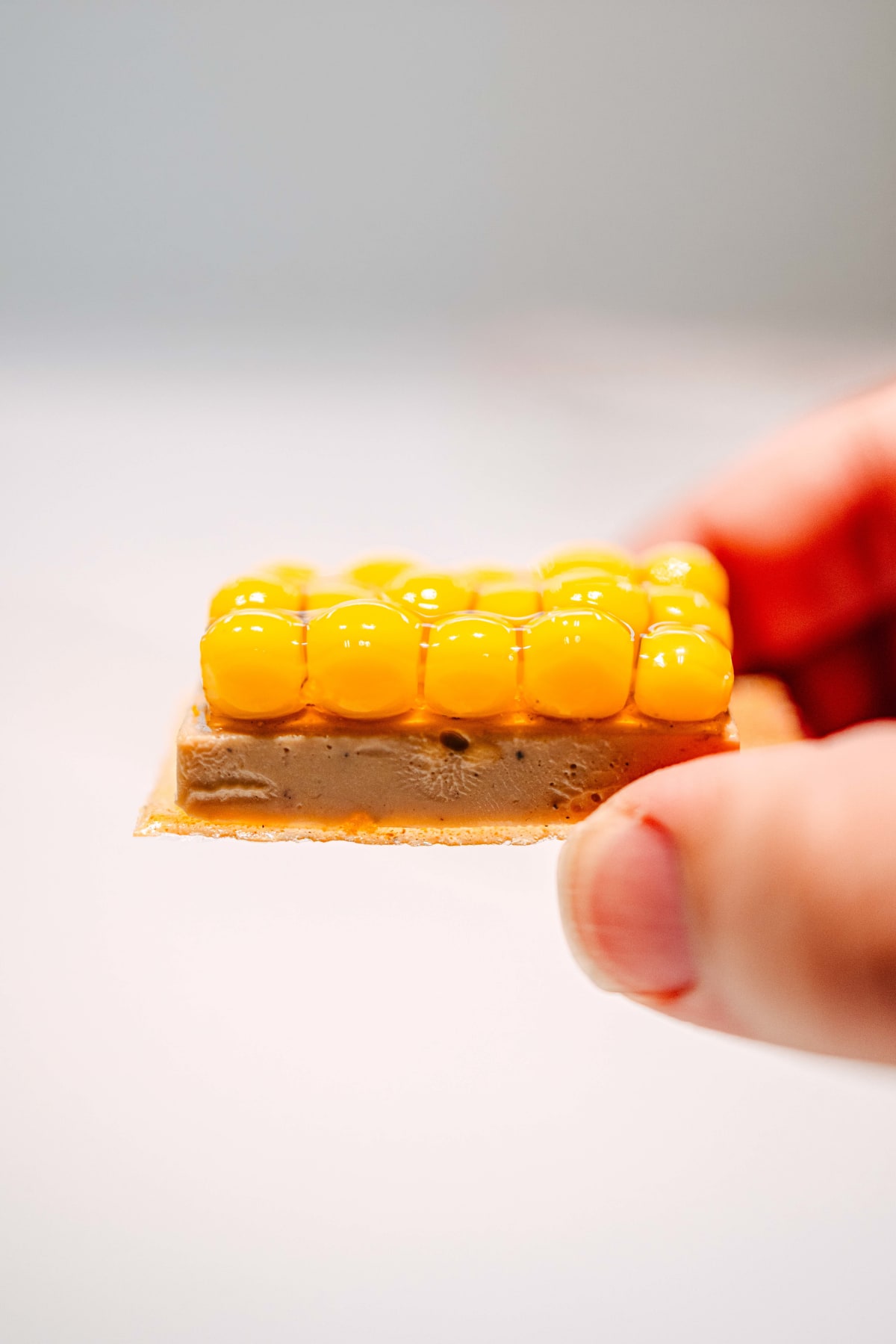
Before the final main came out, "Multi spherical tatin of corn and foie (2016)," something light to eat, arrived. It was a dish that reinterpreted two ingredients, corn and foie gras, through the tatin, the French dessert technique of baking upside down. Look closely and there is a thin film on the very top, which seemed to be a film of concentrated sweetness laid over it to give a slightly sweet taste. Beneath it were spherical beads of corn purée made by multispherification, each one bursting to spread the sweetness and aroma of corn. In the middle was a foie gras terrine, and at the very bottom, under a thin crispy film, was a caramelised corn crumb. The combination of corn and foie gras was really good, and because the corn flavour was faint and a touch sweet, its pairing with the foie gras was excellent.
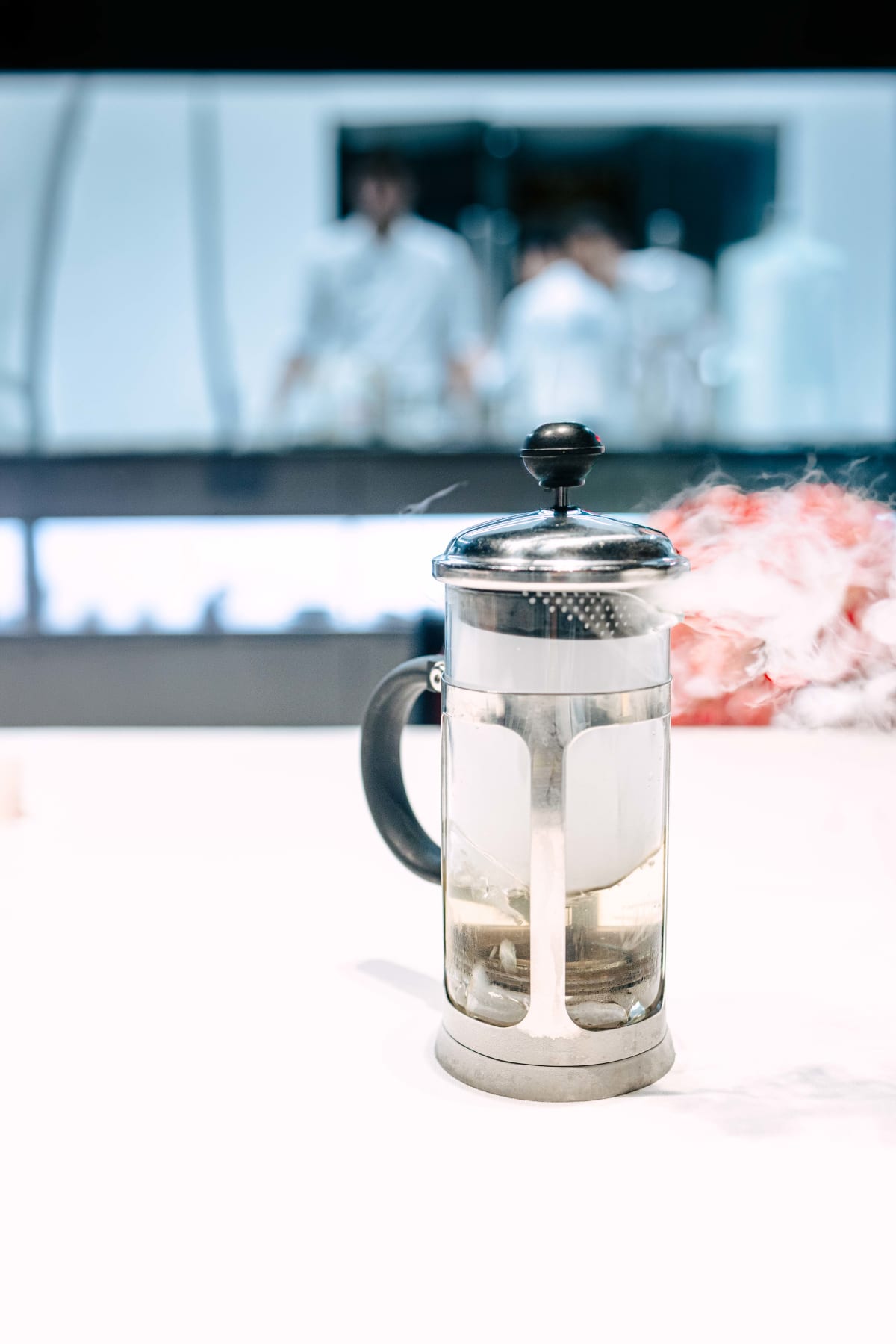
At the end of the grand flow of eighteen courses came the meat main, "Squab with amasake kombu spaghetti, almond and grape (2022)." Before eating the dish properly, they paired a scent once again: the server poured something over dry ice, and a faint scent of apple rose.
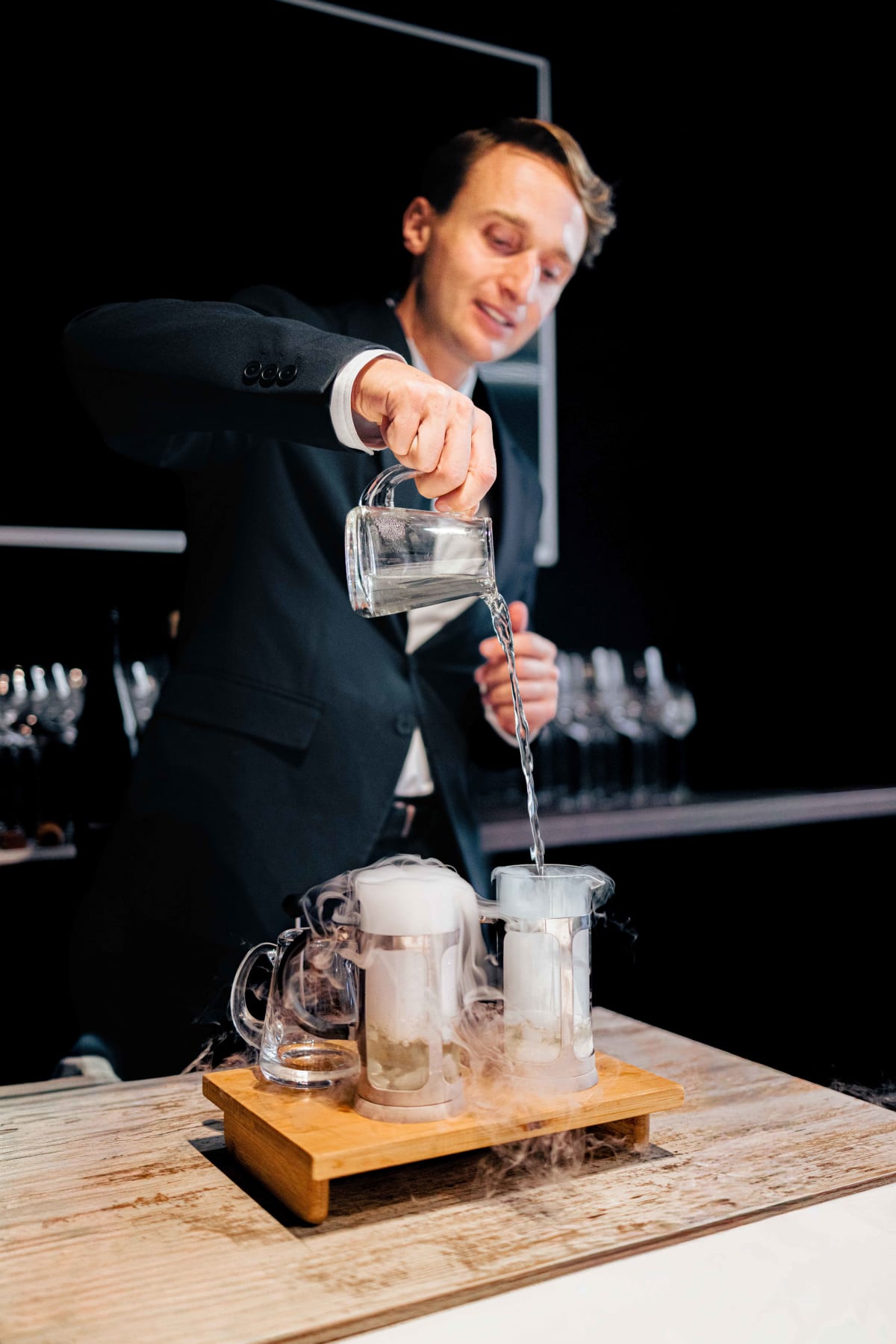
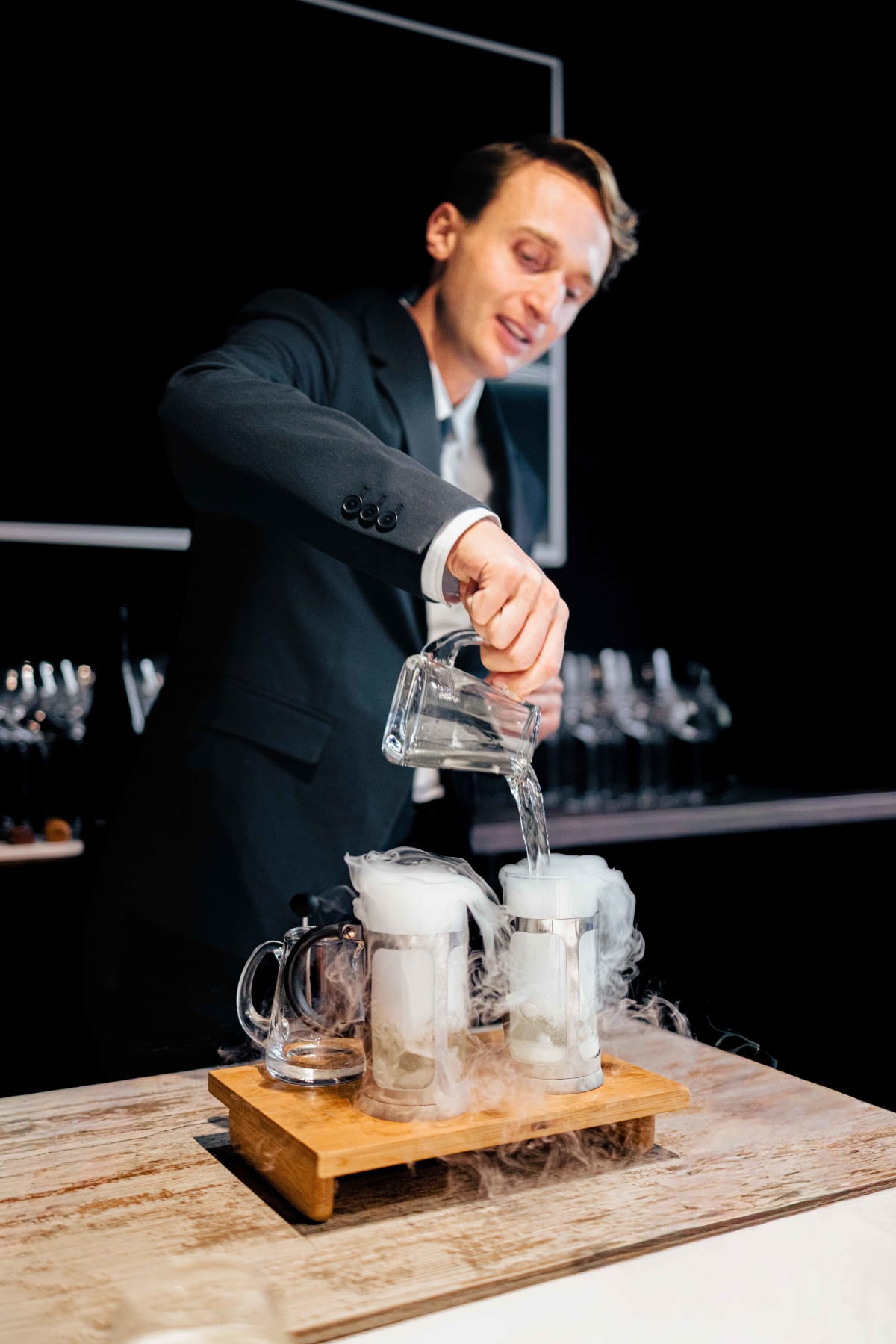
They seemed to have added homemade cider, most likely.
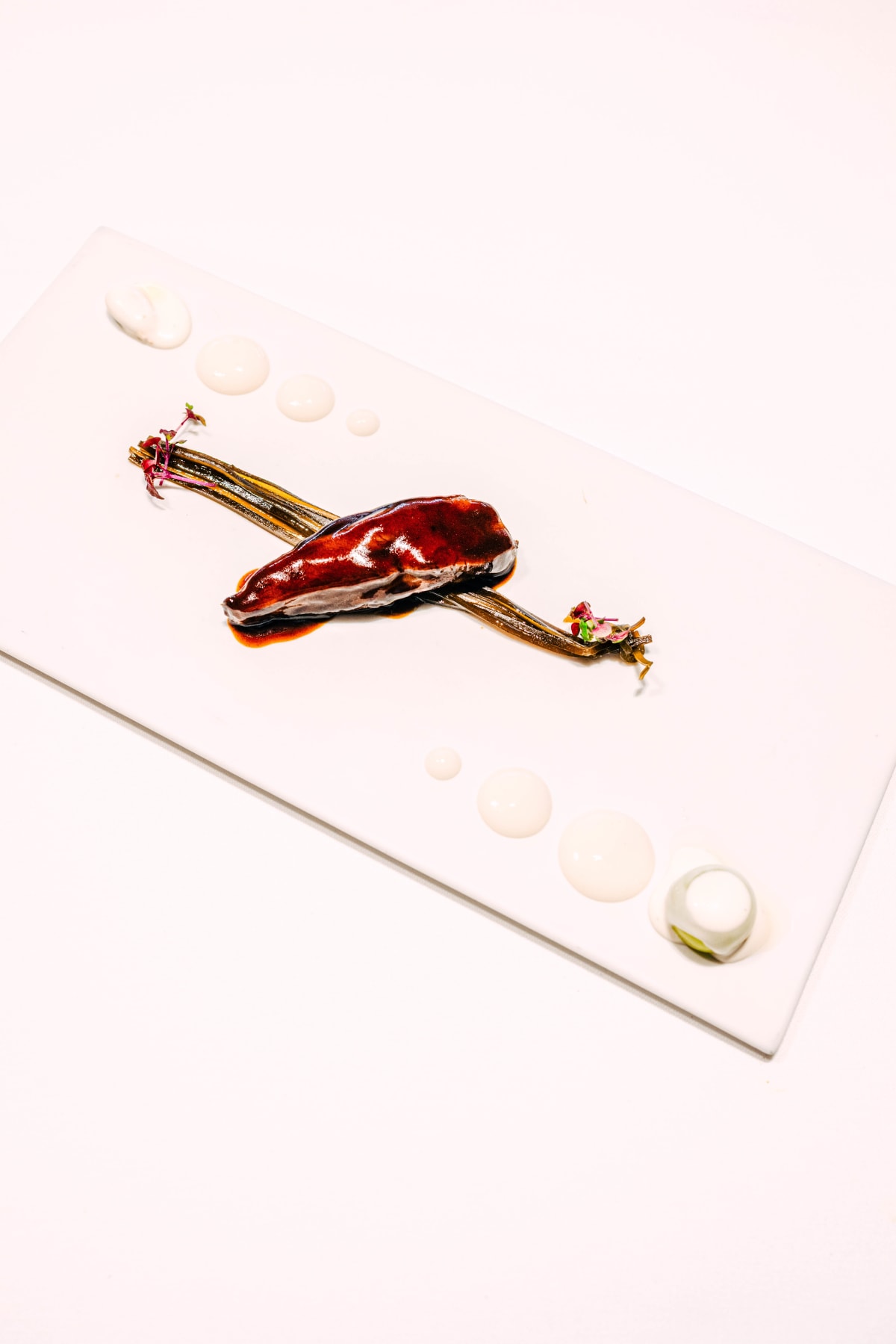
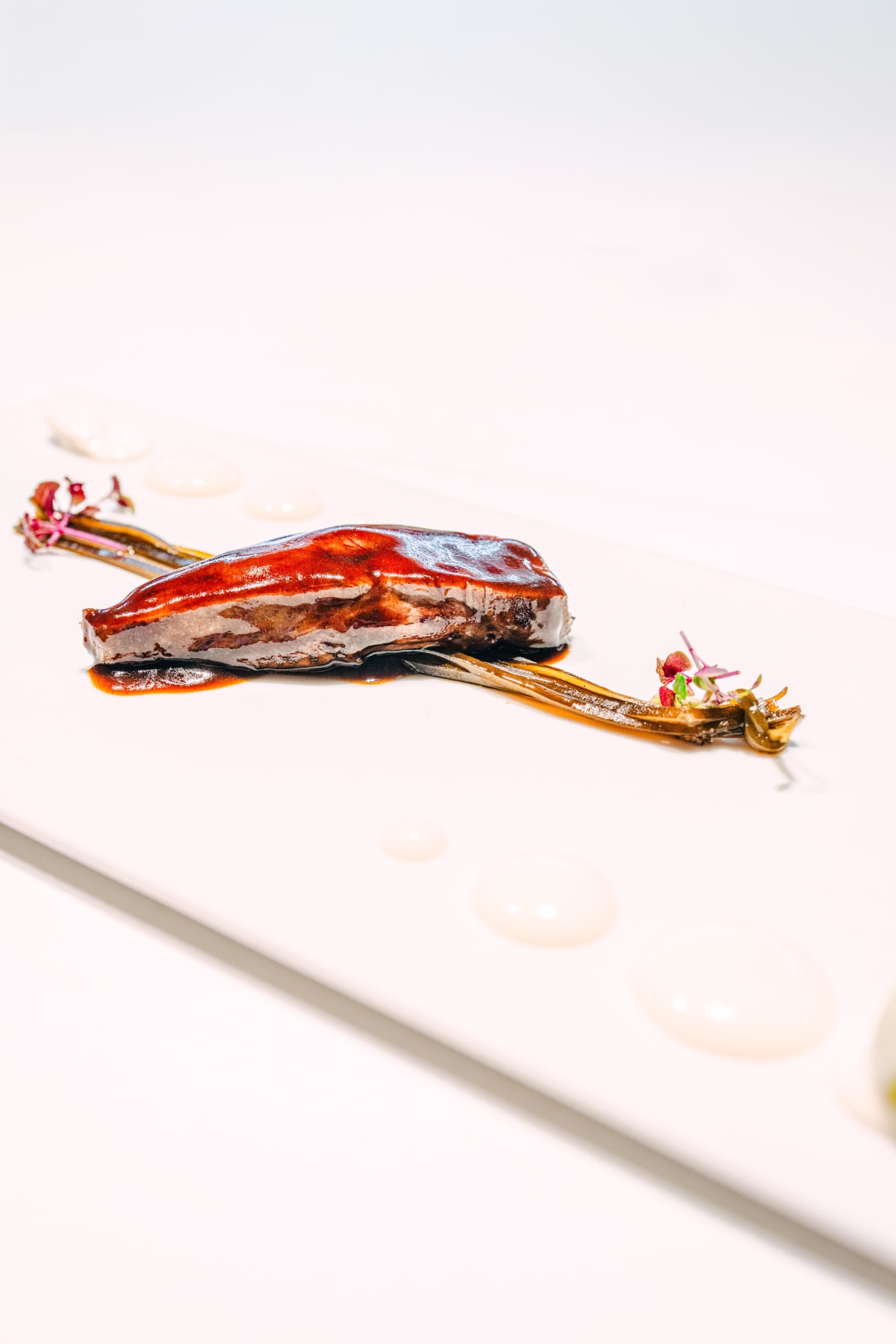
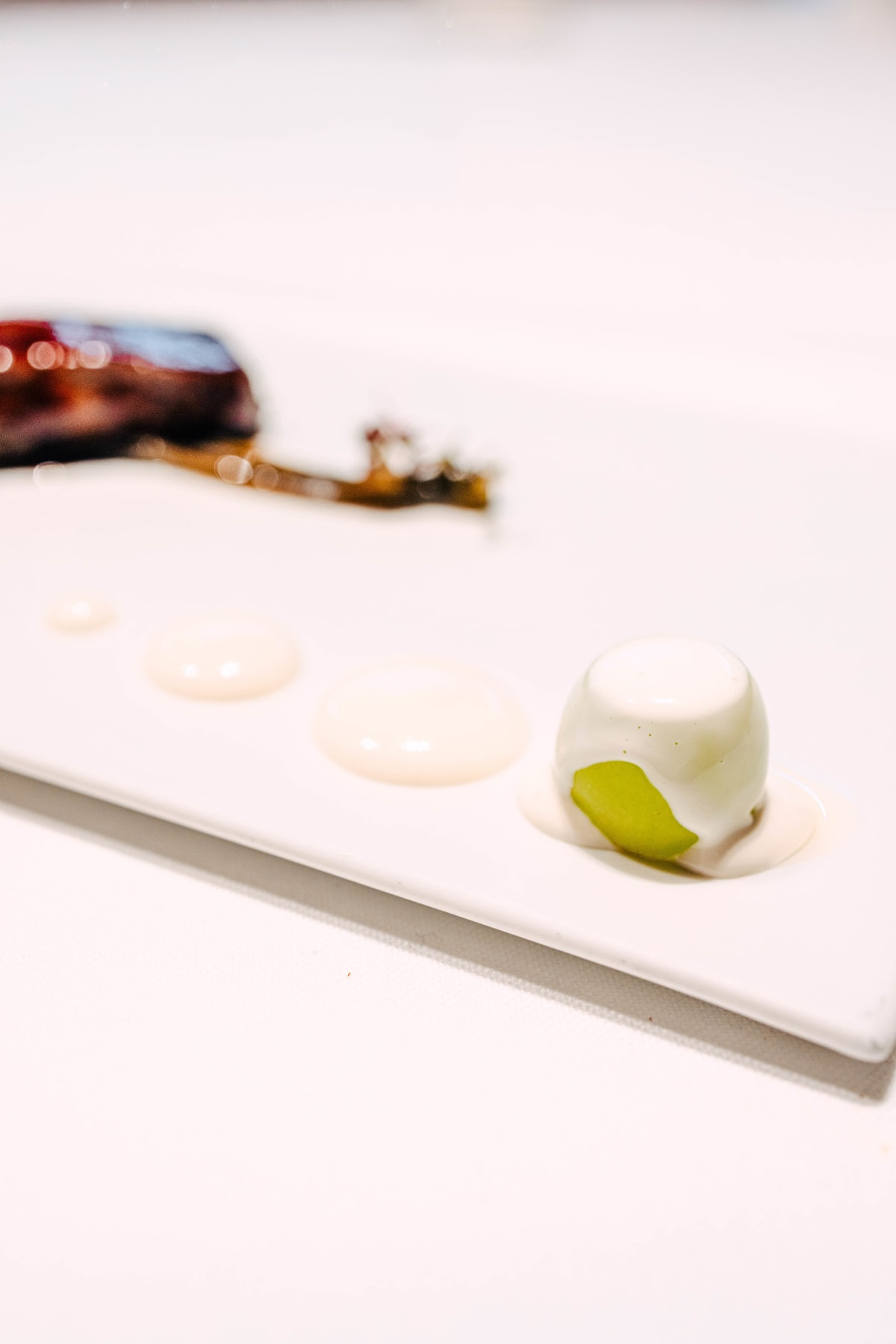
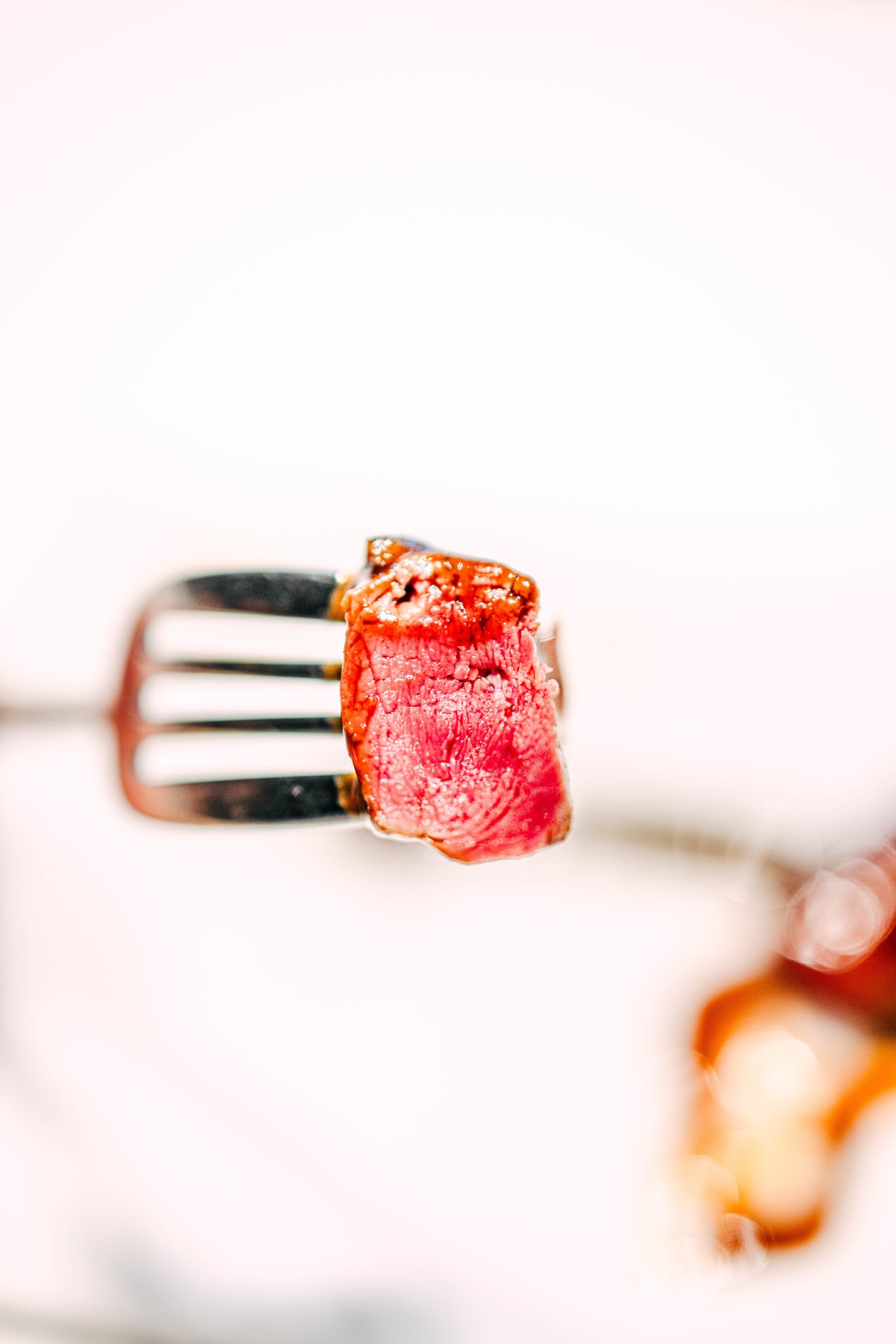
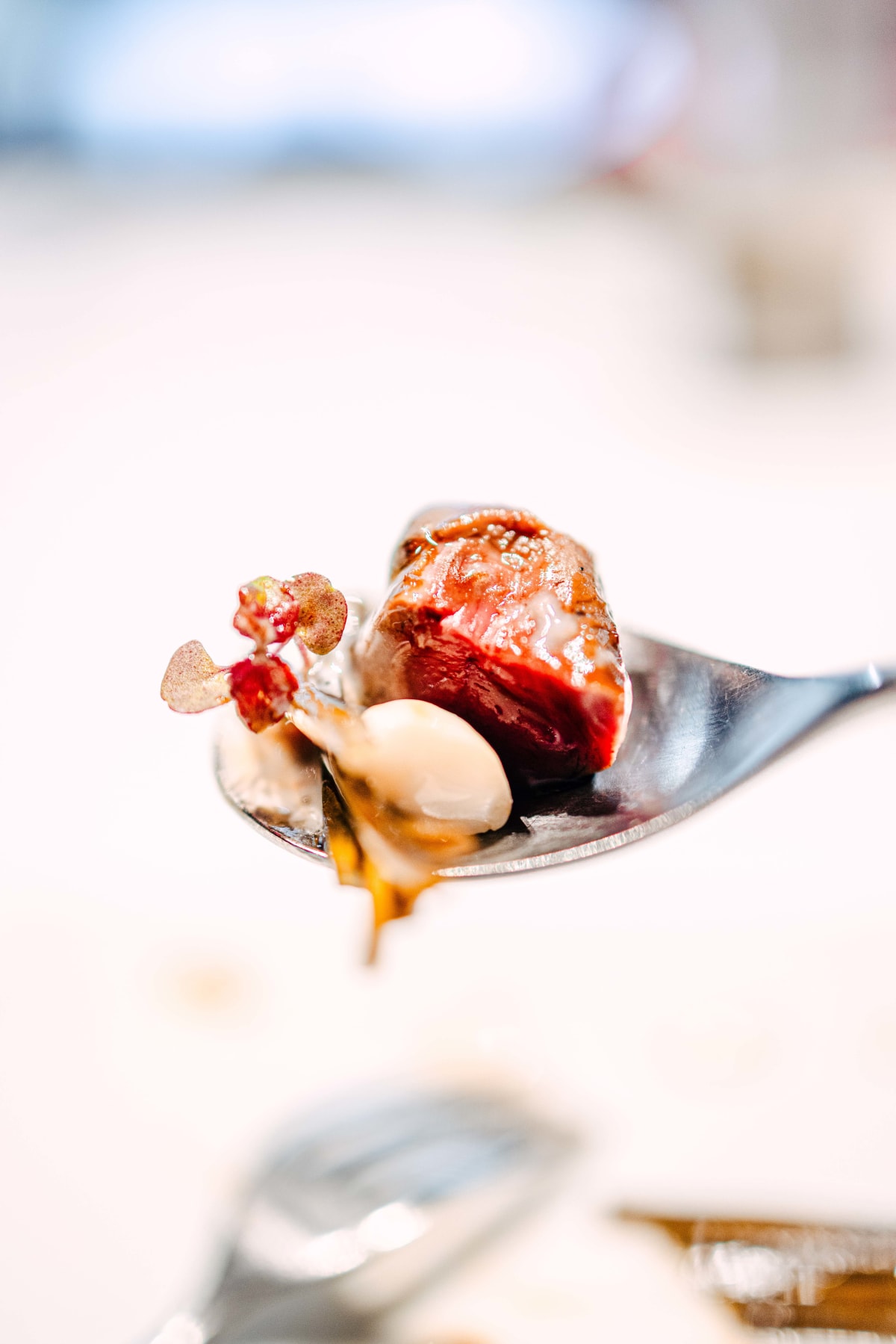
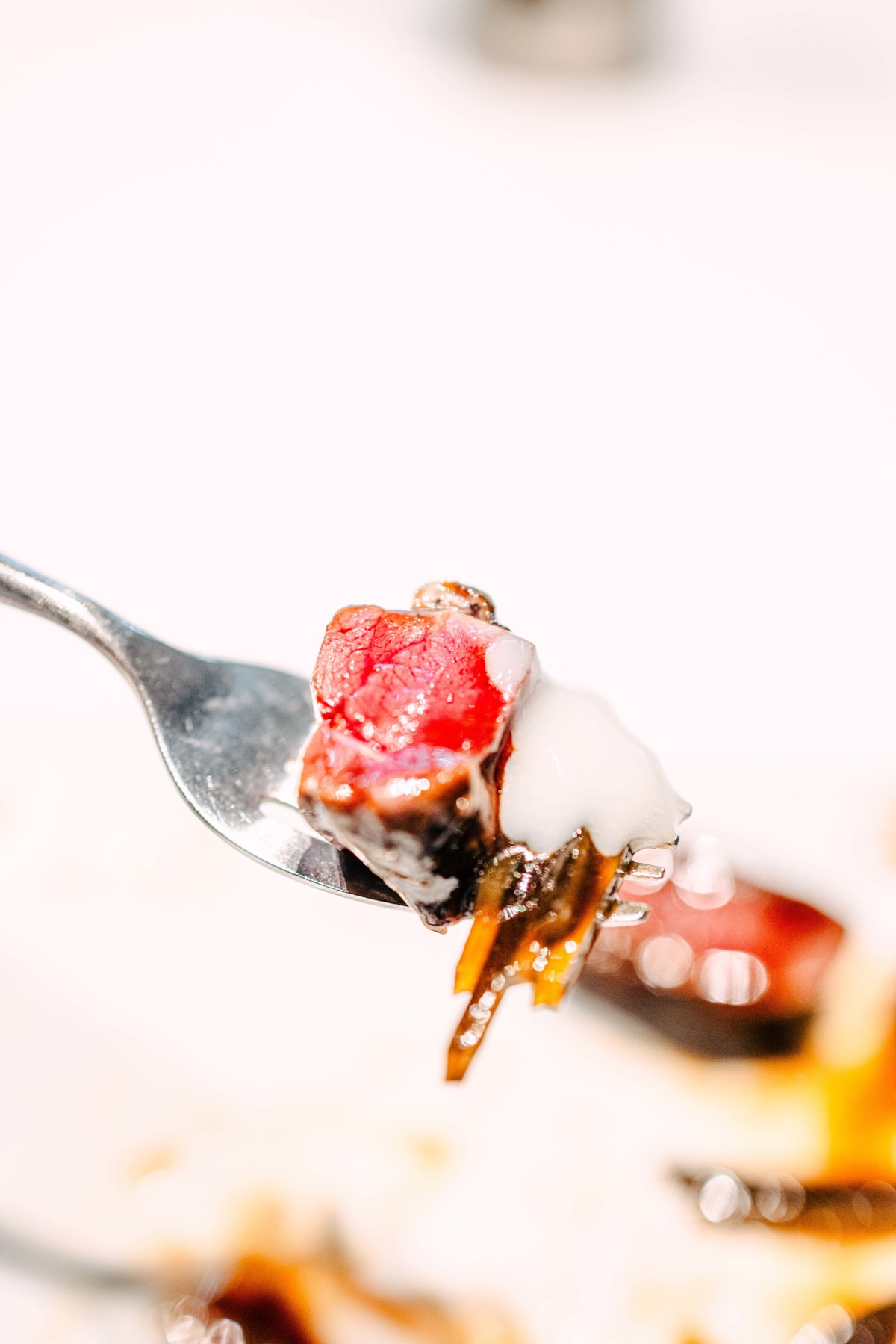
The main was squab, that is, pigeon. The meat at the centre, wrapped in a dark glaze, was the squab, cooked to about medium rare, scarlet to pink inside. Underneath was "kombu spaghetti," thin strands of kombu cut to resemble pasta. This kombu spaghetti seemed to be coated on the outside with amasake, that is, the Japanese amazake, like a sauce. By the restaurant's explanation, it is obtained by fermenting rice starch and gives a faint sweetness. The sauce underneath was an almond cream, and grapes and almonds were set to the side.
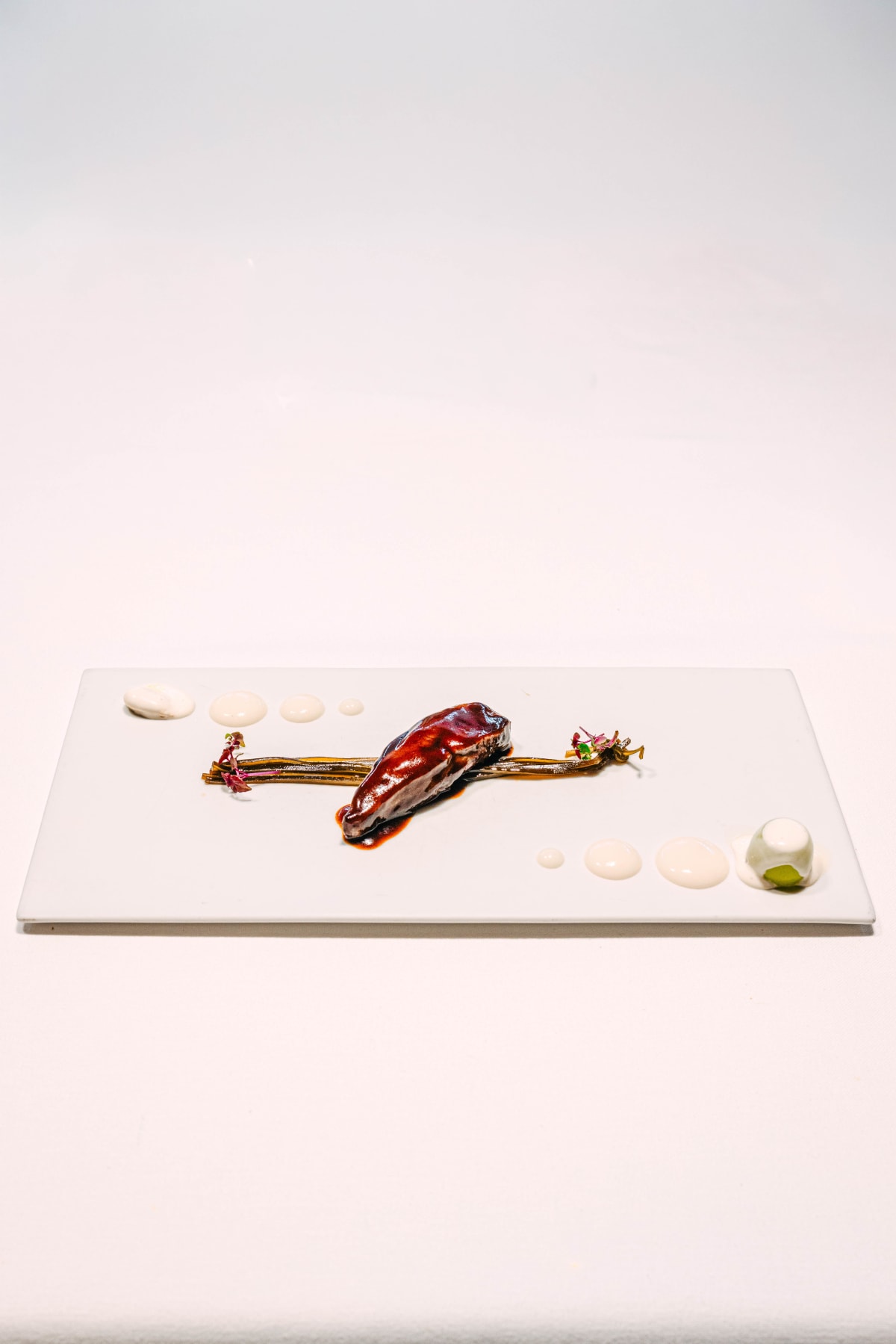
Put plainly, the main was a little disappointing. The creative ingredient combinations and the ingenious cooking techniques that Disfrutar had shown until then were not much in evidence. On top of that, when it comes to pigeon, I personally prefer the French approach. That said, the soft, springy texture of the pigeon was truly impressive. The texture alone was excellent. As for how it went with the ingredients underneath, the combination with the green grapes was better than with the almond.
Section 10·The Sixth Flow: The Cellar's Dealcoholized Experiment, and the Moment the Table Becomes Nature
Before the dessert course began in earnest, a pre-dessert started: "Assortment of microwaved snacks (2021)" and "Homemade cider smoked at the moment (2016)." First, the server came over to the side, lit oak wood with a torch, then covered the cup to trap the smoke.
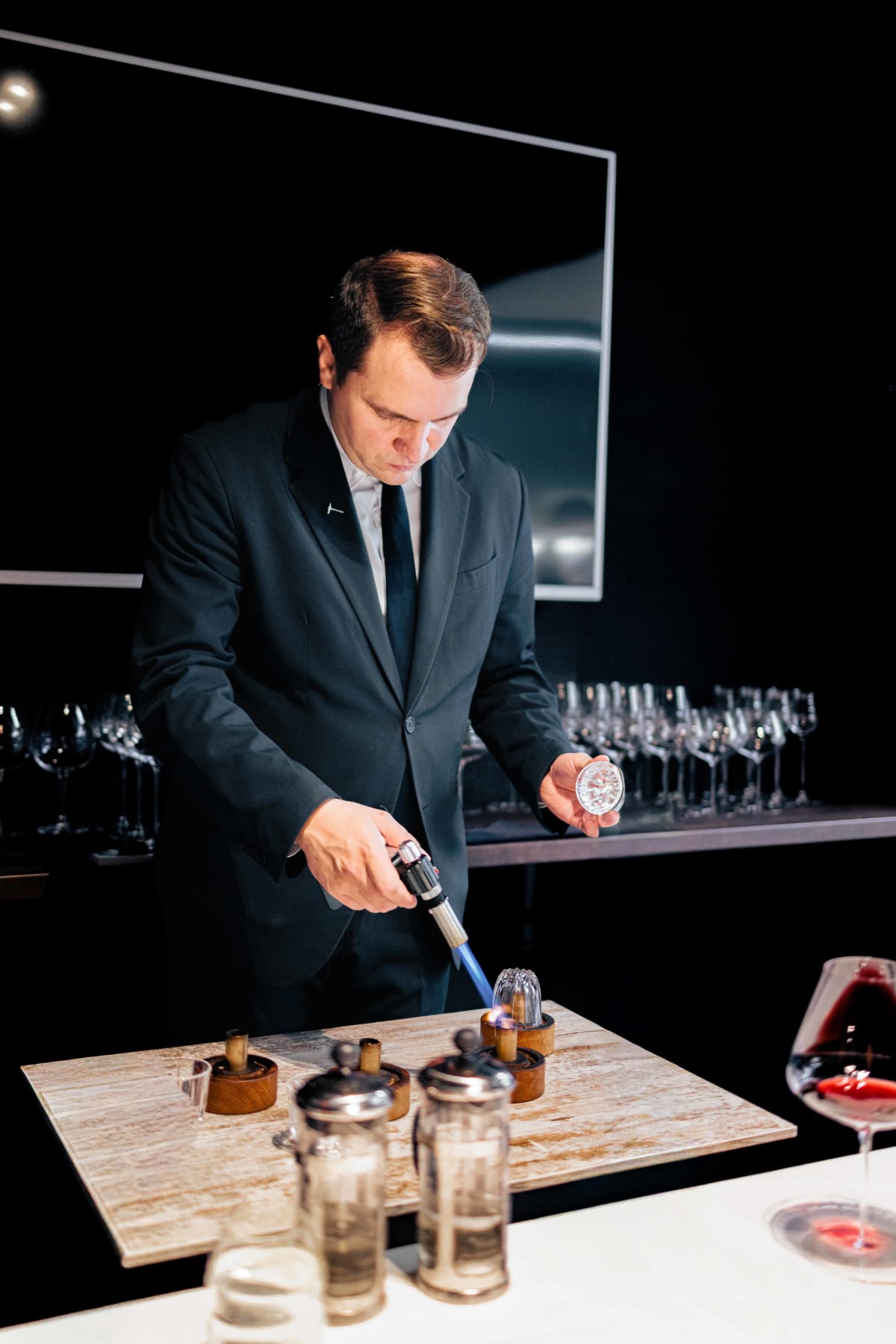
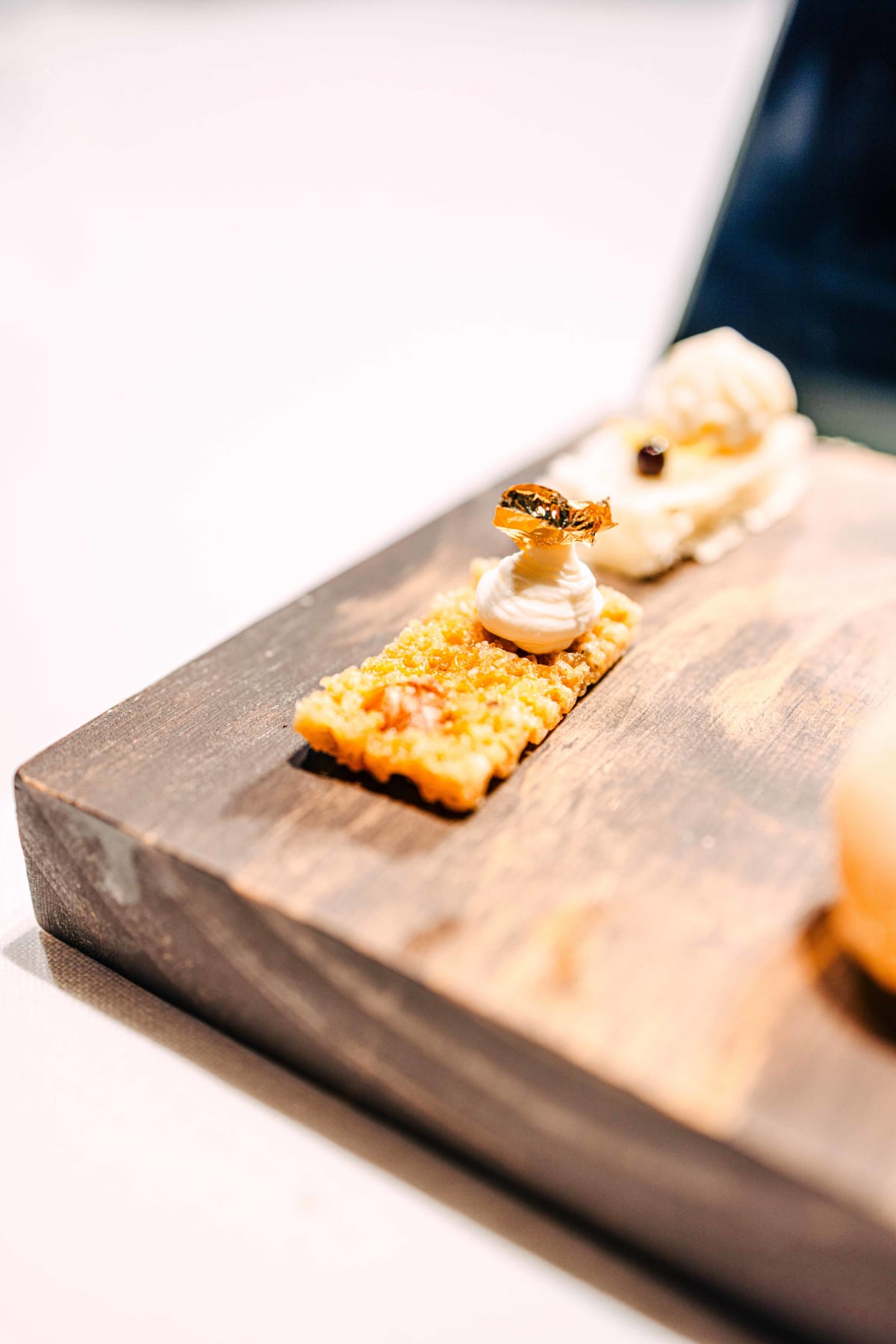
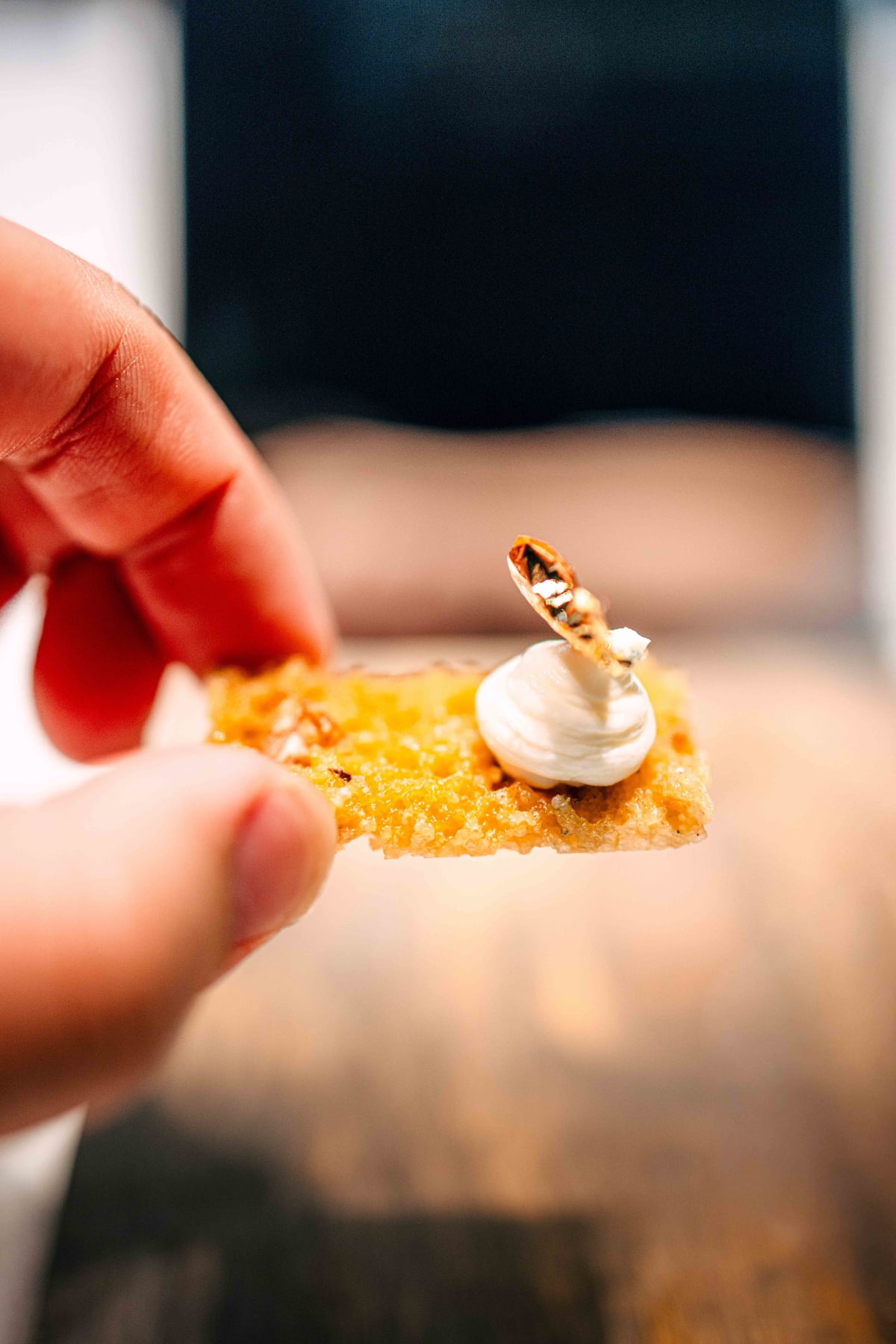
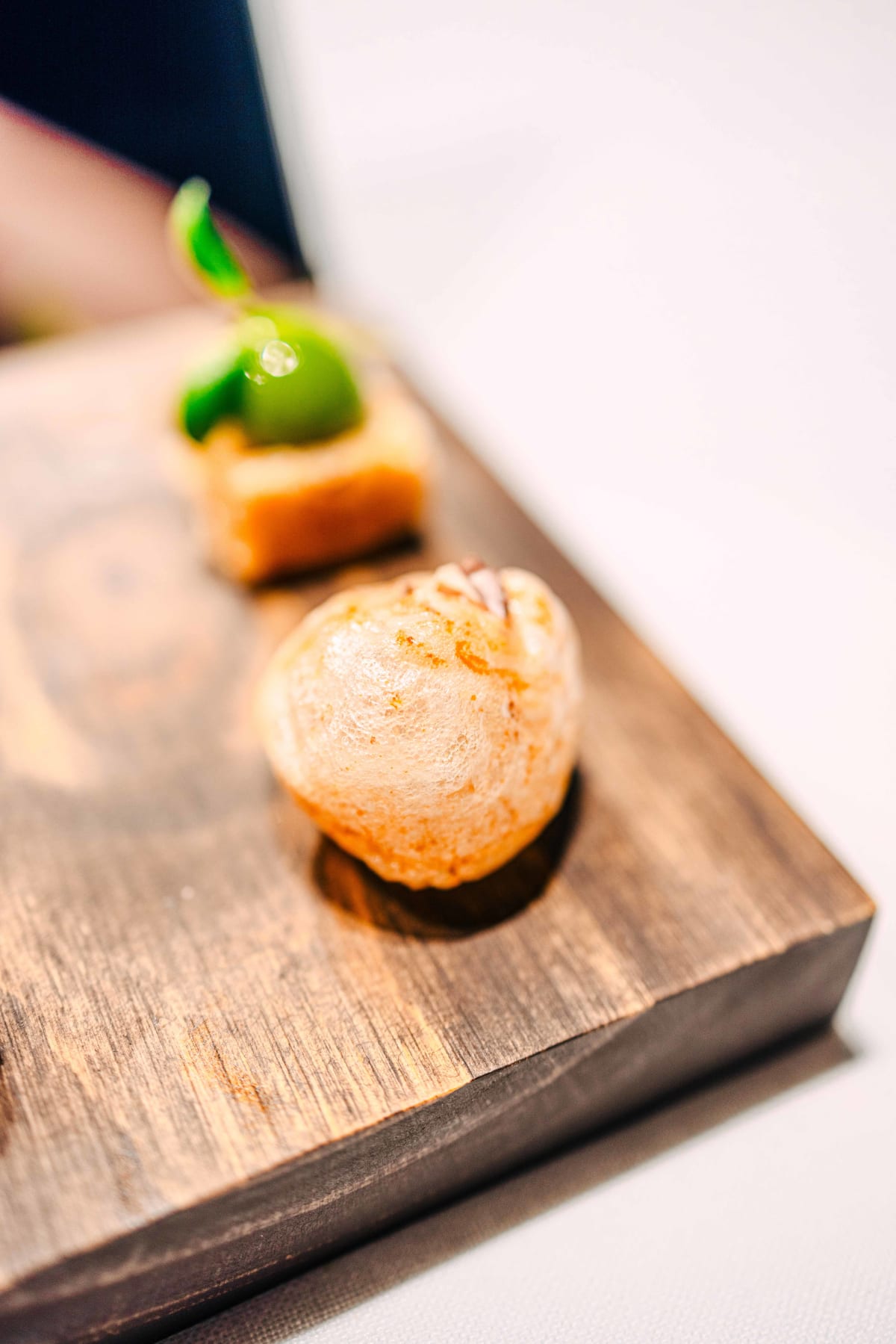
They served apple cider in this cup, so the cider carried the taste of smoked apple skin and apple chips, and it felt like drinking kombucha. The pre-dessert came as four kinds, and the box it sat in was unusual. There is a mirror on the front, and this was a staging that, for the philosophical reason that "we always eat while looking at others but never look at our own face," attached a mirror so that you watch your own expression as you eat. The pre-dessert was four kinds, mostly cheese-focused: Parmigiano and balsamic, Parmigiano and basil paste, crispy blue cheese, and walnut soufflé with praline. Even though there were only four, the cheese flavour was deep, so it was heavier than expected. But the apple cider held the cheese richness of this whole course, and the salty-savoury taste of the pre-dessert, nicely in check.
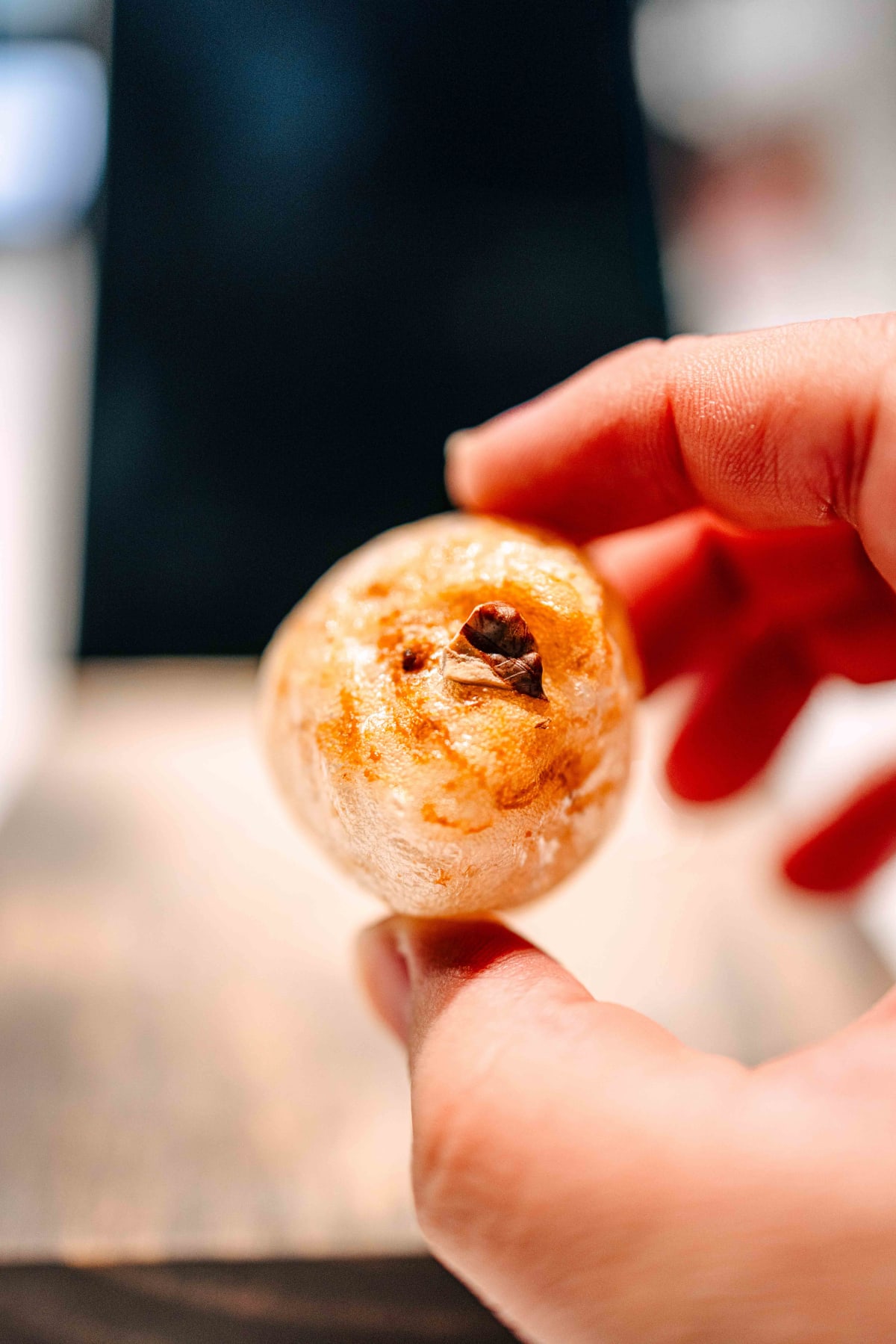
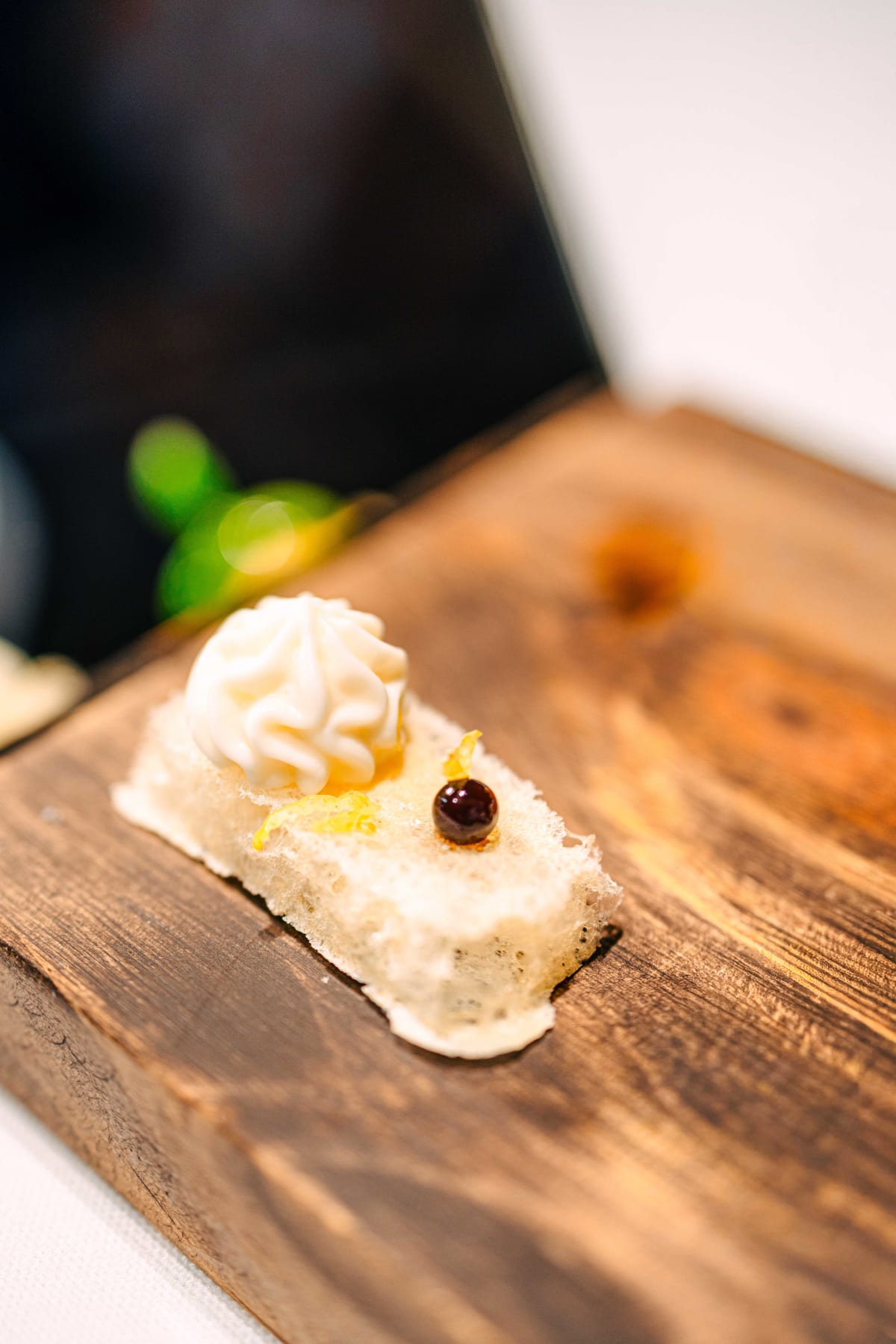
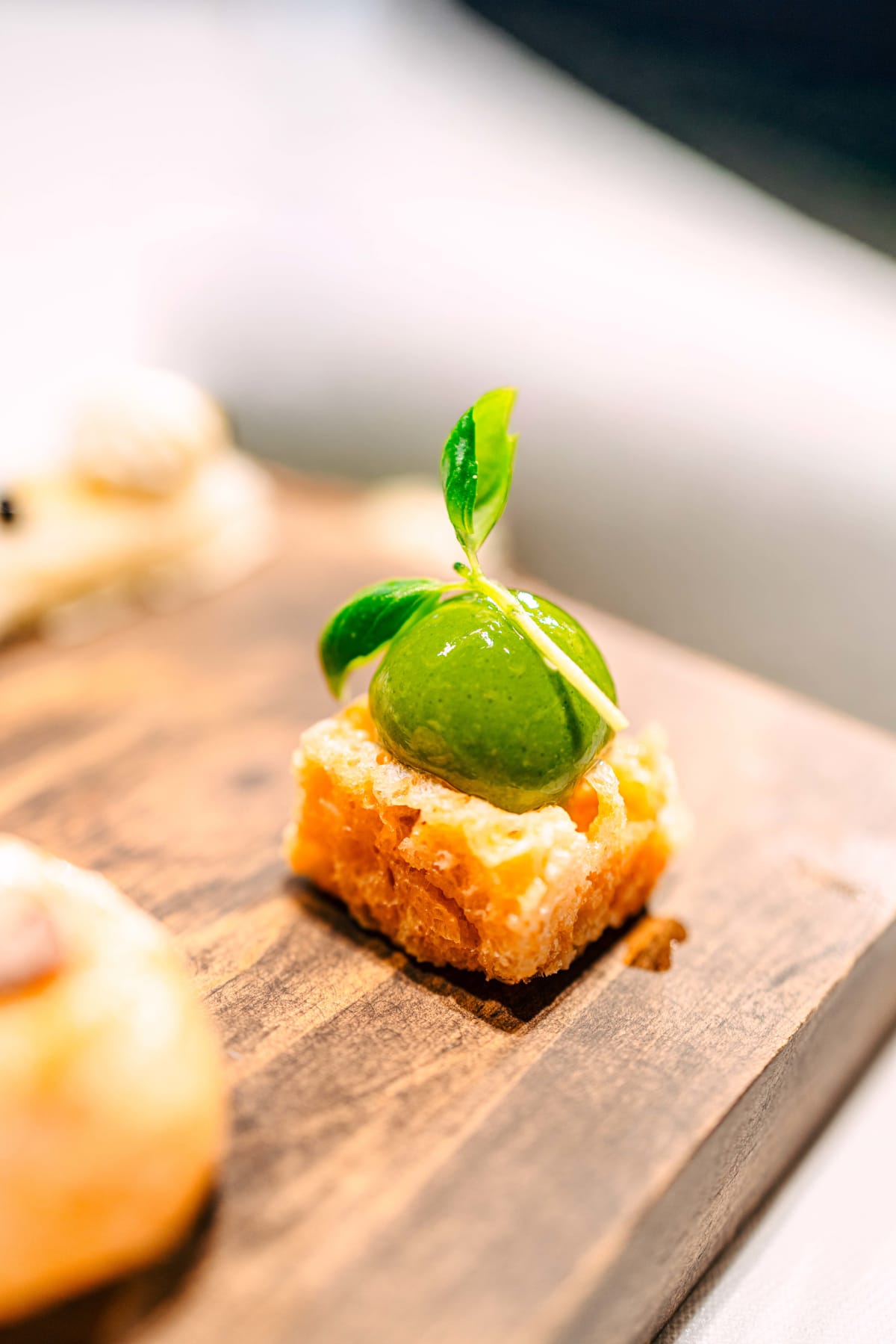
After finishing the pre-dessert, this time we moved location. We moved to the cellar right in front, and it was time to taste a "wine" the restaurant had prepared. At first I simply thought it was wine, but it was nothing of the sort. It was "Dealcoholized wine (2020)," perhaps the course that most clearly encapsulates Disfrutar's experimental philosophy. Here I heard a great deal of the story as well.
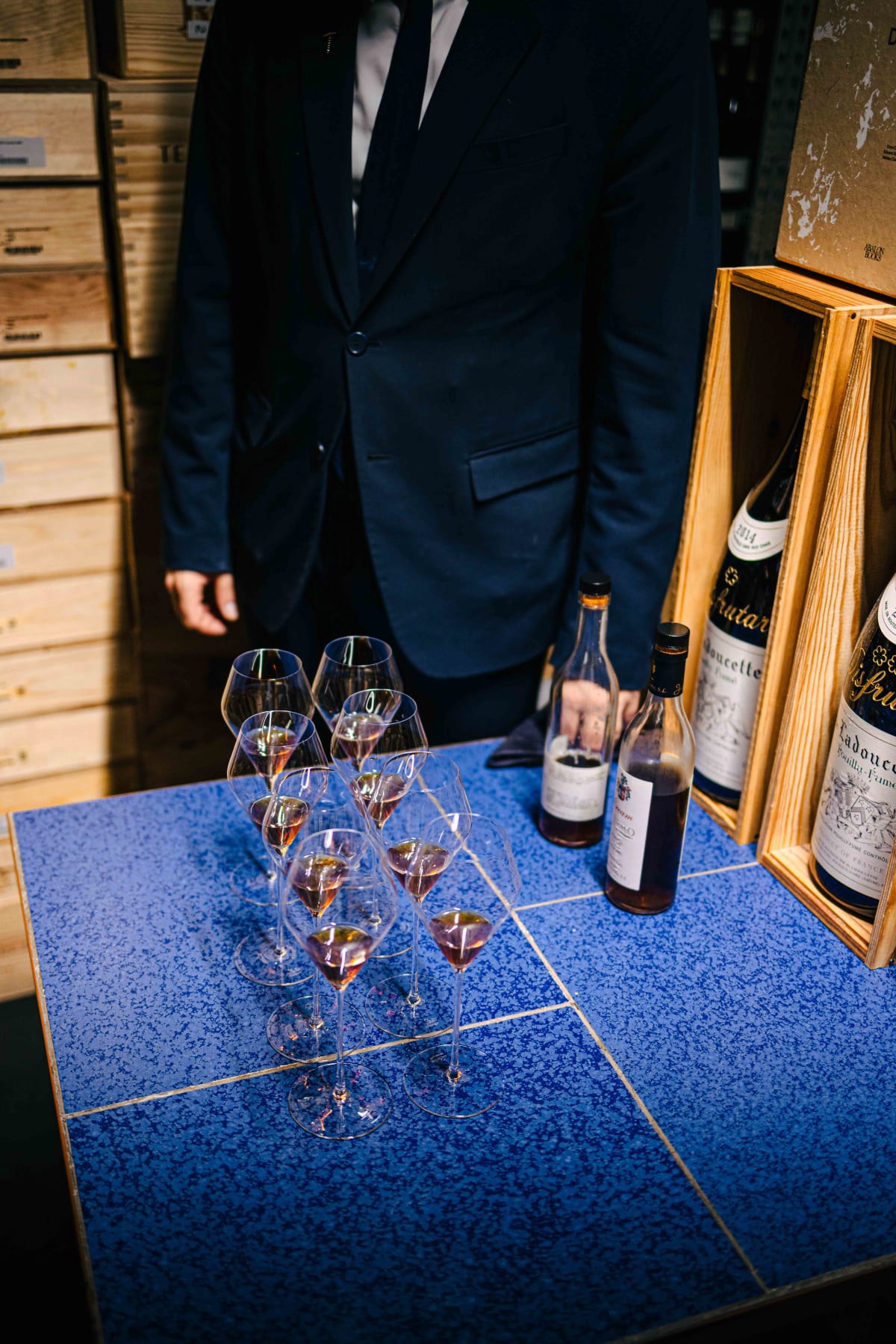
At this spot, the server explained the birth narrative of Disfrutar. elBulli closed of its own accord after winning World's Best five times. The three chefs who had been its head of kitchen, head of creativity, and head of pastry opened their first restaurant in Cadaqués, the northern Catalan fishing village where Salvador Dalí had lived, and then, in 2014, opened Disfrutar in Barcelona. The present cellar space was originally a plain storeroom, they said, but after the pandemic it was renovated into the current cellar and the space of The Living Table.
The server then explained Disfrutar's dissatisfaction with the conventional approach to drinks. During the pandemic, the chefs asked themselves, "we have done avant-garde work in food, so why do we keep repeating the same approach in drinks?" They had felt the limits of the existing options. They had considered tea pairings at some restaurants in China and Japan, the kombucha pairings done at places like Noma, and even mocktail and juice pairings, but for guests who had come all the way from around the world to Barcelona, a "tea pairing with fruit dishes" was not persuasive enough and fell short as a substitute for wine.
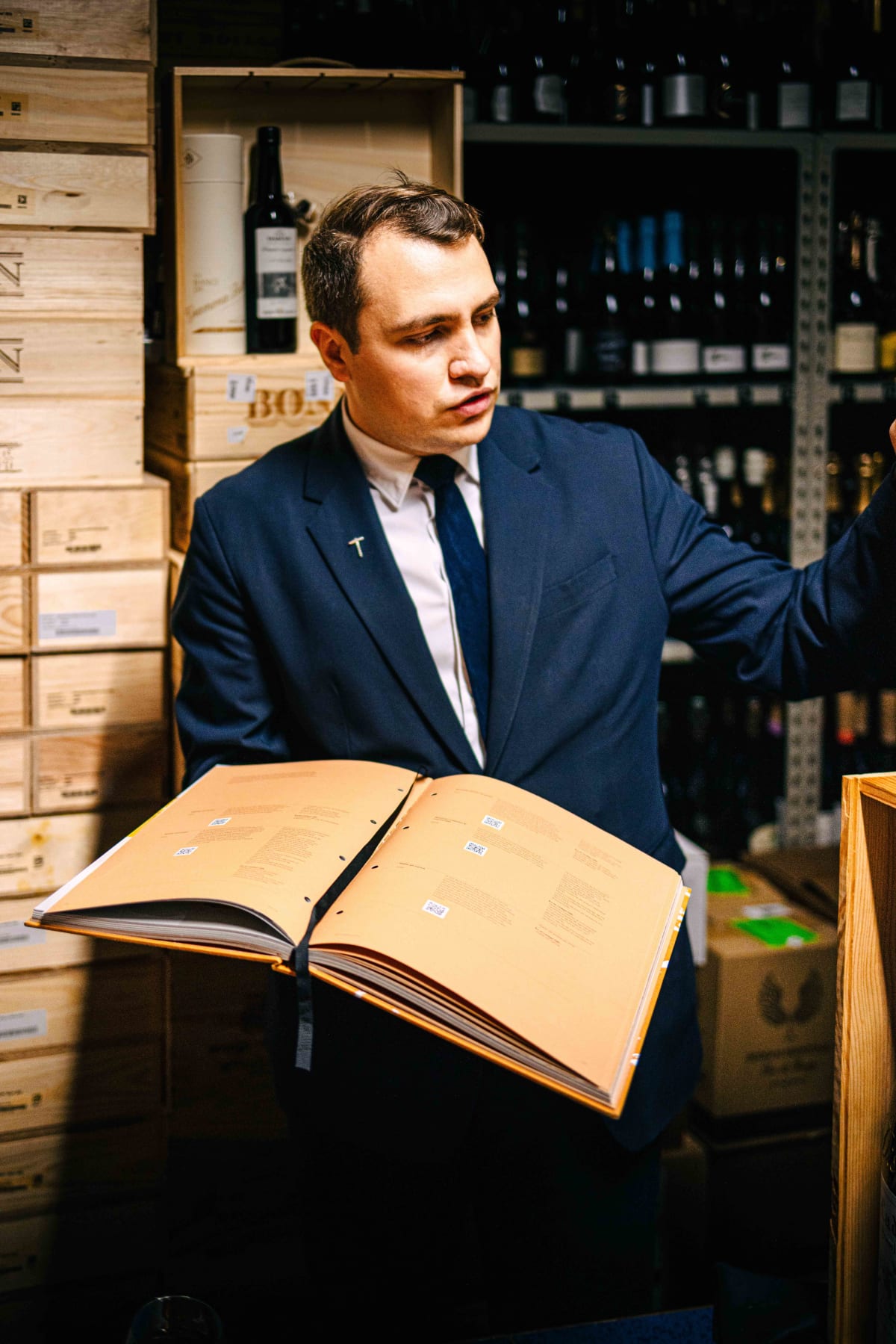

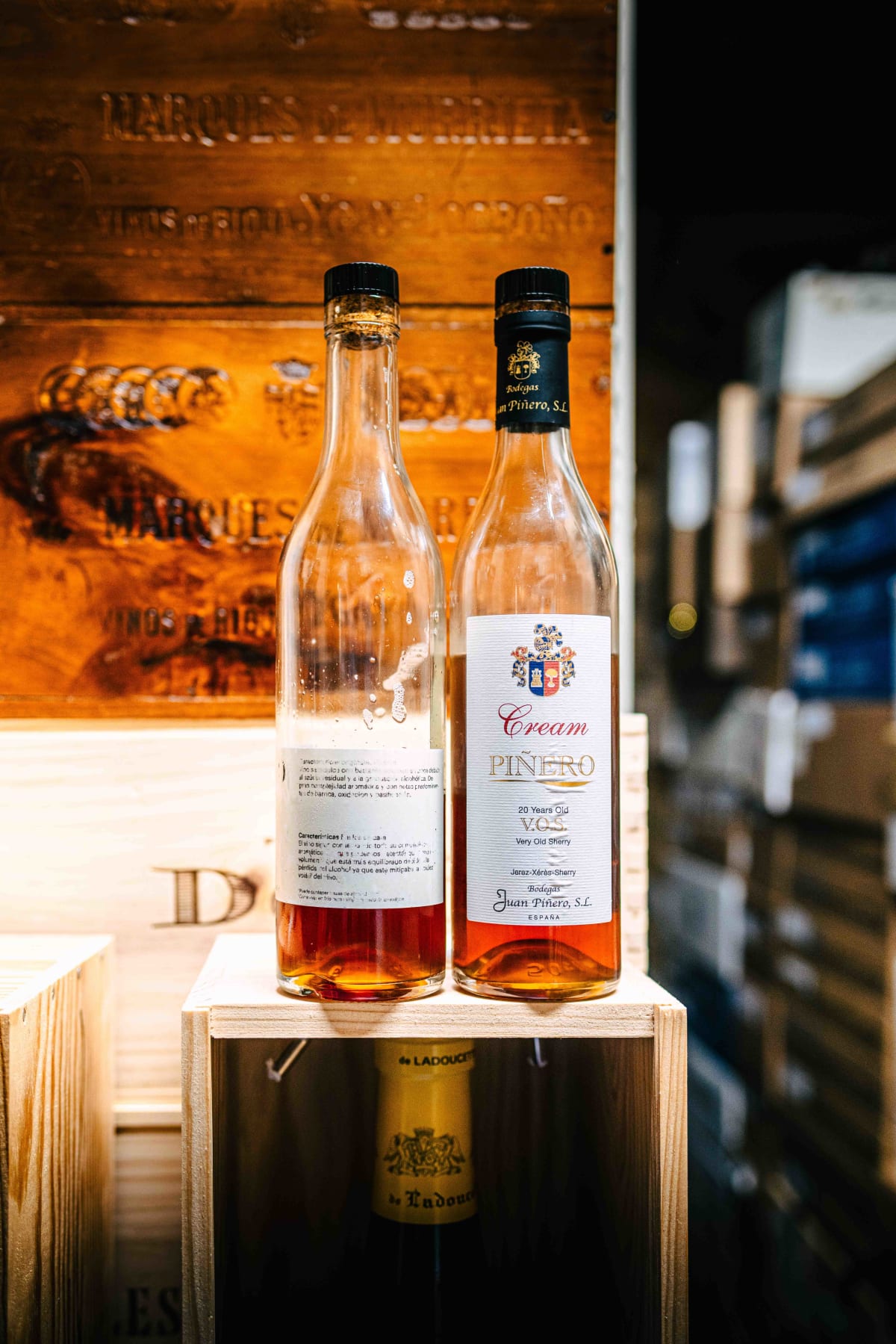
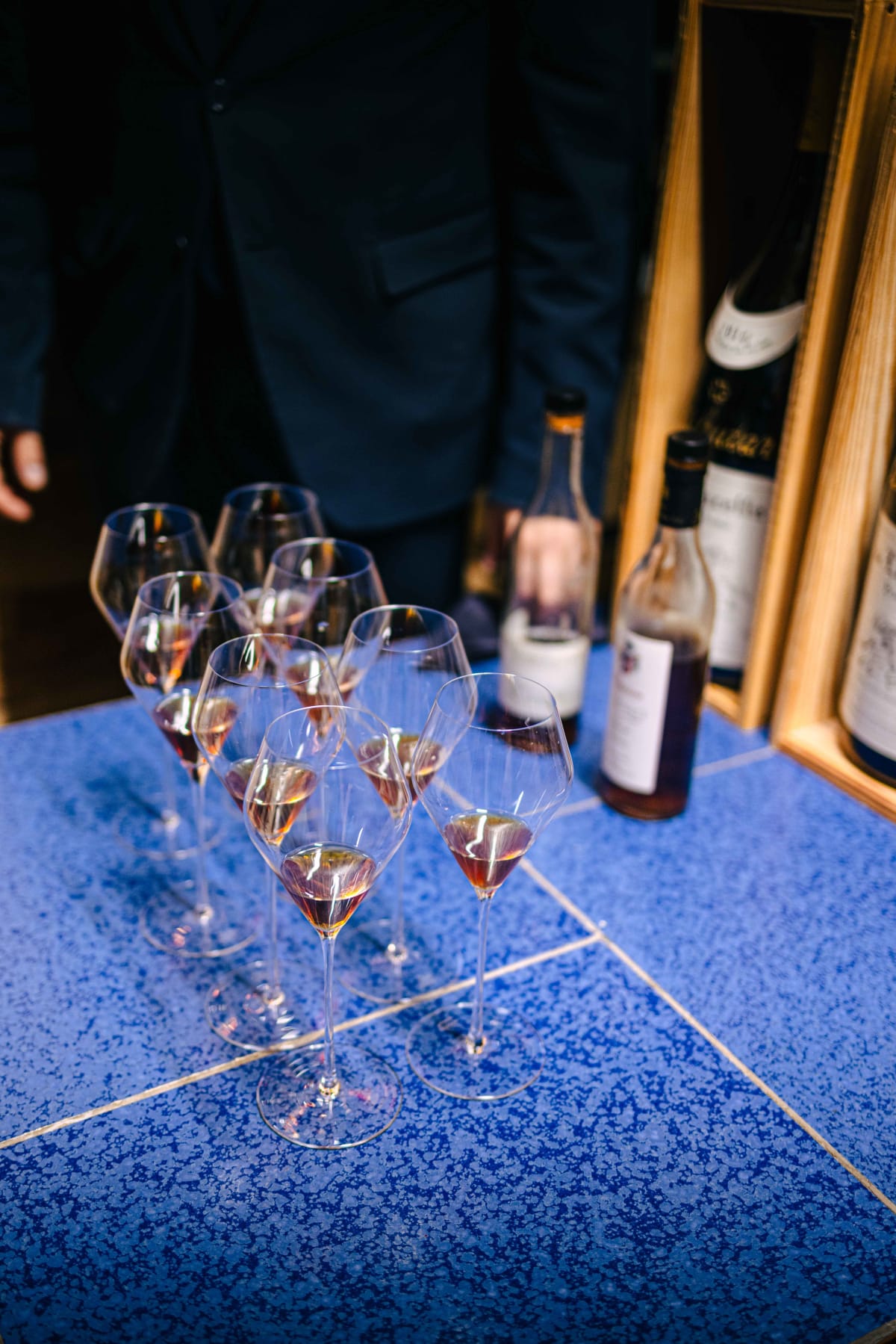
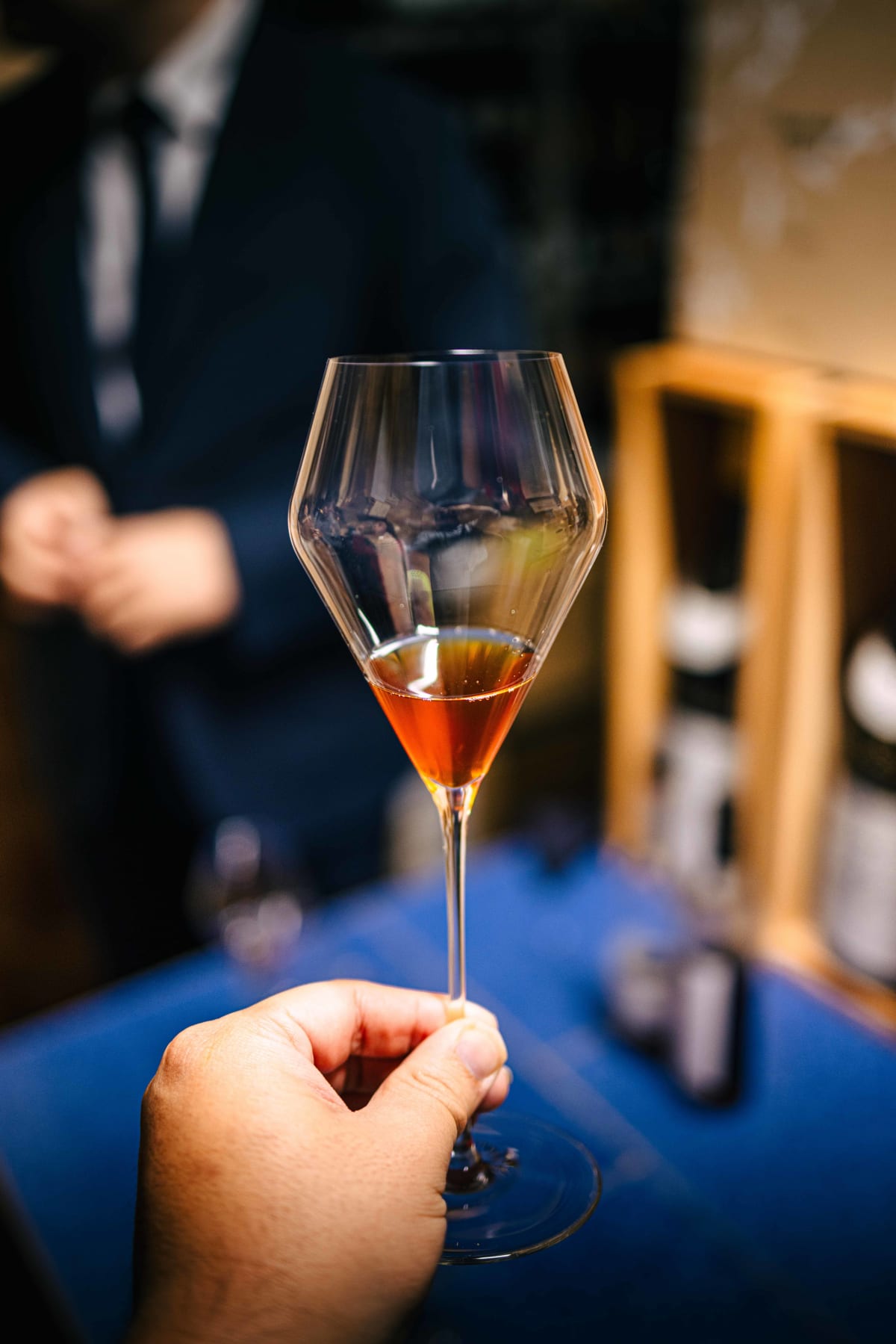
So in 2020 Disfrutar began the "Dealcoholized Wine" project. They ran their experiment with a sherry of about 19% ABV, processing it under vacuum through a piece of equipment called Girovap to remove only the alcohol selectively. The key is not "removal" but "preservation." Create a vacuum and alcohol evaporates even below 30 degrees, so without boiling the wine they selectively removed only the alcohol, keeping the original aroma and structure with no cooking reaction. The result, they said, was a drink reduced from about 19% ABV to roughly 3%, while retaining most of its aroma, oxidative character, and aged nuances.
Here we tasted two drinks. The first was the original sherry wine, the second a dealcoholized wine made from this sherry. The server introduced the two as the same wine. Unexpectedly, the acidity in the dealcoholized version was clean and lifted, and I liked it a great deal. The oxidative character particular to sherry and its mushroom-like nuttiness were well preserved, and because sherry is not originally a category of drink where the sense of alcohol comes through strongly, there was less of a jarring difference.
What matters is that Disfrutar put this experiment into actual service from January 2024 as a pairing of eleven dealcoholized wines. The response, they said, was sharply divided. Some called it innovation; others criticised it, saying it "damaged the soul of wine." Disfrutar no longer offers the pairing as part of its regular service. Instead, it presents the experiment in this form near the end of The Living Table course. But in the fact that they neither hide nor make excuses for the failure, and rather explain this process in person in the cellar, sharing even what fell short, I felt an experience worthy of the world's number-one restaurant. Of course, the fact that they serve even failure as part of the experience may be judged differently depending on one's view of fine dining.
Disfrutar is now, they say, conducting research again with mead, that is, humanity's first alcoholic drink. They do not use honey, though, but ferment on a base of fruits such as pineapple and banana, securing sweetness, acidity, and the complexity that comes from fermentation all at once. The goal is clear: not to imitate wine, but to develop a new kind of drink with a structure governed by a logic of its own. In this process the cellar has become no longer a storage space but a laboratory. I too would like to visit Disfrutar again someday and experience the new results.
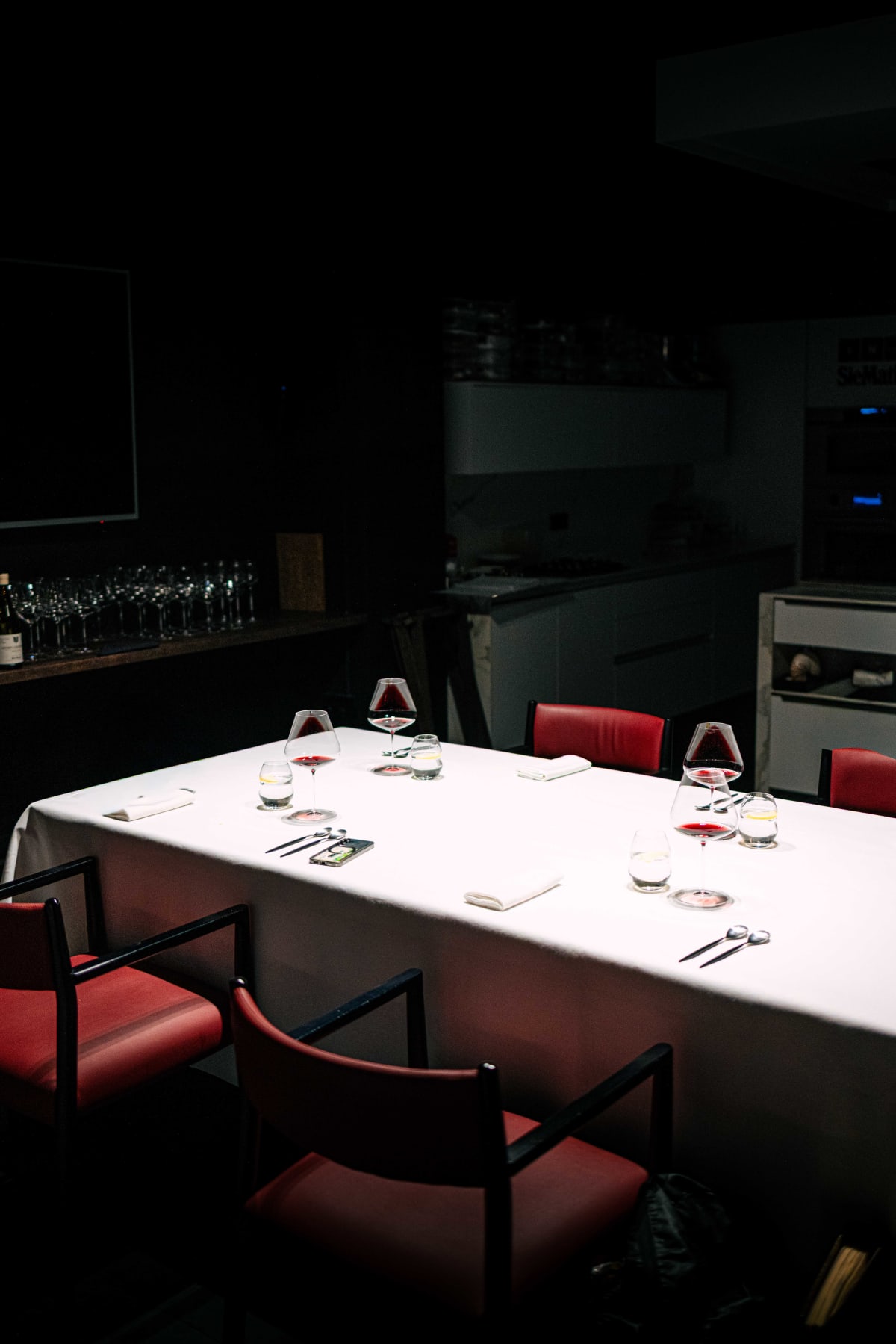
Returning to my seat, the lighting and the mood seemed to have changed somehow.
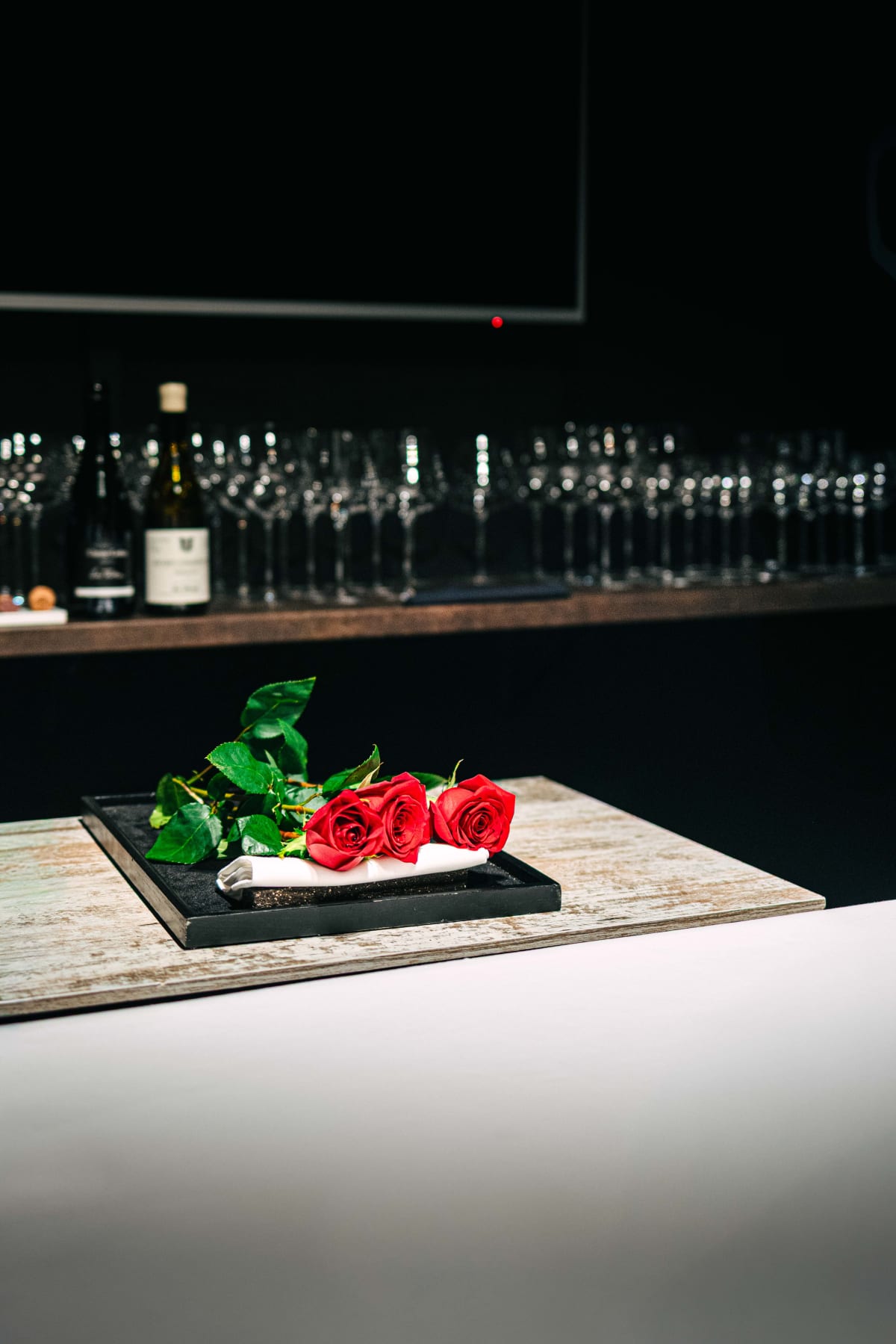
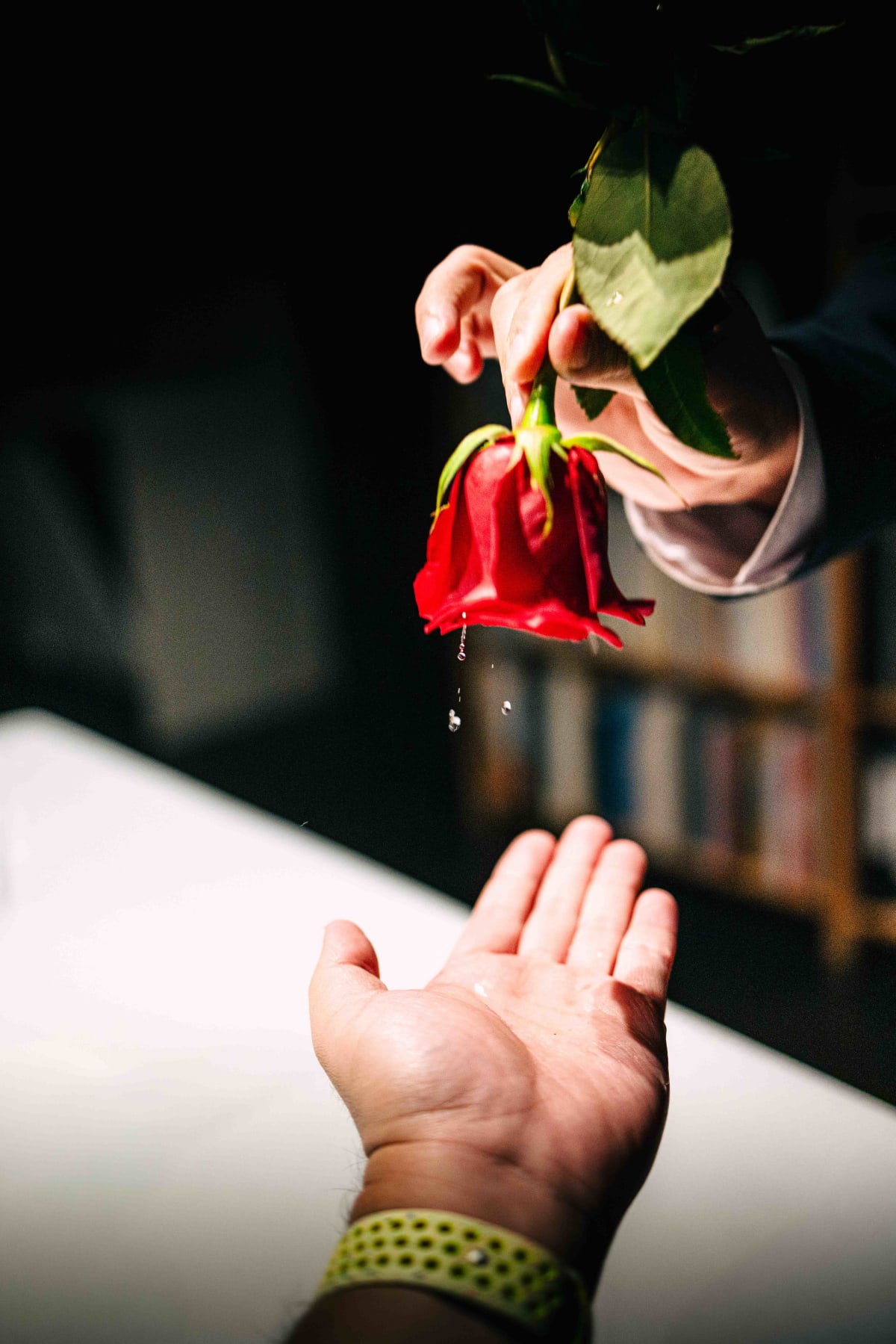
Beside me lay a single rose. This, they said, was "Rose water (2023)." Before entering the dessert part, it is a ritual course of washing the hands. It symbolises the start of a day on which the rose opens red, and they spray rose water, distilled from roses, onto your palms. It is not a simple cleansing but signifies the turning point of the course, they said.
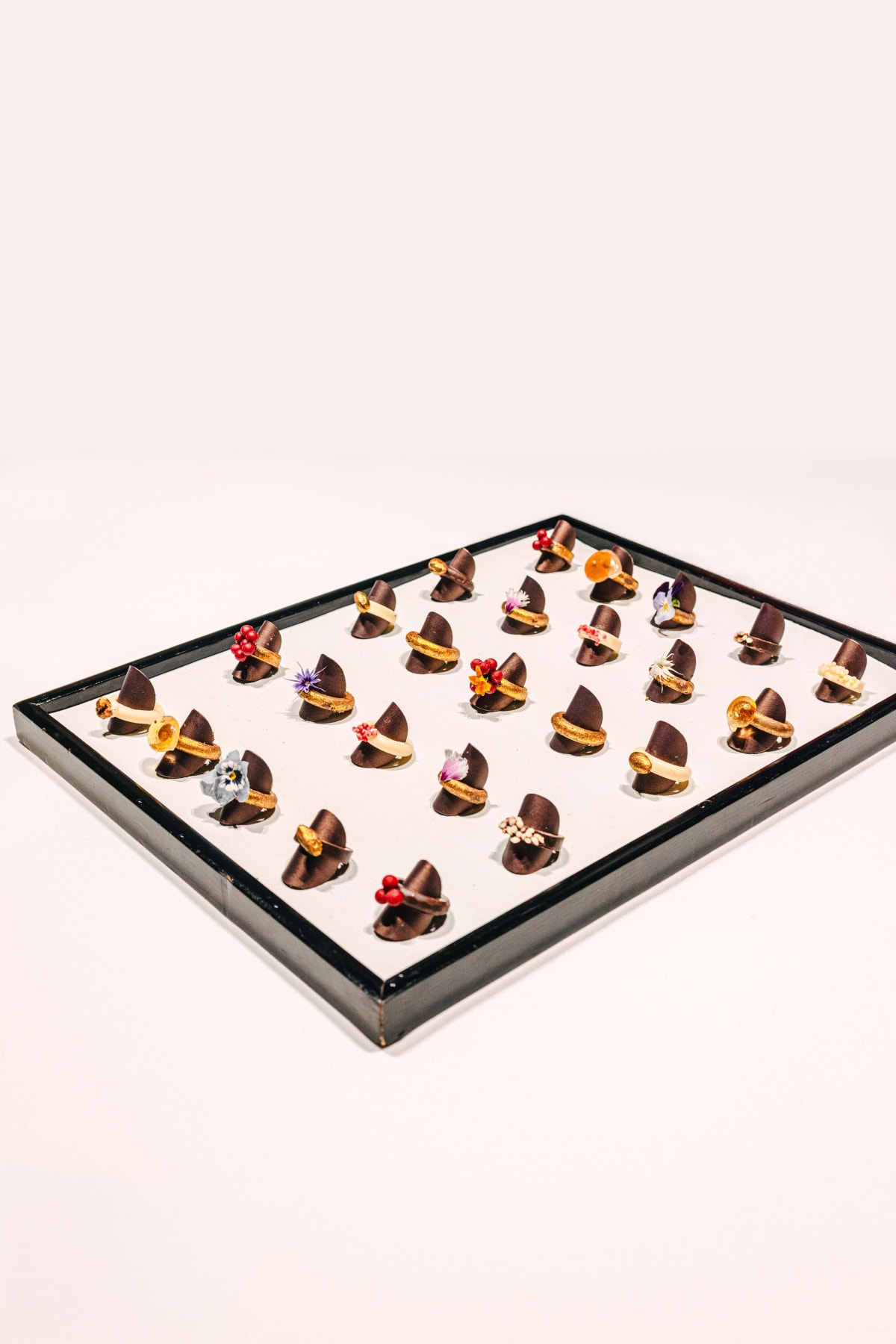
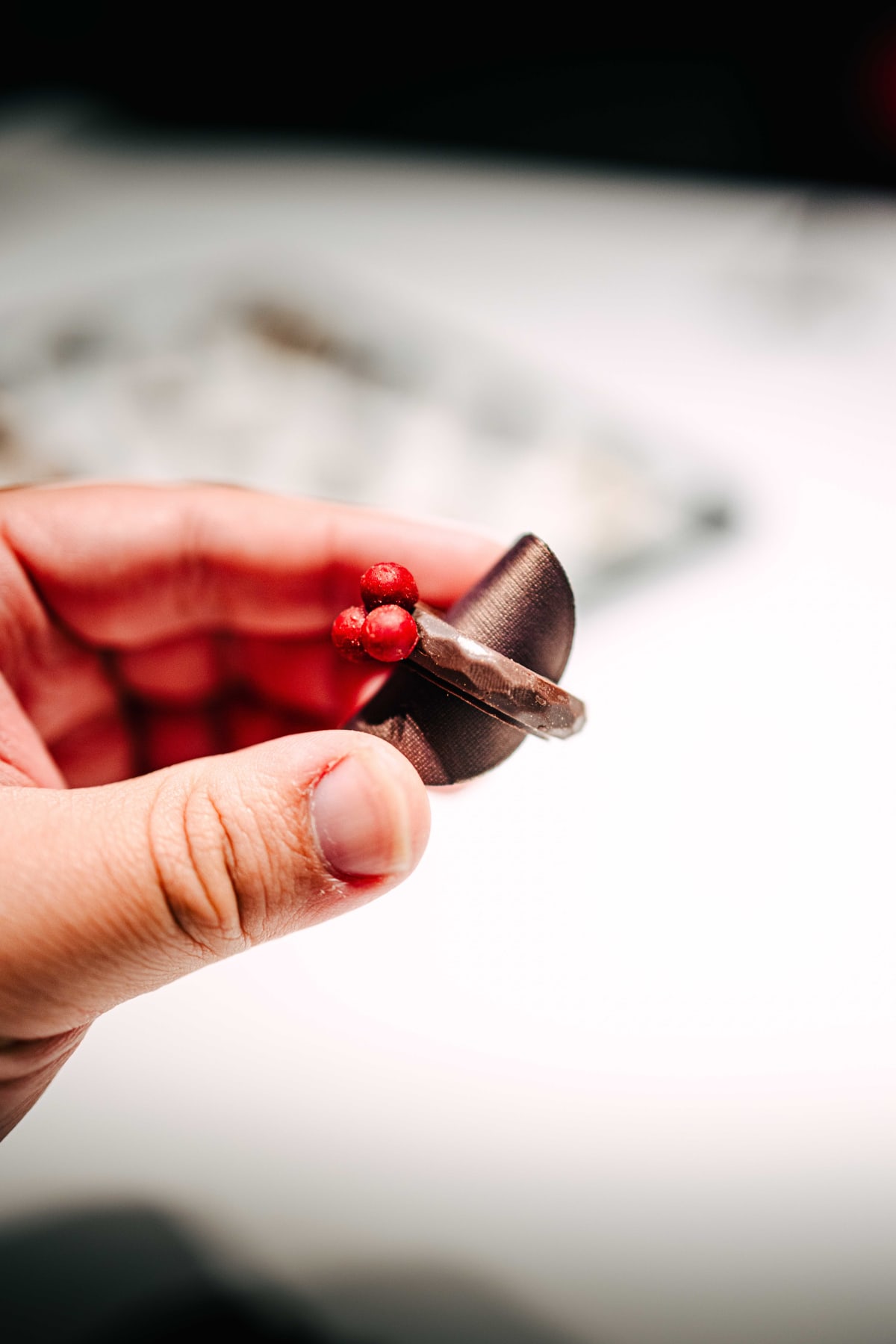
Then one more pre-dessert came out, with countless chocolates stacked in the shape of a ring. This is "Engagement rings (2023)." I wondered, "are four of us supposed to eat all of this," but it was a device to pick and eat just one each. White was yuzu and white chocolate, gold was cinnamon and chocolate, brown was dark chocolate. I chose the dark chocolate. They were not all different, but each had a different ingredient on top. The taste was an utterly ordinary chocolate.
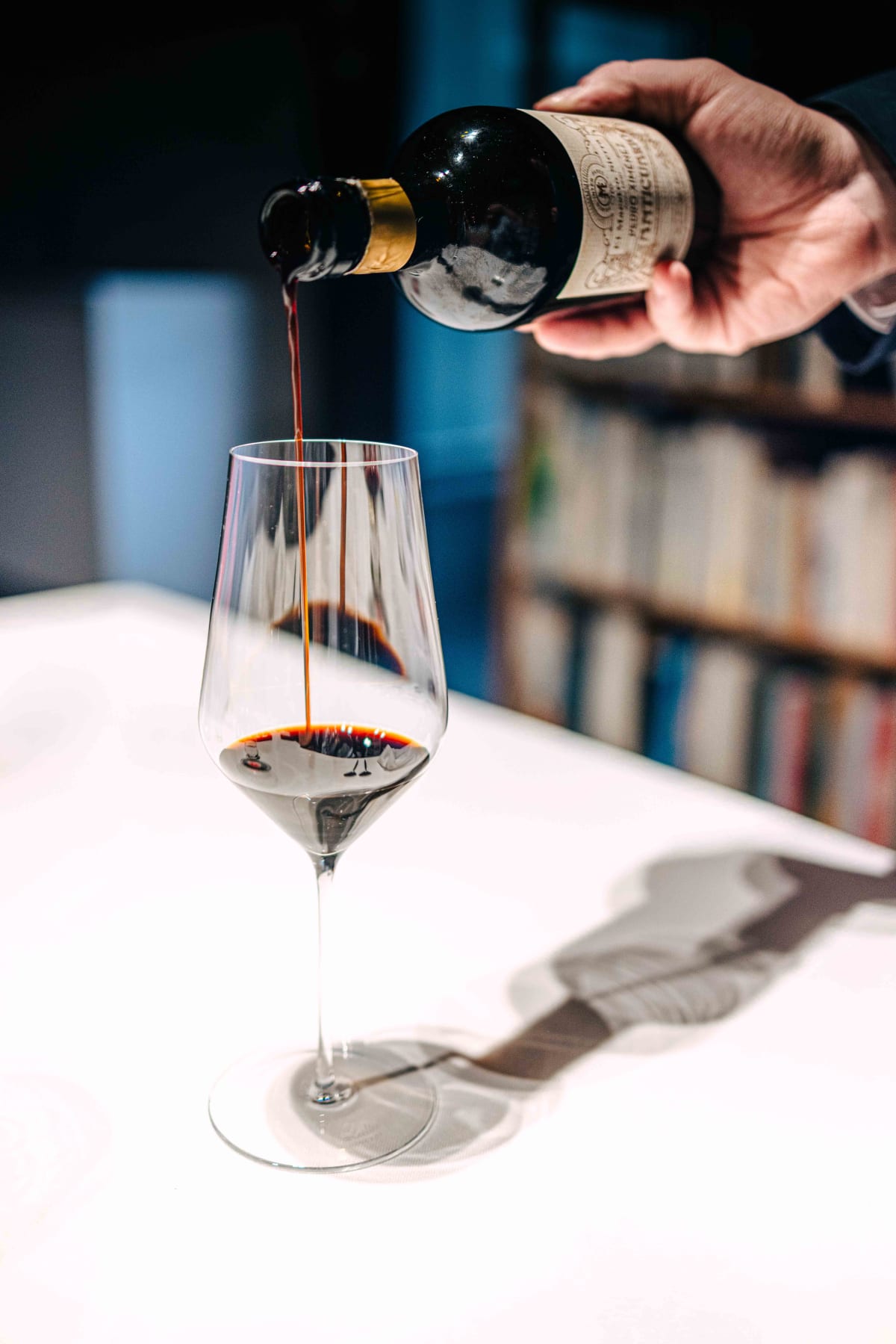
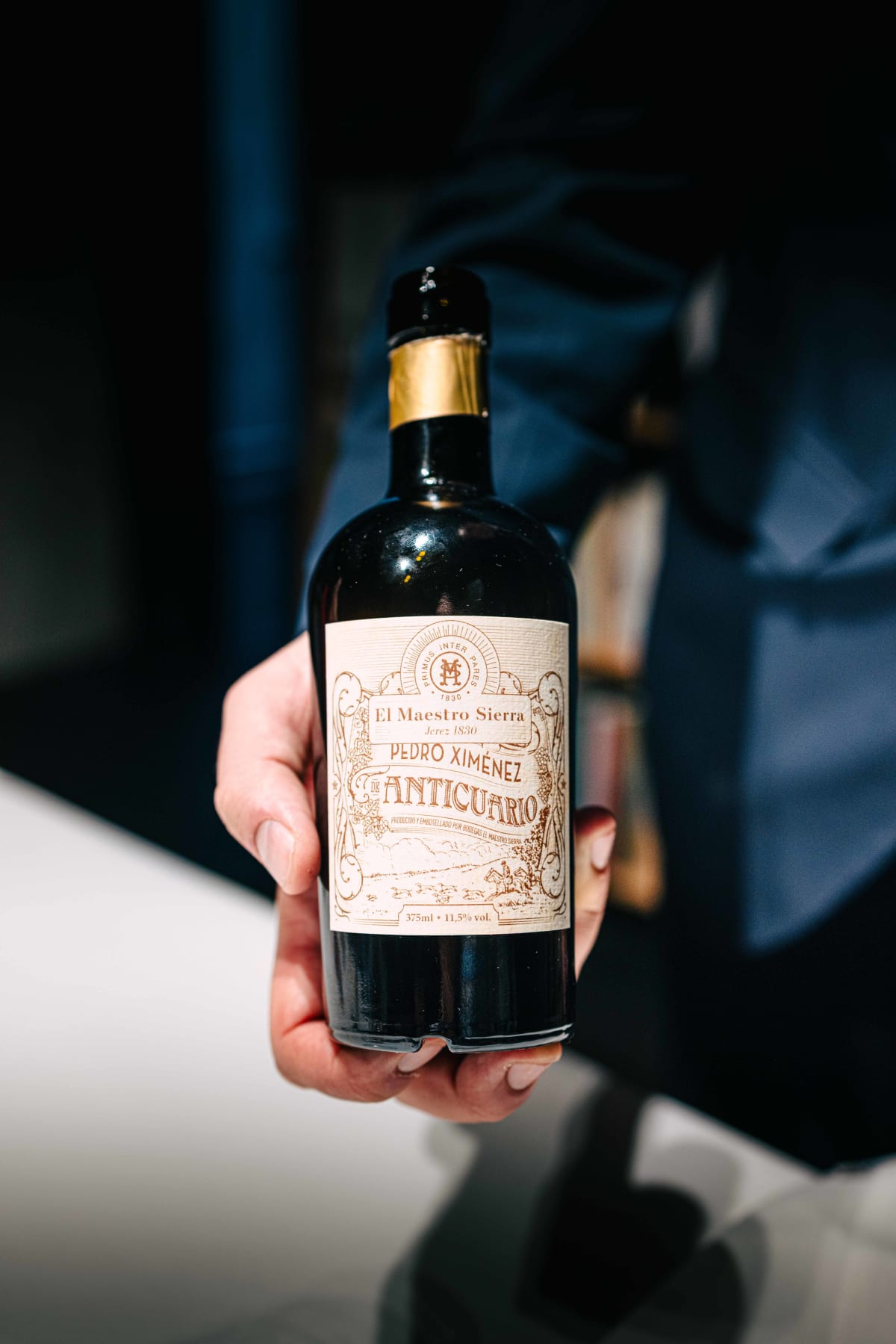
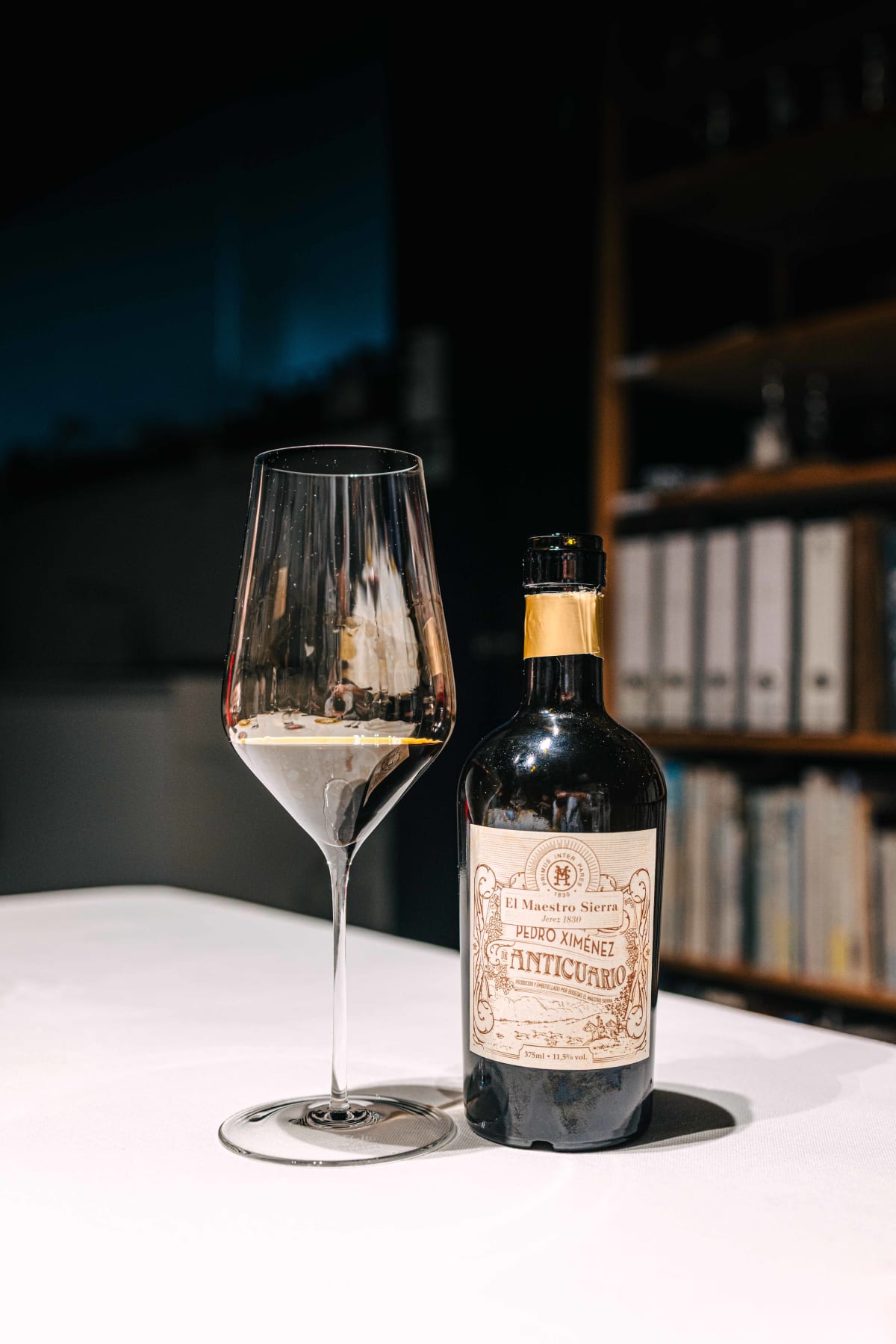
At this point I ordered, on my own, a glass of sherry: Pedro Ximénez Anticuario, El Maestro Sierra D.O Jerez. El Maestro Sierra is a small family-owned bodega founded in 1830 by José Antonio Sierra, a master cooper. Production remains limited, and the house maintains some of Jerez's oldest and most refined soleras. This Anticuario is made only from Pedro Ximénez grapes sun-dried to concentrate their sugar, and is a wine oxidatively aged for an average of fifty years in American oak casks via the solera and criadera method. What is interesting is that, rarely for Jerez, it is unfortified, so the natural alcohol obtained from fermentation alone stays at around 10% ABV, which is why the strength felt lower than expected. Within a thick texture like unagi tare, coffee and dark chocolate, dried fig and nutty aromas burst out explosively.
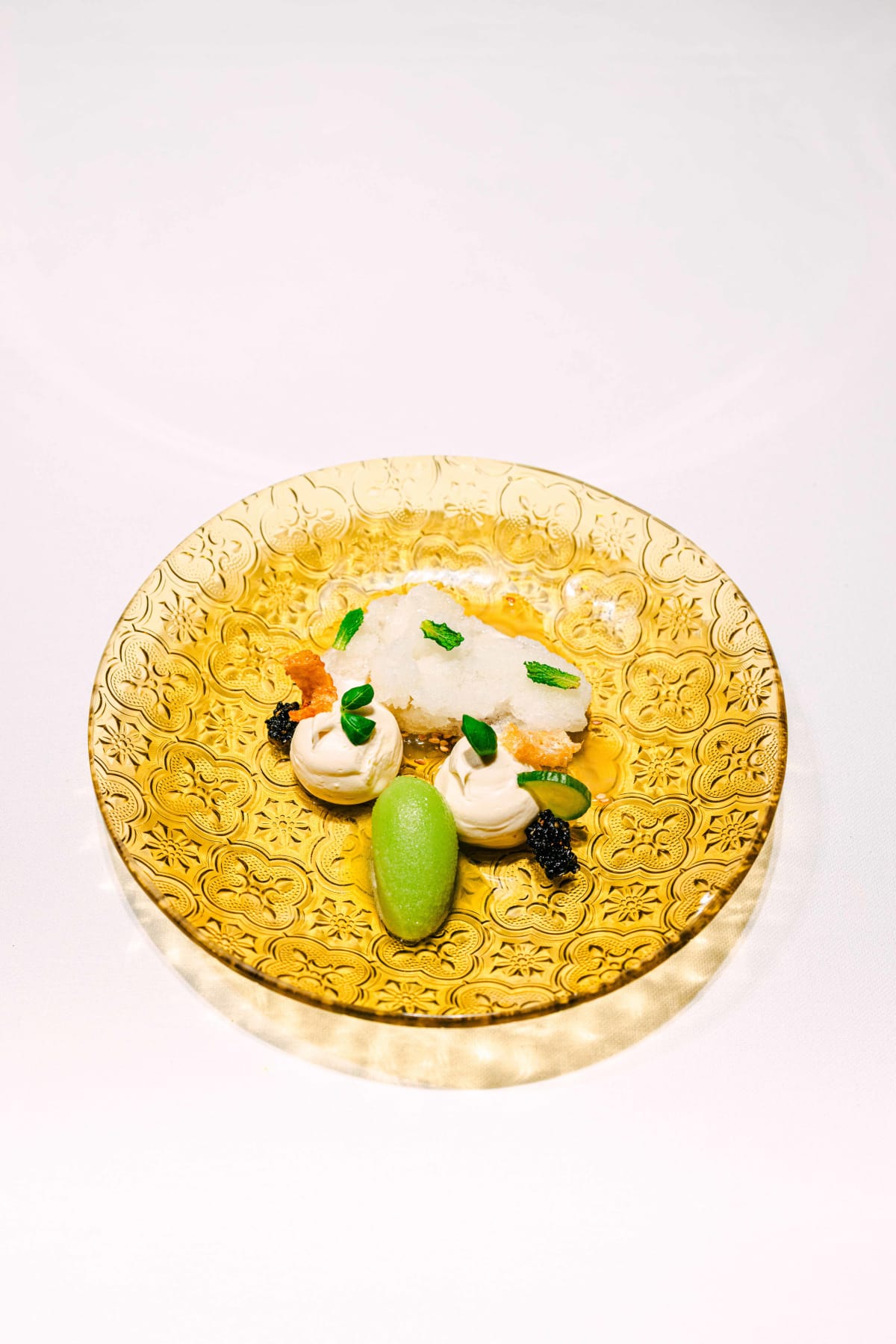
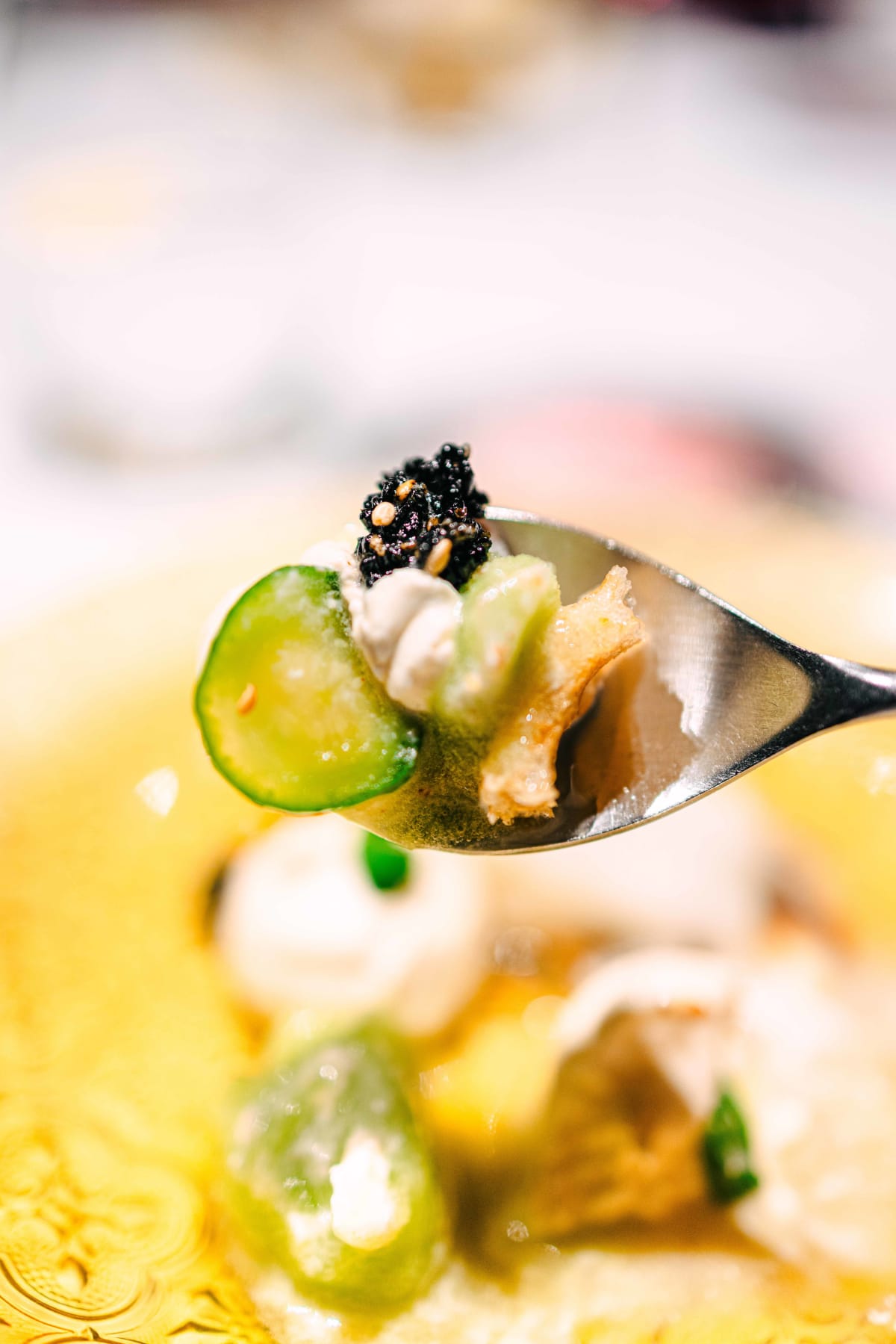
The first dessert was "Hoisin cucumber (2018)." It was a quite amusing dessert, entirely different from the usual taste of a dessert. It held cucumber raisin, frozen ginger, cucumber sorbet, and anise cream, but the important thing was that there was chicharrón. The combination was quite unusual. It is a creamy dessert, yet beneath it lay a deep sauce tasting like char siu or the seasoning of yangnyeom chicken. So the taste was very distinctive, and the cucumber sorbet kept it in balance. It is not easy to call it delicious, but it was a dessert whose combination, in the way it built the structure of flavour, was interesting.
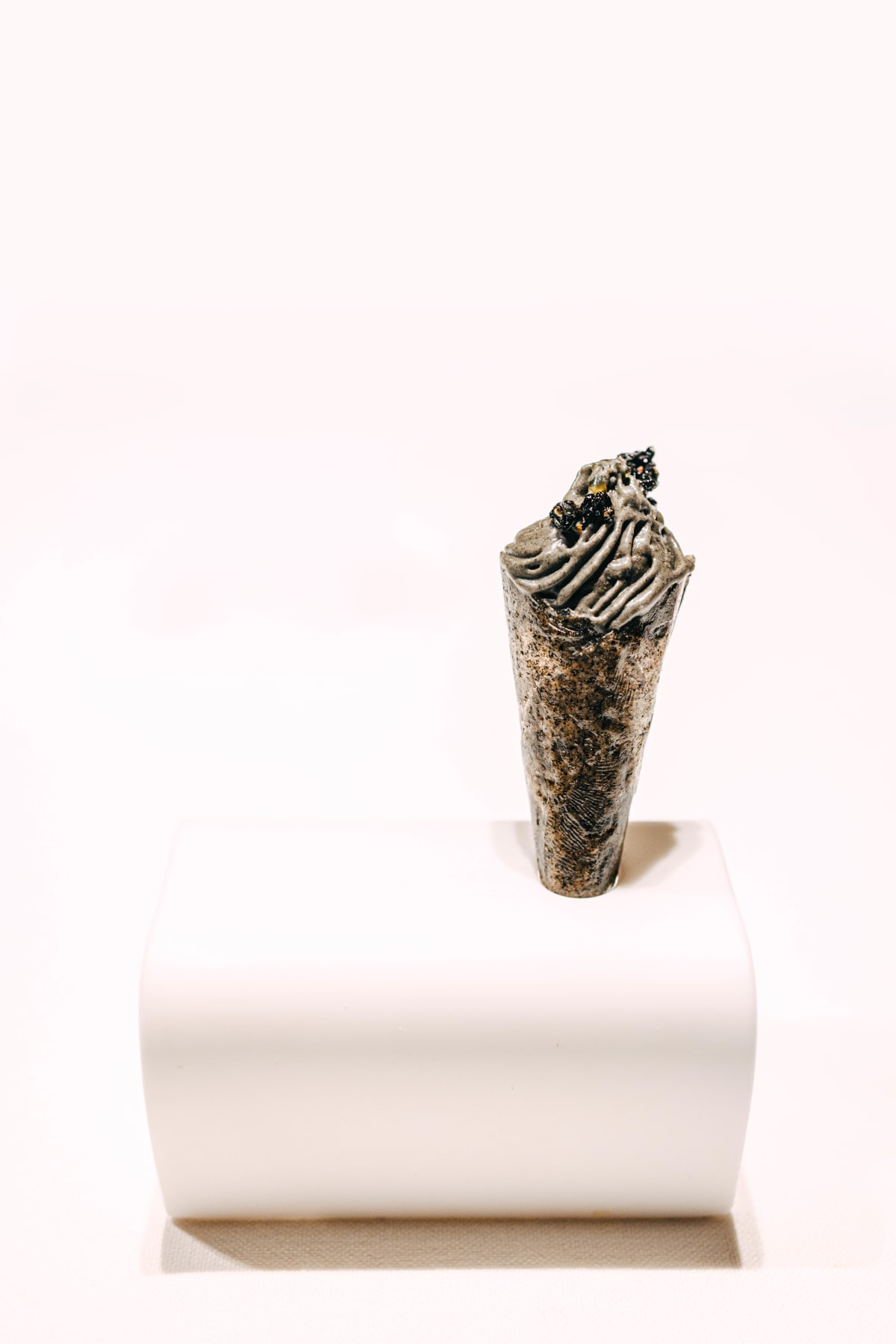
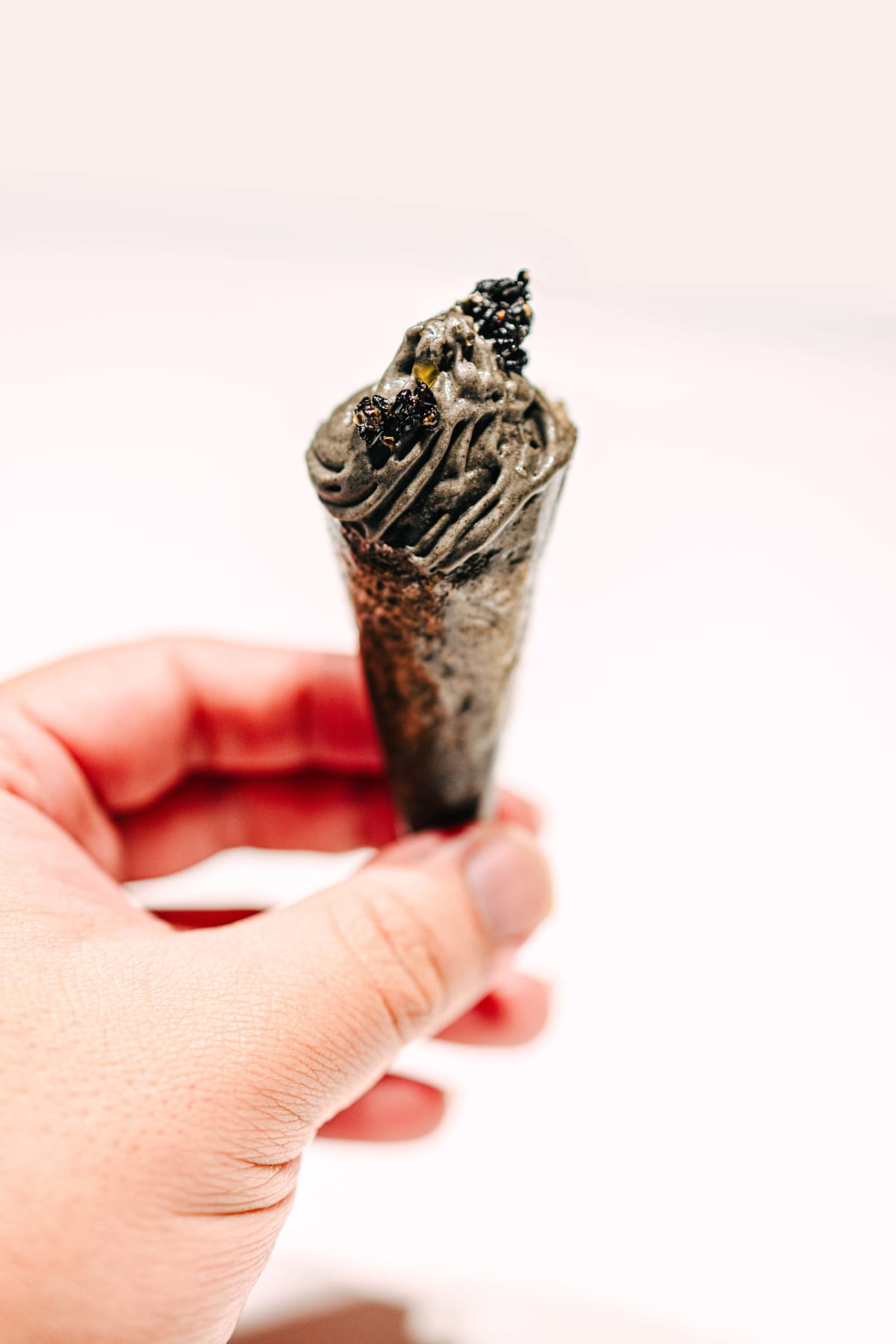
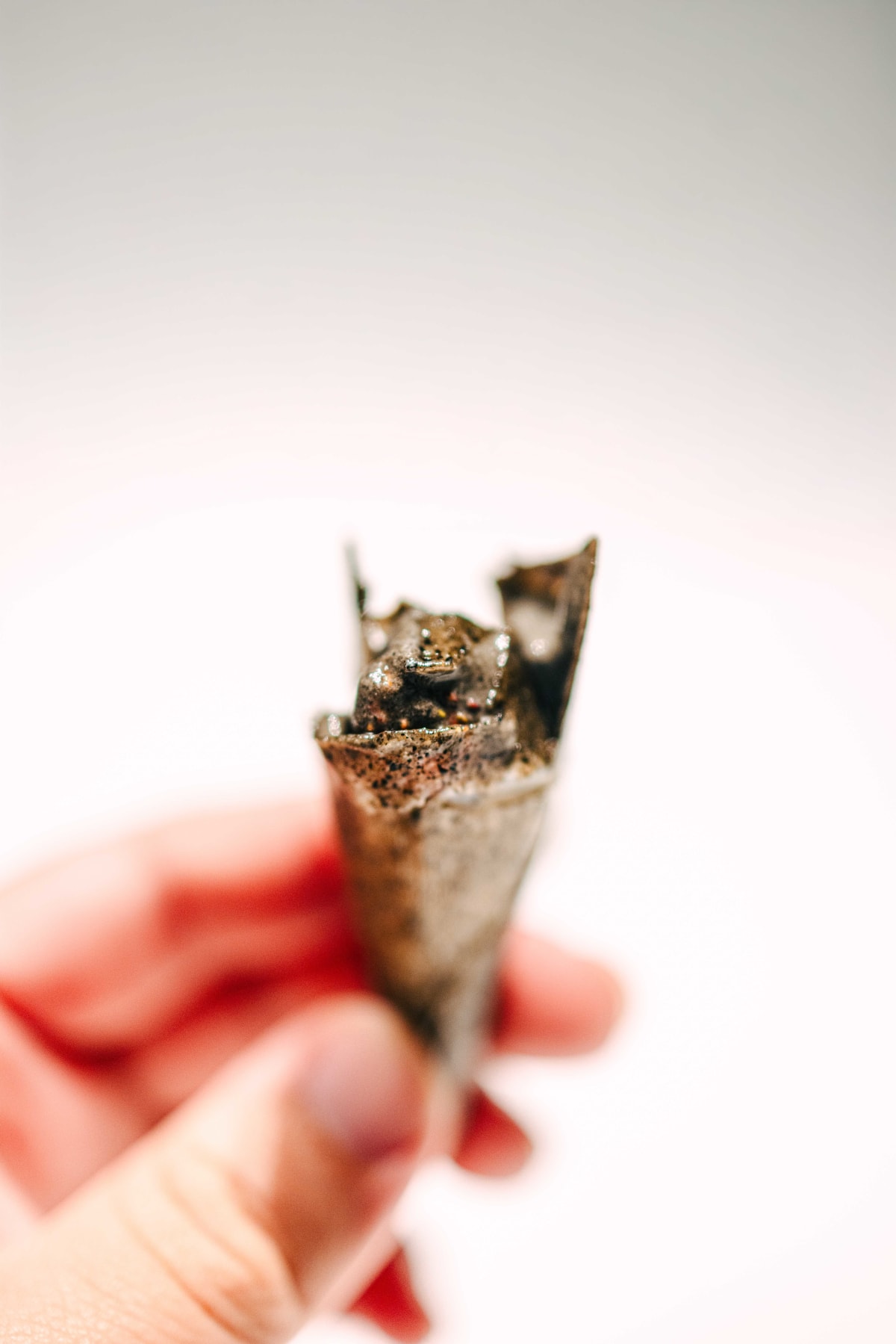
The second dessert was "Black sesame cornet (2017)." It looked like an ice-cream cone, but the shell was not a conventional cone. It was thin and crisp, with a texture reminiscent of pork rind. On top were black sesame cream, berries, and another strawberry-like element, with yogurt at the bottom. This was delicious. The shell was well crisped, while the filling balanced nuttiness with freshness.
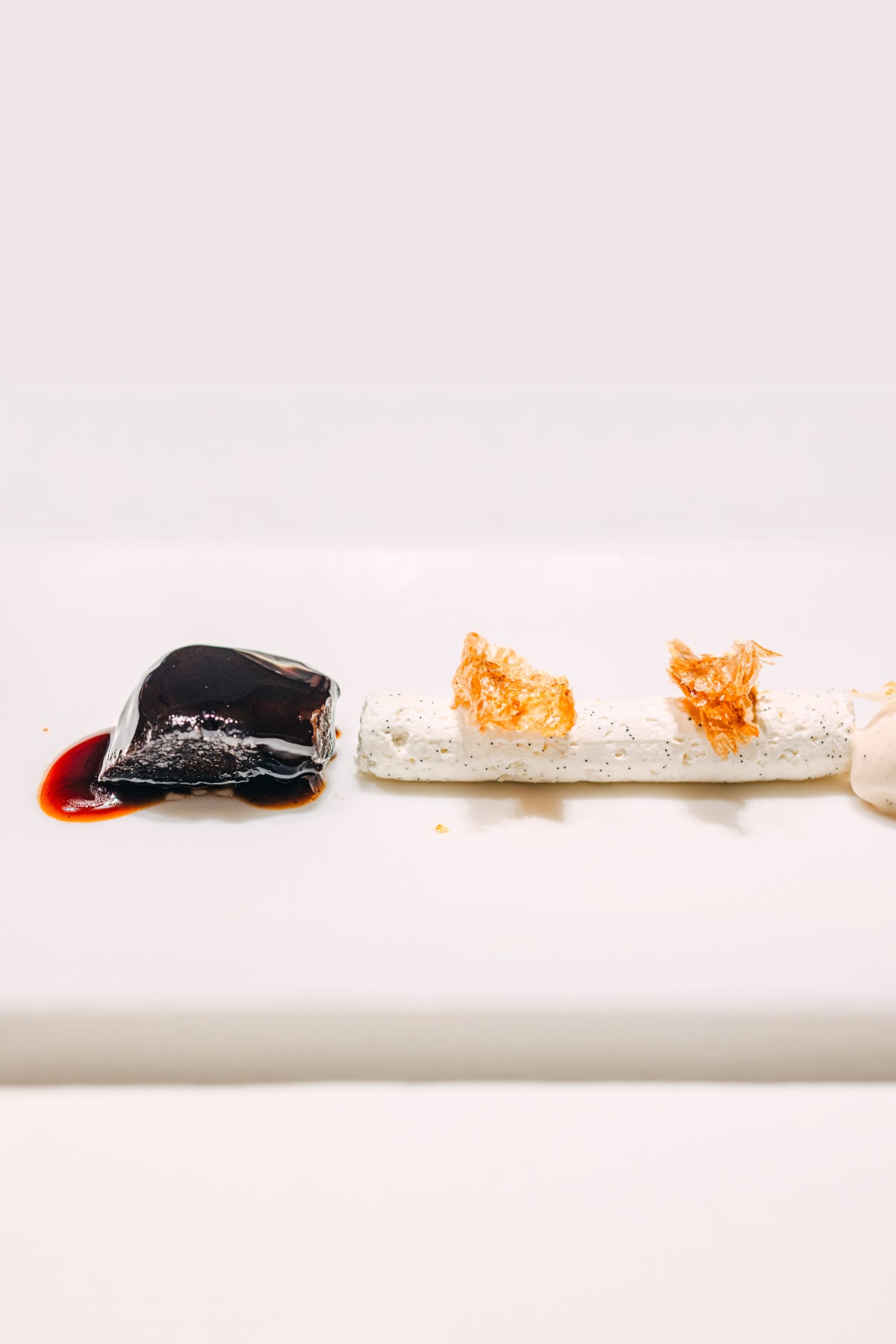
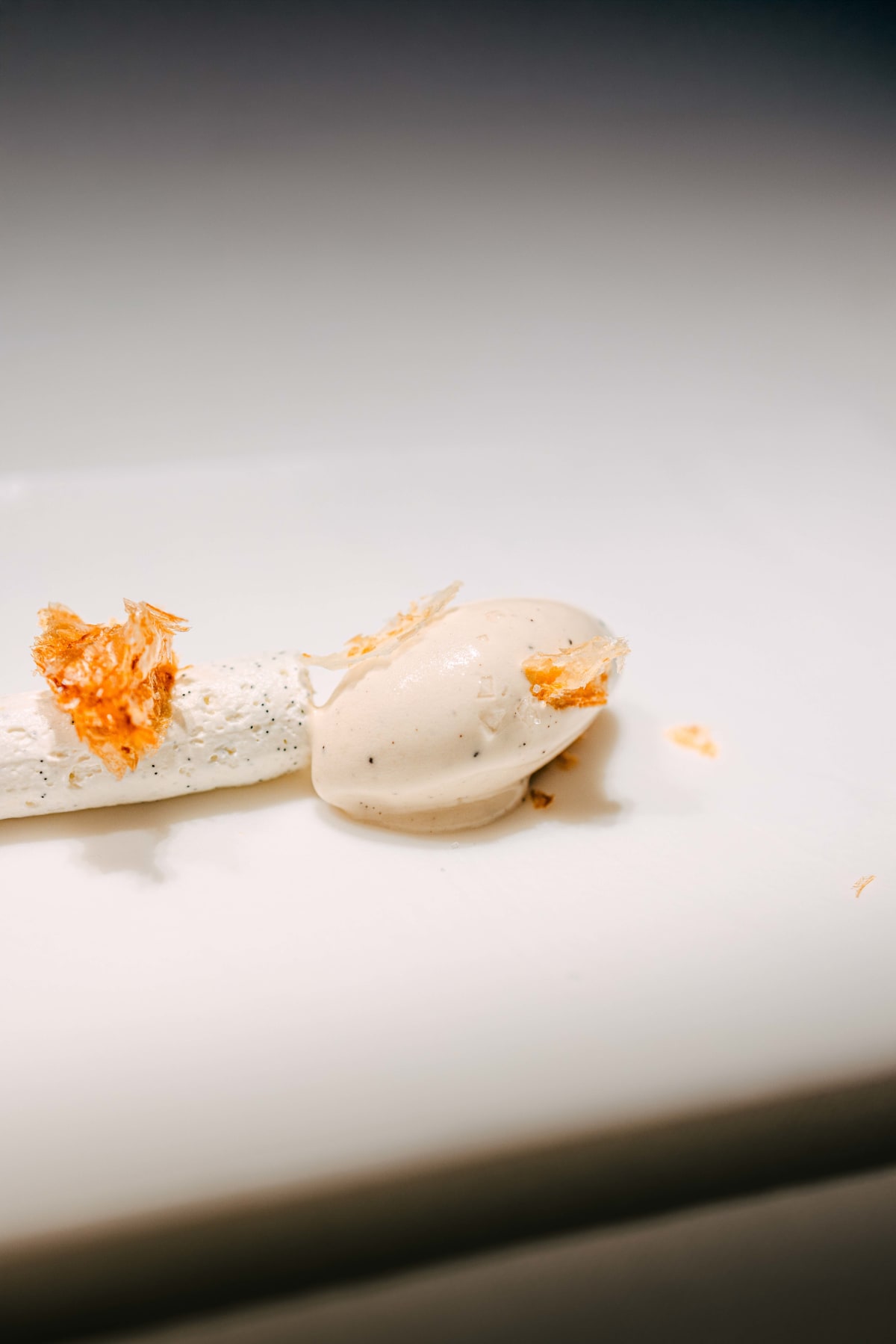
Served with it came "Black apple with noisette butter ice cream and flourless puff pastry (2023)." Before the dessert came out, the server first showed us apples in four vacuum packs; the leftmost was just an apple, and the rightmost was so shrunken you could hardly tell it was an apple.
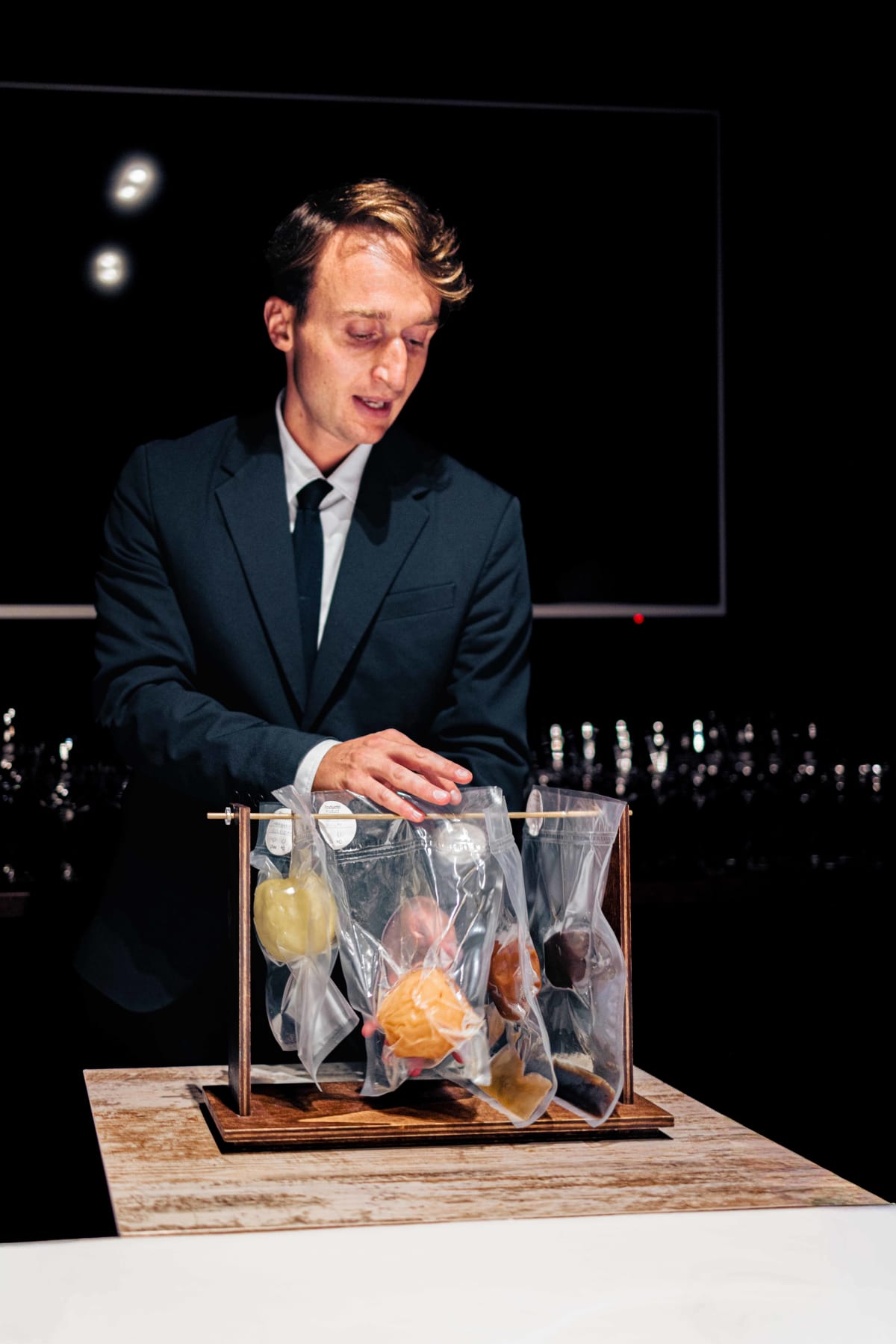
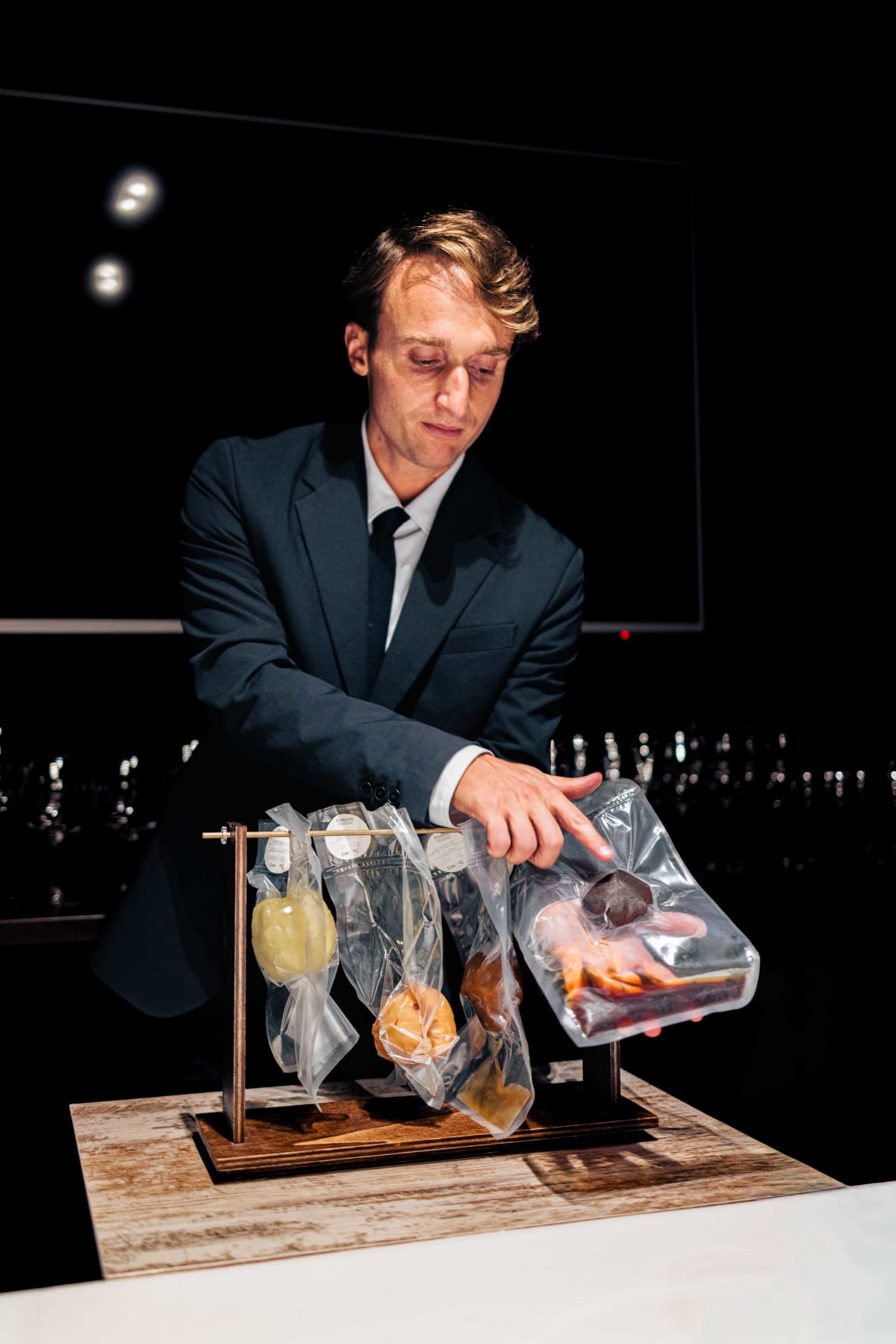
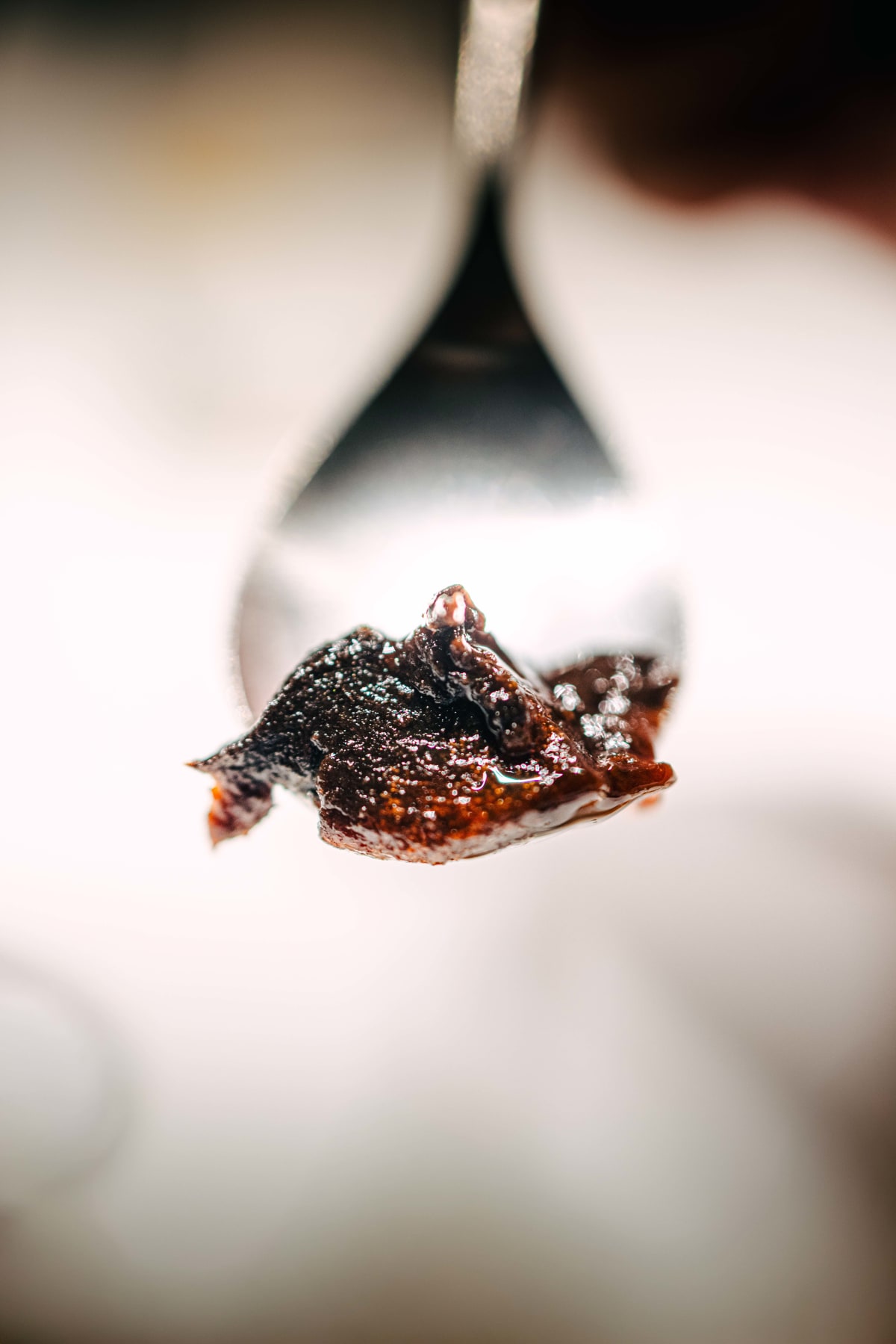
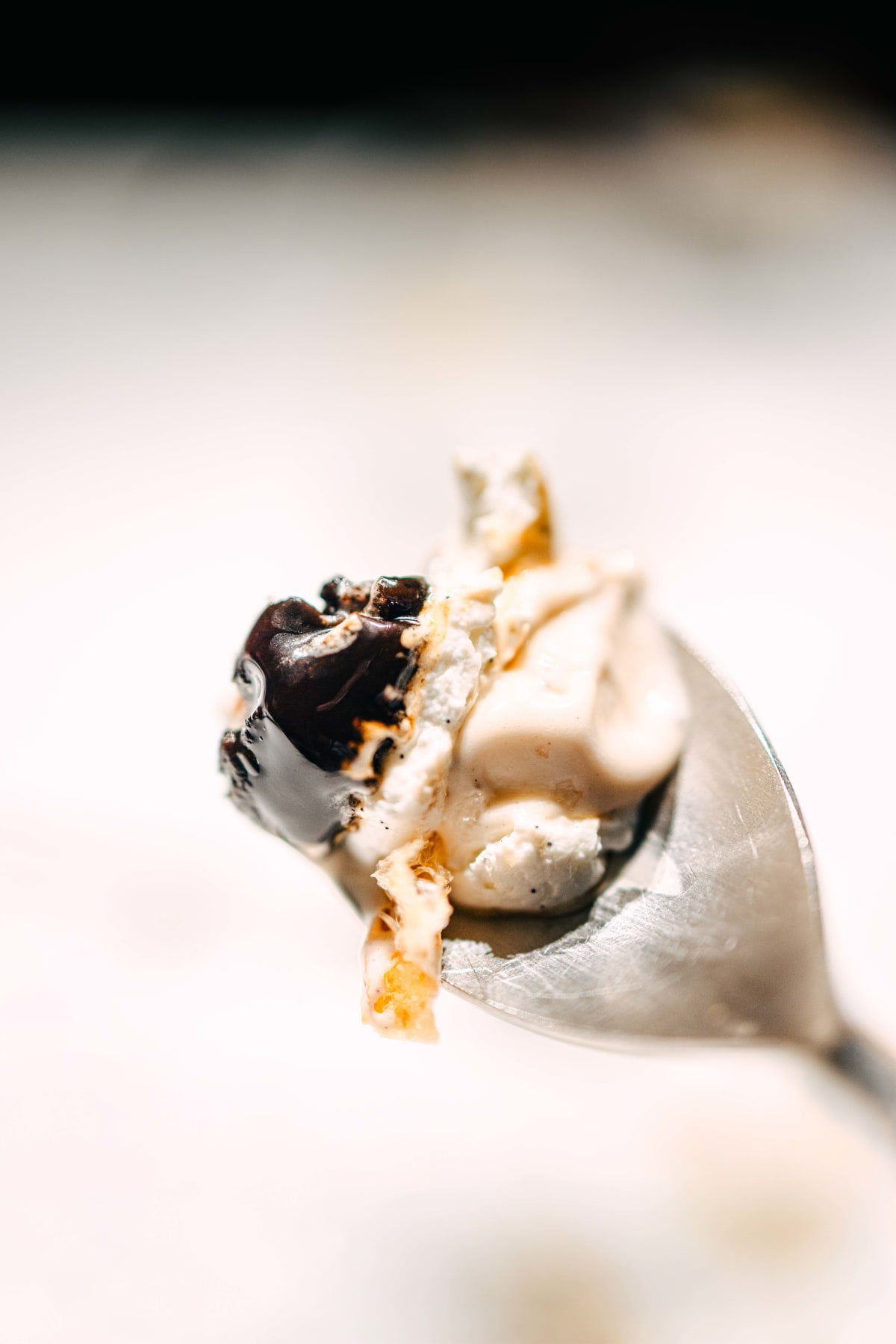
It was an experiment in what time can do to an apple: a black apple produced not through fermentation, but through prolonged low-temperature heat transformation. The way a black apple is made is to vacuum-seal a raw apple and leave it in a 60-degree cabinet for about 60 days. By day 10 the colour begins to change, by day 30 it darkens, and by day 60 it turns completely black and becomes extremely soft. The texture resembles a fully cooked apple, while the flavour turns caramelised with the sweetness concentrated.
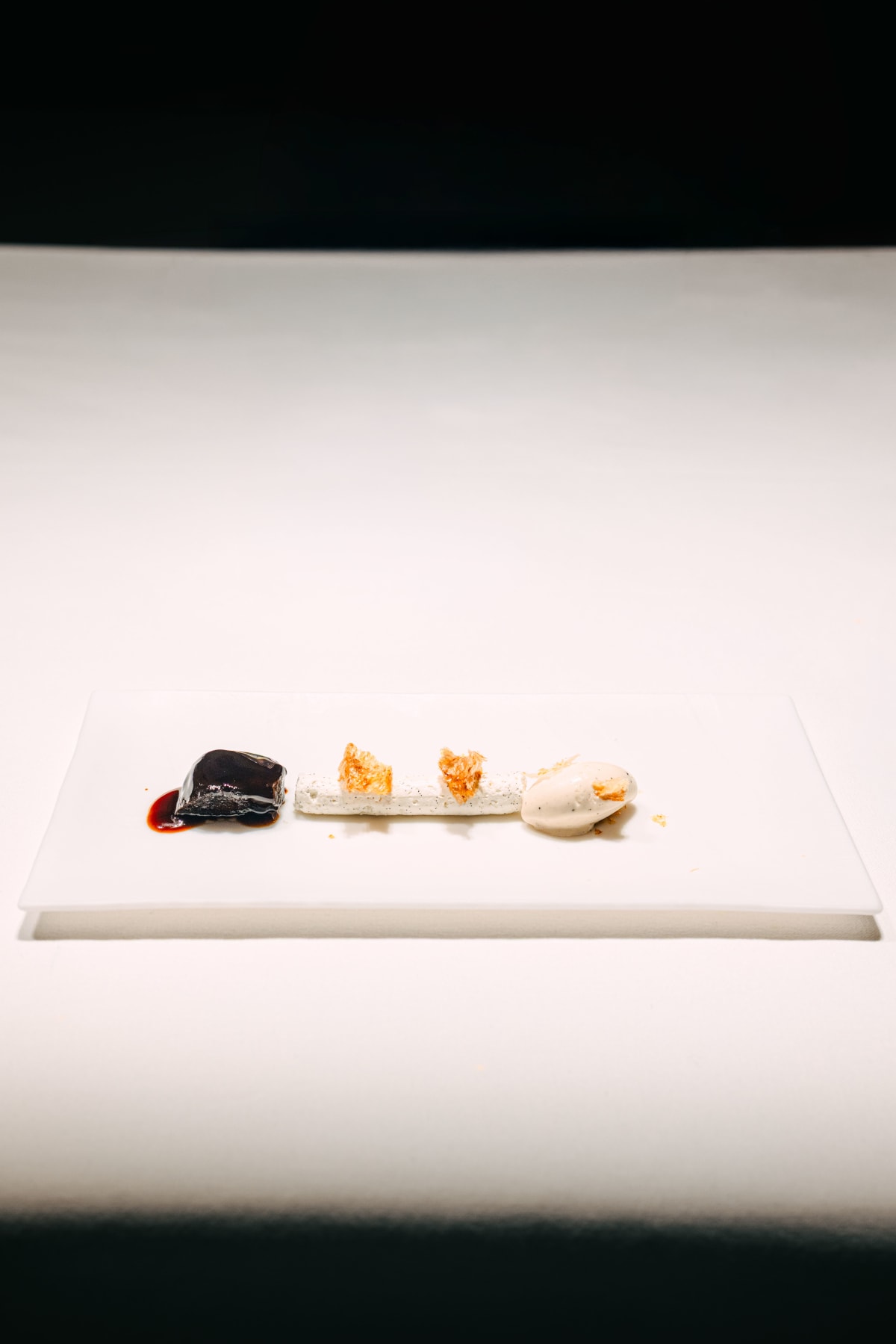
On the far left you could taste this very black apple; next was a vanilla cream topped with the puff said to be made without flour. By adding only a minute amount of sugar, they minimised the sweetness and created a very light texture, they said. Finally, on the right, there was Noisette Butter Ice Cream, a brown-butter-based ice cream. Personally, since I like desserts that taste of apple, the black apple was delicious, and its harmony with the other desserts was fine too. That said, because the high acidity that balances an apple's sweetness was gone, the charm of the black apple did not come through strongly to me.
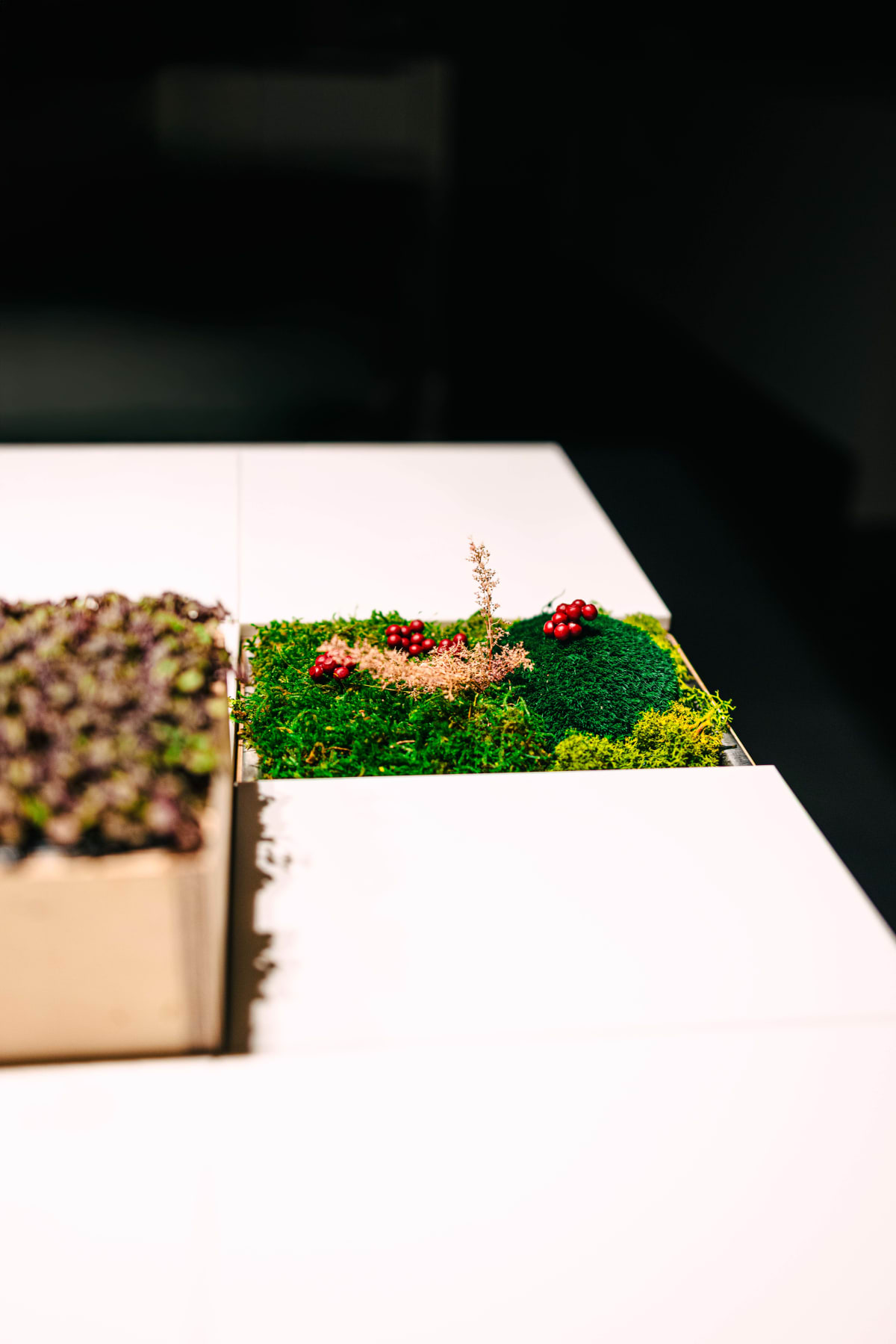
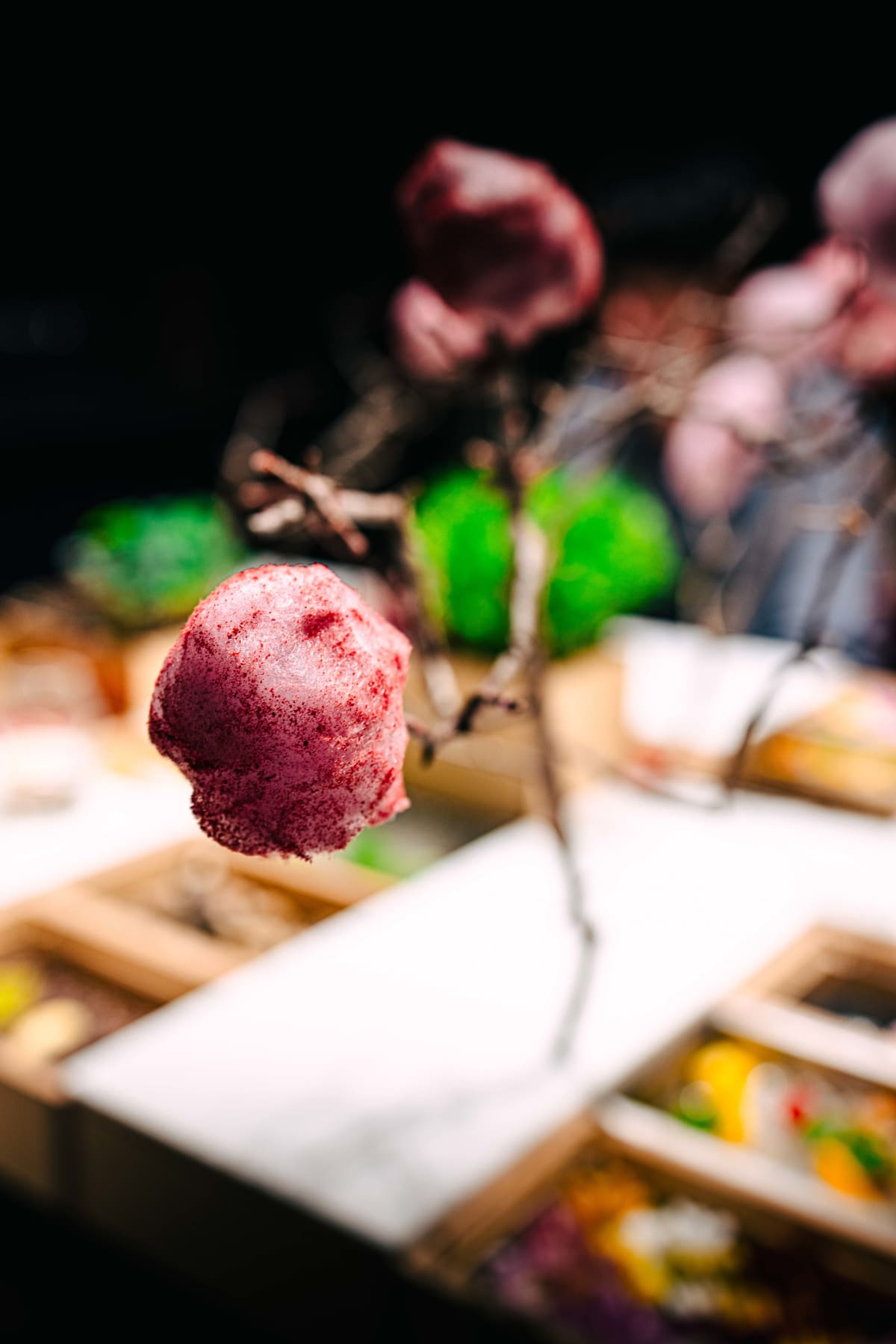
Around this point I was thinking, "now we will eat the petits fours and it will be over," when the server suddenly put on dramatic music and began lowering the lights. Then they cleared every glass and plate from the table and removed the tablecloth. Only then did I realise, "ah, this is The Living Table." One by one the table transformed, and inside it were petits fours. Cotton candy in the shapes of trees and flowers hung above, too. The change that unfolded before my eyes so suddenly felt unreal. In that moment I felt a magnificence that words can never explain.
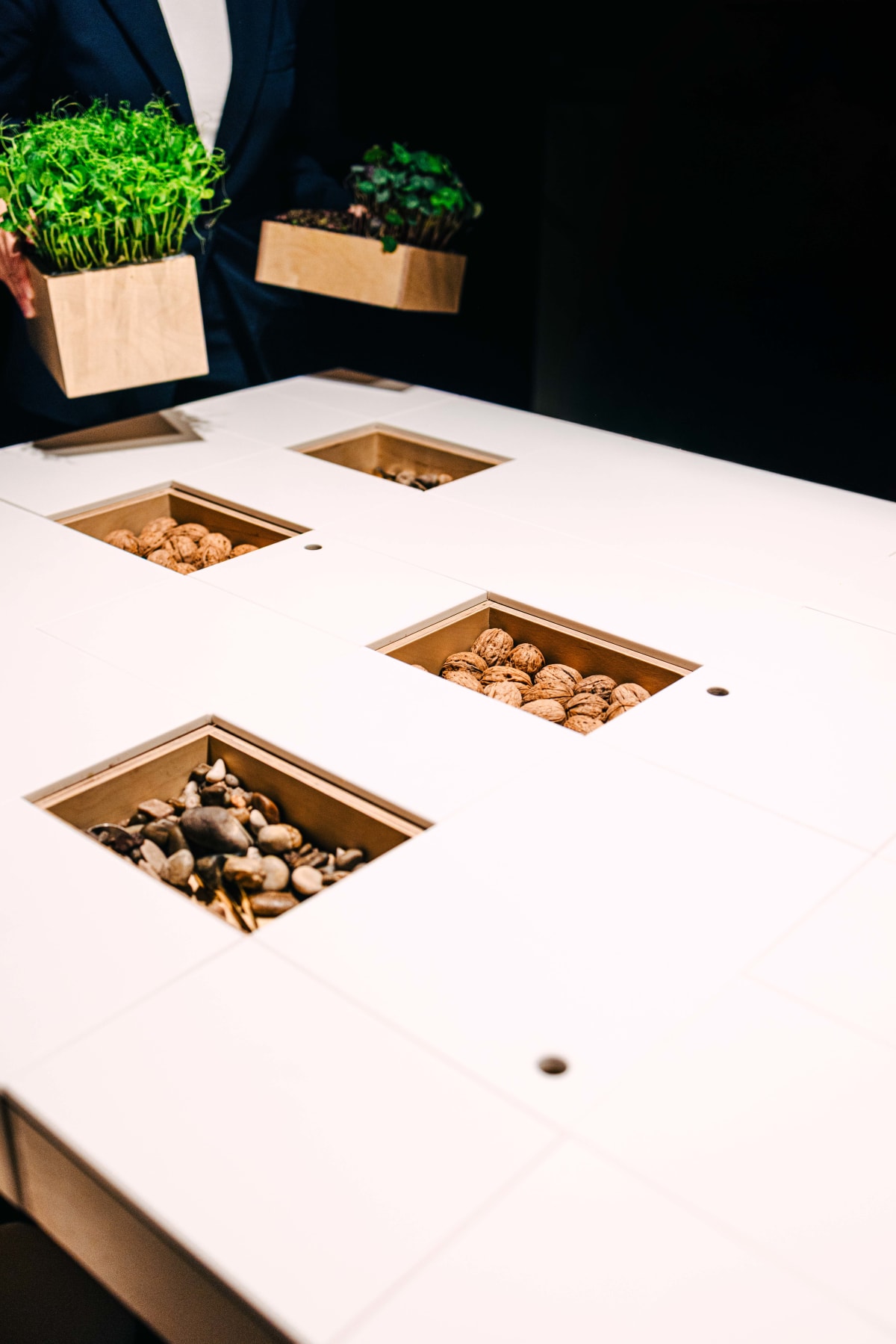
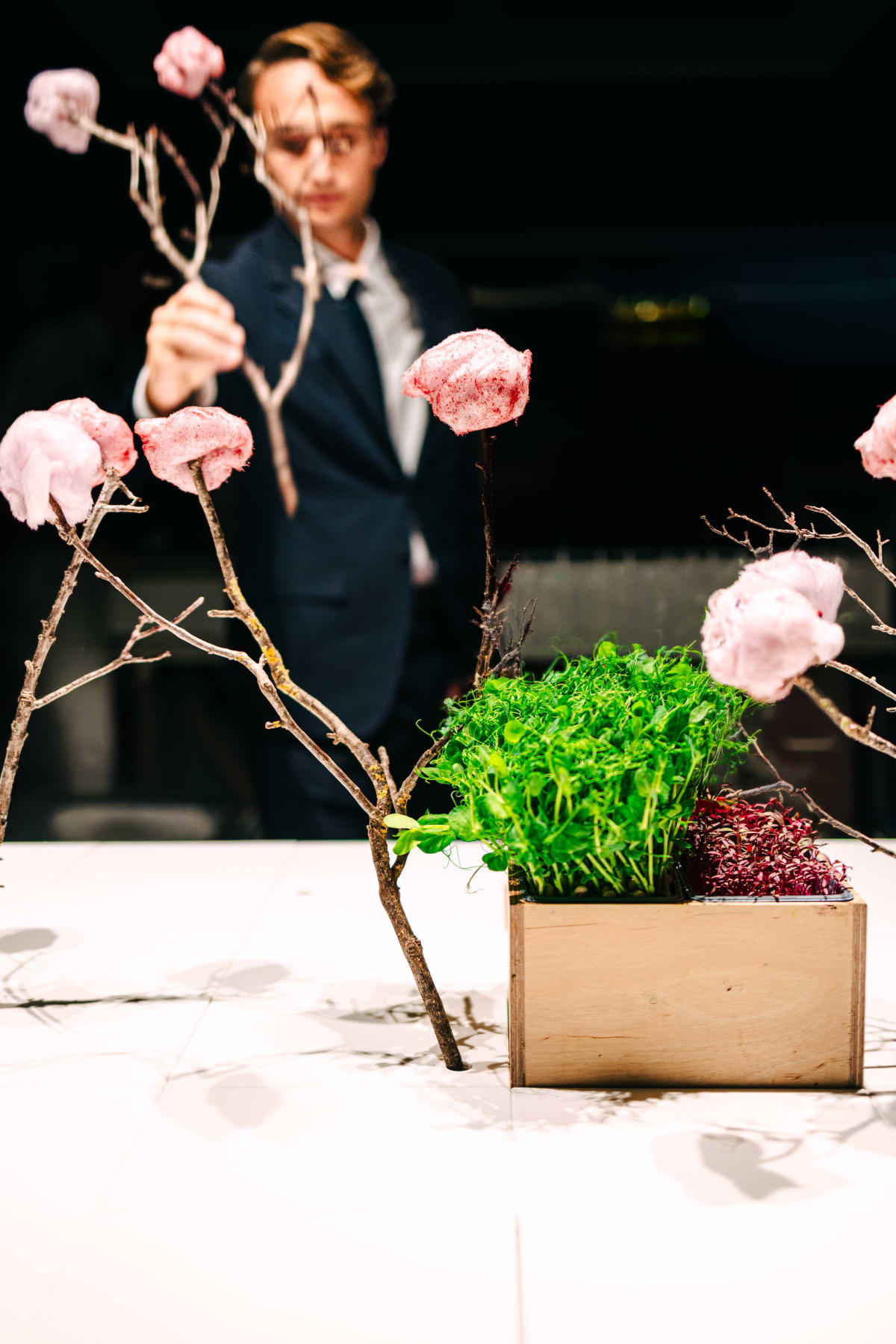
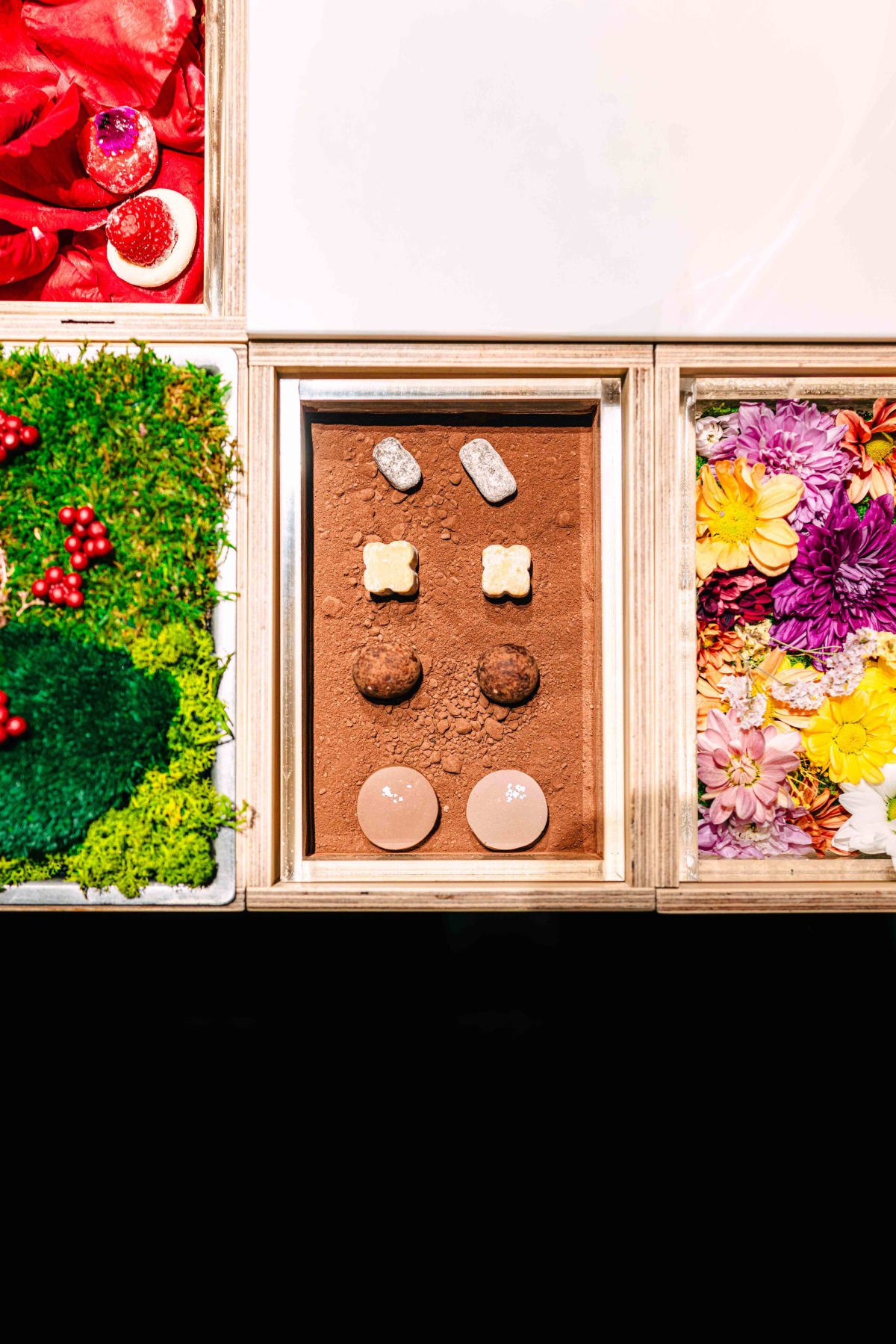
The finale of The Living Table is the act of creating a single scene of nature on top of the table. Each texture and decoration, they said, carries the meaning of the landscape. The swan symbolises the beginning of the scene, the sprout the birth of life, the moss permanence, the dry branch the change of seasons, the petal emotion and memory, and the water the cycle of life. If there is one more important philosophy, it is that "everything dies, but nature never ends." The moss stands for life that does not die; the dry branch is given "the life of sweetness" again as cotton candy; and the plants fallen to the floor stand for the humus layer forming beneath. At this point smoke rises up from below, and it was as if I were watching the creation of nature.
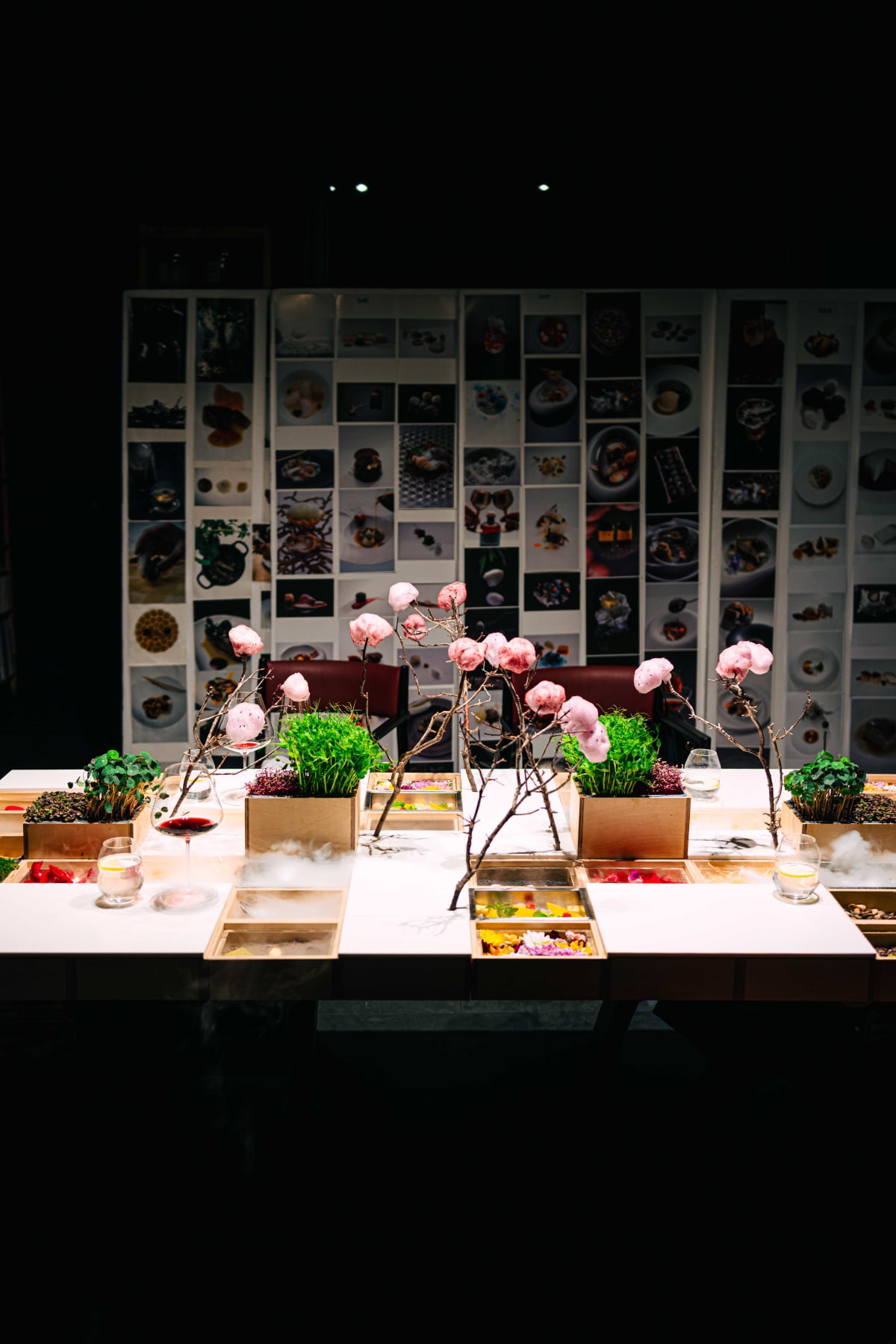
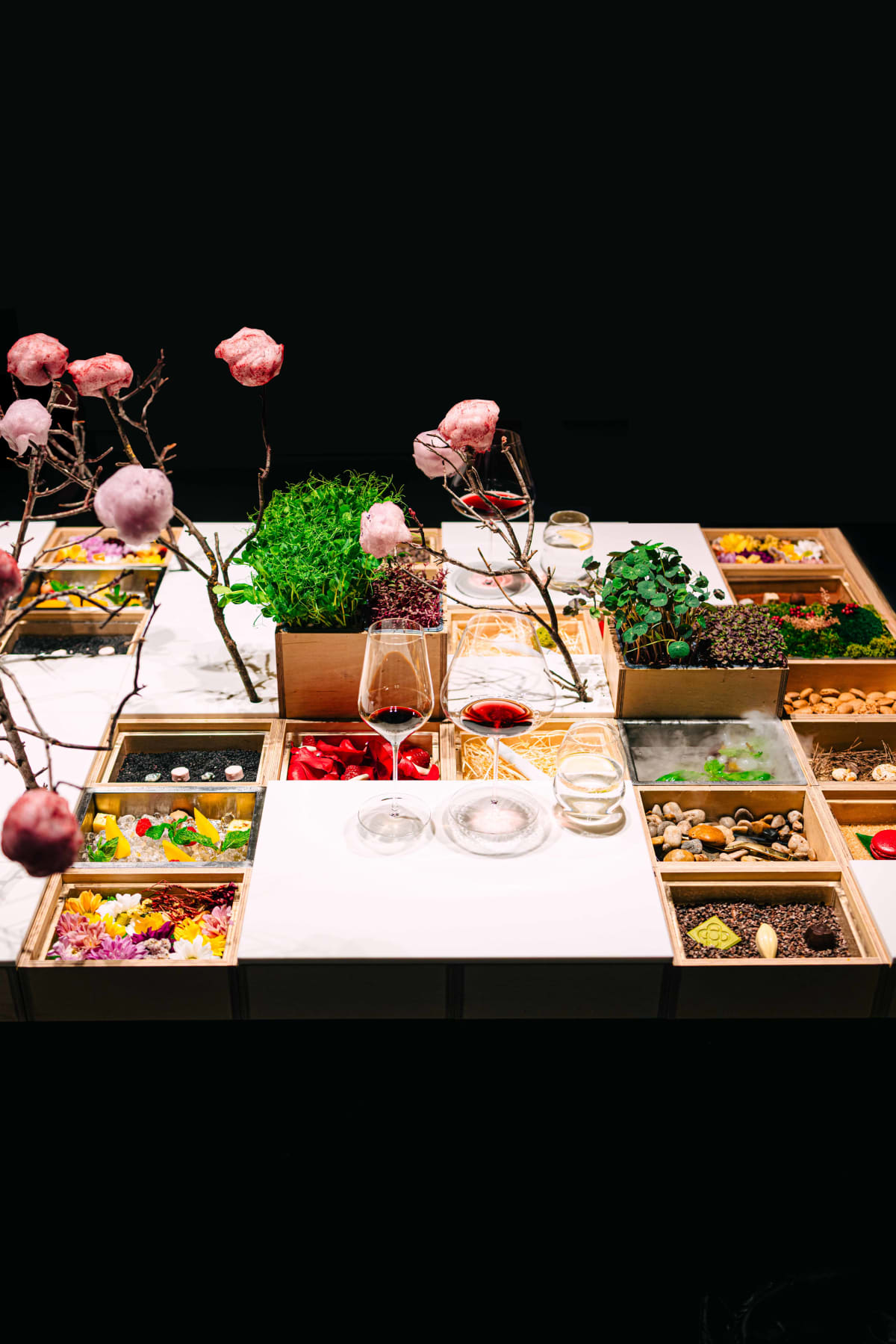
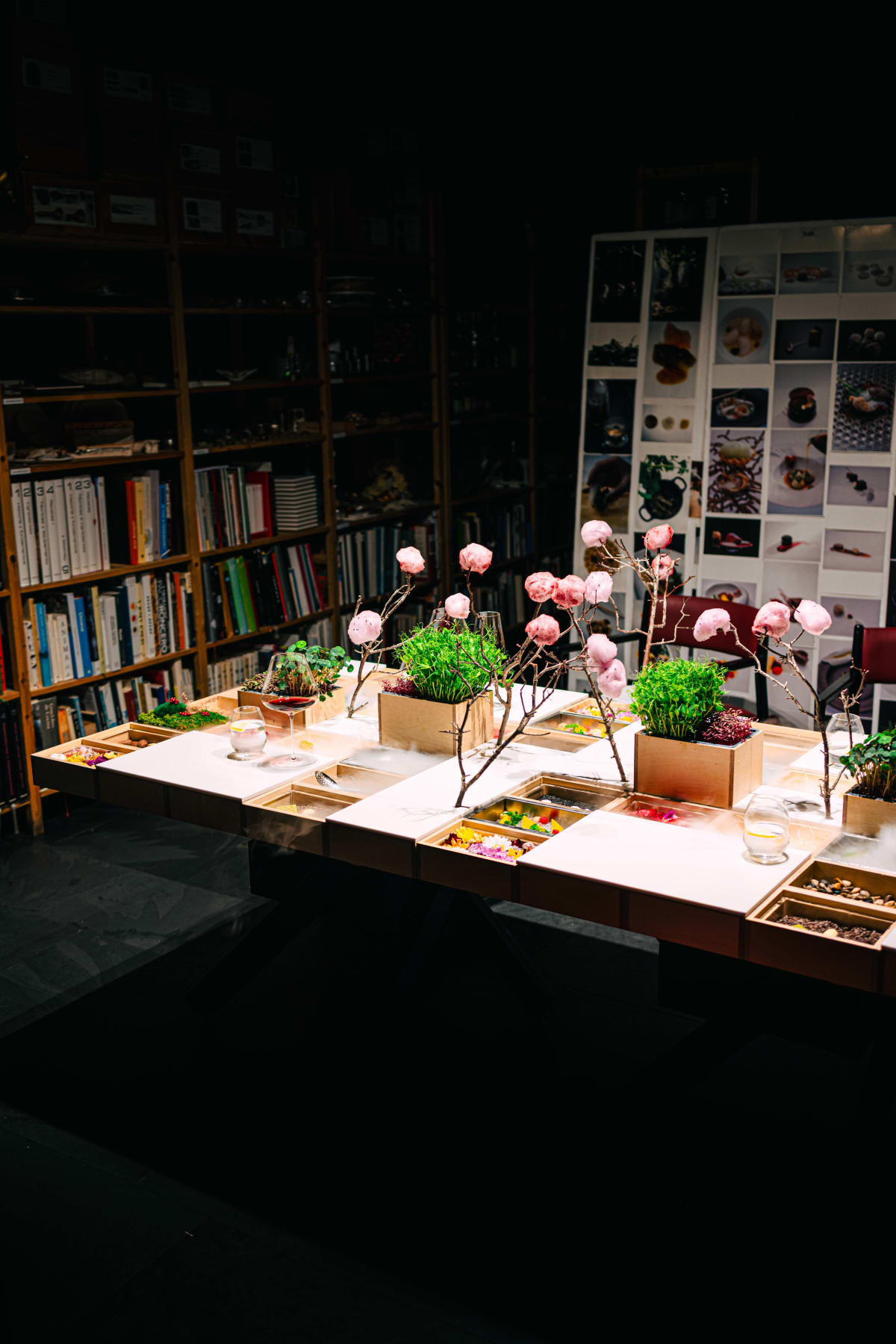
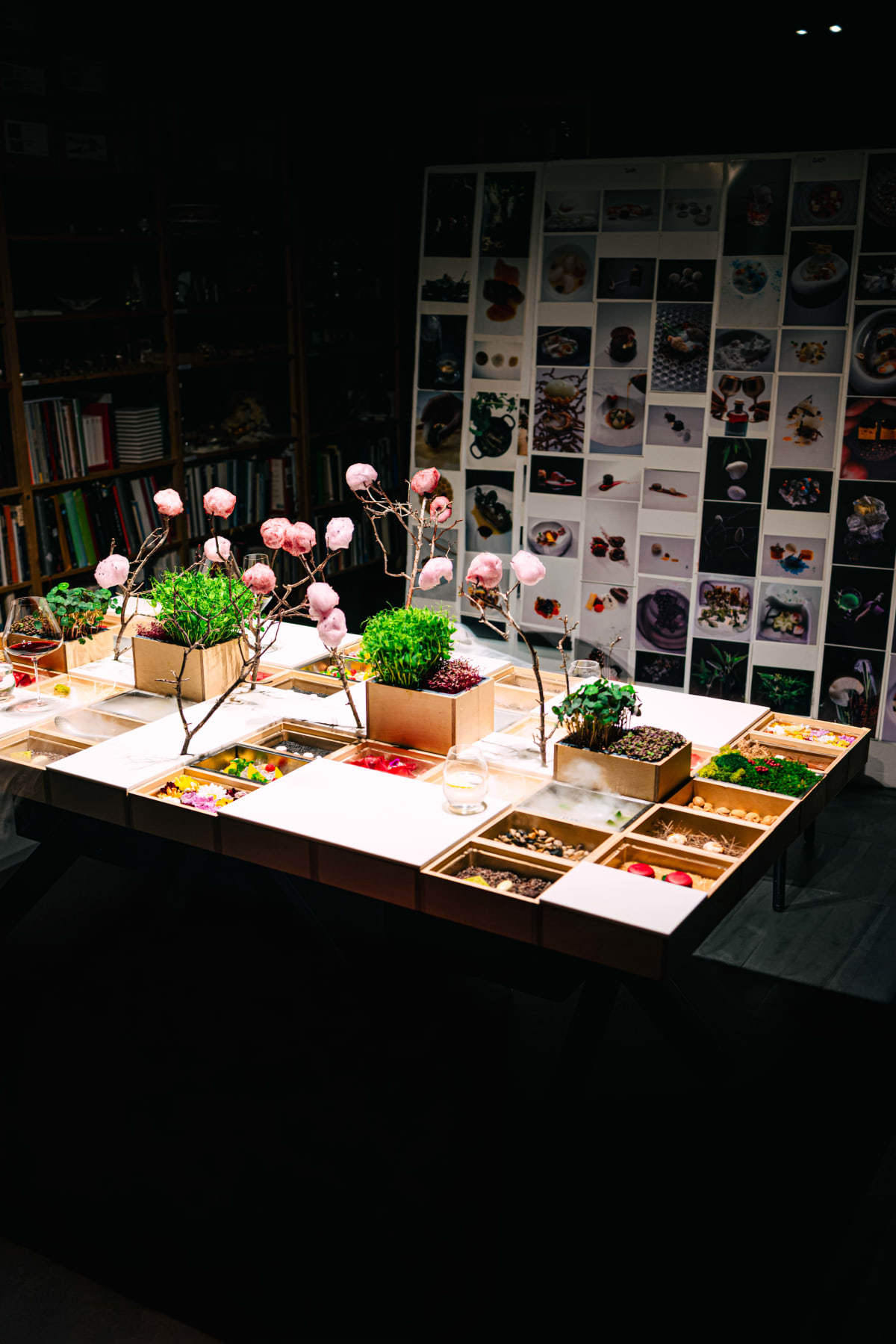
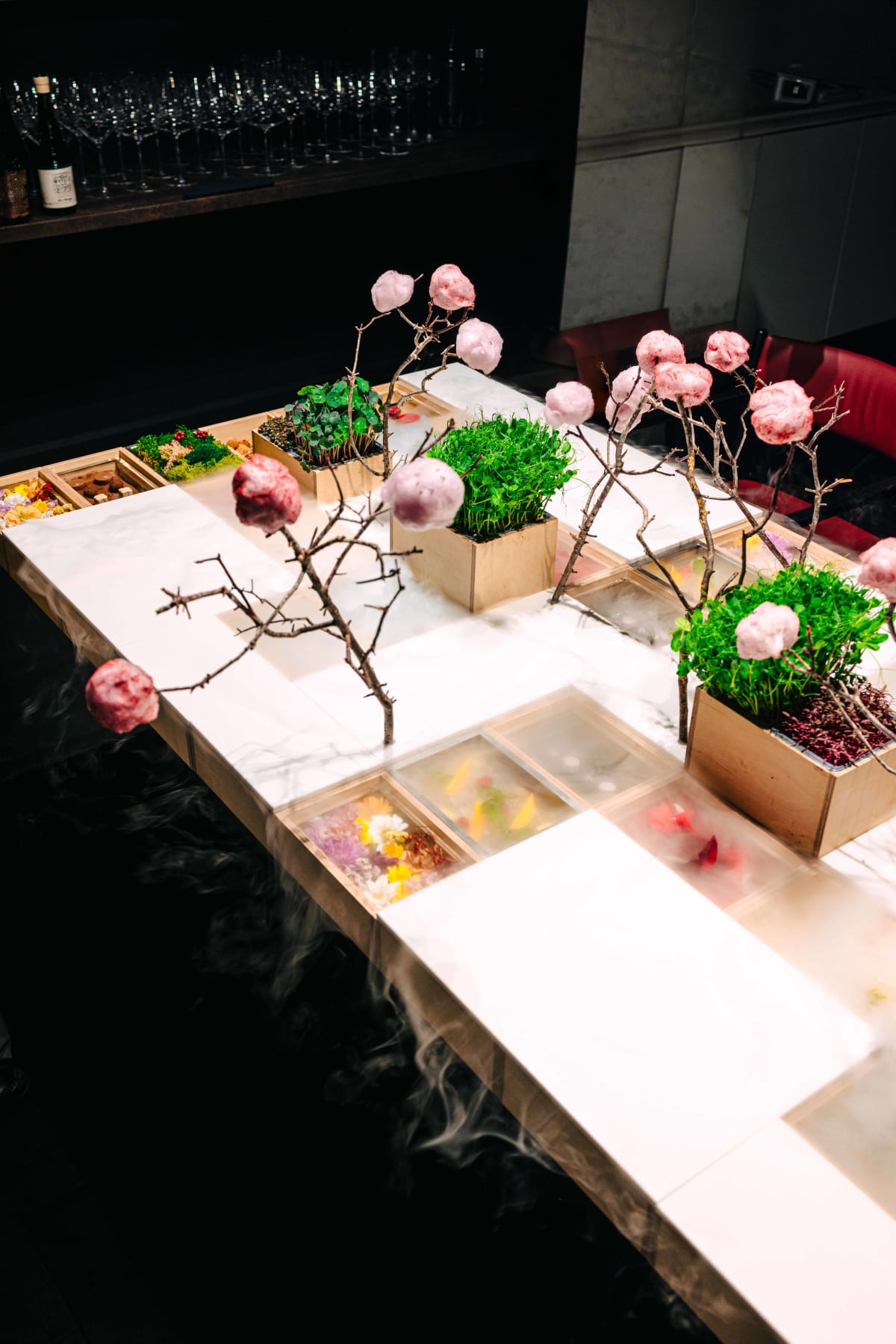
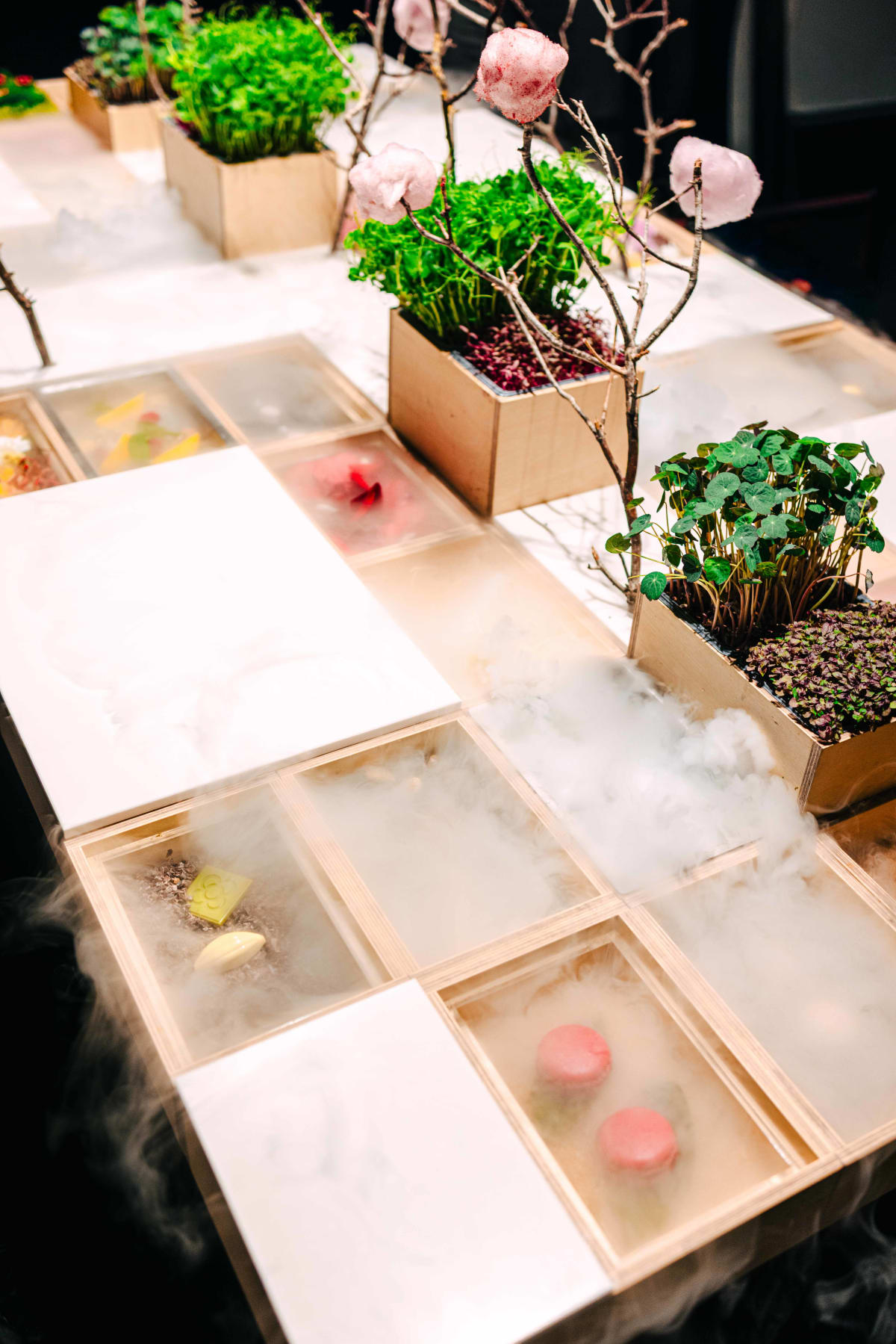
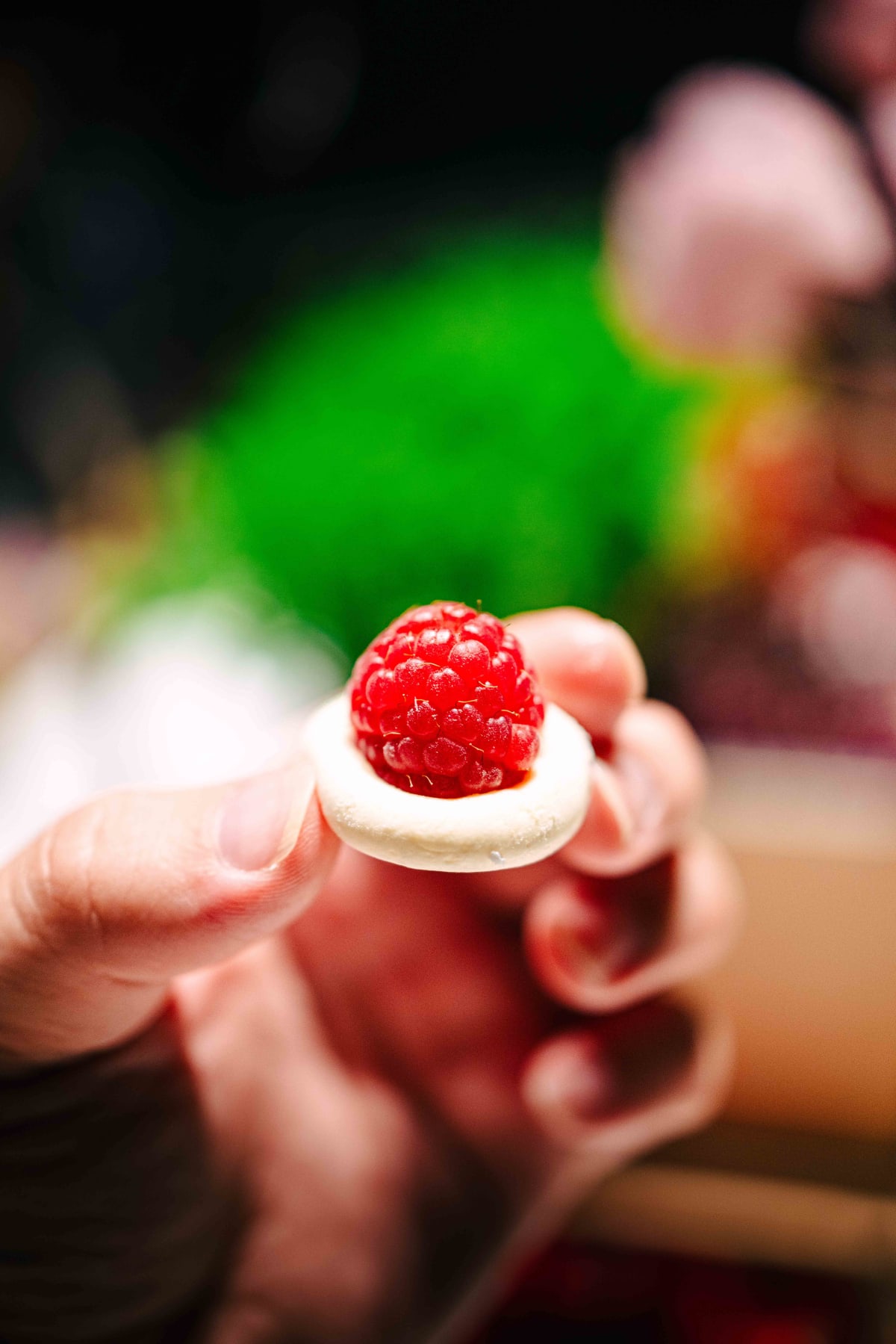
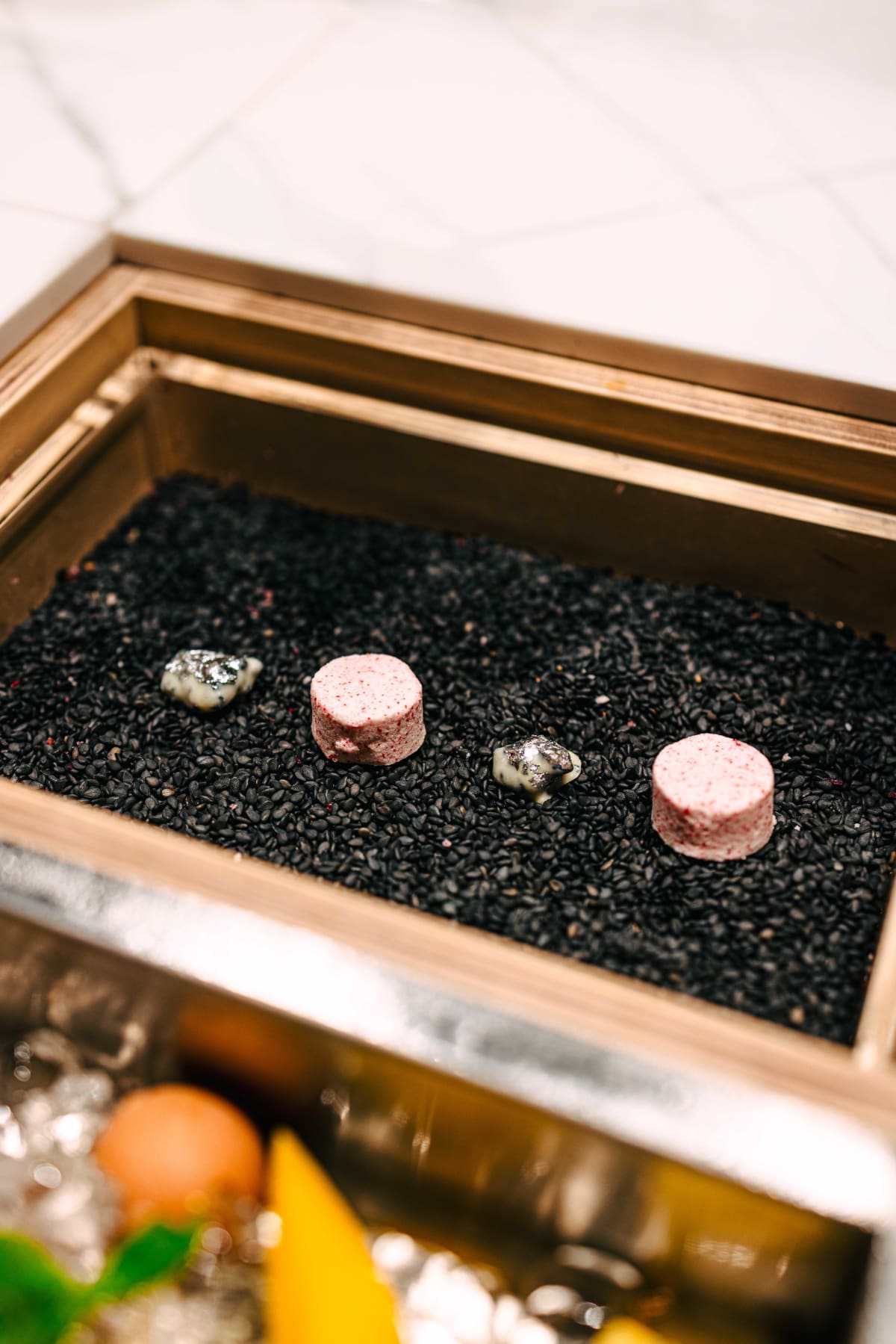
The desserts within were each symbolic. On the moss there was a small ball made of berries and cookie, and the cotton candy on the dry branch was dusted with fruit, violet, and honey-flower powders. On the rose flower, which signifies emotion, there were rose petals and a strawberry mochi, and there were also raspberry-flavoured Rice mellows.
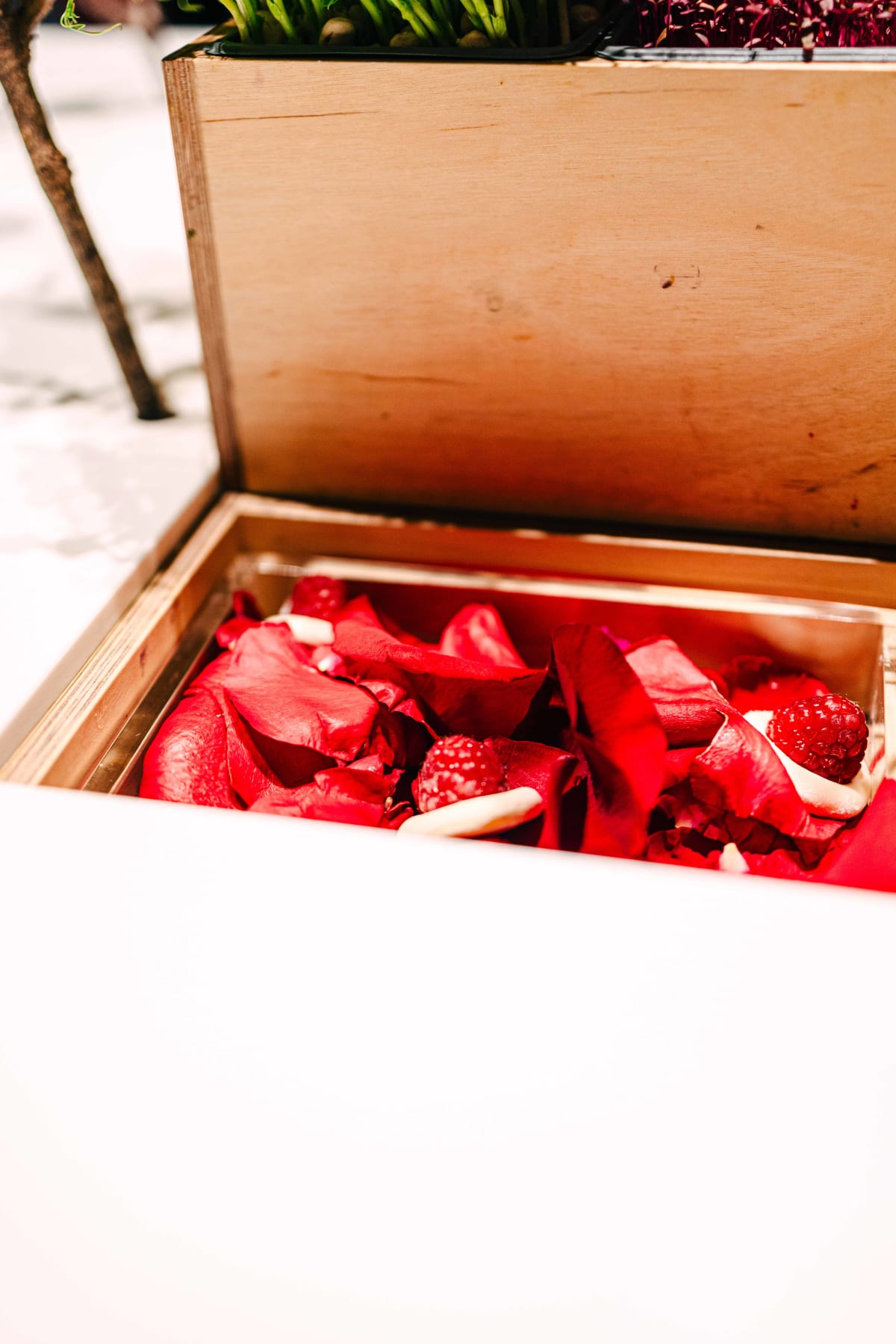
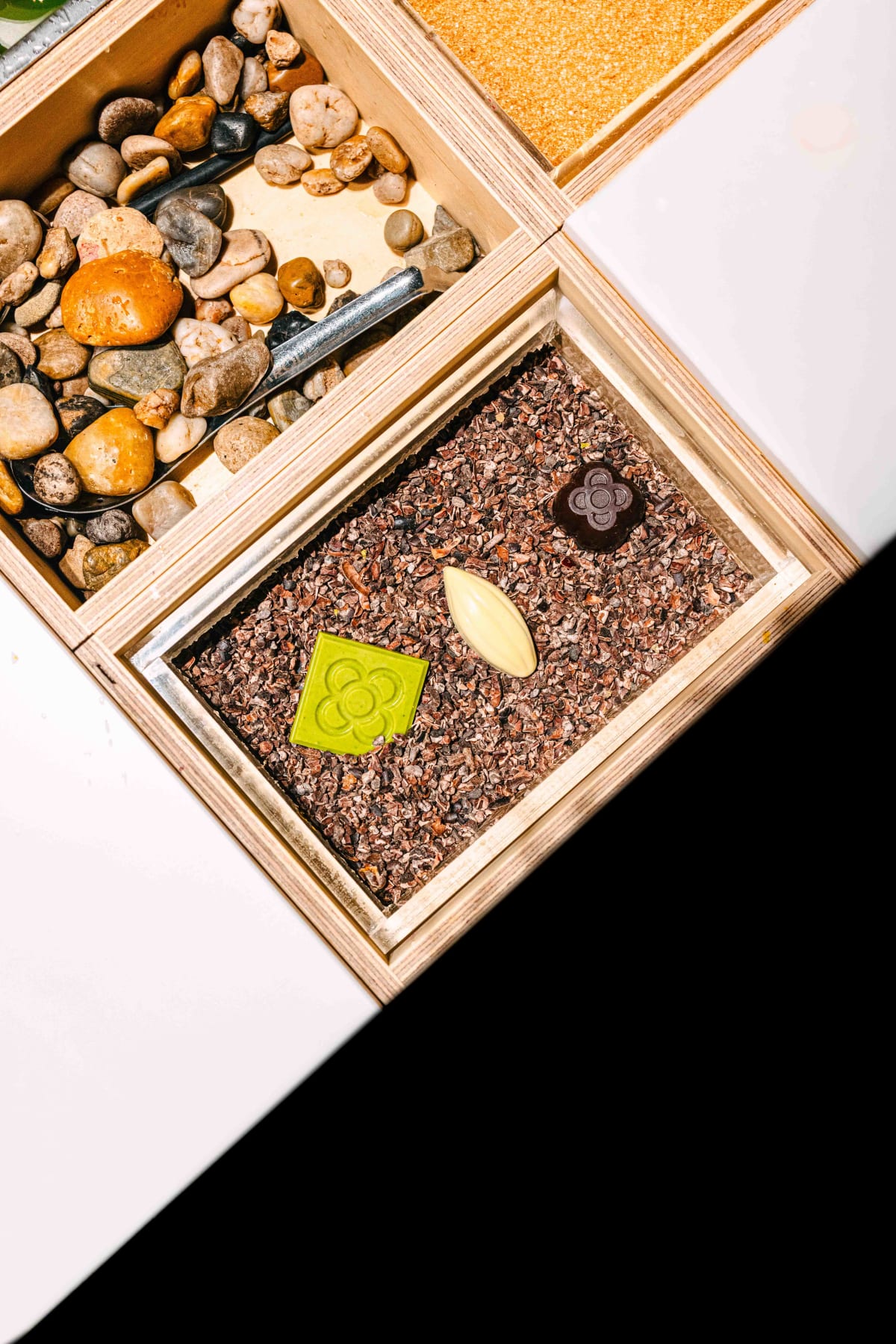
Inside a box conceived as a humus layer, signifying earth, there were matcha stones and yuzu paste, and the cocktail spheres in water, signifying the medium of life, had coconut, cassis, and passion fruit flavours. There were also olive oil jellies hidden among the flowers.
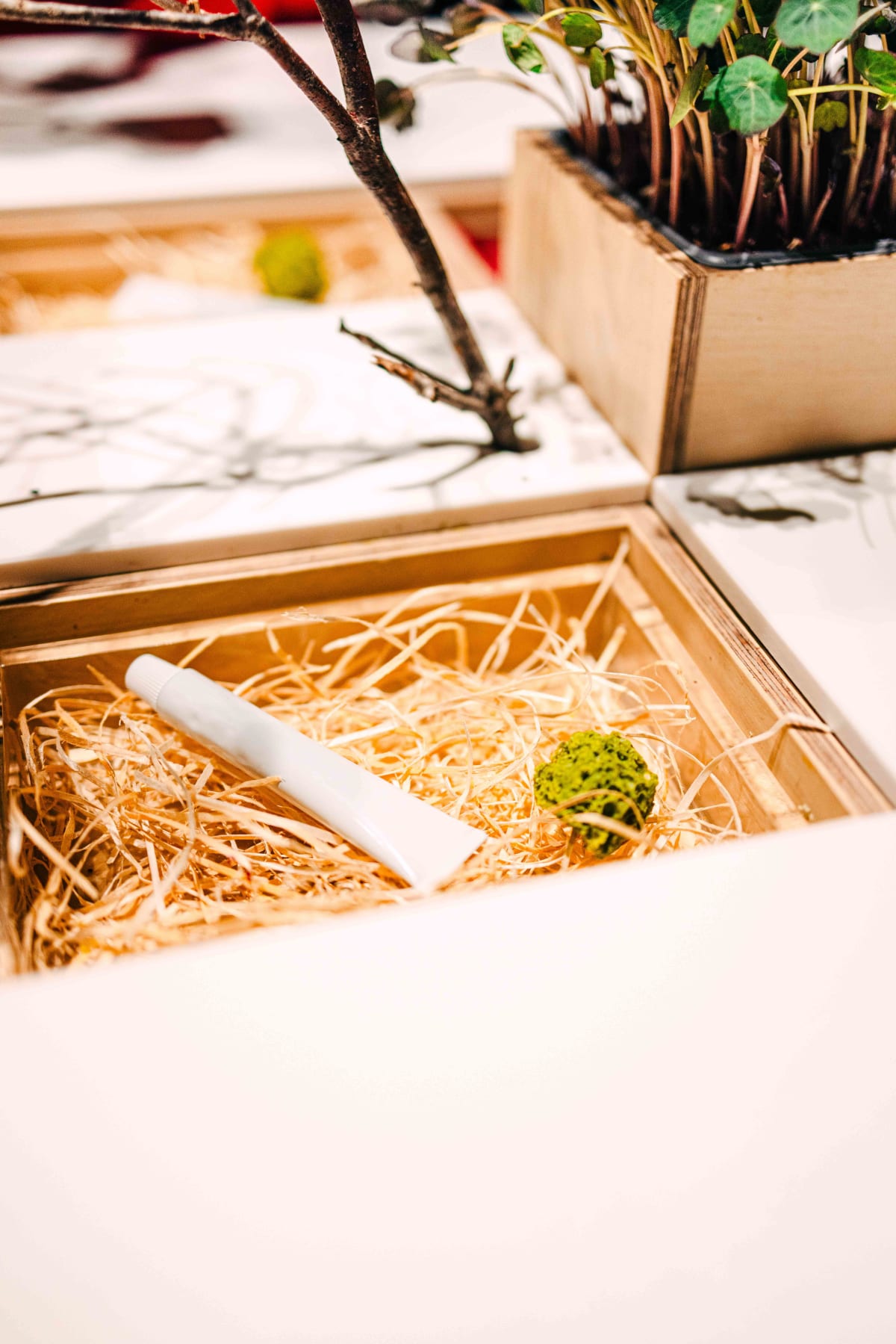
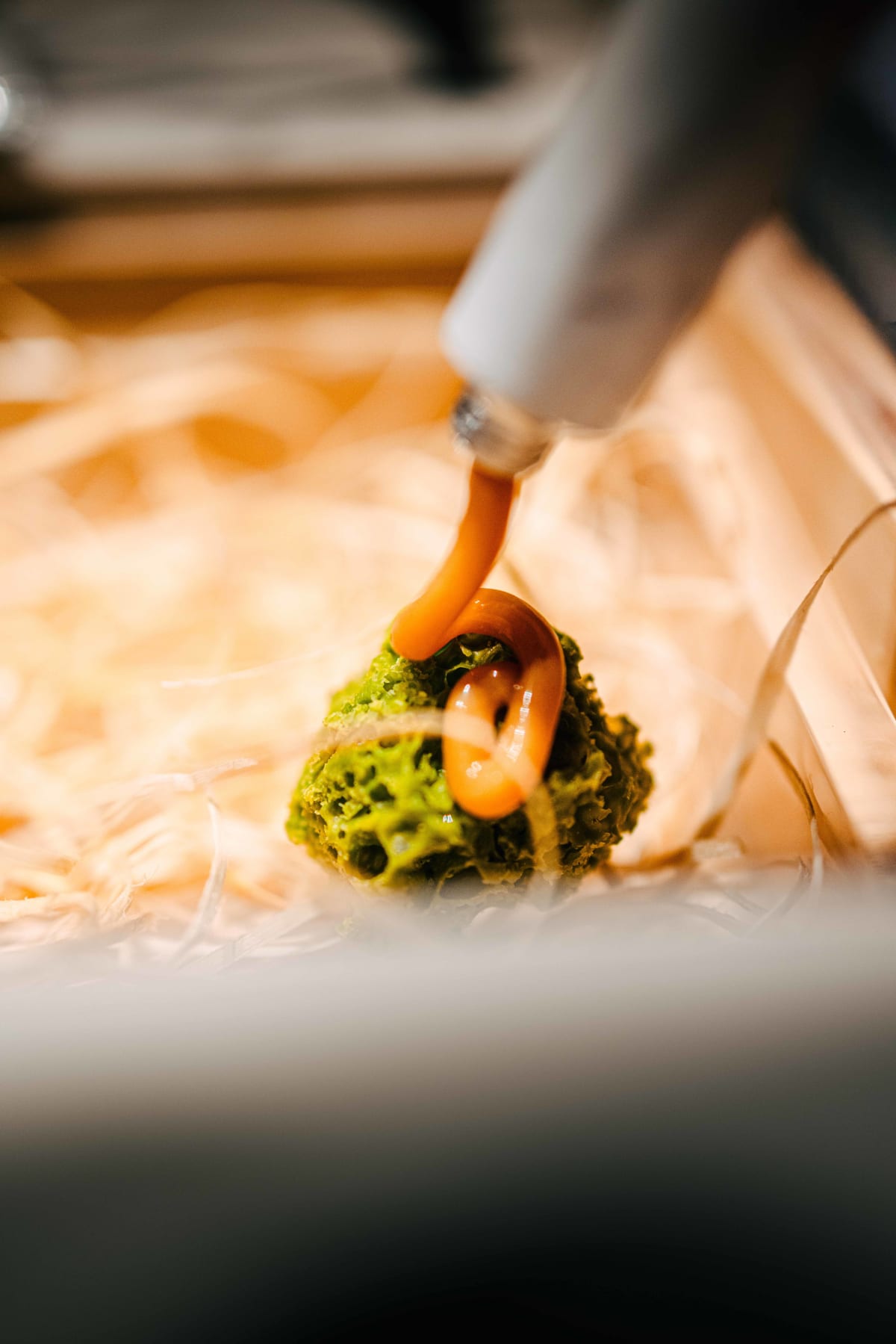
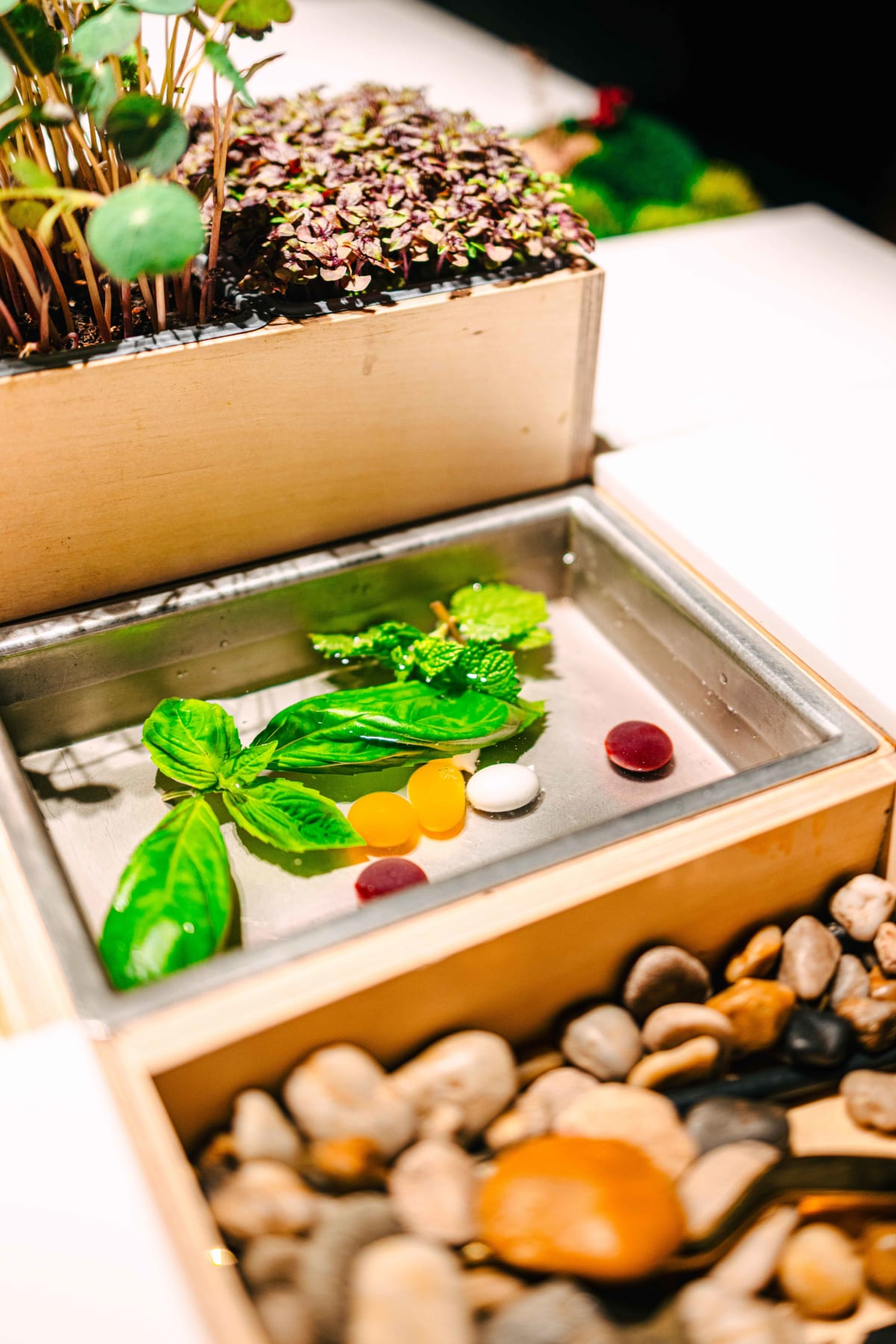
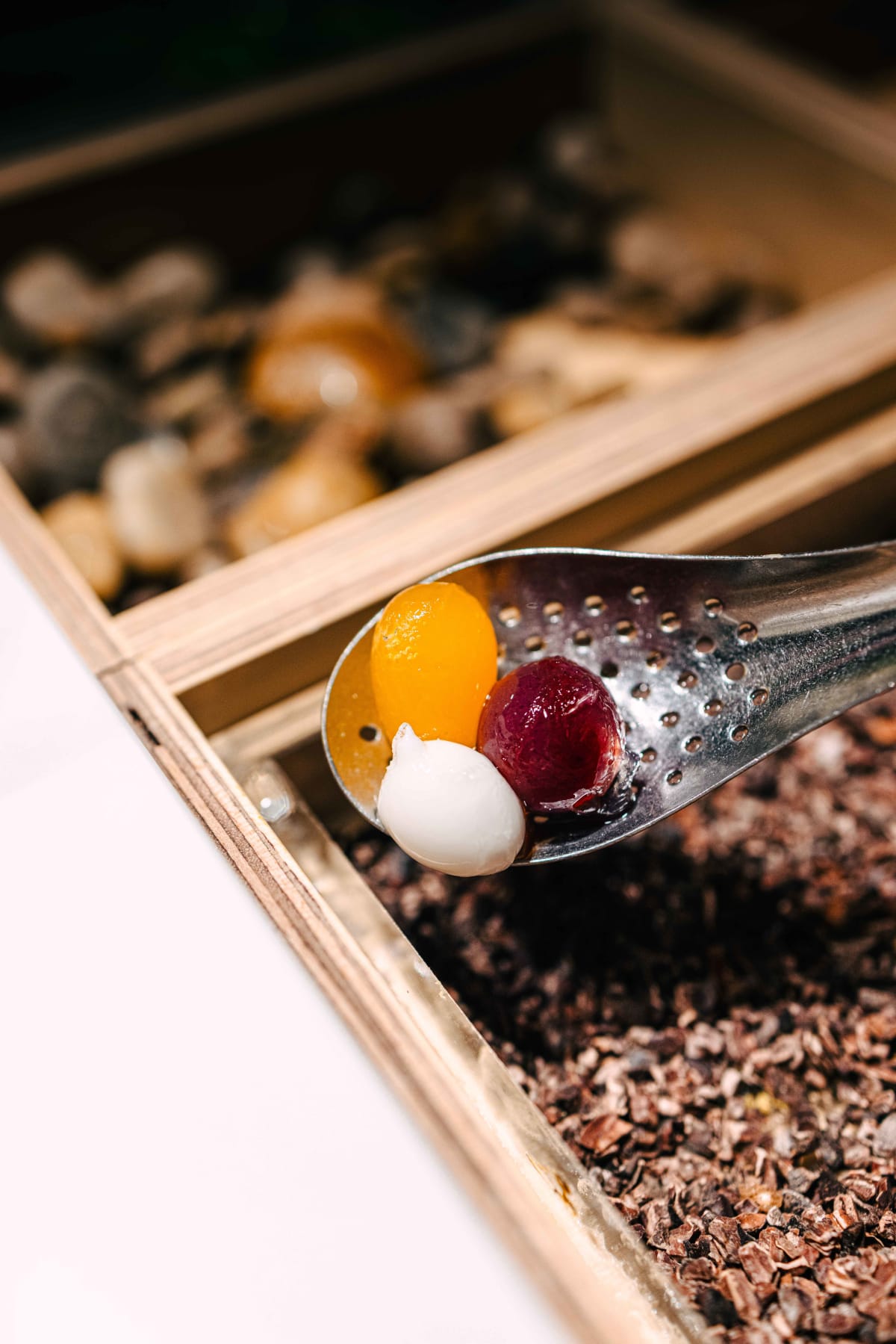
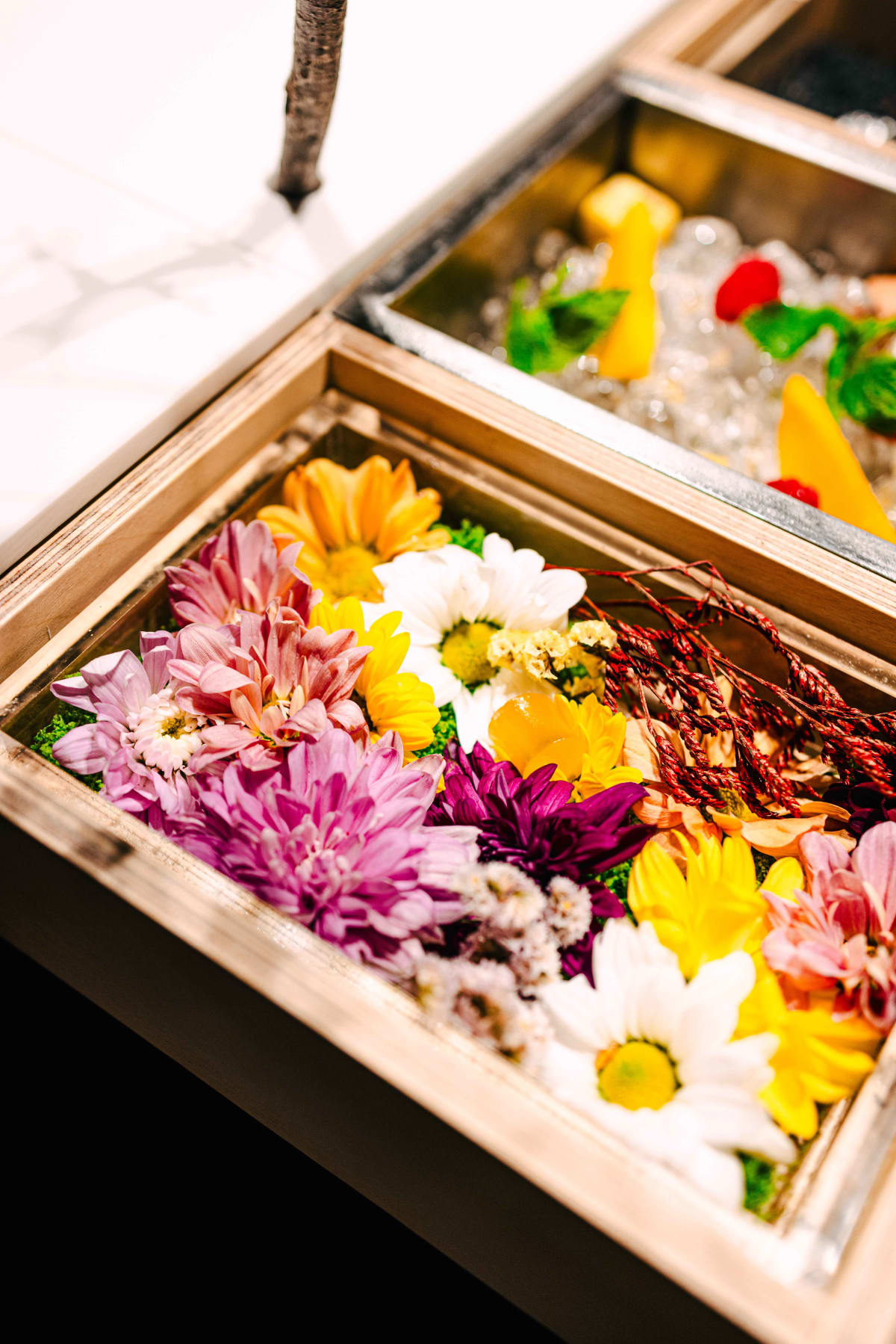
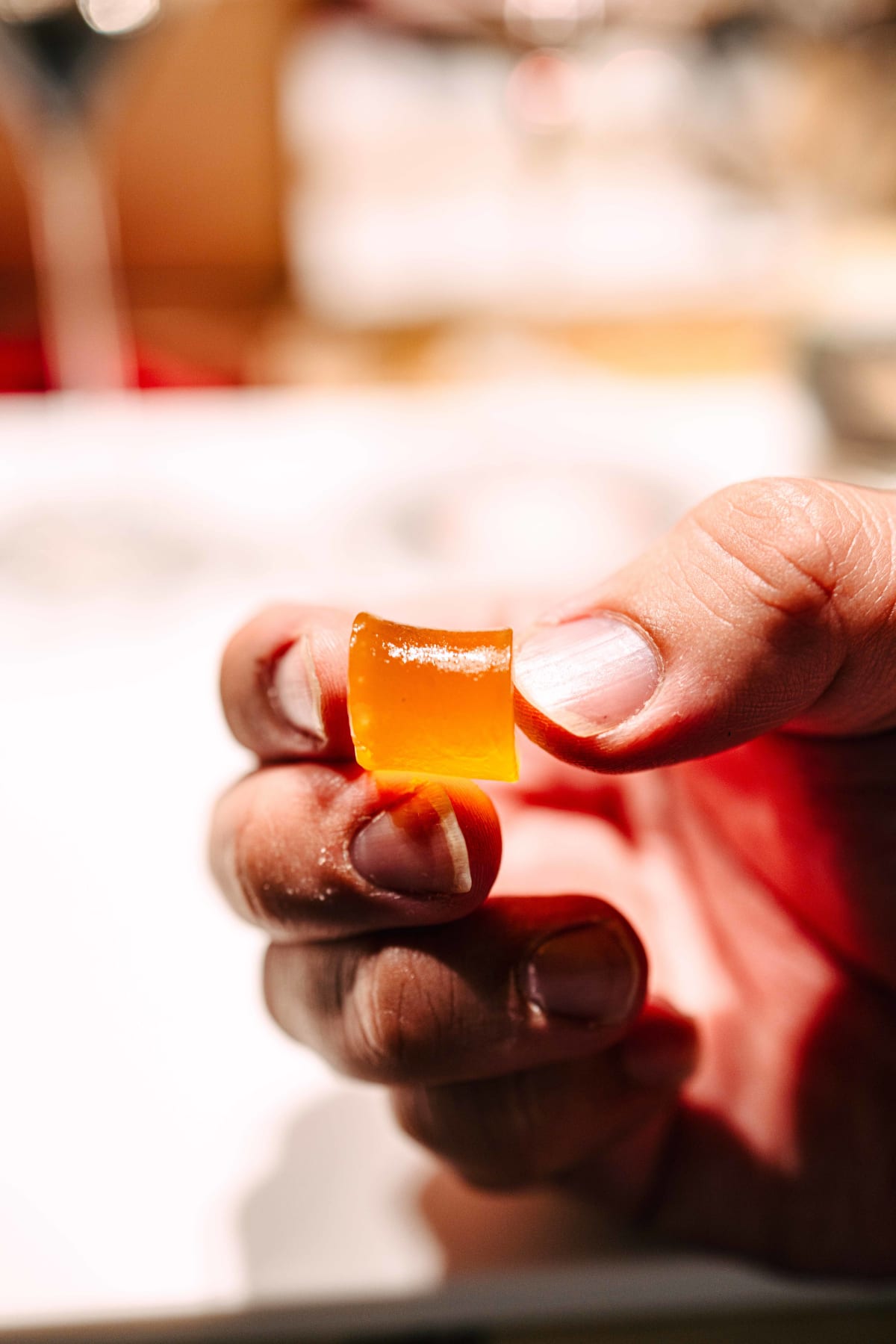
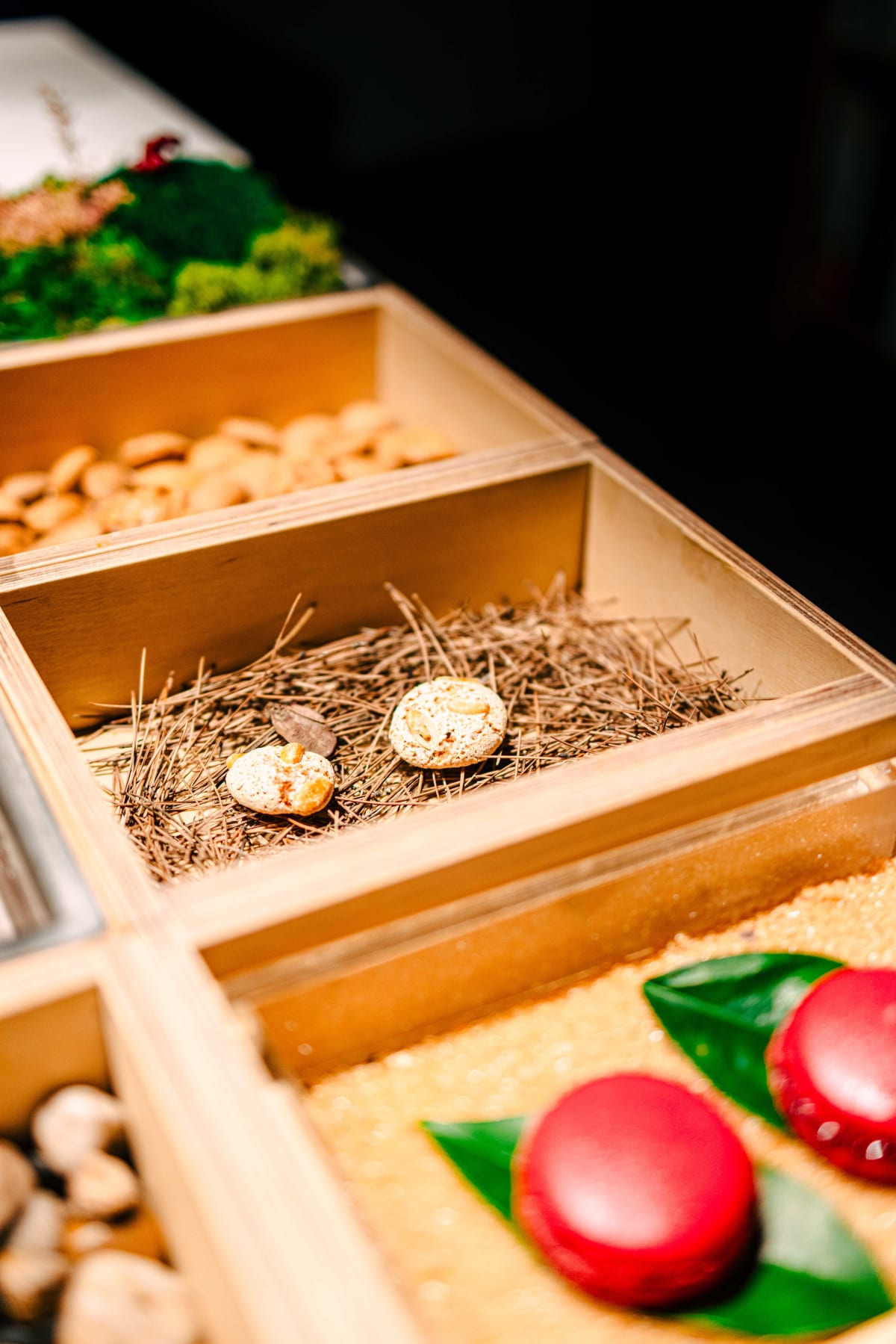
Beyond these, there were a pomodoro made from raspberry, a white-chocolate-coated, caramelised black-sesame "stone," and vodka chocolate served with cleanser fruits such as mango and pineapple. Various chocolates, almond and hazelnut meringues, small pine-cone-shaped cookies, and macarons were arranged over a surface made to resemble fine and coarse soil.
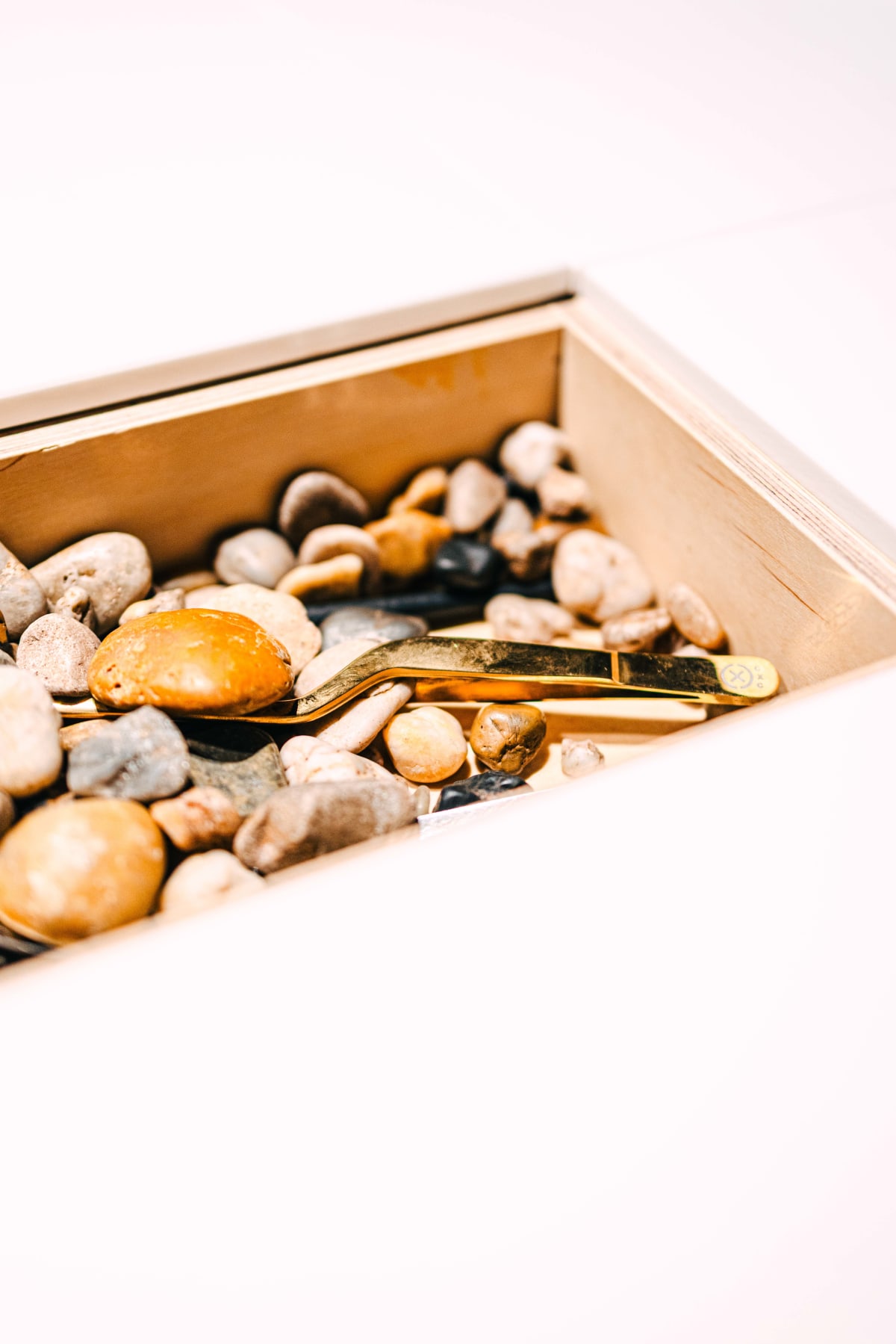
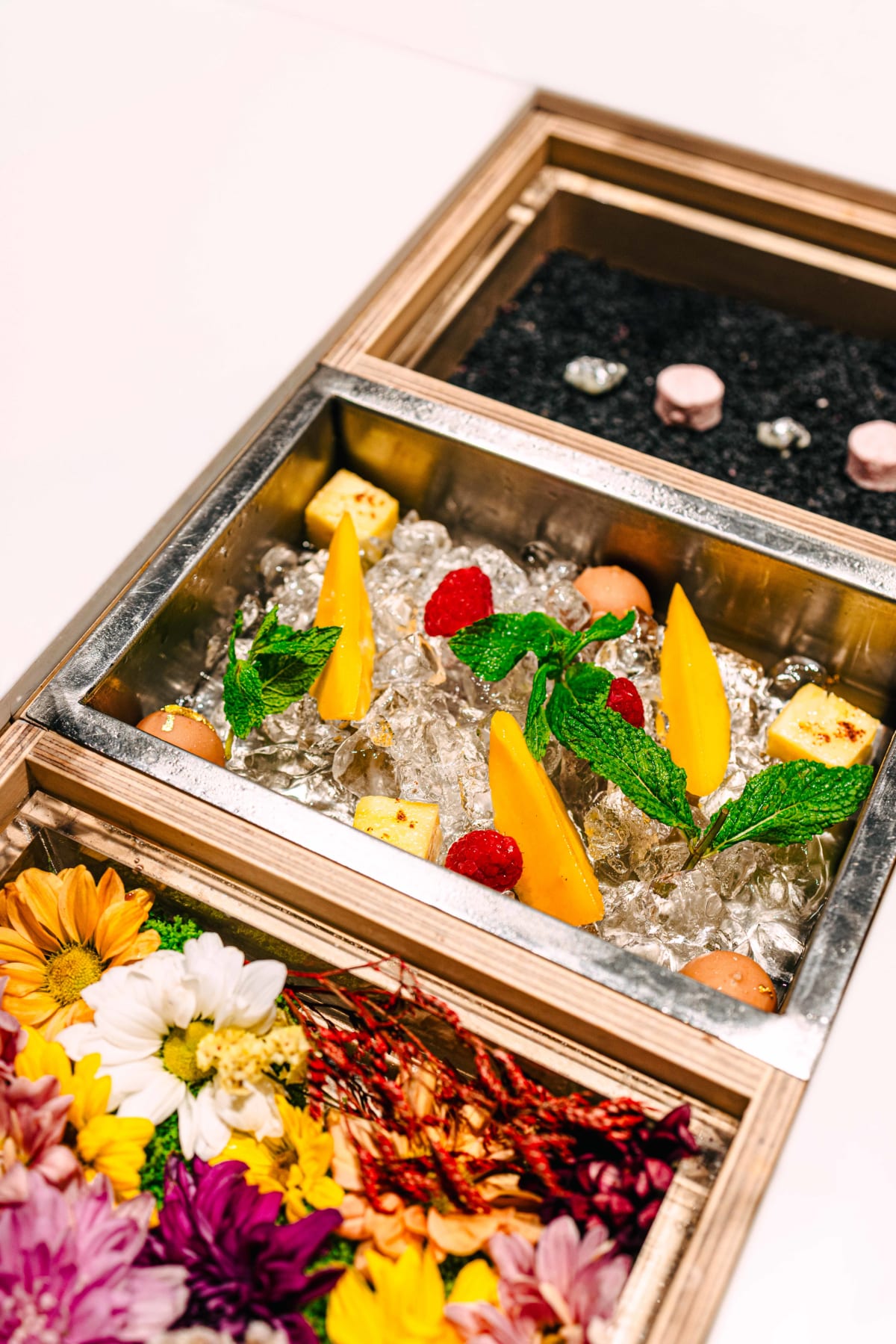
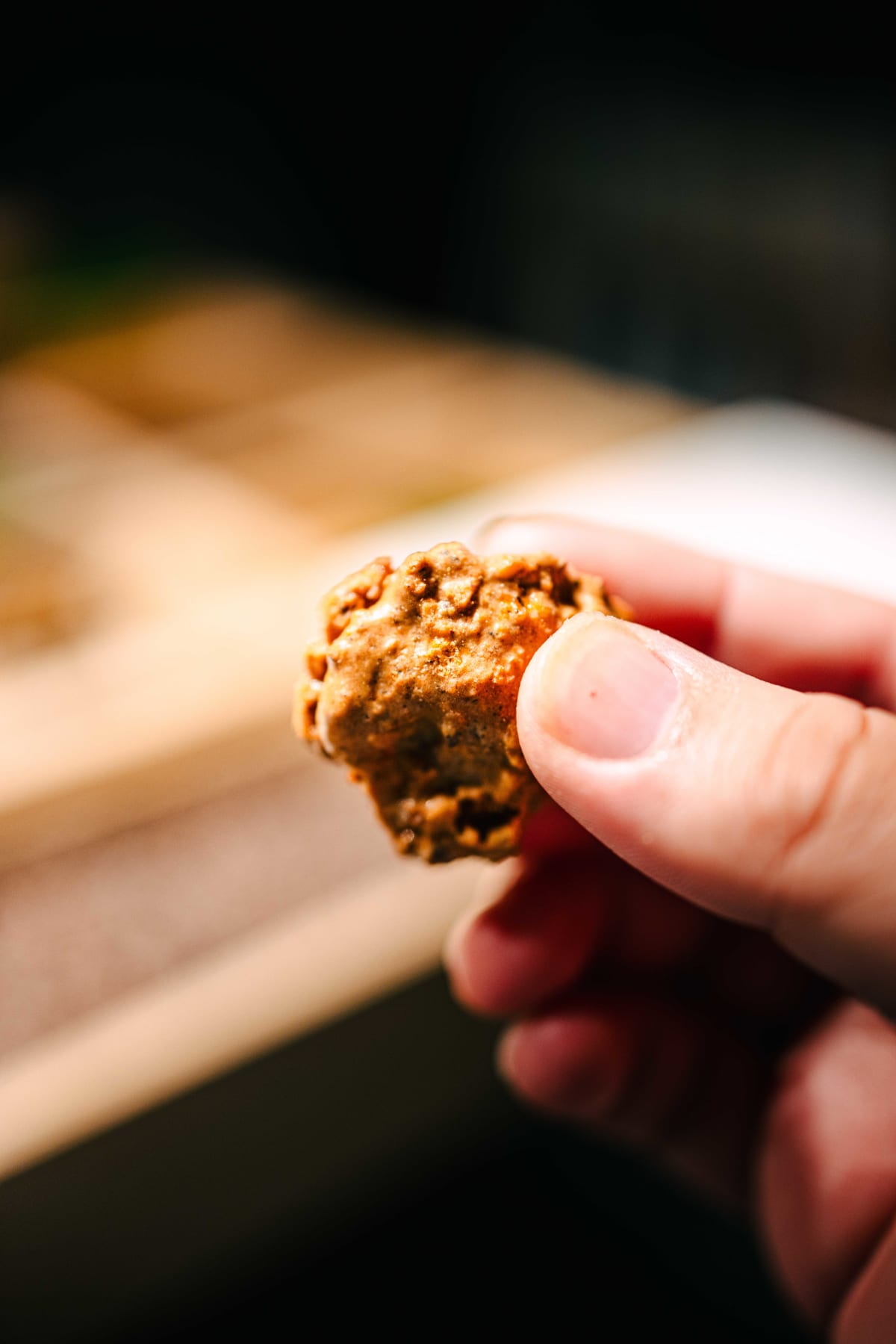
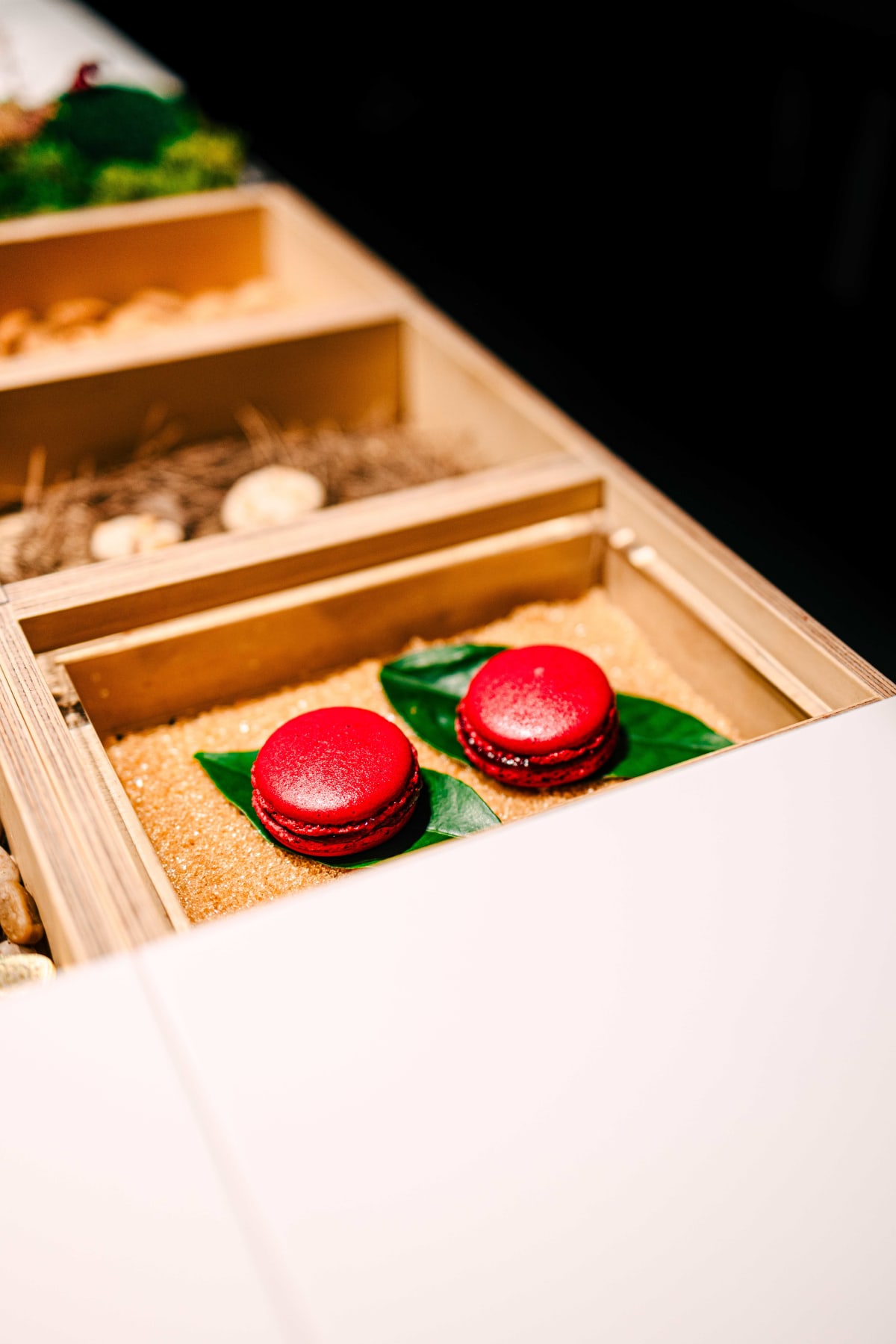
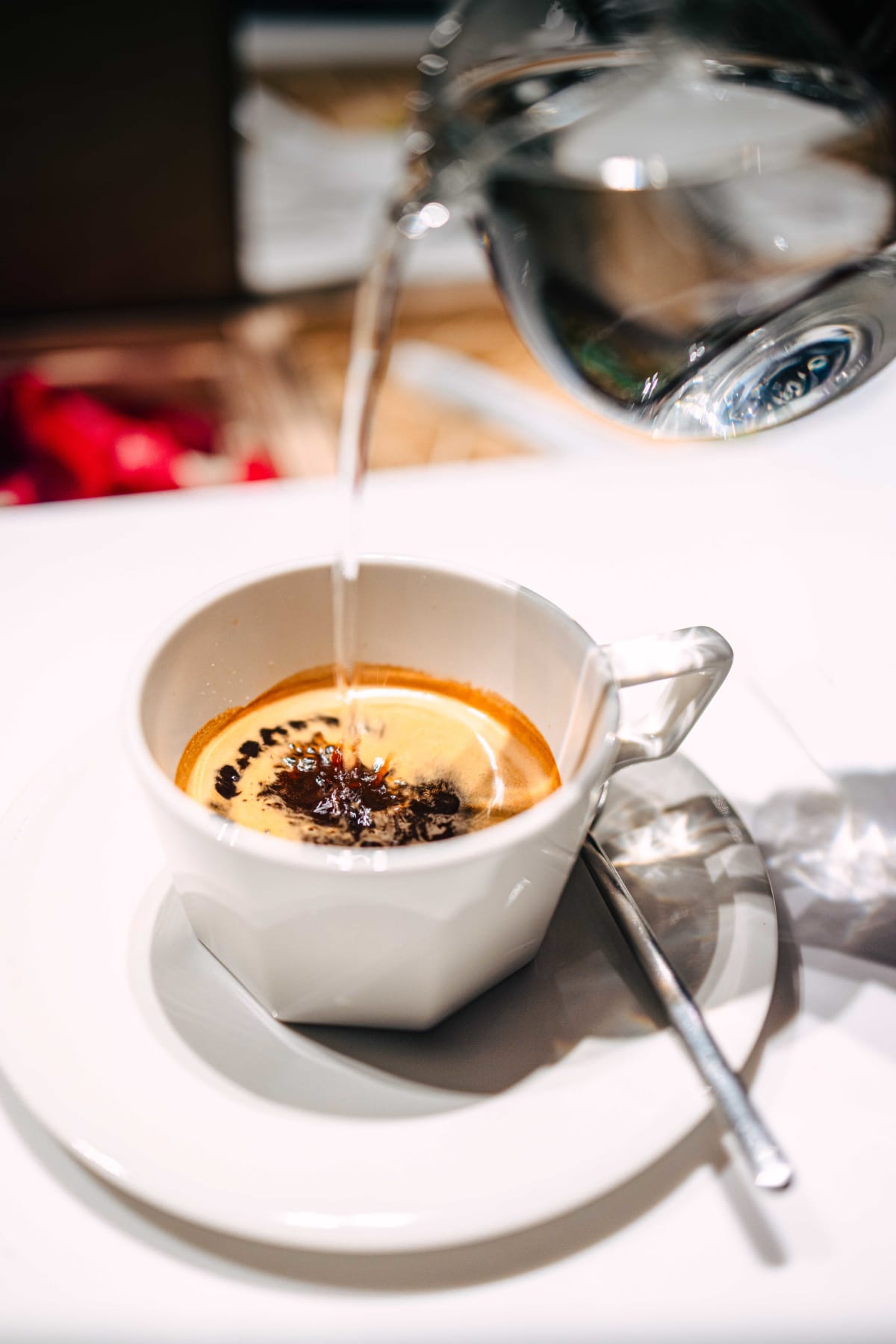
By around this time I was full and could not eat every dessert, but it was a simple, intuitive, and delicious composition. It was good to eat with coffee, too.
Finally, explaining this living table, the server said this: "because this is a table of 24 courses, we wanted to pay a small homage to all the French chefs who invented that very number, 24, as a symbol of excellence." I was struck by the attitude of paying homage to the French chefs who created this, even as they unfolded the final, crowning performance of their own.
Section 11·Closing Thoughts
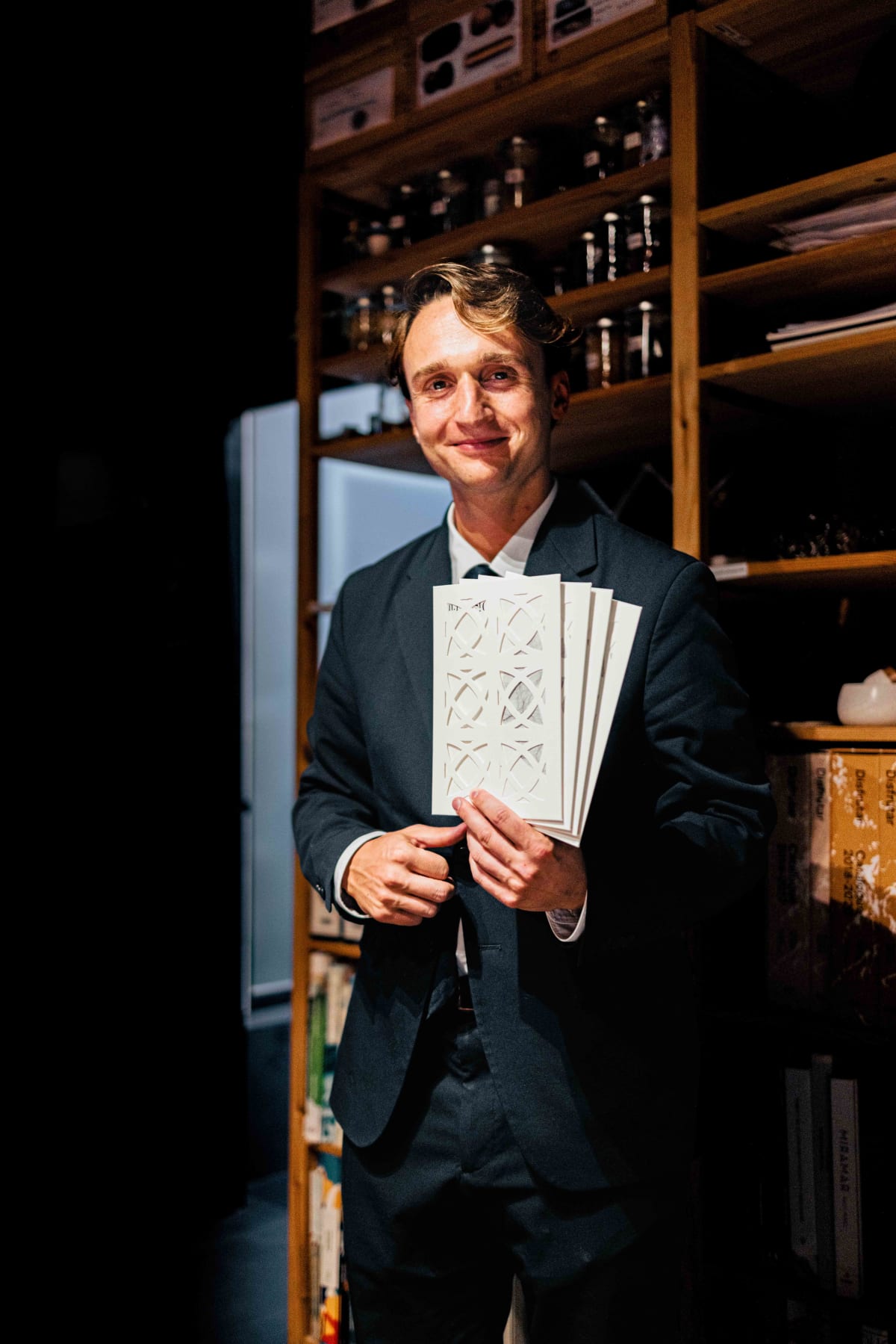
We spent a very long time photographing and tasting before we finally came out, and a staff member gave us one last tour through the dining hall and the outdoor space. It appeared that outdoor dining is also possible in good weather. The afterglow of this meal lingered so long that I even went back the next day to buy souvenirs.
By objective measures, Disfrutar already stands at the very top of the world. To some extent, the titles alone explain its standing: three Michelin stars and No.1 on the World's 50 Best Restaurants in 2024. But there are substantive reasons behind those dazzling titles: the way the cooking preserves the essence of flavour, and the extraordinary power of the staging, service, and space that binds the experience together.
Was there nothing to regret? Of course there was. Personally I think they made dishes that keep the essence of flavour and meet that question, "is this delicious," but naturally not every dish was perfect. The meat main in particular lost momentum and did not fully answer that question, which was a pity. Because the number of dishes was so large, the tempo was fast, and there were moments that were a little hectic. Disfrutar goes a step further in creativity, but in the character and structure of its flavours I felt a kinship with El Celler de Can Roca. DiverXO looks toward a completely different flavour and structure, an exploration of traditions outside Europe, so I would call that creativity running on another axis. Disfrutar, by contrast, never felt scattered. Its underlying structure remained clear, and within that clarity it built layers of complexity through research and creativity.
Disfrutar itself is hard to book, but The Living Table, which requires gathering four people, is harder still. Even so, for those who seriously love gastronomy, I recommend experiencing it at least once. There, we come to confirm that a table is not simply a board for setting down food but can itself become a total work of art.
Immersive, theatrical dining is now its own genre, and it carries a recognisable failure mode: once the table becomes a stage and projection, sound, light, and scent are marshalled into a multisensory show, the spectacle tends to outrun the plate, and the evening is remembered as an experience while the food slips into a supporting role. Set against that tendency, The Living Table's distinction is almost structural. Because the flavour and technique it inherited from elBulli already sit at the summit, the staging never has to carry the meal, and the cooking is never demoted to set dressing. That is the rarest equilibrium this genre offers, and it is the real reason this room sits at No.1 on the World's 50 Best (2024), not as a spectacle that happens to feed you but as a kitchen that happens to stage itself.
Have a question about this restaurant, or want to share your own experience?
Send a message