Fine Dining · Tokyo · Japan / December 2023 / Michelin ★★ · Michelin Green Star · Tabelog Silver (2023) · World's 50 Best #21 (2024) · Asia's 50 Best #2 (2024)
Florilège
"Christmas Eve alone at Florilège's thirteen-metre table, where a radish pie wore caviar of the fields and real caviar"
Section 1·Christmas Eve Alone
I spent Christmas Eve 2023 on my own in Tokyo. Christmas is not a public holiday in Japan, yet I know of no country more devoted to it, and to its illuminations above all. After walking among the Christmas lights and wondering what to do next, I decided that even alone I would treat myself to a proper dinner, and went to Florilège. At the time of my visit it held two stars and a Green Star in the Michelin Guide Tokyo 2024. Two stars notwithstanding, the restaurant is better known for how well it does on The World's 50 Best Restaurants. In 2023, the year I went, it ranked a remarkable 27th in the world, and only four restaurants from East and Southeast Asia stood above it on that year's list: Odette in Singapore, Le Du and Gaggan Anand in Bangkok, and Den in Tokyo. On its rankings alone, it is an innovative French restaurant in Tokyo recognized around the world.
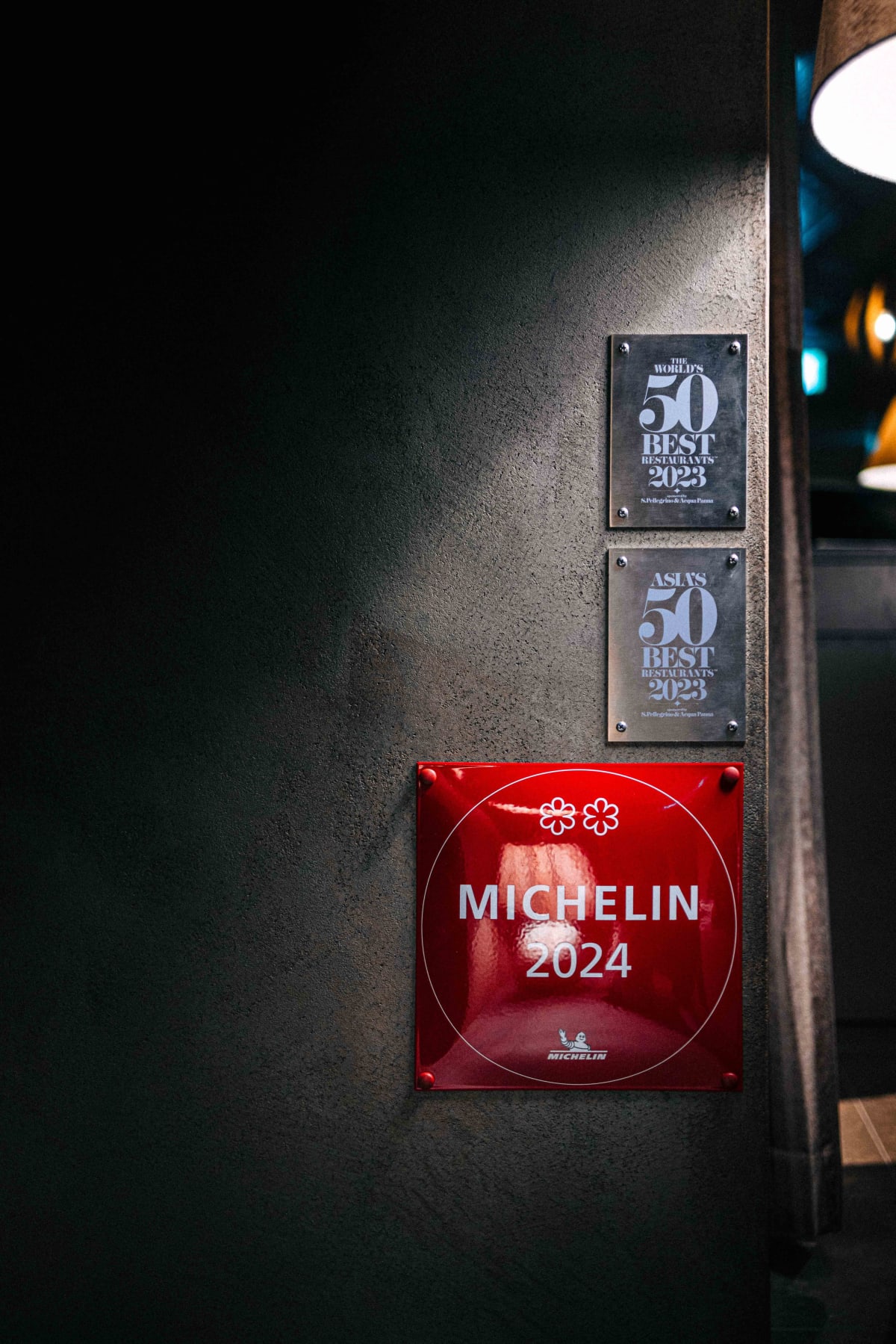
With Michelin it has held two stars since 2018, and when Michelin first brought the Green Star to Tokyo in the 2021 edition, it was one of the six restaurants to receive one. At the Tabelog Award it took Bronze every year from 2017 to 2021, and Silver in 2022 and 2023. Its current Tabelog score of 4.08 is, to be frank, on the low side next to its Michelin and World's 50 Best results.
As a rule, The World's 50 Best Restaurants ranks places with creative, original cooking and flavours above those with direct, classic flavours. When this goes well, the result is original. When it goes the wrong way, the result can be obscure, a flavour that is neither one thing nor the other.
So with Florilège too, I had heard plenty from acquaintances who went before me along the lines of "hmm, it tastes a bit strange" and "it was not delicious," and booking is not that hard either. Get in right when reservations open and you can book with ease. Under the current official guidance, bookings open every day at midnight Japan time for dates up to one month ahead. So I went with some worry, but in the end I was quite satisfied. I will come back to this, but satisfaction here seems to rise and fall each time the menu changes, and I think the reason was that the main course was a good one when I went.
Section 2·Anthology
Florilège means "anthology" in French. The Larousse dictionary defines it as a collection of passages chosen from literary works, poetry in particular, and the word comes from the Latin florilegus, "that chooses flowers."
Chef Hiroyasu Kawate was born in Tokyo in 1978. The official website says he grew up among a family of cooks, so cooking was second nature to him from childhood, and in a 2023 interview with 50 Best he named, as one of his reasons for choosing French cuisine, that the toque his father, also a cook, wore looked cool. He worked at Le Bourguignon in Nishi-Azabu and Le Jardin des Sens in Montpellier, France, returned to Tokyo in 2007 as sous chef under Shuzo Kishida at Quintessence, and in 2009 opened Florilège in Minami-Aoyama.
In 2015 it moved to a basement in Jingumae, near Gaienmae Station. That second address, sixteen counter seats wrapped around three sides of an open kitchen plus a private room, is where Florilège made its name around the world. Then it moved again, to the second floor of Garden Plaza D at Azabudai Hills, which opened in November 2023 to a wave of public attention.
Section 3·The Third Chapter
The restaurant calls this move its "third chapter." A word of warning: Azabudai Hills is enormous and very confusing on a first visit, so learn the way before you go.
Get off at Kamiyacho Station on the Tokyo Metro Hibiya Line and you can walk straight into Azabudai Hills underground. Fortunately Garden Plaza is close to the station connection, but Garden Plazas A, B, C and D are not linked above ground. So head straight for Garden Plaza D underground; go up to street level and you may wander around and arrive late. Florilège occupies the whole second floor, so once you reach the second floor it is easy to find.

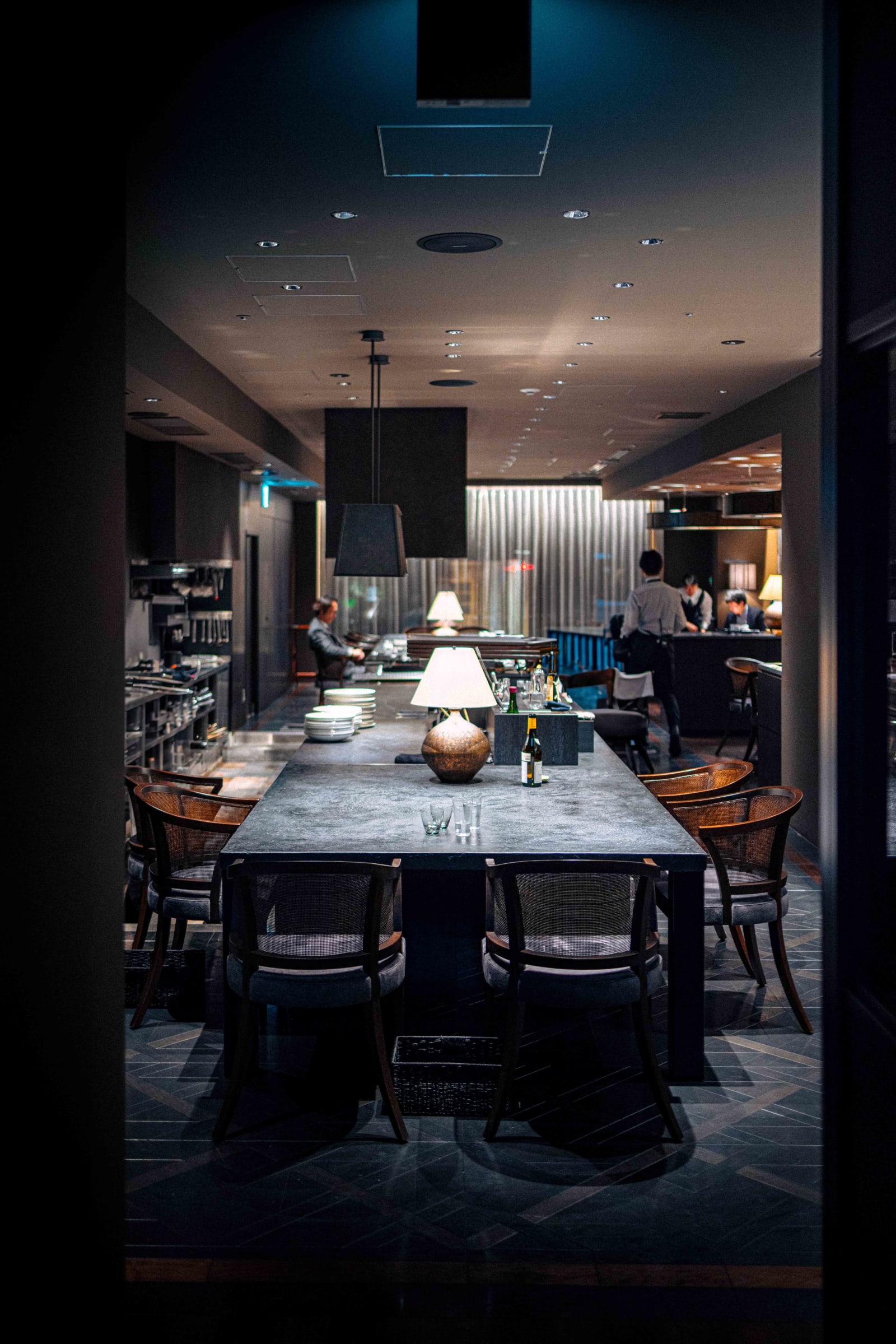
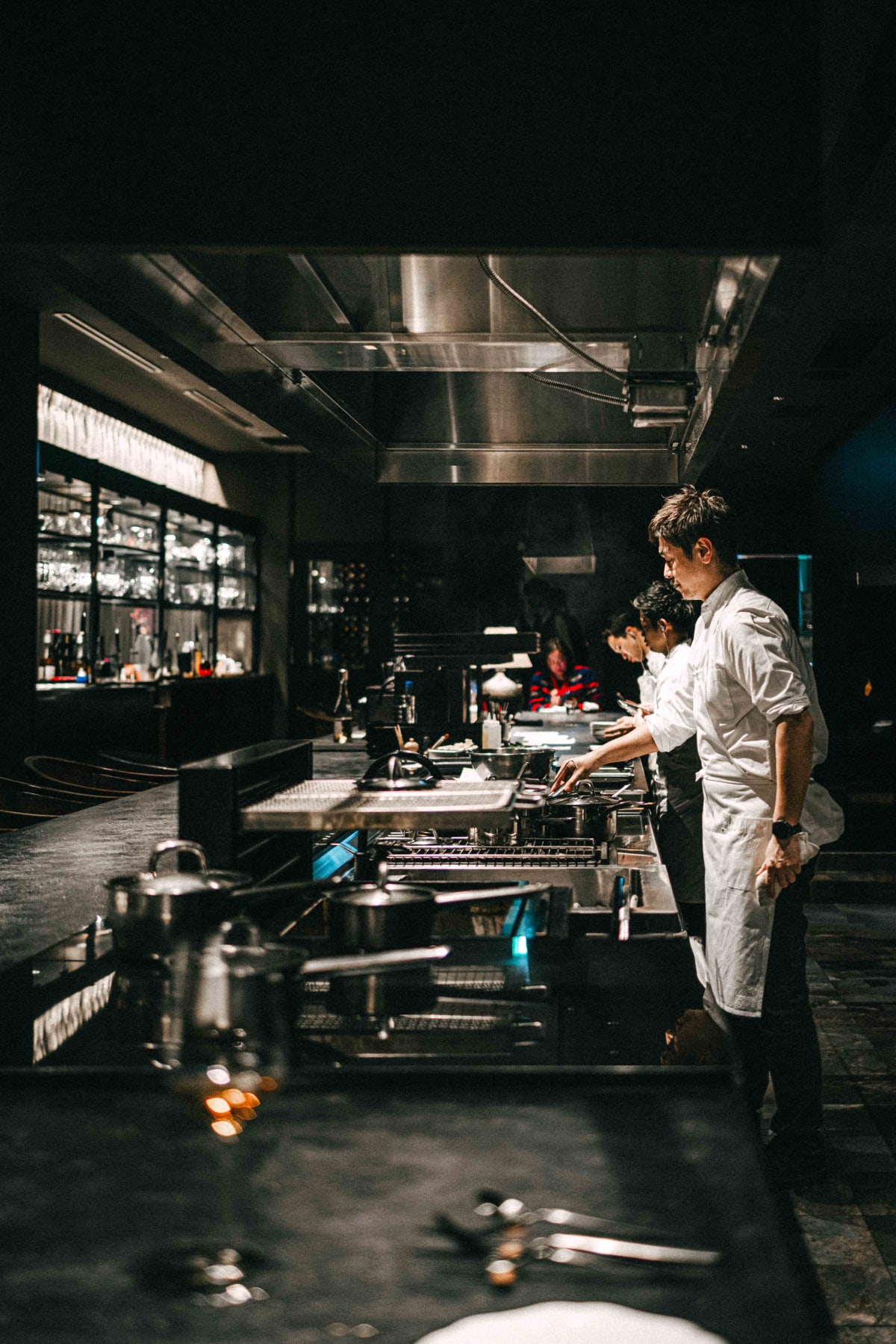
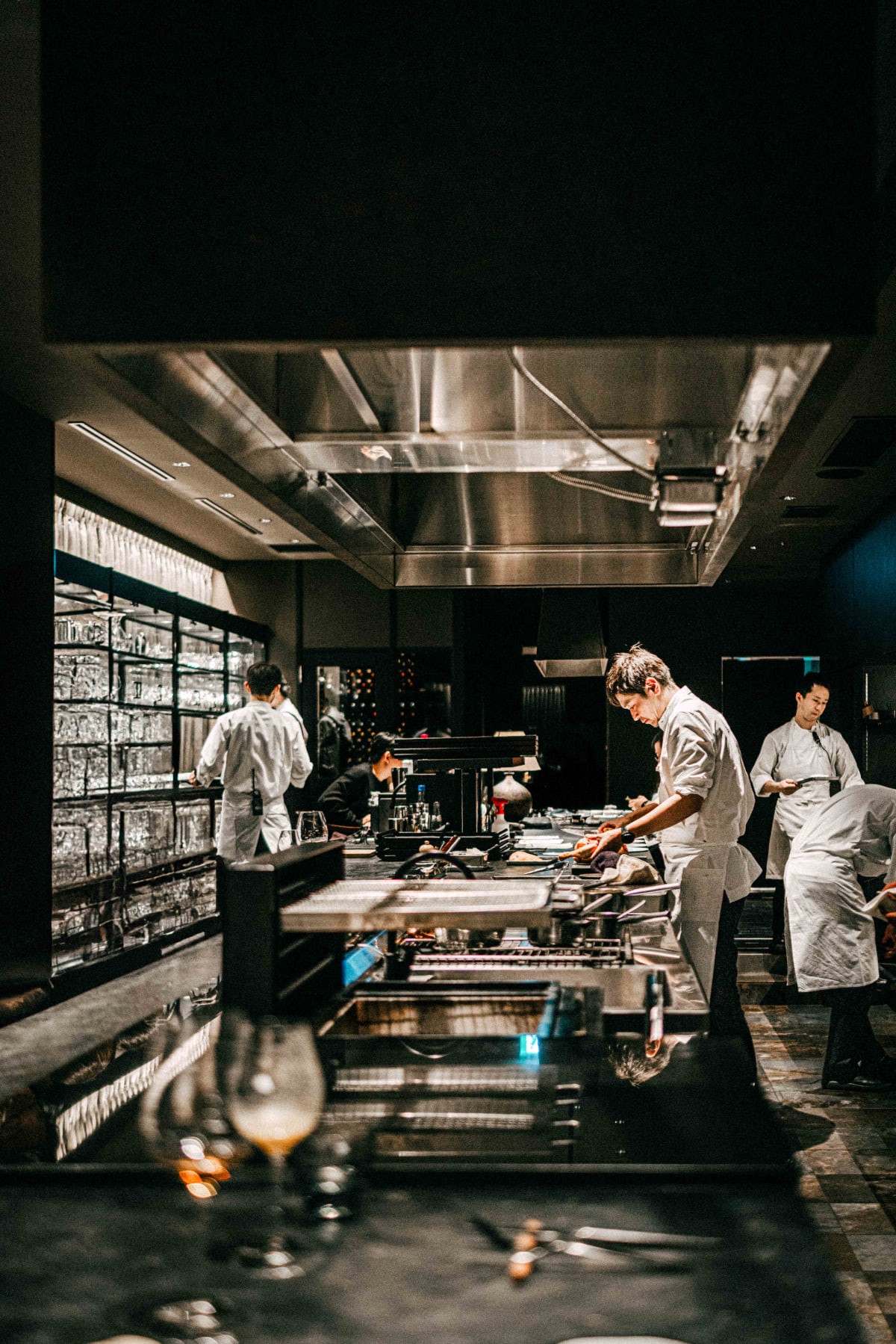
Inside, the feel is less the cutting edge of modern design than modern with a slight classic touch, and the seating is highly unusual. There is one very long, wide table like a library reading desk, plus one or two small tables. The table is thirteen metres long, and the kitchen and the dining hall are joined not merely to the degree of an open kitchen but to the point where you could call them a single space. Perhaps because everything was new and well equipped, no cooking smells drifted over at all.
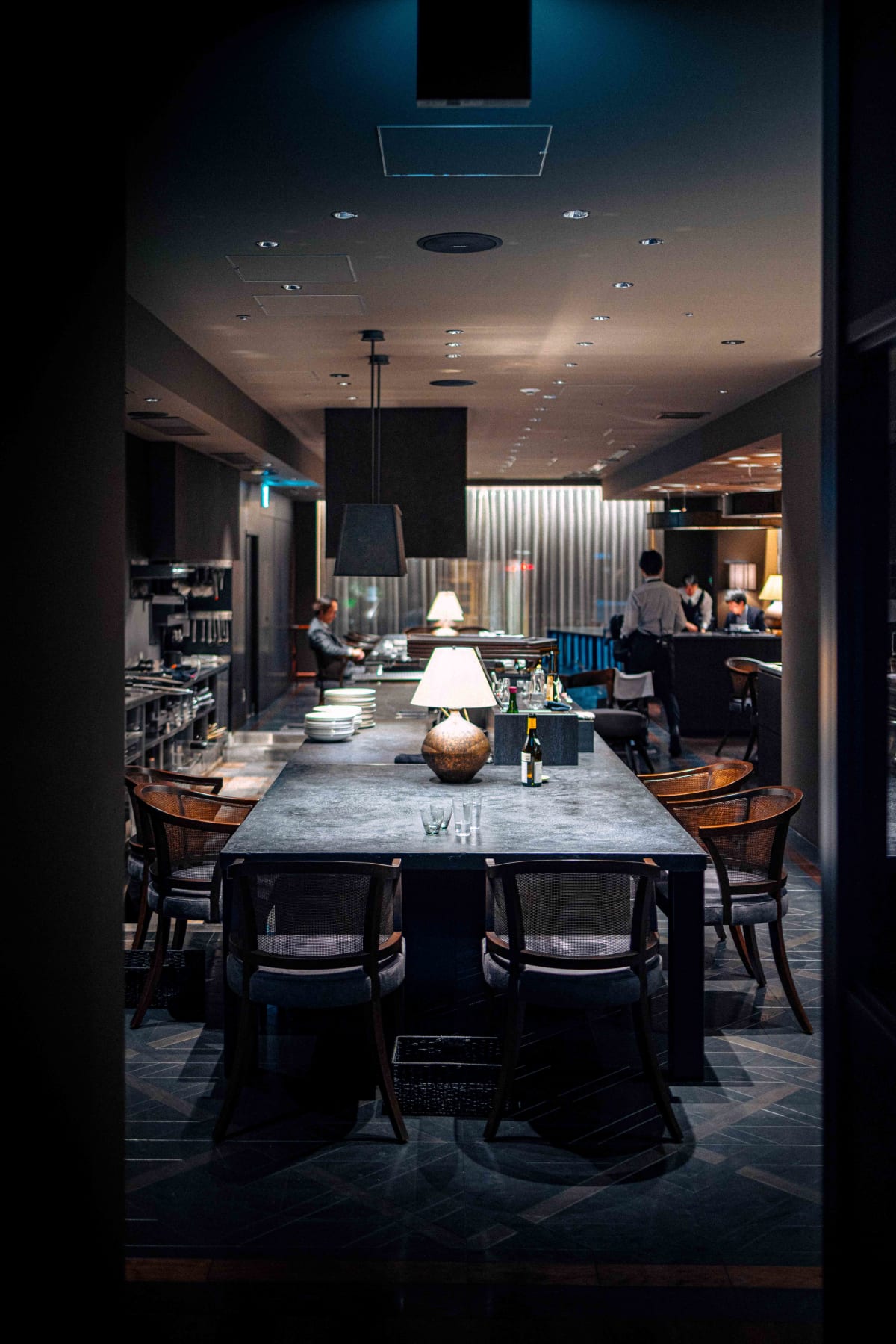
This long table exists for table d'hôte, the format Chef Kawate holds dearest. It is the French way of eating in which guests sit around one table and share the food the host serves, and the Michelin Guide described it as "a long table reminiscent of the dining tables of Western nobility." It is the opposite of the Jingumae years, when guests watched the chef's hands across a counter.
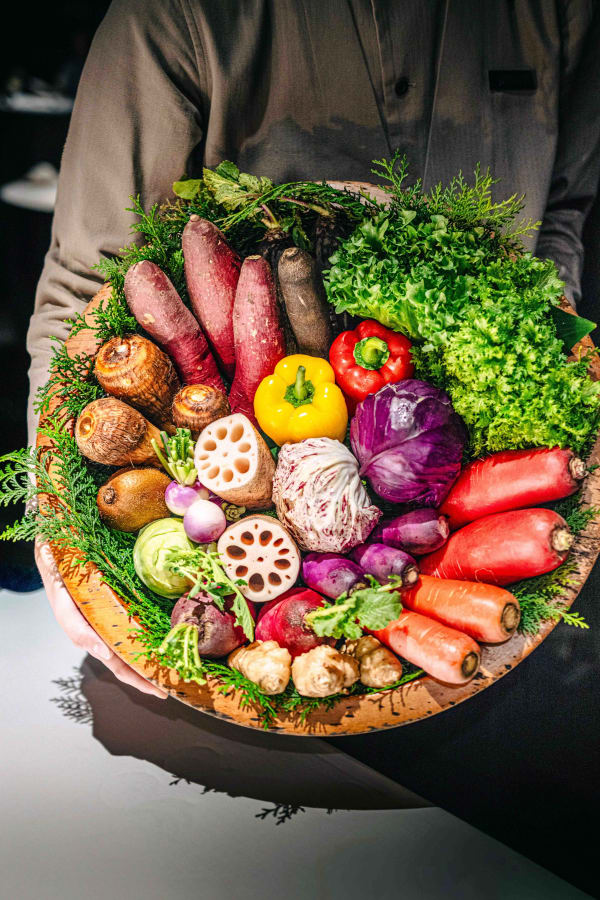
The move changed more than the space. Chef Kawate made plant-based cooking the theme of the new address. In a December 2023 interview with Time Out Tokyo, he said this was not meant for vegetarians or vegans, only a decision to put vegetables at the centre, and that he still uses Japanese fish, beef and dairy. Japanese beef and fish can now be sent anywhere in the world, but vegetables are the one thing that cannot, so what only Japan can offer, in the end, is vegetables.
In a June 2024 interview with the Michelin Guide, he gave as reasons both that Japanese vegetables such as kyo-yasai are hard to obtain abroad and a personal change: as he got older, he came to prefer vegetables over fatty meat. Even in the Jingumae years he cooked without letting ingredients go to waste, with beef from aged cows fattened up again and a consommé made from vegetable trimmings, and in a 2023 interview with 50 Best he said that Japan is a country with a huge amount of food loss, and that as a chef he feels responsible for improving it.
Section 4·Nine Lines On A Card
There is one course, and I chose the pairing, which, as far as I remember, cost a little under ¥15,000. A Tabelog user who ate this same Christmas course that month wrote that course and pairing together came to about ¥40,000, and to me both the course price and the pairing price are on the low side for a restaurant of this reputation.
At the time of writing (October 2026), the official prices are ¥24,000 for the dinner course and ¥14,000 for the pairing, with a 10% service charge on top. Because the pairing is not expensive, it leans mostly on natural wines, and unlike the food, it was simply ordinary.
The theme of that night's course was set by two lines on the card: "24th December 2023" and "Happy Holidays." Instead of dish names it listed only ingredients, nine lines in all: butterbur and carrot, lettuce, tacos, lily bulb, radish, moroko and cabbage, then the main, "兼ね合い (To Balance)," mozzarella and peanut.
The first glass of the pairing was Champagne: Pierre Péters Cuvée de Réserve Blanc de Blancs Grand Cru.
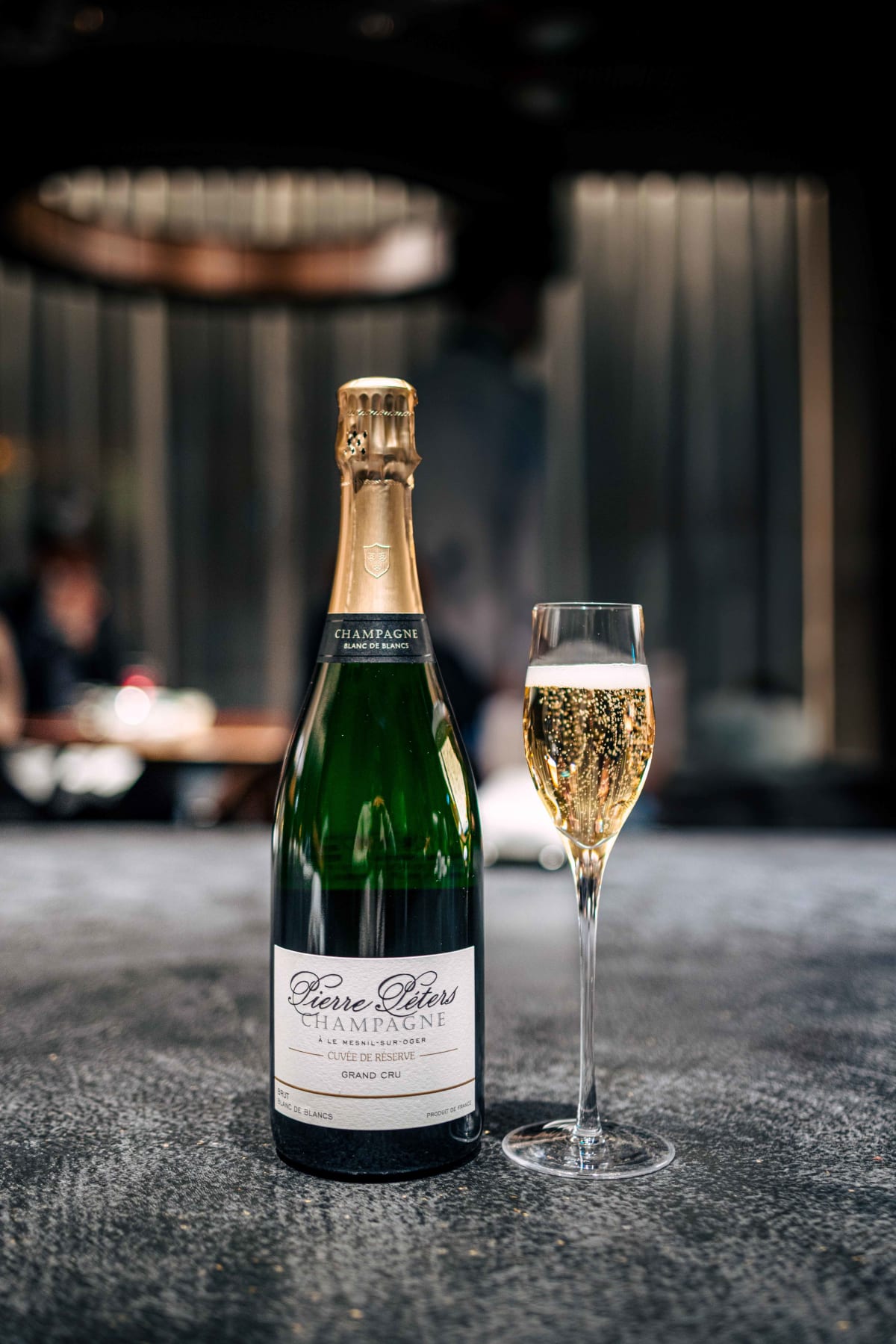
Pierre Péters is a grower in Le Mesnil-sur-Oger, a grand cru village of the Côte des Blancs. In 1919 Camille Péters was among the very first growers in Champagne to sell bottles under his own name, and today the house is run by the sixth generation, Rodolphe Péters. Cuvée de Réserve draws on a perpetual reserve begun in 1988 and topped up with new wine every year.
The first plate was a pair of amuse-bouches, the "butterbur, carrot" on the first line of the menu card. One was a small tart made with kintoki carrot, a carrot of deep red. On the crisp tart sat carrot mousse, finely shredded carrot in the Okinawan style (shirishiri) and carrot powder.

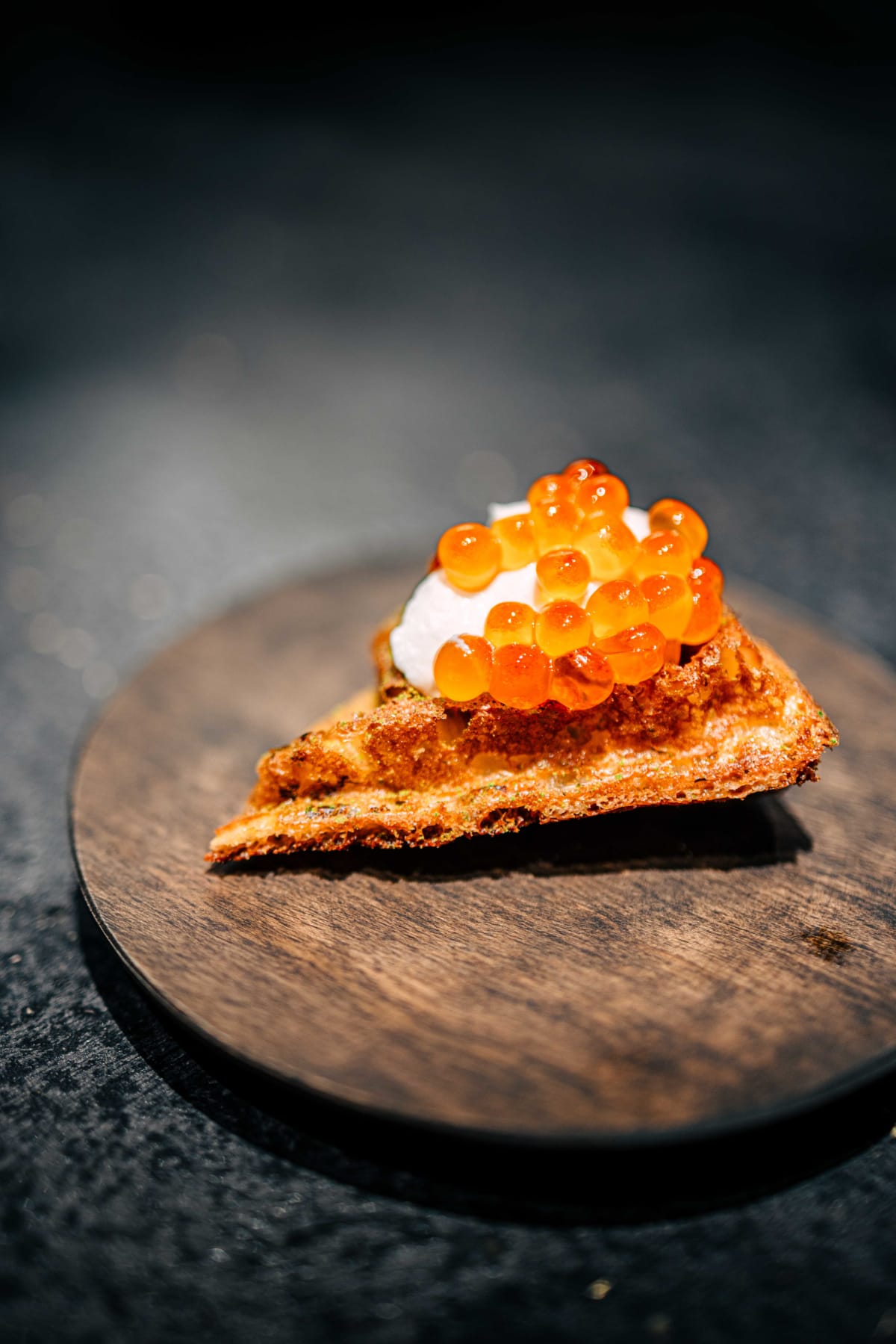
The other was a waffle topped with sour cream and salmon roe. Of the early dishes, the ones that stayed with me were this salmon roe waffle, the very first thing served, and the tacos. Salmon roe, ikura in Japanese, is an ingredient Japanese cooking can hardly do without, above all in seafood. Set on a waffle, with its glowing orange, the richness of the eggs and the smell of the sea, it looked harmonious and, at the same time, unfamiliar.


Section 5·Tacos And Lettuce
There were two tacos, spinach and meat, and the meat taco's tortilla was itself made of meat, which I only realized once I picked it up.

Dipped in the sauce served alongside, they were harmonious and tasted good. According to a Tabelog review from a visit in the same period, the spinach taco held sautéed spinach with lemon, ooba (shiso) and mustard leaf, and the meat taco was tartare wrapped in jerky.


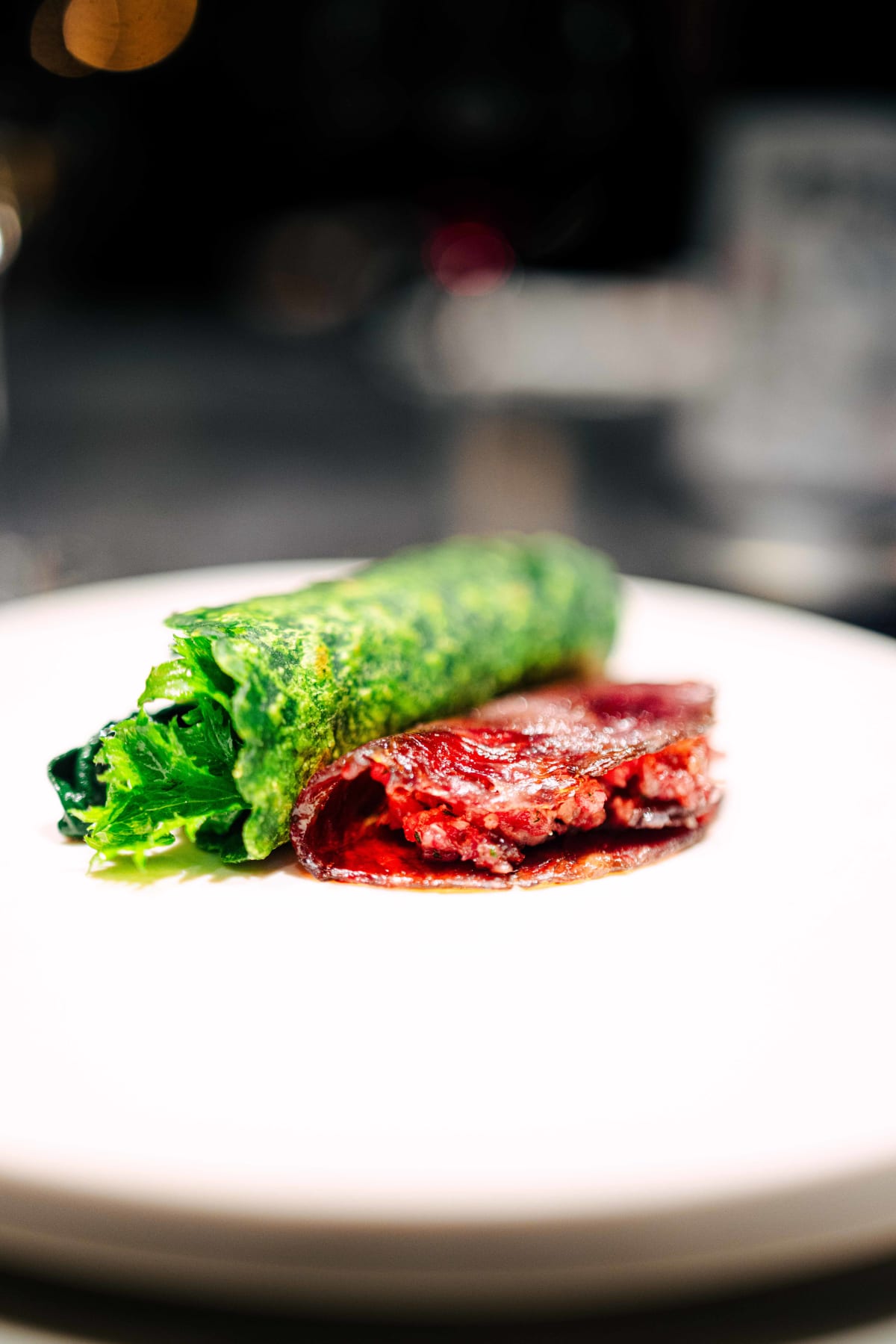
A Discover Japan article from April 2024 noted that the tartare is akaushi (赤牛) beef and the sauce a salsa-style sauce made from Okinawan green chillies.
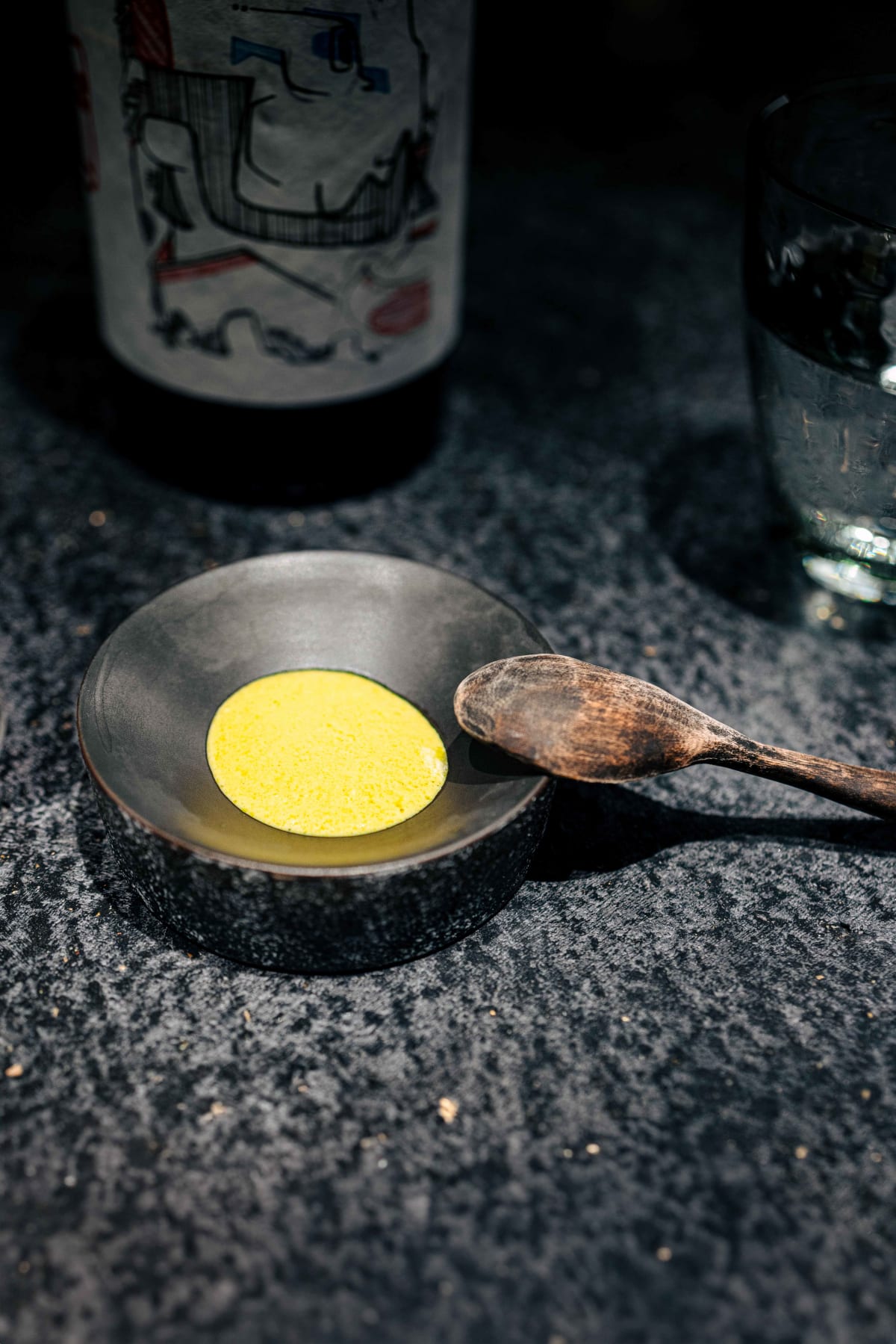

Early in the course though it was, the pairing for the tacos was a red, a Japanese wine with the signature "98wines" at the bottom of a label filled with a drawing.
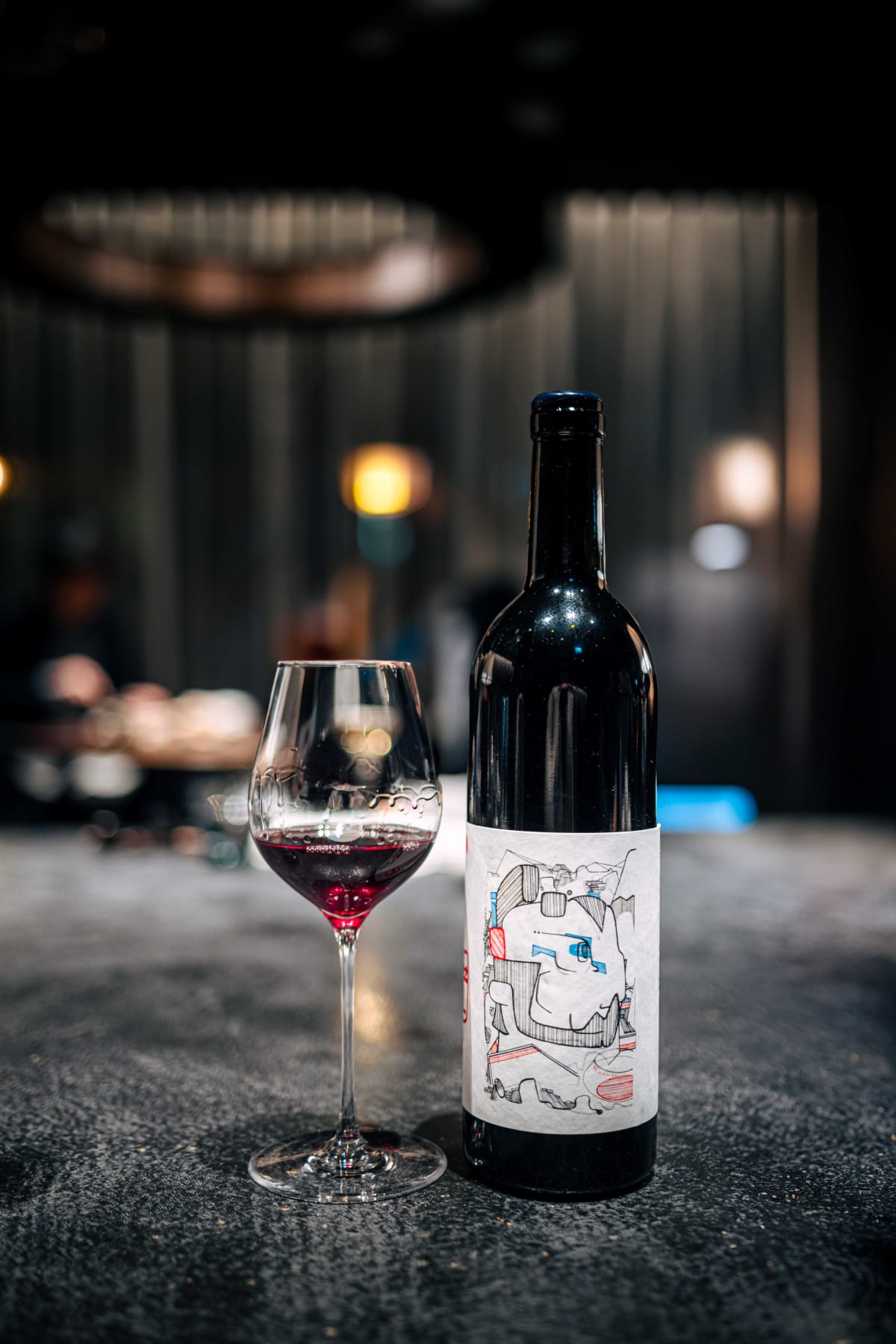
98WINEs is a small winery that opened in 2018 in the hills of Enzan, in Koshu, Yamanashi. It was founded by Shigeyuki Hirayama, who started in wine at a large drinks company's Katsunuma plant, studied in Burgundy and served as head winemaker at several Yamanashi wineries. It works with only two grapes, koshu and Muscat Bailey A, and for the red, whole bunches of Bailey A go into the vat and are trodden by foot before fermenting.
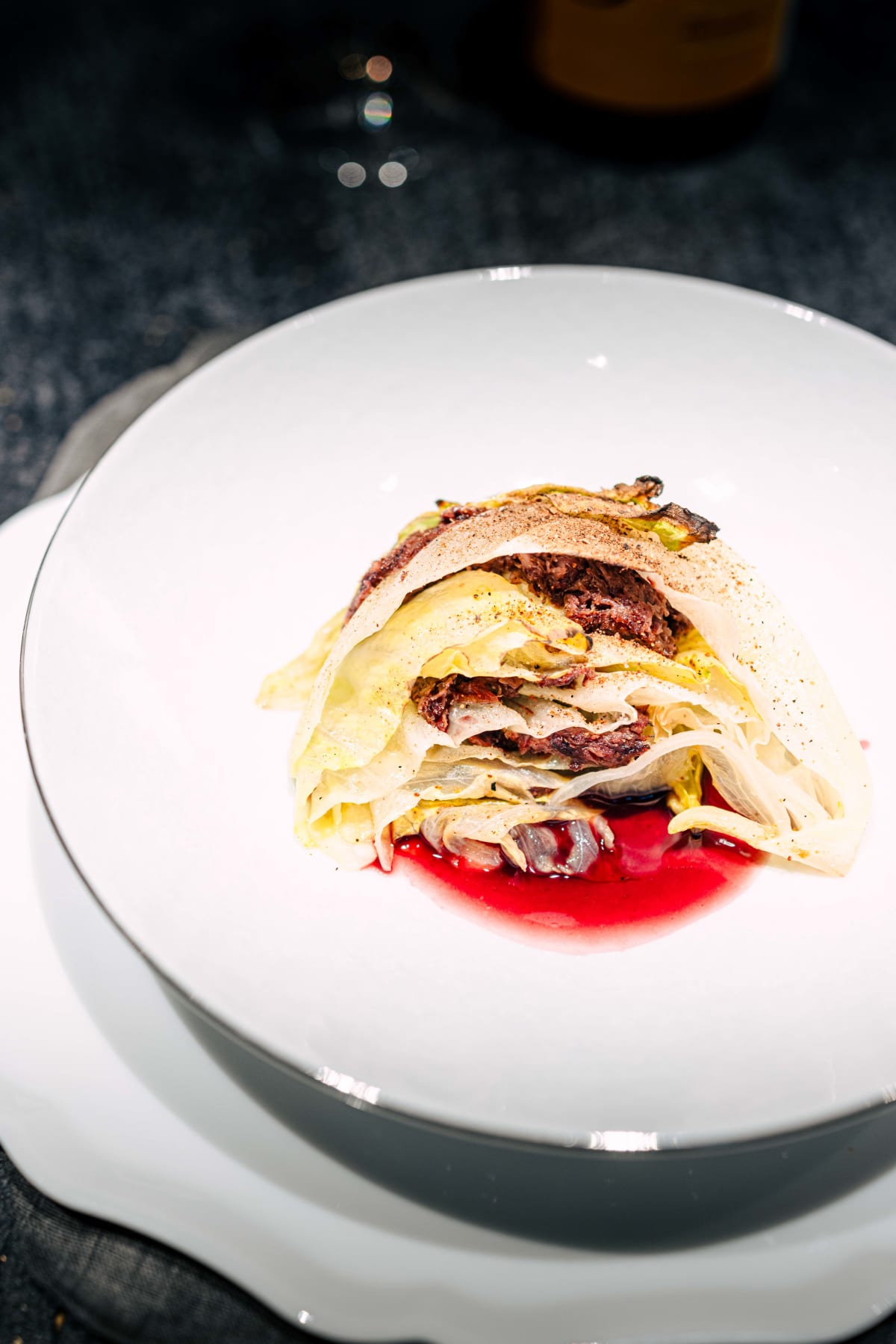
Between the salmon roe waffle and the tacos came a dish of lightly grilled lettuce, filled with tuna, or something with the texture of tinned tuna, bound in a salty sauce like a fermented paste, with a tart juice poured underneath. I cut it into big pieces, took a bite and thought, "ah, so this is what a Green Star tastes like." For someone like me who does not think about health while eating, it was a dish where once is enough.
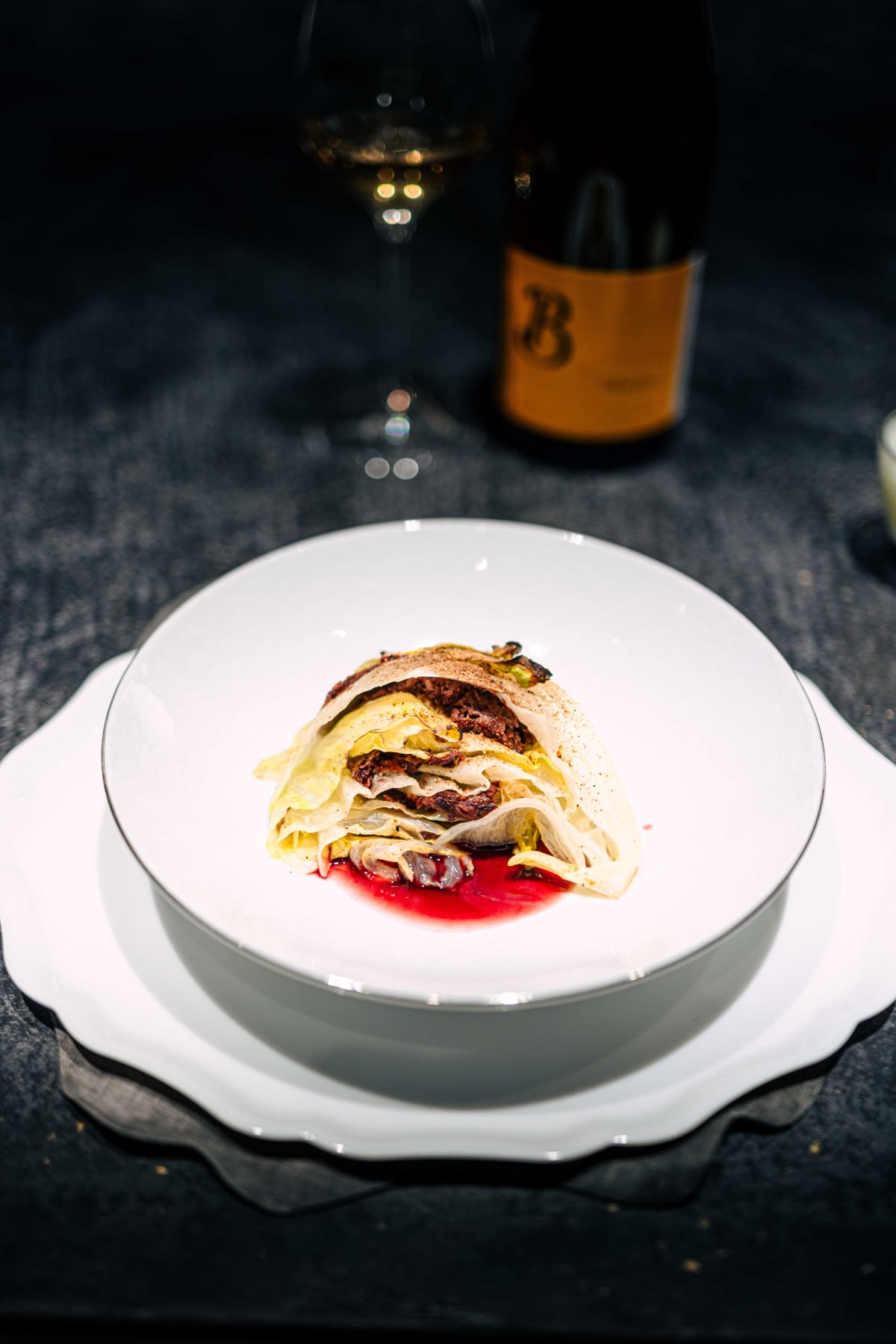
The lettuce in this dish had been marinated, the salty sauce was XO sauce, and the red juice underneath was a treviso sauce. XO sauce is made from dried scallop and dried shrimp, so it made sense that its deep savouriness of the sea came with a texture like tinned tuna.
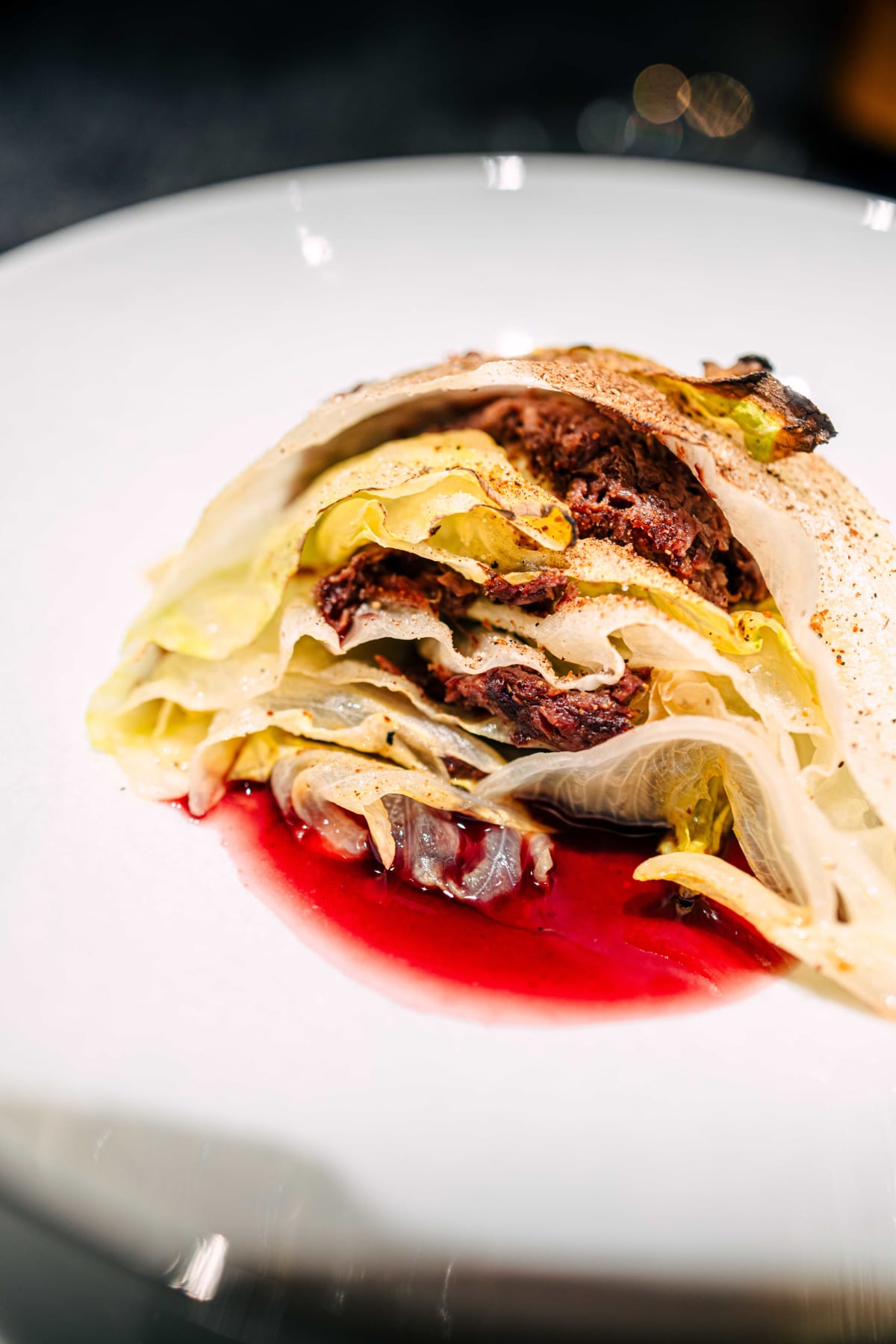
A small glass of lettuce soup came with this plate, lettuce consommé topped with a foam of lettuce potage.

Among the pairings, though, the white served with the lettuce was good: a Loire natural white called SAUVIGNON "B" 2020 from Audrey Pilorget. It seemed a lightly made Sauvignon Blanc, with a pleasant fruity nose, and the acidity did not jump out, so it drank well alongside the food.
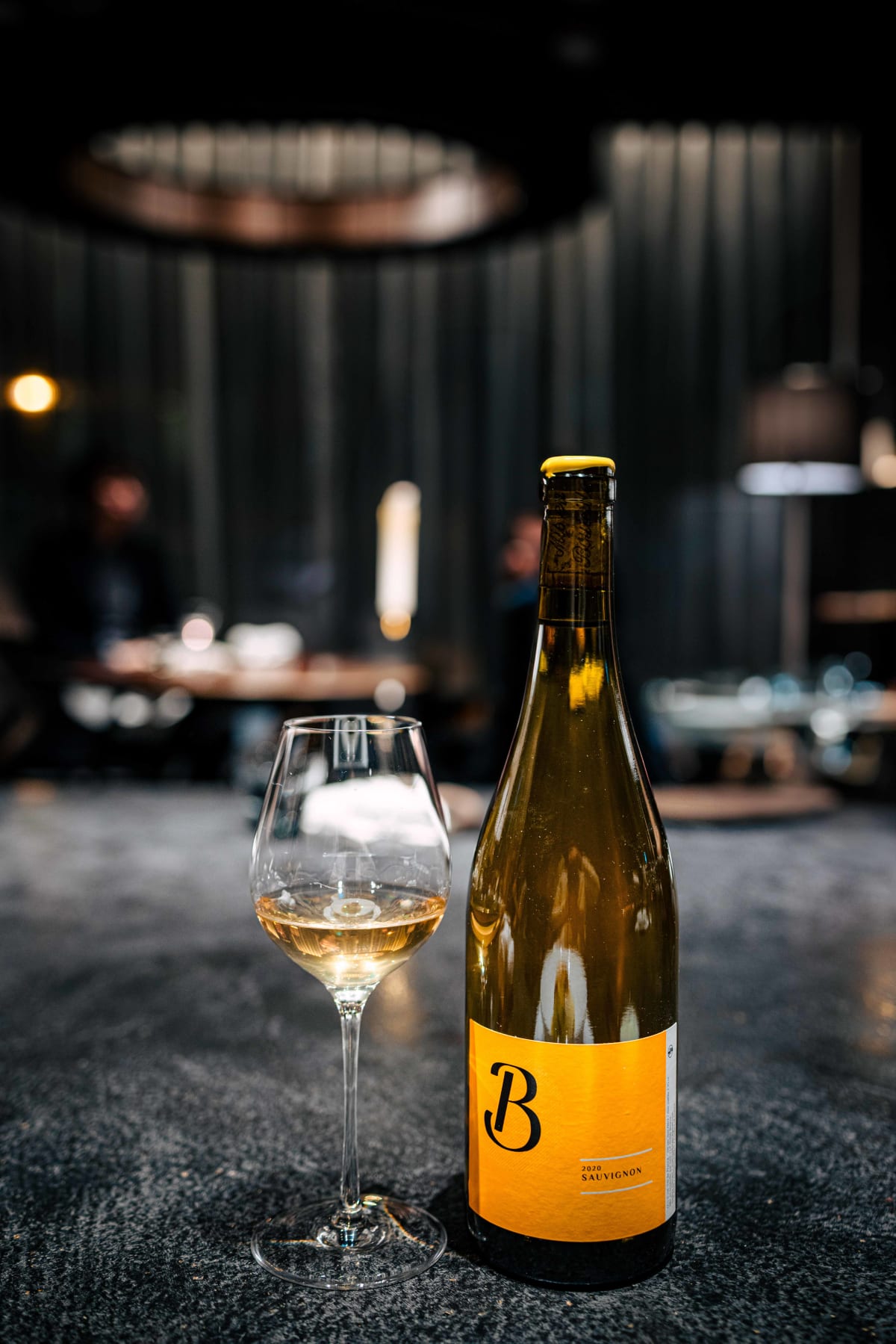
Audrey Pilorget spent twenty years growing grapes in Alsace and nine as a wine merchant in Paris before moving to the Loir-et-Cher in the Loire, where since 2019 she has made wine with nothing added. With no vineyard of her own yet, she takes in grapes grown by one or two growers and vinifies them without chemical or mechanical intervention, neither filtering nor adding sulphites. The side of the label also reads "non filtré, non sulfité," and the wine was bottled in Bourré, on the banks of the Cher.
Section 6·Lily Bulb And Makgeolli
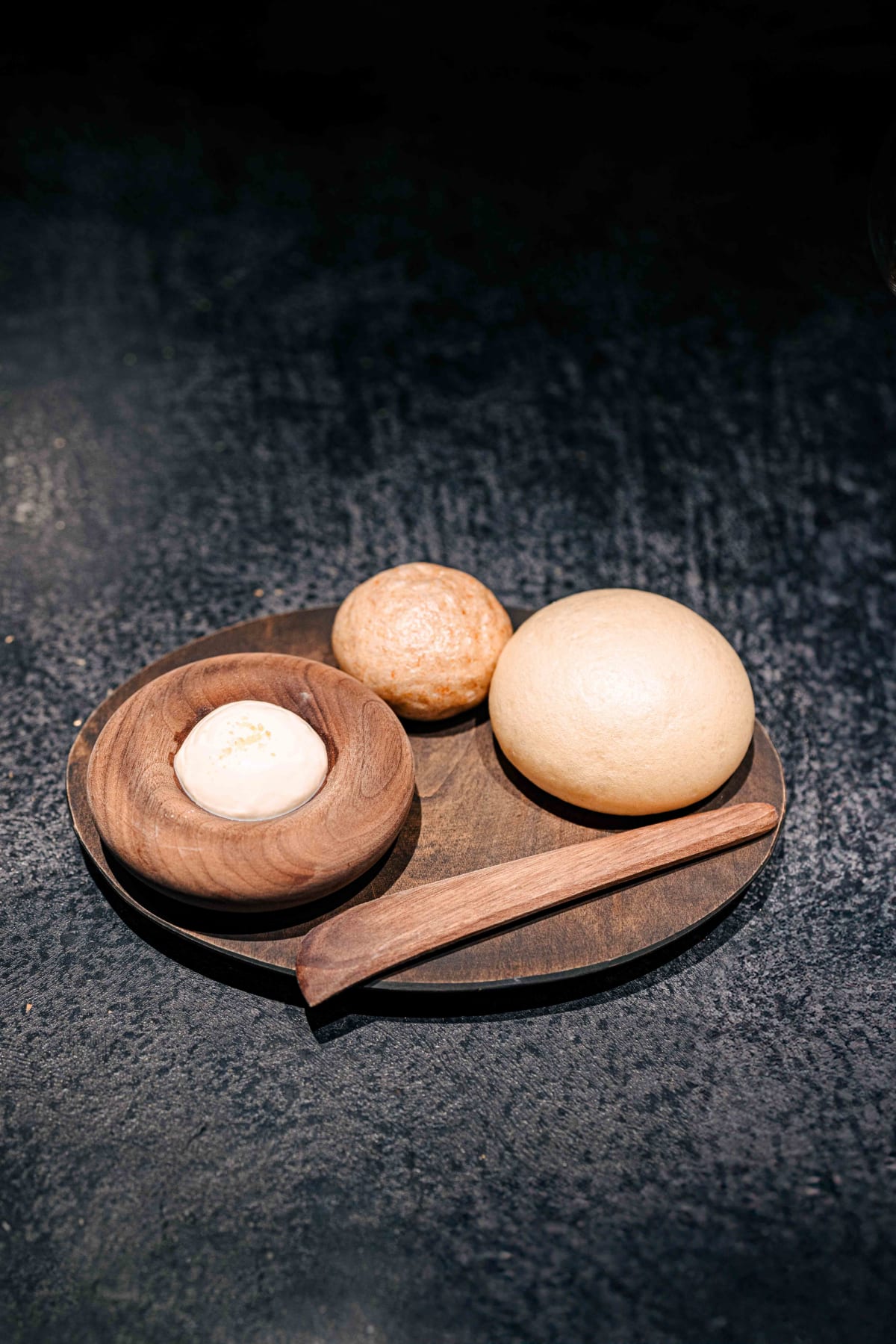
Bread arrives midway through the meal, and if my limited grasp of spoken English can be trusted, they said it was made in-house with natural yeast. The spread served with it was like cream cheese, concentrated, with a yoghurt-like tang. The bread was very soft and fluffy, so good that I asked for more.
Midway through, a delicious cream foam of some kind arrived, topped with truffle. The card said only "百合根 (lily bulb)," and according to the same review it was lily bulb soup topped with black truffle, with lily bulb ice cream inside.


Then the pairing arrived, and the bottle said "makgeolli" in big letters. I had almost never seen a traditional Korean drink served as part of a pairing abroad, so it took me by surprise.
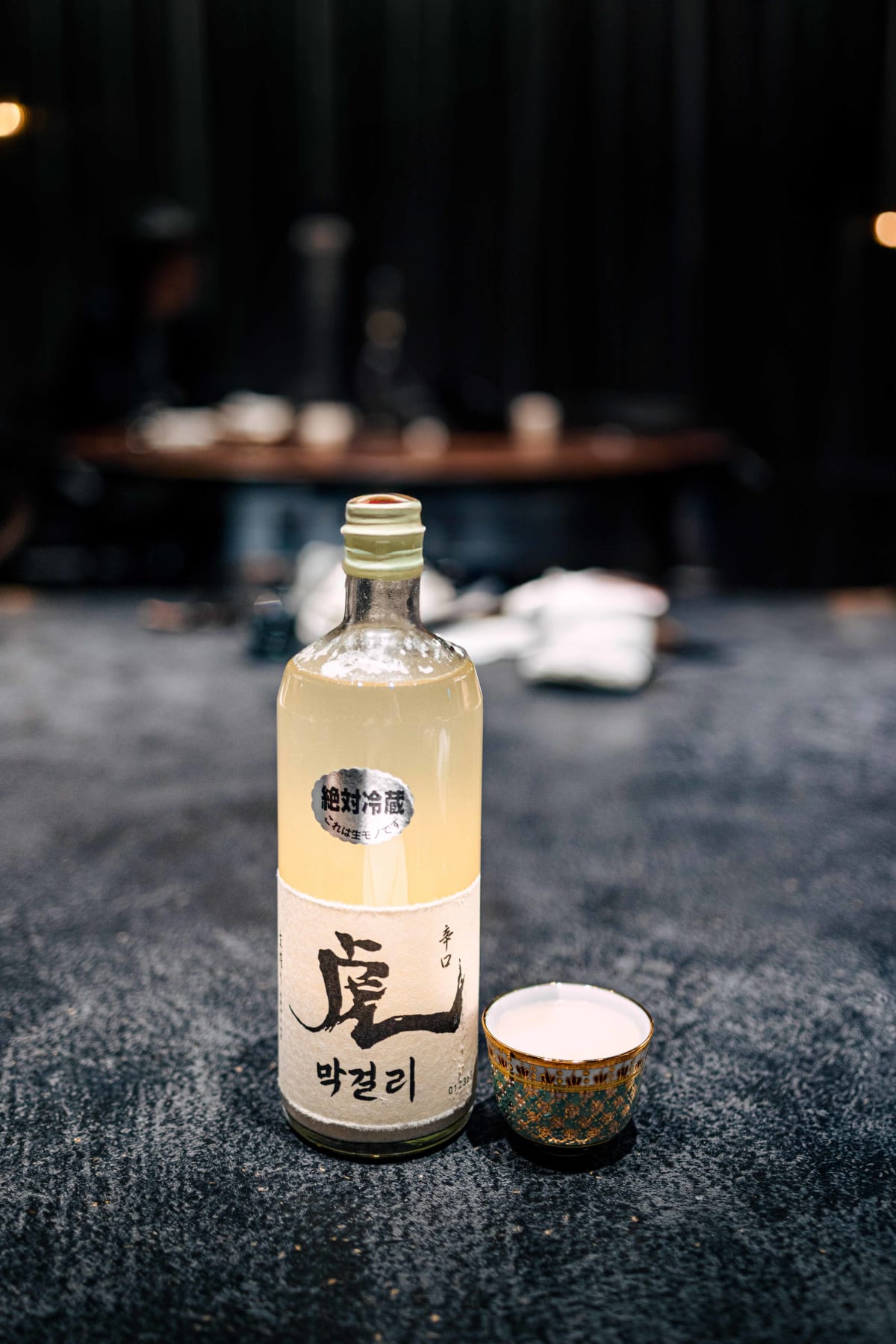
On top of that, I was told it was not makgeolli imported from Korea but makgeolli made in Japan, brewed, no less, in Fukushima. I wondered whether Chef Kawate has a particular interest in Korea.
It tasted somewhat different from Korean makgeolli. Makgeolli is a drink I have never much liked or known well, but this seemed a little more toasty and grainy than the makgeolli of Korea. My guess is that it had not been aged as long. But then there is the weak point of takju, unfiltered rice wine, and the reason that I, though Korean, do not much like makgeolli: drinking it alongside wine, I later had a headache that made the rest of the night hard going.
Tora (虎) makgeolli is brewed by Ariga Jozo (有賀醸造) in Fukushima Prefecture. It is a sake brewery founded in 1774, and its tenth-generation head, Yoshihiro Ariga, fell for the makgeolli he drank at a Korean restaurant in Ueno, Tokyo, and began brewing his own in 1990. It is made from Japanese rice, koji and underground water from the Abukuma highlands, and as an unpasteurized nama makgeolli it keeps fermenting in the bottle. Korean restaurants are said to have wanted it sweeter, but the brewery held on to its dry style.
Section 7·The Radish Pie
Alongside the tacos, the other dish I enjoyed was made with radish. Inside something round that looked like a fritter was radish, with cheese in it as well. I remembered the topping, which looked like caviar, as some kind of plant like seaweed (the taste is nothing like caviar), but when I looked it up it was tonburi (とんぶり), the processed seeds of the kochia plant. In Japan it is called "caviar of the fields."
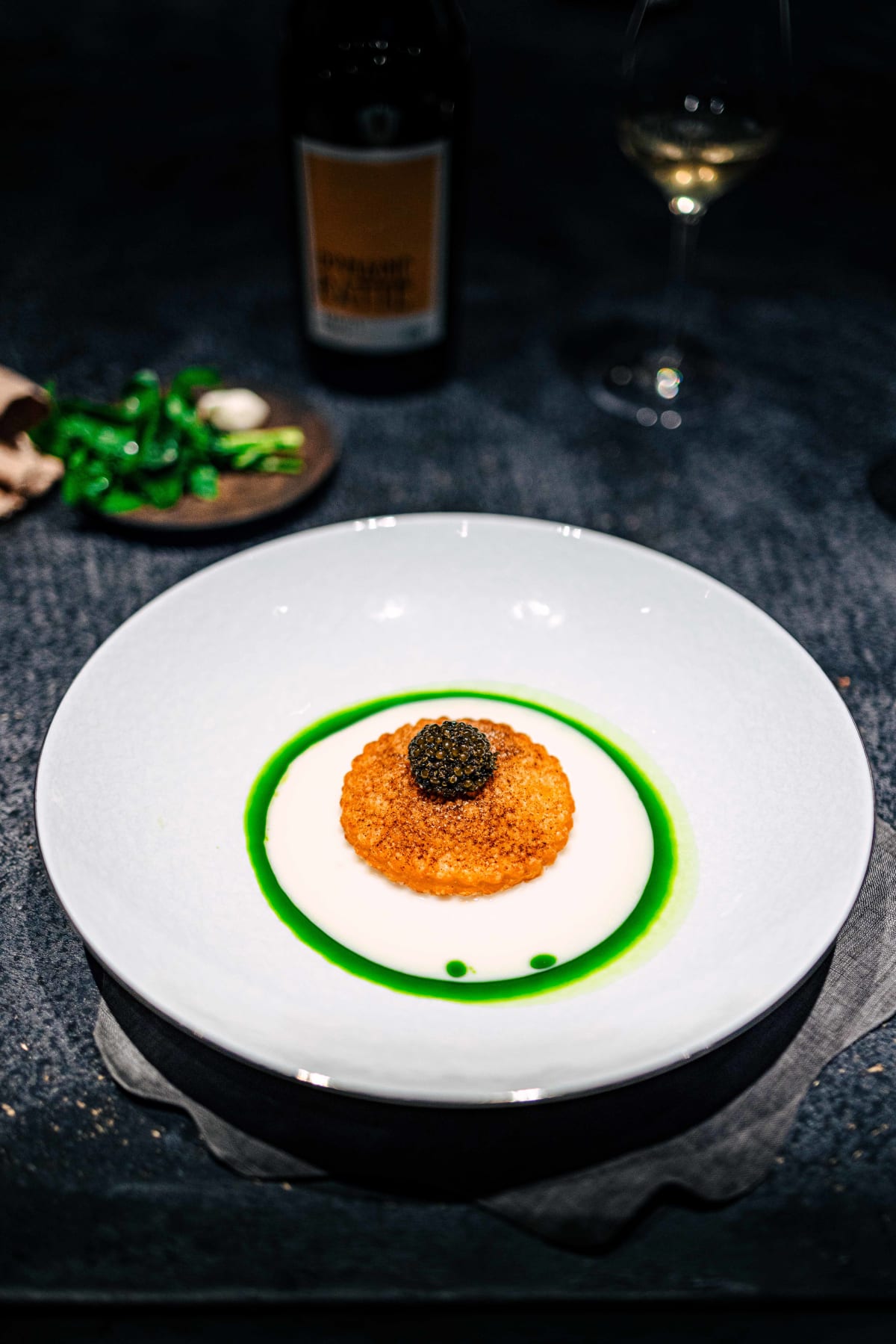
I thought it an unusual combination, but eaten together with the sauce it was far more harmonious than I expected. The topping also added a fun note of texture. Radish confit and radish purée were wrapped in pastry and fried, then topped with kombu powder, tonburi and caviar, and served with a turnip sauce and watercress oil. So on top of the thing that looked like caviar, there was real caviar too.
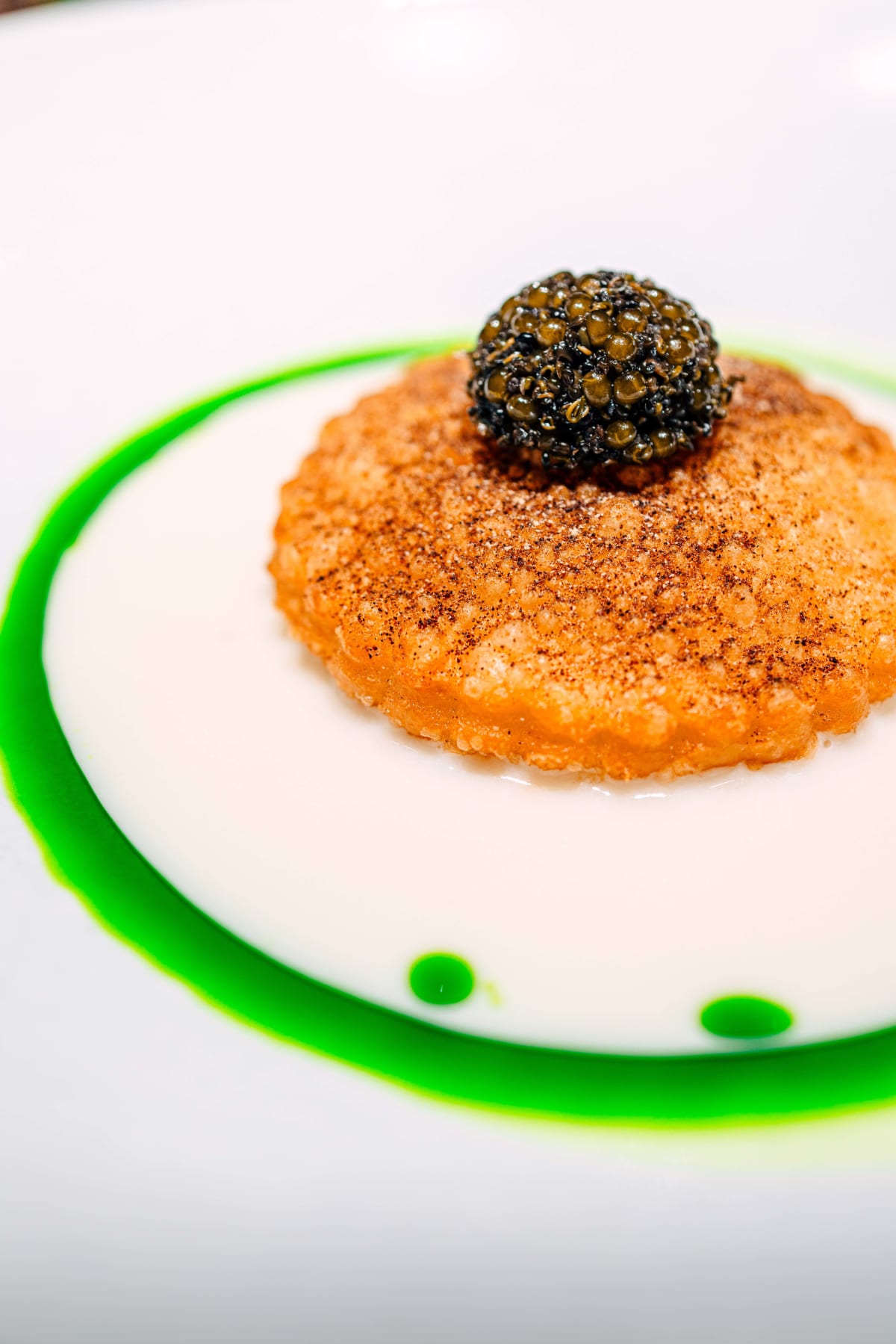
The same radish pie appears in a Discover Japan article four months later, in April 2024, so it seems to be a plate that stays on the menu as the seasons change. On the night, it came with a small wooden plate of watercress and herbs and a dab of cream on the side.

With the radish pie came a white from the Jura, Domaine Ratte Arbois Naturé 2021.
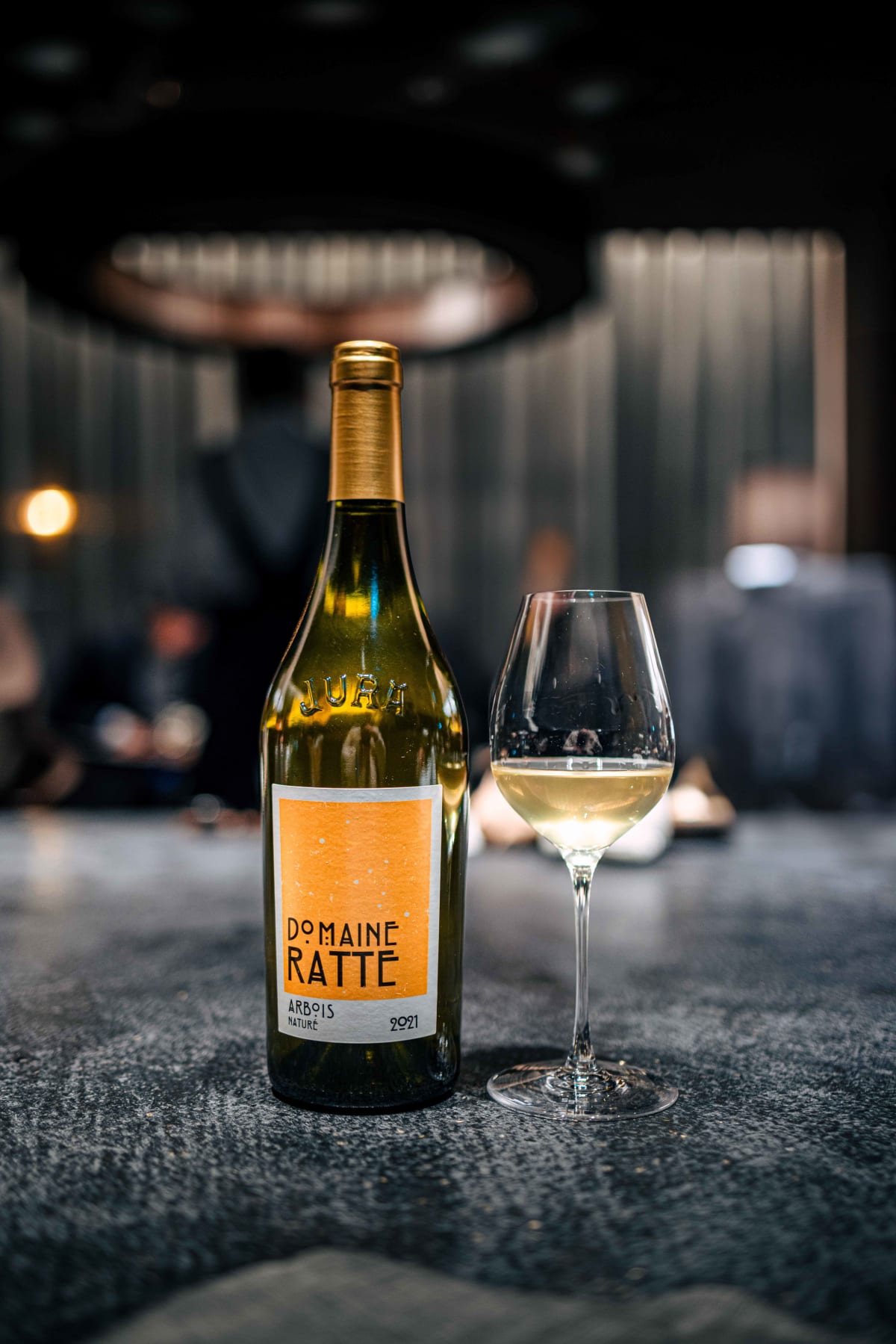
Domaine Ratte is a nine-hectare estate in Arbois in the Jura, run by Michel-Henri Ratte and his son Quentin and farmed biodynamically with Demeter certification. Naturé is an old name for Savagnin. This wine is a Savagnin made ouillé, with the barrels kept topped up as the wine level drops, to keep oxidation out.
Section 8·Moroko And Cabbage
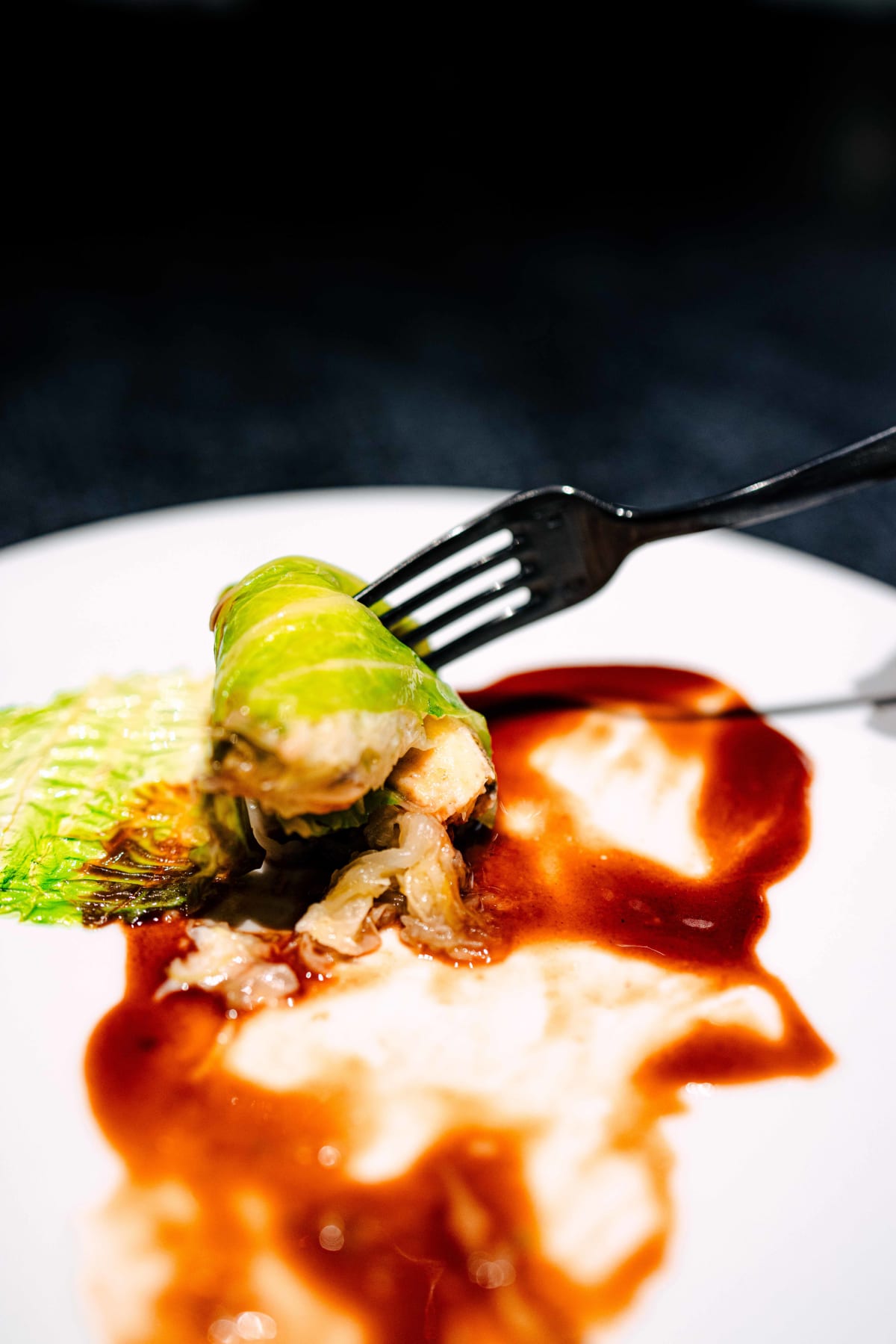
The next course came wrapped in cabbage, with a chip the colour of cabbage on top and a sauce spread underneath. I was told the filling was a Japanese fish.
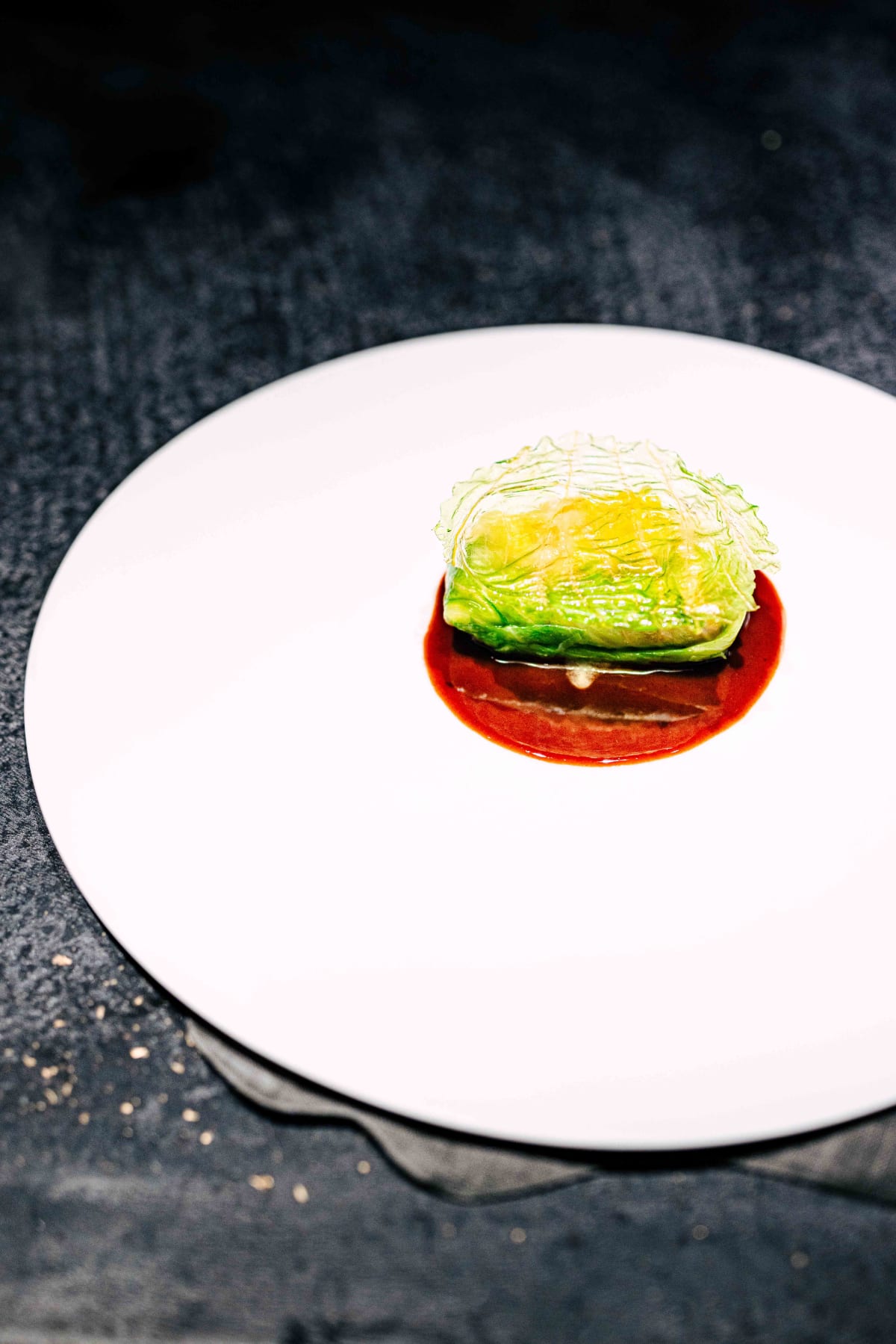
At the time I searched and took it for a fish of the anchovy family, but looking again at the menu card and the same review, it was moroko (もろこ) from Lake Biwa. Moroko from Lake Biwa usually means honmoroko, a freshwater fish of the carp family originally found only in Lake Biwa, in season from winter into spring. Even large ones grow only to about fifteen centimetres, and it is said to be the most delicious of all the carp-family freshwater fish.
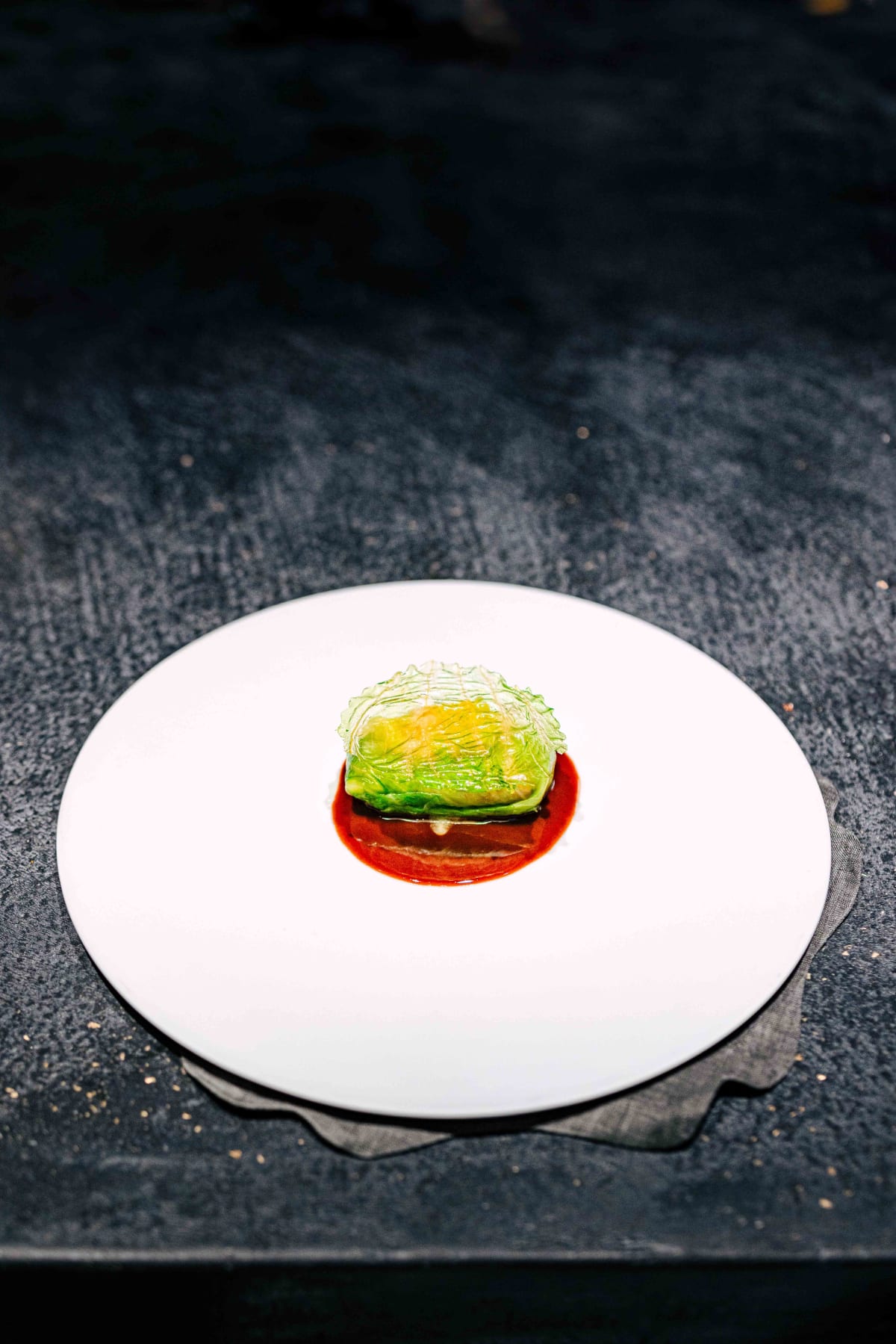
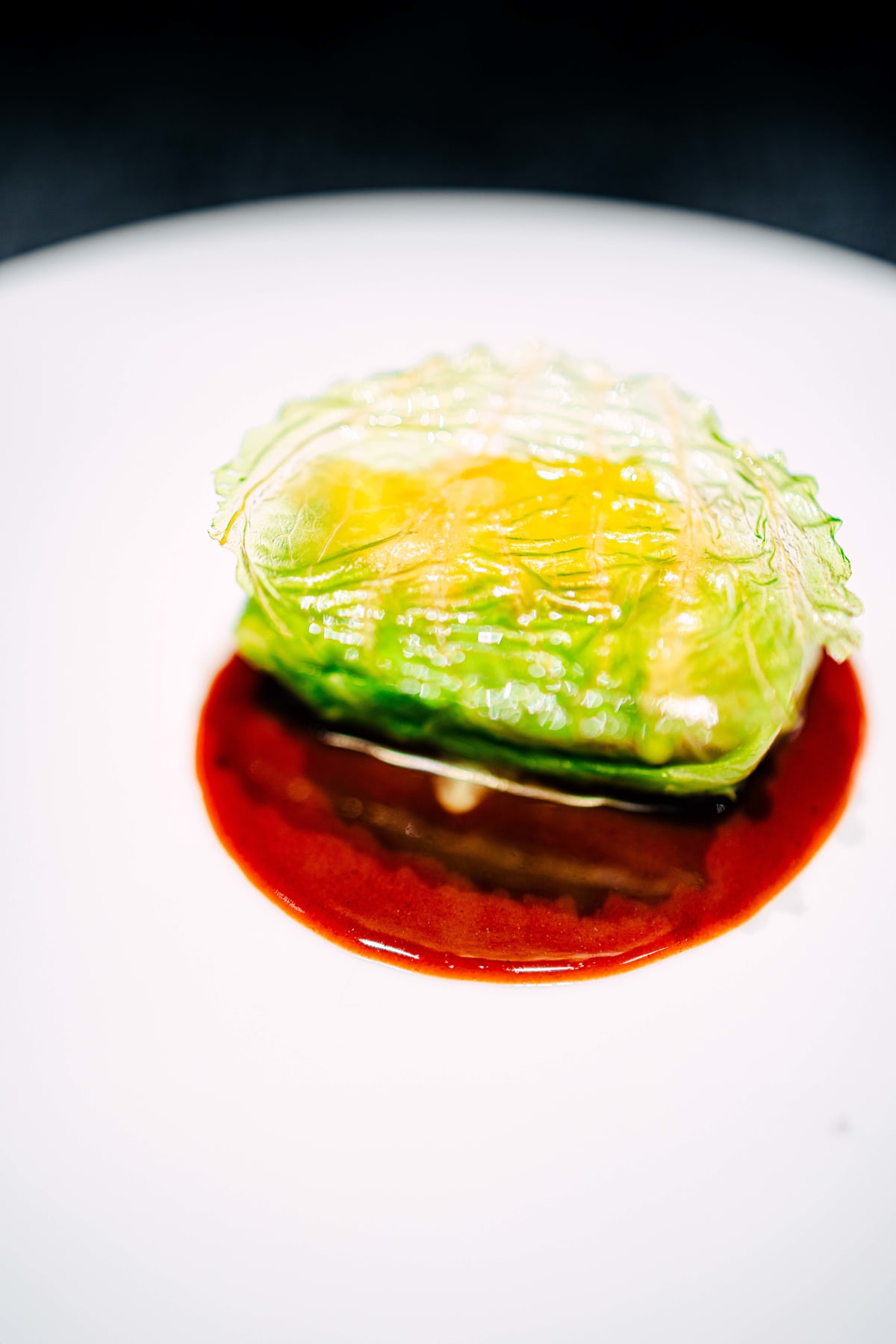
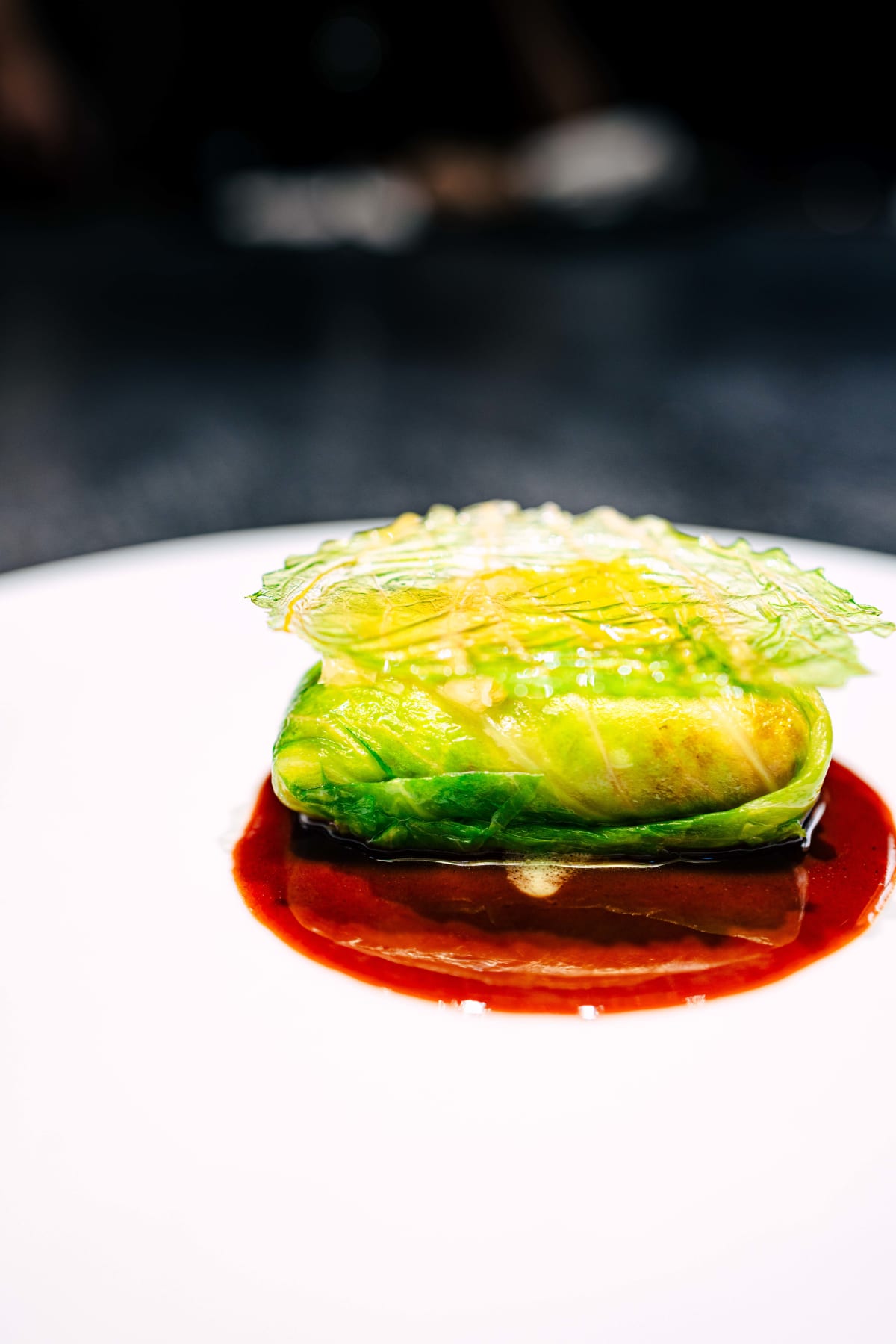
What was unusual was that the sauce underneath was not the light-coloured kind usually served with fish but the deep, dark kind served with meat, and it tasted closer to that too. The same review says it was a red wine sauce, which explains it.
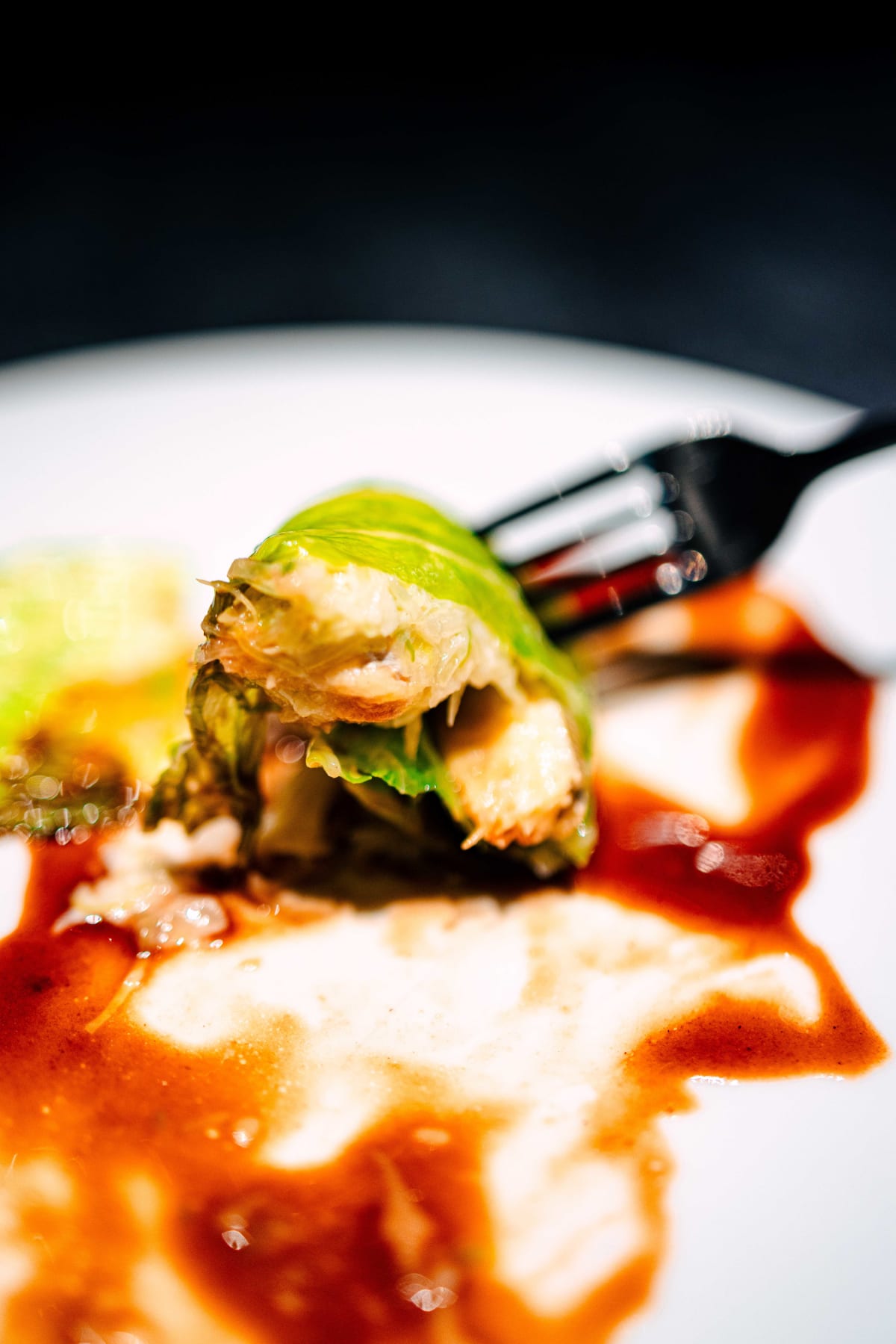
Cutting into it, I found fish and several other ingredients: moroko, together with a scallop mousse. Sadly, this dish was not to my taste.

And not only the dish: the pairing wine that came with it was a real letdown, a rosé from the Rhône. I poured a glass and smelled it, and the musty, repellent smell of cheap natural wine stabbed hard at my nose. It tasted better than it smelled, but I had no wish at all to drink it a second time.
Whether the wine is meant to be like that or this particular bottle had gone wrong, I do not know, but I did not think a restaurant of this reputation should be pouring it. I have done pairings at a great many places, and while the style has sometimes not suited me, I think this was the first time a wine smelled bad enough to make me grimace. The bottle read "Le Rosé des Acolytes."
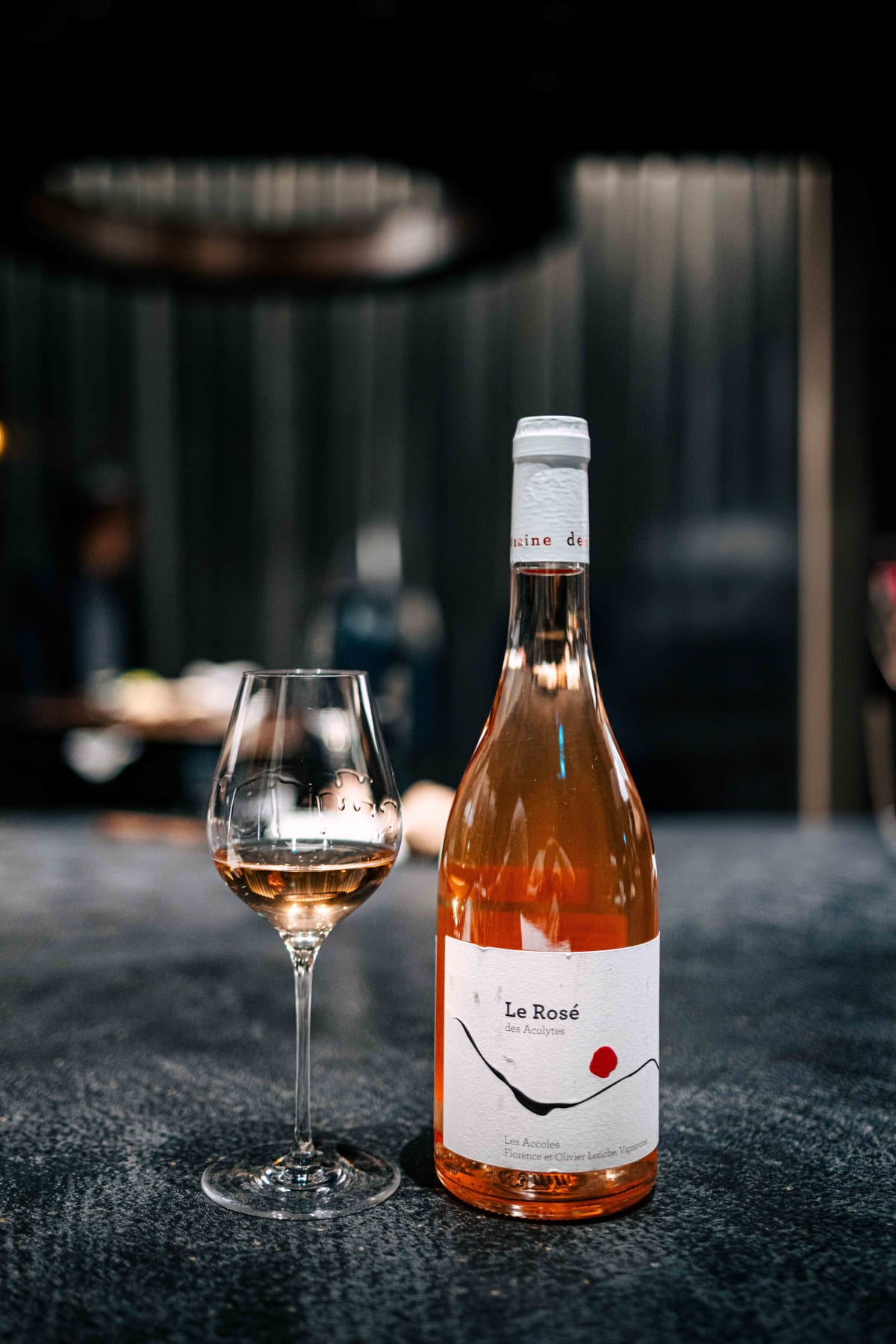
Les Accoles is an estate in Saint-Marcel-d'Ardèche, a few kilometres from the Rhône and the Ardèche gorges. Florence and Olivier Leriche ran the vineyard and winemaking at the biodynamic Domaine de l'Arlot in Nuits-Saint-Georges in Burgundy from 1998 before settling here in 2011. Its twenty-one-odd hectares sit on clay-limestone terraces, just as the name, Occitan for "terraces," suggests, and around half the vines are over fifty years old. It received Demeter certification in 2015.
Section 9·To Balance
The chef brought over the meat to be cooked that night, still in its pot, to show us, and it was chicken. Not a Japanese bird but a large chicken raised in Spain, which he said would be cooked the French way. For the sauce, he said, he uses pumpkin.
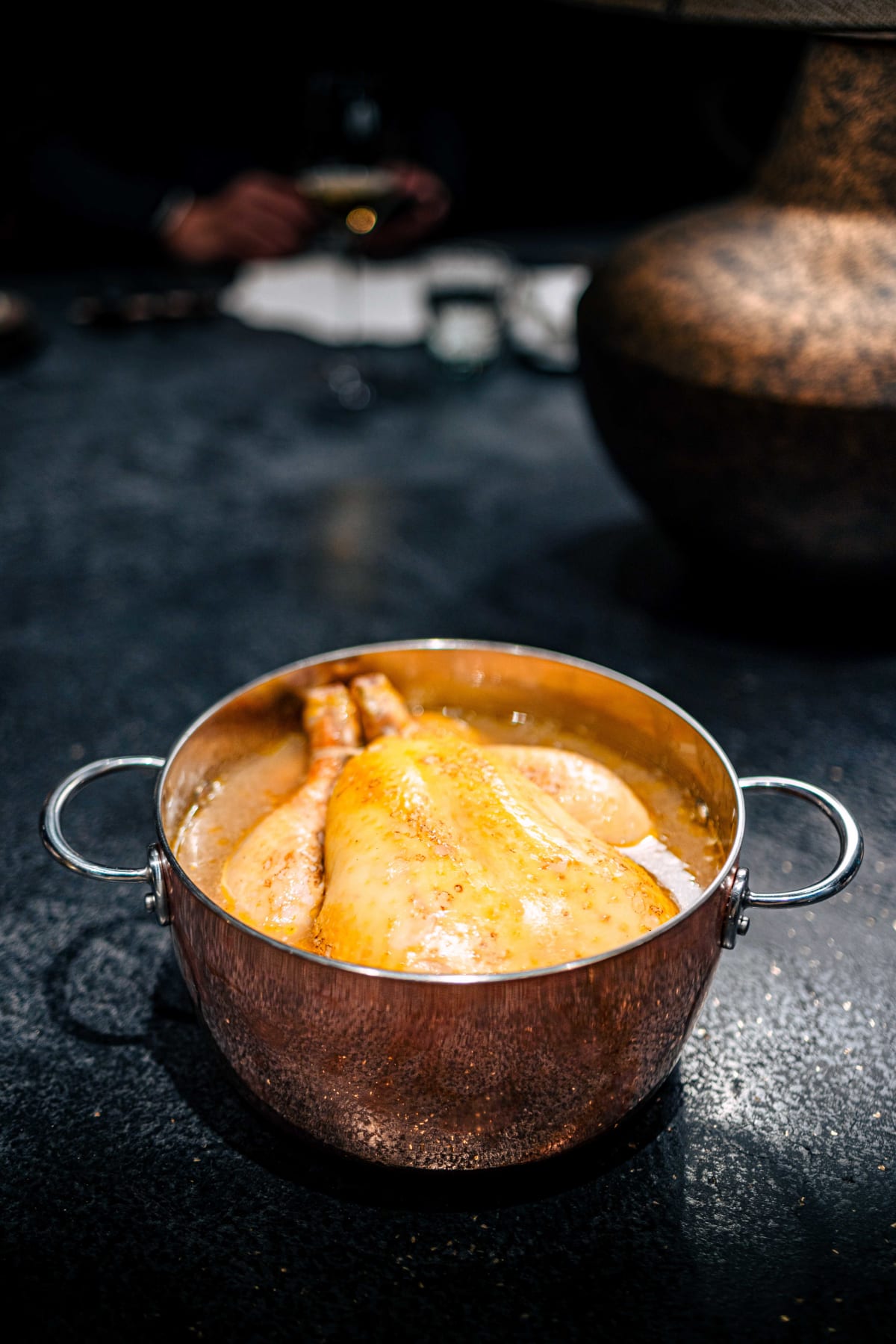
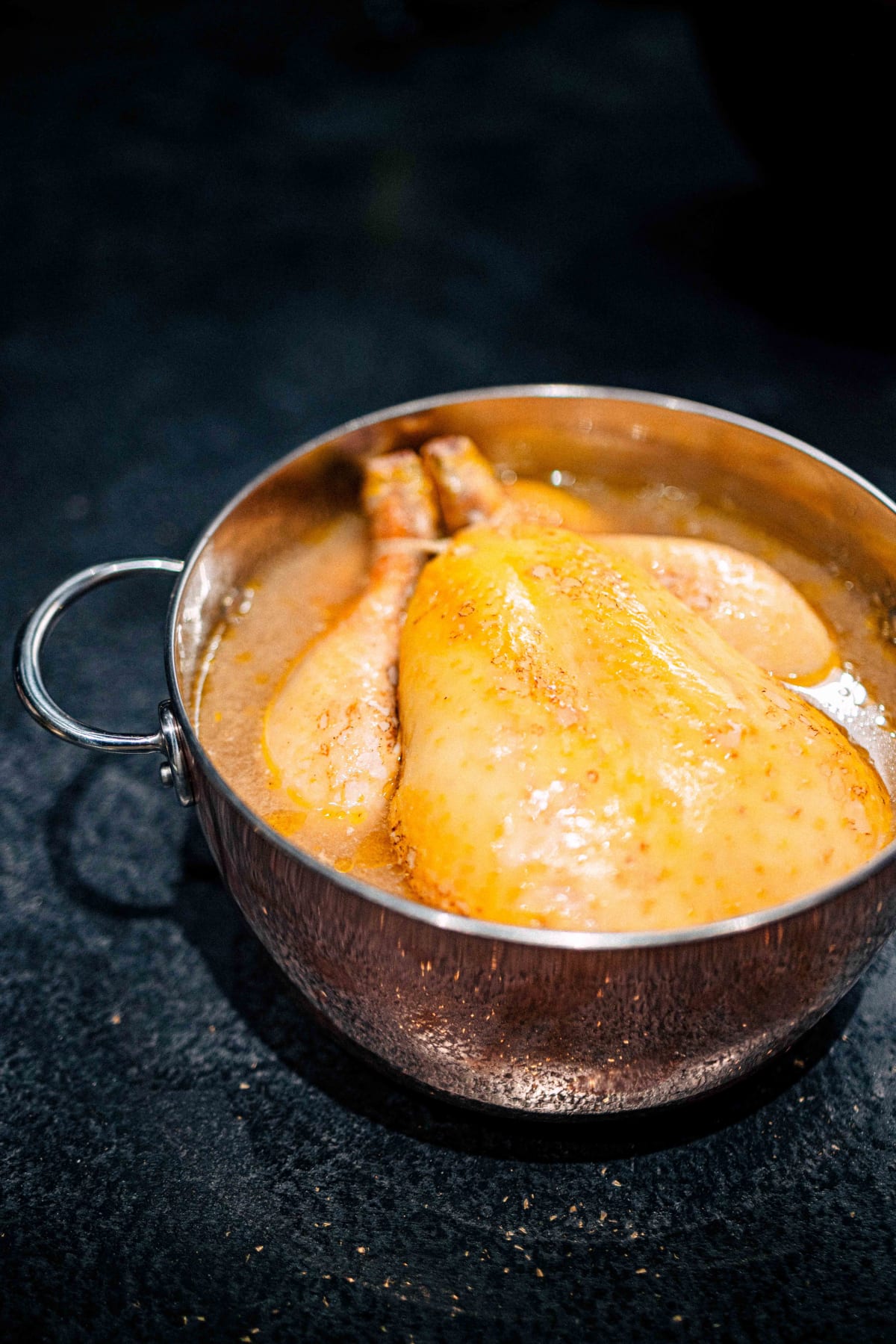

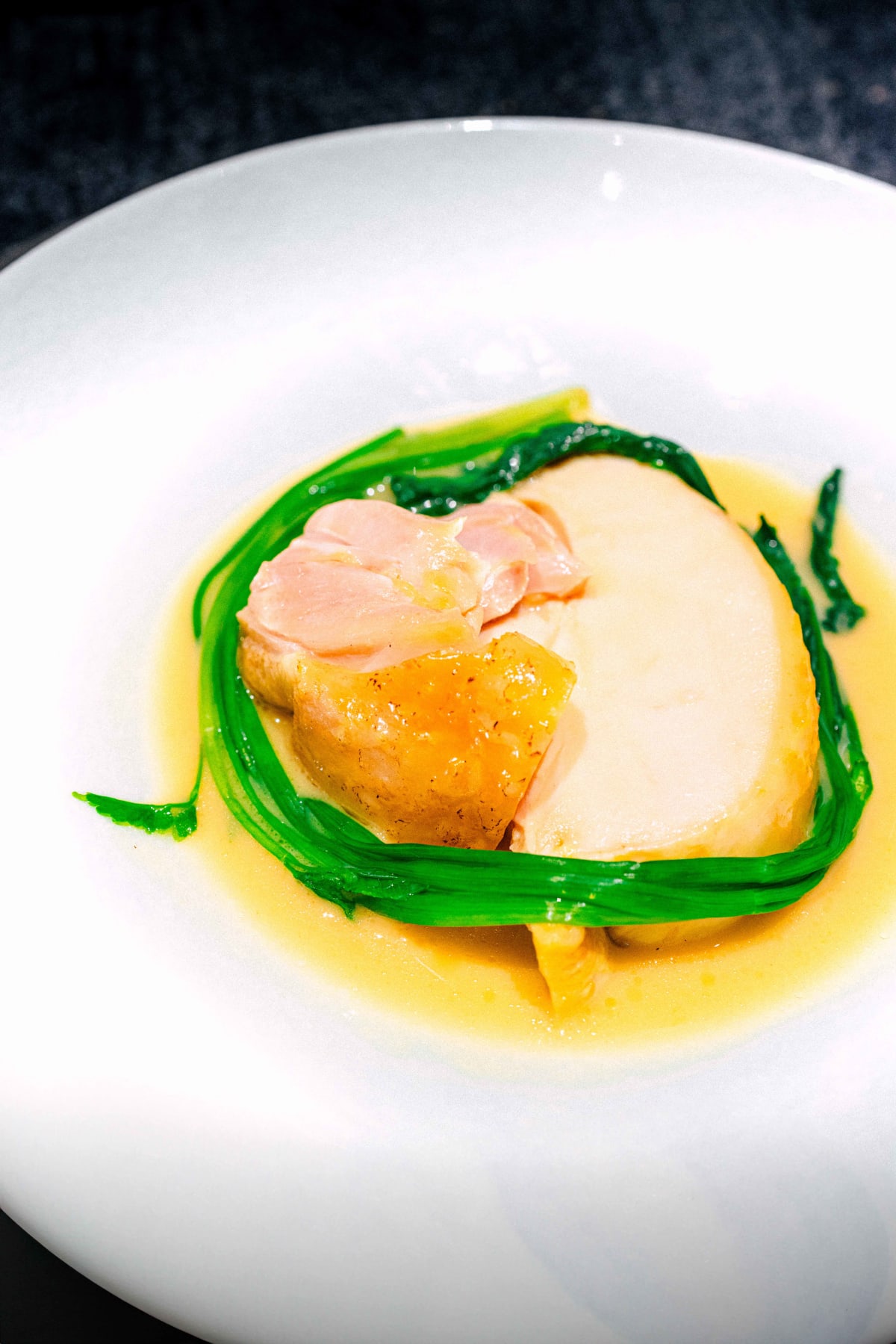
Soon the chicken from the pot, carved by Chef Kawate, came out on the plate with a pumpkin sauce and a line of something like spinach.
On the card, this main was called "兼ね合い (To Balance)." According to the same review, it was poulet jaune, a corn-fed chicken with yellow flesh, cooked sous vide at low temperature with pumpkin juice and served with a pumpkin-juice sauce and seri. The green stalks I took for spinach were seri, a Japanese wild parsley.

The other acquaintances who had been here all said "the main was not as good as expected," but fortunately I enjoyed this main. I liked the buttery, creamy richness the sauce brought to the ingredients, and the texture of the chicken was good too. Even the breast, the dry part, as people call it, was tender and delicious.

Beside the main came a small side plate: a crisp fried square under a layer of sliced white truffle.


The main came with a Pinot Noir from Rheinhessen in Germany, Battenfeld-Spanier 2020 Hohen-Sülzen Spätburgunder Alte Reben.
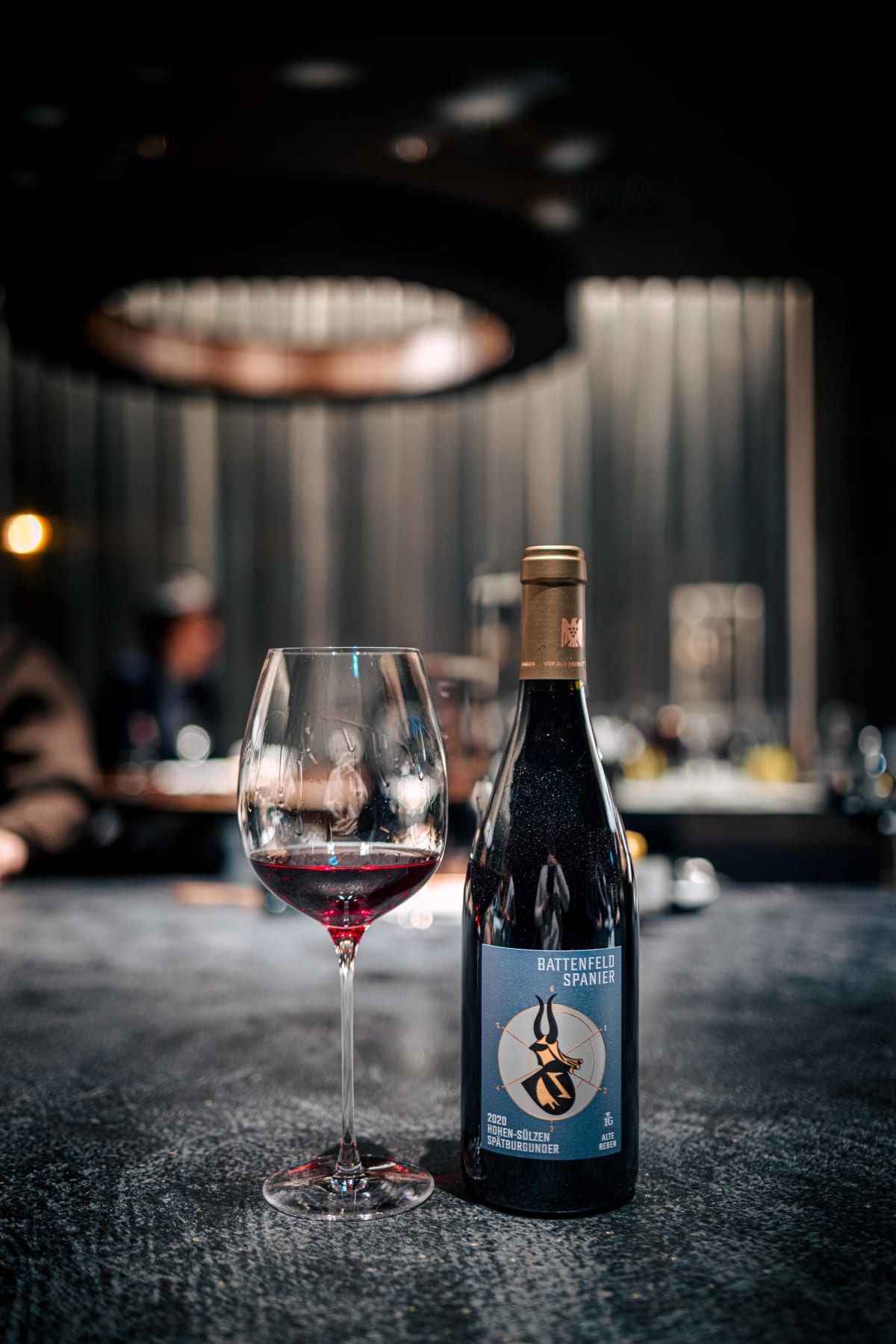
Battenfeld-Spanier is the winery H.O. Spanier built in Hohen-Sülzen in southern Rheinhessen, with all its vineyards on limestone and farmed biodynamically. According to the British merchant Justerini & Brooks in its notes on the 2020 vintage, this Pinot Noir comes from vines averaging thirty-five years old that Spanier planted when he was seventeen, and is aged in one-year-old barrels that came from Domaine Leroy and Méo-Camuzet.
Overall, many dishes carried creative, adventurous experiments, but on this day the main alone seemed to use somewhat classic ingredients. It is not always so: an acquaintance who visited at a different time said the main was venison.
Courses and ingredients seem to change quickly and widely, so you should not judge the food by any one review. Today you choose between a meat main and a vegetable main when you book, but according to the official guidance, choosing vegetables does not turn it into a vegetarian or vegan course.
So I recommend going in the spirit of seeing a film whose plot you do not know, having read reviews that say it divides opinion.
So I recommend going in the spirit of seeing a film whose plot you do not know, having read reviews that say it divides opinion.
Section 10·Mozzarella And Peanut
Once the savoury courses were over, dessert began. As is customary, there were two, and the first left a real impression.
At first I thought it was ice cream and that they were sprinkling a powder on top, but it turned out to be mozzarella, served chilled. Nor was it frozen and crunchy; it was delicious mozzarella of the kind you get at an Italian restaurant.

I was amazed at the creativity of shaping mozzarella like ice cream and serving it as dessert. The dessert was mozzarella and yoghurt topped with micro herbs, with a yuzu soup.


The second was a pastry filled with ordinary choux cream. They first showed us the whole ring-shaped pastry, like a Paris-Brest, but, as expected, brought over just one piece cut from it.
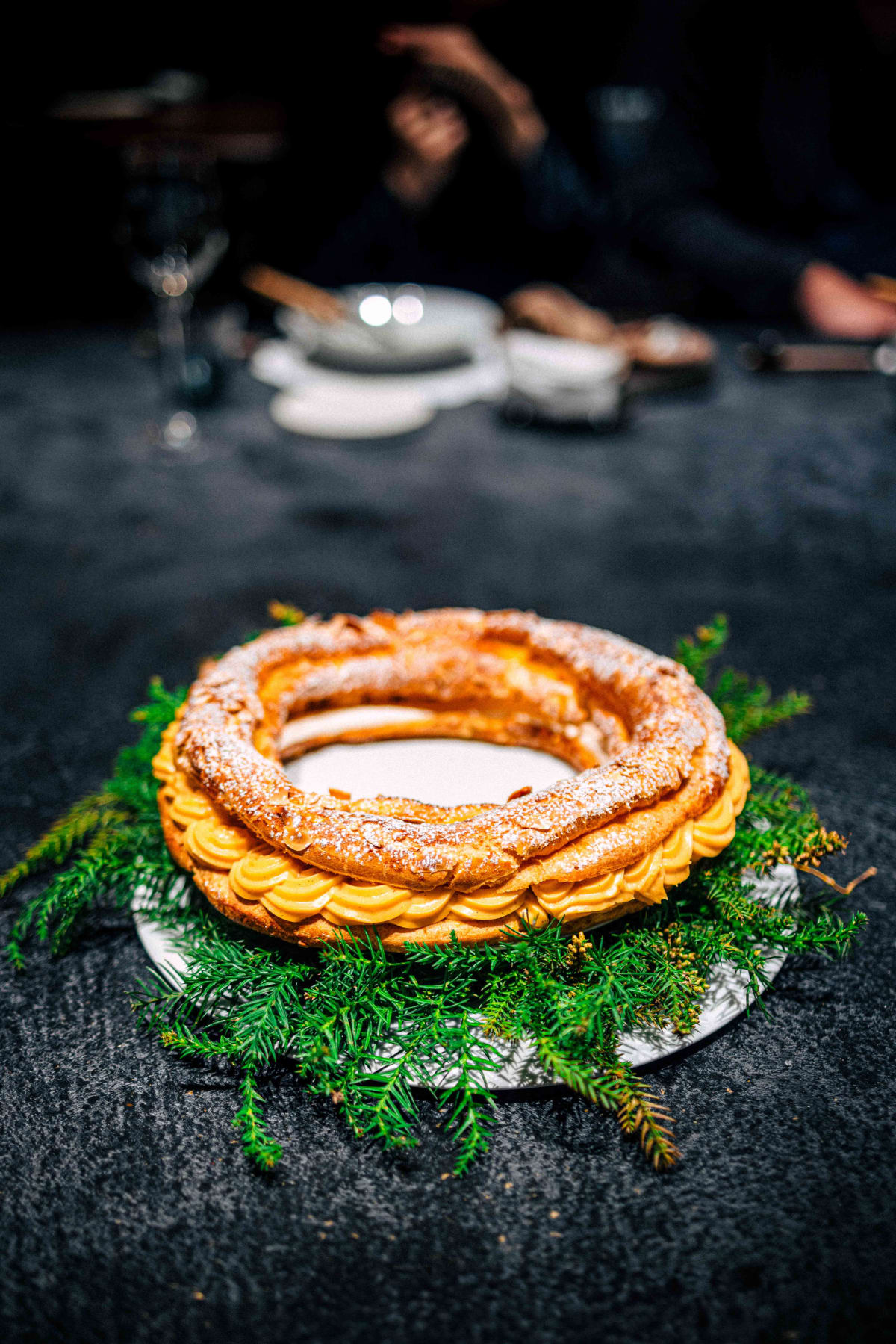
The name on the menu card was "落花生 (peanut)," so the cream seems to have been peanut cream. What made it special was that, it being Christmas Eve, "Merry Christmas" was beautifully written on the plate.

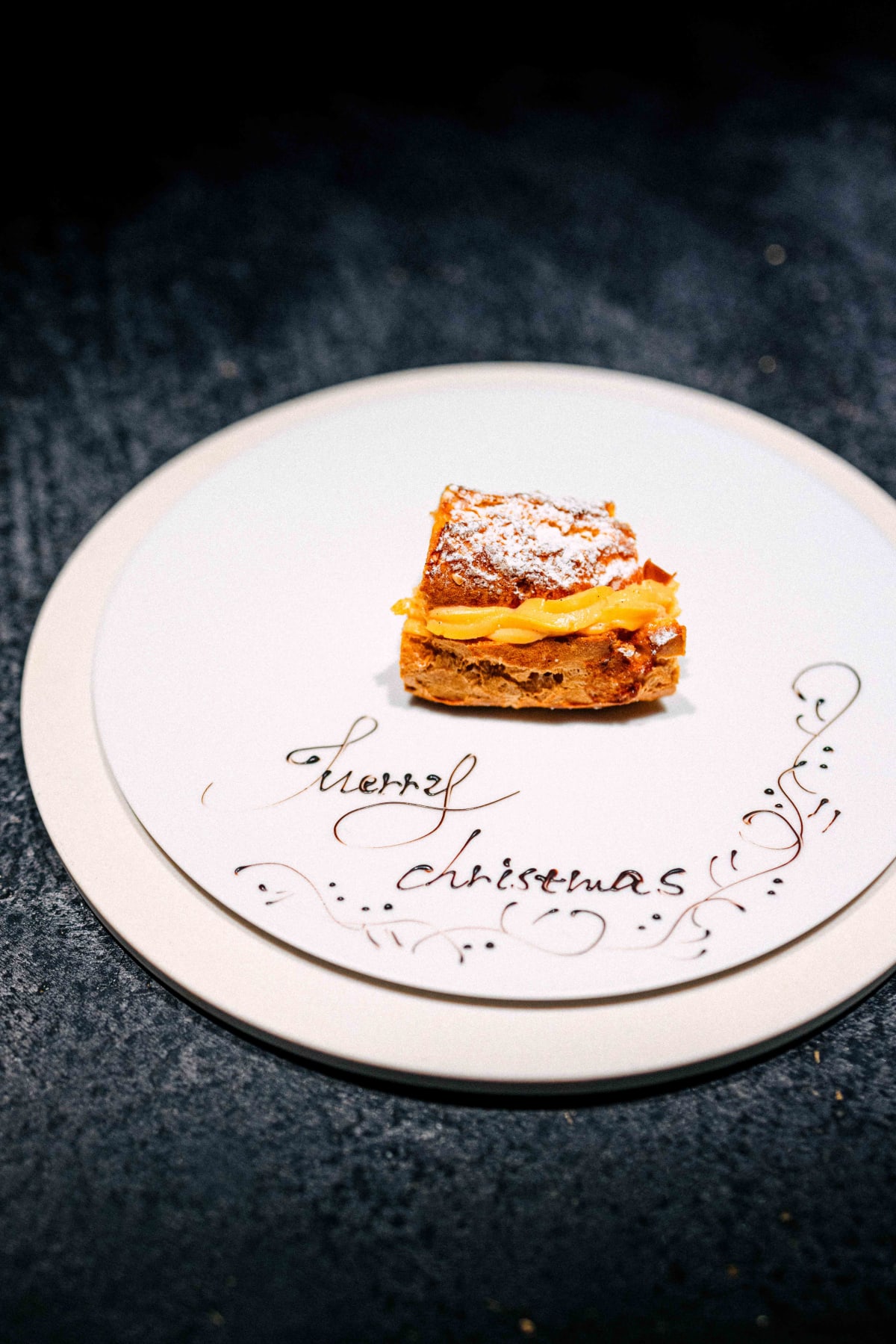
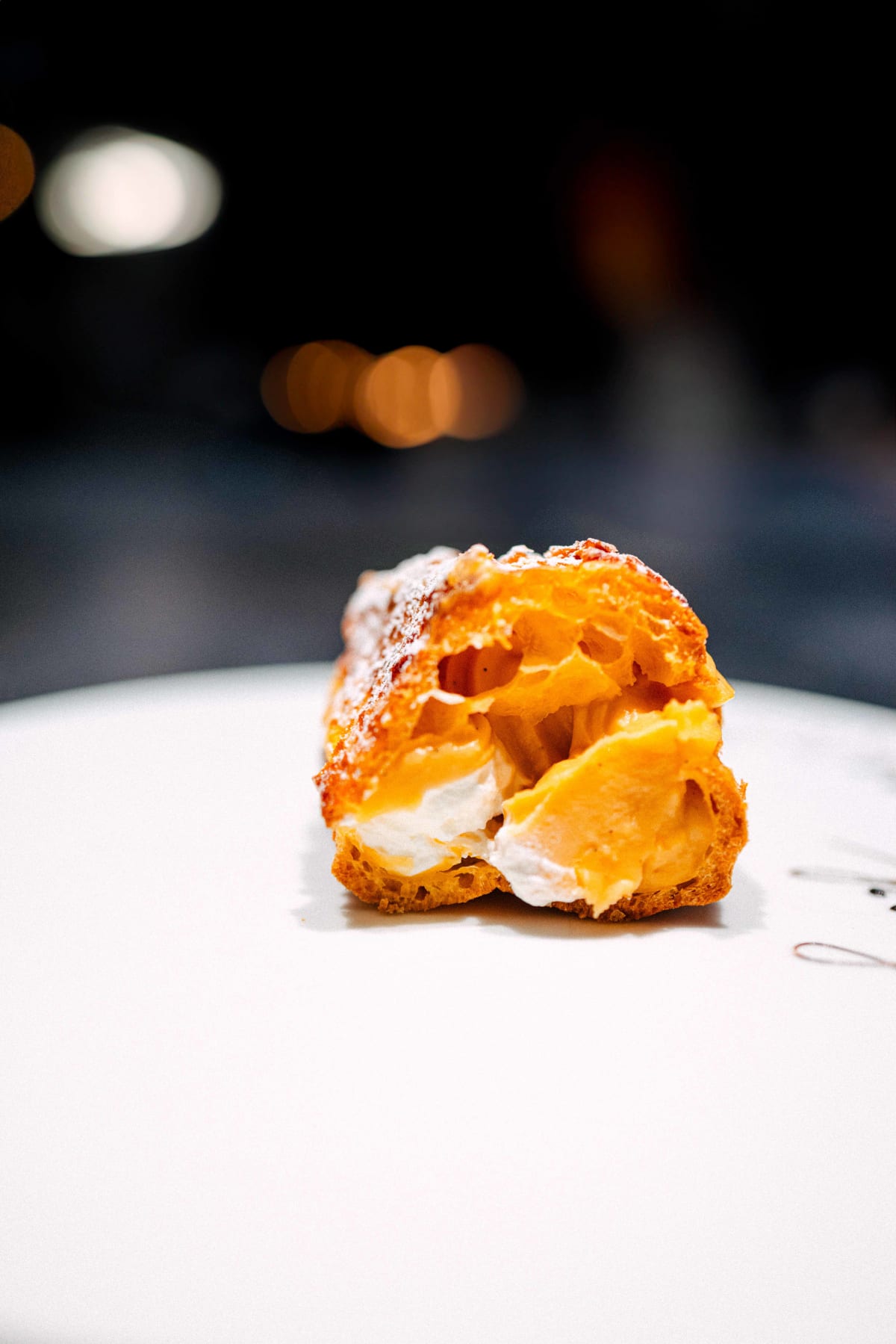
Eating dessert alone at a Michelin restaurant on Christmas Eve, I somehow felt close to tears, but it was so good that the tears went straight back in.
Eating dessert alone at a Michelin restaurant on Christmas Eve, I somehow felt close to tears, but it was so good that the tears went straight back in.
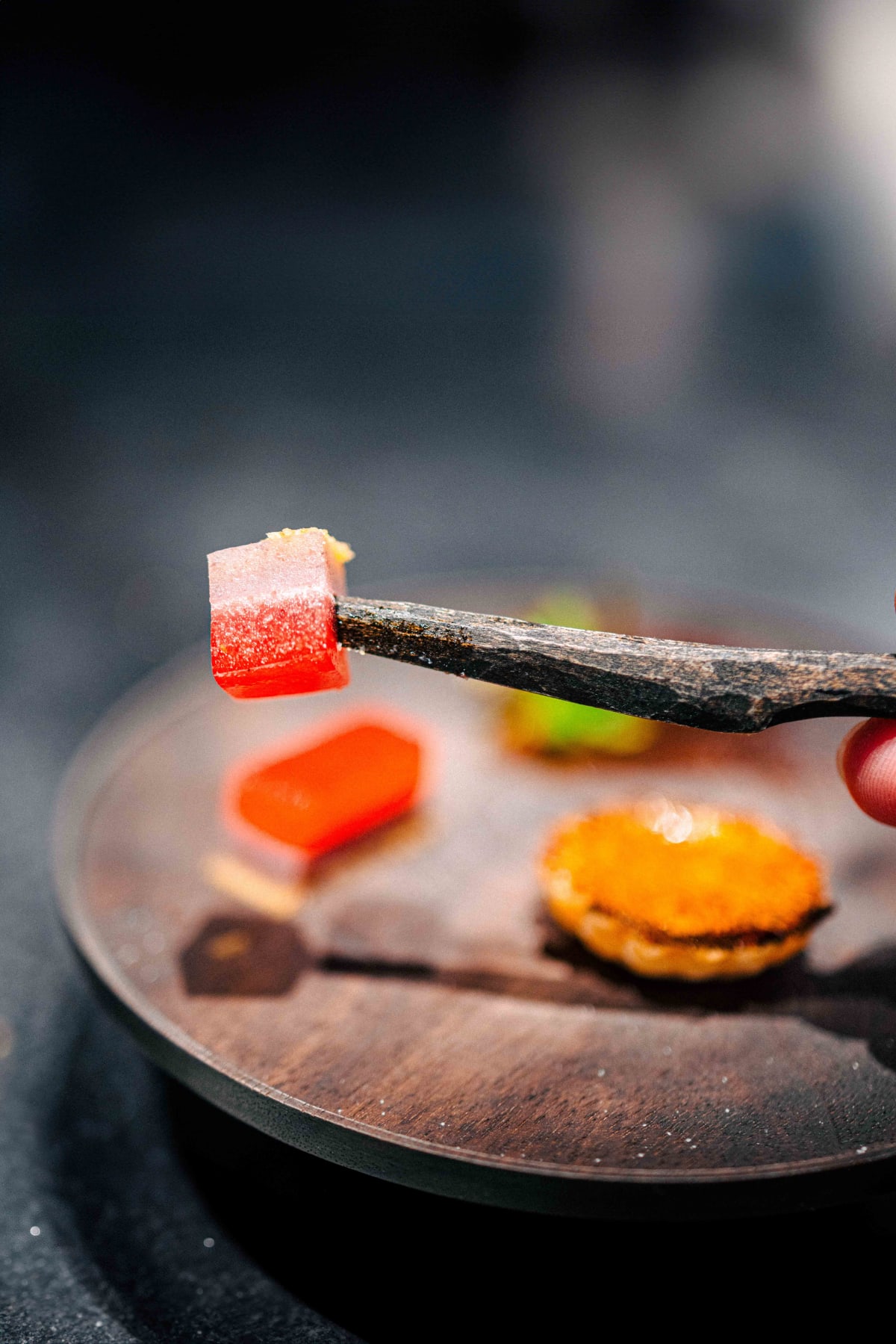
Finally came three petits fours, one stick of jelly and coffee, and the petits fours were simply ordinary, as at any restaurant.
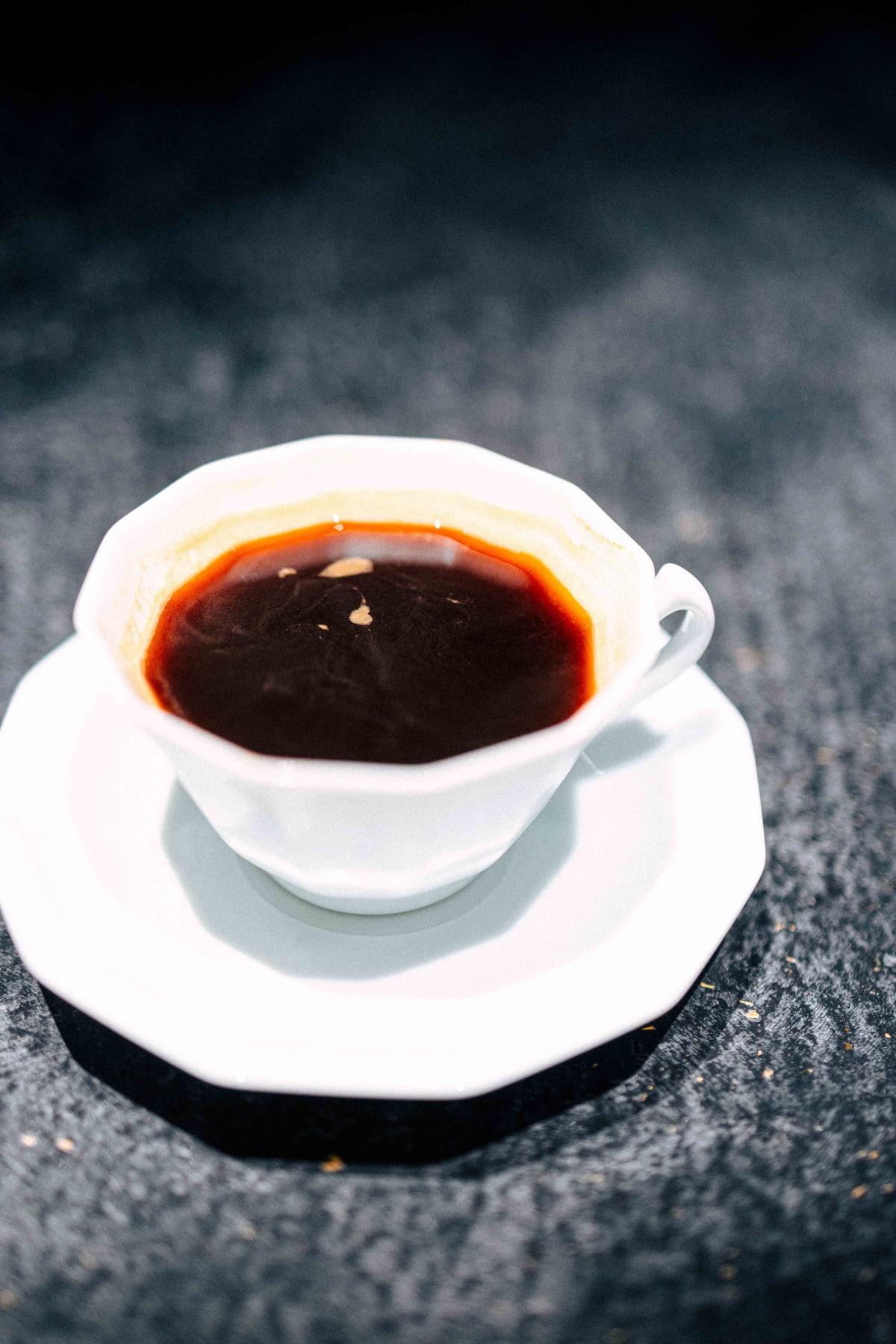


But the semi-translucent white stick of jelly that came with them was fun, like the jelly you could find long ago at country markets in Korea during the holidays.


The knife that came with it was made of wood, which also caught my eye, and cutting the jelly bit by bit with it was fun.


Section 11·After The Last Guest
Even after finishing all the desserts, I sat quietly in the restaurant for a long while, because once most of the guests had left, I felt at ease, as if the whole wide table had become mine.

As I said earlier, here every guest sits at one wide, long table. Two people visiting together sit side by side rather than across the table from each other, so a stranger sits opposite you.
So whenever I looked up from the food or wine, I kept meeting the eyes of the guest across from me, and after hours of this it became a little uncomfortable, so later I deliberately avoided looking straight ahead.
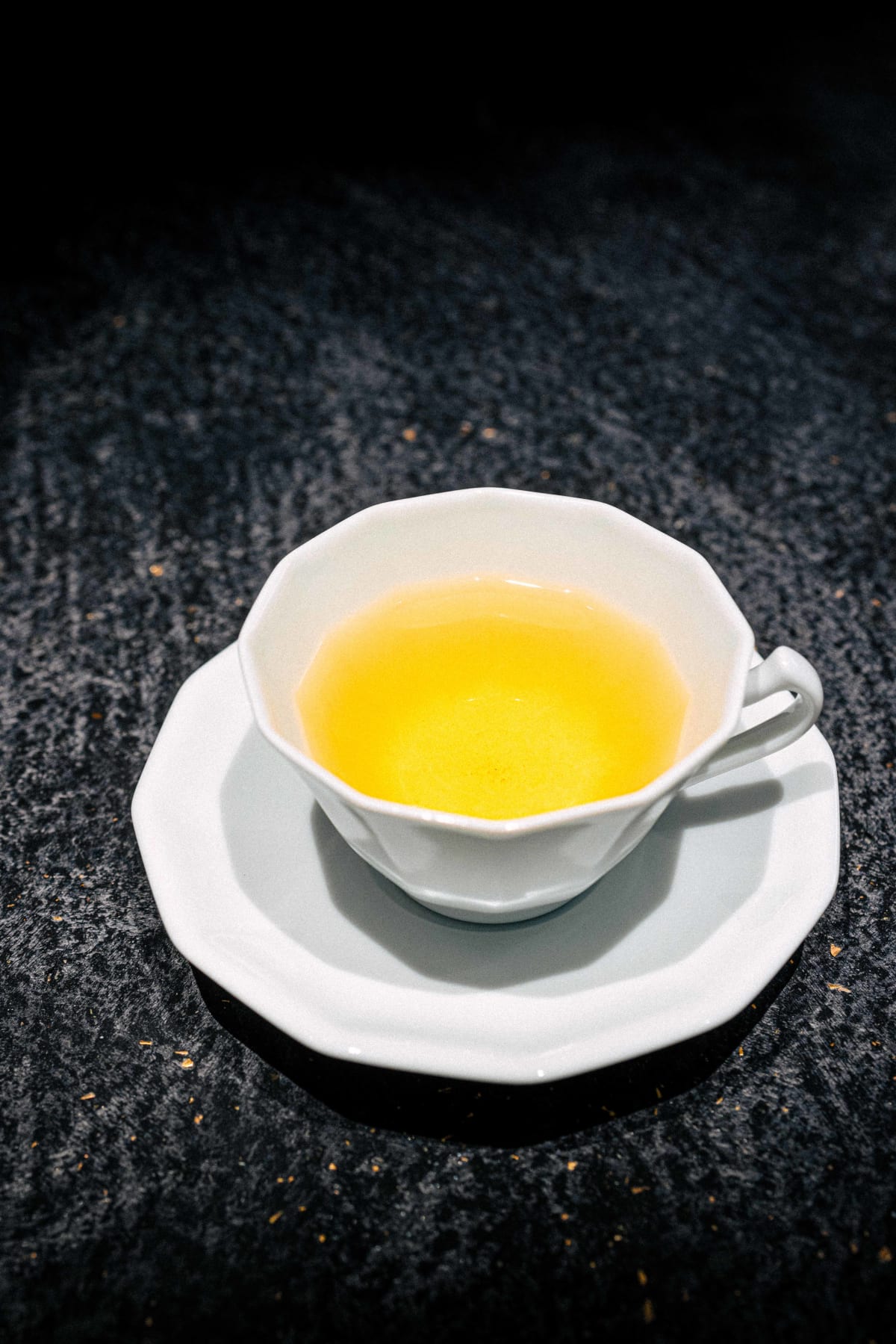
Once the guest opposite had left, the discomfort went too and my gaze was free. Looking around the restaurant after the dining was over, I liked the slow, relaxed mood of the modern interior late at night. So later, when a waiter came and asked whether I would like another cup of tea, I had one more and stayed a while longer.
Leaving the dining hall, you come out into the lobby, where you can see Florilège's many awards and plaques. The two-star Michelin 2024 plaque and the Green Star clover, the World's and Asia's 50 Best 2023 plaques and trophies, and the Chefs' Choice Award trophy Chef Kawate received that year stood side by side.

Not everything satisfied me, but because this is a place that refuses to rest on its success and keeps challenging itself and changing, I came away at once disappointed where it fell short of my expectations and satisfied in ways I had not seen coming.
When I first wrote up that night, I noted that this was a place I hoped would leap a level higher through bigger changes in its new home. And in 2024, its first year after the move, Florilège did reach its highest positions on both lists: 2nd on Asia's 50 Best Restaurants and 21st on The World's 50 Best Restaurants. It has since slipped to 36th in the world in 2025 and 31st in Asia in 2026, but its two Michelin stars remain in place as I write.
Florilège and L'Effervescence both won Green Stars in the first Tokyo edition to award them, and both put vegetables at the centre, yet the two lists have split them: Michelin gave L'Effervescence a third star in that same edition, while the 50 Best voters have ranked Florilège far above L'Effervescence's best. If natural wine is not to your taste, the ¥10,000 non-alcoholic pairing, well regarded in Japan, or the selected pairing from ¥20,000 is the safer bet. Lunch, at ¥12,000, costs exactly half of dinner. Seat requests are not accepted, so who sits opposite is left to chance.
Have a question about this restaurant, or want to share your own experience?
Send a message