Fine Dining · Tokyo · Japan / April 2024 / Michelin ★ · Tabelog Chinese Hyakumeiten (2024)
Ippei Hanten
"The Cantonese counter where technique outranks the shopping list"
Section 1·Chinese, Not Japanese
The genre leading the most sensational trend in Asia right now, and the most popular worldwide, is Japanese. But the centre that runs through hundreds and thousands of years of Asian food culture, traditionally, is Chinese.
Chinese cooking has had a large influence on the food cultures of Japan and Korea, so in both countries it is a genre that has soaked into everyday life. There are a few differences between Korea and Japan, and one of them is that in Korea the influence and the popularity of Chinese food stay within popular eating, while in Japan Chinese food carries considerable weight and popularity in the high end of fine dining at Michelin star level too.
There are a few differences between Korea and Japan, and one of them is that in Korea the influence and the popularity of Chinese food stay within popular eating, while in Japan Chinese food carries considerable weight and popularity in the high end of fine dining at Michelin star level too.
I became very interested in Chinese dining in Japan and went to a number of places, and since the Michelin guide is the most universal reference in fine dining I went looking for the Chinese restaurants among its one stars.
Among them, on a Tokyo trip at the end of 2023, I went to ShinoiS, a one star Chinese dining room I had high hopes for, and came away disappointed. Whether Chinese dining as a genre does not suit me, or whether that particular place fell short that day, I could not tell, and while I was weighing up whether to try one more, a friend recommended this place, Ippei Hanten.
Section 2·One Producer, Three Rooms
This is also a one star, a high end Chinese restaurant in the Japanese counter format. Anyone interested in food will have heard of Sazenka, the three star Chinese restaurant in Tokyo. The person who produced Sazenka also produced Myoujyaku, which held two stars at the time and now holds three and has appeared on the Asia's Best extended list, and this place is another Chinese restaurant produced in the same way.
To put the lineage down more precisely, the person who links these houses is not a chef but the owner and restaurant producer Hayashi Ryoji (林亮治). Born in Shimane in 1977, he came up as a cook himself, spending three years at Chikushiro in Ebisu and three years across Azabu Chokou in Nishiazabu and Takamatsu before taking over Tousenkaku, the Chinese restaurant his family ran in Shimane. In 2017 he opened Sazenka in Minami-Azabu together with chef Kawada Tomoya, and after it took three stars in 2021 he transferred the restaurant to Kawada.
Ippei Hanten and Myoujyaku were both created by Hayashi in 2022. Myoujyaku is not Chinese but the Japanese restaurant of chef Nakamura Hidetoshi, opened that April in Nishiazabu. Hayashi is not a chain owner replicating his own cooking. He is closer to someone who finds a good cook and builds an environment where that person can make the food they want to make, which is why the results are completely different even though they came through the same hands.
Sazenka has already been transferred and is separate in management, and Ippei Hanten sits under a separate company Hayashi set up, so rather than bundling them as one group it is more accurate to see them as the restaurants of different chefs, each born through the hands of one producer.
Section 3·Twenty Five Years
Chef Adachi Ippei (安達一平) was born in 1979, and when he opened this place in 2022 he was already a veteran of twenty five years. Out of culinary school he spent five and a half years at the Chinese restaurant of the ANA hotel that had just opened in Toyama. At the time the centre of high end hotel Chinese cooking in Japan was Cantonese. He moved up to Tokyo and joined the opening team of the Shin-Yurigaoka branch of Akasaka Rikyu, a noted Cantonese house, and in this period he travelled often to Hong Kong and Guangzhou and fell for Hong Kong food.
At thirty, in 2009, he went into a Hong Kong kitchen outright. His first posting was at a four hundred seat house, Feicui Jinge Haixian Jiujia, and the section he asked for there was siu mei (燒味), Cantonese roasting. Cantonese roast duck and roast chicken, crispy pork, char siu, whole roast suckling pig, and lou mei, meats and offal simmered in spiced soy, were all learned in that section.
At Kirinken that followed he handled Shunde cooking along with knife work and prep, and it was here that he learned demanding Cantonese dim sum, including translucent starch wrappers like the shrimp dumpling. His stay in Hong Kong came to two and a half years in total. Back in Japan he learned Sichuan spices and the use of oil in the kitchen at Piaoxiang, and at the opening of Ore no Chuka in Ginza he ran the roasting section for a year and a half.
Section 4·A Hidden Street
Bookings here are not hard and the Tabelog score is not top tier, so as a tourist who gets to Tokyo a few times a year it was not a place I had on my wish list. But the recommendation came from someone I trust and the person who opened Sazenka and Myoujyaku opened this too, so I booked and went, and in the end I was very satisfied.
The price is not low but it is reasonable for a Michelin counter restaurant, and there were points in the food and a lot that came through directly.
This meal was in April 2024. Ippei Hanten took a star straight away in the Michelin Guide Tokyo 2023 edition, immediately after opening in March 2022, and has held it since. On the Tabelog side there is no award, but it was selected for the Chinese Cuisine Tokyo Hyakumeiten in 2023 and again in 2024. The impression that the score is not top tier is correct, but within the genre it is already inside the top hundred.
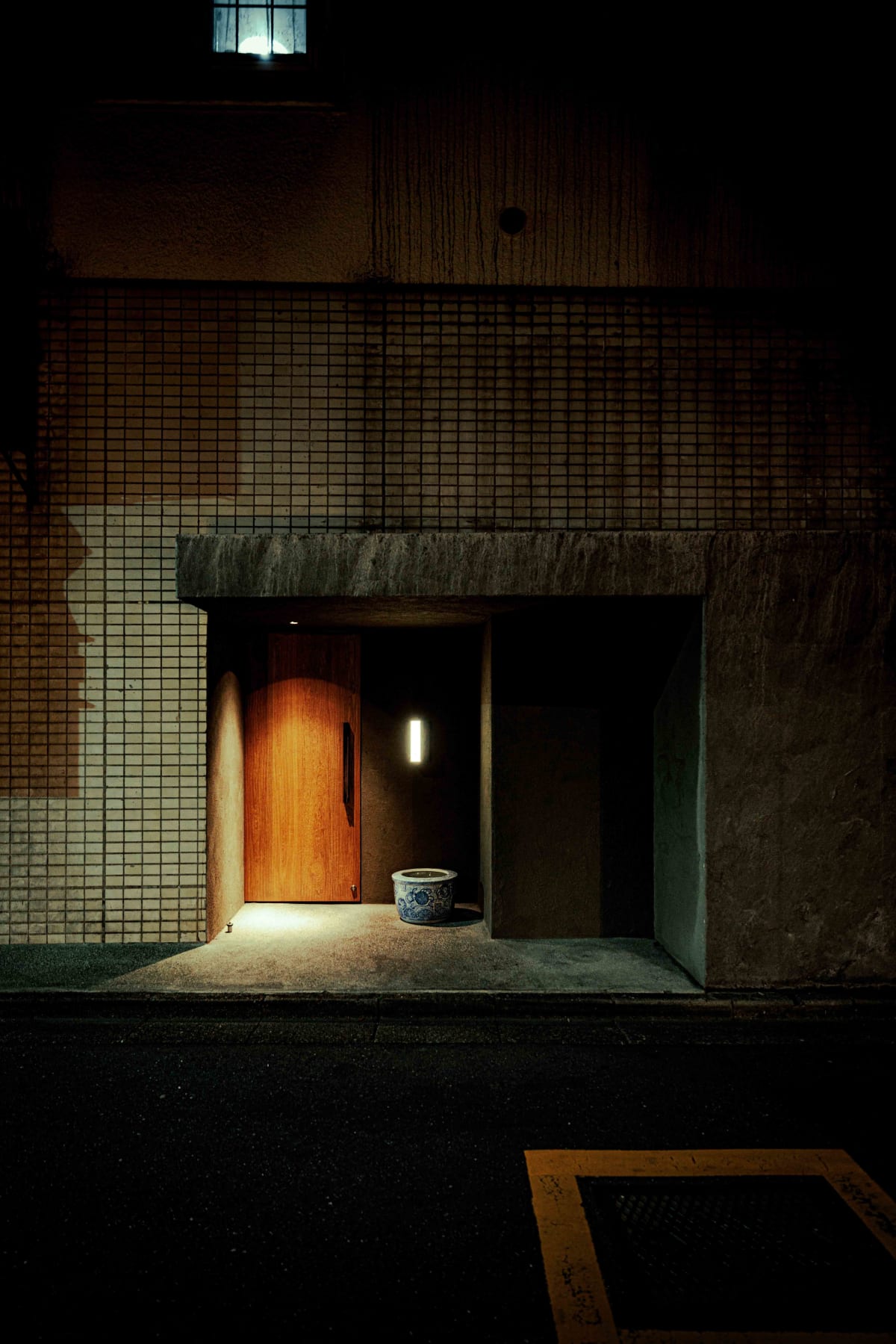
It is in Motoazabu, hidden in a residential area a little away from the centre. Without Google Maps I think it would have been hard to find. The interior does not read as Chinese in style but modern, and it seats about eight.
Inside, instead of ornate Chinese decoration, it is a restrained space built on earthen walls and timber with the back streets of Hong Kong as the motif, and the chef and the owner worked out the concept and the layout together. There are eight seats at the counter plus separate private rooms, and opening two of them up takes eight people.
As I felt at ShinoiS, perhaps because the cooking process in Chinese food is dynamic, this is a counter restaurant but the kitchen is kept toward the back, so the advantages of a counter come through less than in other genres like Japanese or French.
Section 5·Heat And Aroma
What Adachi states most clearly in interviews is heat and aroma. He cites wok hei (鑊氣) directly as the concept Hong Kong treats as important. Not the smoky note that comes off high heat, but something closer to holding the heat, the aroma, the moisture and the state of the oil that rise off the pan the instant it is cooked, all the way until it reaches the guest.
The reason this house takes a shape of many small plates, shouryou tasara (少量多皿), is not only modern presentation. Cook a large amount at once and a difference in temperature opens up between the first plate and the last, so even at the cost of cooking in several rounds, hot things go out really hot and cold things cold.
Cook a large amount at once and a difference in temperature opens up between the first plate and the last, so even at the cost of cooking in several rounds, hot things go out really hot and cold things cold.
Section 6·Champagne First
There were plenty of excellent places to follow on this Tokyo trip, so I held off on a pairing and ordered a glass of champagne. The chilling was a little off and the taste was ordinary.
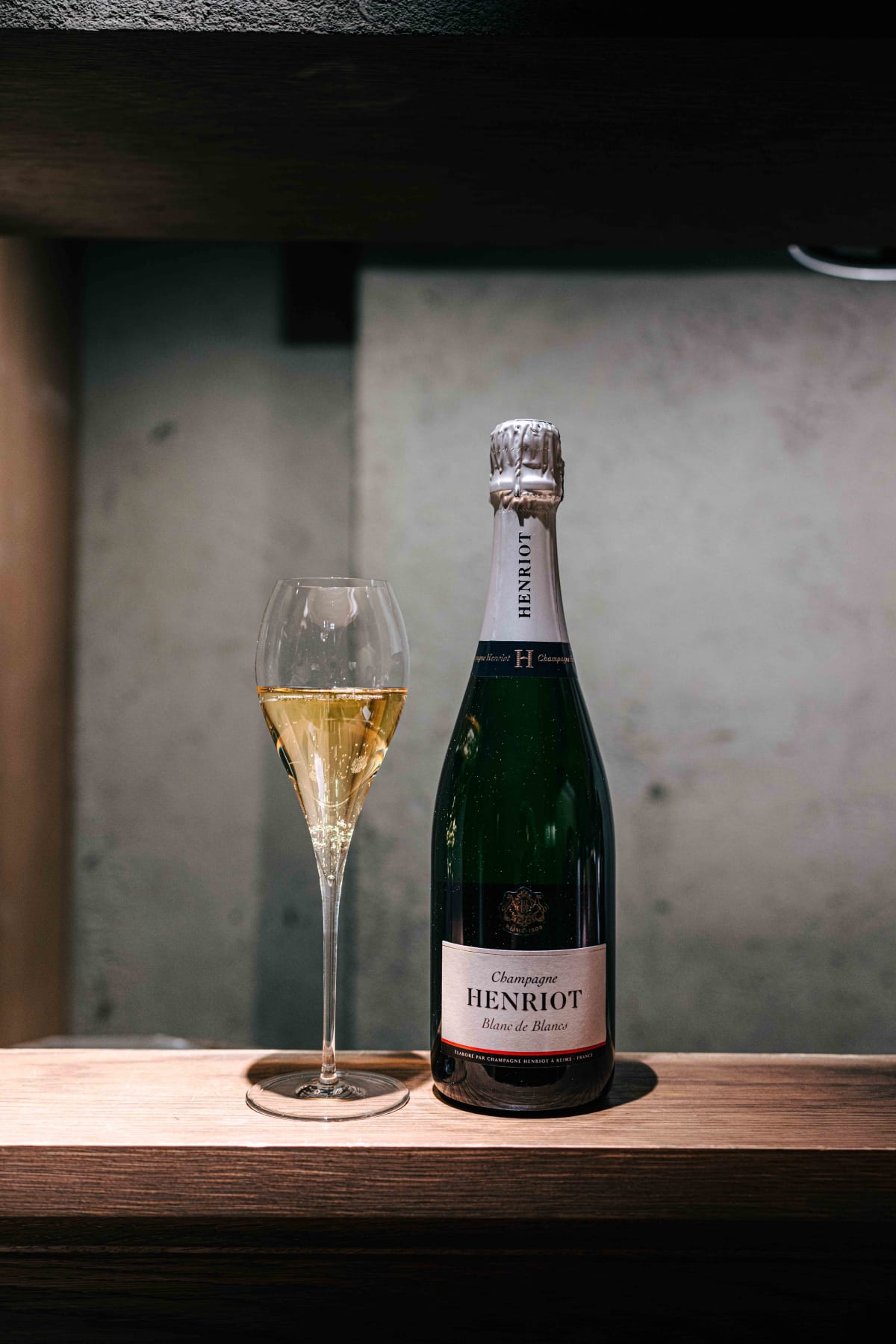
The champagne was Henriot's Blanc de Blancs. The house was founded in Reims in 1808 by Apolline Henriot, and in 1880 the fourth generation Paul Henriot married Marie Marguet, from a family holding grand cru in the Côte des Blancs, which brought Chardonnay into the domaine's vineyards.
Blanc de Blancs is the cuvée dedicated to that Chardonnay and stands as the face of the house, made only from premier and grand cru Chardonnay of the Côte des Blancs and the Montagne de Reims. It rests on the lees for a minimum of three years and carries a high proportion of reserve wine.
Before the meal chef Ippei Adachi comes out and greets each guest before going back to the kitchen, and the first dish follows almost immediately.
Section 7·Porridge And Jellyfish
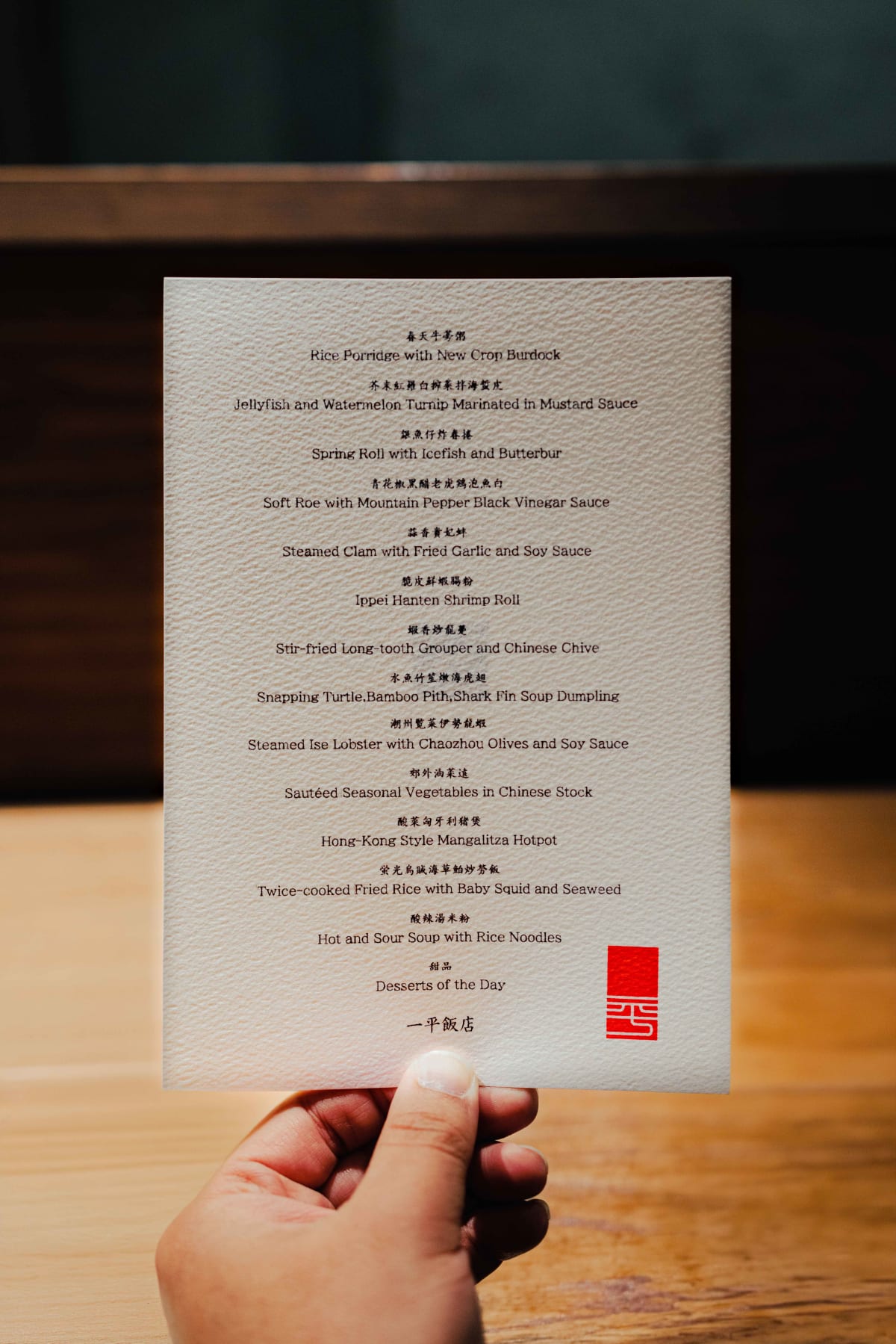
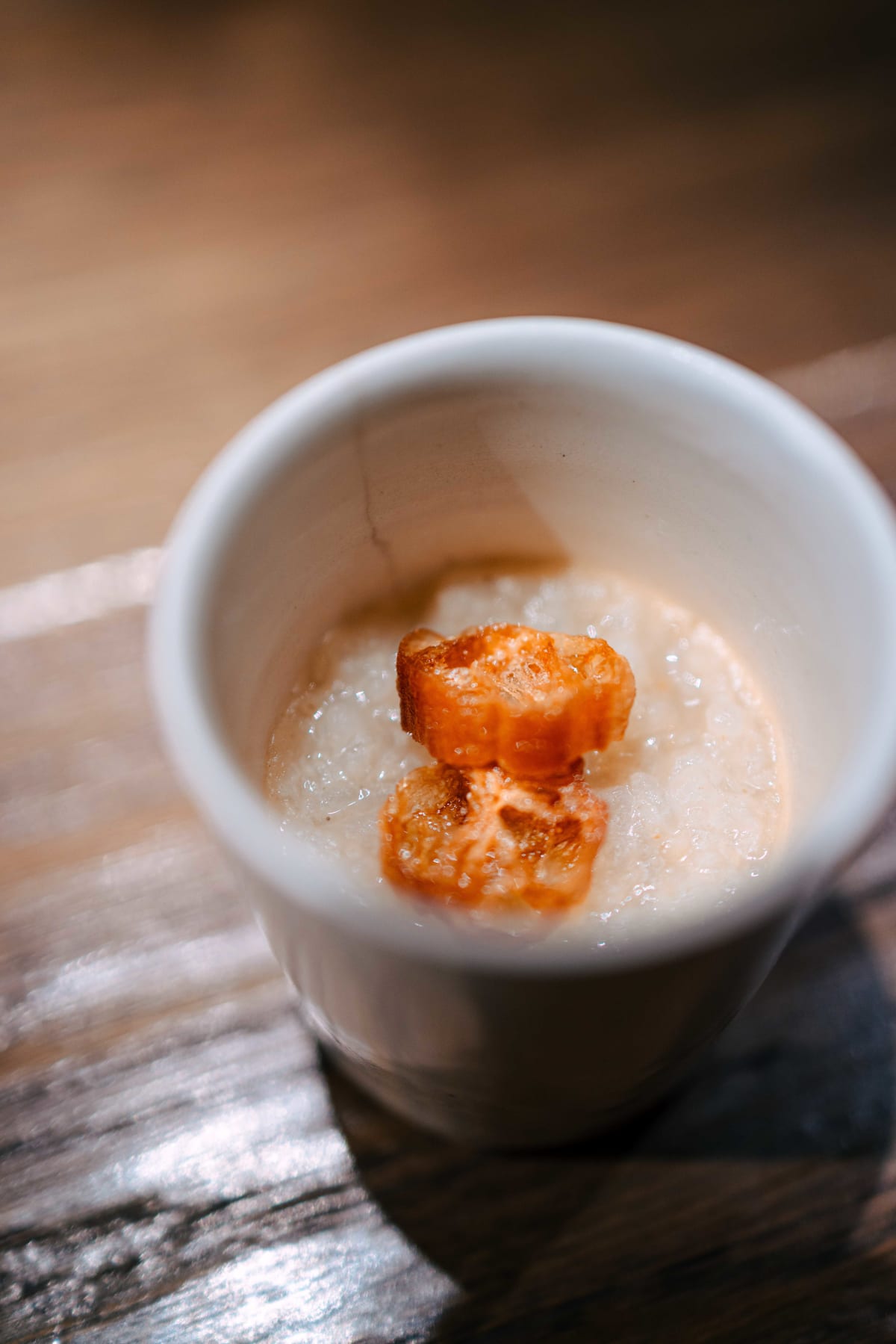
Rice Porridge with New Crop Burdock (春天牛蒡粥)
The first dish was a congee made with duck, and it tasted like the duck congee we make in Korea. Warm, with the aroma of duck coming up quietly, a good dish for a start.
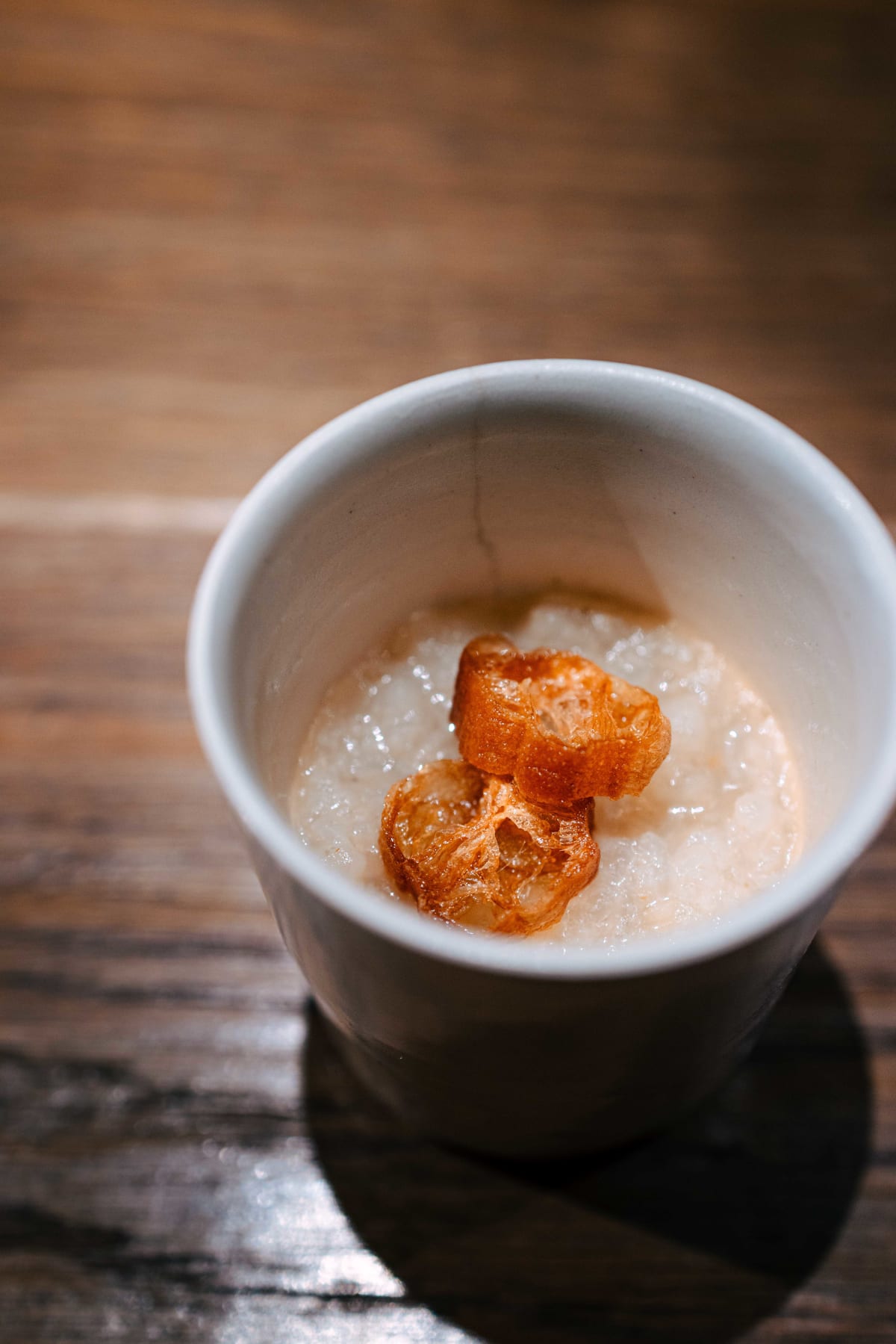
The name of this plate is 春天牛蒡粥, spring burdock congee. In Hong Kong congee is an everyday food rather than a fine dining dish, and opening the course with it is a decision to put that everyday food on the first plate. Michelin also picks this out in the context of food that expresses daily life in Hong Kong.
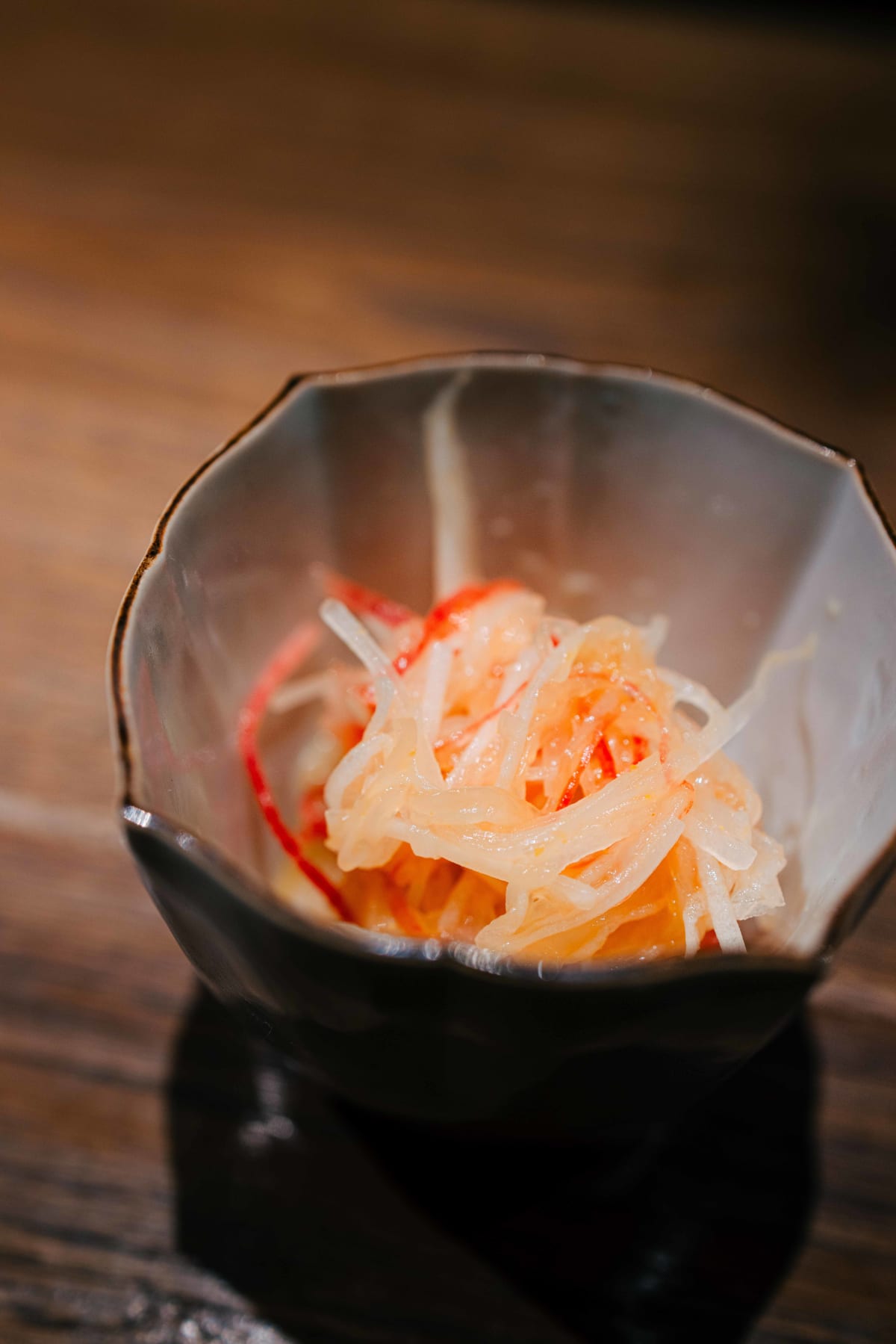
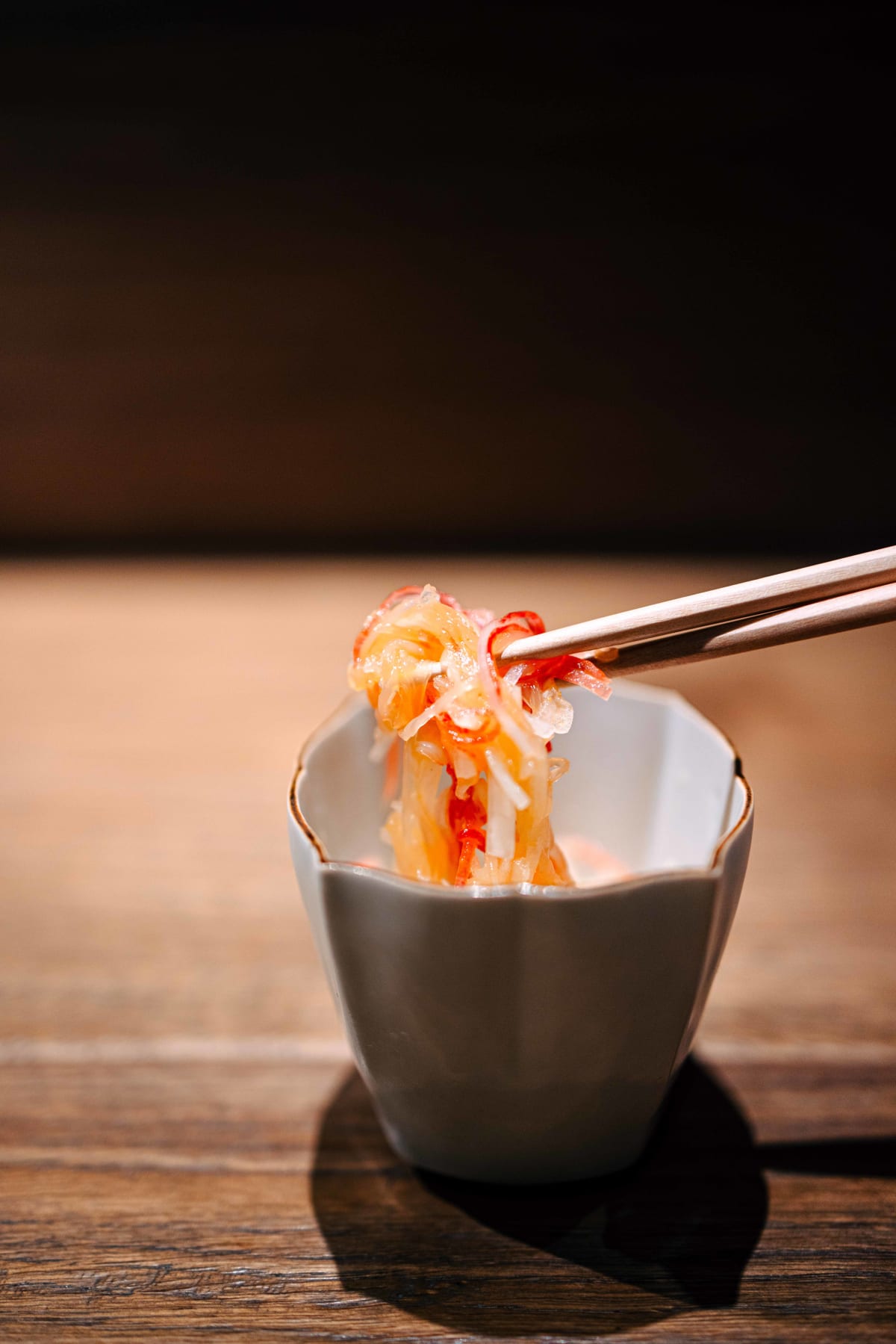
Jellyfish and Watermelon Turnip Marinated in Mustard Sauce (芥末紅蘿白蘿菜拌海蜇皮)
The second was a cold plate, jellyfish and watermelon turnip cut into strips the shape of shredded jellyfish and served with a mustard sauce, and the combination of two different textures from the two ingredients was good.
Section 8·Icefish Spring Roll
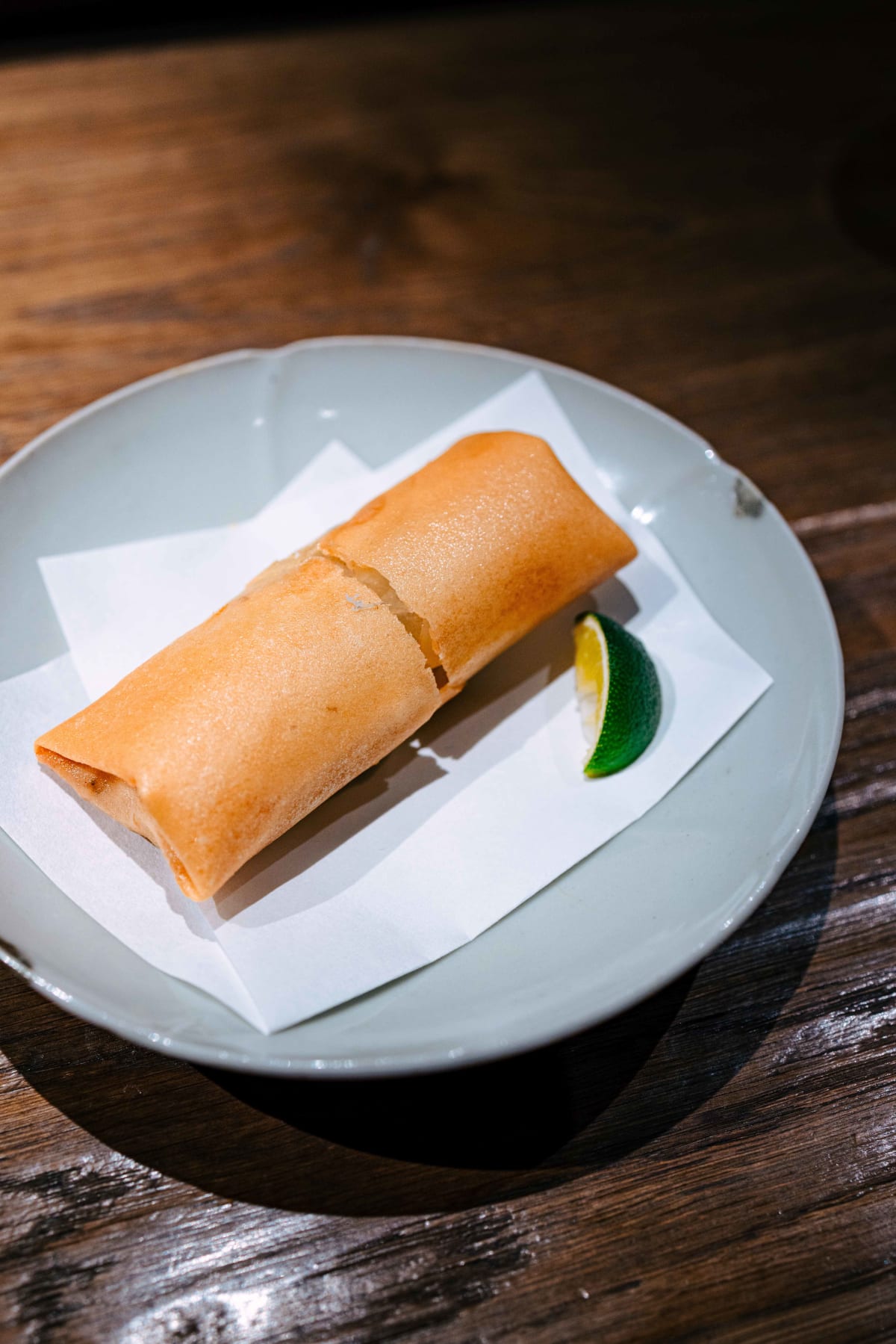
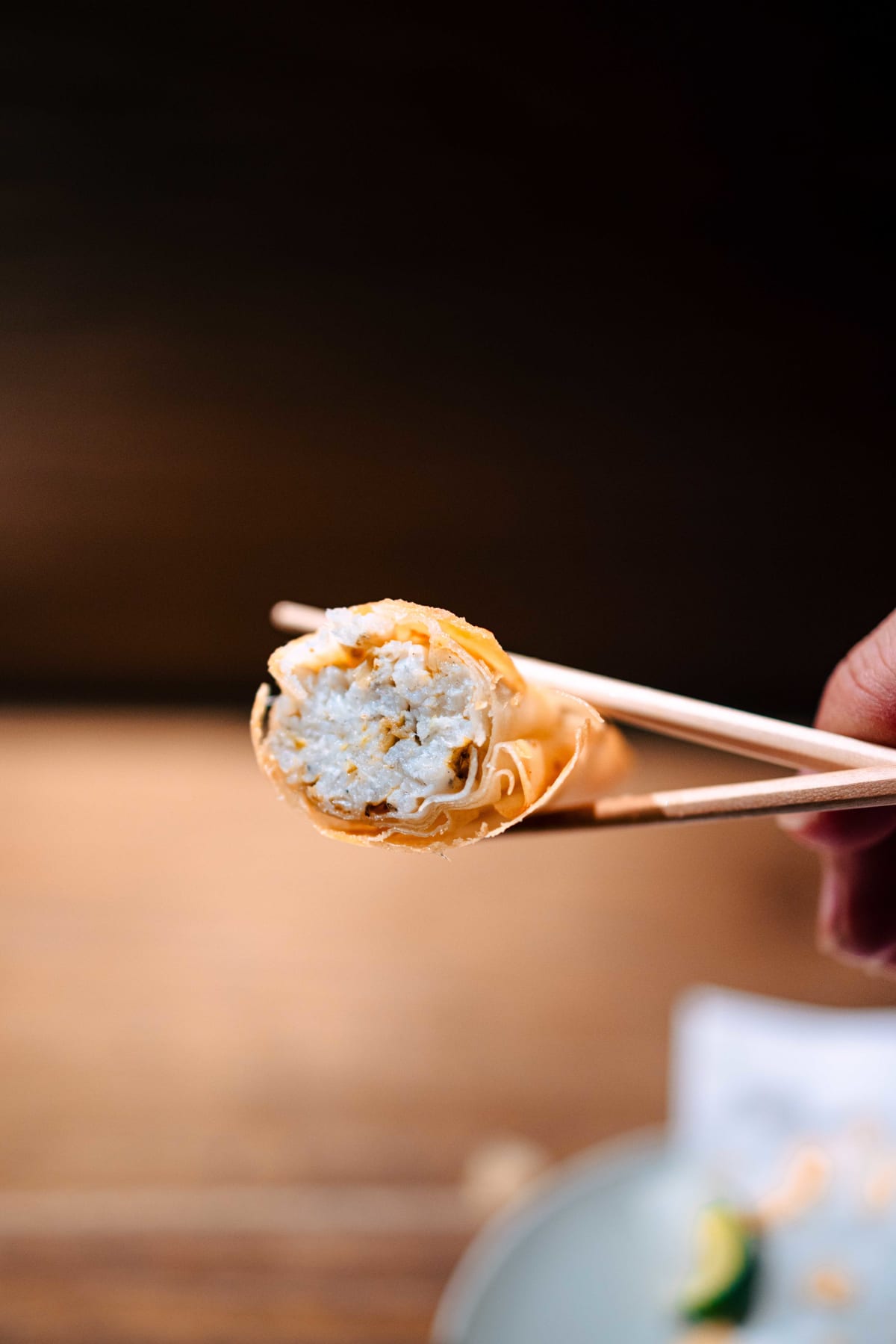
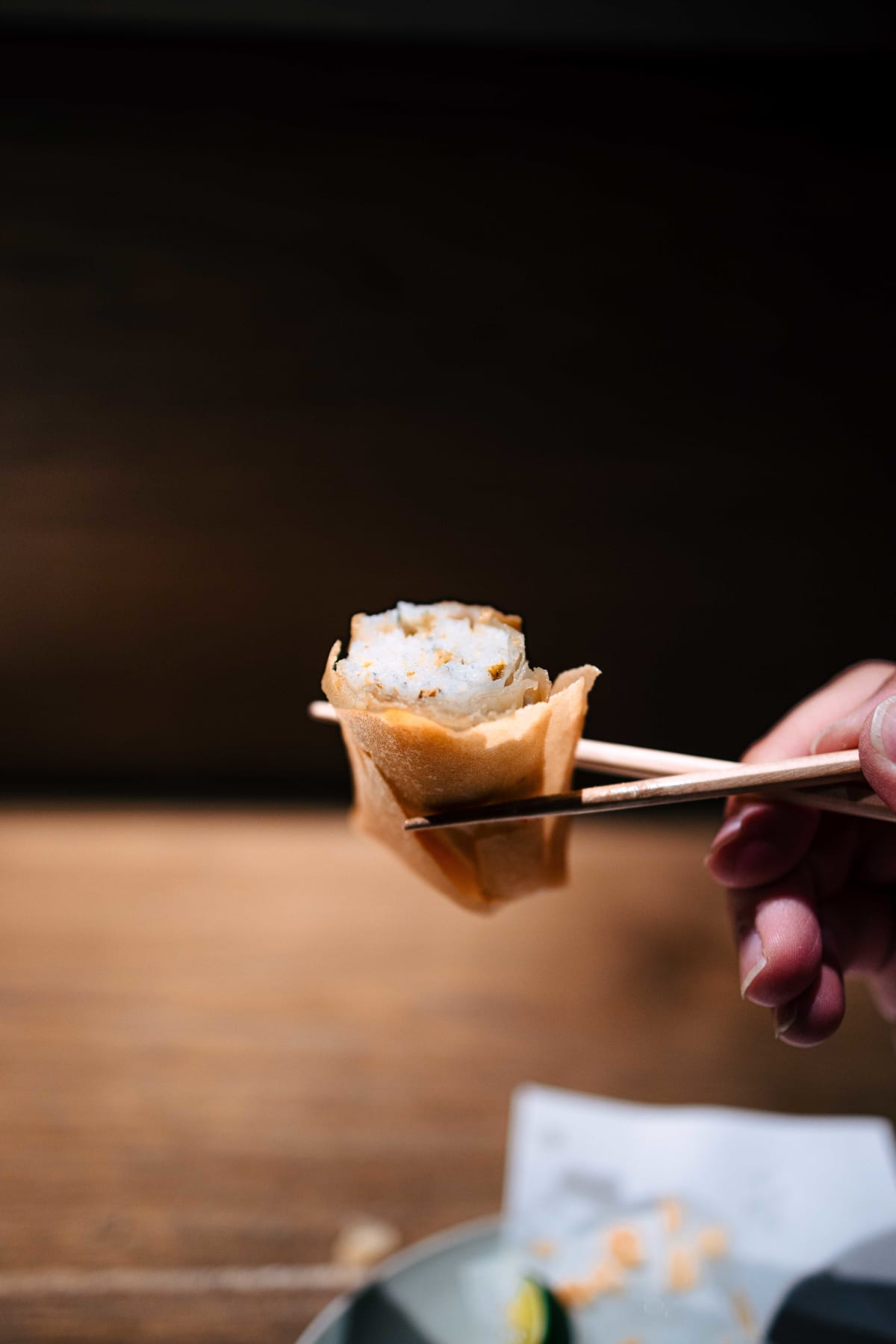
Spring Roll with Icefish and Butterbur (銀魚仔炸春捲)
The third was a fried spring roll with icefish inside. The roll was packed with the flesh of the icefish, and on the first bite the biscuit like shatter of the wrapper and the flavour of the fish burst out together and it was good, and it went well with the champagne.
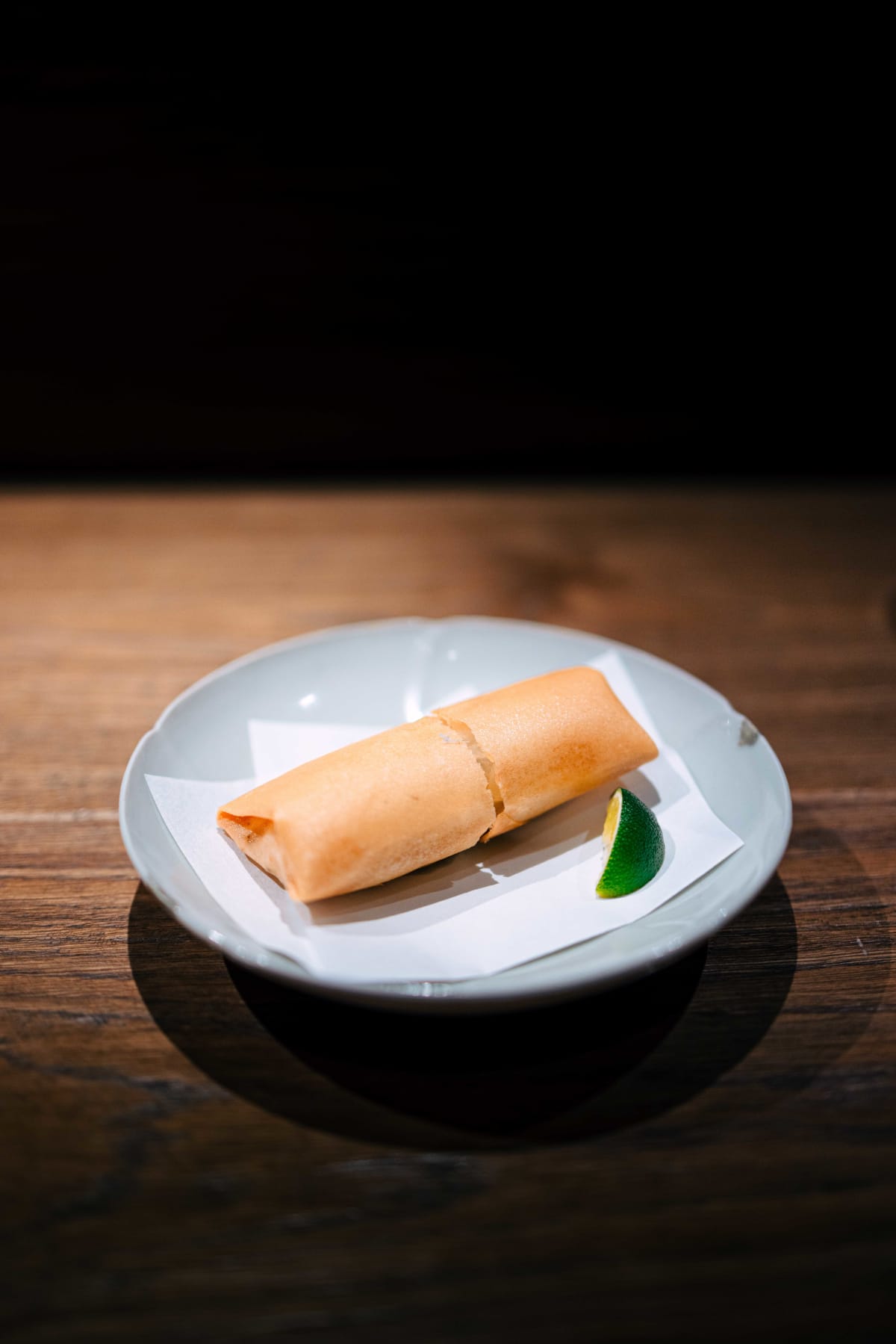
There was not much of it, and yet a few bites in it turned rich. Whether because of the wrapper, the richness made it easy to tire of and the impression did not last long.
After the icefish spring roll the small portioned appetisers kept coming, and the food was good with a fair number of memorable dishes among them.
Section 9·The Soft Roe
Soft Roe with Mountain Pepper Black Vinegar Sauce (青花椒黑醋老虎鶏泡魚白)
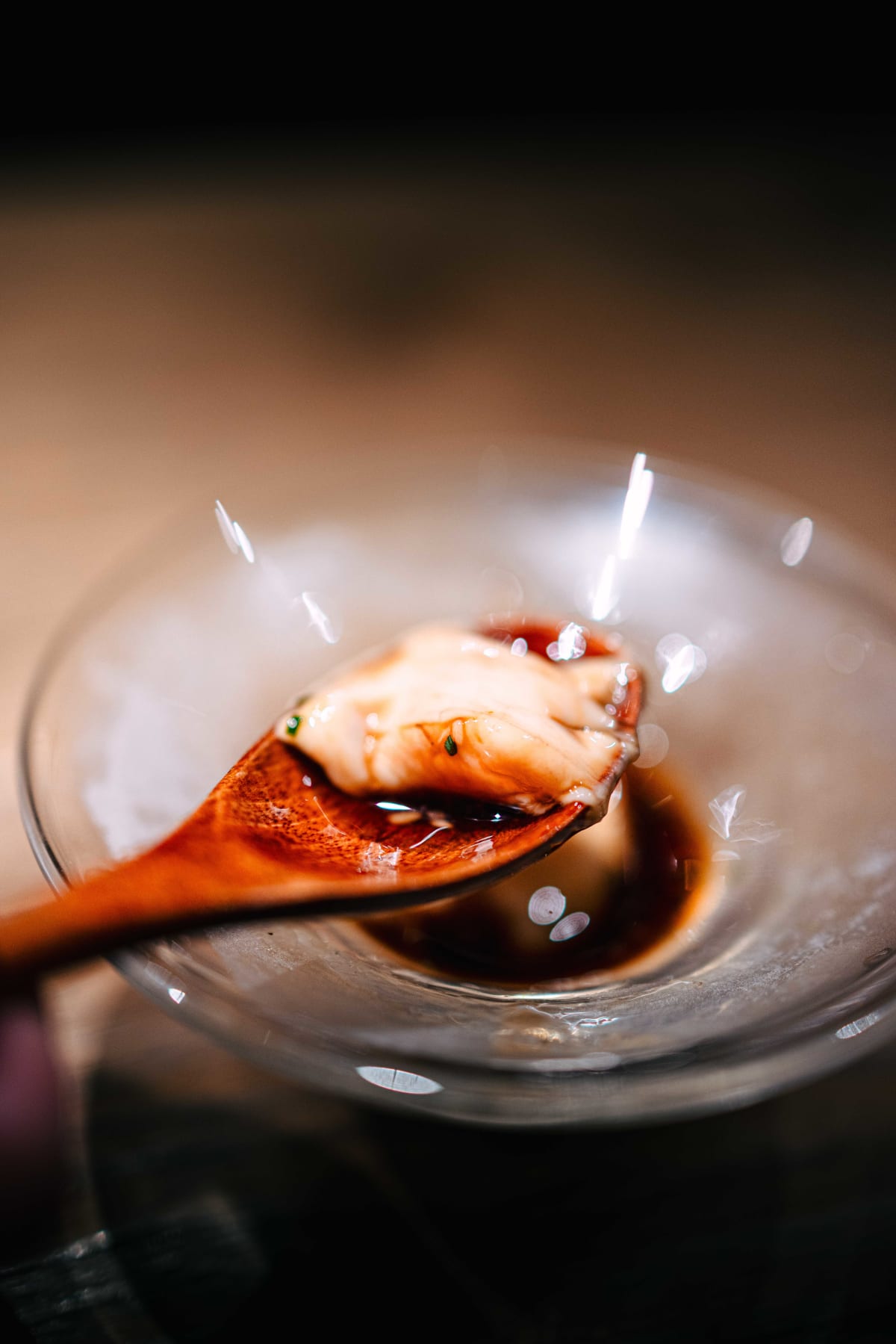
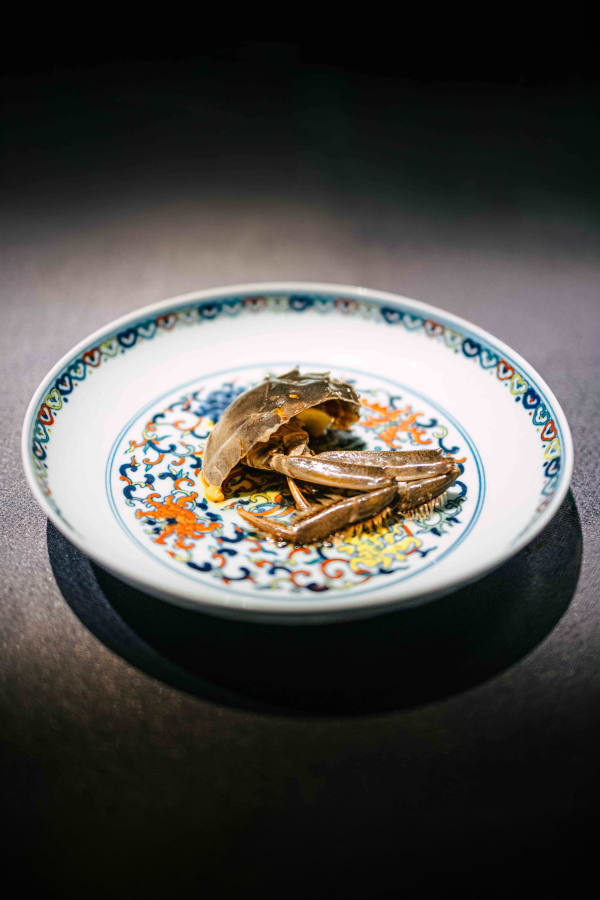
This is the dish I would pick as the best of the meal. Fugu soft roe. Black vinegar sauce spooned underneath and finely cut chilli on top, and the texture of the roe was extraordinary. Like a properly made, moderately cold pudding or jelly, and extremely unctuous.
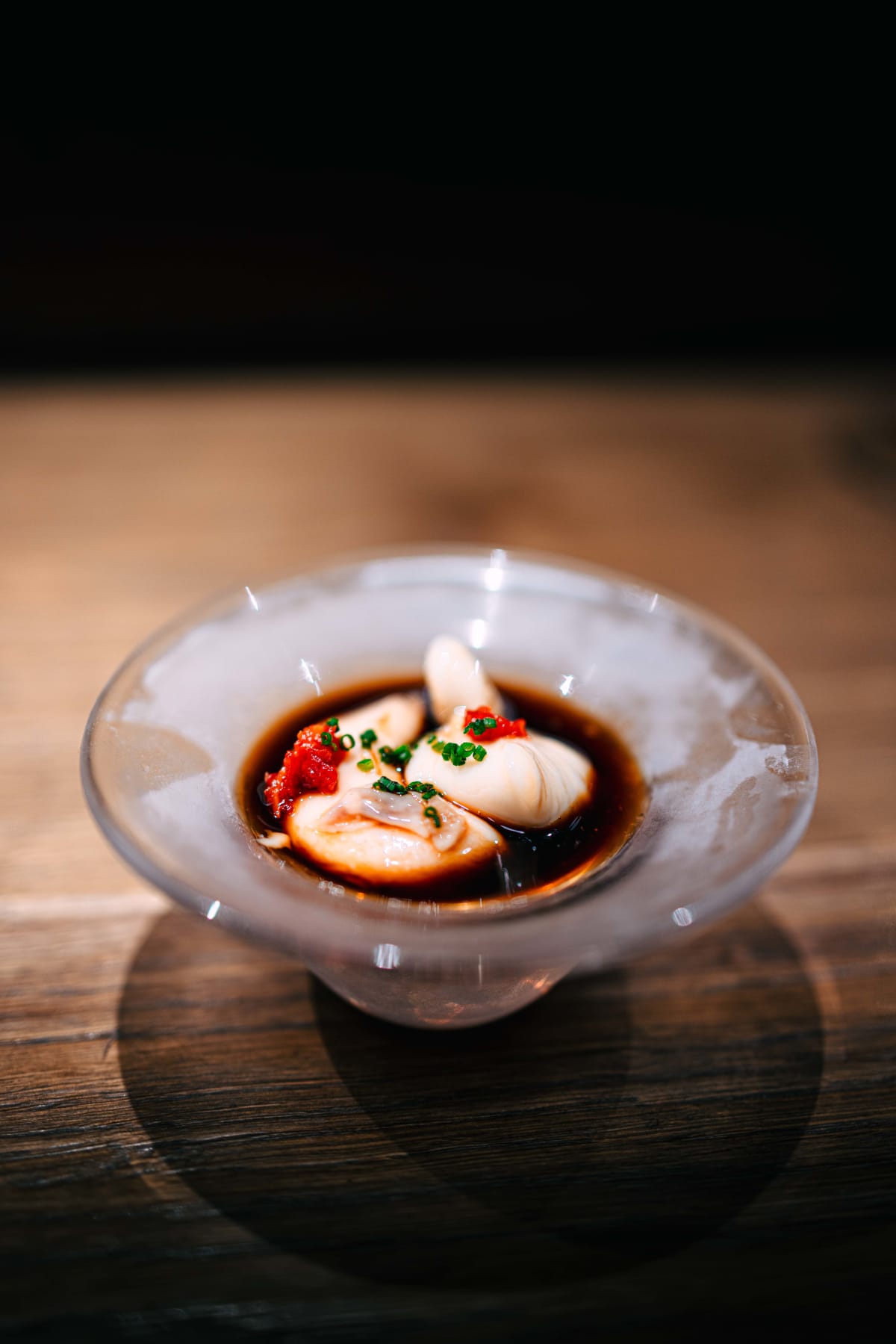
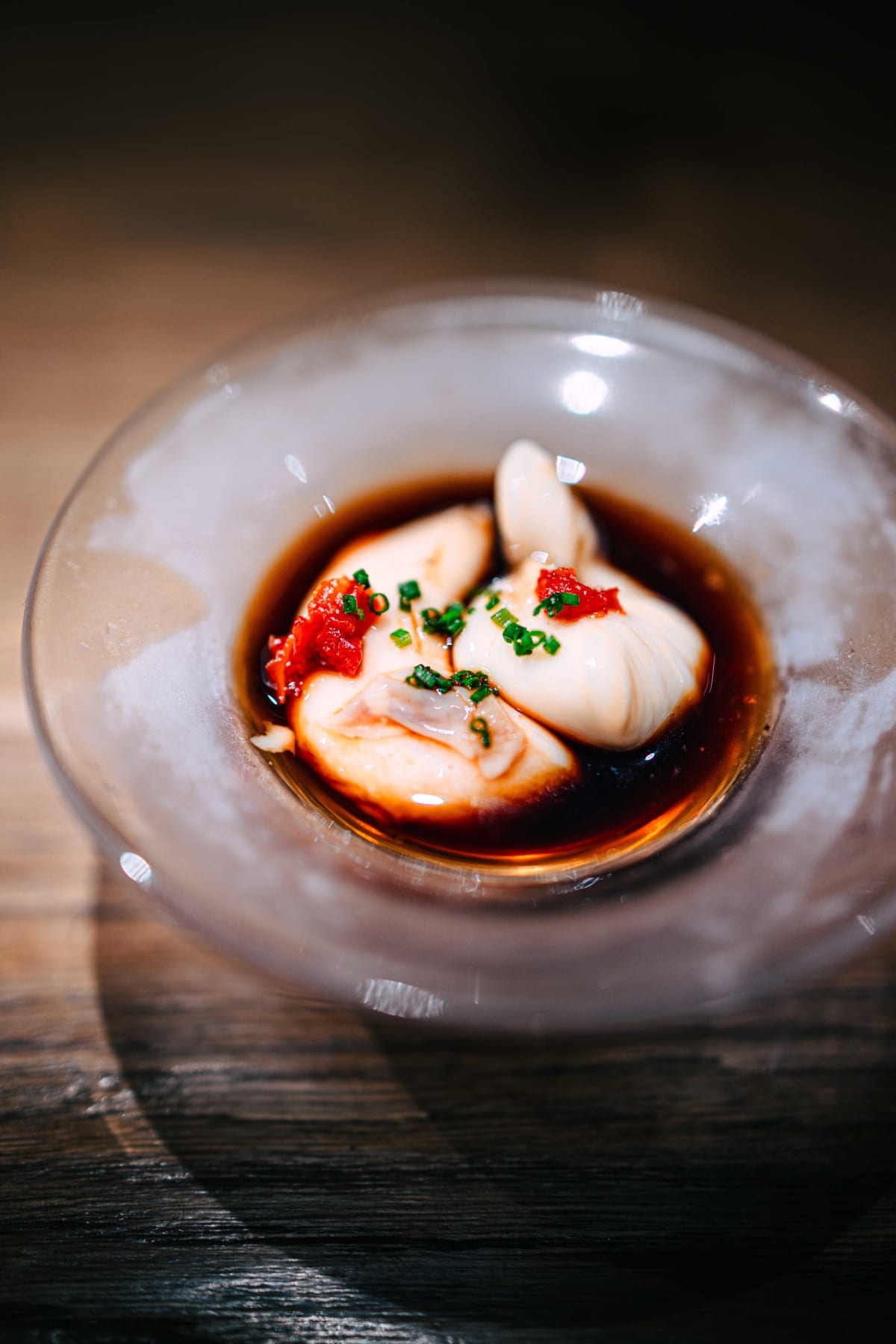
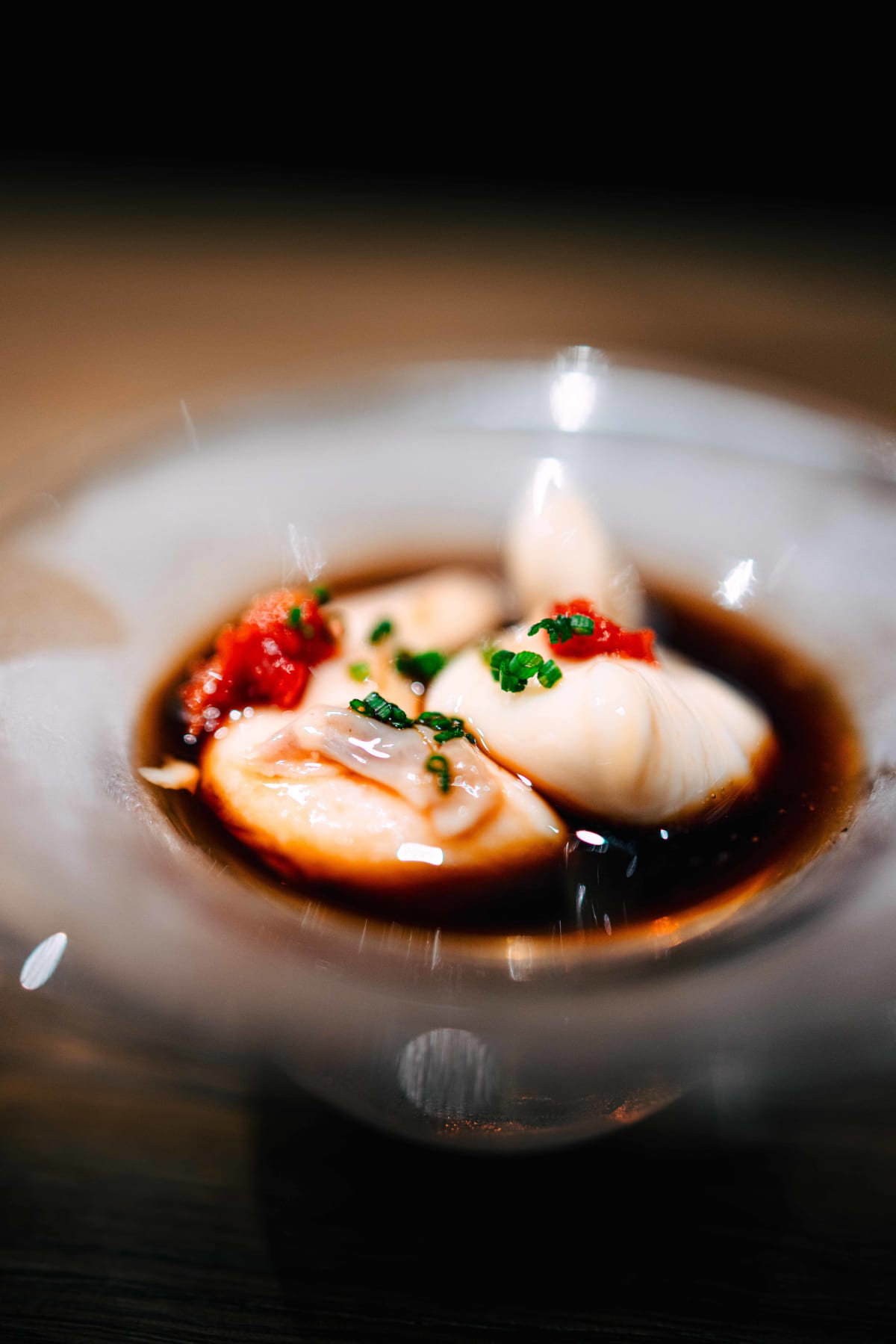
The taste and aroma of fugu soft roe on its own can become heavy if you keep eating it, so serving it with a high acid sauce, something like a five spice braise sauce, was excellent. This is a dish I would go back for.
Section 10·A Koshu Interlude
Having eaten this I had finished the champagne I ordered, so I asked for a white to follow and was given a Koshu 2021 from a winery in Yamanashi. Koshu is the variety that usually appears when you order a Japanese white, and perhaps because the acidity is low it struck me as somewhat similar to a Spanish white.
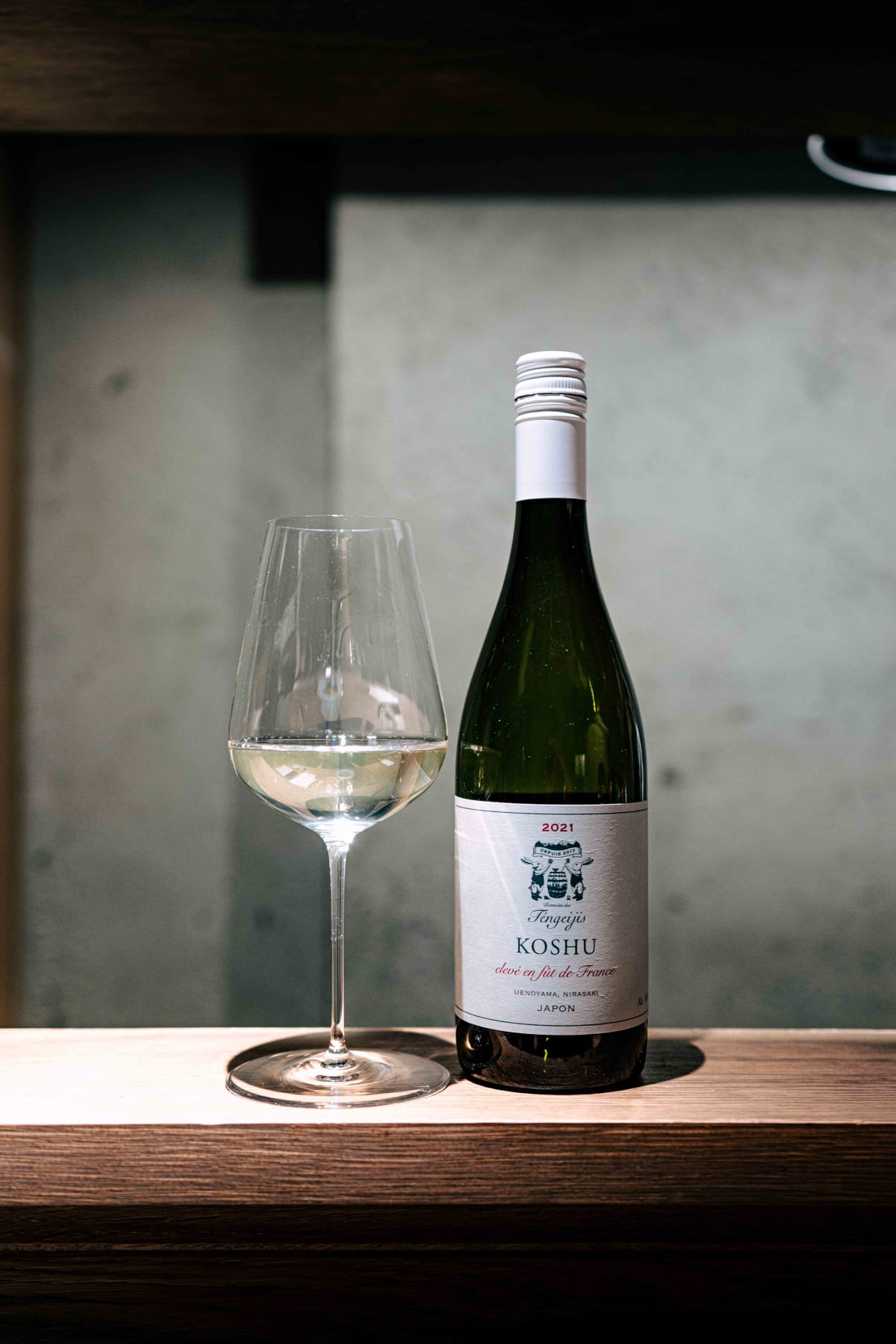
The wine is Domaine des Tengeijis' Koshu 2021. A young winery that opened in the autumn of 2017 in Akeno, Hokuto, Yamanashi, started in 2016 and not yet ten years old.
The vineyards are split across two sites. The Akeno Ogasawara plot next to the winery sits at seven hundred metres, reclaimed from abandoned farmland that had been left untouched and planted with two thousand vines, while the Uenoyama plot in Nirasaki, fifteen minutes away by car, was taken over from a farming family who could no longer manage it with age. The Koshu in this bottle comes from that Uenoyama plot.
The label carries a note that it was aged in French oak. Turning abandoned farmland back into vineyard and creating employment through that work is this house's stated purpose, and it puts forward a sustainable farming method mixing traditional organic practice with newer technique. The slogan is real wine carried into the future.
In Japanese dining rooms the pairing lists tend to carry a lot of Japanese wine, and continuing to introduce and consume your own country's wine is impressive and something worth following. But from the point of view of a guest who came to find and taste good food and good wine, when a Japanese wine that does not fit or does not justify the price appears, it is a little disappointing.
Section 11·Clam And Cheung Fun
Steamed Clam with Fried Garlic and Soy Sauce (蒜香貴妃蛤)
Alongside the wine came a steamed clam with a soy sauce in a Chinese register and garlic on it, and a great deal of fried shrimp piled on top at the end, and the clam was enormous.
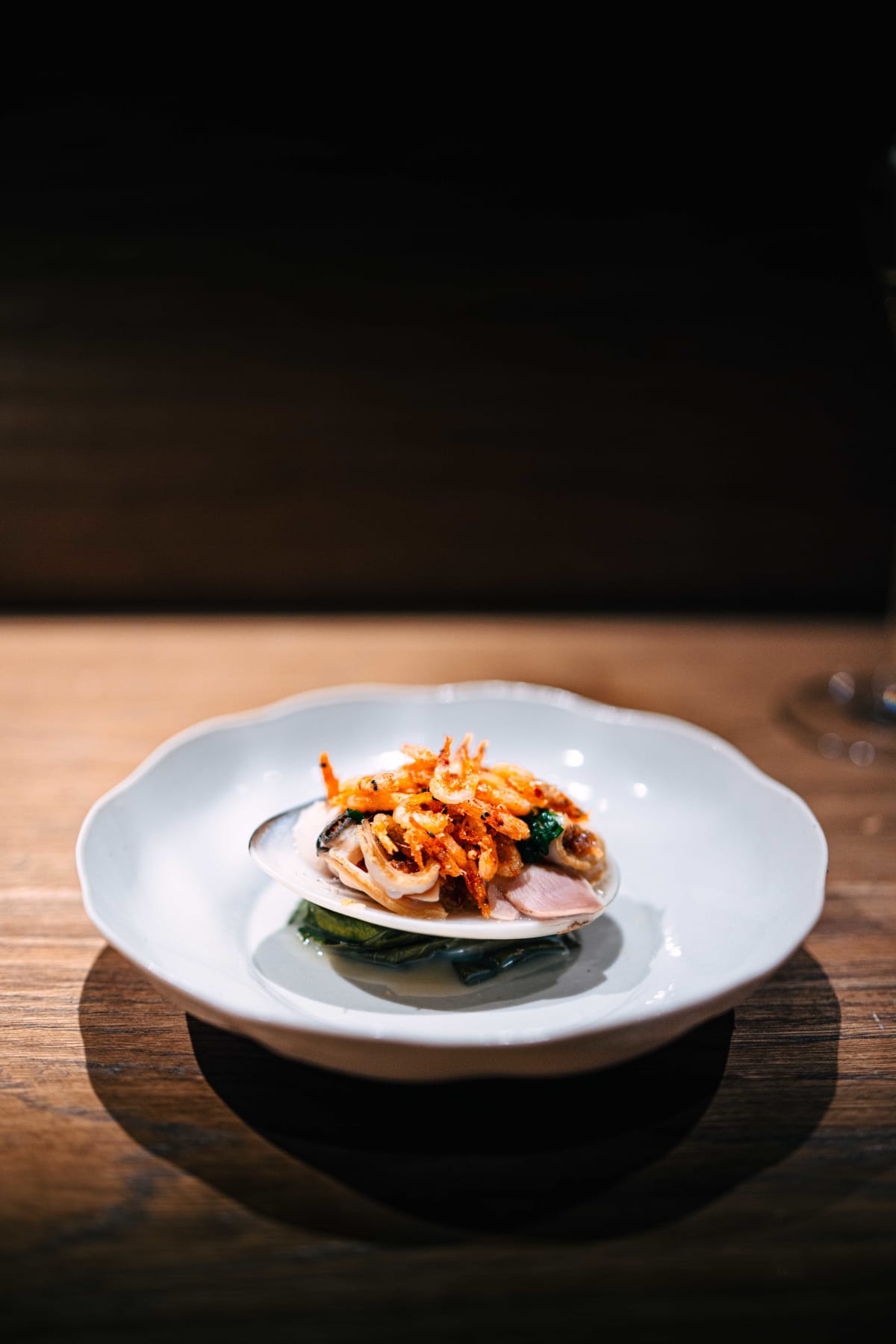
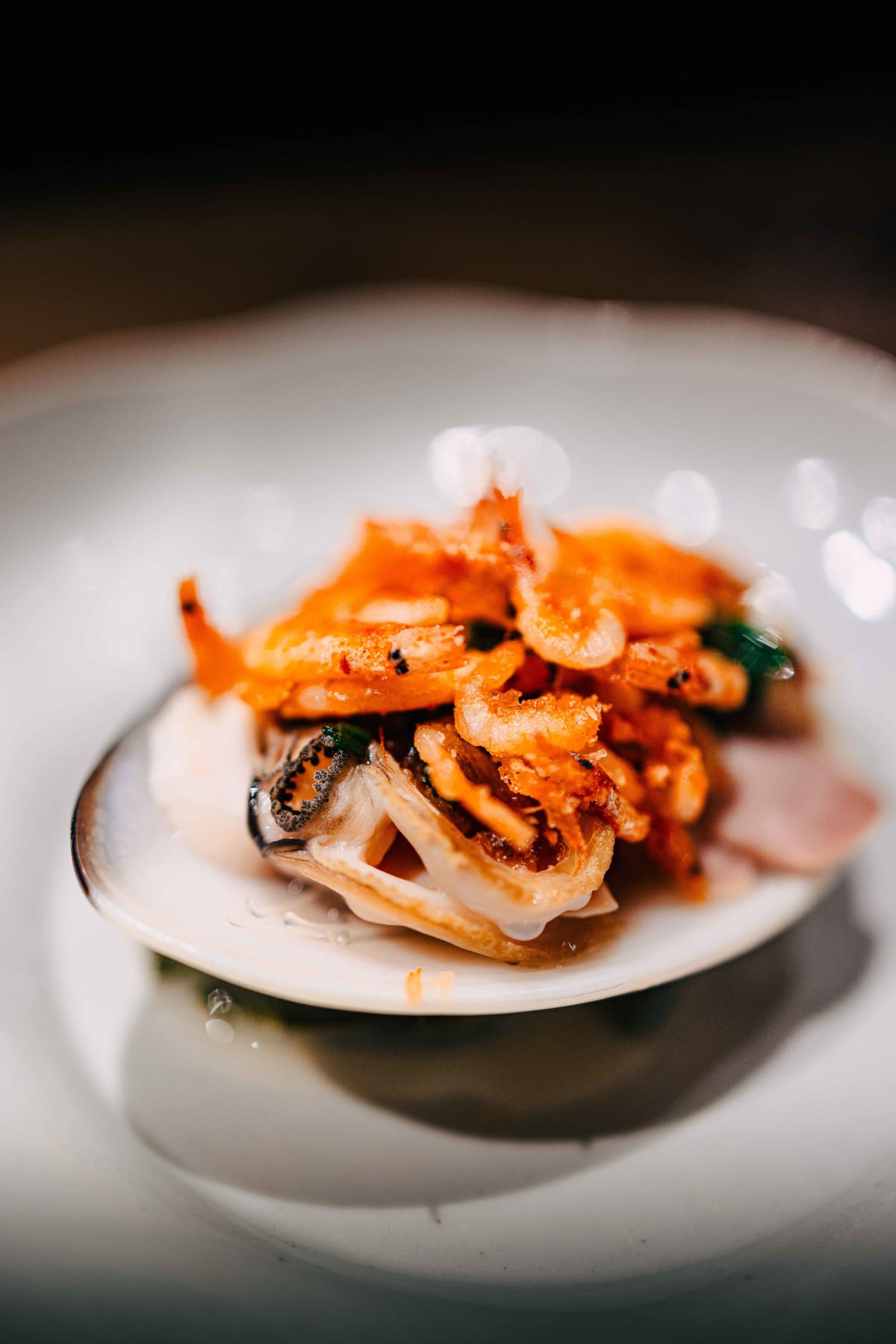
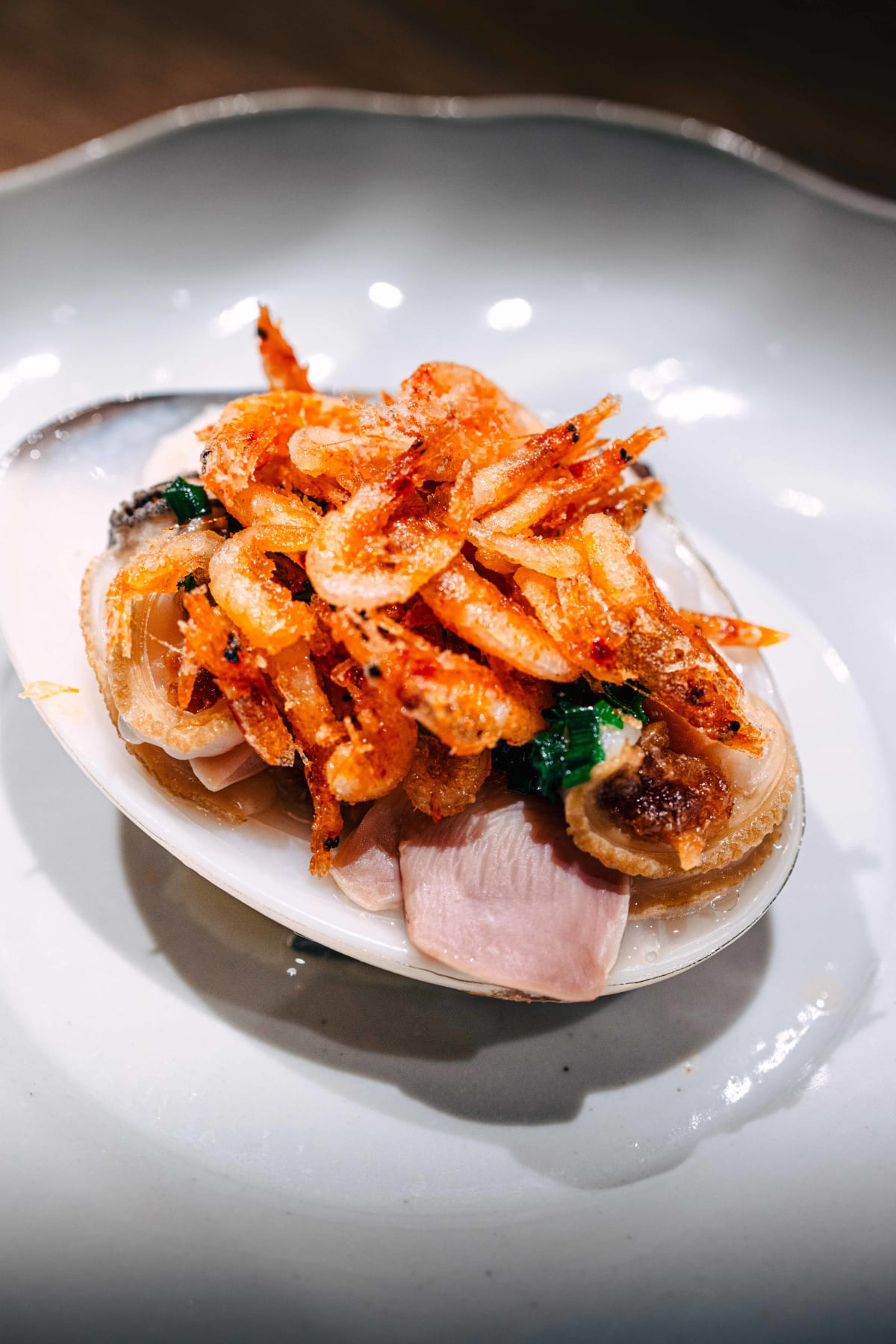
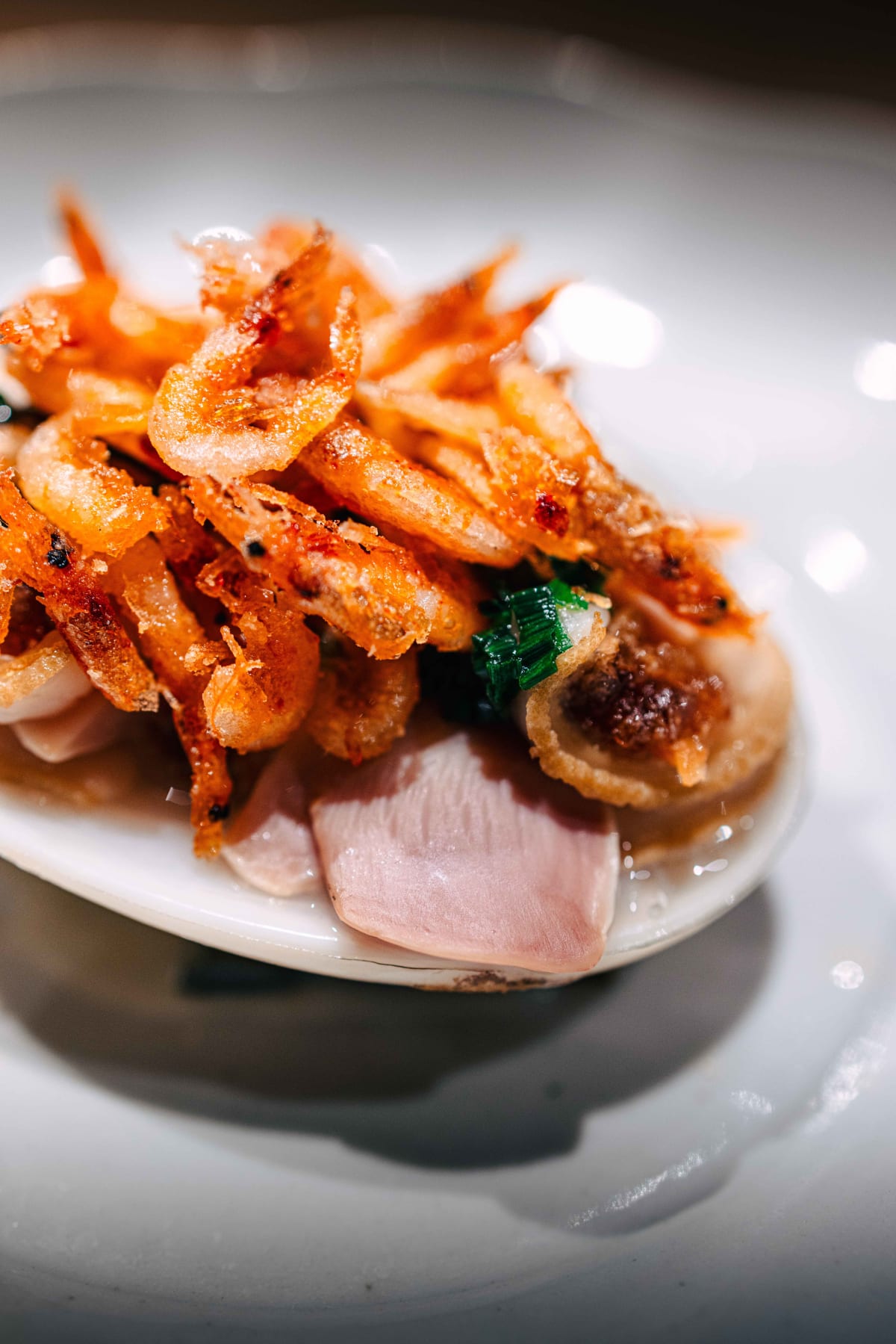
I would guess hamaguri. Even cut into several pieces, every one filled the mouth. But I like good seafood served simply, the way Japanese cooking does it, so the texture of that fried shrimp struck me as getting in the way instead.
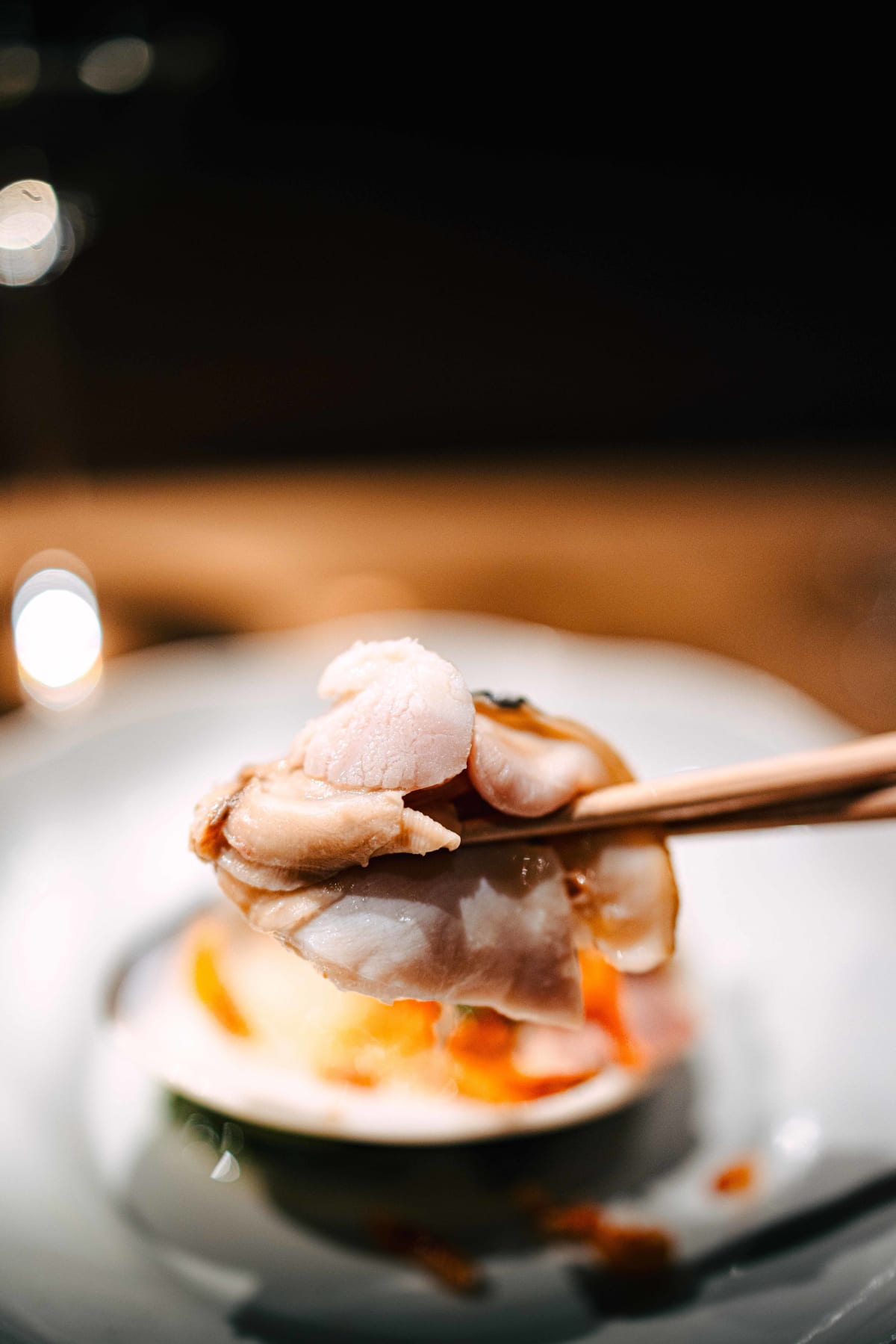
Ippei Hanten Shrimp Roll (脆皮鮮蝦腸粉)
The dish that came next is a roll of shrimp wrapped in cheung fun, and one of the memorable things in the early part. The pillowy texture of the roll in particular was extraordinary. Beyond that, the texture and the harmony of the shrimp and the yuba inside, and the taste of the shrimp itself, were all excellent.
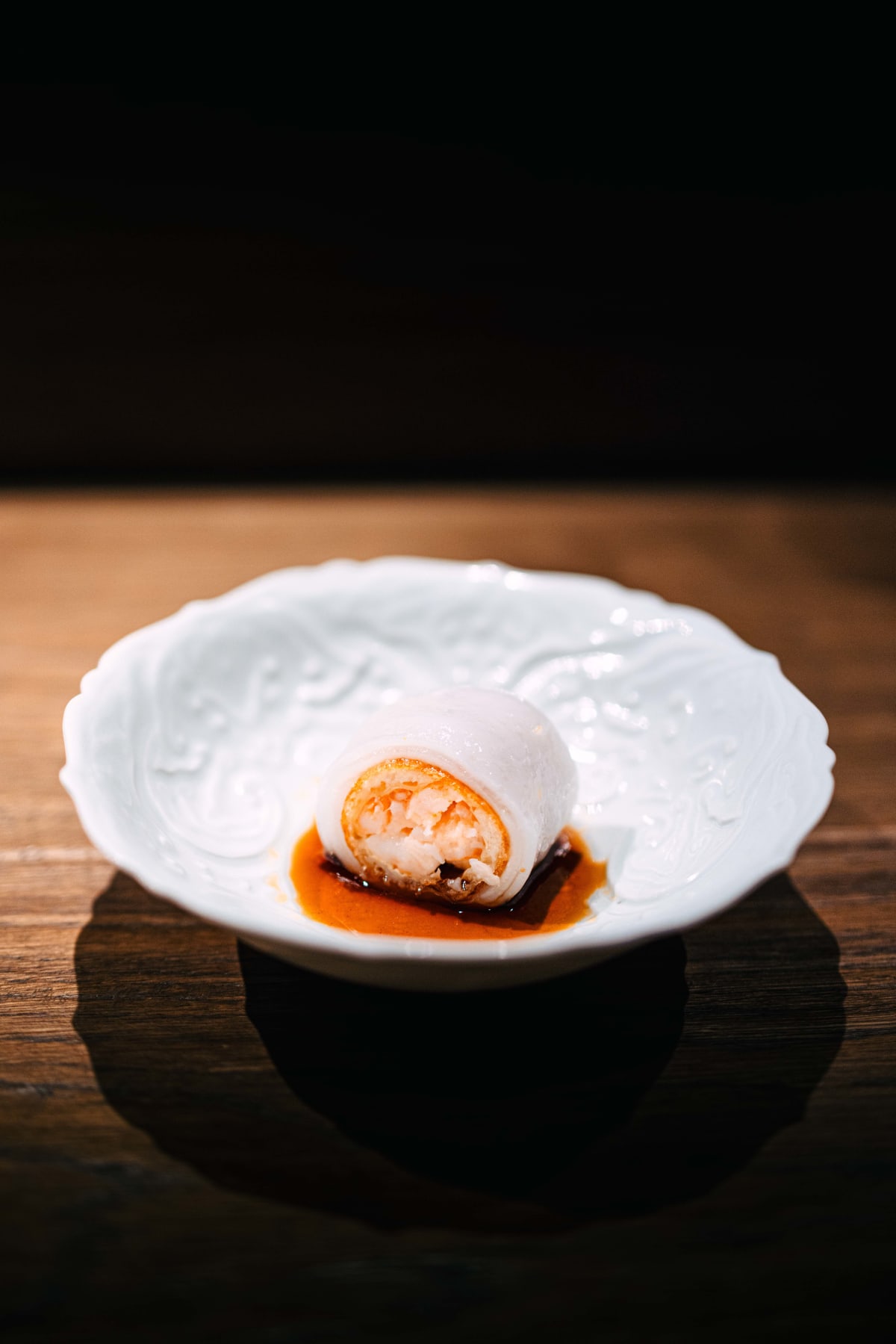
The cheung fun in this dish is a sheet made by steaming rice flour thin. The yuba is the part fried and placed inside. It arranges crispness, the spring of the shrimp and the softness of the rice sheet within a single bite, and it is said to be the plate where the dim sum technique Adachi learned professionally in Hong Kong shows most directly.
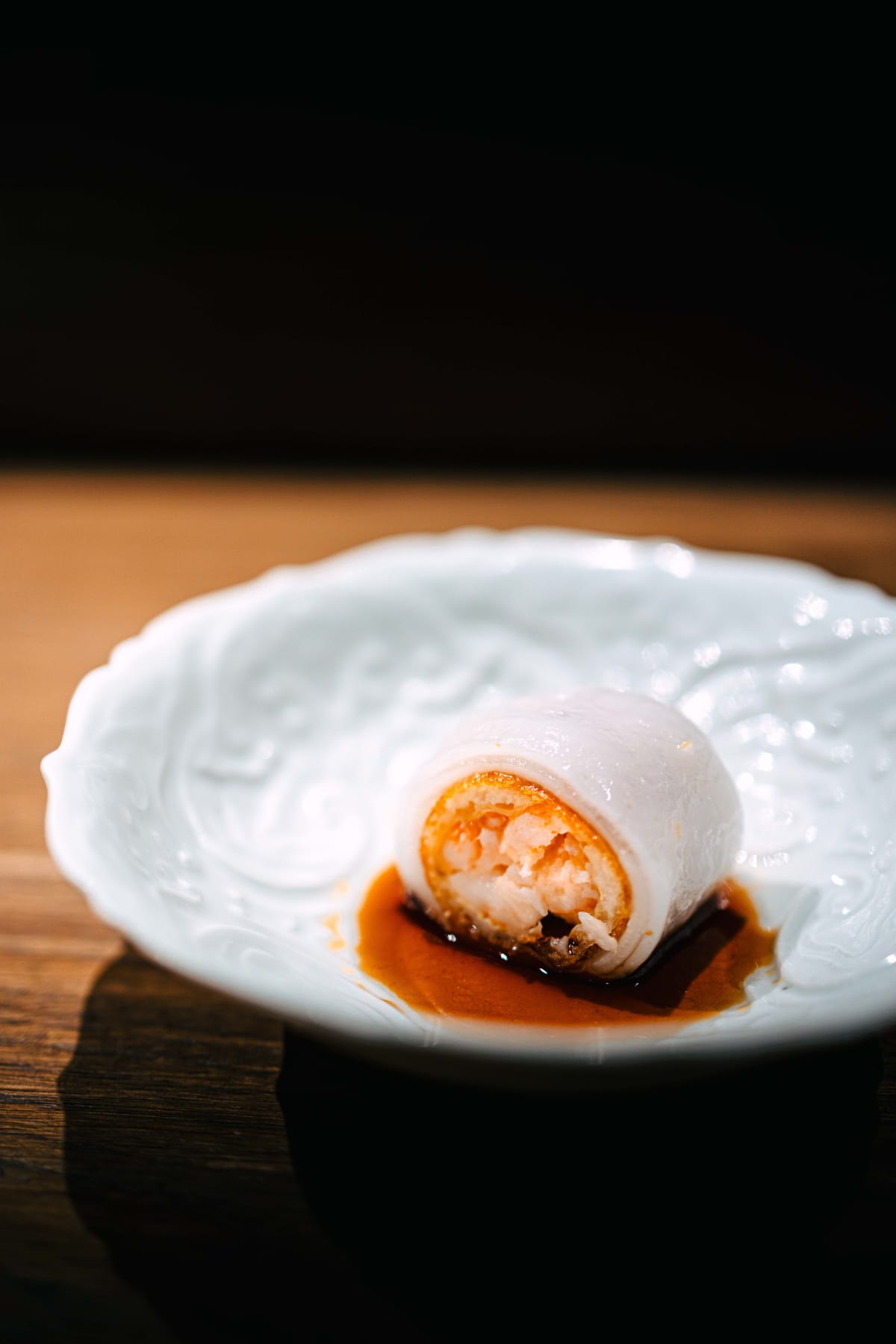
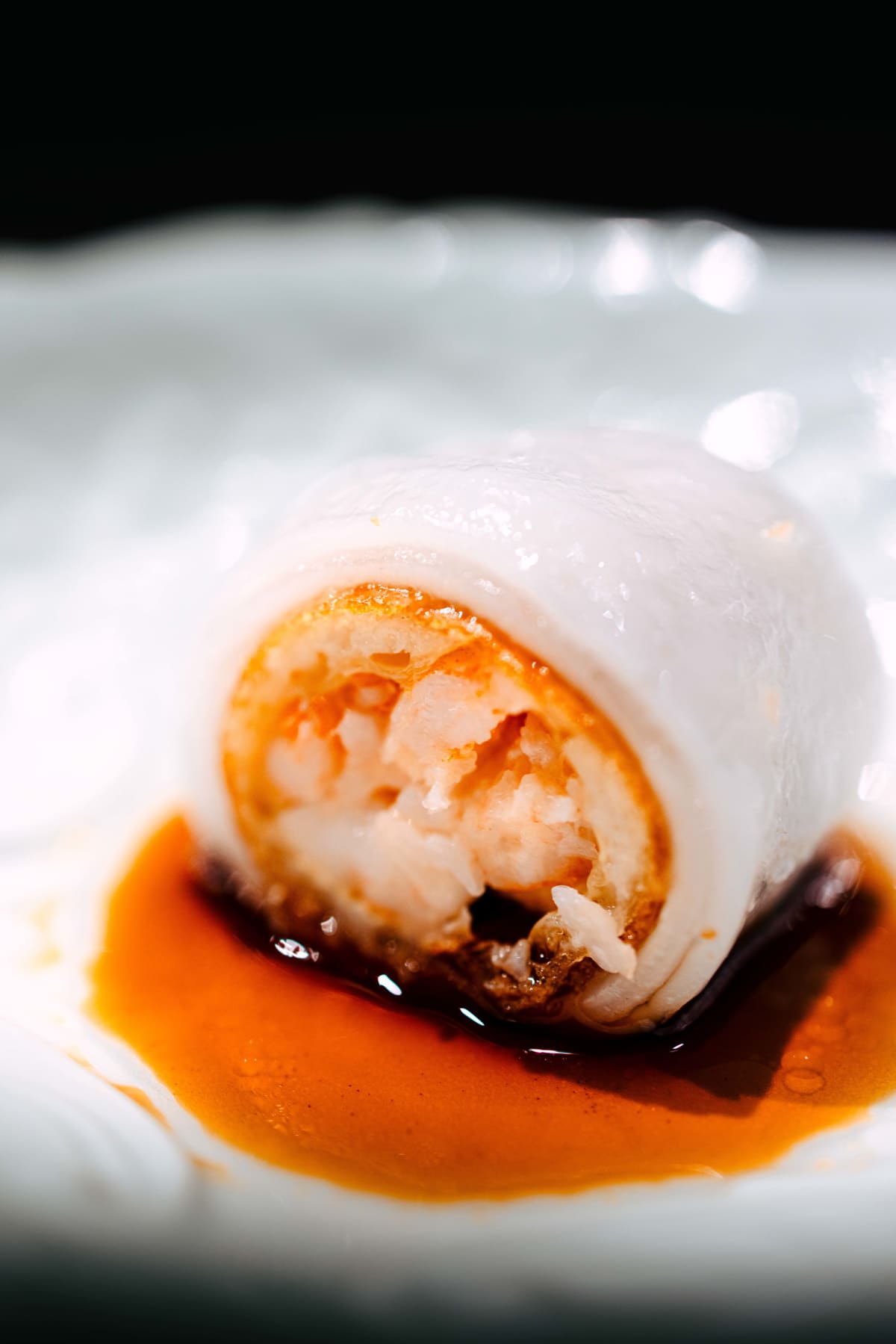
Eating this far I thought this one had worked out today. The Chinese dining room I went to last time simply had not suited me.
Section 12·Grouper, Turtle, Lobster
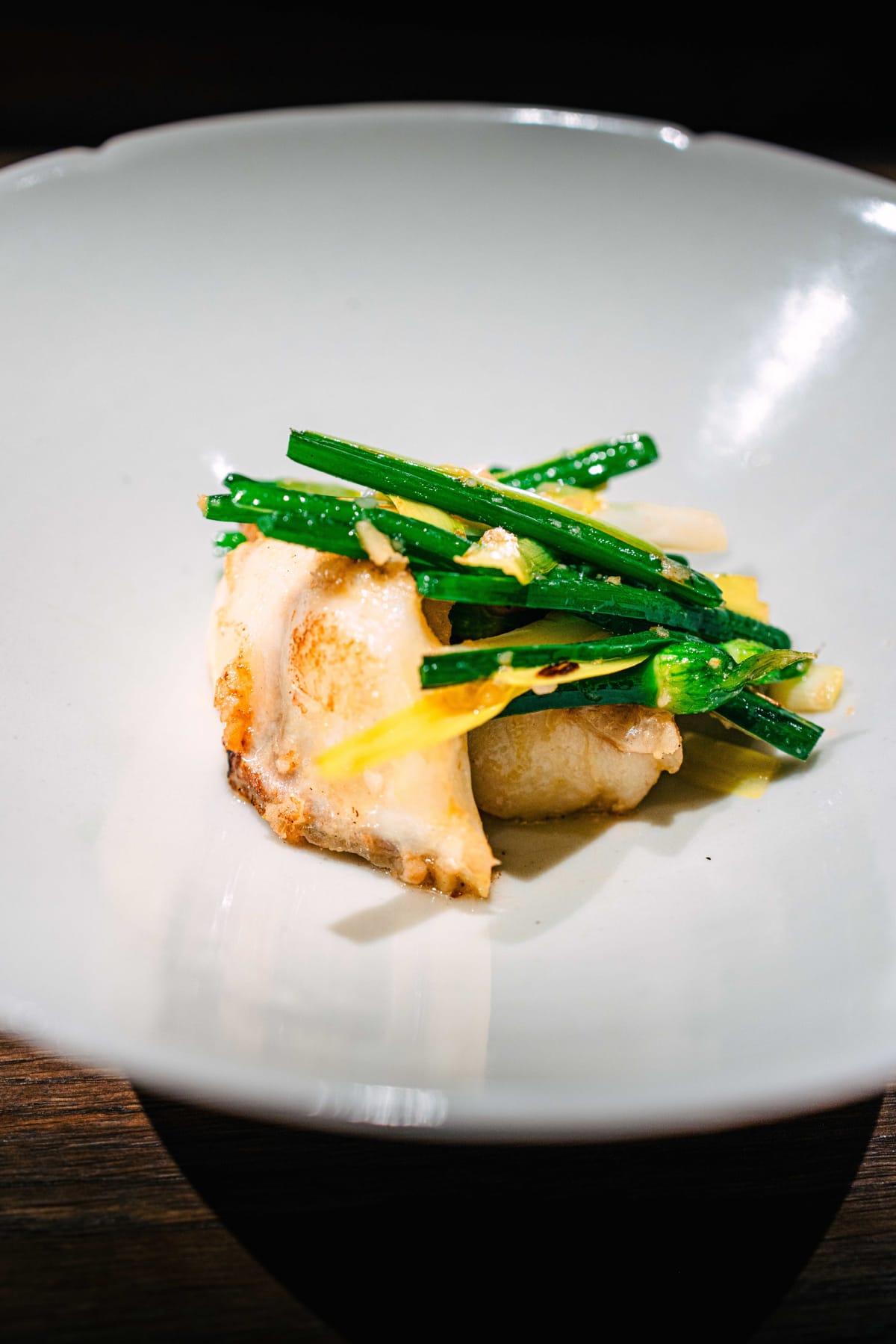
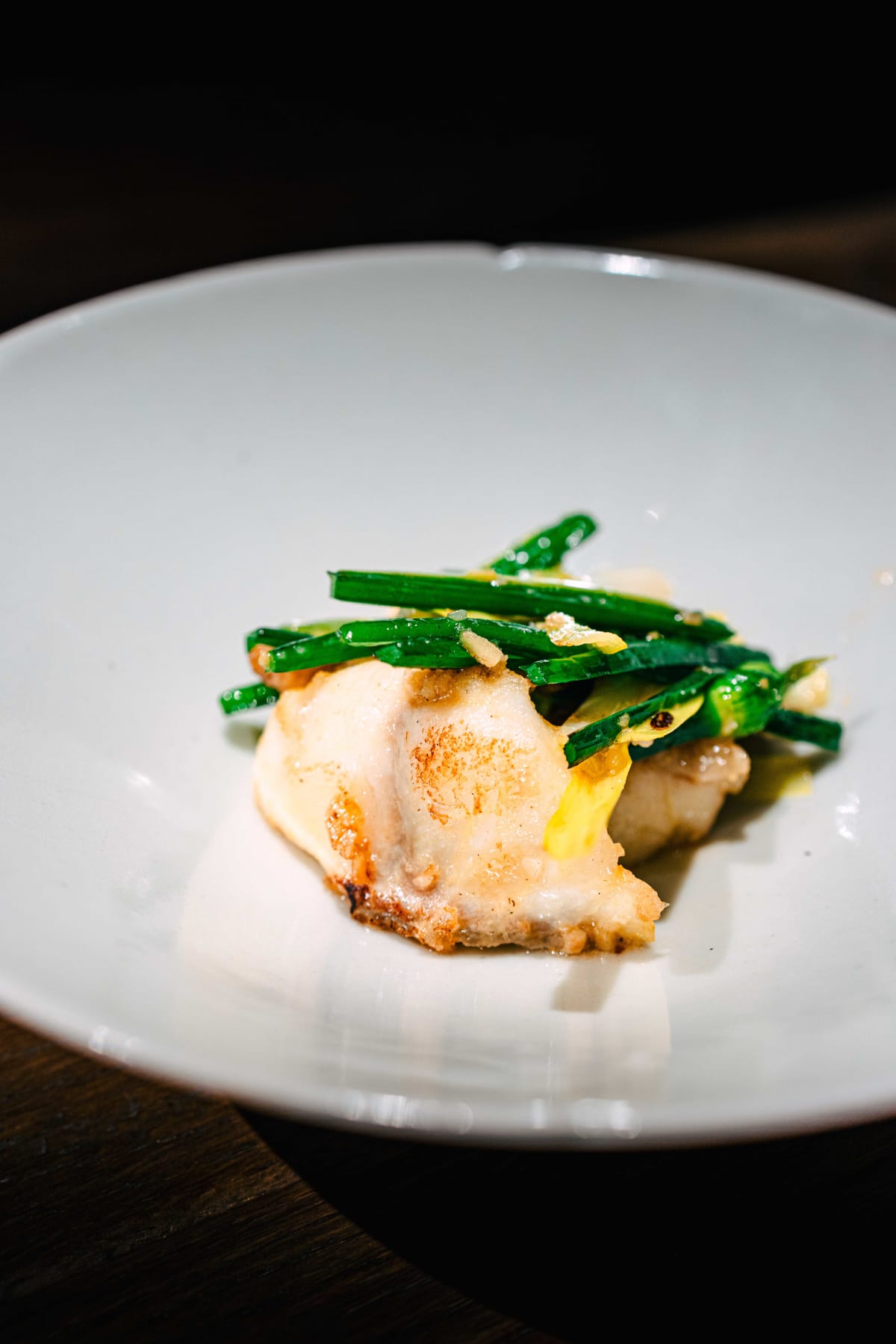
Stir-fried Long-tooth Grouper and Chinese Chive (韭香炒龍躉)
The small portioned early section of a fairly long course was ending, and the fish dish that marks the middle arrived: longtooth grouper. It is a fine species, good enough that most raw fish restaurants in Korea sell it at a high price as dageumbari, and here the flesh is stir-fried in oil with Chinese chive.
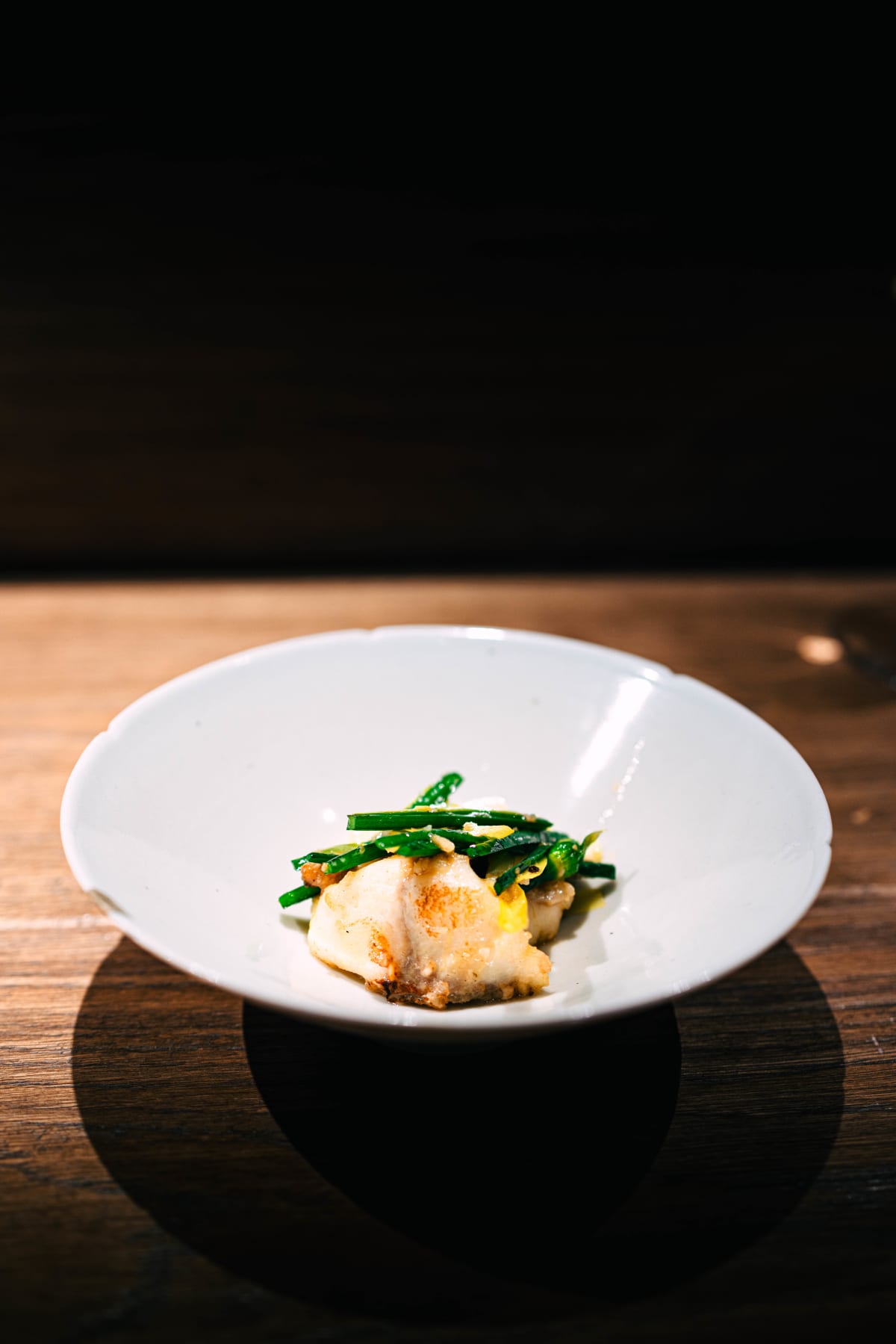
But set against the expectation I had when I heard grouper was coming and wondered how it would be cooked, it was rather ordinary. I thought a cheaper fish would probably have produced a similar taste.
Ippei Hanten is known for Cantonese cooking within Chinese food, and up to the early section it was good to get a rough sense of what Cantonese food is like. It read clearly differently from the high end Chinese food I have eaten in Korea, and I was glad I had come with the thought of trying once more.
Enough had been fried and stir-fried in the early part that around the time I wanted something hot and brothy, a soup arrived at exactly the right moment.
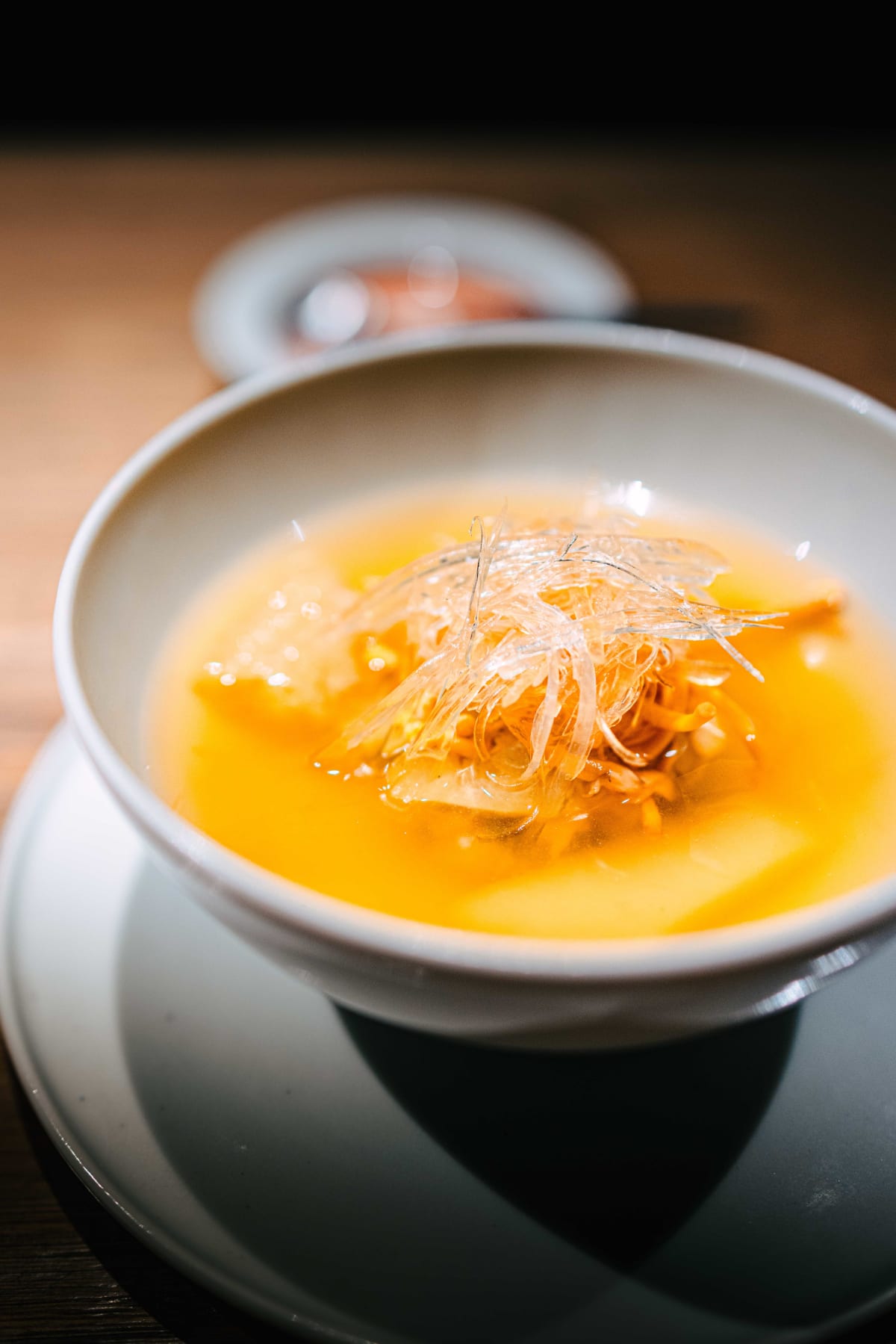
Snapping Turtle, Bamboo Pith, Shark Fin Soup Dumpling (水魚竹笙燉海虎翅)
Snapping turtle, what is that? Looking it up, it is soft-shelled turtle. I knew that Japanese cooking and high end Chinese cooking use turtle a lot, but this was my first time eating it so I was very curious. Along with the turtle there were expensive ingredients like the mushroom called bamboo pith and shark fin.
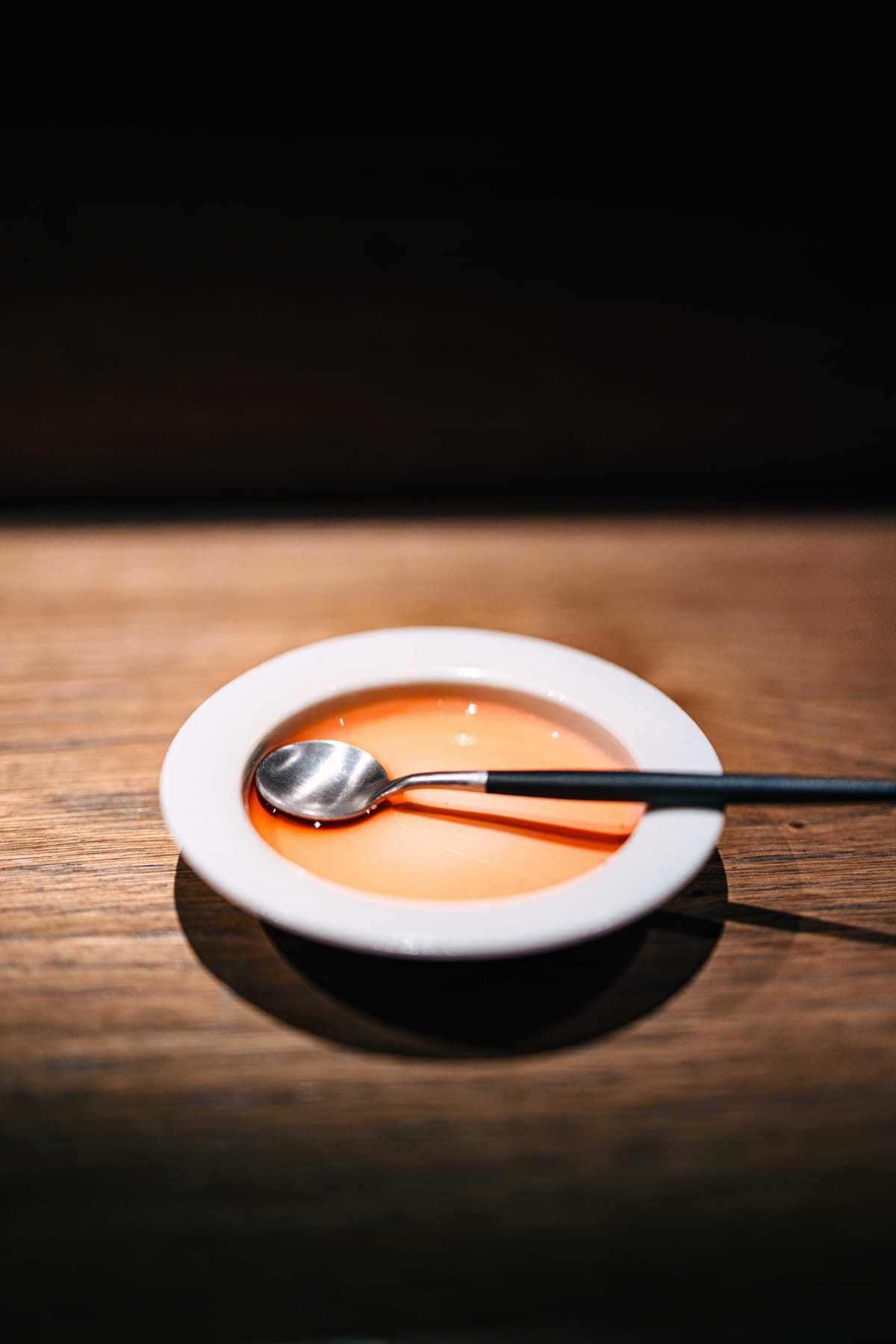
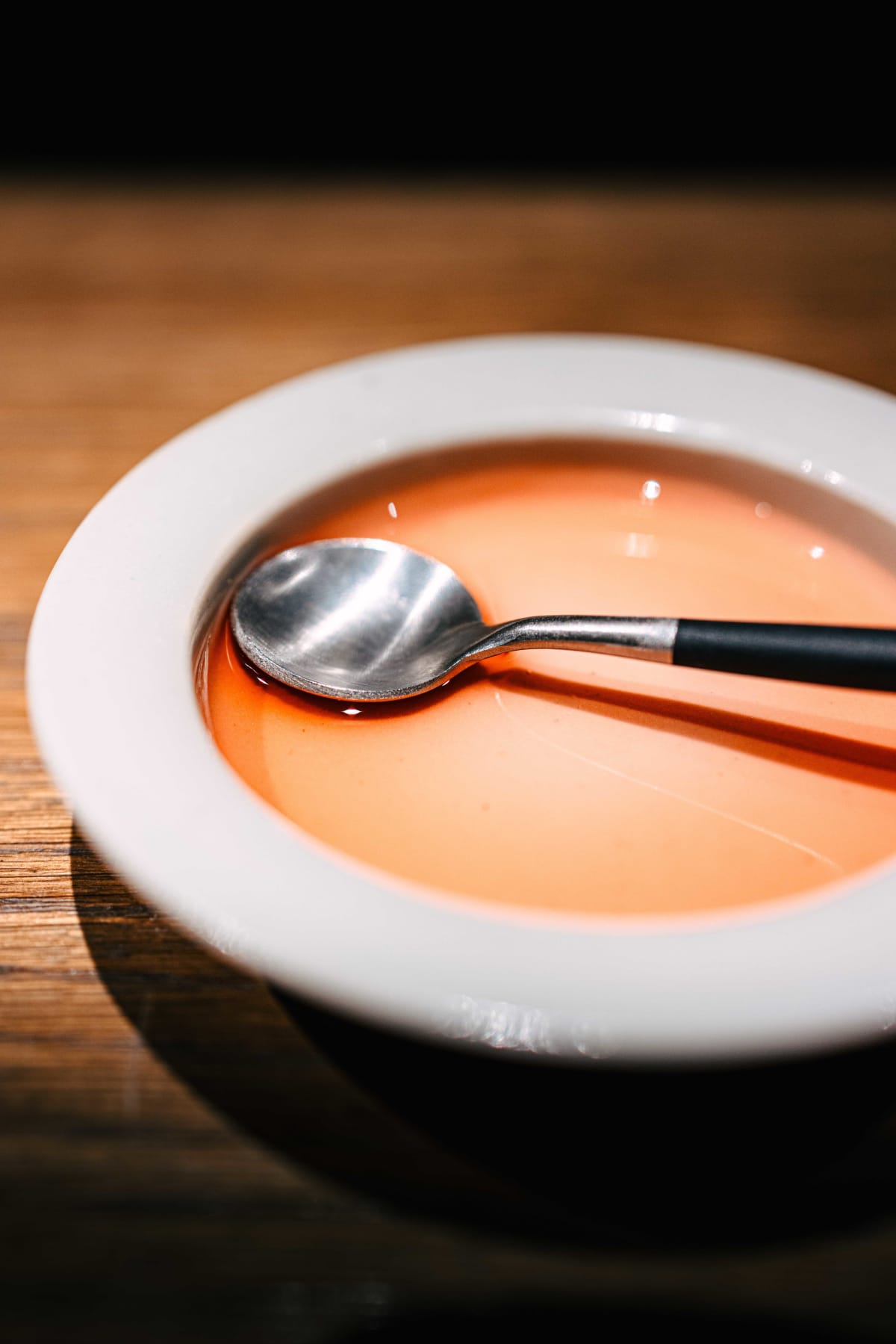
There was one large piece of turtle inside. I have not eaten turtle before so I cannot say for sure, but it looked like a cut with plenty of meat and some offal attached. The texture was far springier than I expected, like eating a firm lobster. It took a little effort in the jaw to pull the meat off. I was slightly worried about an earthy or unfamiliar off note and there was none at all, so I ate it happily.
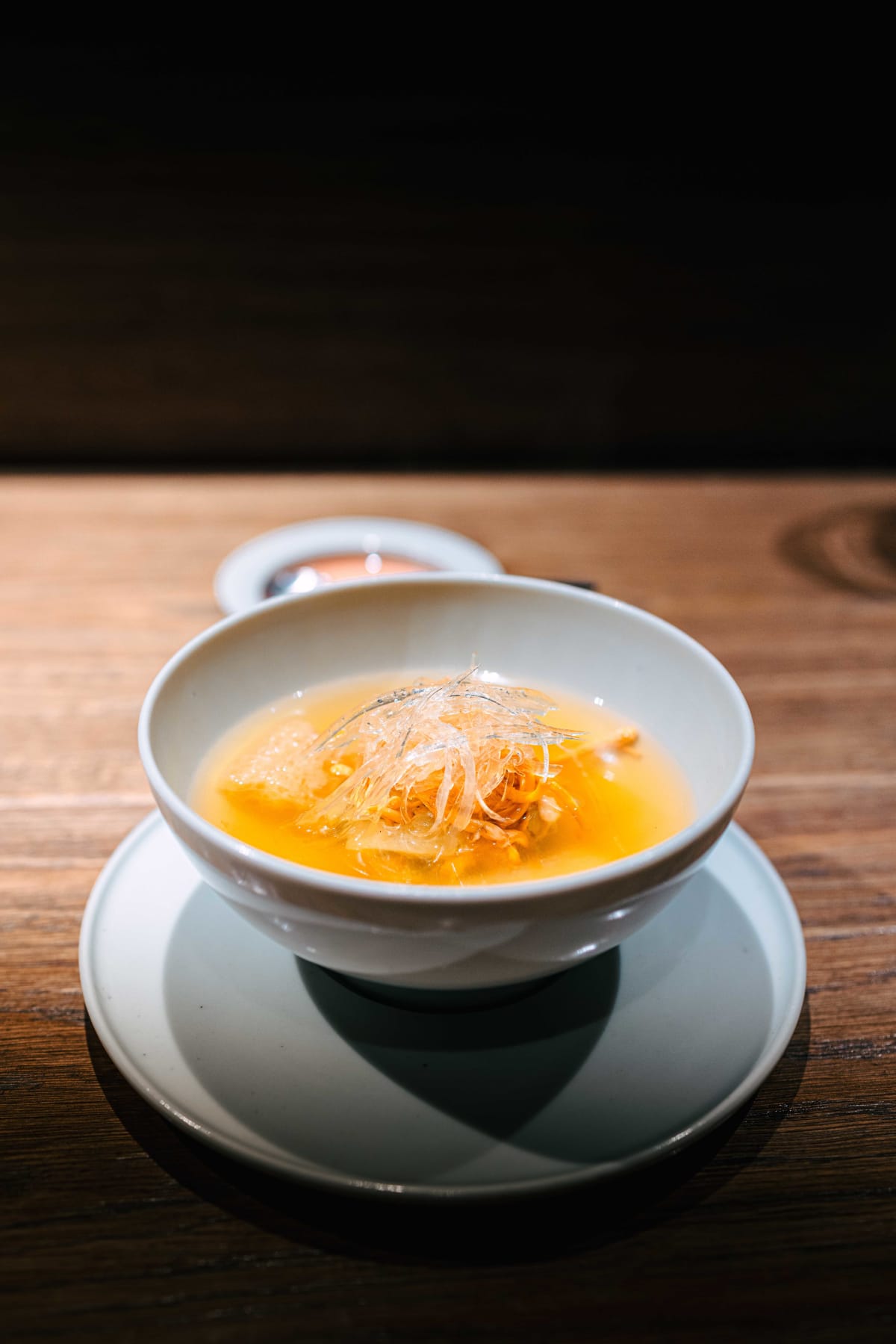
Along with the turtle there was a good deal of shark fin, so there was a range of textures to enjoy, and the broth was restorative soup itself.
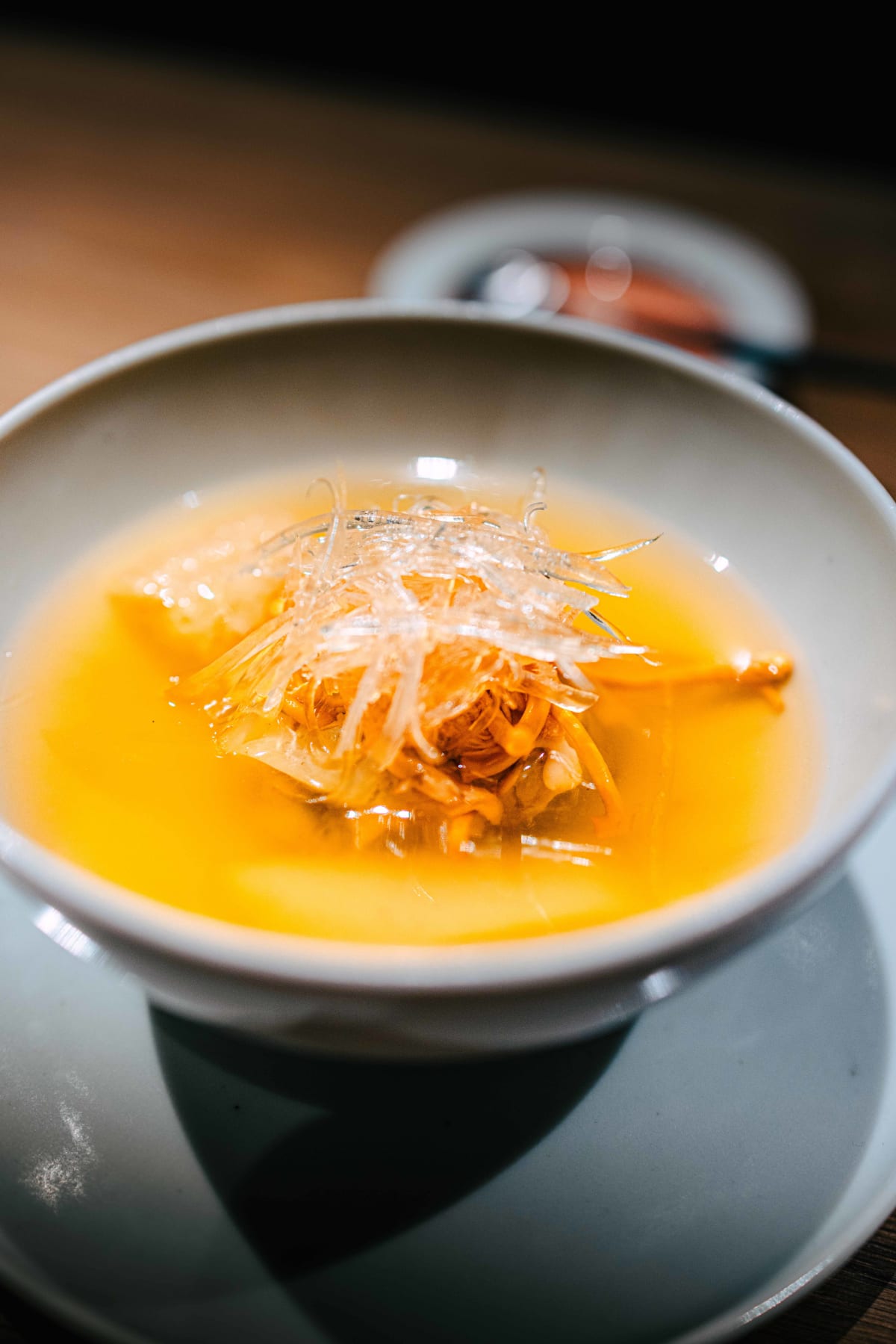
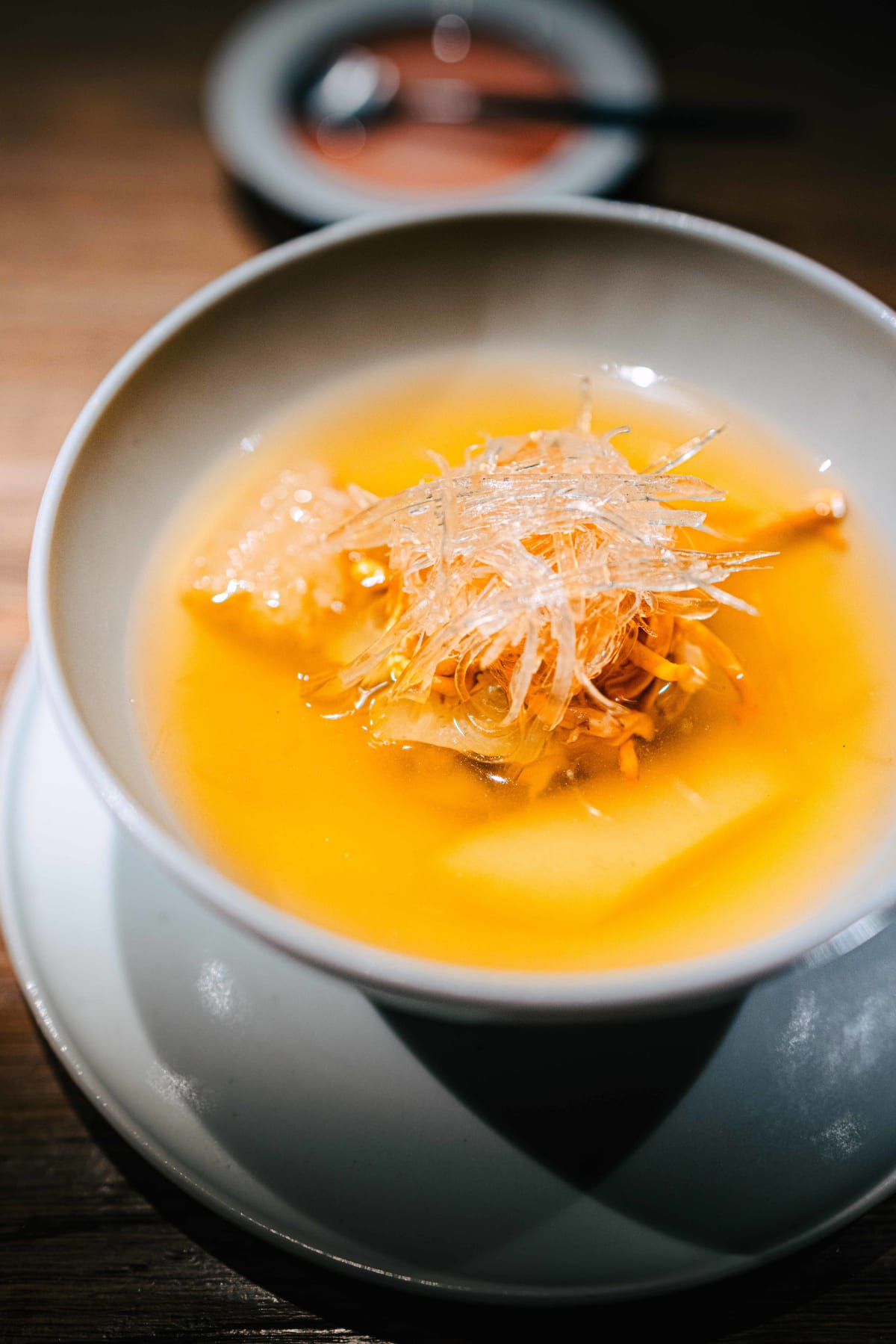
They also brought vinegar to stir in, and personally I preferred it without. April was on the early side for it, but it felt like a proper restorative.
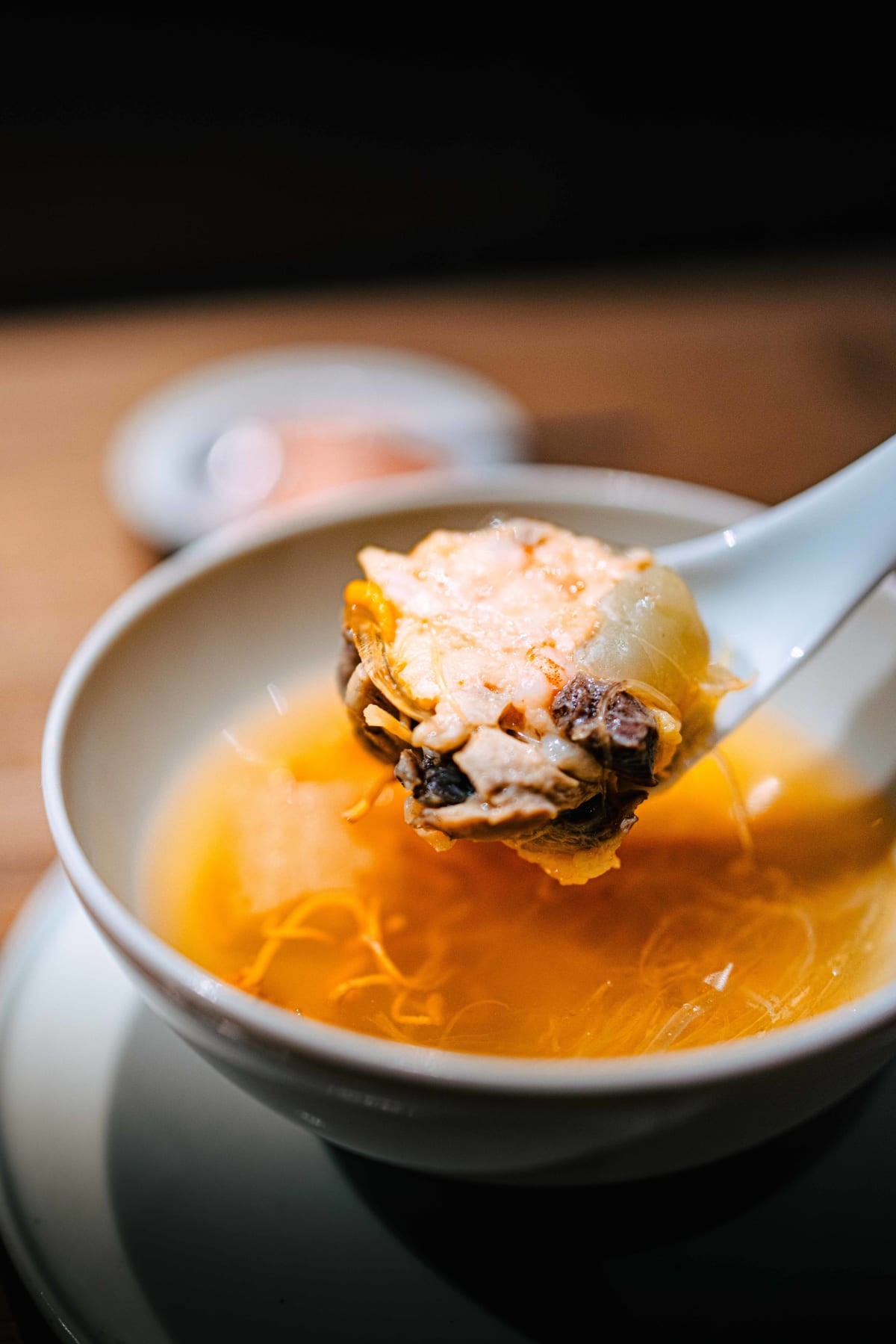
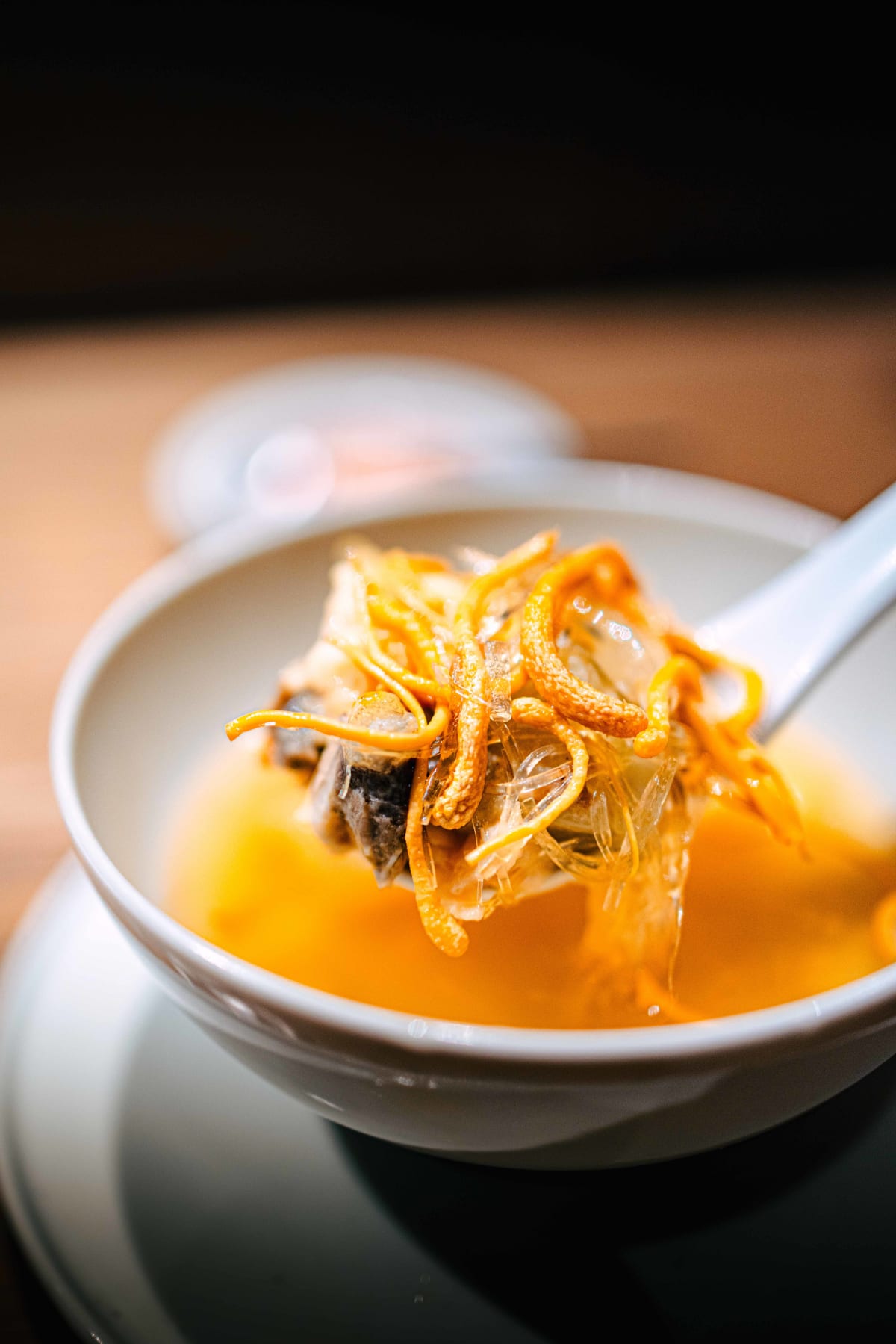
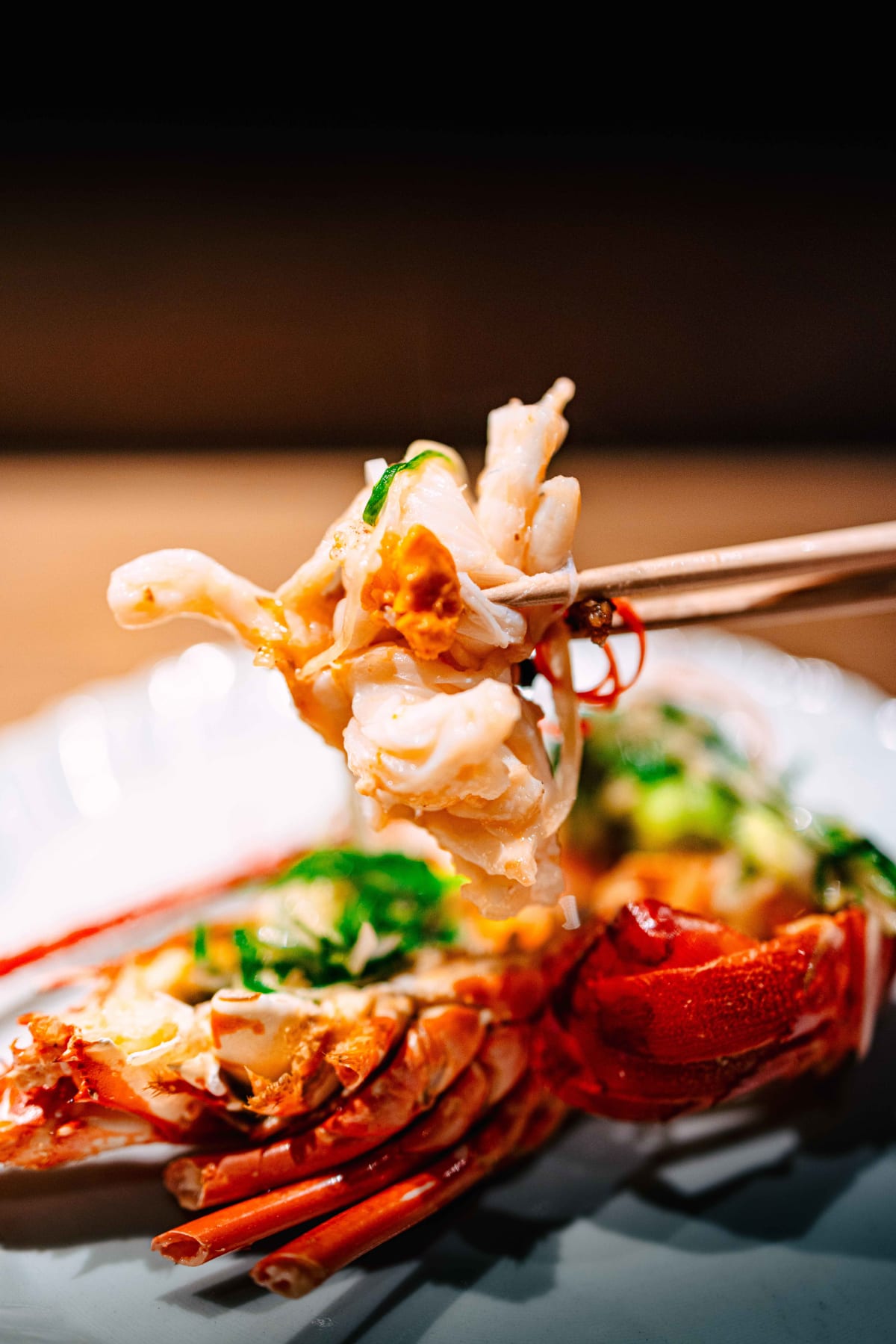
Steamed Ise Lobster with Chaozhou Olives and Soy Sauce (潮州欖菜伊勢龍蝦)
Next came lobster cooked in a Chinese style. From the explanation the lobster is steamed with vegetables stir-fried in a soy sauce laid over it. The description mentions Chaozhou olives, which are not olives at all but the fruit of a tree that grows in Southeast Asia.
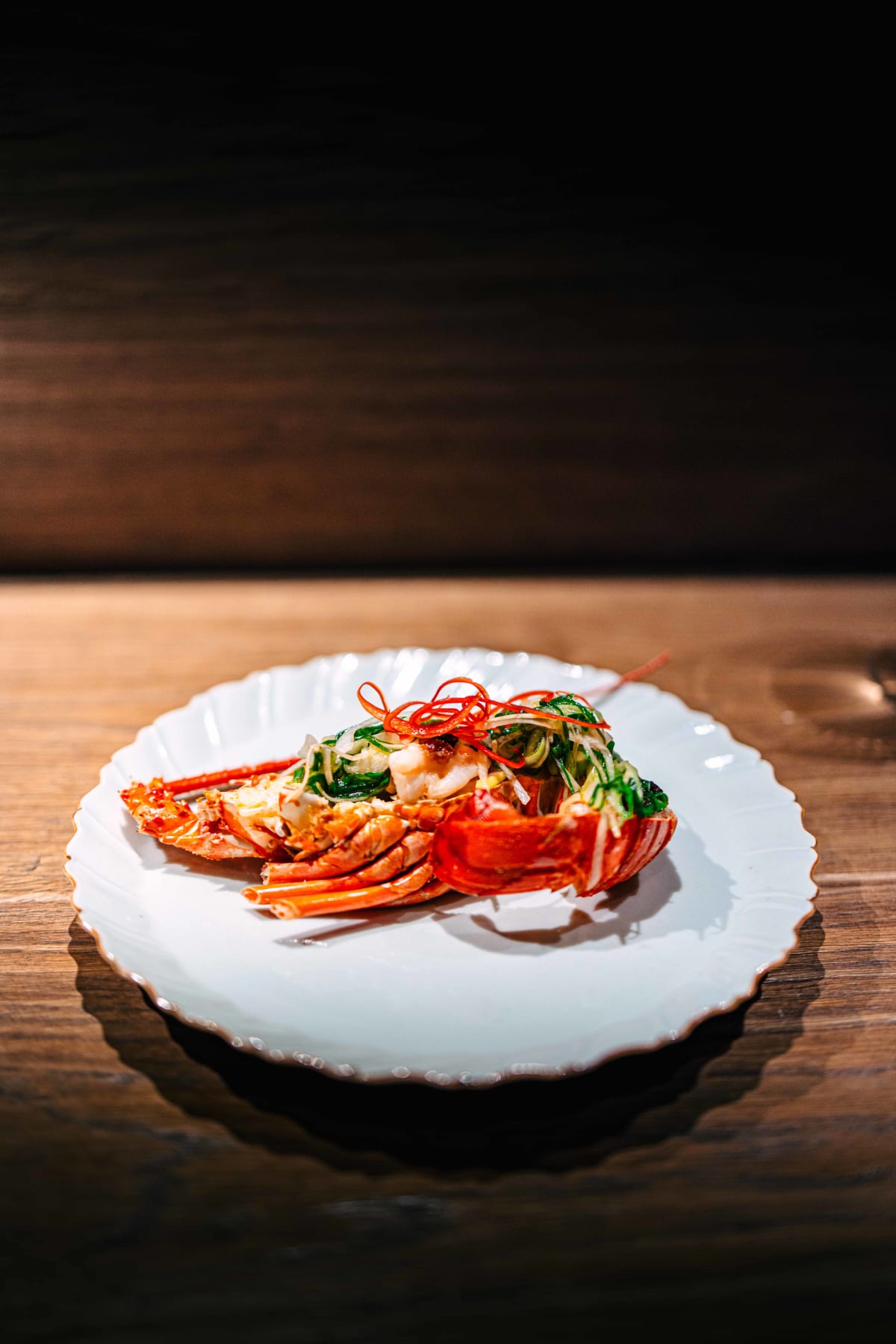
I did not pick up any distinctive flavour in the dish that made me stop and wonder what it was.
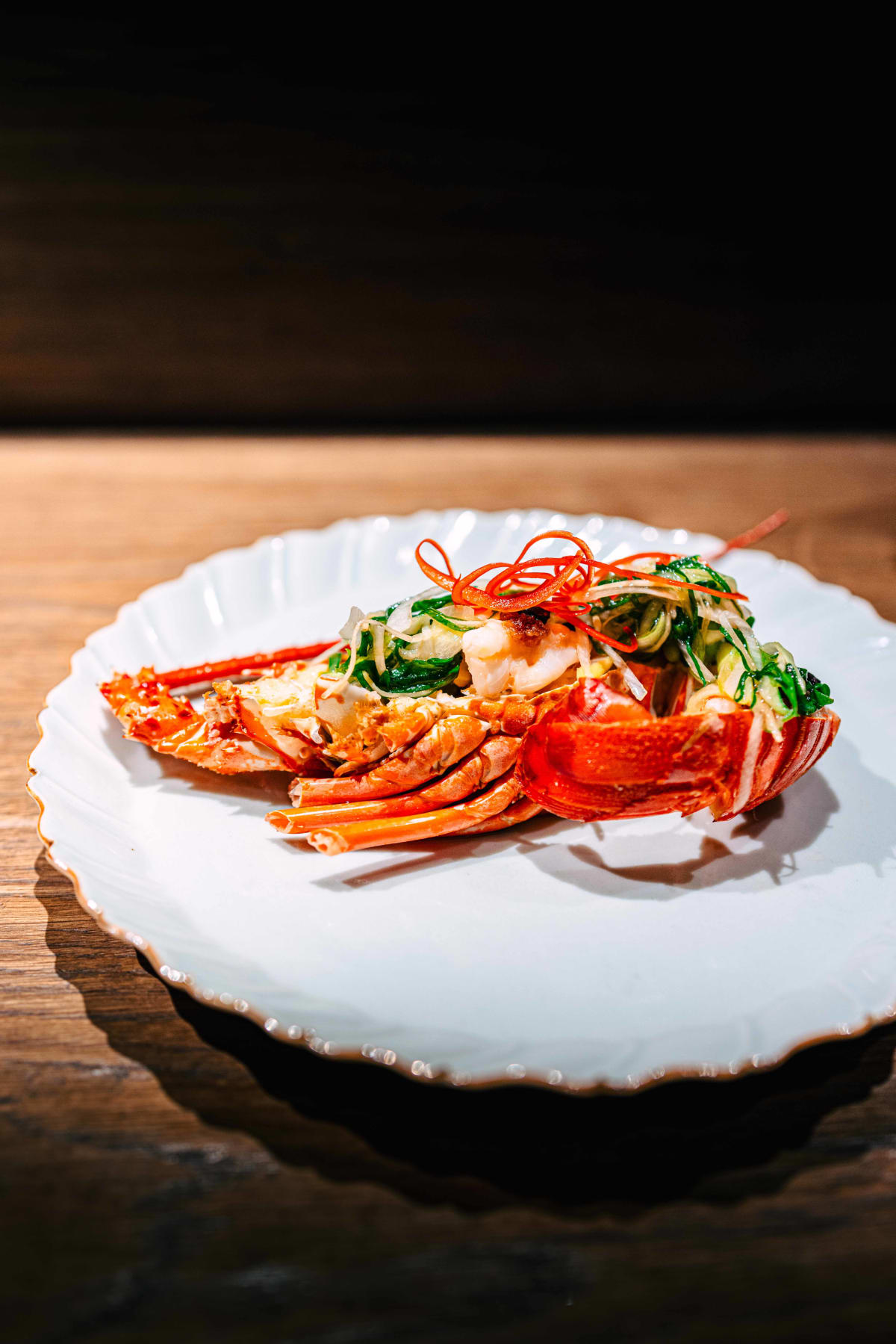
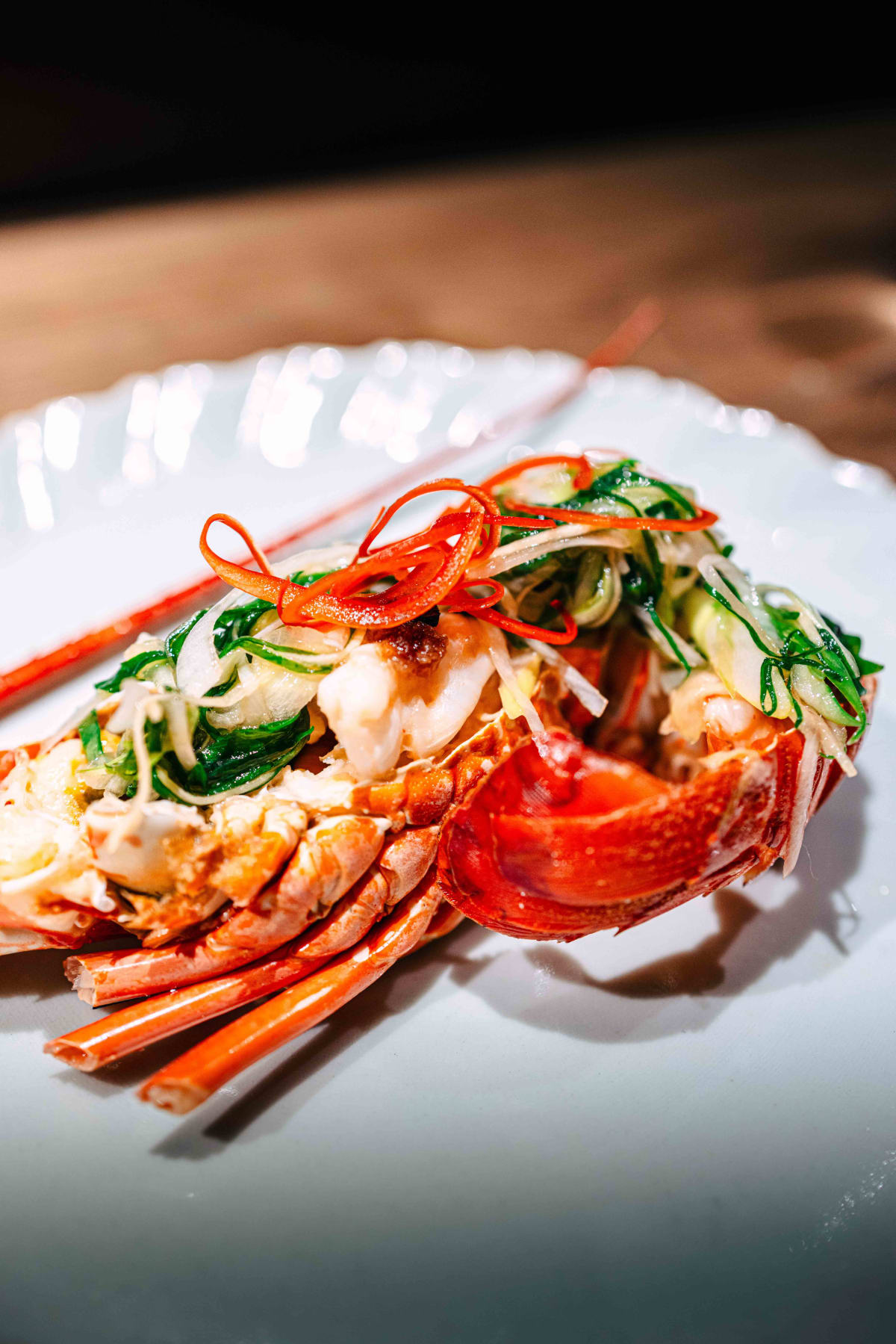
Getting half a lobster whole and eating generously was good, but it was not a memorable taste.
Section 13·Stock And Yellow Wine
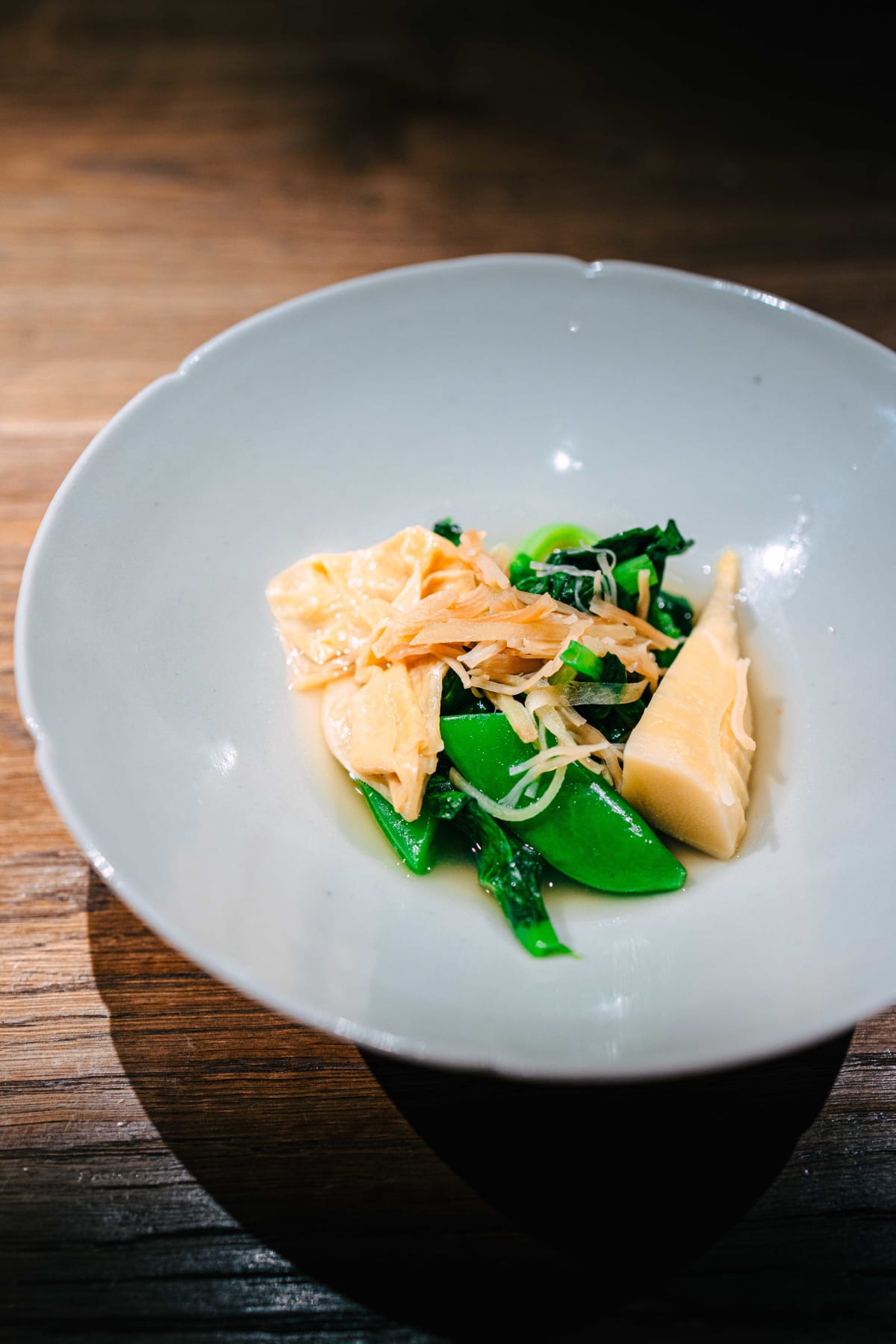
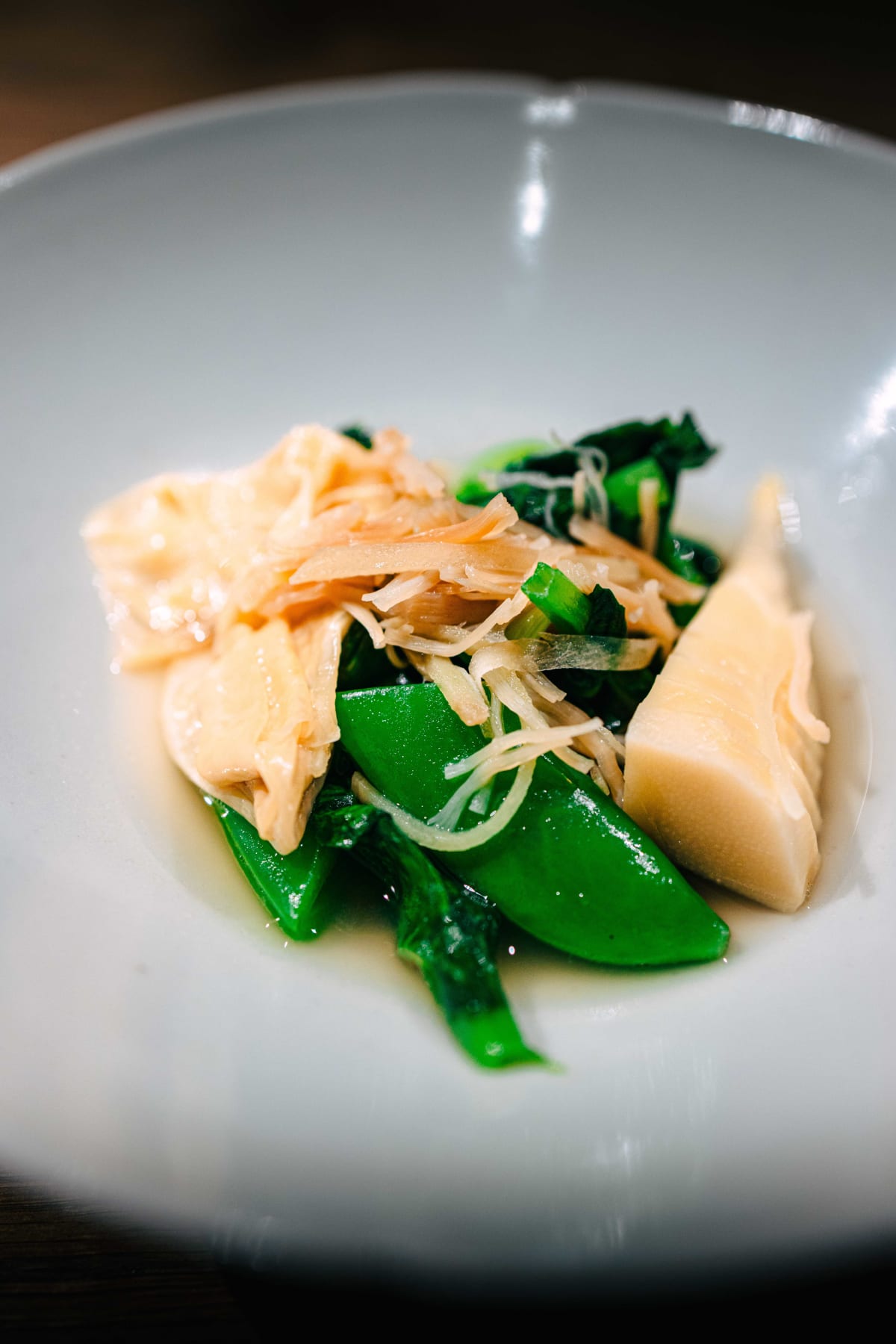
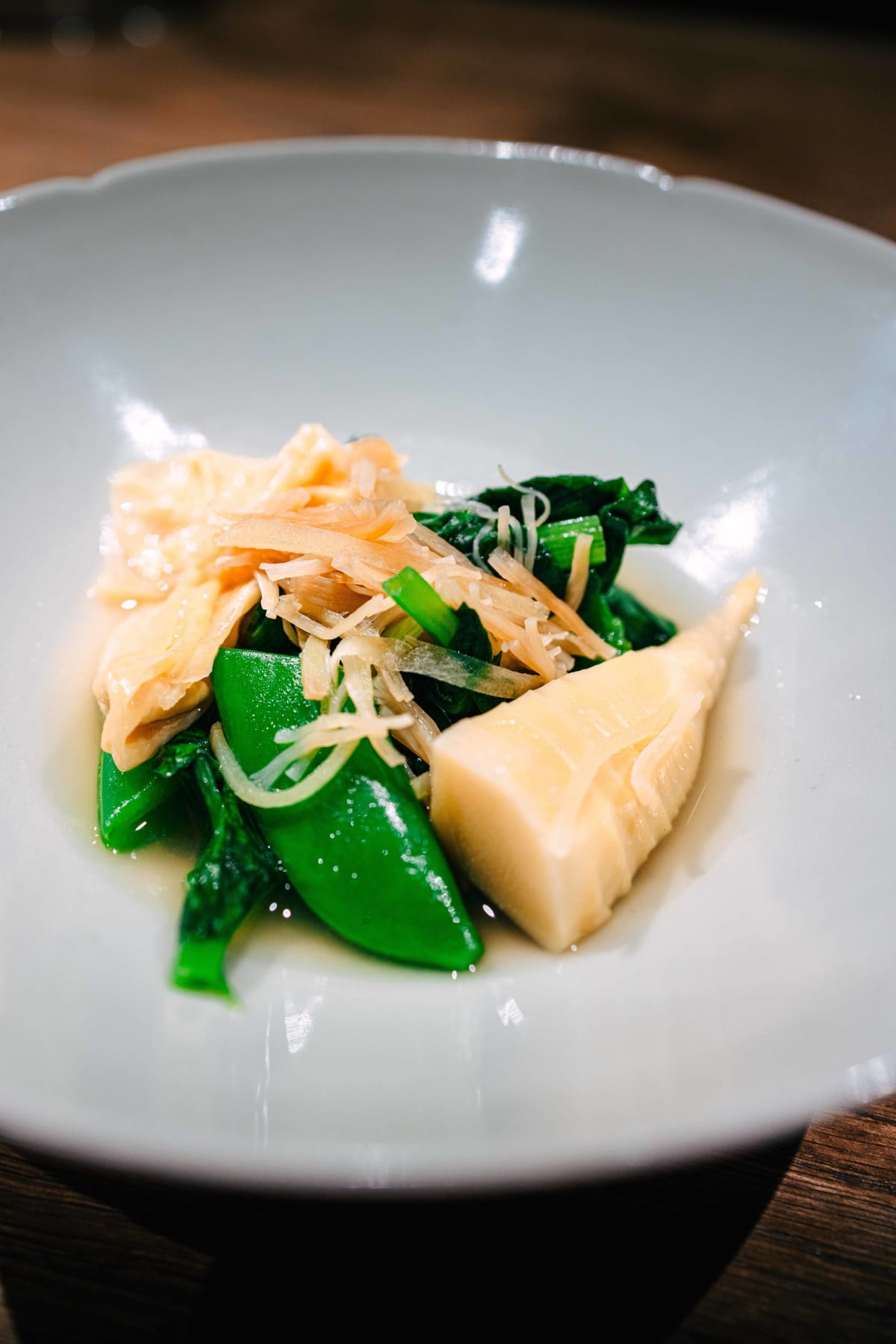
Sauteed Seasonal Vegetables in Chinese Stock (郊外油菜遠)
Next was a plate of seasonal vegetables stir-fried, with bamboo shoot in it and something like yuba as well. A similar seasonal vegetable dish had appeared at ShinoiS, and it made me wonder whether Chinese cooking treats seasonal vegetables as important.
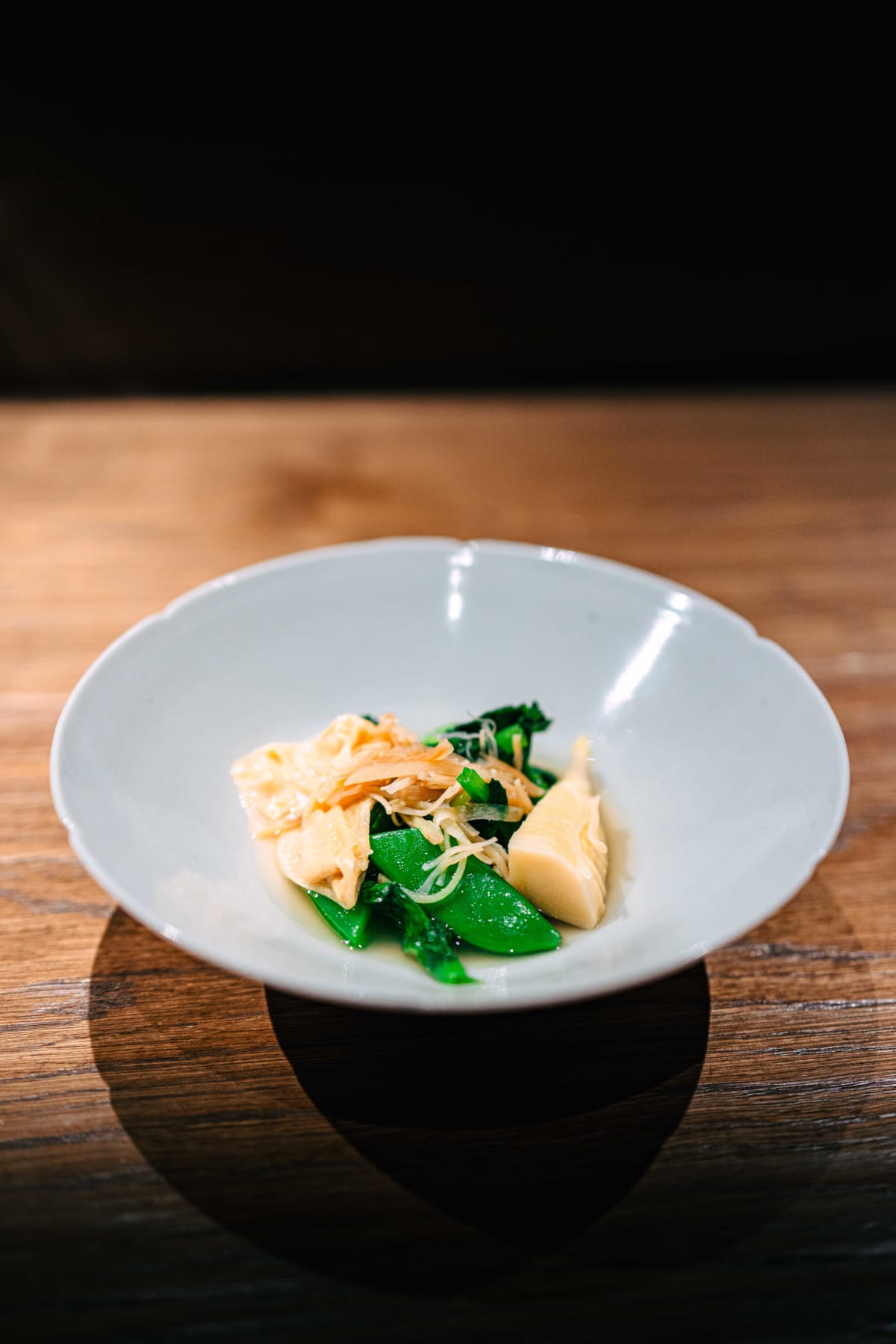
The taste was the predictable taste of a good vegetable stir-fry, but the combination of textures was excellent. Putting a range of vegetables in together let a real range of textures come together as you ate.
The Chinese stock written on the menu is seung tong (上湯). The base broth of high end Chinese cooking, drawn from chicken and Jinhua ham among other things, and if the heat is too high or it cooks too long it turns cloudy and picks up off flavours, while too weak and the flavour does not come out, so the chef checks its state almost constantly.
This broth is not used only in a single bowl of soup. It soaks umami into the jellyfish, or goes into the fried rice at the end in a small amount to add aroma and moisture, working as the invisible floor of the whole course. More than the showy expensive ingredients, the clarity and the finish of this broth show the level of a restaurant like this more accurately.
At this point I was running short on drink and thought about ordering one more glass, and I wanted a Chinese drink rather than wine. Looking at the list there was a twelve year old Chinese yellow wine I had drunk at Nan Ei Bi Shoku in Yokohama, so I ordered a glass.
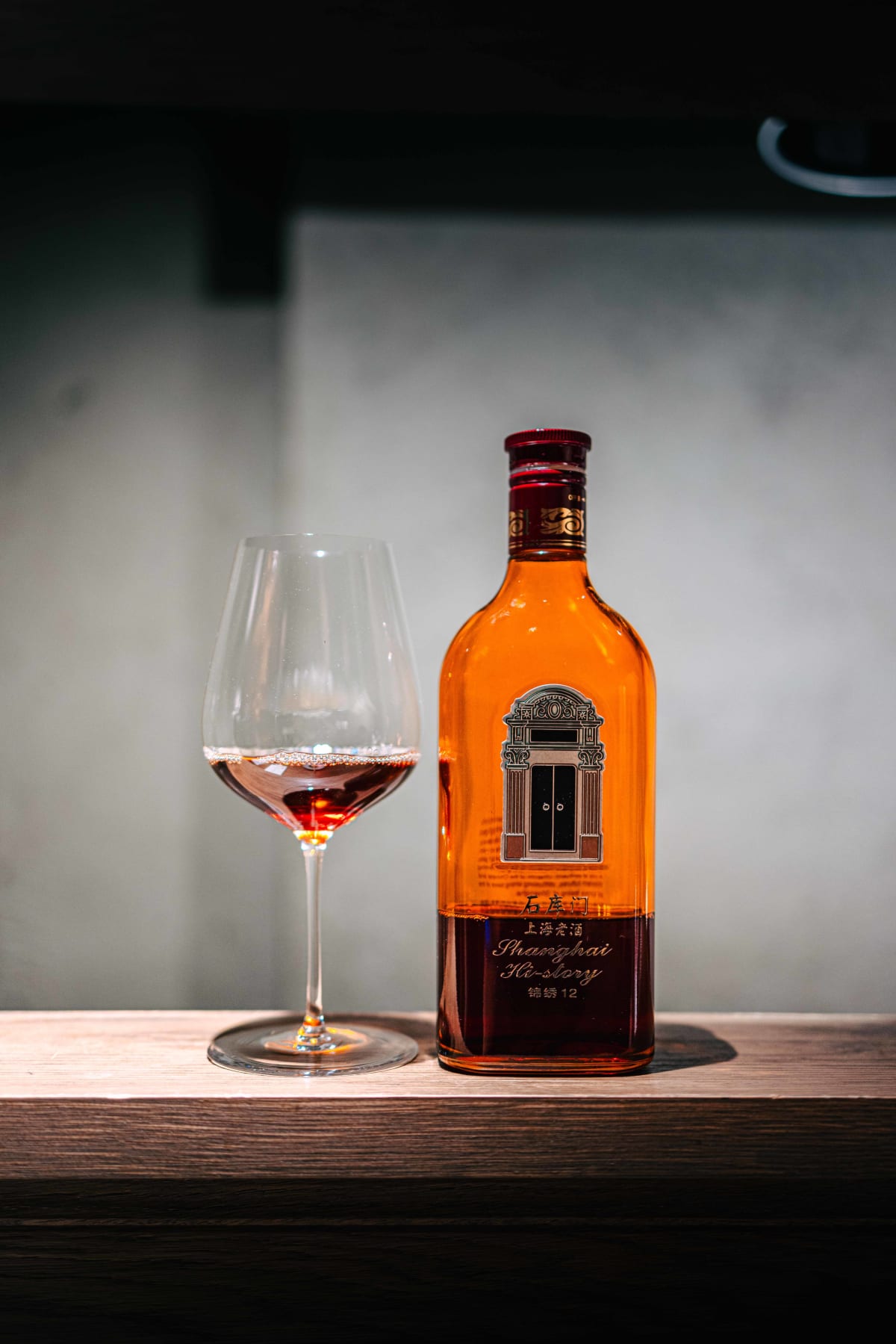
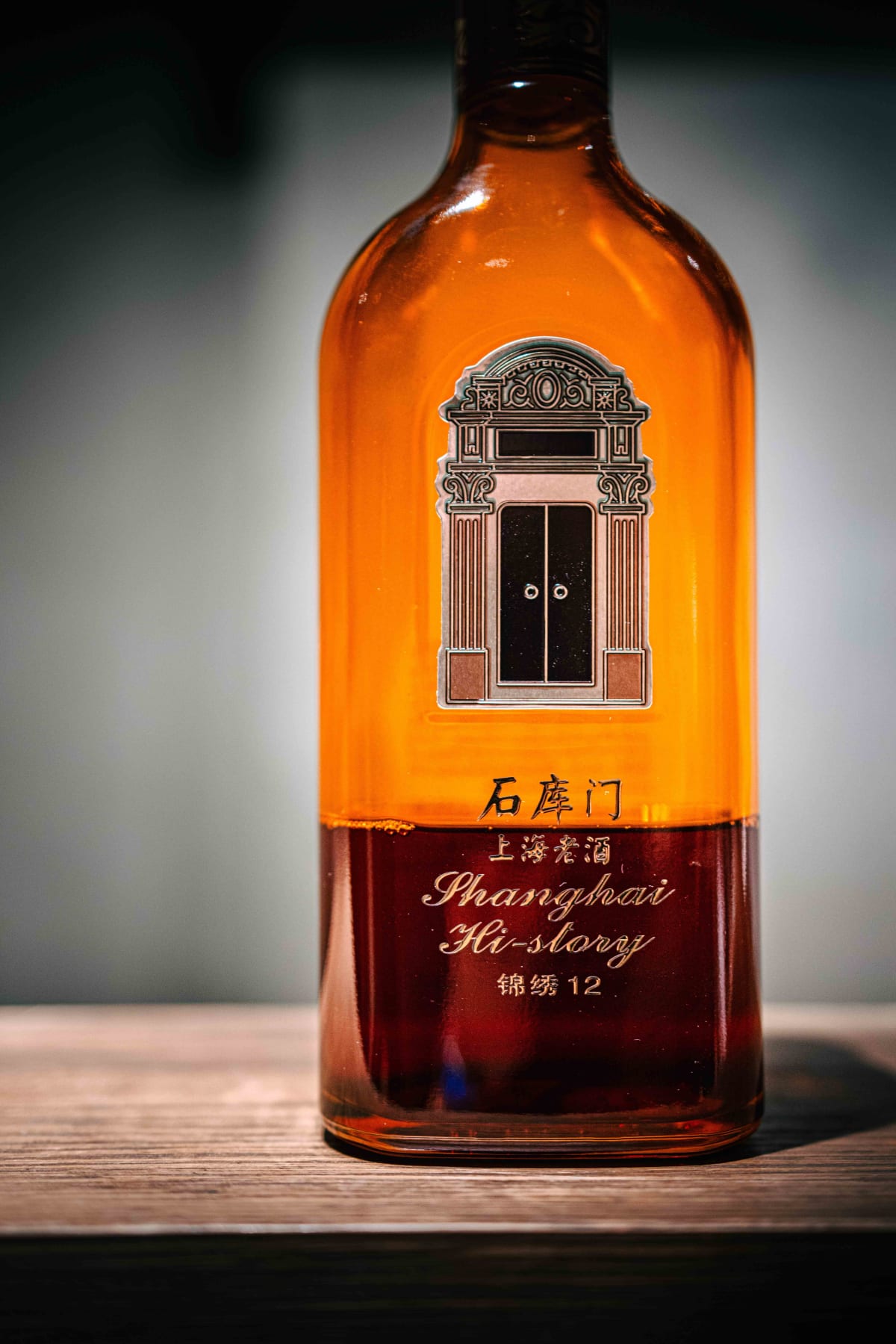
The formal name of this drink is 石庫門 上海老酒 錦繡 12 year. Shikumen (石庫門) is a hybrid Western and Chinese architectural style that appeared in Shanghai in the 1860s, meaning a door framed in stone. At its height nine thousand of them accounted for sixty percent of Shanghai's housing, and that door is drawn in the middle of the bottle.
It is not Shaoxing wine. Both belong to the huangjiu (黃酒) family and both are brewed from glutinous rice and wheat koji, but this one also carries honey, goji berry and dried plum. It sits at 12.5 percent and passes in Shanghai as the yellow wine the comfortable classes drink.
The taste is not fierce the way baijiu is, and a slight nuance of port came through, so I could drink it lightly and enjoyably. When I see it at a Chinese restaurant I should have it now and then.
Section 14·Hotpot With Sichuan
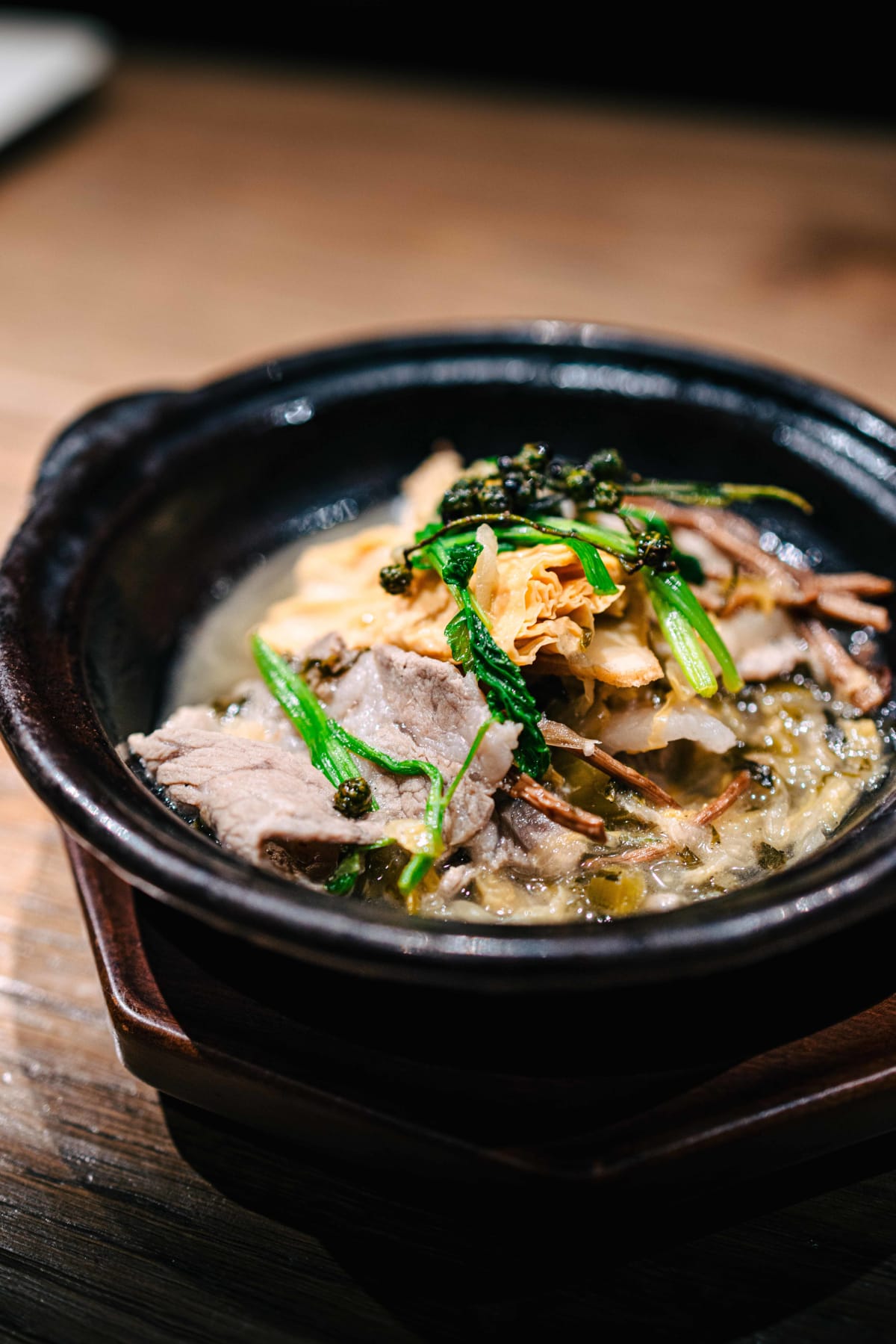
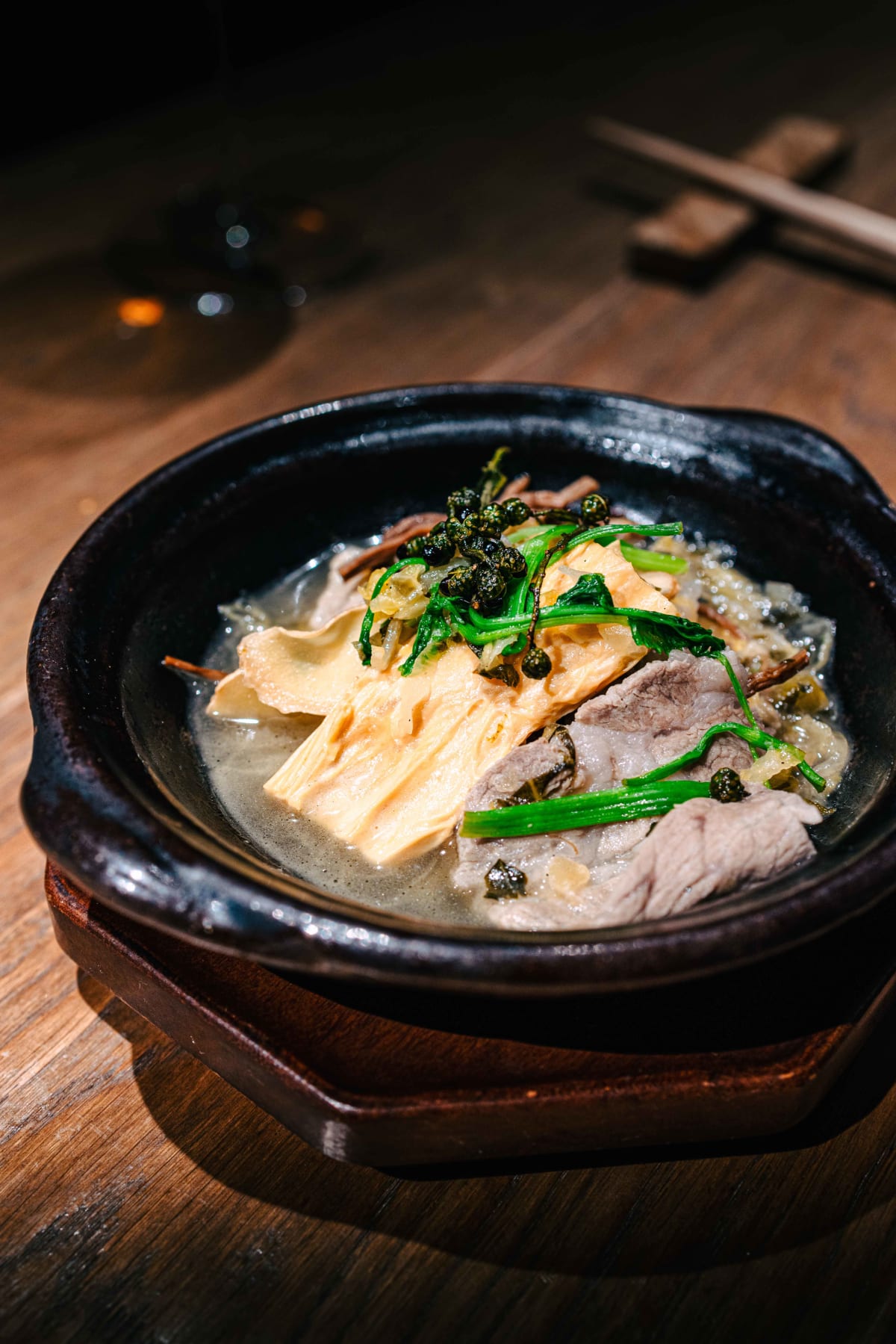
Hong-Kong Style Mangalitza Hotpot (酸菜匈牙利豬煲)
The last dish before the rice and noodles is a Hong Kong style hotpot. Inside the hot vessel were vegetables, yuba, pork, matsutake and so on, and importantly there was sansho on top. It was quite numbing, and the chef said that although the base is Cantonese he has also been influenced by Sichuan cooking, so a few dishes come out with this mala character.
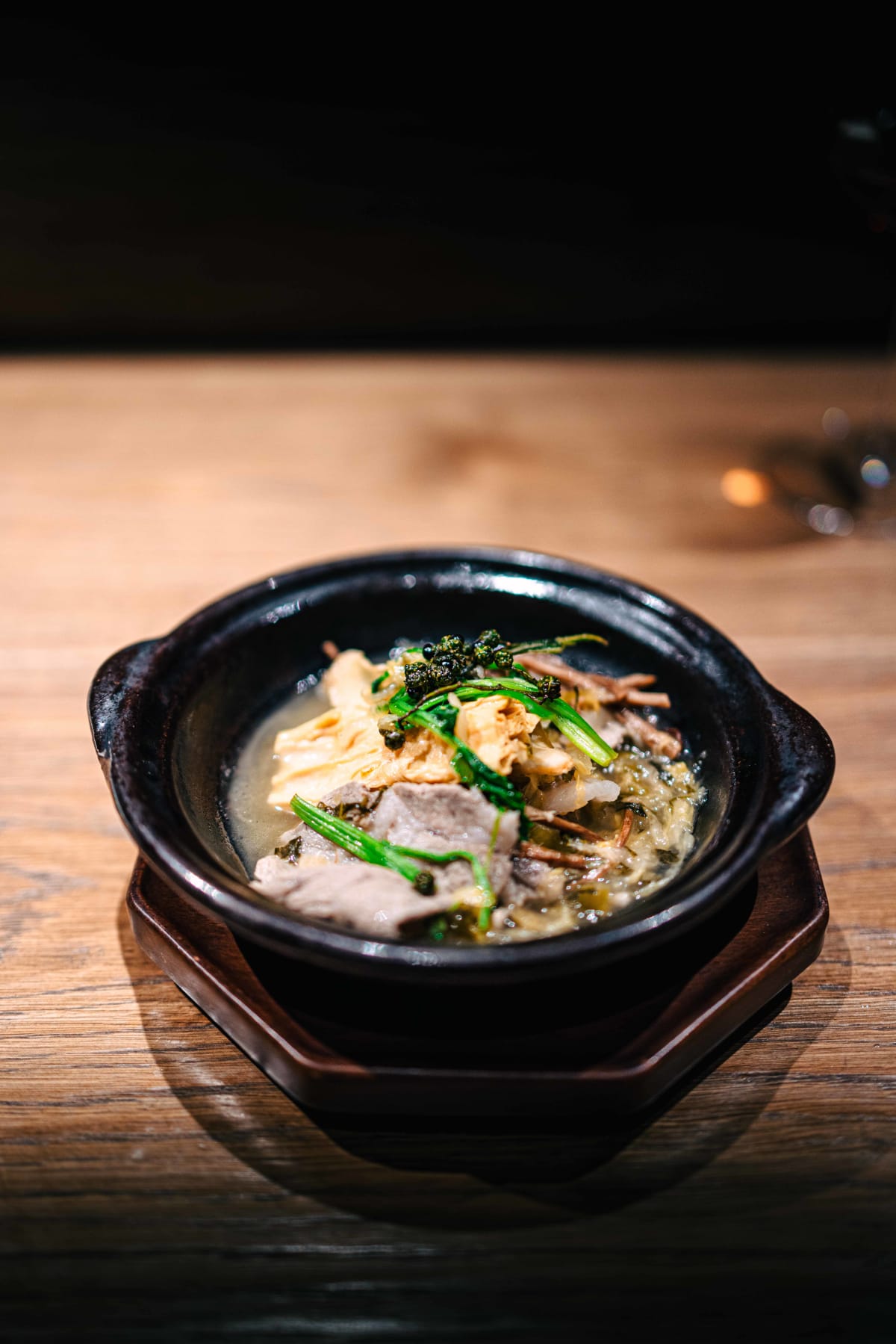
The name is 酸菜匈牙利豬煲. It means a pot of Hungarian Mangalitza pork simmered with pickled cabbage, and Mangalitza is a Hungarian heritage breed with a curly coat, known for the quality of its fat.
Sitting next to me that day was an American friend from Hong Kong who had also come alone, and we talked about a lot of things. He felt the food here does not read as authentic Hong Kong or Cantonese. It cannot help being adjusted to Japanese palates, so it will taste somewhat different from the complete original, the way we feel in a Korean restaurant abroad.
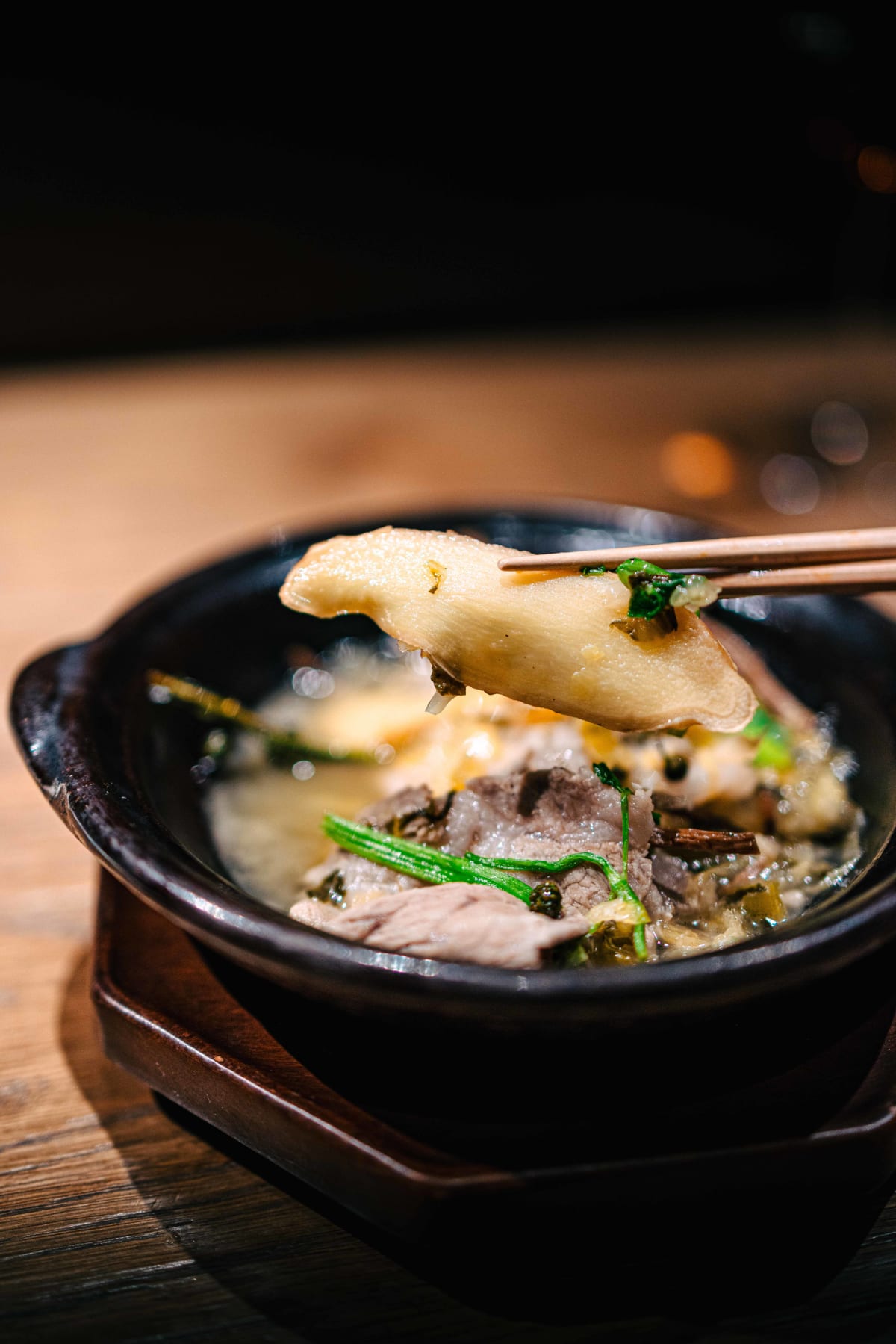
The numbing mala I had not expected surprised me, but the taste itself was good. The broth was good, the ingredients sat well together and tasted good, and where the dishes so far had read as high end Chinese dining, this hotpot felt like eating local Chinese food, which I liked.
Looking at the dishes at Ippei Hanten there is almost no heat, so the numbing quality in this last hotpot running against everything that came before also played a part in how much I enjoyed it.
Ending with the Hong Kong style hotpot, the rice and noodles begin. In truth eleven dishes had already come out before this and the portions per dish are not small, so it did not matter that the rice and noodles were not large, and I was already fairly full.
Section 15·Rice, Noodles, Sweets
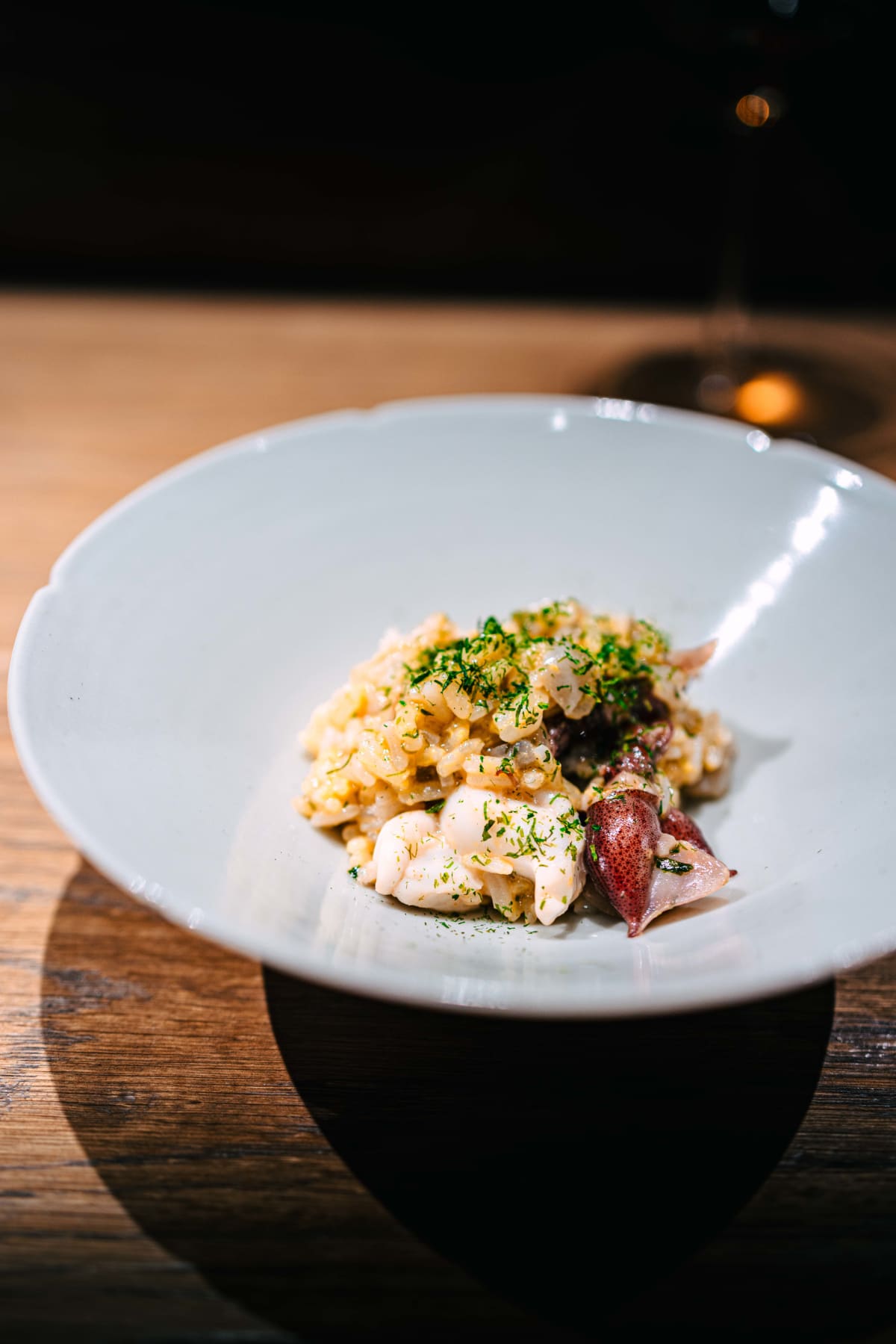
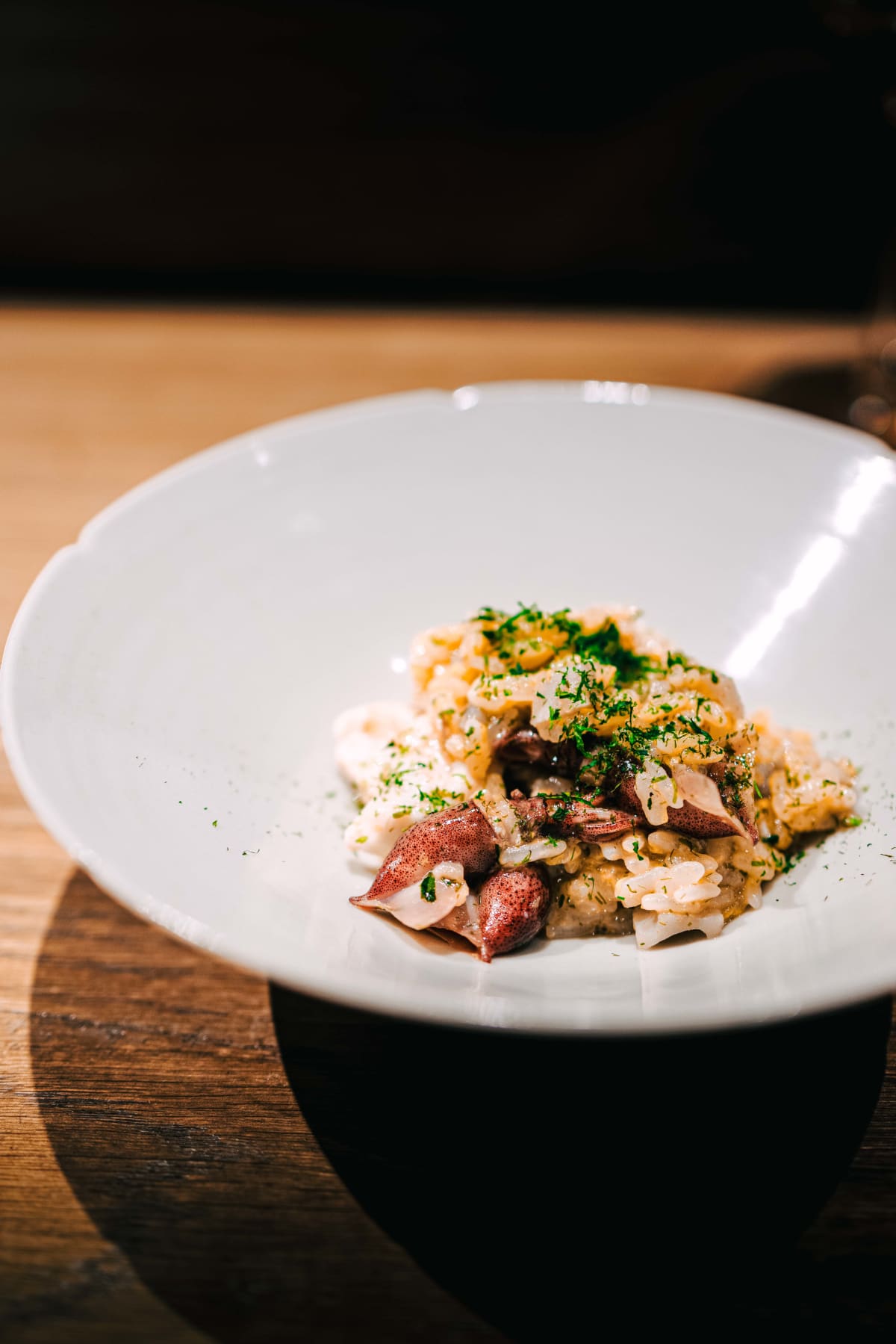
Twice-cooked Fried Rice with Baby Squid and Seaweed (螢光烏賊海草餡炒菜飯)
The first was fried rice, though the texture and the feel of what arrived were closer to risotto. Baby squid and seaweed were in it, and perhaps because of that it was a fried rice with the smell of the sea rising off it, like the paella I ate on the beach in Barcelona.
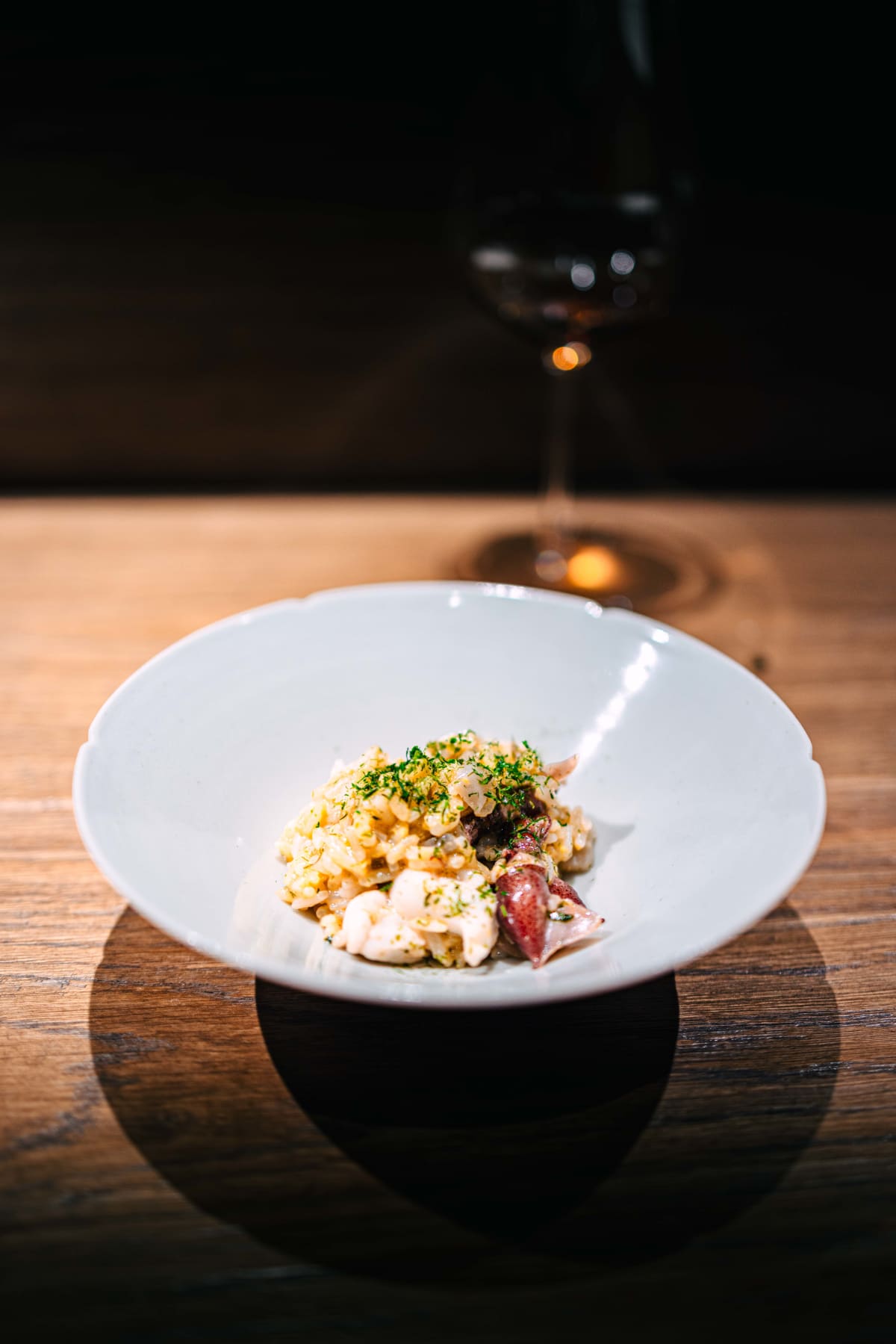
There were a couple of pieces of baby squid cooked properly, and the amount was exactly right. A solid plate.
Hot and Sour Soup with Rice Noodles (酸辣湯米粉)
The first was rice, so the second came as noodles. The first thing that surprised me on receiving it was the colour of the broth. Red. If the hotpot earlier had brought a sudden numbing heat, this one looked numbing before I had tasted it.
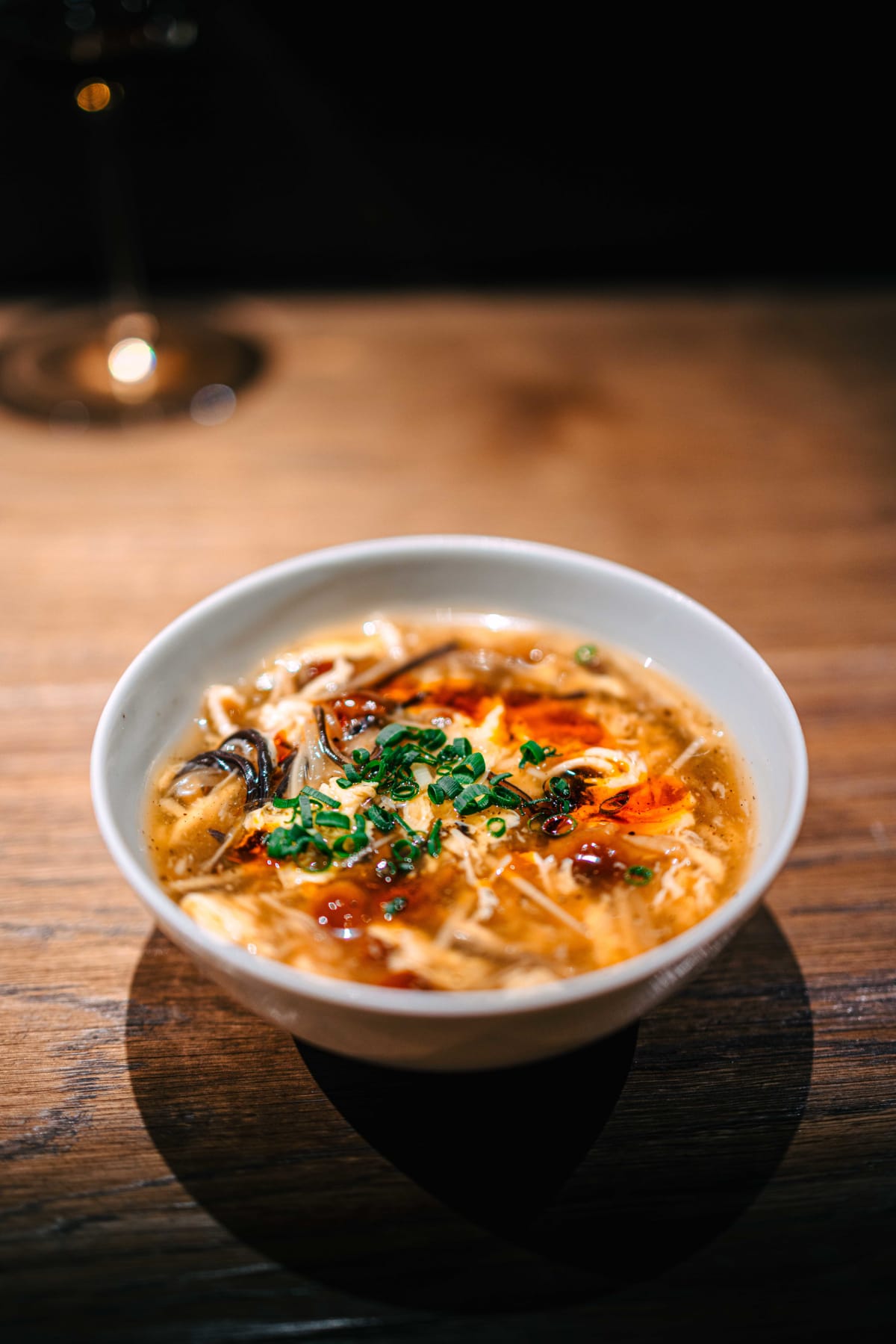
In the look of it and in the taste, what I felt on the first mouthful was that this is sanlatang itself, the thing you can eat at a Chinese restaurant in Korea. It turns out, and I only learned this while writing this up, that sanlatang in English is hot and sour soup.
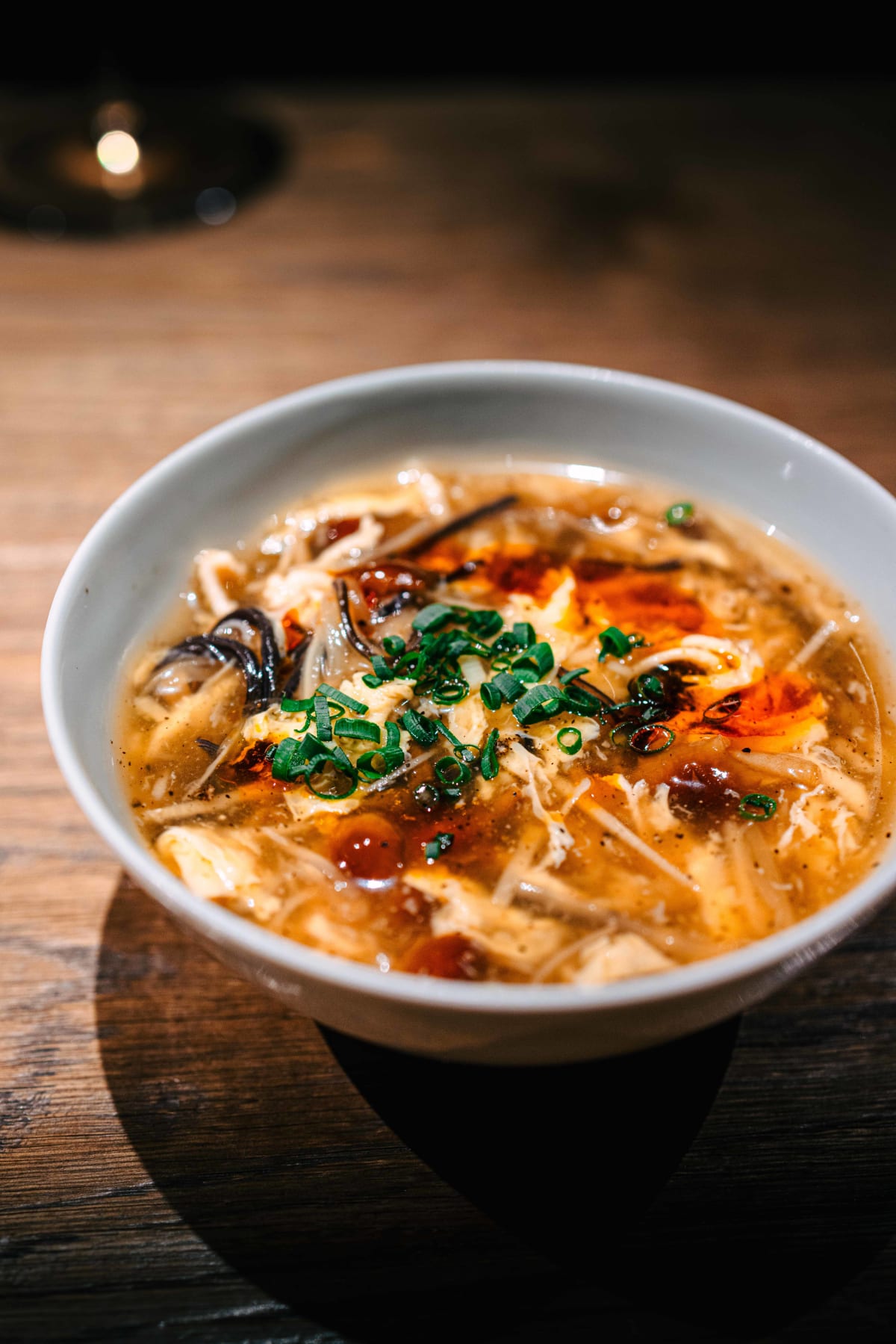
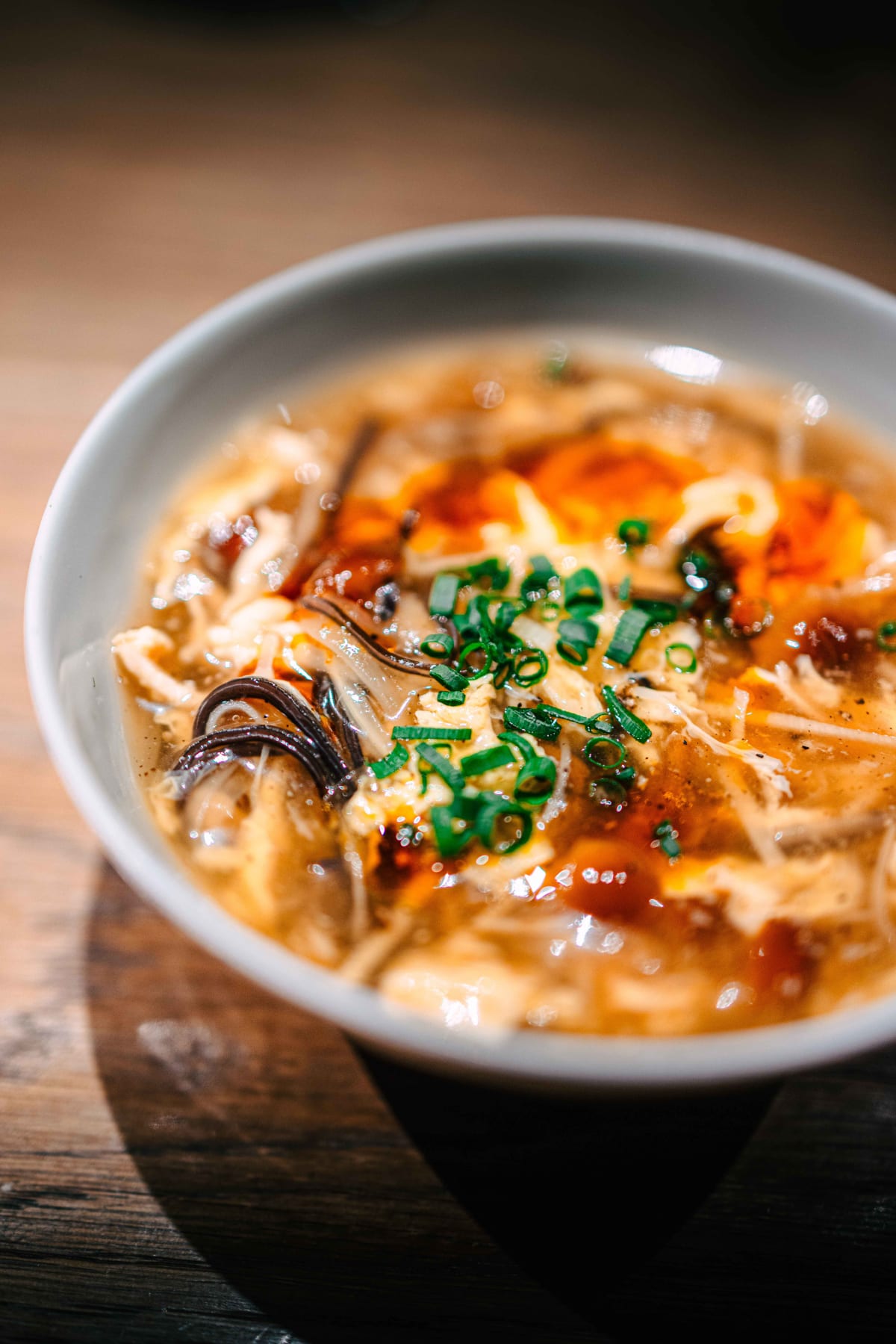
A familiar taste is a formidable thing. At Sandong Mandu in Mapo I would eat dumplings and other dishes and then a spoonful of sanlatang broth and it was good, and here too, eating sanlatang at the end settled the stomach and was very welcome. I finished this one down to the last of the broth.
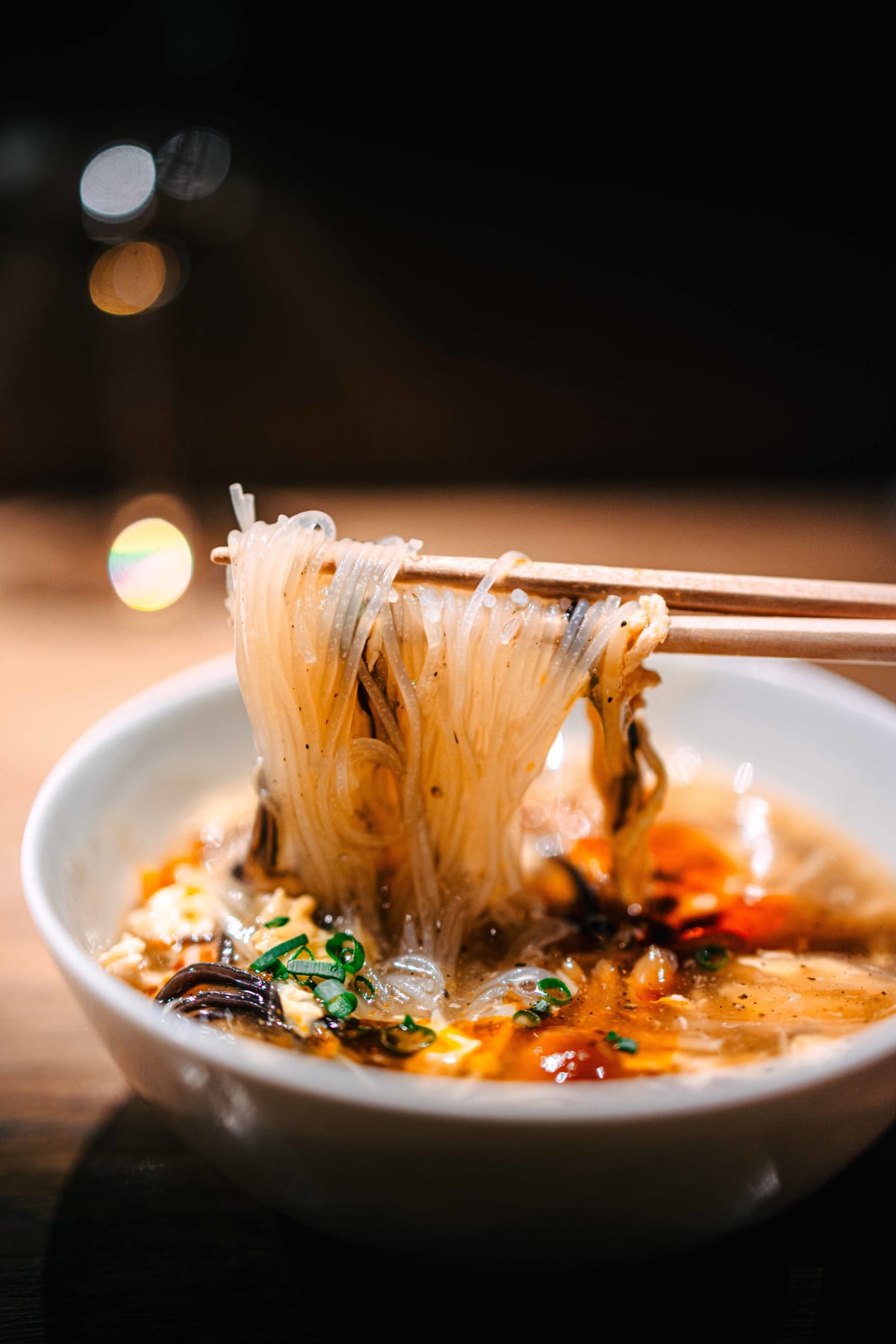
The noodles inside were unusual. Rice noodles. At a glance they looked like glass noodles, but the texture was clearly closer to rice noodle. Not the wide kind you get at a Vietnamese restaurant but a thin rice noodle, and I think this is the first time I have seen this form.
Compared with a Chinese wheat noodle, a thin noodle is better for this kind of rice and noodle service at the end of a course, filling you appropriately. So although it runs differently from a Cantonese course, I liked it and enjoyed the soup.
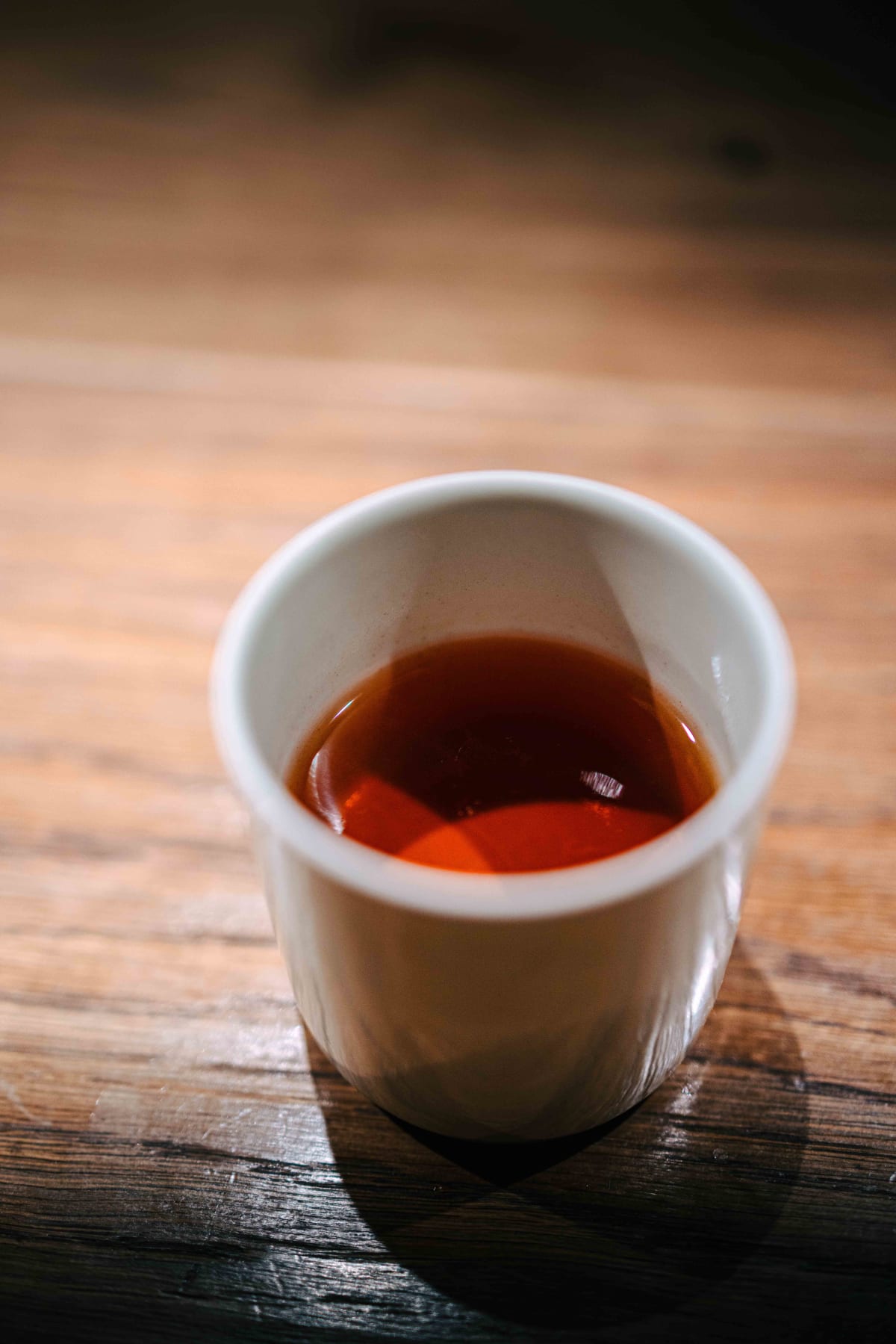
With the whole course and the rice and noodles finished, dessert came, and there were two. On the menu this slot is written as a single line, 甜品, Desserts of the Day.
The first was almond doufu. Written 杏仁豆腐 and also called haengin dubu, and since it is a dessert eaten in Japan as well as China it seems to have appeared this way.
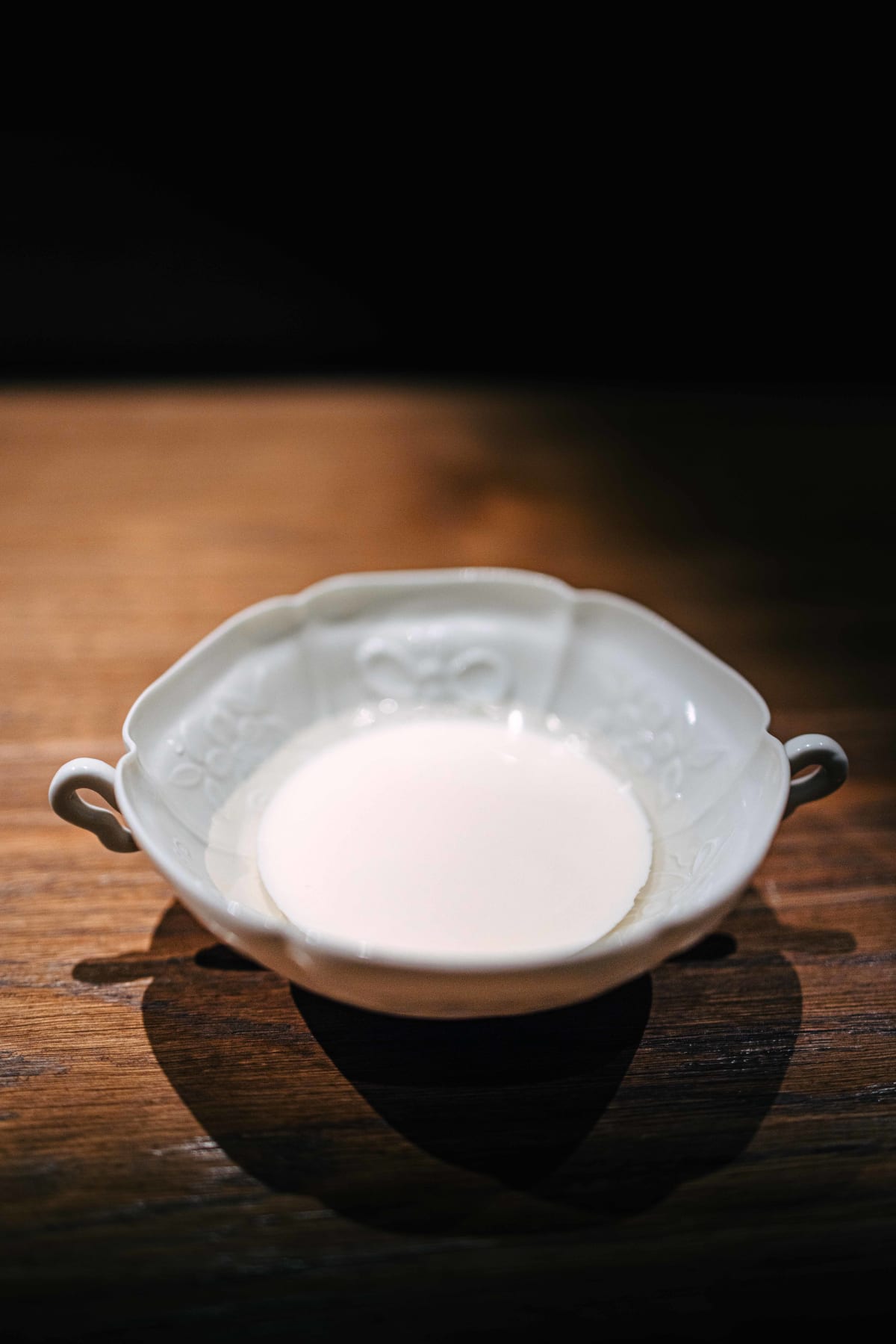
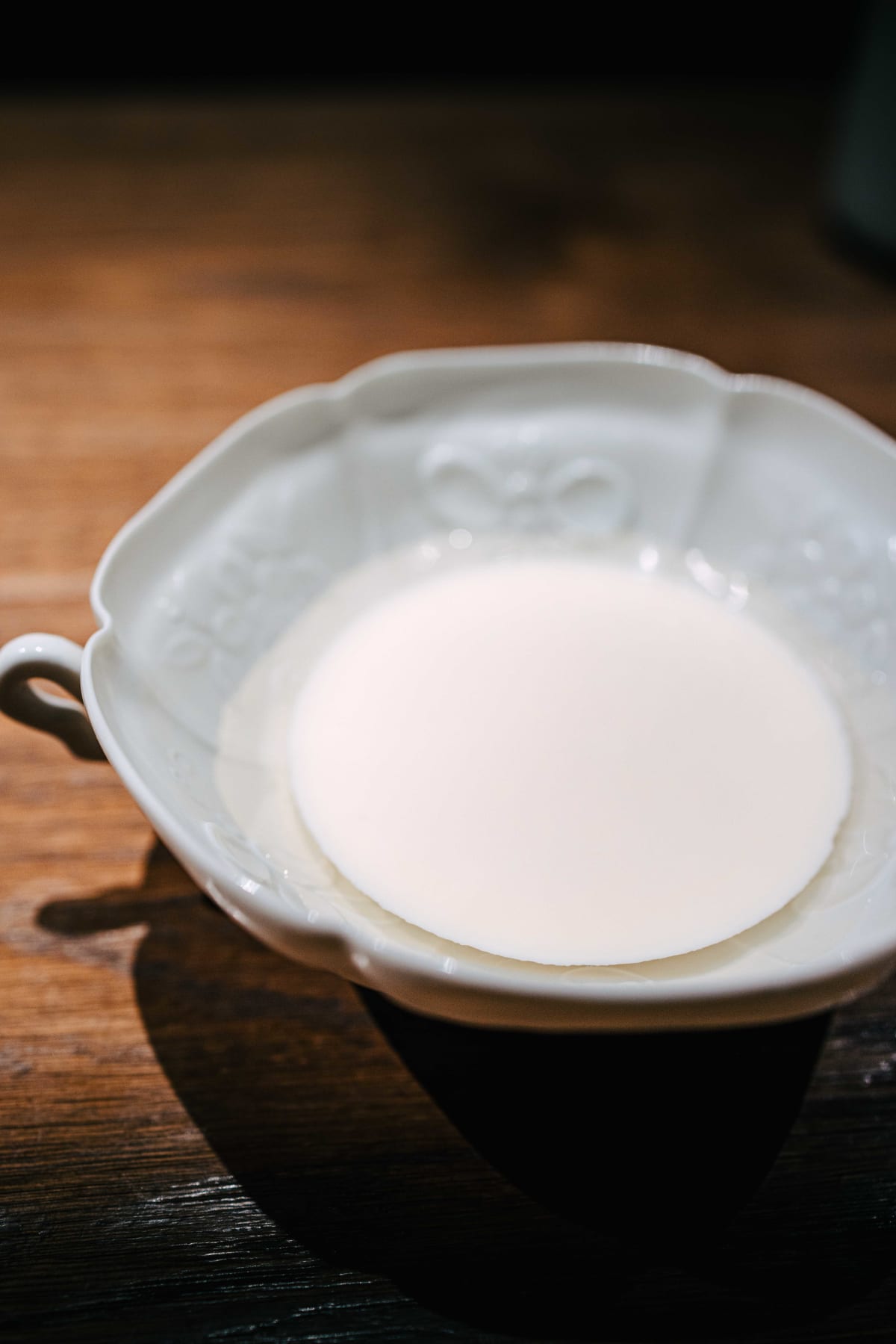
The shape was very neat, like a pudding or soft tofu, and it looked good to eat. What was interesting about the taste is that to me it tasted of pistachio. The temperature was slightly cold, which made it good as a first dessert to clear the palate, and I ate it with interest.
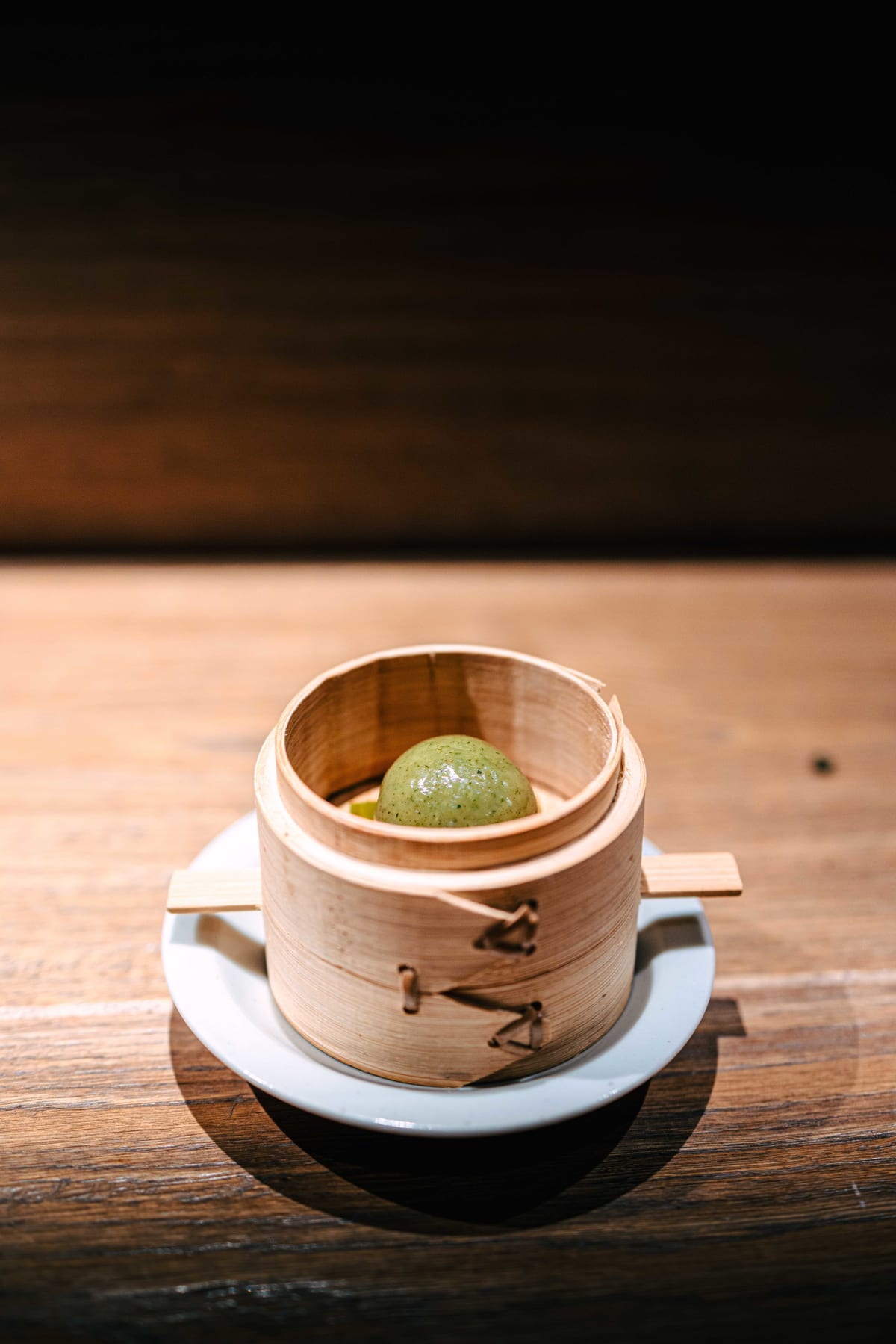
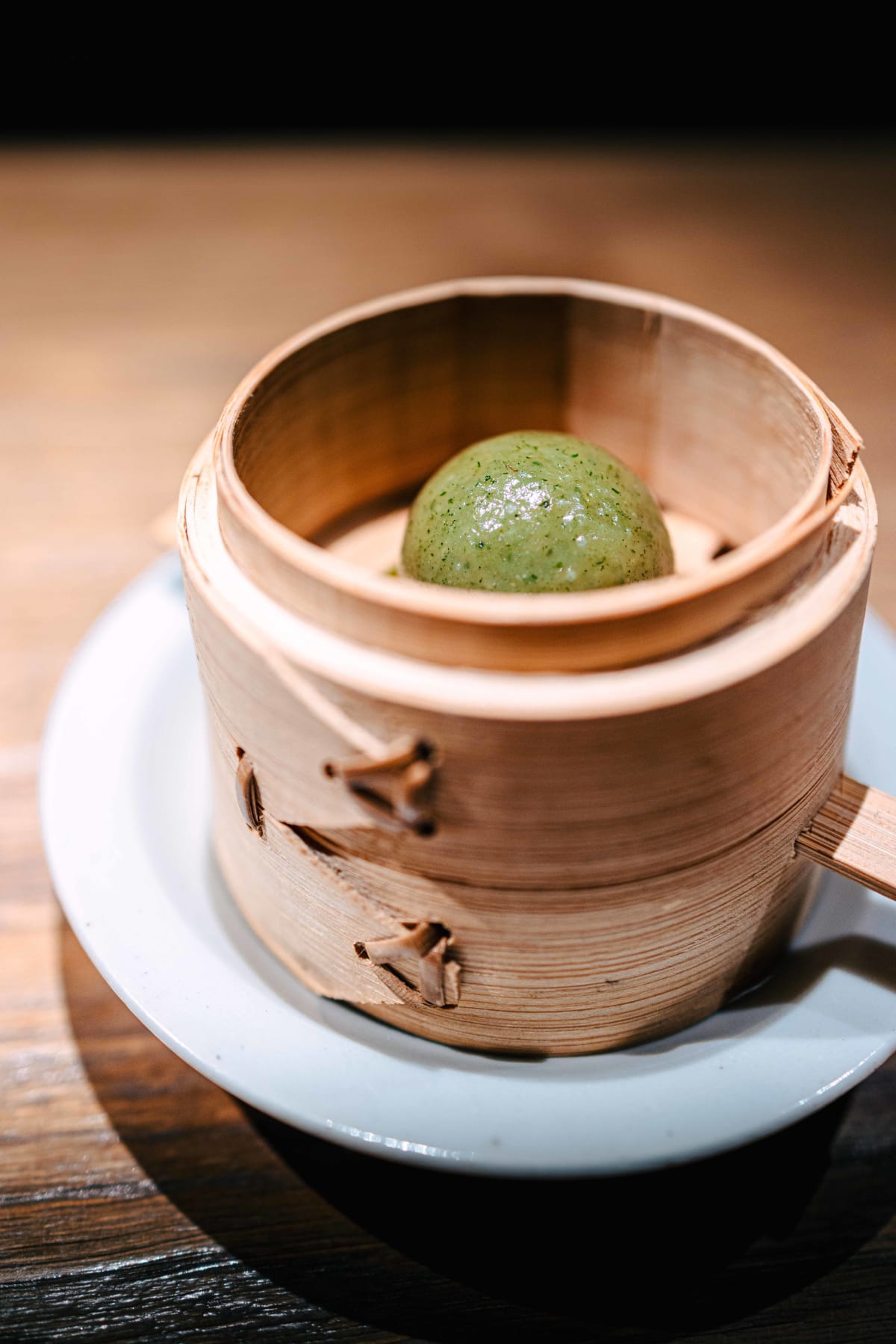
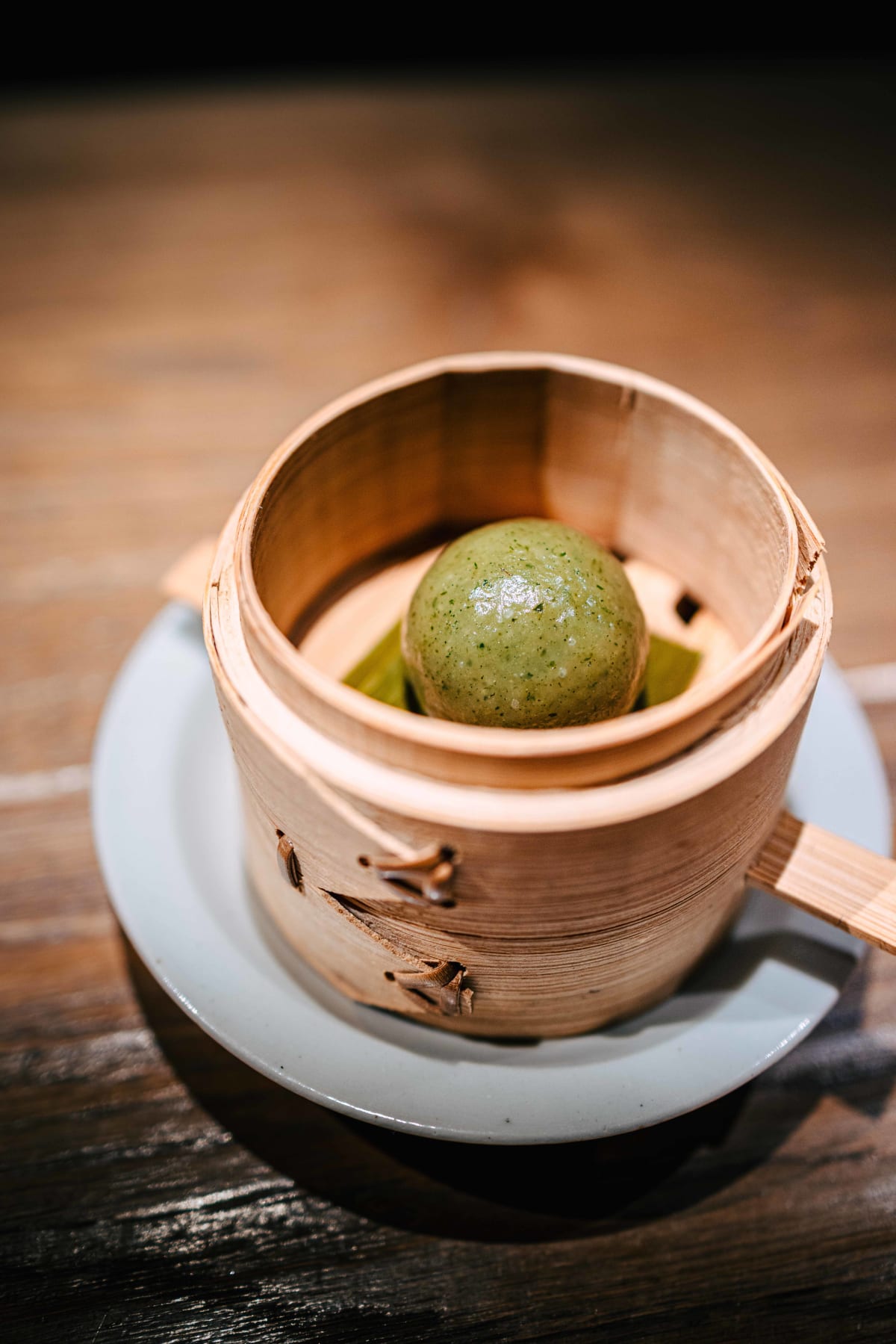
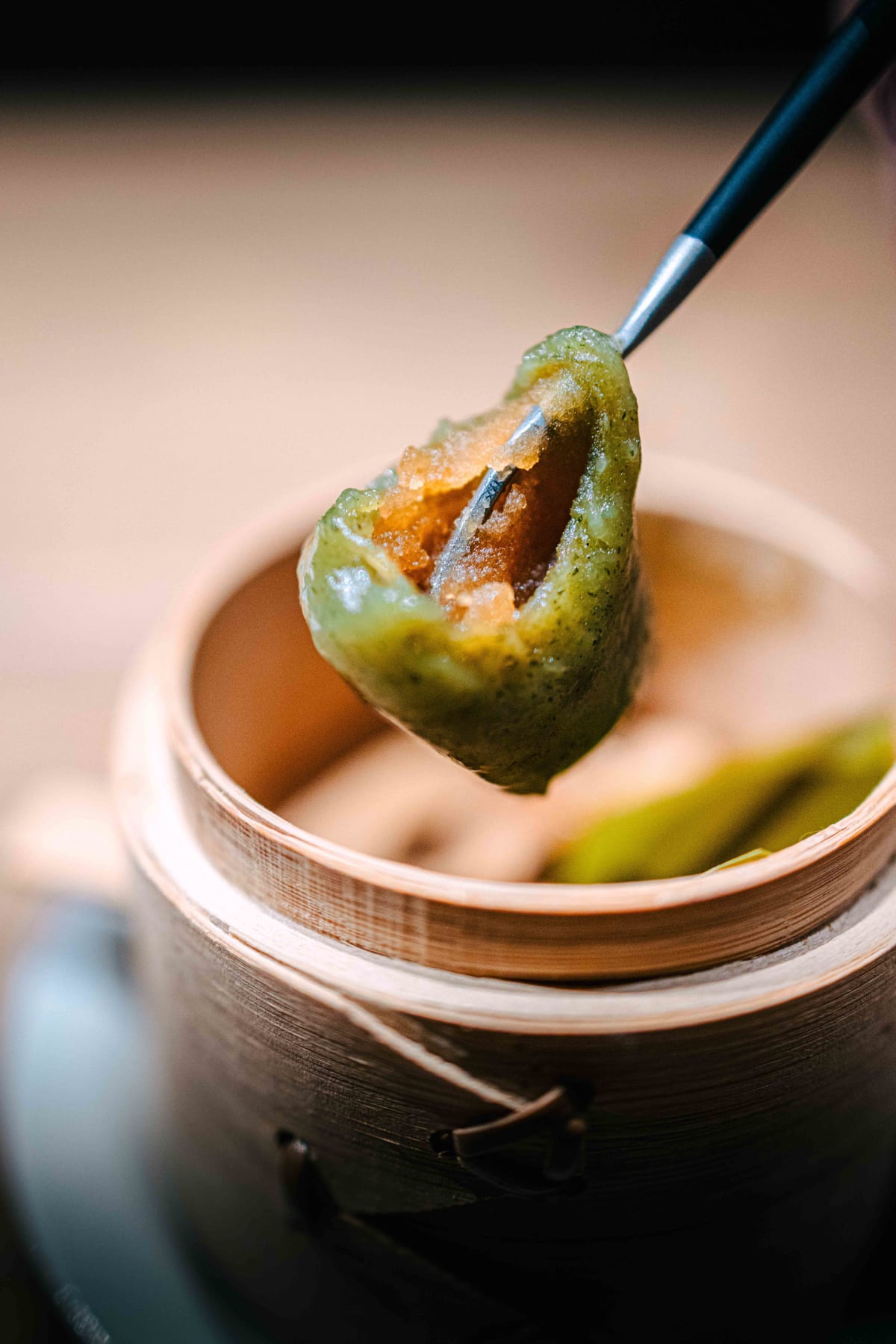
The second dessert was mochi. Chewier than a Korean chapssaltteok and with a feel that it would stick to your fingers if you picked it up, so pressing it with a fork pushed the mochi down until the fork went through. I bit into it and it was sweet and good. Inside was a filling the brown colour of apple jam, and the feel of the mochi was good and the taste of the filling was sweet and good. It felt very different from Korean rice cake.
By the time I am writing this I have been to a great many Japanese counter Chinese dining rooms, but at that point this was the second. Even thinking about it again now, I think Ippei Hanten, being the more direct in flavour among Japanese Chinese dining rooms, will land harder for people without much experience of Chinese food.
A lot of the ingredients used were good, and since the portions are not small I think the balance between the course dishes and the rice and noodles was right. Japan and Tokyo have more varied and better conceived Chinese restaurants than we do, and if you are curious about this Japanese style of counter Chinese dining, Ippei Hanten looks like a good choice for a first visit.
One thing to add. At nine in the evening this place trades under a different name in the same room, Ye Hong Kong (夜香港). Where Ippei Hanten is a course refined into many small plates, Ye Hong Kong pushes the seasoning and the aroma harder and serves Hong Kong style dishes on large platters.
The reason is that another part of what Adachi sees in Hong Kong food is the culture of several people sharing a big plate noisily. If the daytime Ippei Hanten is his Hong Kong cooking carried over into the style of fine dining, the night time Ye Hong Kong moves rather more directly toward the Hong Kong he remembers.
Sort the plates by what was meant to carry them and the pattern is immediate. Everything that disappointed led with an expensive ingredient: the grouper, the lobster, the giant clam buried under fried shrimp. Everything that landed led with depth of flavour: the soft roe under black vinegar, the rice sheet around fried yuba, the broth holding the turtle. Adachi's twenty five years are in roasting, dim sum and stock, and none of those is a shopping list. The menu is strongest where his career is and weakest where the ingredient is asked to do the work. Stay past nine if you can. The same room becomes Ye Hong Kong and serves the other half of what he remembers.
Have a question about this restaurant, or want to share your own experience?
Send a message