Fine Dining · Sydney · Australia / March 2025 / Good Food Guide 2 Hats (2025) · World's 101 Best Steak Restaurants #1 (2020)
Firedoor
"Sydney's wood only kitchen, where the fire is the whole argument"

Section 1·Student Before Master
Through 2025 I set myself one concept, one place, and made a sort of pilgrimage of it. The place was Asador Etxebarri, the legendary grill restaurant in the Spanish Basque Country. It has inspired countless grill restaurants around the world, still ranks high on the World's 50 Best list, and counts as one of the hardest reservations in Europe. Not by design, but over the same stretch I ate at Etxebarri and at both of its famous disciples. One of them is Firedoor here, the other is Txispa.

Firedoor came first, in March 2025. Txispa was seven months later, in October, and Etxebarri was the very next day after Txispa. So it was not a case of touring the master and then seeking out the students. I met one student first, then met the other student and the master across two days a long time afterwards. The me sitting in Firedoor in March did not yet know what kind of house Etxebarri was, and was working backwards from the fire in front of me to that original.

Etxebarri owes its global standing mostly to chef Arginzoniz, but if you name one more person it is Lennox Hastie of Firedoor. Born in England, he built a career across several Michelin restaurants in Europe before growing sceptical of cooking that leaned on technique rather than on the ingredient itself, and around then he heard about a place in Spain that cooked with fire alone.
The me sitting in Firedoor in March did not yet know what kind of house Etxebarri was, and was working backwards from the fire in front of me to that original.
Section 2·Five Years At Etxebarri
The chef's name is Bittor Arginzoniz. The career Hastie grew sceptical of was built in Michelin kitchens in England and France. Struck by what he had heard, he wrote a letter himself, joined as an apprentice and stayed five years, folding the fine dining skills he had accumulated into the cooking at Etxebarri and helping carry the restaurant out into the world. He did not simply put in shifts there. He holds a real share in Etxebarri going from a local name to a global one.

The city Hastie chose after going independent was Sydney. His reasons were that it sat apart from the established gastronomic culture of Michelin, which made it a good place to test his own philosophy, and that good timber and fresh produce were abundant. Firedoor also opened as a woodfire restaurant with no electricity and no gas, cooking on burning wood alone, and it went to number one on the World's 101 Best Steakhouse list and became one of the most talked about restaurants anywhere.


Hastie did not open a place of his own the moment he landed in Sydney. After returning in 2011 he joined forces with the Fink Group, who run Quay and Bennelong, and it was under that partnership that he opened Firedoor in 2015. In 2022 he opened Gildas, a Basque style wine bar a few minutes' walk away. Taking full ownership of both came only in 2025. Independence in the real sense was completed not at opening but ten years after it, and the year I visited was that year.


Section 3·Two Hats, Not Three
The number one placing on the World's 101 Best Steak Restaurants came in 2020 and 2021, two years running. Michelin has not come to Australia, so the working standard is the hat awarded by the Sydney Morning Herald's Good Food Guide. In the 2023 edition Firedoor held the top rank of three hats along with NSW Restaurant of the Year, and in the 2025 edition, the one in force when I sat down in March 2025, it held two. The three hats in that same edition went to four houses: Quay, Sixpenny, Oncore by Clare Smyth and Saint Peter.
I had seen the Firedoor episode of Netflix's Chef's Table and decided I had to go. I was late and the bookings were full, but the place is large enough that once I joined the waitlist the calls came often. So I got in on the last day of an Australian trip, and I came away from a fairly memorable dinner.
Section 4·A Dark Street
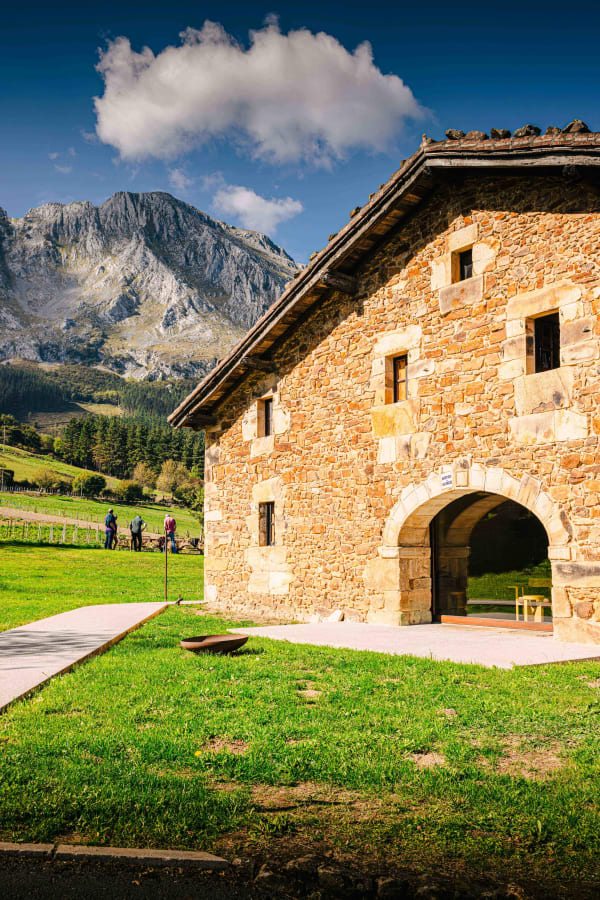
Surry Hills, near Central Station rather than the Opera House end, on a dim street where you find yourself asking whether there can really be a restaurant here. Inside it is quite large and mostly tables, but there is a counter, and I asked for the counter so I could take photographs. There is one drawback particular to the counter seats at this restaurant. The wood fired kitchen sits directly in front of you and it is intensely hot. At first I sweated enough to wonder whether eating was going to be possible, but I adjusted quickly and enjoyed the meal.


The menu is a seven course tasting including dessert, with three add-ons: oysters, the signature smoked caviar, and the 200+ day dry aged beef. I took all of them. For drinks I went with the Firedoor wine pairing, and in a very Australian way the cocktail programme is good enough that there is a separate bar next door, so take whichever suits you.
Section 5·Ninety Five Percent Fire
The drinks programme at Australian restaurants is a feature in its own right. In a country with famous wine regions, the lists at any sizeable place tend to run reasonably deep, and whether through British influence they take beer and cocktails seriously too, so signature cocktails are common. Saint Peter, which I had been to earlier, was the same. Firedoor went as far as putting a separate bar next door, and the wine list took the top three glasses rank at the 2024 Australian Wine List of the Year Awards.

I ordered the pairing, five glasses at 195 Australian dollars. Before the pairing began I ordered a glass of Mount Majura Vineyard's The Silurian 2022. A traditional method sparkling of Chardonnay and Pinot Noir from the Majura Valley in the Australian Capital Territory, in the Canberra District. The name Silurian comes from the geological age of the rock the vineyard's soil derives from.


Limestone laid down in the Silurian, 430 million years ago, was covered soon after by the Ainslie Volcanics, and movement along a fault running through the valley mixed the two layers. In 1971 Dr Edgar Riek, one of the first to plant vines in the district, picked out the limestone on an east facing slope from a geology map, drew a parallel with the Côte d'Or and planted there. In a house that cooks on wood alone, the meal opened with a glass named after 430 million year old rock.

Section 6·Oyster And Trout Roe
The first add-on, before the tasting proper, is the oyster. Australia loves oysters enough that every restaurant has them, and the interesting part is that no two places have served the same style. Every restaurant adds its own point to them, and this one does too.


Here it is an oyster from Pambula in NSW, an area known for clean water, with desert lime, seaweed oil and house made trout roe on top, given a smoky note from juniper wood. The pop of the trout roe was superb in texture, and the brightness of the lime held down the salt and the richness of the oyster well. The smoke though. Perhaps because an oyster is such a strong ingredient in itself, I could barely detect it.

What goes on top gets called caviar, but it is not the sturgeon roe we usually mean. It is trout roe. It shares a name with the smoked caviar that comes next and is a different thing entirely. The oyster itself I thought was excellent in terms of complexity.


Section 7·The Smoked Caviar
The second add-on is the smoked caviar, one of Firedoor's signatures. Chef's Table covers this dish in detail, so it is worth watching. Smoking it directly would dry the caviar out and dehydrate it, so they lay kombu underneath and let only the aroma settle onto it. Put it in your mouth and the salt comes up with a restrained smoke behind it, and I think it is the first time eating caviar on its own has struck me as this good. It left a real impression.

But this dish is delicious and carries a large disappointment at the same time. The cornbread and the soup served alongside it. The problem is not that the combination fails. It is that they exist at all.


Their flavour and aroma are stronger than the caviar's, so the moment you eat them together the delicacy and the merits of the caviar are buried completely. Worse, once I had eaten it that way, the caviar I had enjoyed so much no longer came through even on its own afterwards.


Section 8·Kangaroo And Meunier
The first course proper is a kangaroo dish called Figs in a Blanket. Red kangaroo treated like tataki, almost raw inside, eaten in one bite with fig and a miso made from bunya nut, a native Australian nut.
Kangaroo is hard to come across outside Australia, and bunya nut comes from the cone of the bunya pine, a native nut Aboriginal Australians have held sacred for thousands of years, said to carry a toasty flavour like chestnut or potato. Using signature Australian ingredients like these for the opening dish makes complete sense for the concept. But kangaroo as an animal does not have much in the way of good flavour, so I could not really tell. If the surface had been cooked further there would be aroma or flavour coming off that, and I did not get much of it either, so it came down to the taste of the fig plus the texture of the kangaroo, and nothing more. The miso added salt, but the impression of the main protein was weak enough that the single bite carried no real impact. Eating this I wondered whether I had come to the wrong place. Happily that was not the case.

The pairing started with this kangaroo dish. The first glass is Laherte Frères Rosé de Meunier Extra Brut. The house was founded in 1889 by Jean-Baptiste Laherte in the village of Chavot, with parcels scattered across the Coteaux Sud d'Épernay on the southern slopes of Épernay. The seventh generation, Aurélien Laherte, runs it now. He took over operations in 2005, turned the vineyards organic and biodynamic, and in 2009 founded Terres et Vins with Raphaël Bérêche, a collective of Champagne's more progressive growers.


This cuvée is made from Meunier alone, from vines around thirty years old, and the method is unusual. Sixty percent is taken off the skins immediately and made as white wine, thirty percent goes through maceration, and ten percent is made as red wine outright, then the three are blended. Dosage is 2.5 grams per litre. Meunier is usually the supporting player in a blend. Here it stands alone on the stage.


Section 9·Bonito, Plum, Yamahai
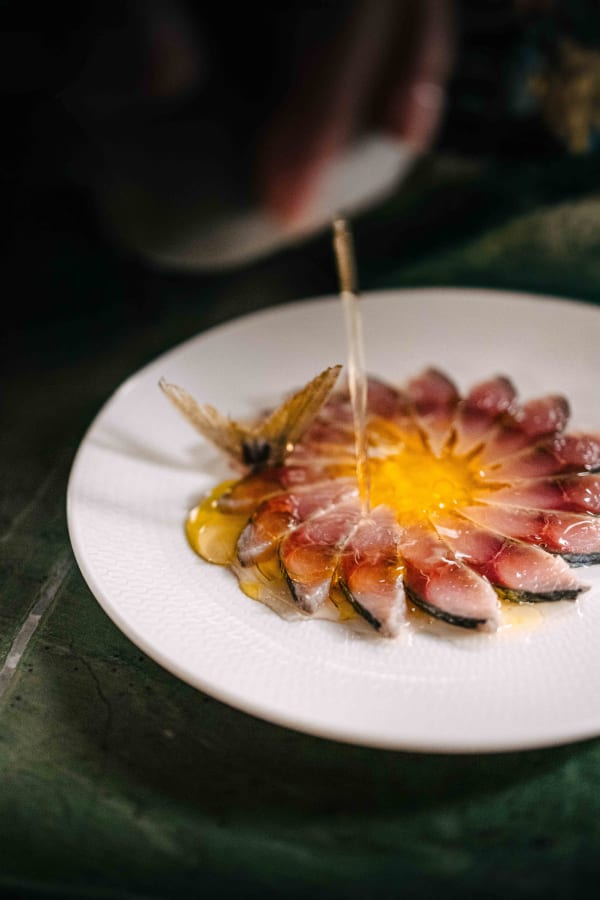
The second course is bonito, Line-Caught Bonito Tataki. The surface alone is fired to a crisp, with a blood plum sauce underneath and agretti, a bitter European herb, alongside. Wasabi came with it.


This one arrived with the sort of varied components that read as fine dining, and I wondered whether it would be better to taste the bonito on its own. After eating it I think there was a reason. If it had been the acid rich, vivid bonito you get at a Japanese sushiya you would want to eat it as it comes, but look at the cut surface and it differs from Japanese bonito, and on the palate there is little acidity and less weight.
So the plum sauce, which can supply acid and weight, and the agretti, which supplies bitterness, were built around that. You could feel a lot of chef's deliberation in it. The raw material is a little disappointing, but the cooking and the resulting texture were close to a hundred out of a hundred. Cooking only the surface in an instant over open flame split the crispness and the softness of the flesh inside cleanly at the cut. The pairing of the supporting elements has an awkward side, but it was worth seeing what gets attempted to overcome the limits of an ingredient.
The pairing here was very good. The sake was Hanatomoe (花巴) yamahai nama. Hanatomoe comes from Miyoshino Brewery in Yoshino, Nara, a house that holds to wild yeast and to traditional methods like yamahai and bodaimoto, with deep acidity and depth as its signature. Usually in fine dining, and especially outside Japan, the sake that appears tends to be obvious and not very good. This was excellent.


Miyoshino Brewery (美吉野醸造) was founded in 1912. It sits in the Yoshino known for the cherry blossom on Mount Yoshino, and on the conditions of a mountain district it builds everything around fermentation and acidity. Since 2017 it has stopped using cultured yeast entirely and brews only with the microbes living in the brewery. It runs yamahai, mizumoto (水酛) and sokujo side by side, and the grain of the acidity that comes out of each differs, so the expression of the sake divides. The bodaimoto noted above is another name for this mizumoto, the oldest method of making a starter, devised in Nara in the Muromachi period. Sake from Nara, made in the way Nara invented, set down in front of a wood fire in Sydney.
In Australia, a nama sake? But the nutty aroma particular to nama was well alive, and the acidity and depth particular to yamahai supported the acidity of the bonito naturally. It was clear they had put thought into the sake as well as the wine.


Section 10·Bread From The Hearth
The third is bread, Shady's Woodfired Bread. A pumpkin sourdough made with an eighteen year old mother starter comes first, with smoked butter they smoke themselves in the hearth inside. The butter came with buttermilk, barley, honey and milk alongside. Everything from the bread to the butter comes out of this restaurant's own fire.


This bread was very good. Eat the bread alone and not much flavour registers, eat the butter alone and it is too much and out of balance, but together the balance lands and the flavours synergise, which was very good. The quiet sweetness of the pumpkin sourdough takes on the smoke of the butter and a single bite of bread becomes a small course in itself. To be blunt, when it arrived I thought, bread as a dish? One taste changed my mind. It was an excellent combination and a plate where the identity of woodfire shows clearly even in bread.


After the bread they take you on a tour of the kitchen inside, and the heat astonished me. The counter was hot enough already, and going in was another dimension entirely. It was an environment that had me worrying whether the people working here would damage their health over the long run.

What remains is one fish and one meat. If the earlier courses had been uneven, this is where the restaurant's real quality starts to show.


Section 11·The Barramundi
The fish dish is Chris Bolton Barramundi. Cooked skin side down over the fire so the skin caramelises to a real crispness, with bullhorn peppers salad, gem lettuce and capers alongside. Measured on the texture of the fish itself, of all the fish dishes I had eaten in my life up to that point, I think this was fighting for first or second. When people discuss a French poach or a well cooked fish they usually mean a yielding softness, but this barramundi had the softness of the flesh and a chew at the skin at the same time, an insane texture.

On top of that the seasoning of the fish itself was excellent and the smoke coming off the area near the cooked skin was good. Wood fire is far harder to control for temperature than gas or electricity, and the cooking was mad enough to make you wonder how they arrive at it. This one dish alone tells you what level Firedoor works at with fire.

The elements beside the fish were good too. Grilled gem lettuce, bullhorn pepper and bright, sharp capers made it cohere without covering the character of the fish. With the bonito earlier I had found the supporting elements awkward, but in this fish dish they did exactly their job and lifted the main. It was a completely different kind of fish cooking from the soft French poach, and this was properly delicious and left an impression clearly distinct from my earlier experience.


The white matched to this dish was Envínate's Benje Blanco 2022. Envínate is a project started in 2005 by four people who studied oenology together at the University of Miguel Hernández in Alicante: Roberto Santana, Alfonso Torrente, Laura Ramos and José Martínez. The name is a pun meaning wine yourself, and they dig into old land shaped by the Atlantic, places like Ribeira Sacra and the Canary Islands.


Benje comes off the volcanic slopes of Santiago del Teide in northwestern Tenerife. The name is taken from a volcanic crater nearby. Between 900 and 1,100 metres of altitude, and because phylloxera never reached the island, ungrafted own rooted old vines have been alive for seventy to a hundred and ten years. The vines stand untrained, sprawling as they like, worked entirely by hand. The variety, Listán Blanco, is the same grape as Palomino in Jerez, and at this altitude and on this volcanic ash it becomes something else entirely. Most of it is pressed straight away, a portion left with the skins, then rested on the lees in concrete and old French barrels before bottling with no filtration, no fining and no added sulphites. Flint, smoke and salt come first. A grape grown on a volcano set beside a fish cooked on wood.


Section 12·Two Hundred Days
Last is the 200+ Day Dry Aged Beef. An add-on I paid extra for, and the flavour and aroma were a different order from any dry aged steak I have eaten.


They show you the meat partway through the course and the look of it alone is something. Rangers Valley Pure Black Angus, and they say even within this breed it is a good animal, carrying marbling you do not usually see. The cut is bone in loin toward the rib, and the ageing is roughly a month and a half first, then wrapped in fat for a second ageing of more than 200 days. The reason for wrapping it in fat seems to be to minimise moisture loss while maximising the aged flavour. Perhaps because of that, even after more than 200 days of ageing the meat was not dried out and the moisture was still alive in it.


The cooking is a hard sear on the surface over high heat charcoal, then a slow finish at low temperature, so the outside is crisp while the inside shows the red of a medium rare. The meat comes cut into seven pieces, with the bone and the flesh still attached served alongside.

The flavour of the meat was enormous. A toasty fermented aroma you do not get from ordinary raw beef, like blue cheese and nuts, came up, and the complexity was outstanding. The outside has a crisp quality and the inside was quite soft. There was a fair amount of fat running out of the marbling and it was richer than I expected. The inside was barely cooked and even so almost no blood ran, which surprised me, and between the thin slicing and the texture I found it extremely fine. Onion and chimichurri came on the side, but I ate little of them so I could take the steak whole.


Where Rockpool Bar & Grill, which I had eaten at before this, was like an Italian dish with deep, direct flavour, this was like a French dish with cheese alongside, complex and fine. Two steaks eaten in the same city with quite different characters, so which one is better will split by taste.


The truth is that in this steak the bone impressed me far more than the flesh. There was some meat left on it and something like sinew, so it was hard to cut, but the aroma was almost cheese itself. It felt like the aged flavour you can smell in beef had been concentrated down, which left a real impression and was the best of it for my palate. Nowhere lets you feel the depth of the ageing as directly as the meat around the bone. These two dishes, the barramundi and the dry aged steak, were the highlight of this Firedoor experience.


If you like dry aged steak, the add-on runs to about USD 45 and it is worth every bit of it, so I recommend eating it.

The bottle opened with this steak was the 2019 Barolo Bussia from Podere Ruggeri Corsini. It began in the mid 1990s when Loredana Addari and Nicola Argamante left city life and bought a small farm in Monforte d'Alba in the Langhe. The name of the estate is three pieces. Podere, meaning farm. Ruggeri, the surname of Nicola's mother, who put up the money for the purchase. And Corsini, the name of the hamlet they bought.


Both studied agriculture and then viticulture and oenology separately, and their two daughters work with them now. Bussia is a Barolo cru belonging to Monforte d'Alba, and the parcel they hold is a little over one hectare, southwest facing on a mix of clay and loam. They destem completely and age for thirty months across French barrels and long used Slovenian casks.
Section 13·Pineapple And Pandan
Dessert is Queensland Gold Pineapple. An entertaining dessert with coconut, pandan, finger lime and chocolate in it. Pandan is a leaf you find in the tropics and here it went on top as a foam. It tasted like eating vanilla, and the pineapple and finger lime underneath supplied acidity and sweetness. Tropical fruit and herbs stacked in layers, and the elements came together well enough to make it a dessert with real complexity.


The last glass, matched to dessert, is Symphonia's 2021 Royal Late Harvest Manseng. It comes from the King Valley in Victoria, and the vineyard began in the early 1980s when Peter Read chose and planted varieties nobody in Australia was planting at the time. Manseng is a thick skinned small berried variety used for sweet wines in southwest France, in Jurançon and Pacherenc du Vic-Bilh. Here they cut the canes in April to concentrate the sugar while the fruit hangs on the vine, then hand pick only the most raisined bunches a few weeks later.
There is a story attached to this variety. In 1979 the CSIRO imported cuttings it believed to be Petit Manseng, and DNA testing revealed in 2020 that they were in fact Gros Manseng. It had carried the wrong name for more than forty years, and the gros manseng printed on the pairing card is the notation after that correction.


Last came a marshmallow with chocolate and raspberry jam inside, grilled on the outside until it went soft as if about to melt. Using fire right down to the final bite was very Firedoor.


Section 14·Fire, And Then What
Setting the food aside, one of this restaurant's greatest strengths is how kind the staff are. The servers and the sommeliers are good, but the cooks, who never lost a smile in that heat and still spoke to you and answered questions, impressed me. Separate from the quality of the food, that atmosphere lifted the whole experience a level.

In a very Australian way the kitchen is extremely mixed, from local white Australians to Europeans to Asians. That diversity seems to come through in the cooking and made the room livelier. Perhaps because I am Asian too, the Asian chefs looked after me particularly, and I talked at length with a Japanese chef and with a Filipino Singaporean chef.


The Japanese chef is from Chiba, and he did not move over as a child. He went to Sweden for study and career before coming to Australia, so he knows the current Japanese restaurant and dining scene well and we talked about a lot of interesting things. He plans to study here and then go back to Chiba to open a restaurant using wood the way Firedoor does.
The base will be yakitori, with the various seafood and vegetables of Chiba served alongside, so perhaps in a few years there will be a serious woodfire restaurant in Chiba.
It was good to talk with chefs who are each dreaming up a woodfire restaurant of their own. It made me think Firedoor also works as an incubator for people like this. The Filipino Singaporean chef said he would give me a parting gift and burned the menu on the spot with a torch, giving it a very Firedoor feel. That kind of careful, witty service was good too.

To close, the greatest strength of this restaurant is, in a way perhaps the most basic thing, fire. The ingredients cooked over the fire that is its identity are delicious. The barramundi and the dry aged steak in particular left an enormous impression, and the smoke soaking in off the wood was fundamentally very good. Fire is hard to control, and the cooking is good enough to make you wonder how they arrive at it. That is the core of this restaurant.

On the other hand, the weakness is that beyond fire there is not much. In keeping with Lennox Hastie's career, there is more fine dining technique and more combination of ingredients here than at Etxebarri, but the devices meant to give that complexity were somewhat unclear. Some of the direct flavours made me tilt my head, and with some I wondered whether it would be better to eat the ingredient with nothing on it. It feels like drifting somewhere between direct simplicity and complex cooking.


It feels like drifting somewhere between direct simplicity and complex cooking.
Look at the Google reviews and you find the opposite of me, people who came expecting fine dining level cooking and disliked the simplicity and the plainness, and that reaction seems to come from the same ambiguity of position.

The price itself sits at around USD 130, the position of a casual restaurant, so rather than expecting the hardware of a two or three star Michelin house or outstanding complexity, it works better to keep the focus lighter, on the concept of cooking over wood and on how the flavour of an ingredient changes when it meets fire. If you like woodfire as a genre, it is worth going once.

The drift running through this meal is not a positioning problem. It is a biography. Hastie spent a career in Michelin kitchens learning how to add before he wrote a letter to a mountain village in Bizkaia and spent five years learning how to stop. Both trainings are still on the menu, and the menu splits along that seam. Every plate that landed was one where fire did the work and the garnish knew to stay out of the way. Every plate that missed was one where something got put on top of an ingredient that did not need it. The cornbread beside the caviar is the whole argument in a single serving. Take the counter if you can stand the heat, and take the dry aged beef, because the bone is where the two hundred days live.

Have a question about this restaurant, or want to share your own experience?
Send a message