Fine Dining · Seoul · Korea / November 2023 / Michelin Green Star
GIGAS
"Jung Ha-wan's farm-led kitchen, where the field in Gunpo decides the menu before the chef does"
Section 1·A Green Star
The Michelin Guide has generally handed out ordinary stars, one star and two star and so on, along with the Bib Gourmand for places where you can eat well without spending much. And from 2020 it also began awarding a Green Star to restaurants making food that is ethically and environmentally sustainable. Korea has three of them, and among those the one where you can sit down to a proper dinner is GIGAS. GIGAS now holds a Michelin star as well.
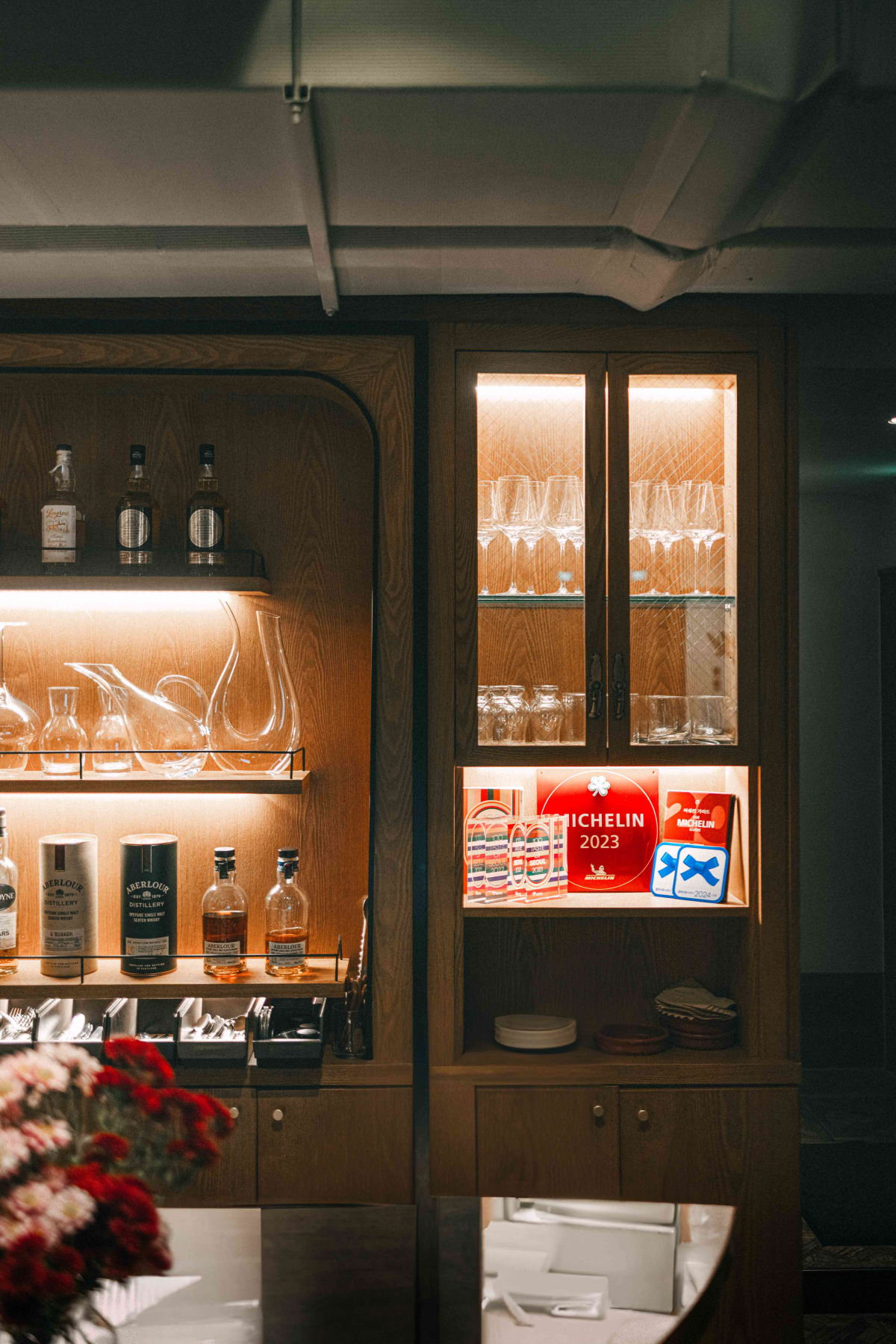
To set it against the time of my visit in November 2023: GIGAS had been named a Green Star restaurant for the first time that year, in the Michelin Guide Seoul 2023. The one star came much later, in the Michelin Guide Seoul and Busan 2025, so the GIGAS I went to was still a house wearing the Green Star and no star at all. The Green Star itself it kept, running through to 2026.
The name GIGAS comes from the Gigas of Greek myth, the beings born of the earth. Chef Jung Ha-wan says he kept asking, while preparing the restaurant, where cooking begins, and found this name in the course of it. So what the name points at is not the grandeur of a giant but the line running from earth to seed to crop to cook to table. It comes closer to meaning that the cooking at GIGAS begins not in the kitchen but at the moment the chef and his family sow seed in the field.
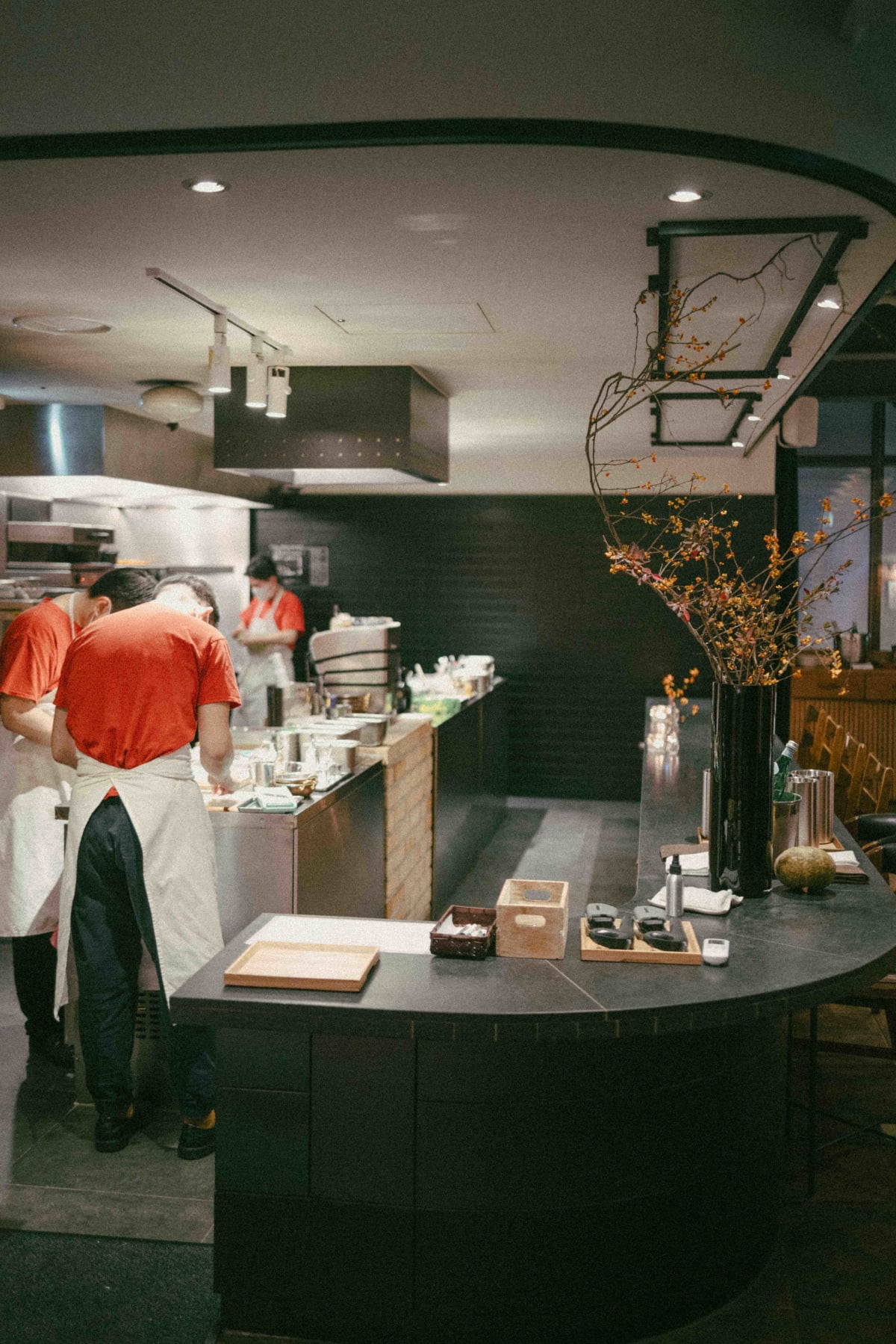
Section 2·Wani Farm
The vegetables and herbs GIGAS uses are grown organically at Wani Farm, which the chef runs himself. Beyond that the seafood is bought straight from producing regions in Korea, which is why the menu changes often with the season and the harvest and the moment, on a short cycle.
Wani Farm is in Gunpo, Gyeonggi Province, on the slopes of Suri-san. Beside the farm stands the head house of the Dongnae Jeong clan's Dongnae-gun branch, its main hall thought to date to 1783, the seventh year of King Jeongjo's reign, and Jung Ha-wan was born and raised in that house. The kitchen garden the family had used for generations was widened into a working farm as he prepared to open GIGAS.
It sits partway up the mountain, so the nights turn cool, and that swing in temperature is said to work in favour of the crops. On the restaurant's day off the chef goes down with his family to sow seed and decide when to harvest. Hosta, tears beans, Tutankhamun peas, lotus seeds, ingredients hard to source reliably through ordinary distribution, all come out of this field.
That is also why the menu changes so often. Most restaurants have the chef design a menu first and order the ingredients it needs, and GIGAS runs the order in reverse. He checks first what has reached its best condition on the farm and decides the menu after that. If the harvest goes badly the menu changes; if a crop has come up earlier than expected it goes into a new dish. So this house has almost no signature that stays fixed for long, and a dish of the same name can differ in taste, in composition, even in its pairing, once the season and the state of the crop have moved.
To add to that, what GIGAS means by seasonal does not only mean what was dug out of the field today. Starchy crops like potato and squash turn their starch to sugar during a period of storage after harvest and grow denser in flavour, and the winter table carries root vegetables harvested in autumn and matured, along with the radishes and spinach that have held out against the cold underground. The measure is not the season on the calendar but the time at which each ingredient reaches the state in which it tastes best.

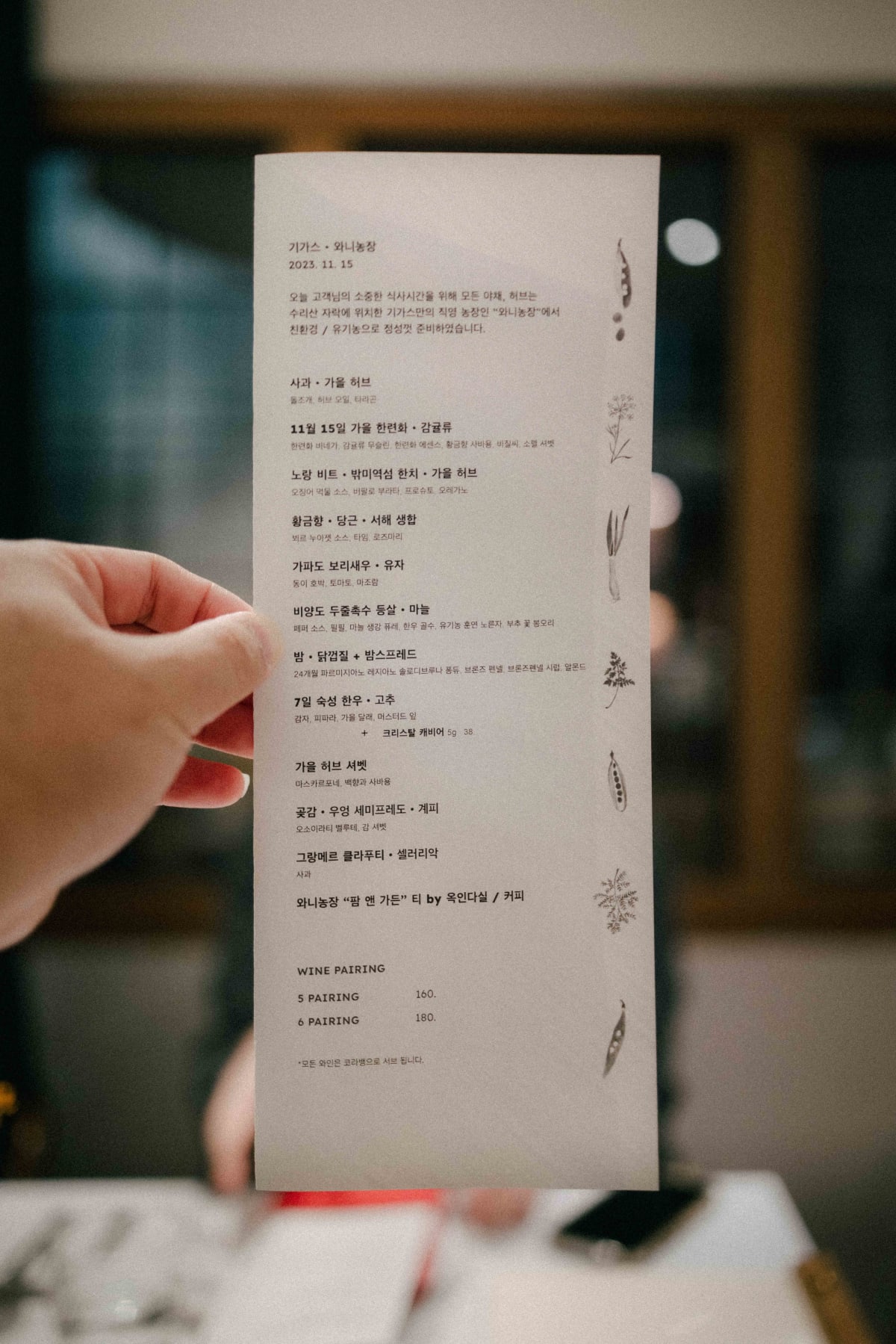
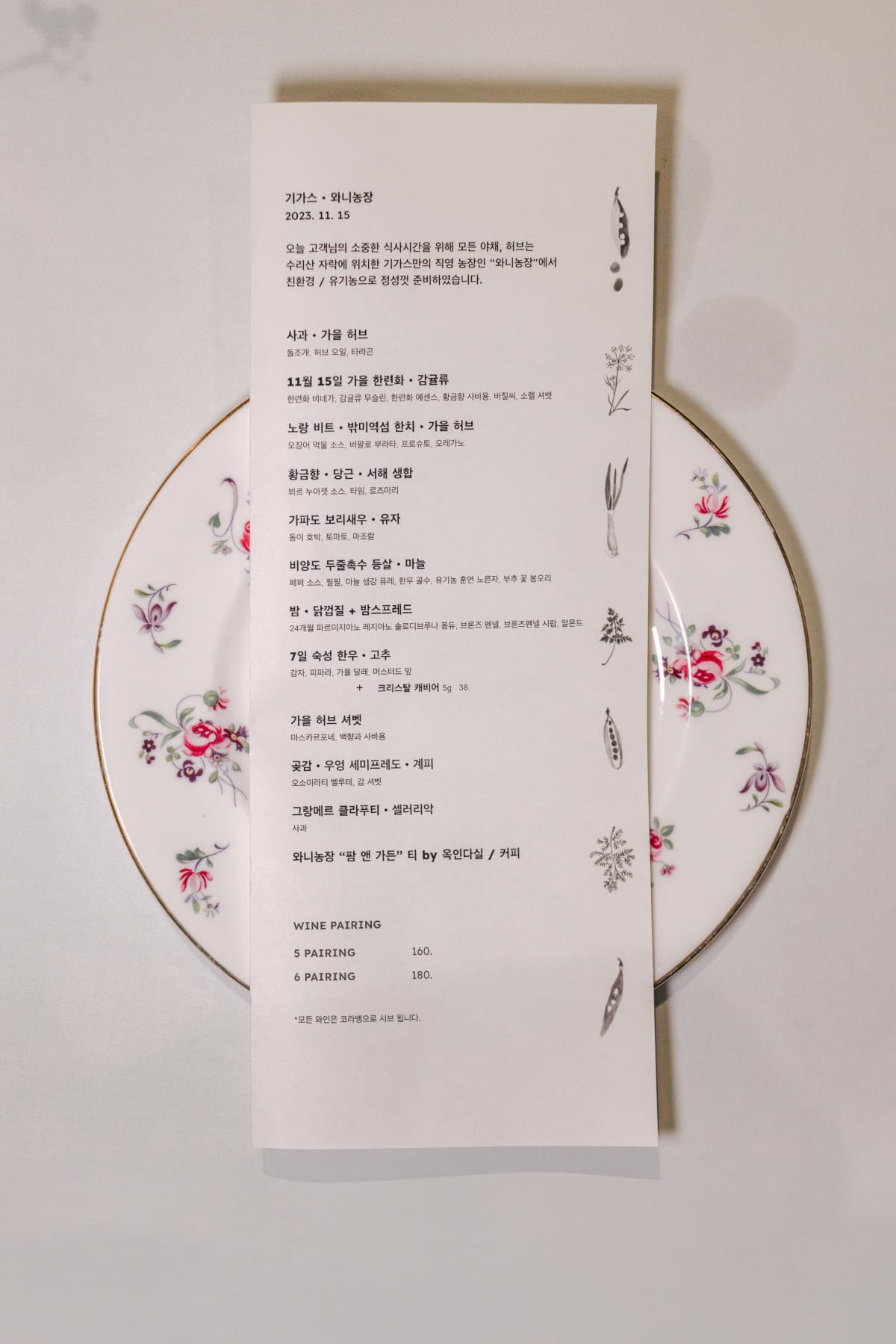
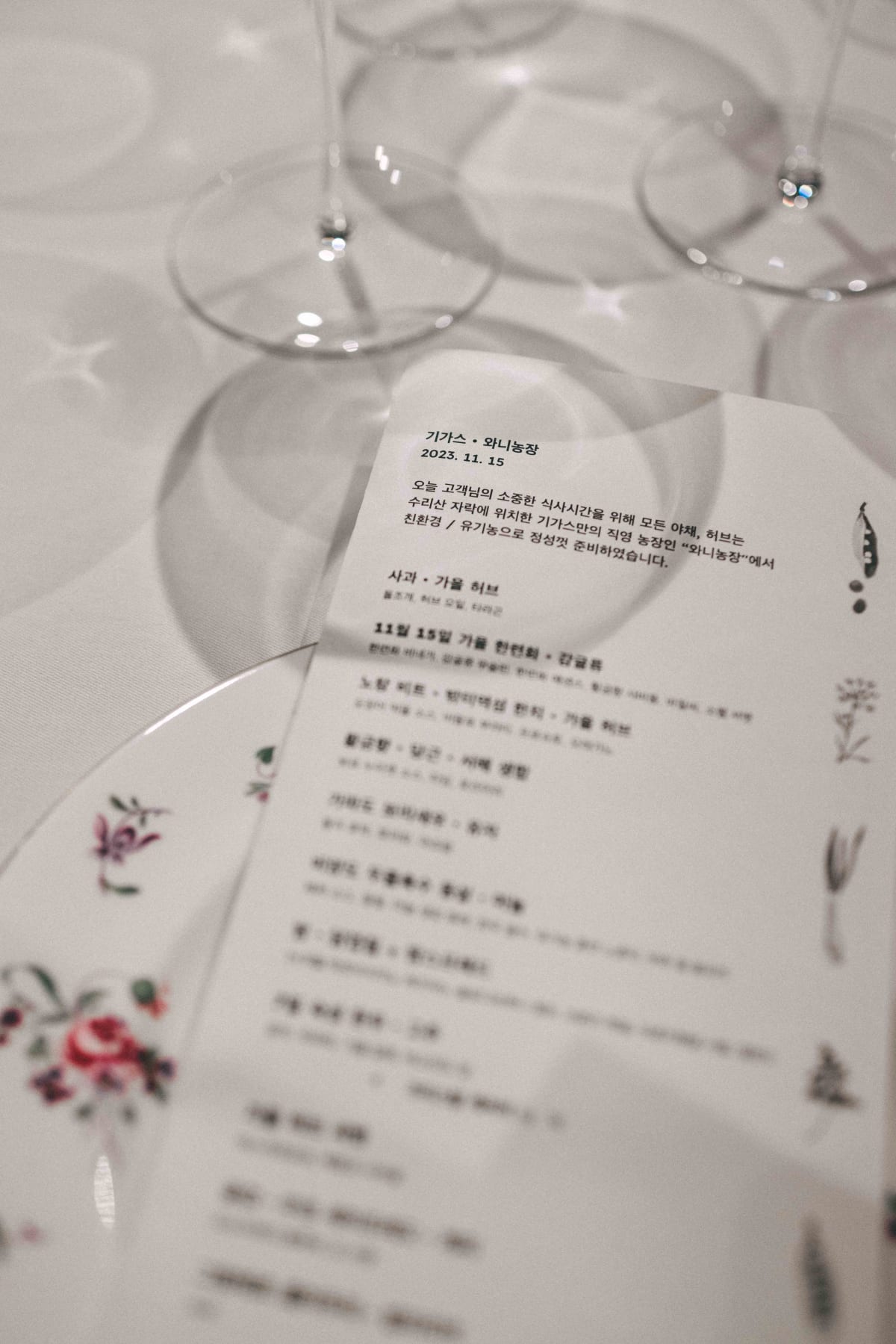
The menu card handed out that day carried the date of the visit, 15 November 2023, and I was told the herbs and vegetables used had all been grown at Wani Farm within a short window and brought straight into the cooking.
Section 3·Mediterranean as Method
Travelling around Europe I had felt there really are a great many farm to table restaurants, and to have one like this in Korea feels like a precious thing for the sake of variety alone. The food was good too. People commonly call GIGAS Mediterranean cuisine, but from what I hear neither the chef nor the restaurant has ever said our food is Mediterranean.
This point matters quite a lot to understanding GIGAS. The early GIGAS came closer to reproducing orthodox Mediterranean cooking, but the Mediterranean Jung Ha-wan speaks of is less a country or a set of recipes than a method and an attitude. Putting seasonal vegetables and herbs at the centre, using olive oil and acidity and seafood freely, not overdoing the seasoning, not covering the direction of an ingredient with complicated technique. He says a tomato grown in Italy and a tomato grown in Korea are different things, and that for someone who has lived within the nature of Korea an ingredient that has passed through Korean climate and soil can leave a longer finish. The most accurate way to put the GIGAS of today is that it is a restaurant translating Korean terroir into the grammar of Mediterranean cooking.
The most accurate way to put the GIGAS of today is that it is a restaurant translating Korean terroir into the grammar of Mediterranean cooking.
Section 4·Jung Ha-wan
Knowing a little of the chef's career makes that read differently. Jung Ha-wan was born in 1979 and grew up in a head family house in Gunpo back when ox carts still went down the road. He dreamed of cooking after watching a documentary about European chefs in high school, but the family objected strongly, and only after finishing military service did he get into the industry through room service at the InterContinental, moving later into the kitchen. After some years in a hotel kitchen he left for Europe in 2009, wanting to know how it was possible to give a guest food that truly tasted good rather than how to run efficiency and volume.
His first significant post was Mugaritz in the Spanish Basque country. A two Michelin star restaurant led by Andoni Luis Aduriz, a place that extended cooking beyond food into an experiment in perception and thought. There, he says, they climbed the mountain every morning to gather vegetables and wild plants. Unlike an ordinary kitchen that receives deliveries and cooks them, it was time spent experiencing the border between nature and cooking directly, and the farm-centred running of GIGAS carries that on. Afterwards he worked as creative head chef in charge of menu development at La Vie, the three Michelin star restaurant in Osnabrück, Germany.
The conclusion he drew from working in Europe's top kitchens was that technique can be acquired through repetition, but where a cook came from and what life he has lived cannot be copied. Faithfully following another chef's technique still leaves you a copy if your own life is not in it. That is the background to why the man who returned in 2021 and opened GIGAS near Dosan Park talks about a field in Gunpo rather than hanging out a Mediterranean sign.
Section 5·Terras Gauda
There were four of us that day so we were shown to a private room, and a fine sommelier looked after the wine service. The pairing felt like a stretch that evening so I ordered by the bottle, and we drank TERRAS GAUDA from Galicia in Spain. Having come back from a trip through Spain and Portugal not long before, it felt oddly like meeting an old friend.
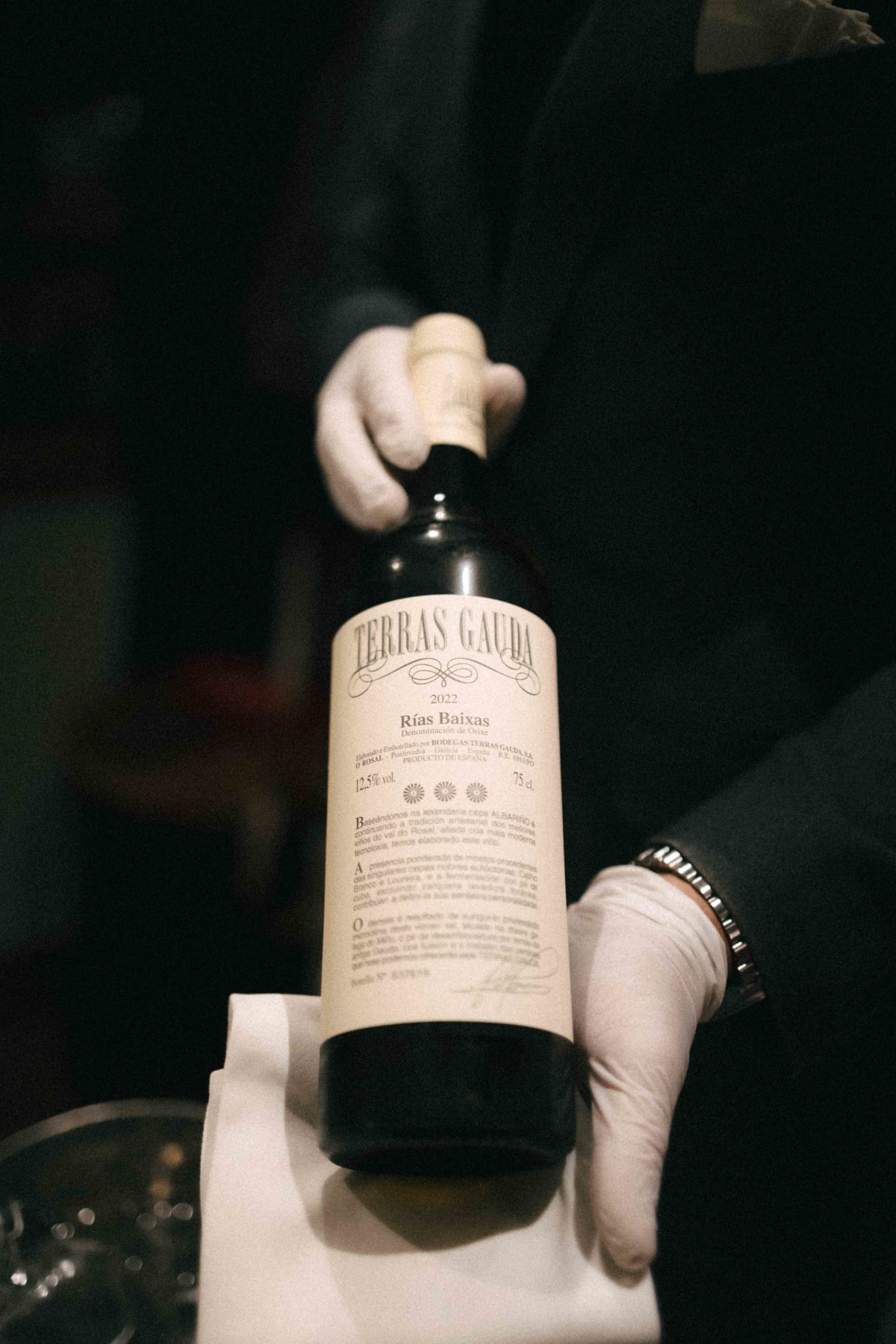
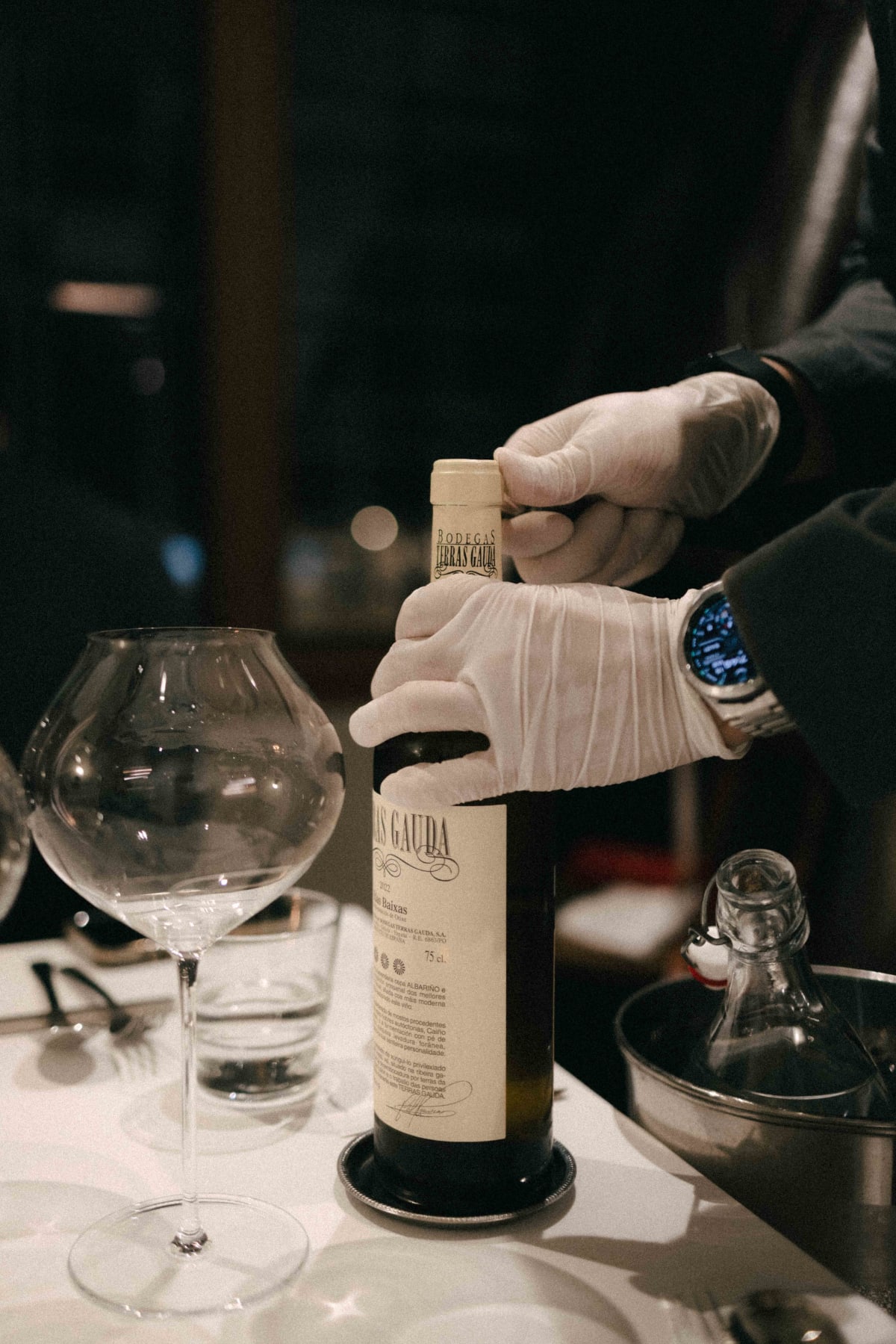
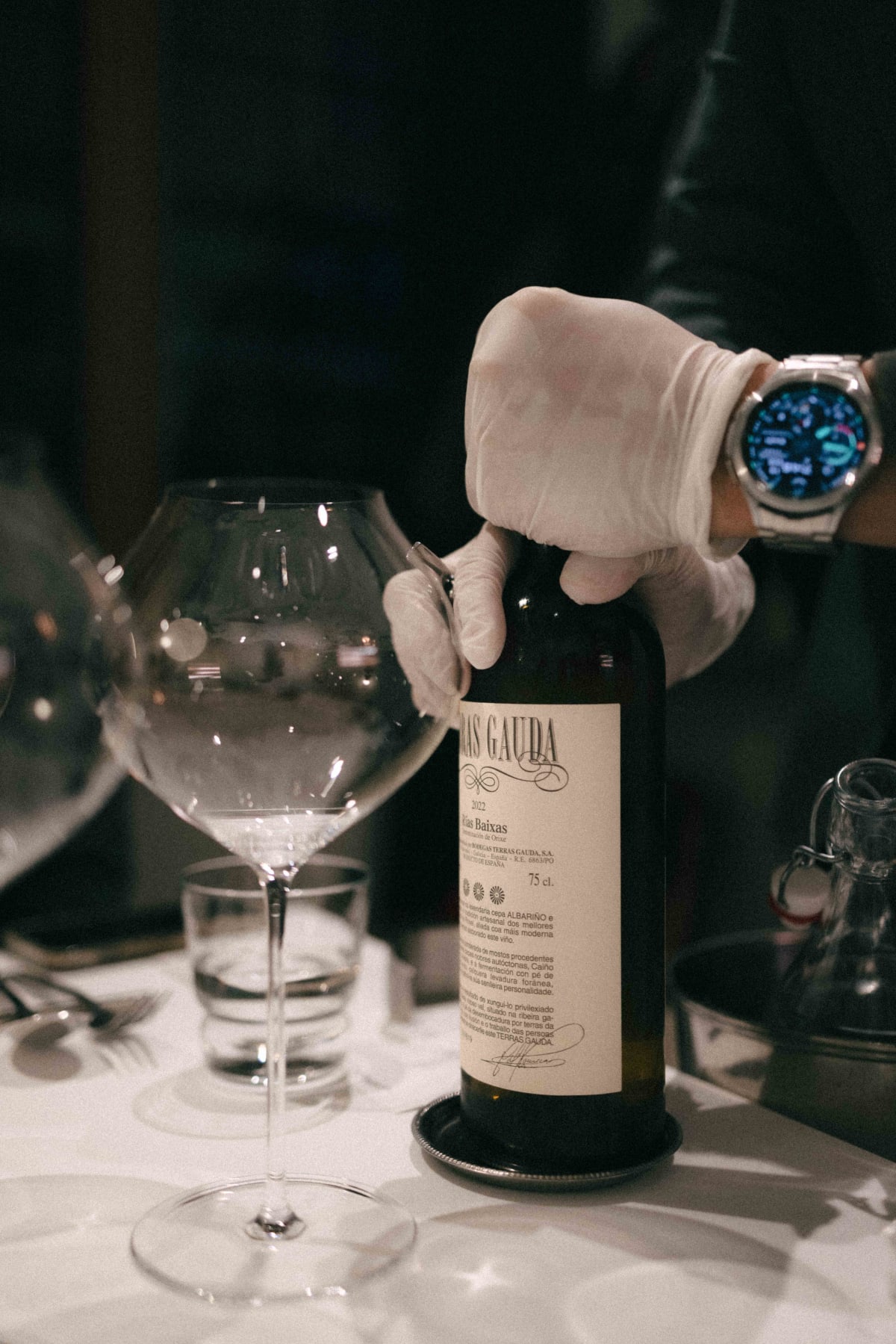
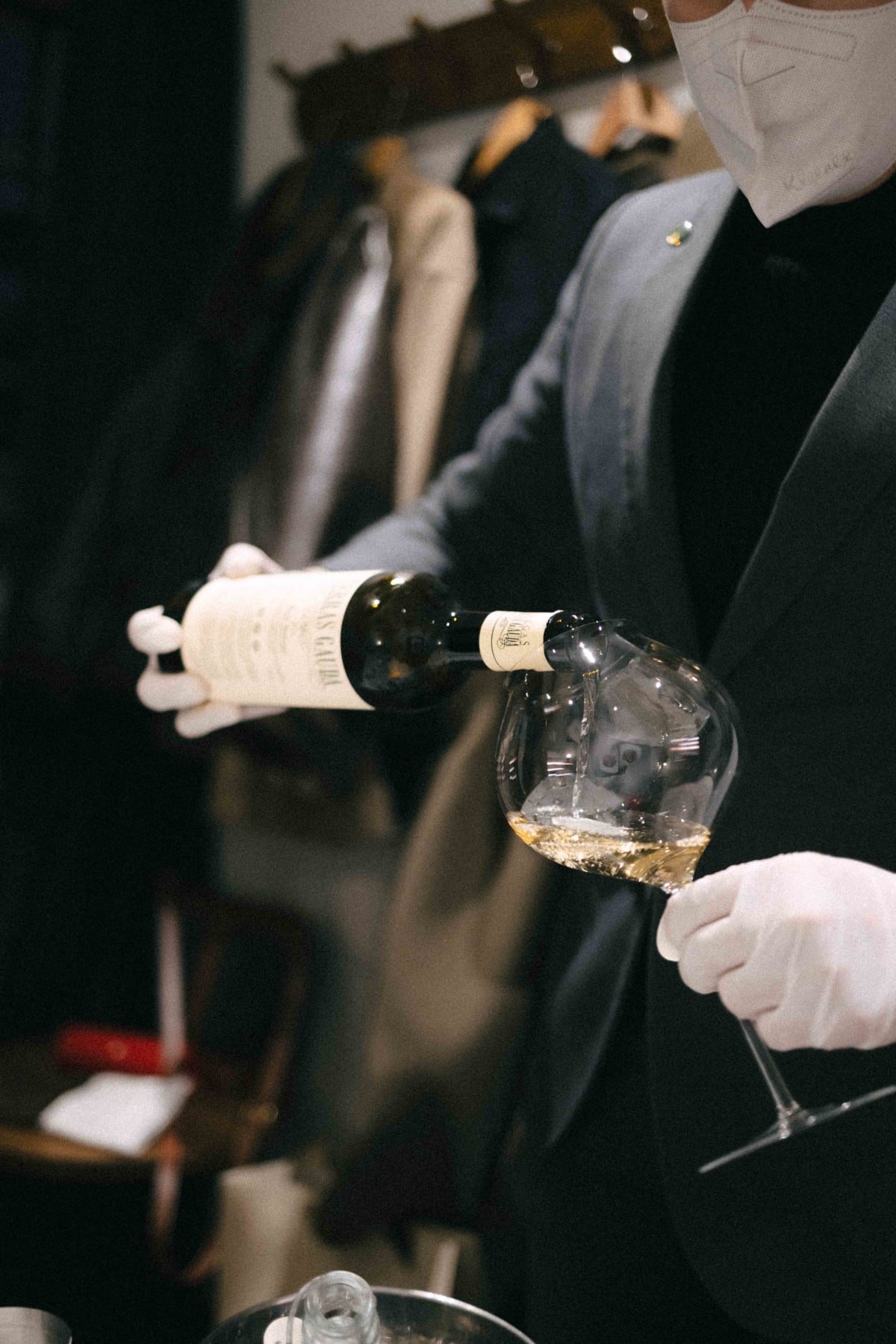
Terras Gauda is a winery founded in 1989 in the O Rosal valley of Rías Baixas in Galicia. It holds around seventy hectares on the right bank of the lower Miño, at a spot where the far side of the river is already Portugal. Its method is to use Albariño for around seventy percent while blending in Caíño Blanco and Loureiro.
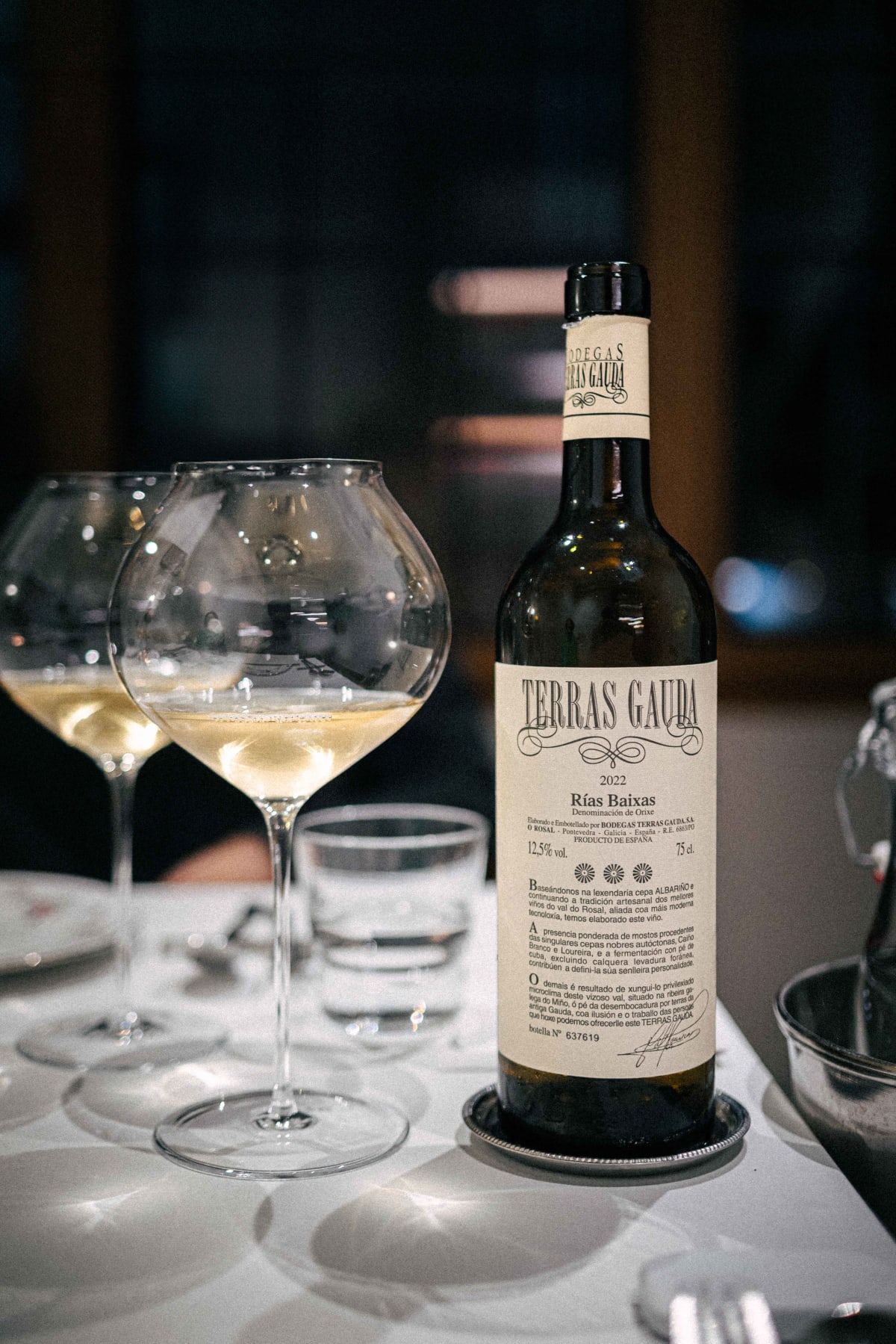
Those two varieties had all but disappeared from the area, and Terras Gauda is known for having brought them back. The Gauda of the name comes from the Latin gaudium, meaning joy. Fermentation runs on indigenous yeasts and the wine rests on its lees, and the composition lays the structure of Caíño and the aromatics of Loureiro over the saline acidity particular to Albariño.
Looking at the menu descriptions, at how many ingredients are written into them, you can feel the traces of the chefs racking their brains over these combinations. And since they grow the ingredients on the farm themselves, they must have worked at it that much harder.
Section 6·Why the Green Star
A lot of people misunderstand the Green Star as vegetarian, partly because of hugely famous restaurants like Arpège and Eleven Madison Park, but it is not necessarily that. It goes to places that are environmentally sustainable, so the proportion of vegetables does tend to be high. I had heard there are Green Star places where the food is not good, so I went half unsure, and there were dishes delicious enough to startle me, which left me satisfied. For the record, Michelin has now discontinued the Green Star. The date of the discontinuation, to set it down, is 18 May 2026. Michelin announced it would do away with the Green Star and replace it with a platform called Mindful Voices.
The reason GIGAS was given that star does not end at buying eco-friendly ingredients. They grow the crops themselves and control the timing of the harvest, and food waste that has not been touched by seasoning is collected separately, made into compost and sent back to the farm. Rather than throwing out packaging and swapping it for new eco-friendly products, they choose to keep and maintain the containers they already have, and for storage they use glass and stainless steel first.
What matters is that sustainability here is not a moral ornament. The reason for farming directly is not only the environmental case but also to get vegetables with a stronger aroma and a denser taste.
Section 7·The Opening Plates
It began with Apple and Autumn Herbs (surf clam, herb oil, tarragon). The clam was of better quality than I had expected, and here you could already tell that the other elements were not supporting cast arranged to flatter the home-grown vegetables. With the apple it was fresh and I liked it.
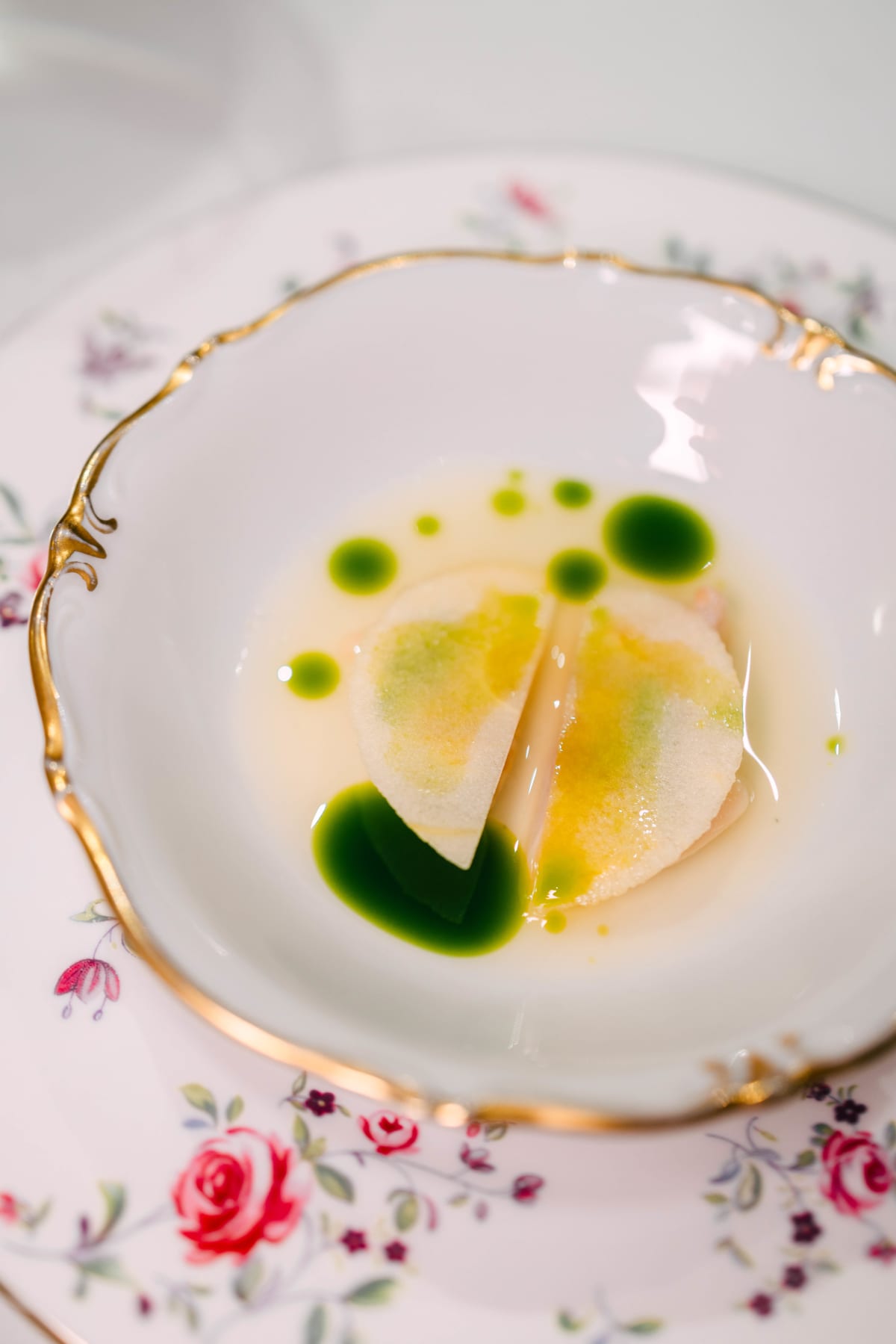
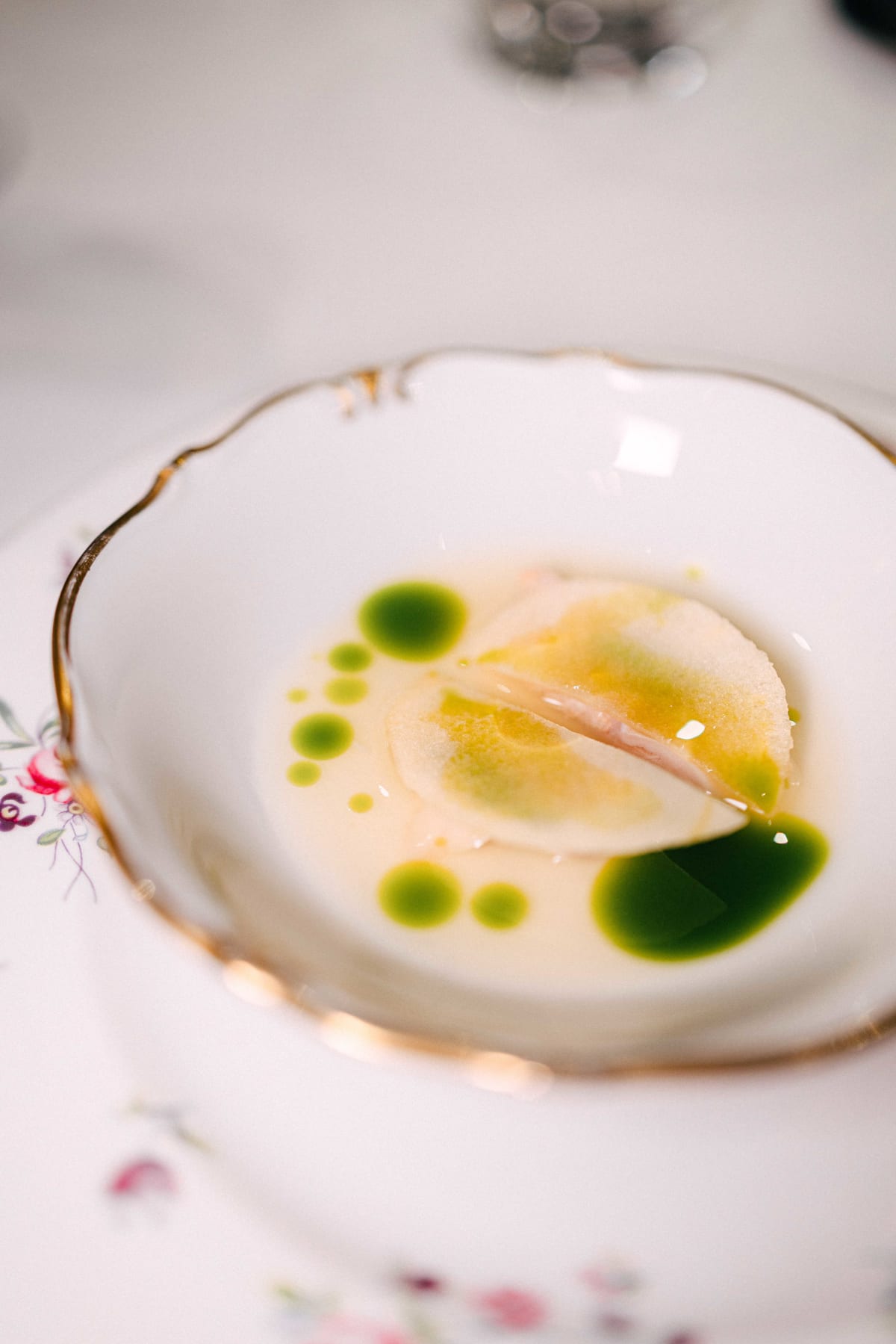
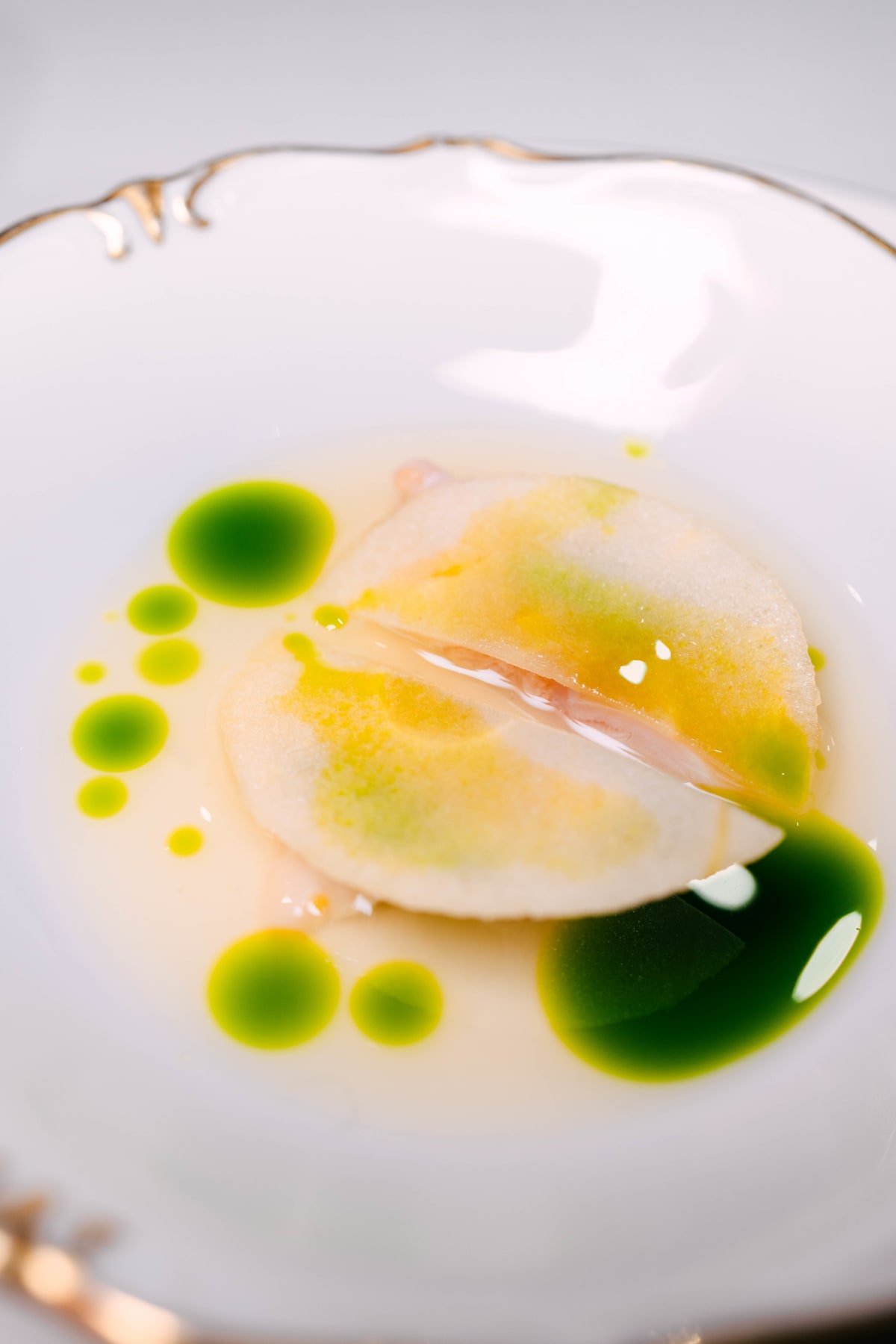
Among the early dishes the ones that made an impression were:
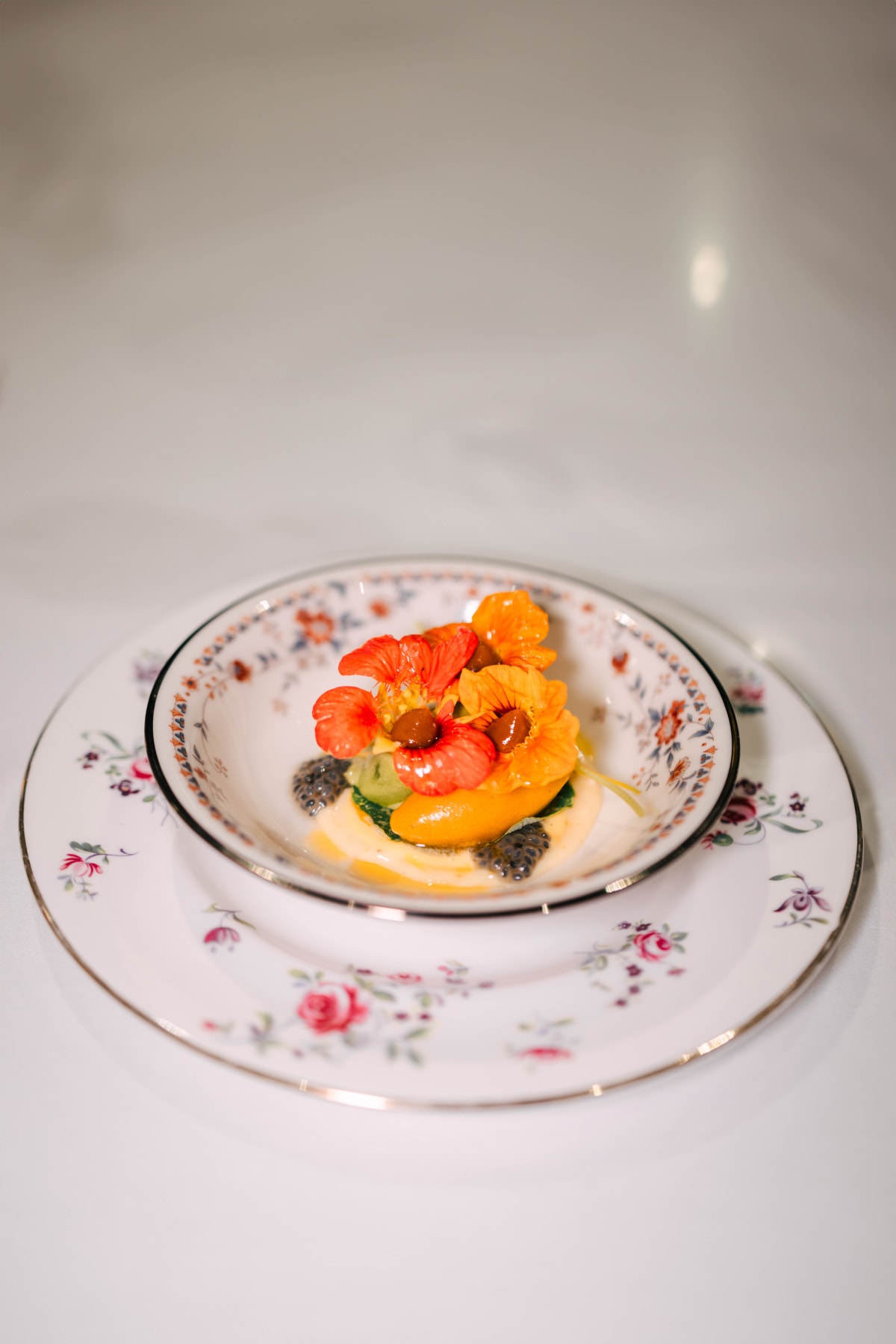
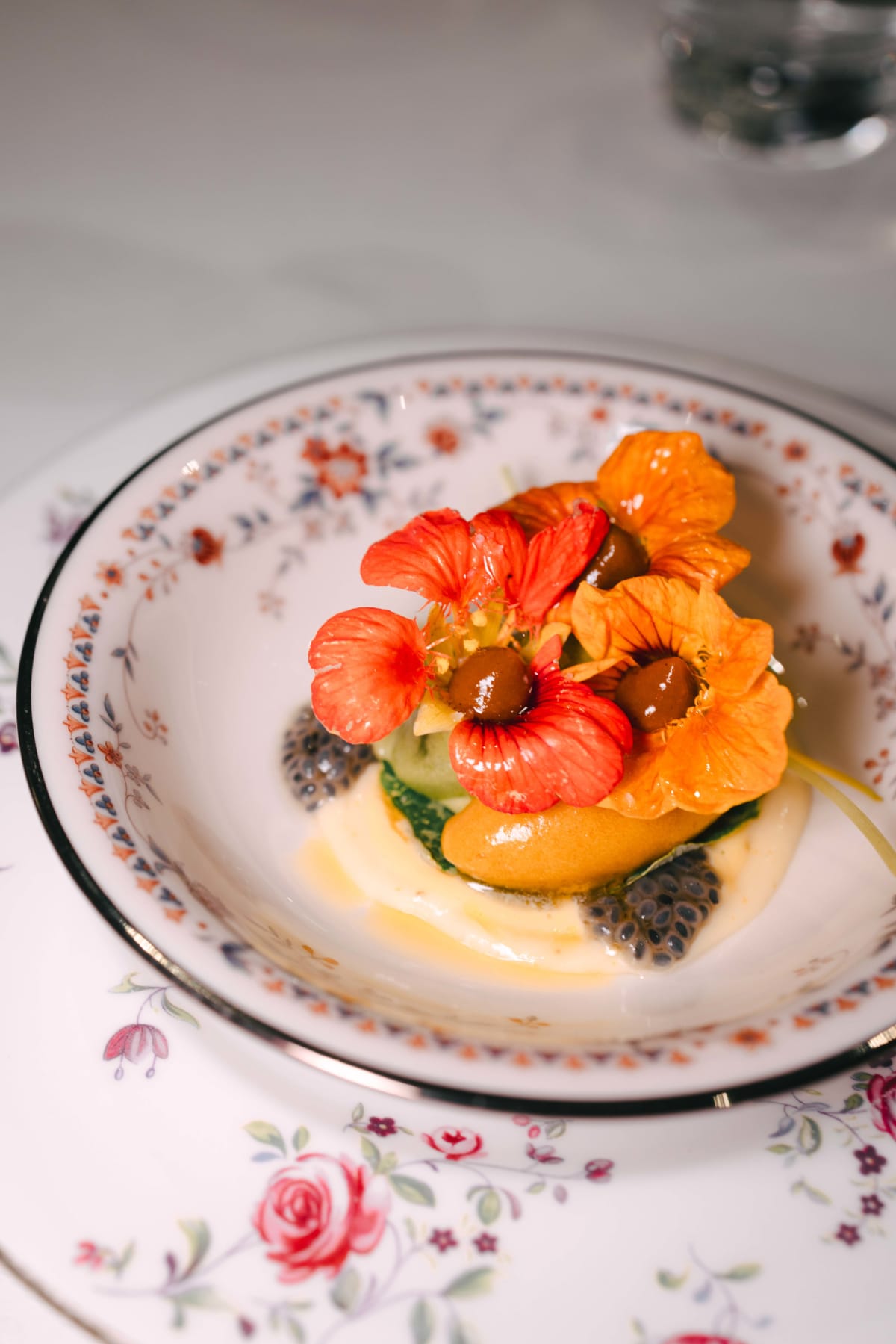
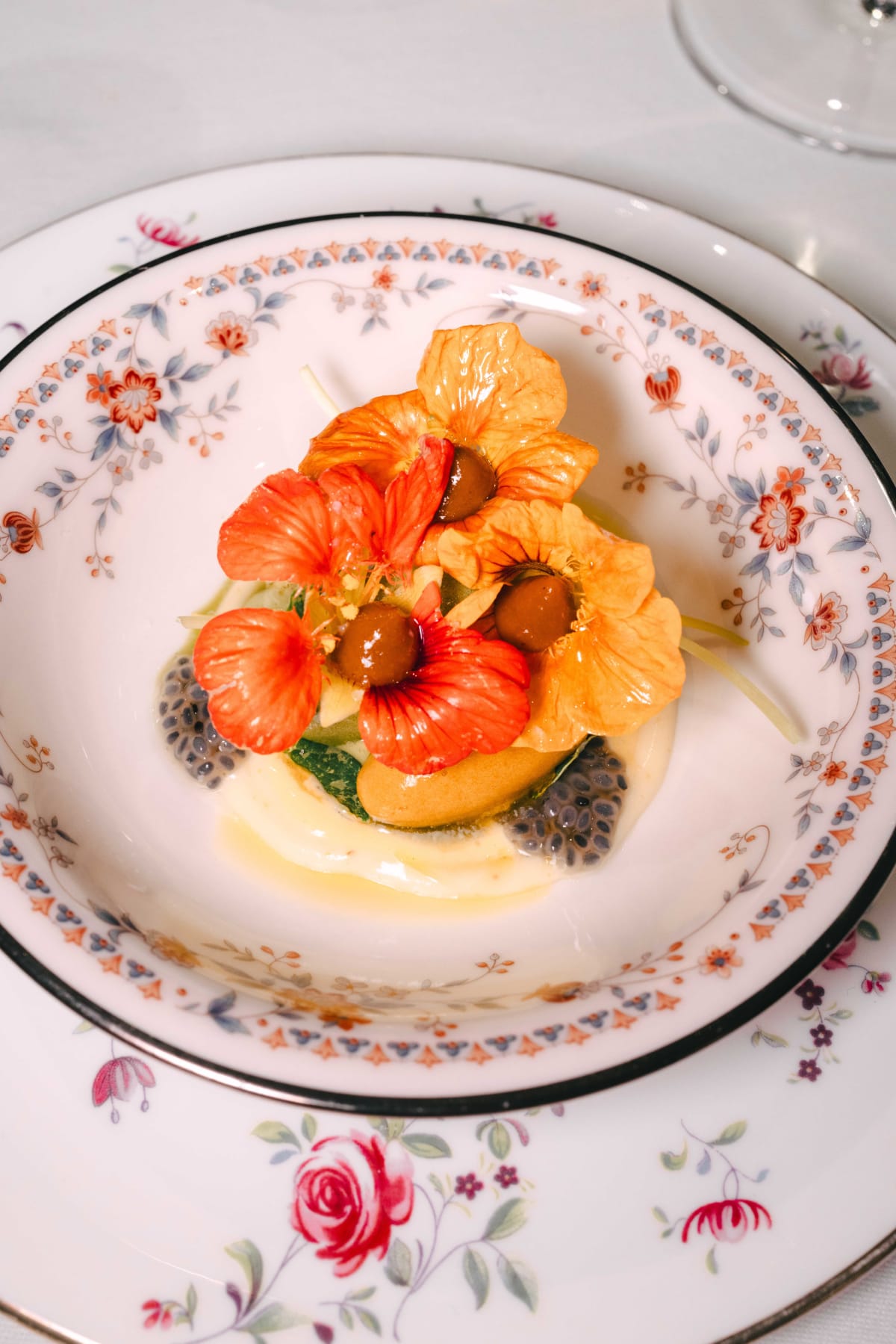
15 November Autumn Nasturtium and Citrus (nasturtium vinegar, citrus mousseline, nasturtium essence, hwanggeumhyang sabayon, basil seed, sorrel sherbet)
Hwanggeumhyang, Carrot and West Sea Surf Clam (beurre noisette sauce, thyme, rosemary).
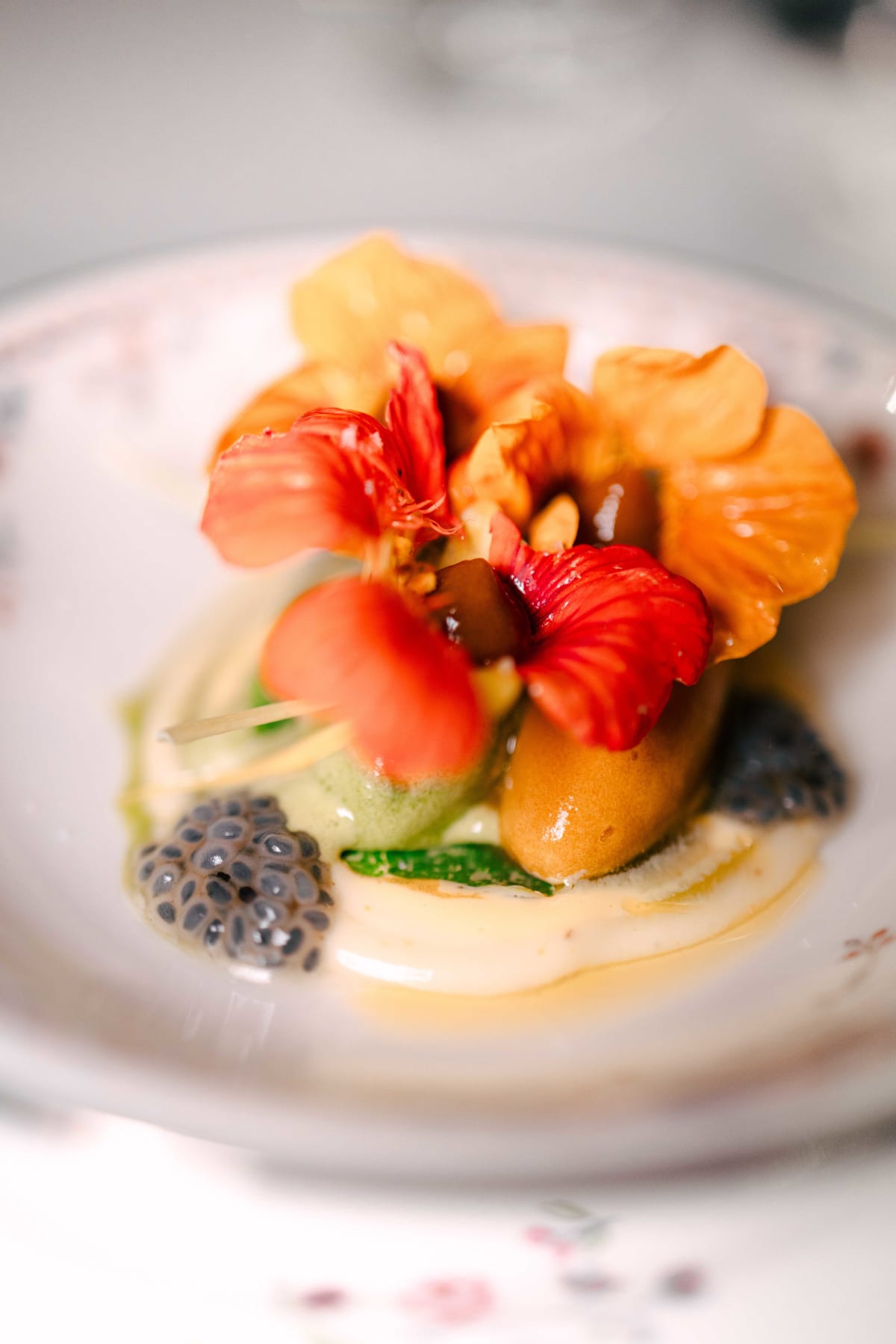
The first, from the description alone, makes you wonder whether this is dessert, and it came early as an appetiser. Even visually, the ingredients one by one are not far from the things my mother used to smack me on the back and feed me as a child for being chubby, but eaten all together they were so harmonious. The off-putting aromas and the bitterness that come from eating a vegetable or a flower on its own gathered up and cancelled each other out, if that is the way to put it. Eating it for the first time I thought it remarkable.
The second, the hwanggeumhyang with carrot and West Sea surf clam, was simply a delicious dish. The clam does not show on the surface but is hidden inside, and eaten with the beurre noisette sauce it was so good. Fine flavour, and with all those ingredients coming together in the mouth there was synergy in both texture and taste. They say this is something of a signature dish for the restaurant and I understood why.
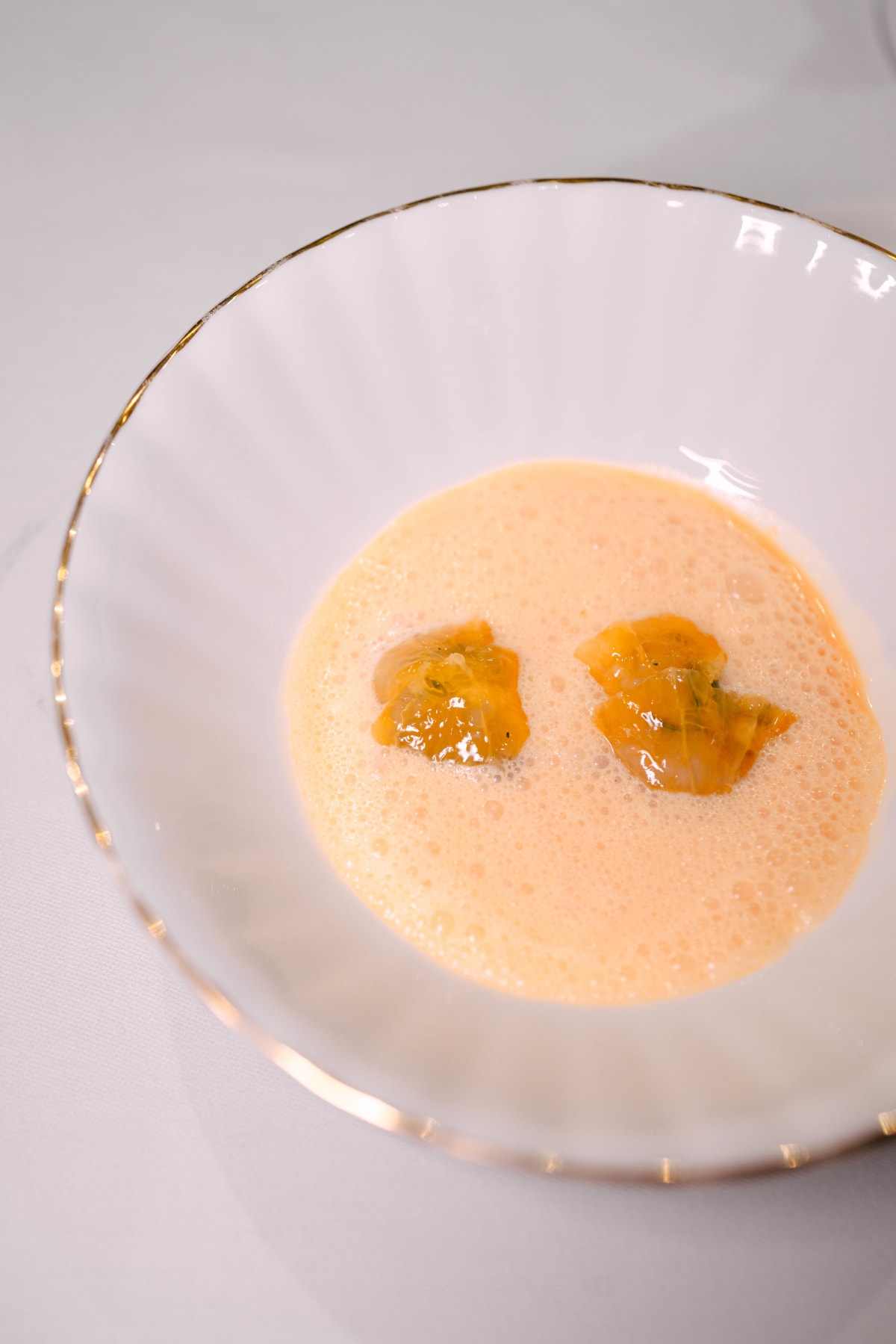
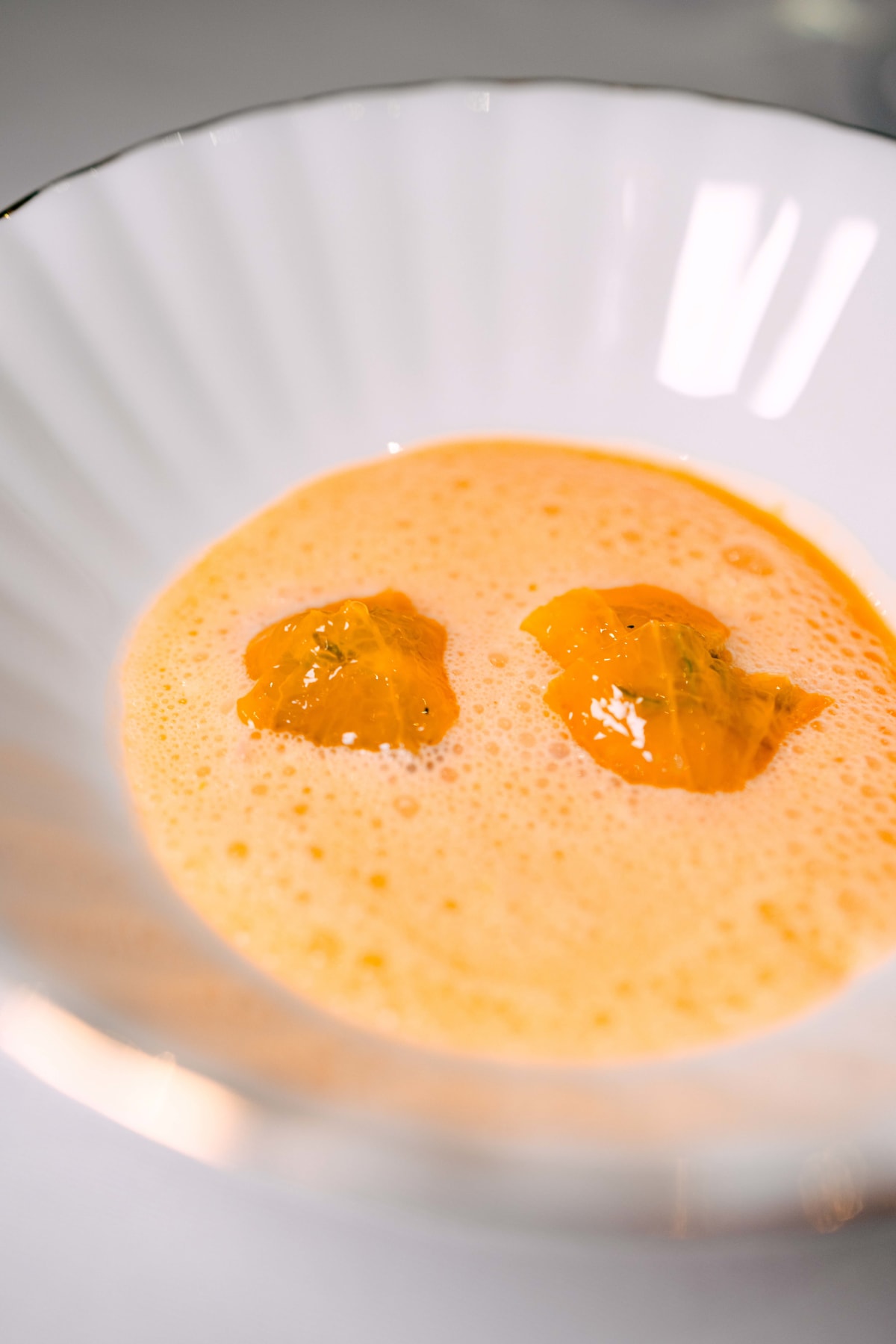
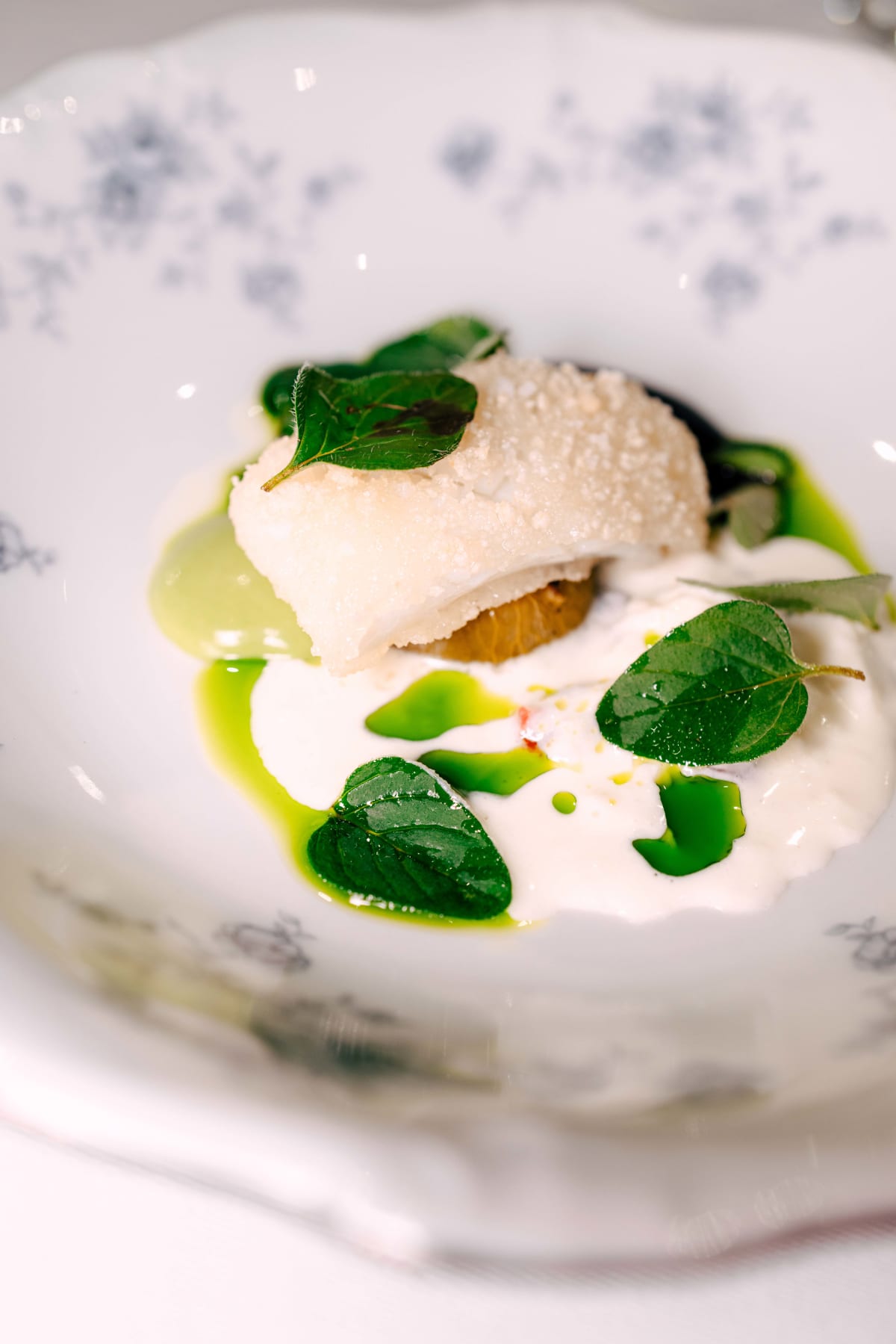
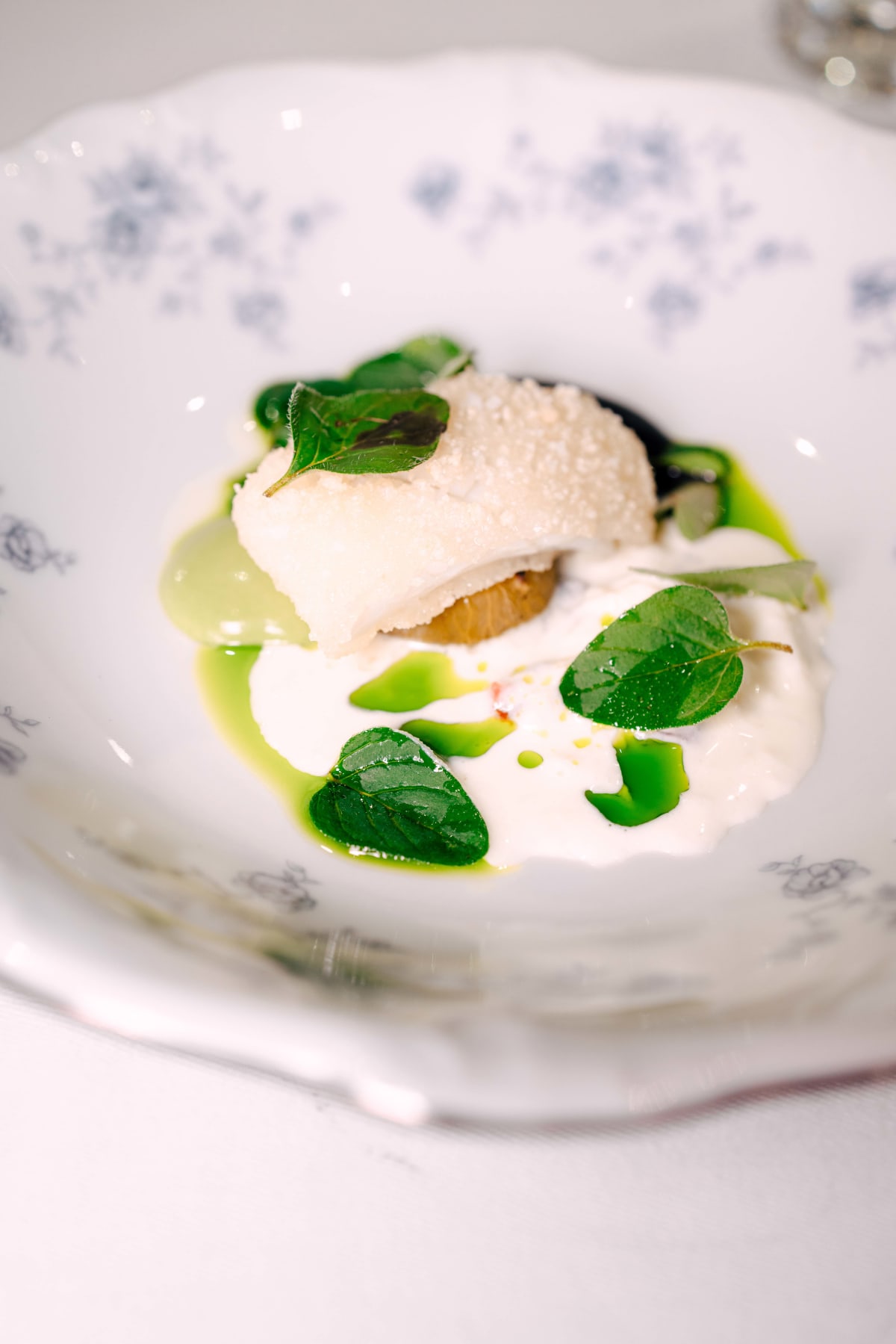
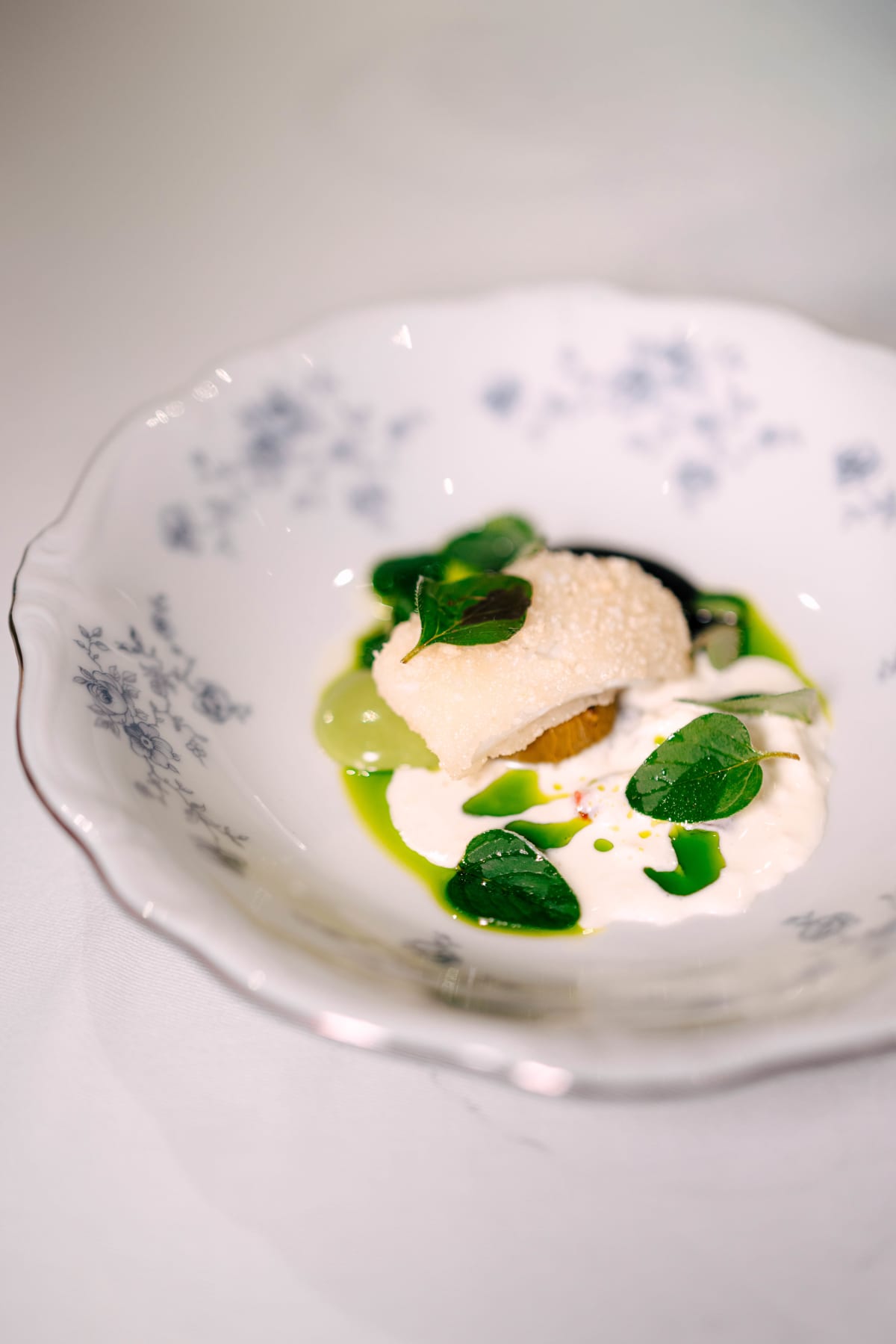
Yellow Beetroot, Bakmiyeokseom Squid and Autumn Herbs (squid ink sauce, buffalo burrata, prosciutto, oregano) had the outside of the squid cooked, so rather than the texture of the material itself it was a dish where you tasted the fit between the other elements, that fresh quality.
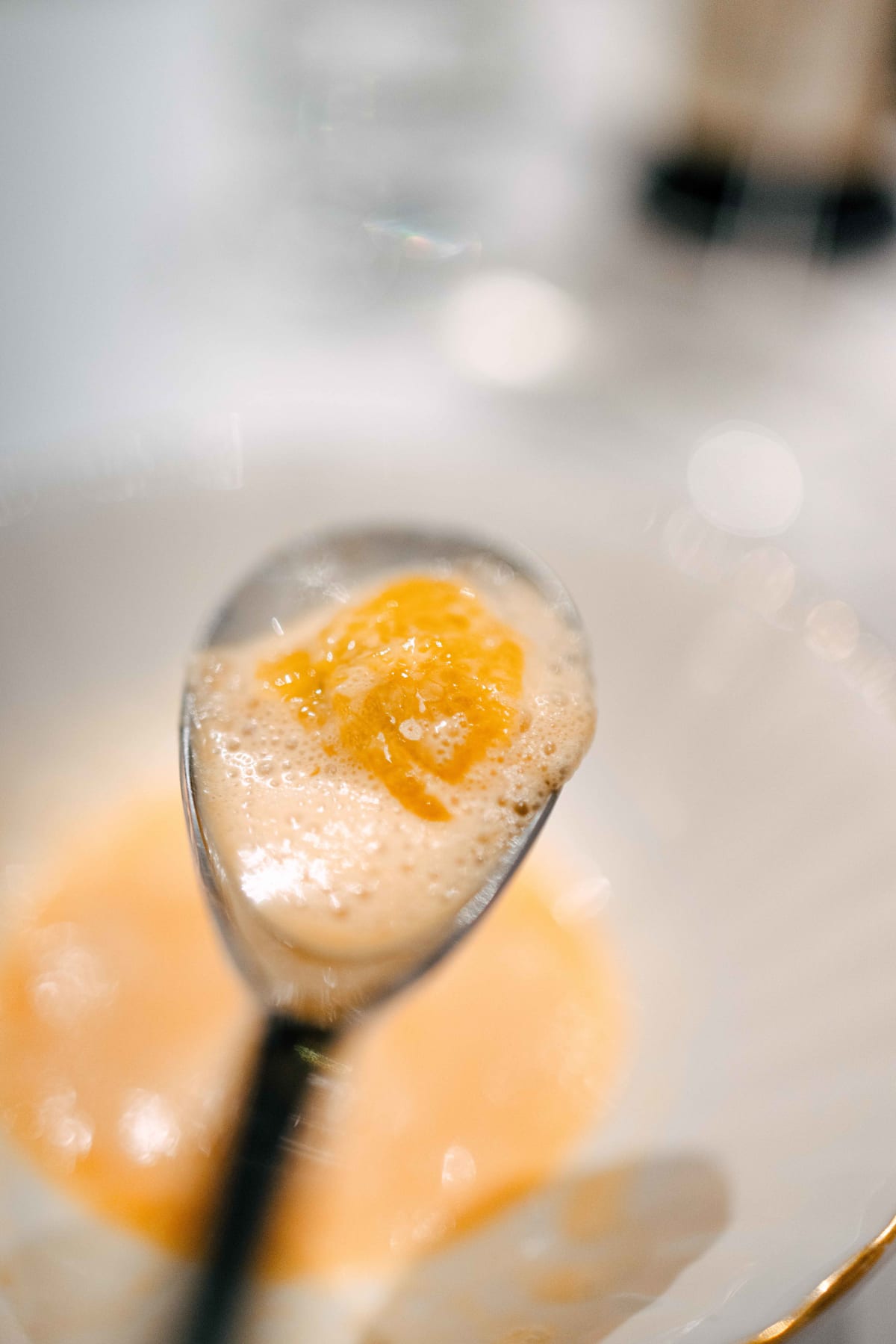
The clam is lifted out with a spoon rather than found on the surface.
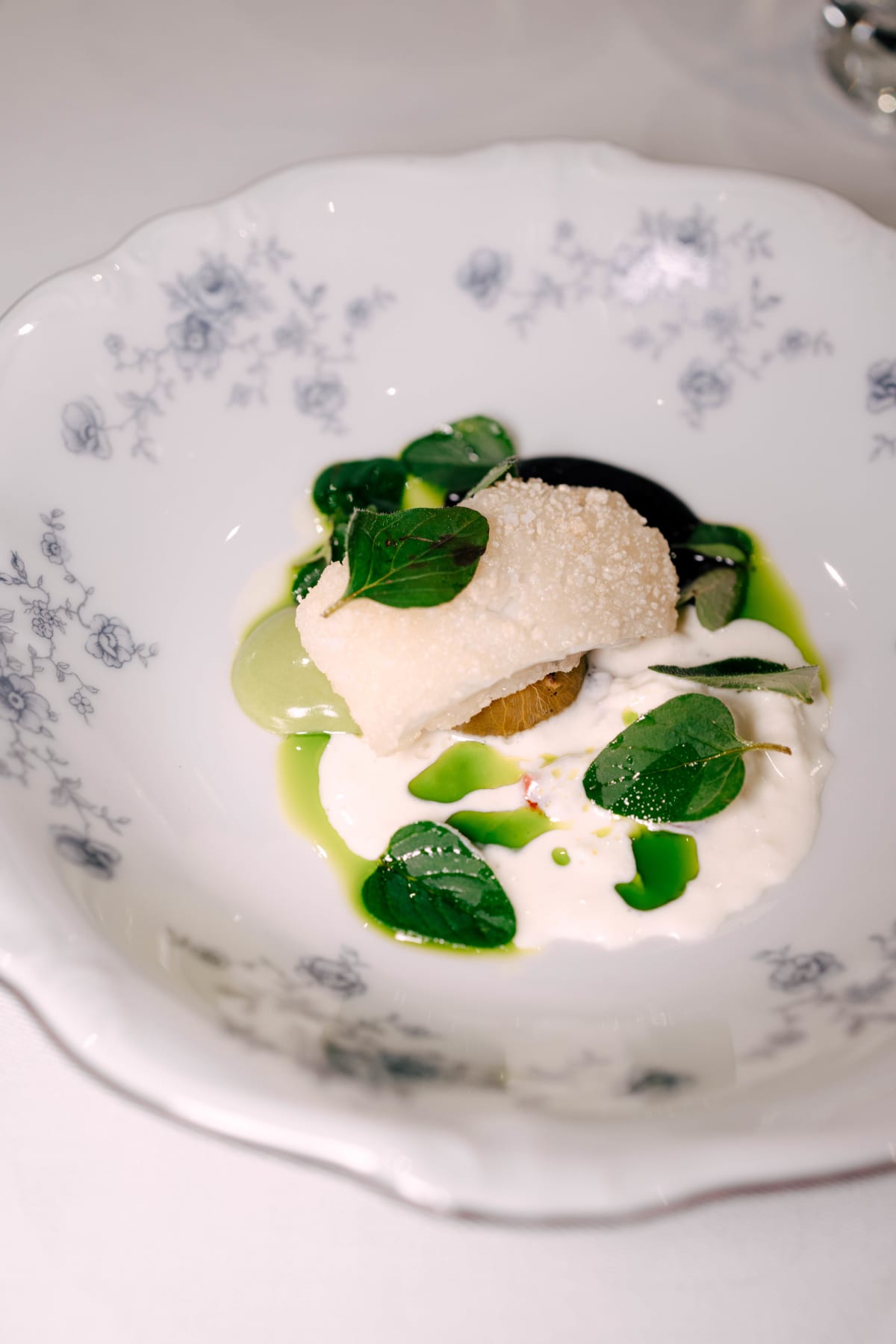
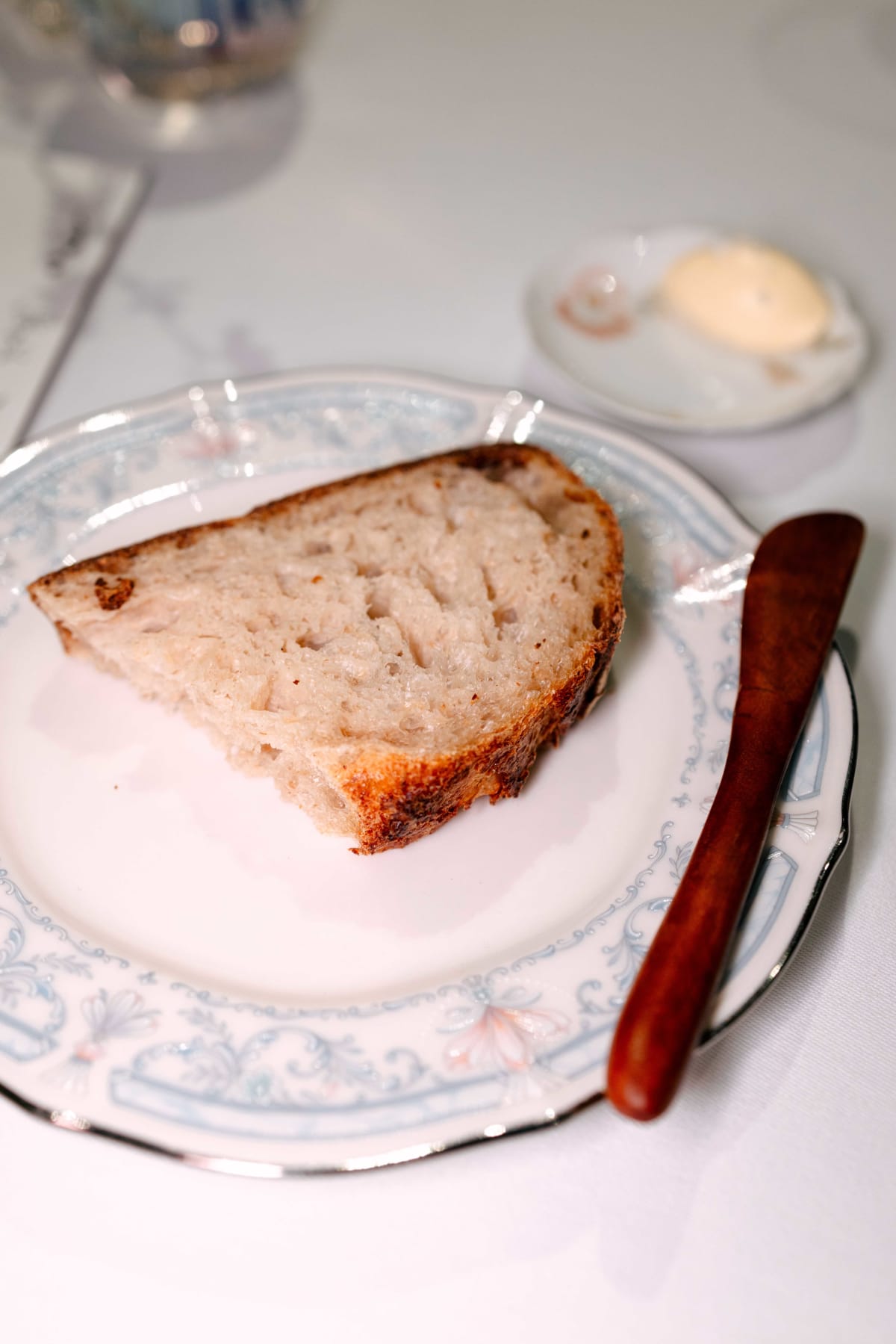
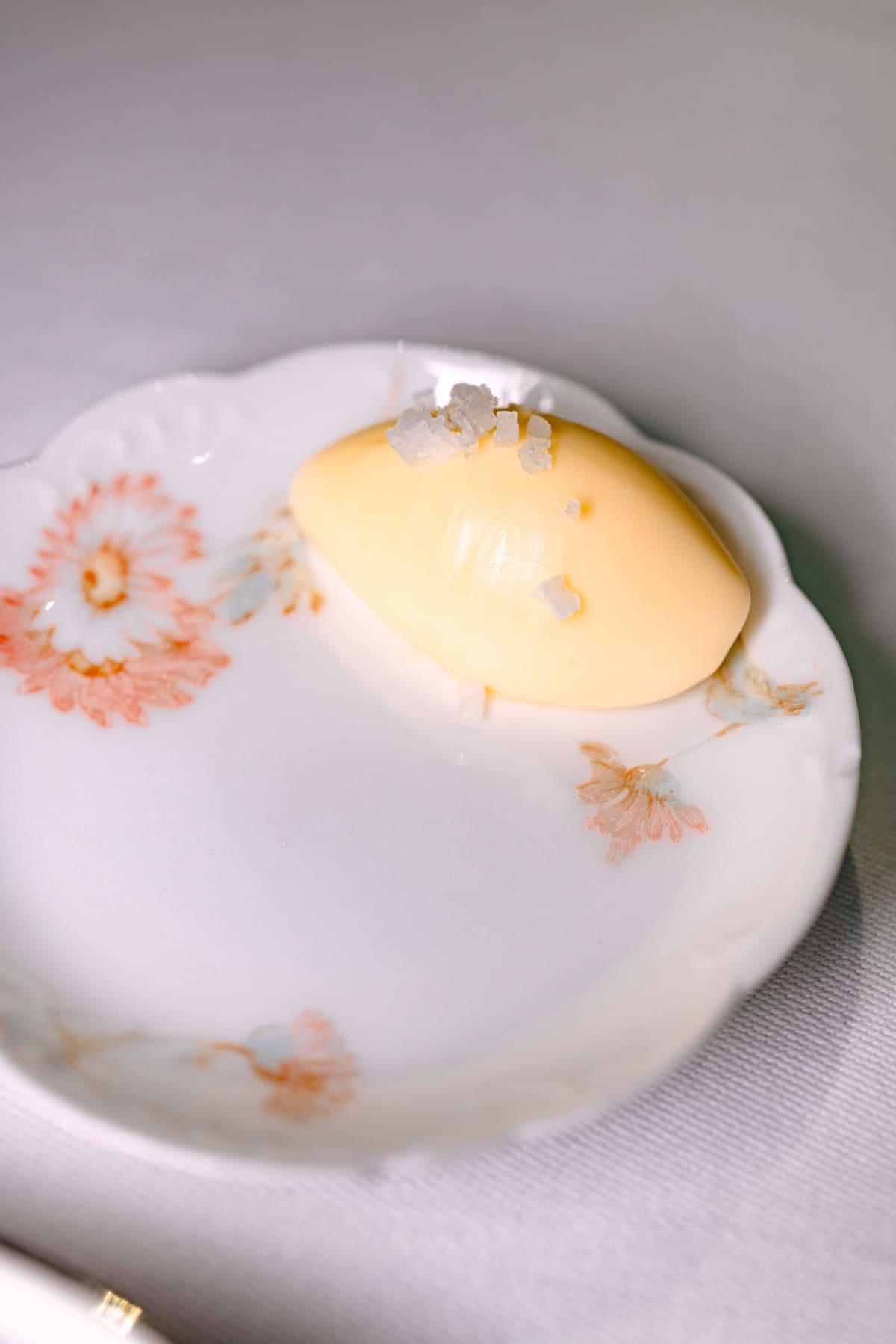
Bread came alongside.
Section 8·The Second Half
The fun and unfamiliar dishes of the first half carried on into the second, in menus led largely by seafood and meat.
First:
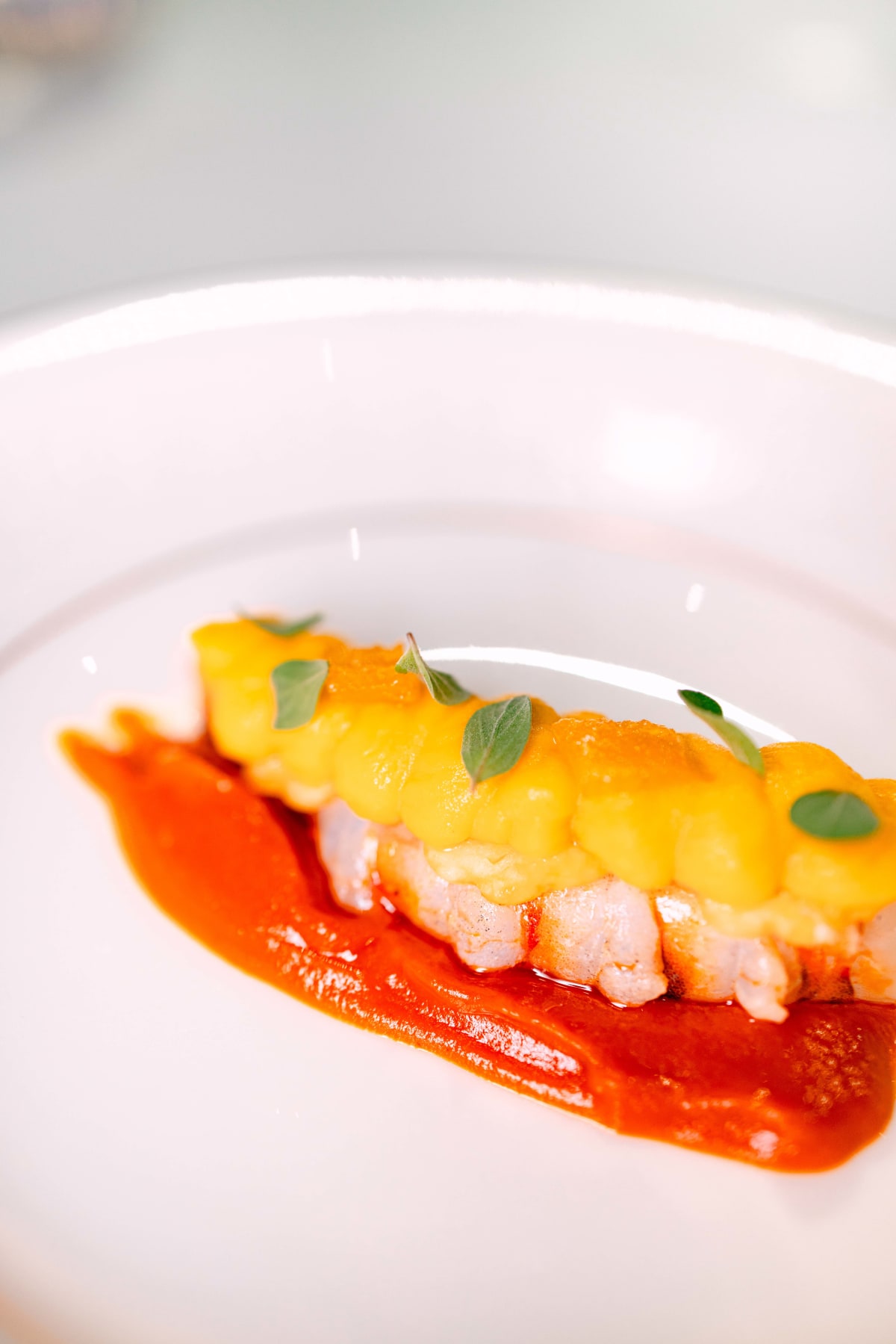
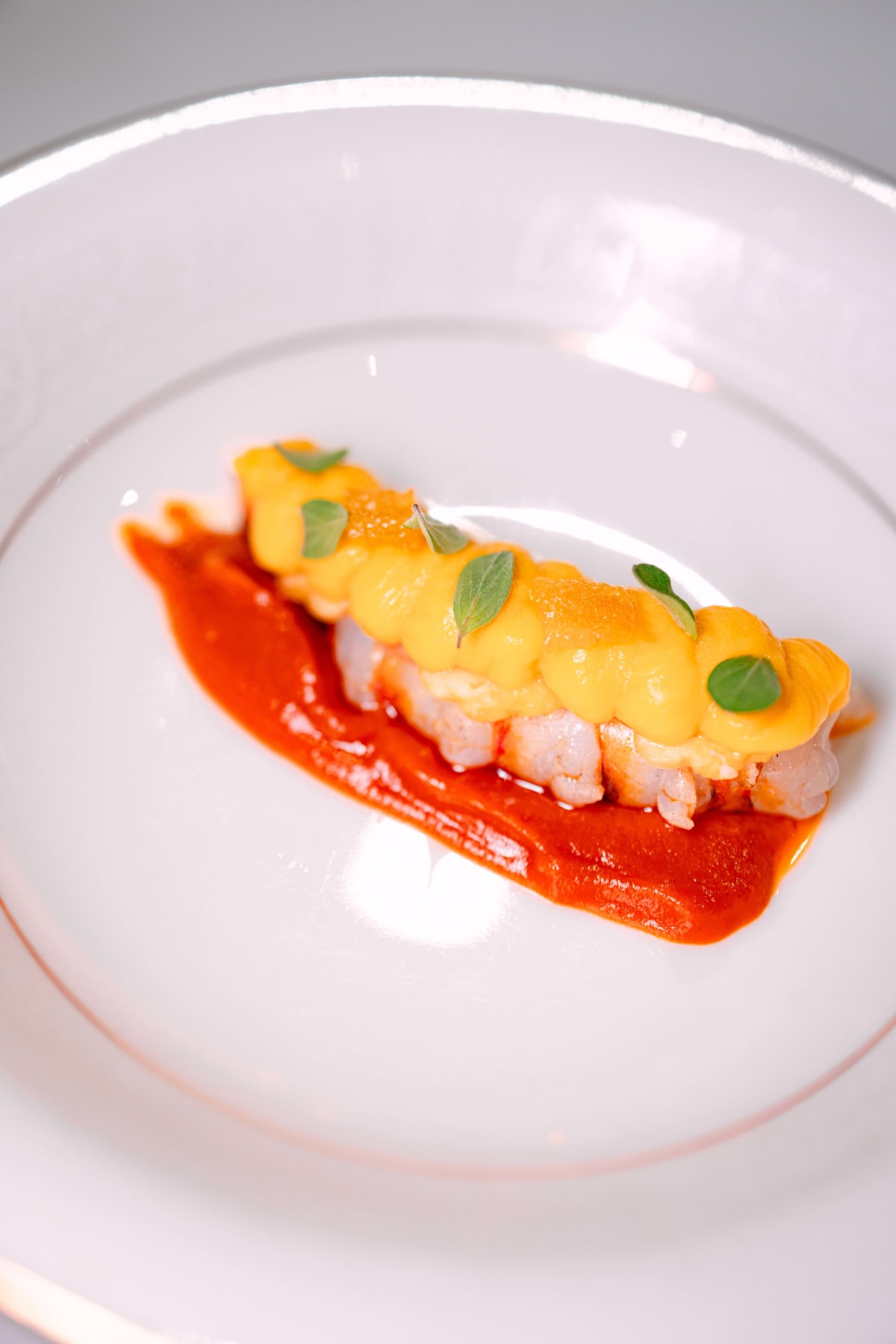
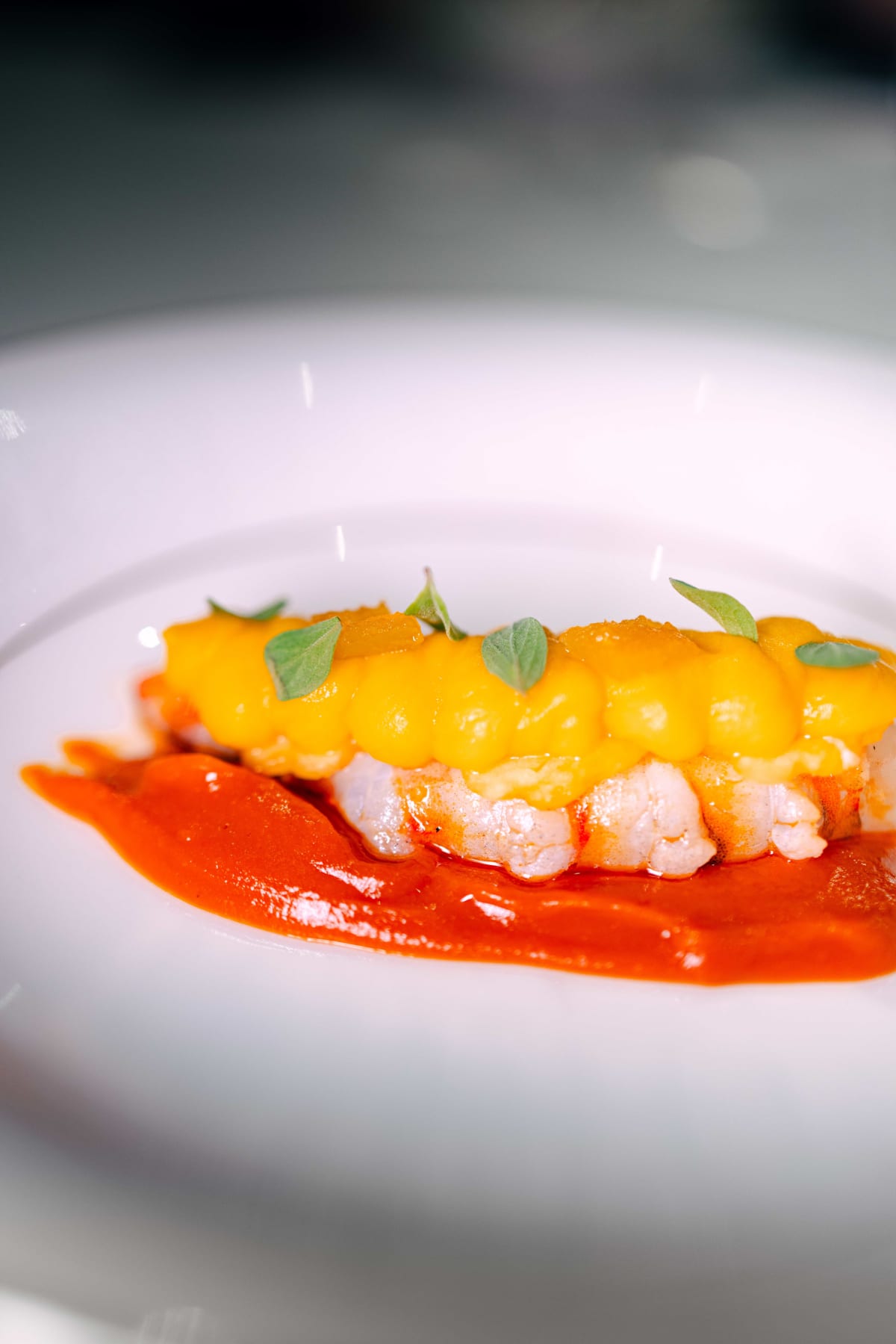
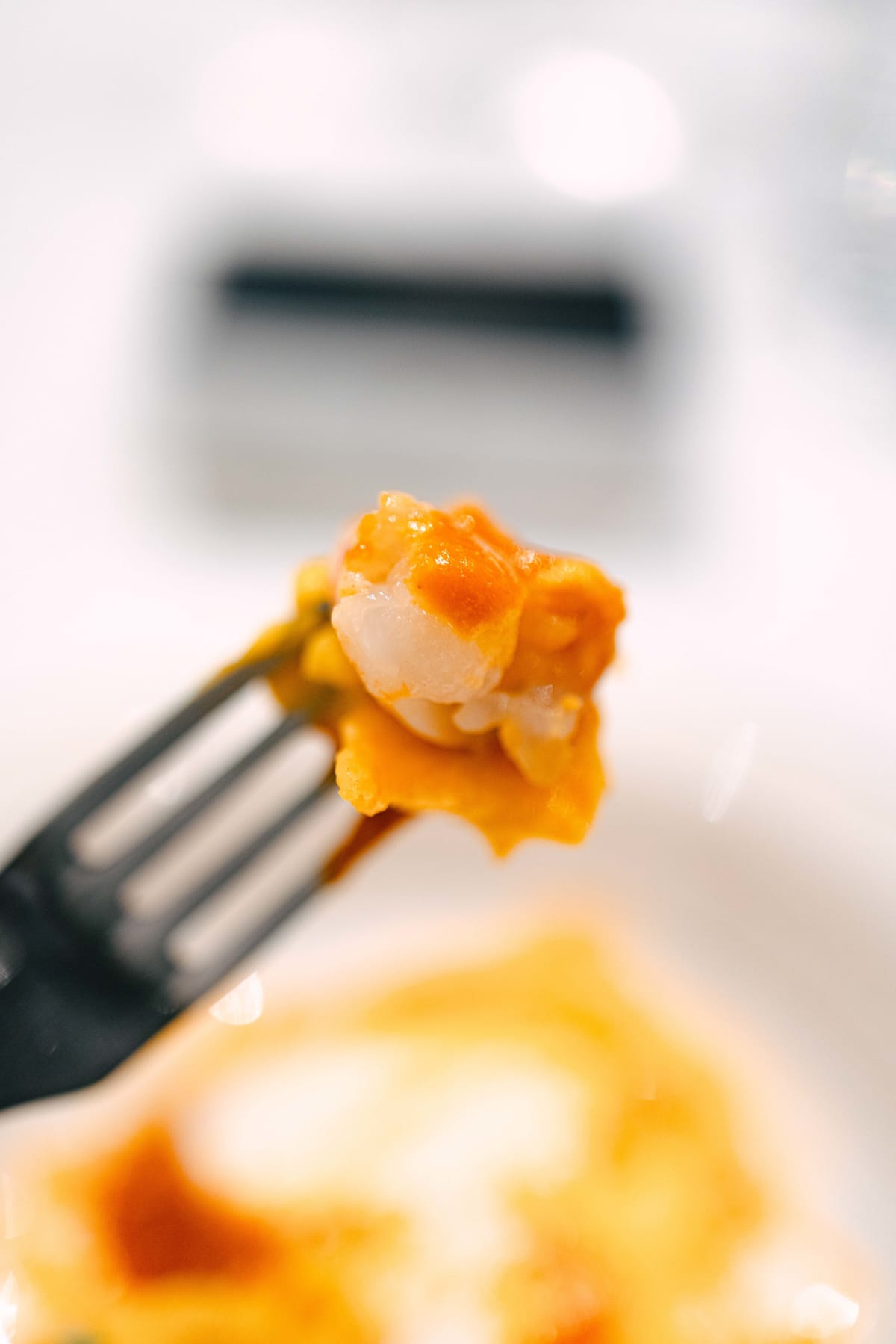
Gapado Spot Prawn and Yuja (dongi squash, tomato, marjoram)
The prawn itself was plump and delicious, but the sauce had a slightly spicy edge and there was a sense of the ingredient being buried under it. Even so, the prawn alone made it a decent dish.
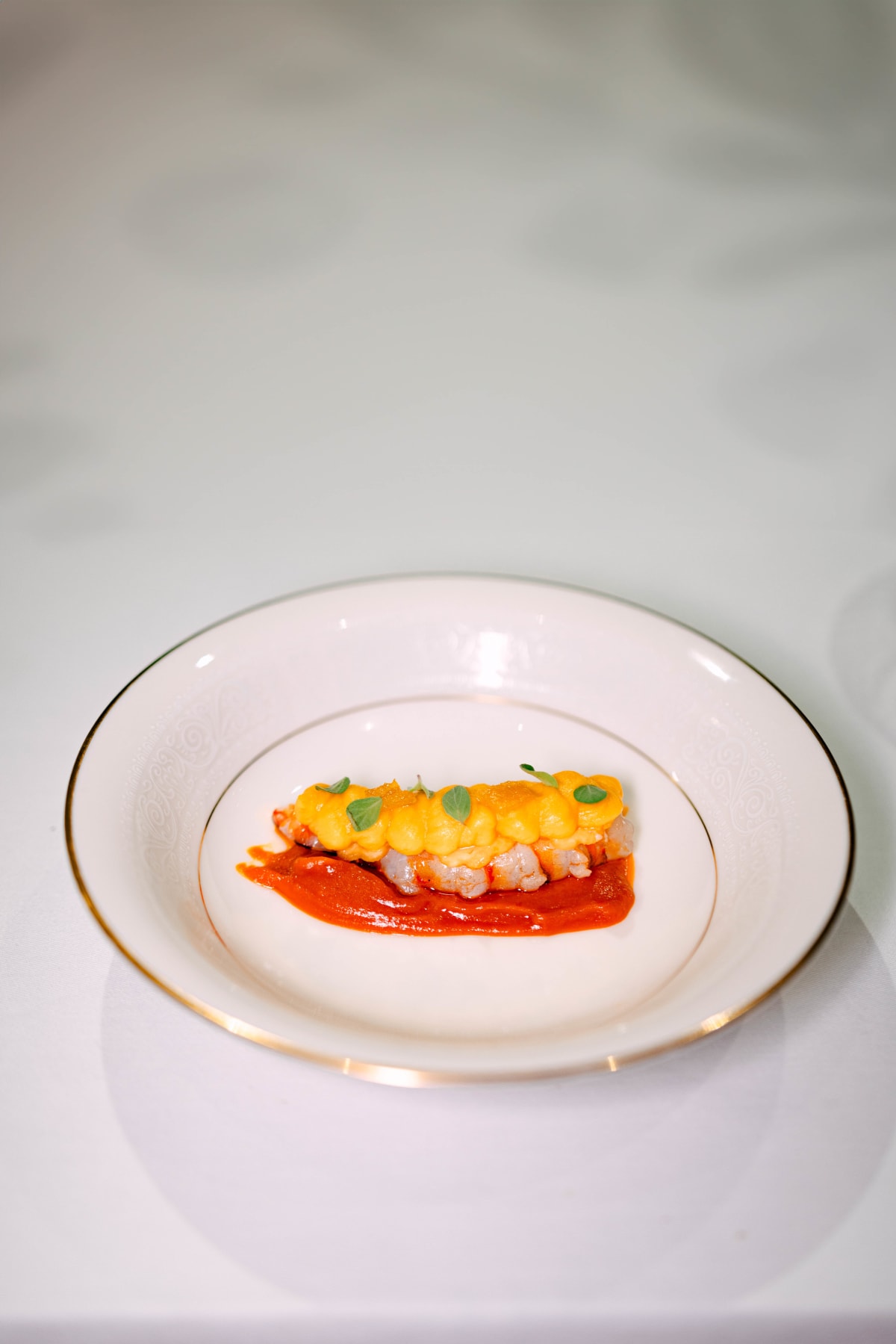
The squash and tomato sat under it.
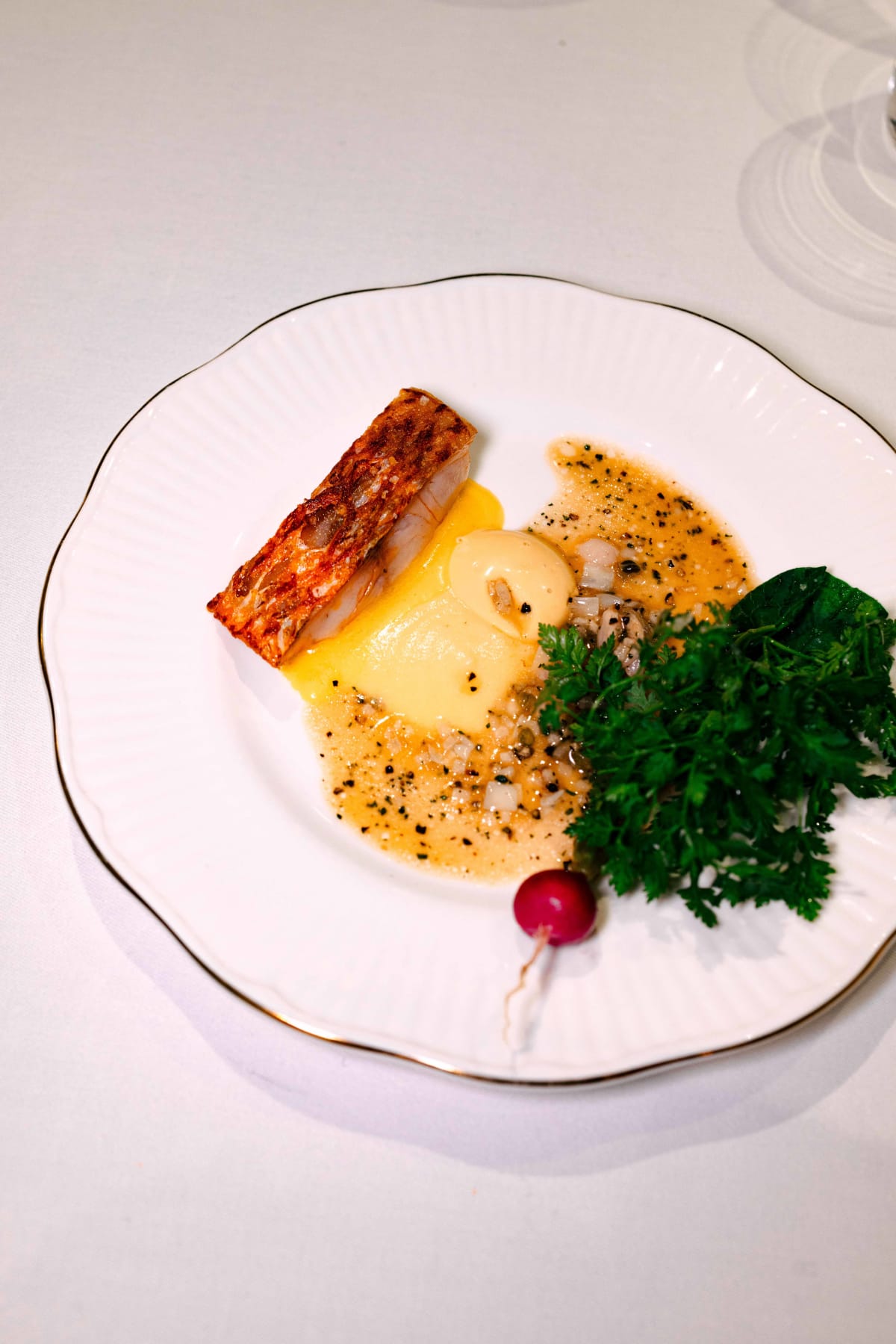
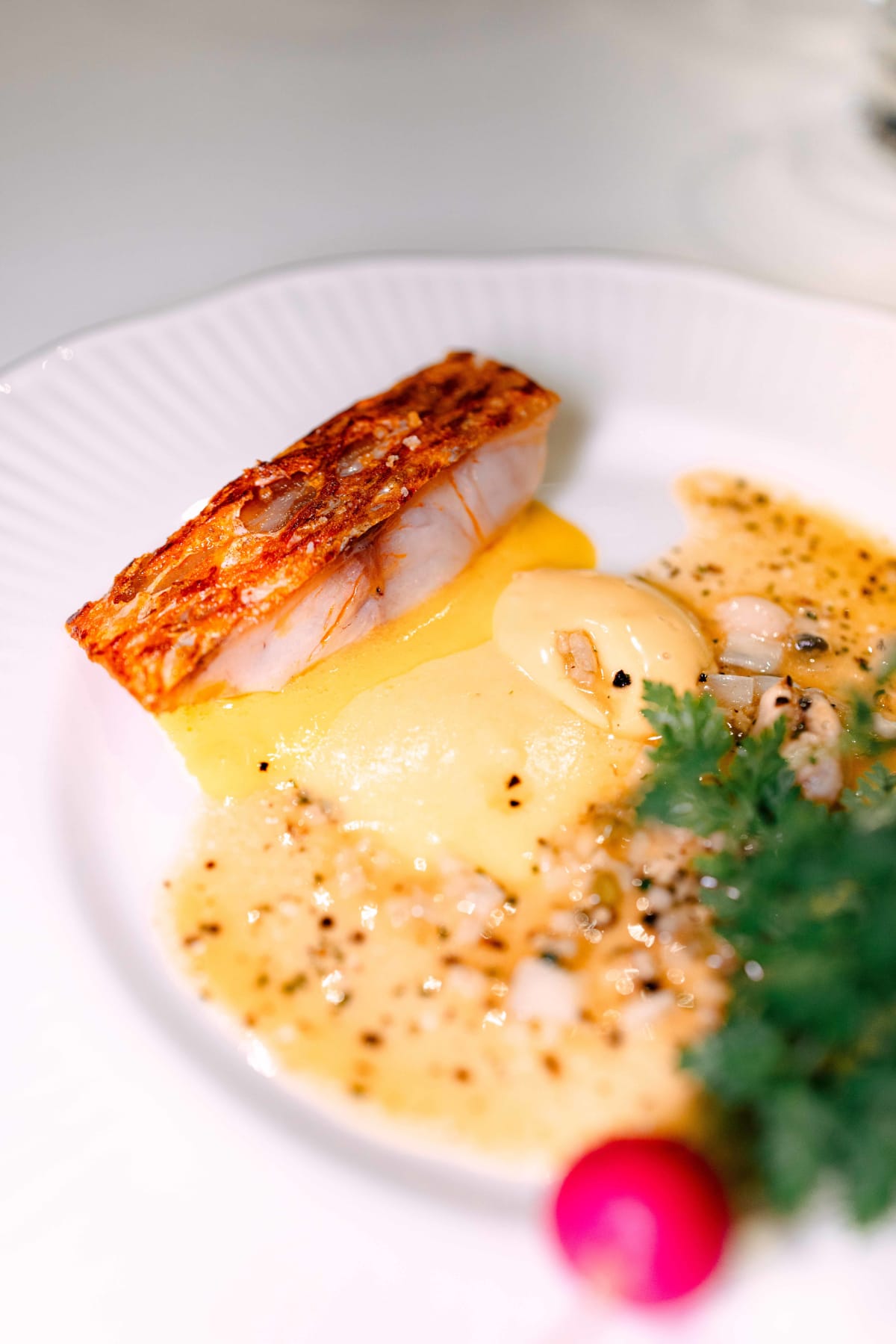
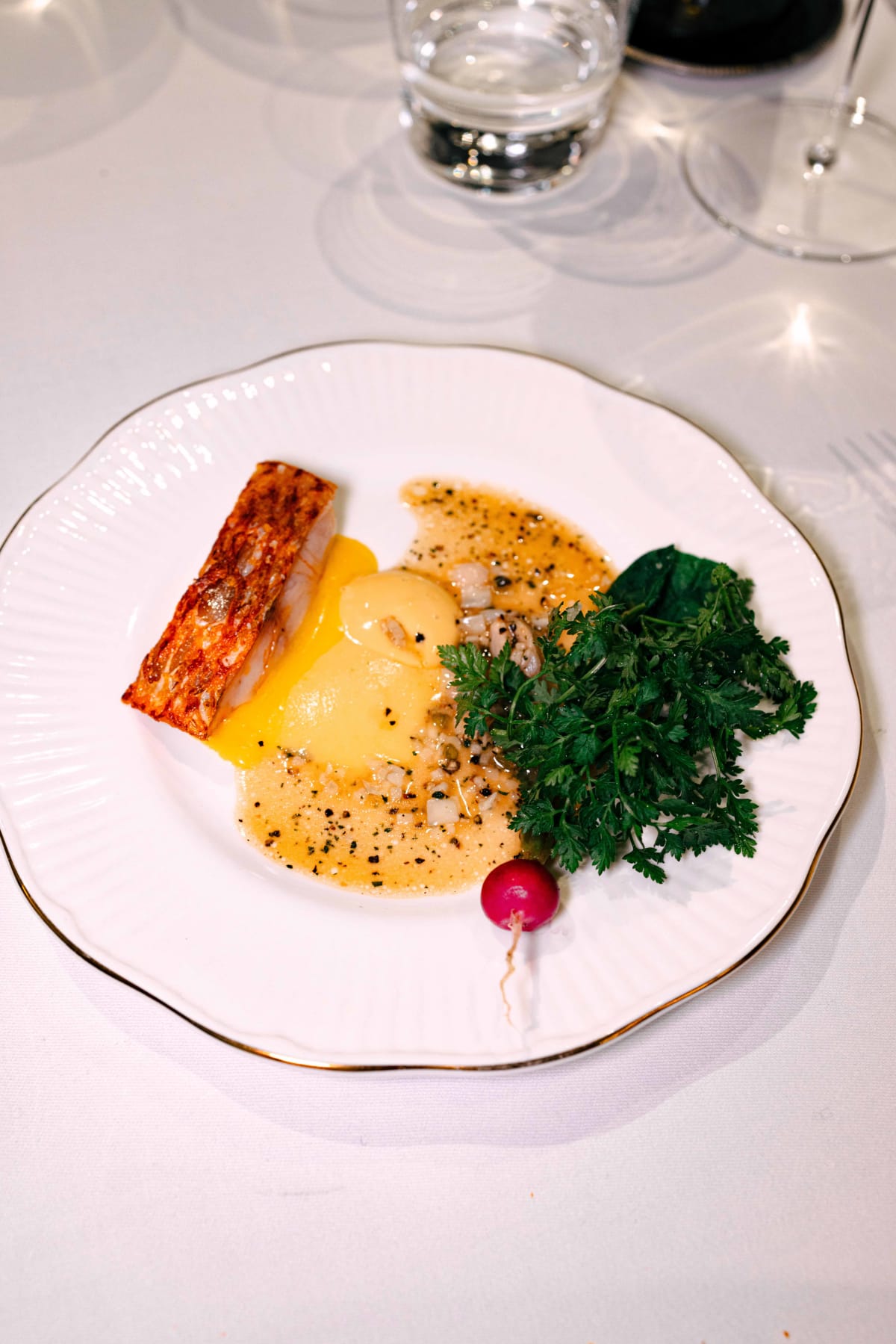
Biyangdo Goatfish Loin and Garlic (pepper sauce, pil pil, garlic and ginger purée, Korean beef marrow, organic smoked yolk, chive flower bud)
This was the dish I liked most in the second half. The goatfish seemed to have been lightly dried, and the matured aroma that comes off a fish as it dries, the sort of funk you can smell at a fish market, drifted through faintly. Some people would dislike it, of course, but it satisfied me. The sauce was particularly good on top of that, and eating the fish alone and eating everything together each had a different pleasure to it.
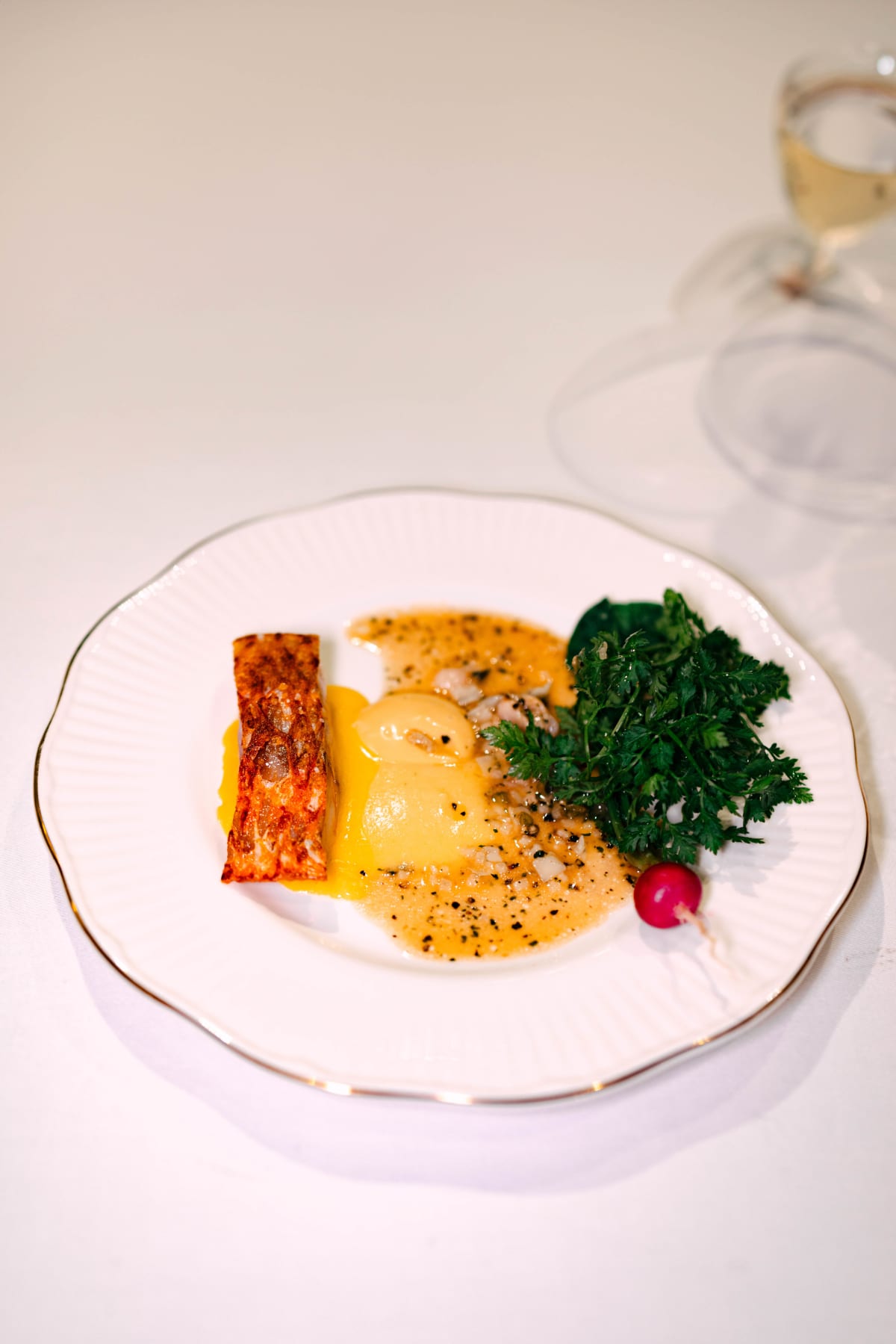
The marrow and the smoked yolk went underneath the fish.
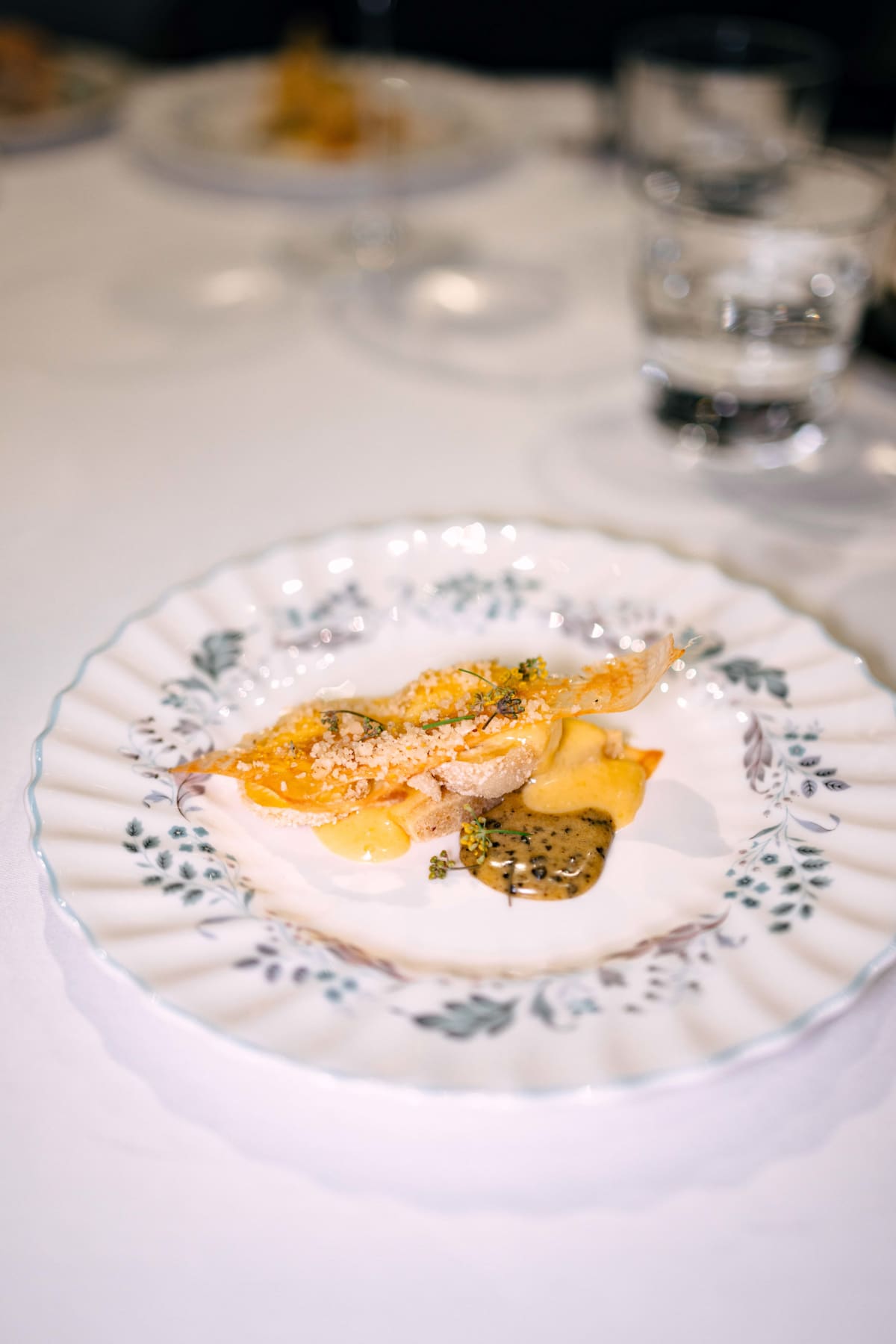
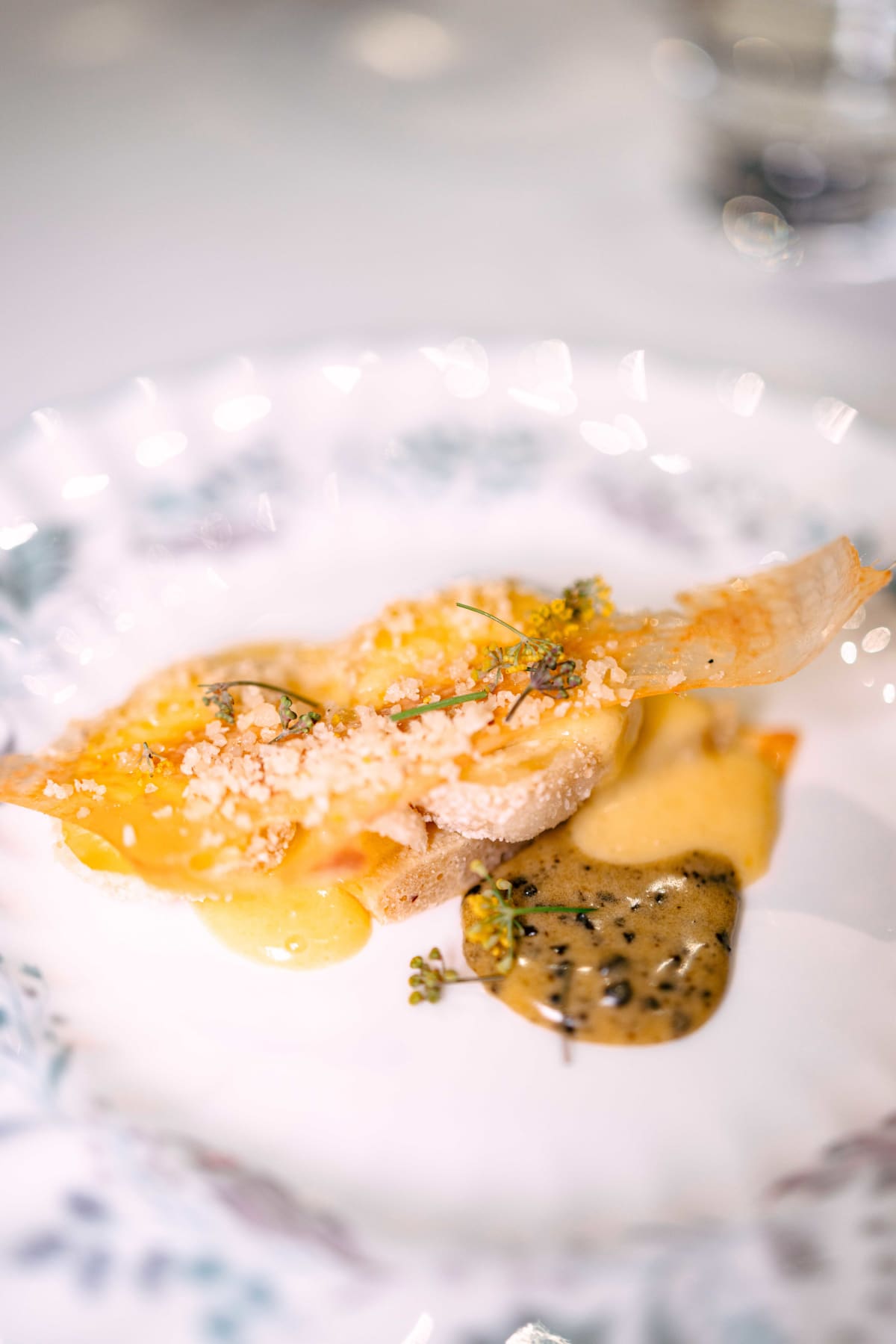
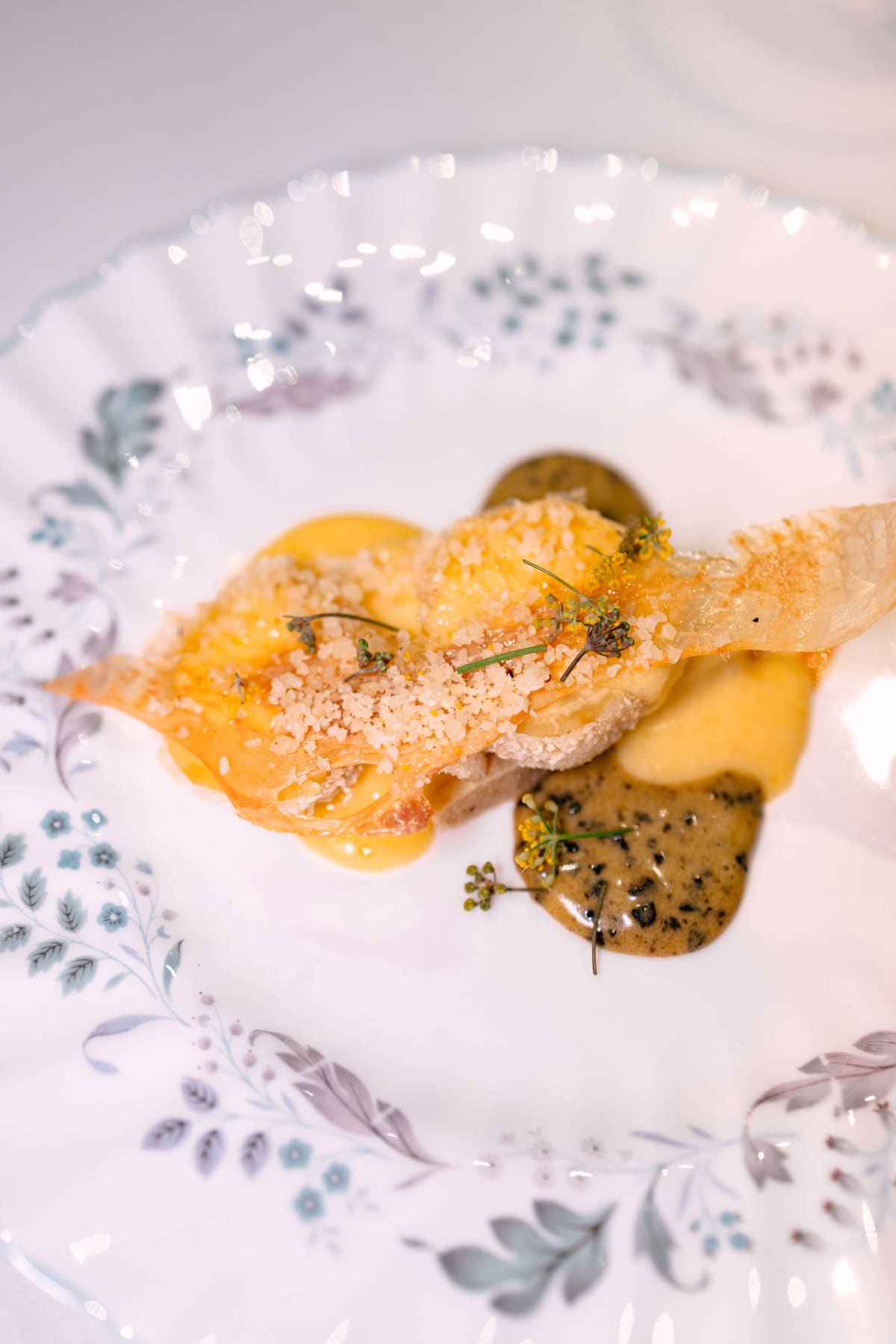
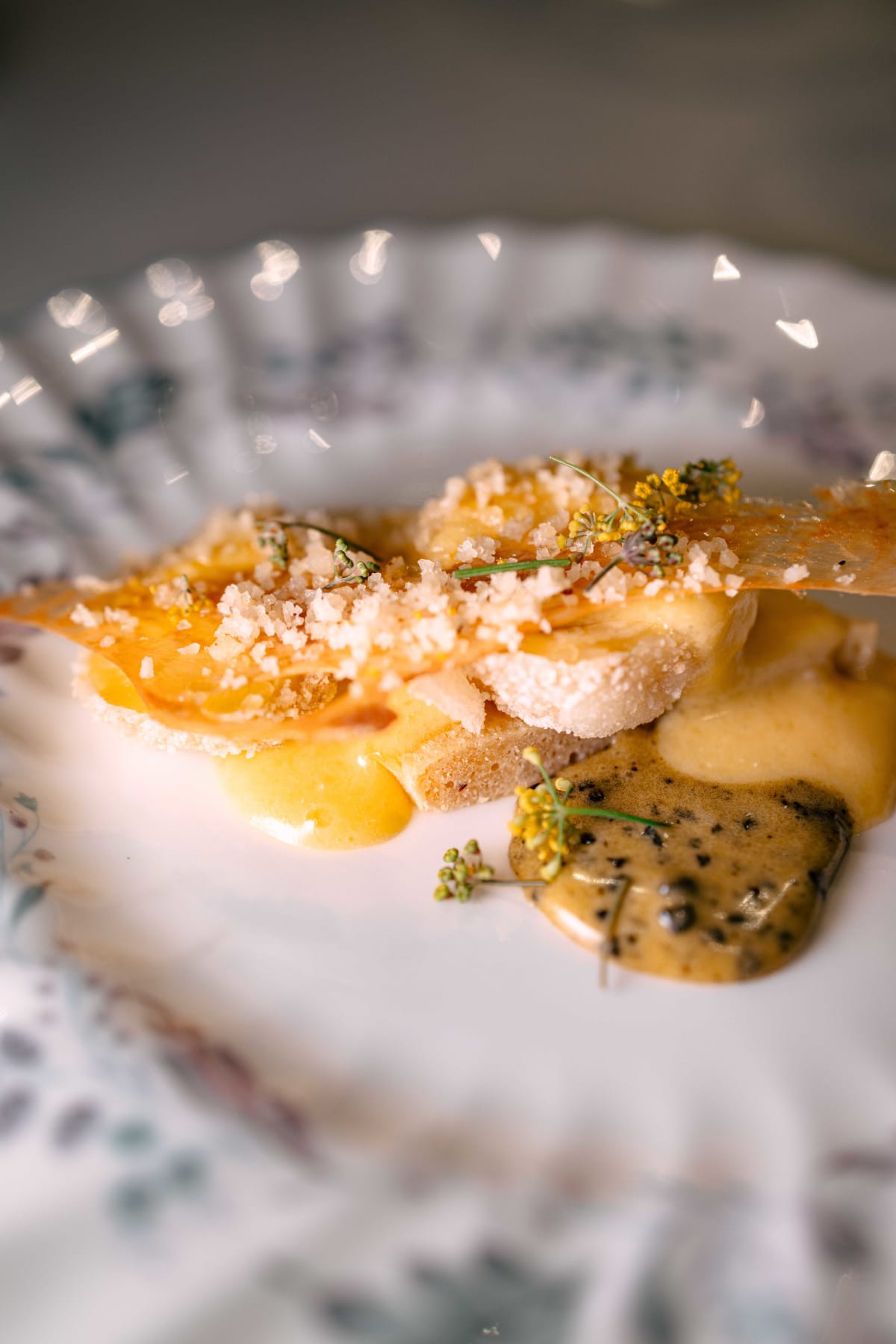
Chestnut and Chicken Skin with chestnut spread (twenty-four month Parmigiano Reggiano Solo di Bruna fondue, bronze fennel, bronze fennel syrup, almond). This was a considerably interesting dish too. Not chicken but chicken skin came out, and around it were chestnut and various other sauces.
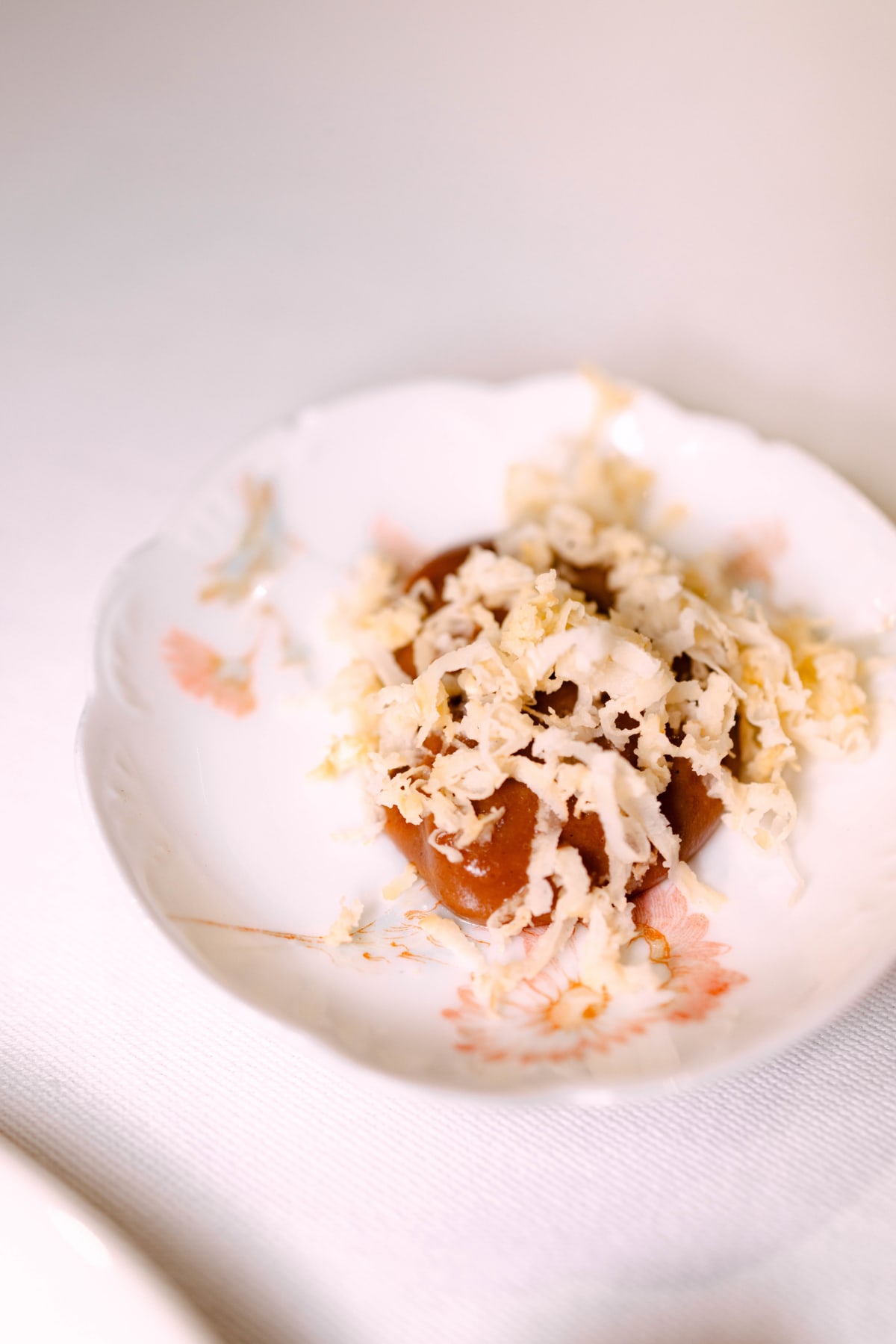
The flavour of the Parmigiano Reggiano was, for me personally, the masterstroke of this dish.
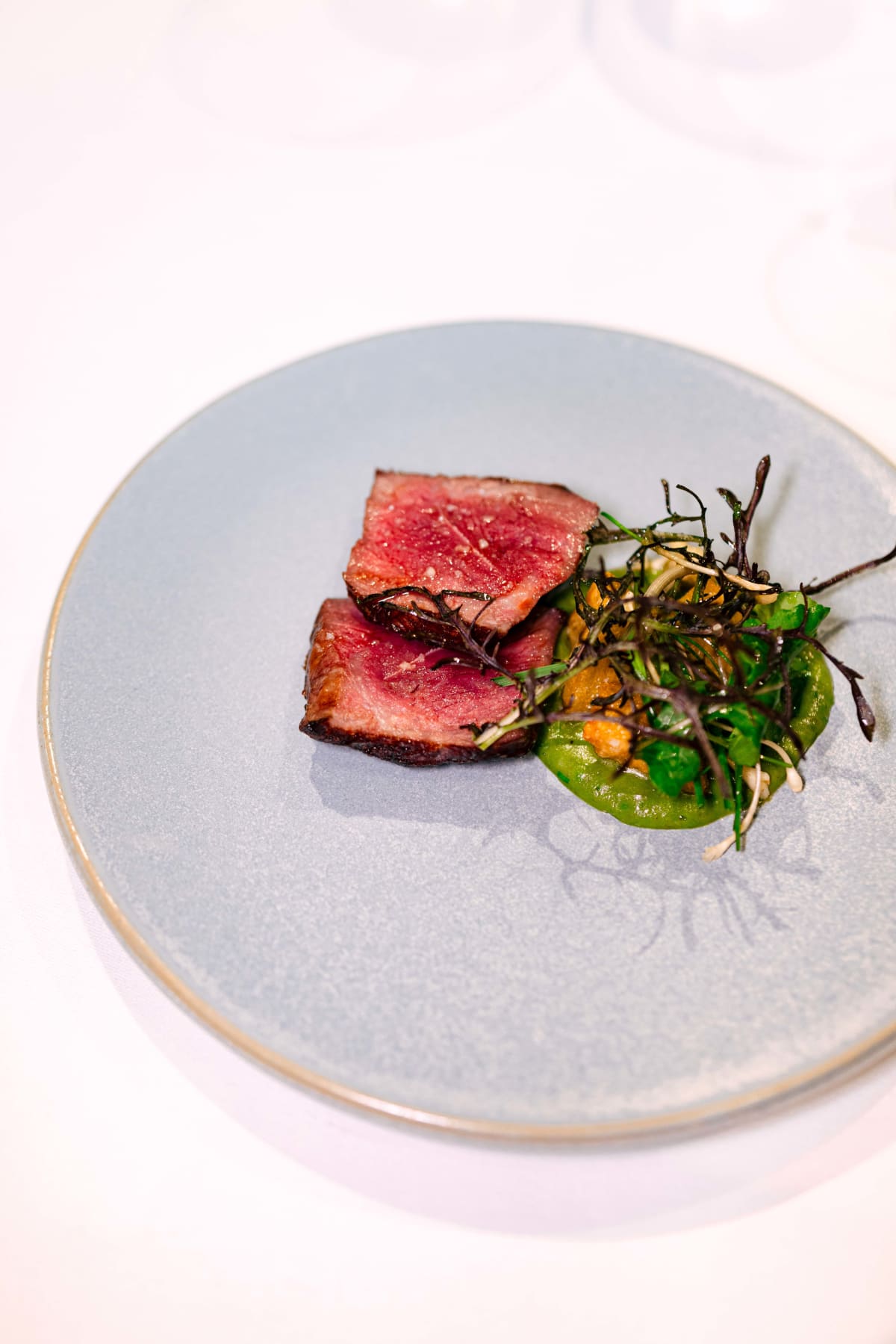
Seven Day Aged Korean Beef and Chilli (potato, piparra, autumn wild chive, mustard leaf)
The last meat main was aged Korean beef, and this was another dish I ate with real pleasure. The point, though, is that it was not the meat that made it good, but the potato and the various vegetables and the sauce that came with it. Rather than the melting tenderness we expect, the beef had a style with chew to it, and I prefer that myself, as long as it is not tough, since it tastes better and does not tire you. It was a dish where the synergy of eating everything together came through far more than any single element.
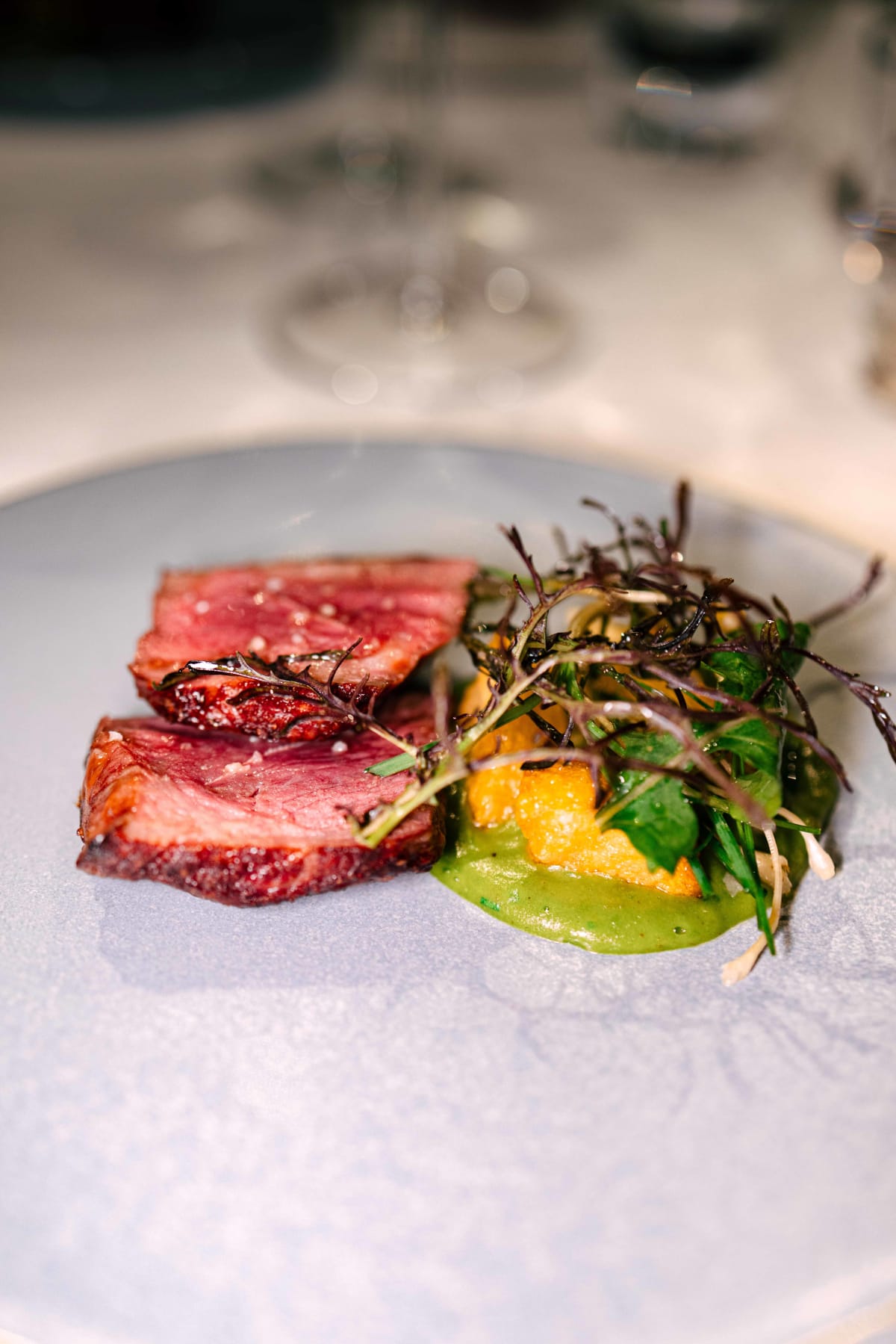
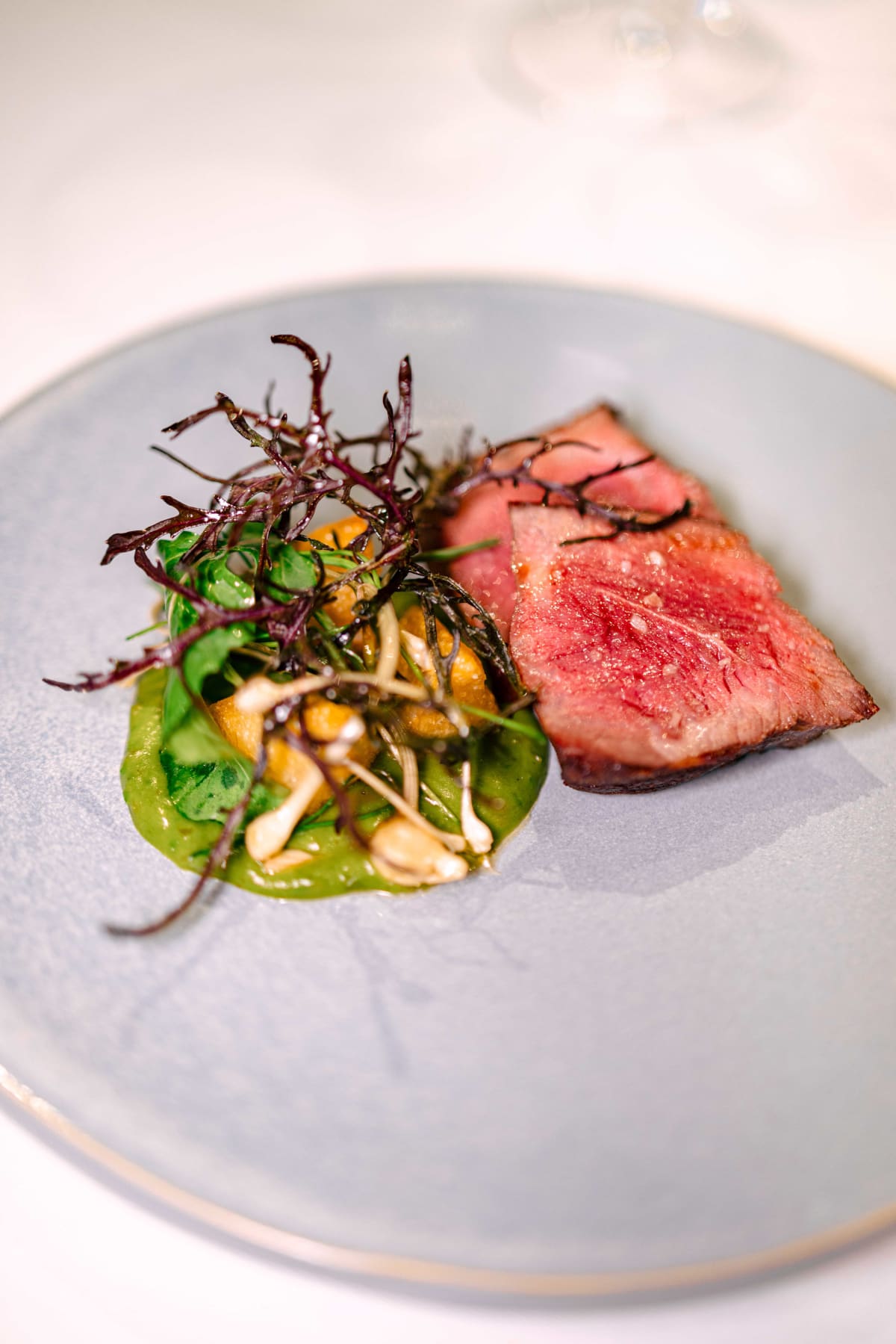
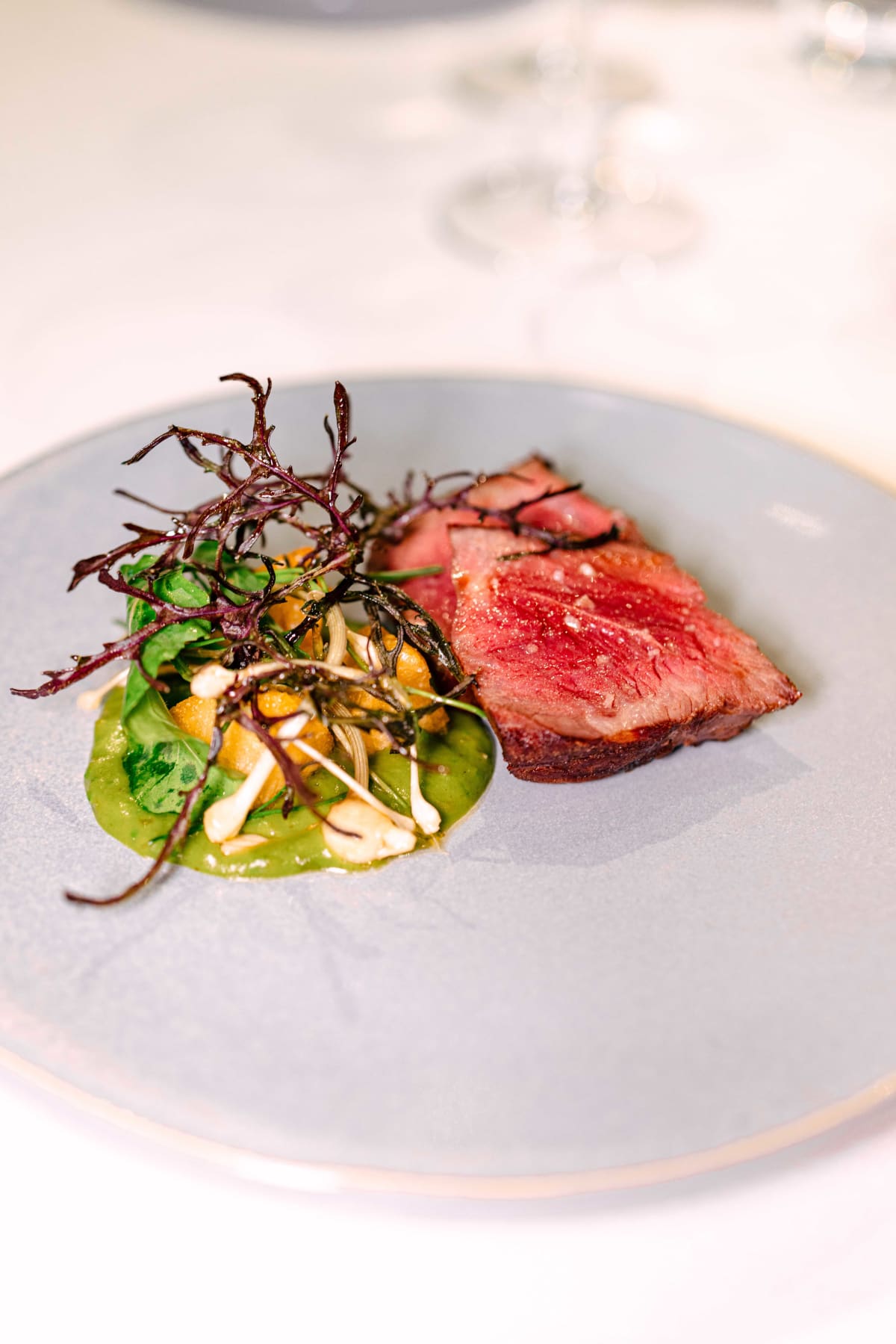
That I felt more synergy from eating things together than from any single ingredient does not seem to be an accident. The part Jung Ha-wan takes particular care over is the sauce, and many of them are built on a vegetable base. The method is to concentrate or ferment and then combine oil and acidity to draw up the aroma of the raw material. The opening juice of a past course is said to have contained twenty to thirty herbs and seeds, cumin seed and coriander seed and fennel flower among them. In the other direction he tries to touch the ingredients less, and the reason for keeping even knife work to a minimum is that he sees moisture and aroma escaping as the cell structure is damaged. So even when a plate looks simple, the core of the cooking sits on the invisible side: the timing of the harvest and the maturing, the heat and the time, the water content of a vegetable, the balance of oil and acidity.
Section 9·The Desserts
Then it was dessert's turn.
For the first dessert:
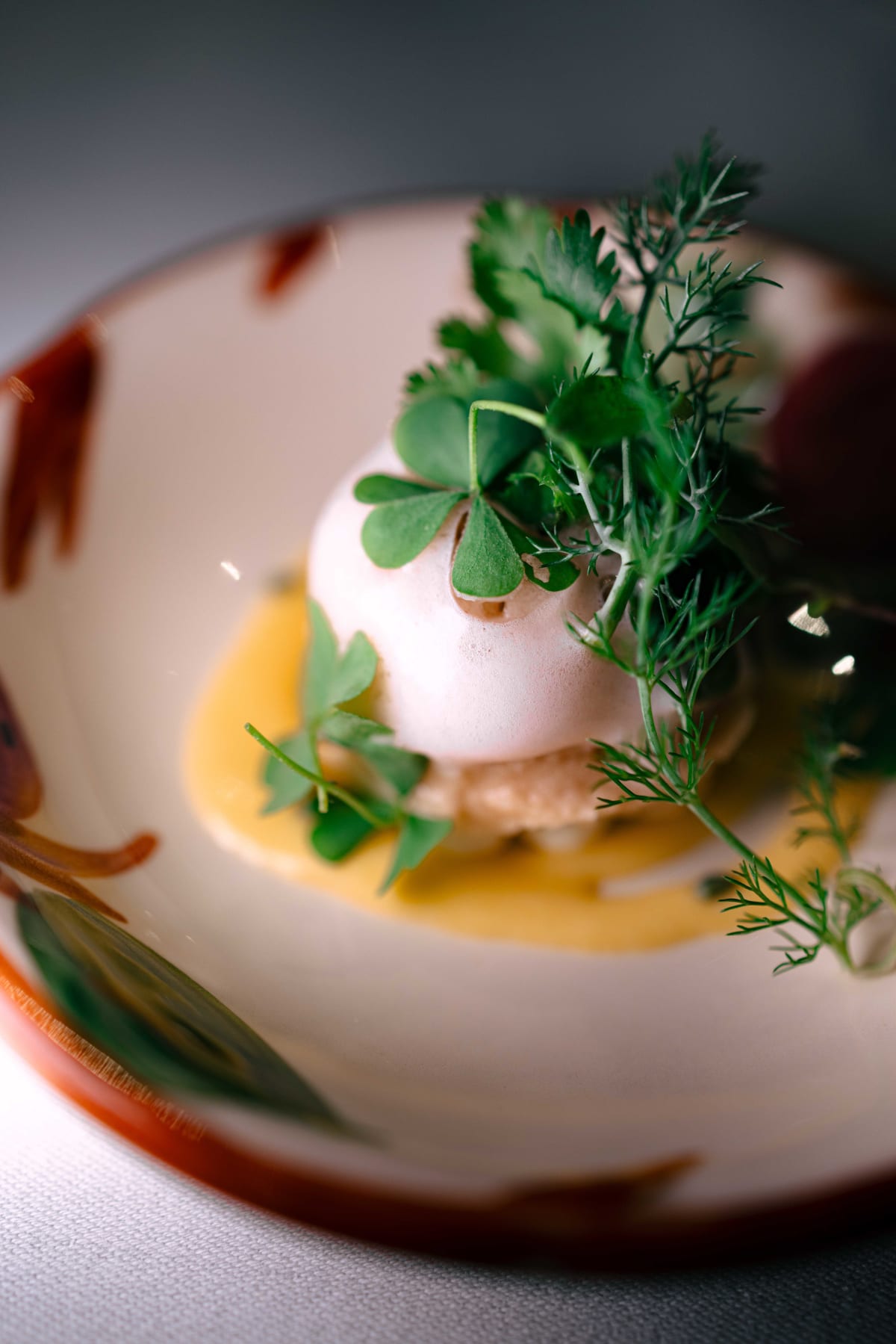
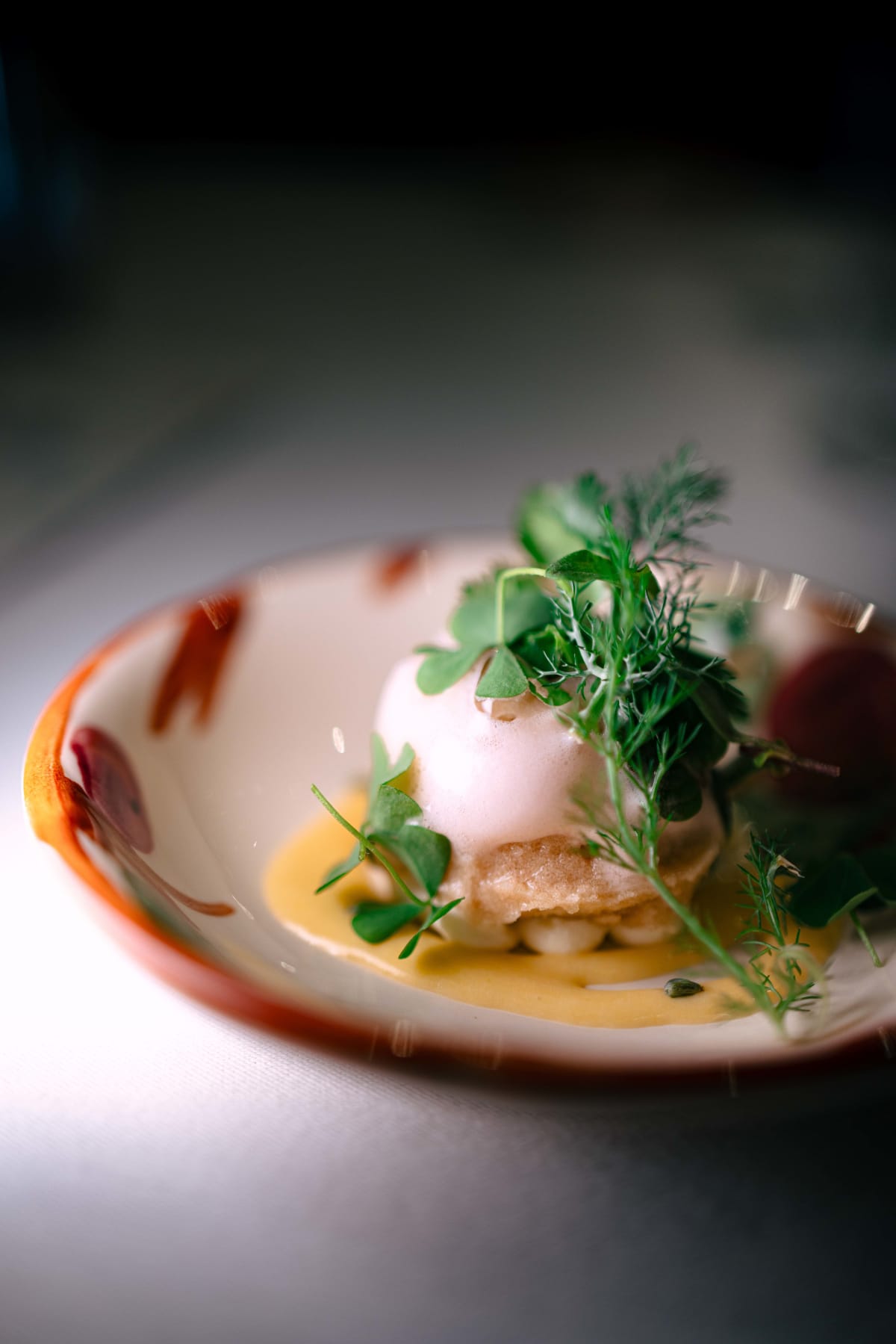
Autumn Herb Sherbet (mascarpone, passionfruit sabayon)
A herb sherbet was prepared. Not herbs somehow made into an ice cream flavour, but the herbs themselves laid whole on top.
At first I thought, will this be any good? And in fact, when the herb aroma went in together with the cold ice cream and spread right through, nothing could have been better. To match herbs with ice cream like this. This was when I felt how deep the chef's craft runs.
The Terras Gauda I had ordered at the start was long gone and I was short of something to drink, so around dessert I ordered a glass of wine.
Muscat de Beaumes de Venise 2020, a fortified wine from the Rhône. The alcohol is not all that high, though.
There is a reason it does not feel high in alcohol. Muscat de Beaumes-de-Venise is a vin doux naturel, made by the mutage method of pouring pure grape spirit in during fermentation to kill the yeast and stop it.
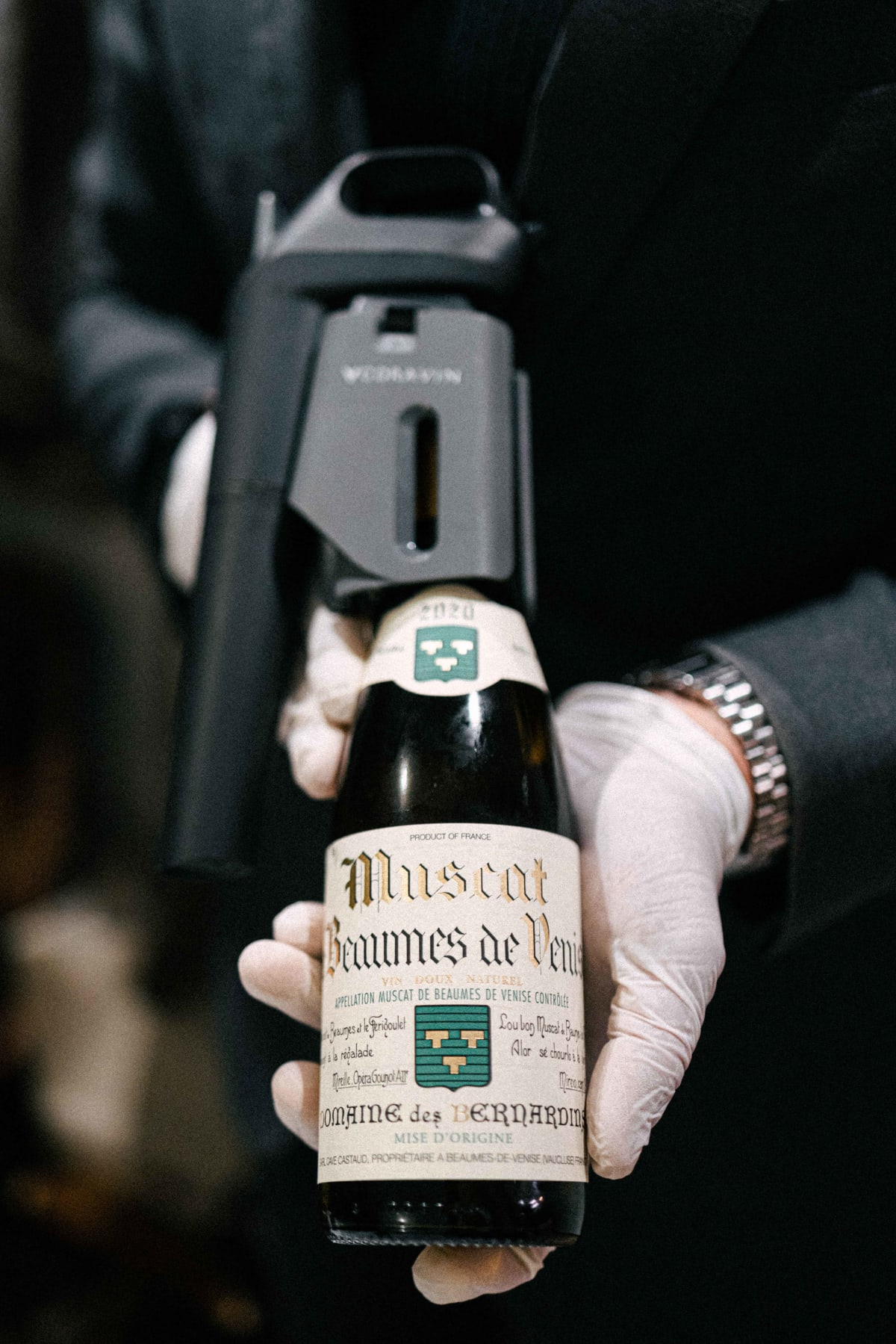
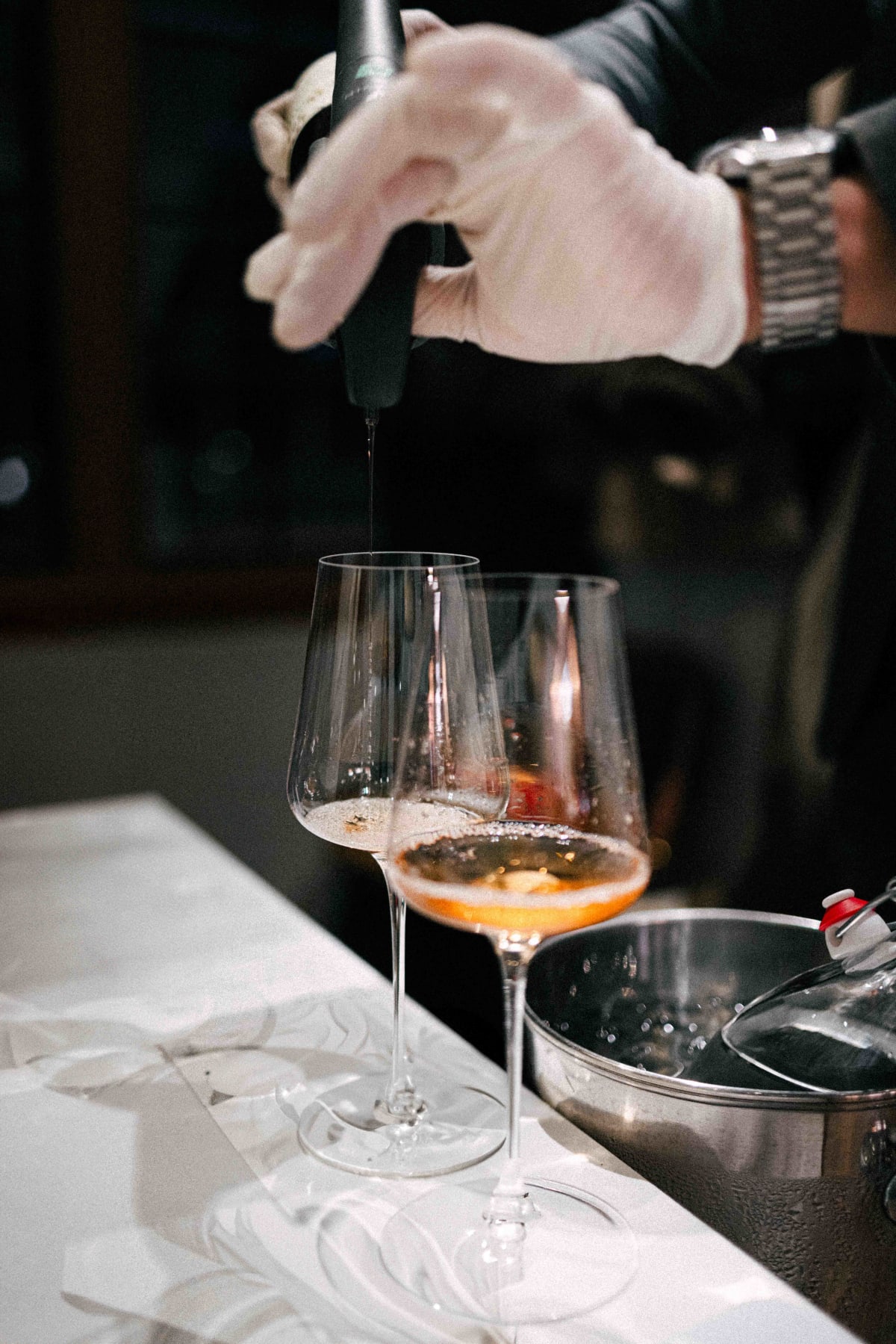
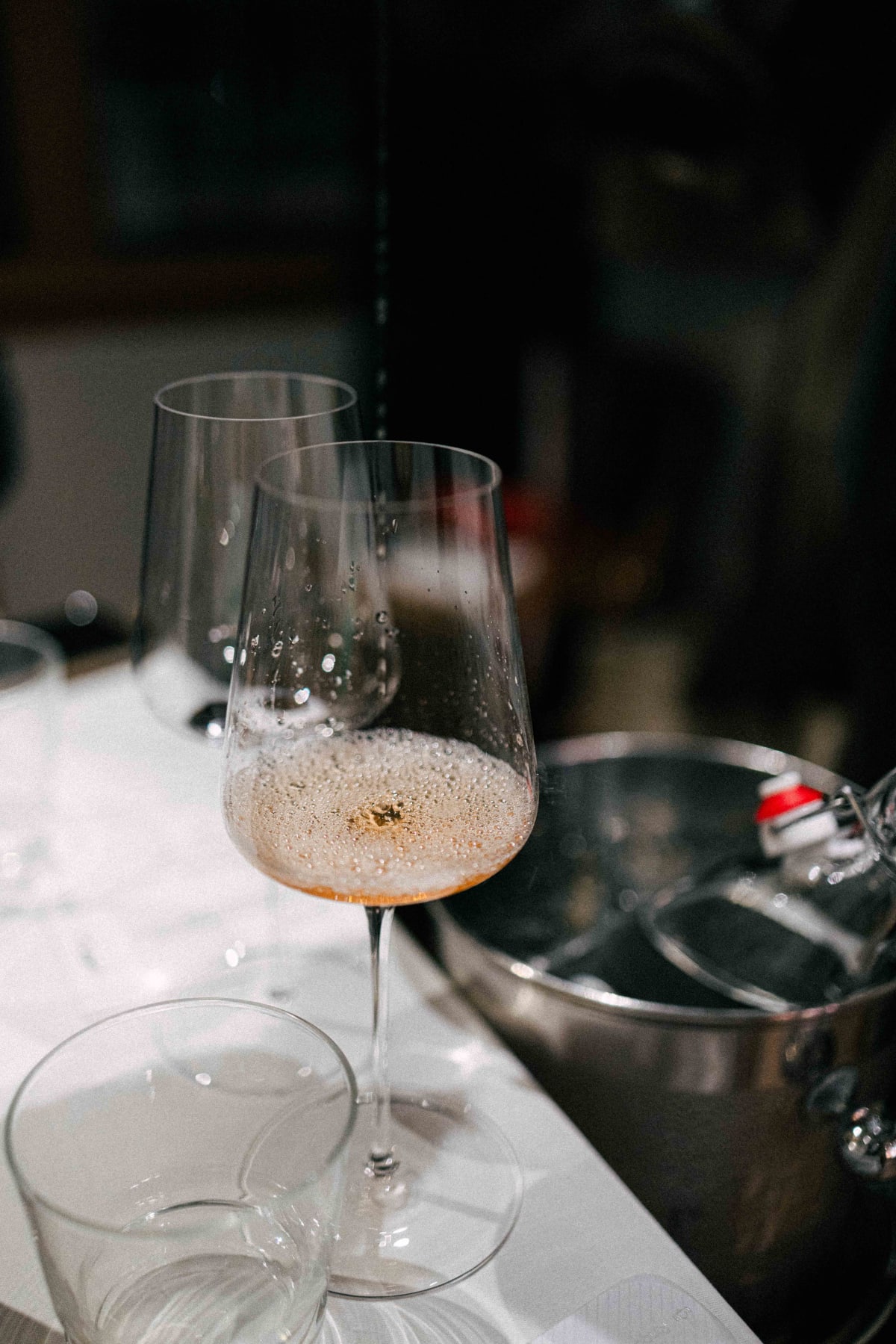
No sugar is added and the sugar the grape already had is left in place, and by regulation the fruit must reach at least two hundred and fifty-two grams per litre at harvest while the finished wine needs only fifteen percent alcohol. Against port or sherry running between eighteen and twenty, that is on the low side. Only one grape is used, Muscat à Petits Grains. It can be made only around the village of Beaumes-de-Venise at the foot of the Dentelles de Montmirail, and having gained its appellation in 1943 it remains, with Rasteau, one of only two vins doux naturels in the Rhône valley.
If you look at the bottle photographs you can see the wines by the glass are served with Coravin. Which is why, as I felt on my first visit too, the range of wines by the glass is very wide.
That Coravin lets you enjoy a wide range by the glass is one of the reasons I would recommend GIGAS for drinking wine. I gather a Coravin costs a fair amount, and the gas too, and although they have moved since, at that time there were not many tables, so preparing that variety of wines by the glass struck me as really impressive.
The dessert that came after the herb ice cream was:
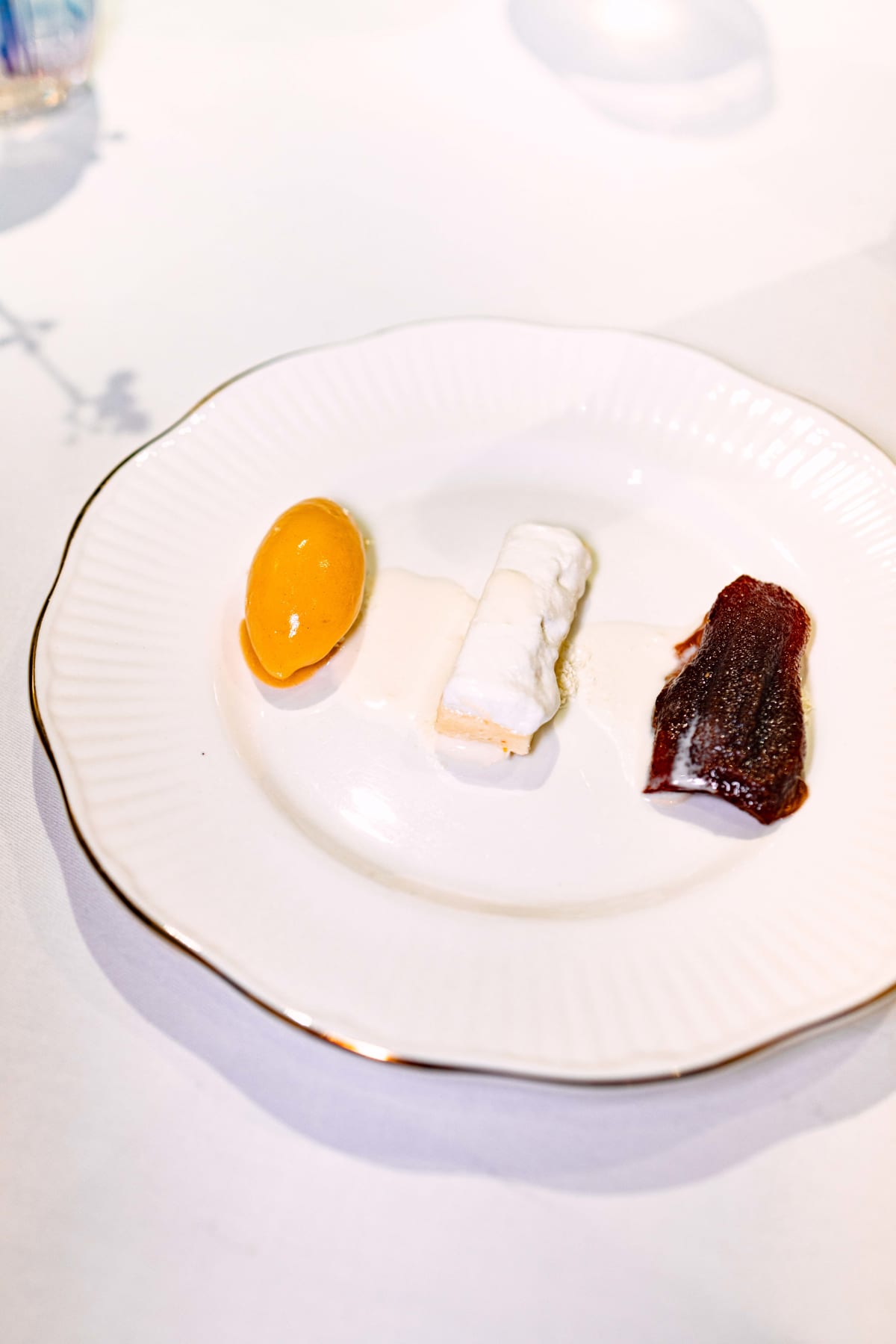
Dried Persimmon, Burdock Semifreddo and Cinnamon (Ossau-Iraty velouté, persimmon sherbet)
Three small desserts came arranged side by side on the plate. Each had its own character to it.
Grand-mère Clafoutis and Celeriac (apple)
The last dessert. Clafoutis is said to be a traditional French dessert made with cherries, and at GIGAS it had apple in it. As someone who likes apple pie, I ate this happily. I liked it all the more for not being aggressively sweet.
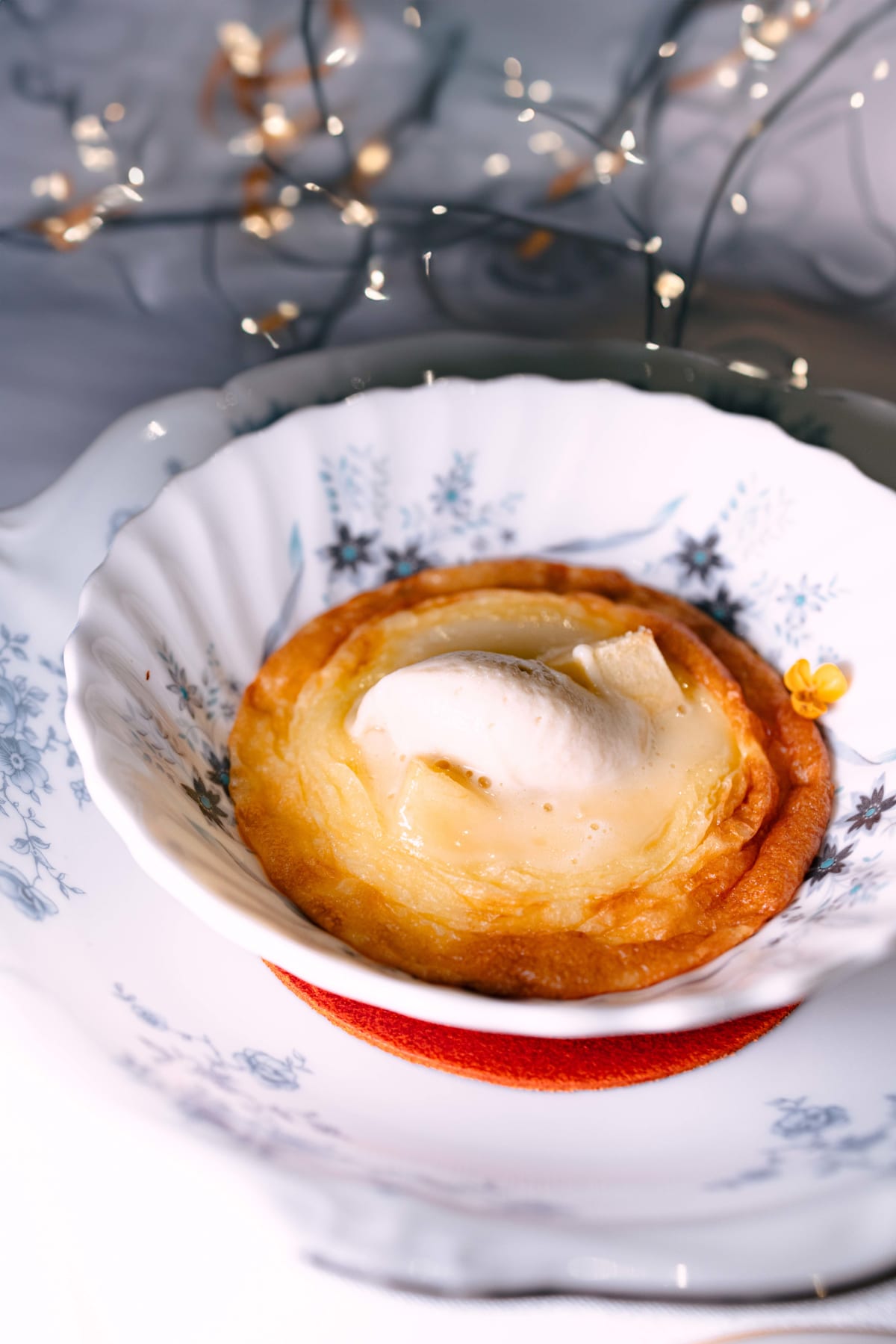
As an aside, there were so many dishes and marks on the table late in the course that I edited the whole upper part of the frame with generative AI in Photoshop, and it followed the pattern of the pretty porcelain and made it beautiful. An unexpected beauty.
Section 10·Quarts de Chaume
Around the time we were eating dessert the sommelier came over with another bottle of dessert wine and gave us a glass on the house to try.
Domaine Patrick Baudouin Les Zerzilles Quarts de Chaume. A botrytis wine made from Chenin Blanc in the Loire. I had known botrytis wine only from Sauternes, so the Loire version was one I was hearing of and tasting for the first time. Unlike a fortified wine the alcohol is not high, so it is easy to drink lightly too. The sommelier gave us a young vintage that day and told us the true worth of this wine shows in a vintage with some time on it. I found this one plenty good enough as it was.
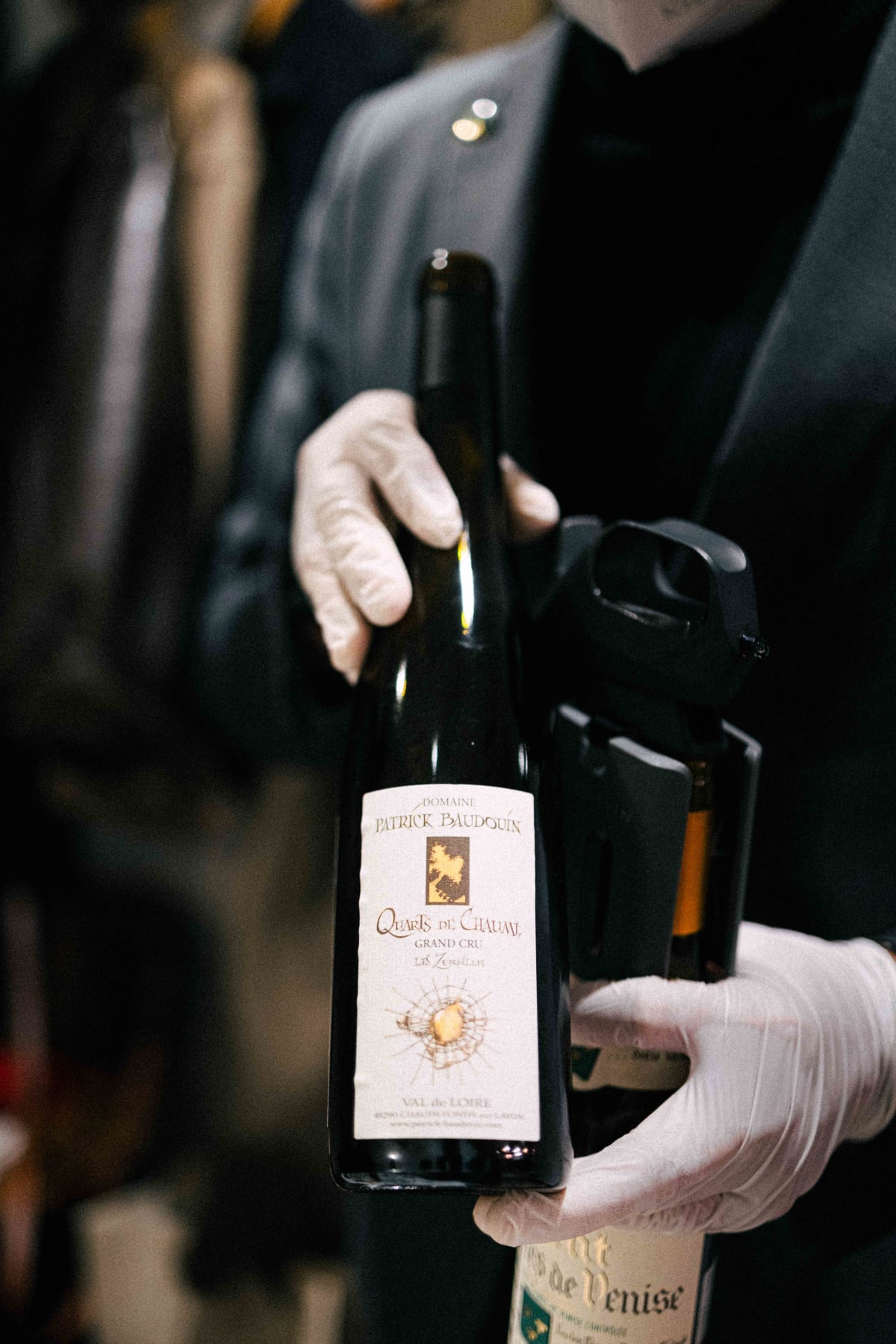
Quarts de Chaume is an appellation inside the Coteaux du Layon in the Anjou region of the Loire, and carrying Grand Cru status it is among the finest sweet wine sites in the Loire. The morning mist that forms where the Loire and the Layon meet brings on the botrytis, and what the Ciron does for Sauternes these two rivers do here.
Domaine Patrick Baudouin farms around thirteen hectares organically across Anjou-Saumur, and Les Zerzilles is one hundred percent Chenin Blanc from a parcel planted in 1970. It sits at fifty to seventy metres on south-east facing schist bedrock with clay and sand over it. The alcohol staying around twelve percent is because the sugar comes from botrytis rather than fortification, and the sommelier's remark about needing time comes down to how long the acidity of Chenin Blanc from this area holds up.
Next time I go to France I should look for one.
Section 11·After the Move
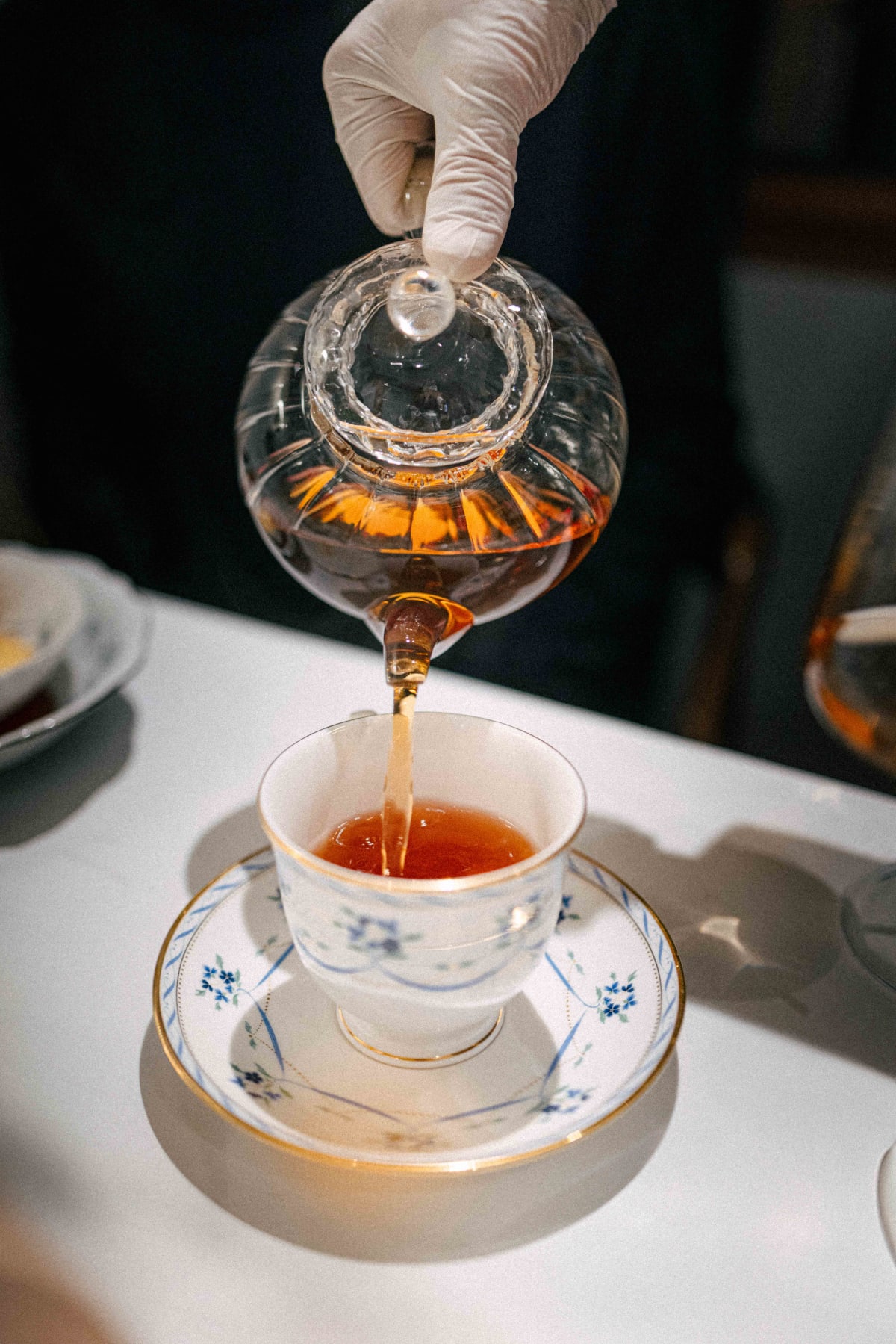
Wani Farm "Farm and Garden" tea by Okin Dasil, or coffee.
The last thing to come was tea, and knowing nothing about tea I can still say the aroma was good and it made a decent close.
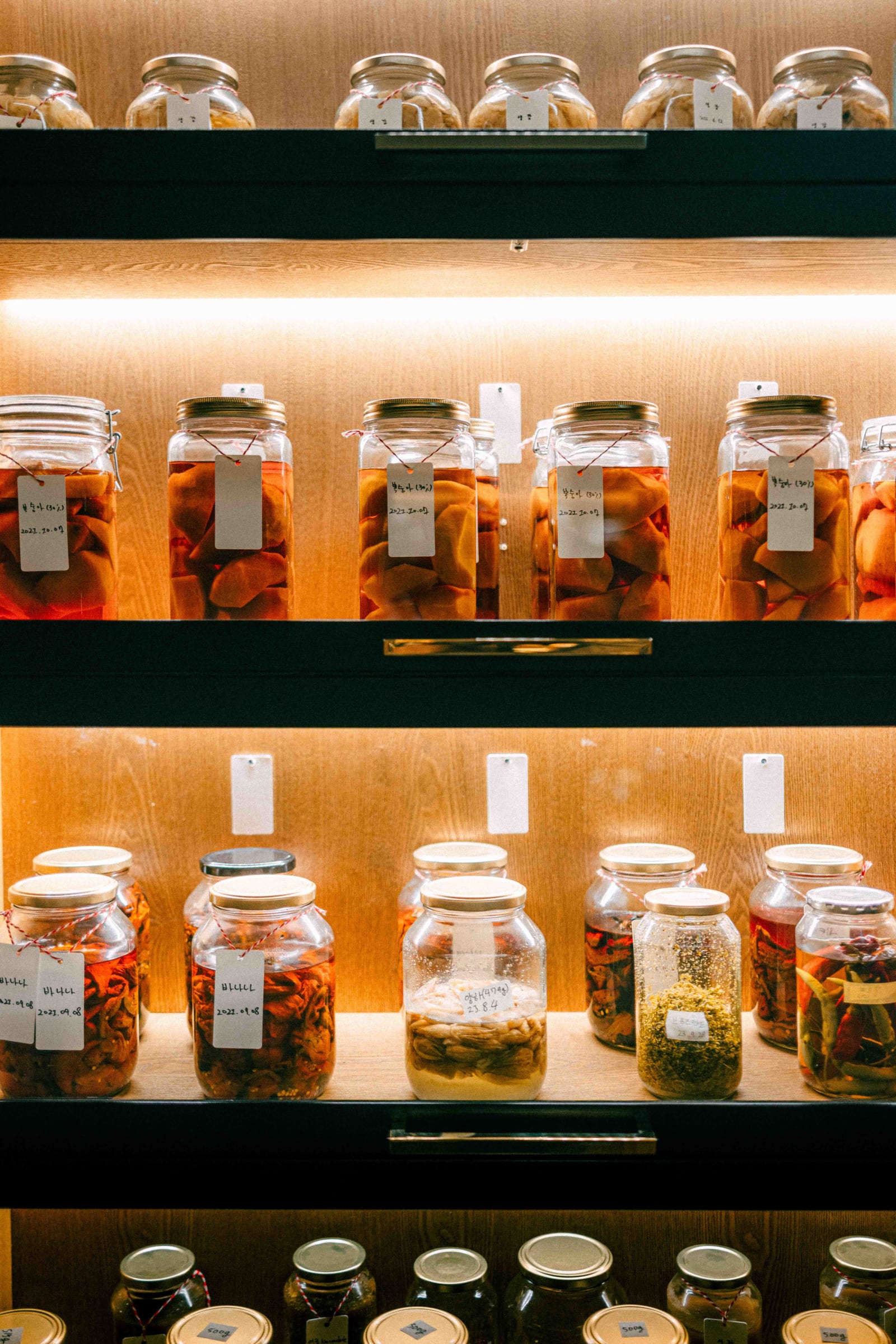
On the way out after the meal, at the entrance, there were peaches and bananas and ginger and garlic, all sorts of fruit and vegetables, in jars and maturing. The jars had names and dates written on them, and when I asked what they were I was told the chef pickles crops and fruit he has grown himself, and that they would go directly into the cooking at GIGAS.
When I visited, GIGAS was on Dosan-daero, and it has since moved to Piknic in Hoehyeon, Jung-gu, Seoul. It looks to have moved into a more comfortable and better space. I want to taste the other dishes, interesting and delicious, made there from crops and fruit and ingredients they grow and make themselves.
The new space is on the third floor of Piknic, the cultural complex on the slopes of Namsan, and the design team is said to have gone to Wani Farm and the Gunpo head house themselves to bring the soil of the farm and the walls and wood of the hanok, the texture and colour of the tables, into the interior. Jung Ha-wan says that where the GIGAS of before the move leaned toward persuading guests of what vegetables could do, after moving he came to focus on flavour anyone could enjoy intuitively, ahead of the message.
That the first Michelin star arrived in 2025, the year after the move, overlaps with that period. So the GIGAS on Dosan-daero that I went to was the last stage he stood on before he put his own cooking back in order.
So the GIGAS on Dosan-daero that I went to was the last stage he stood on before he put his own cooking back in order.
Reviewing a distinction that no longer exists is a strange position. Michelin retired the Green Star in 2026, so the badge this house wore on the night I came is now a category in the past tense. What was not retired is the reason it was given. The field still decides the menu before the chef does, and the compost still goes back to the ground it came from. The award described a system rather than rewarding one, and systems outlast their descriptions. Nothing written here is a recommendation of a dish, because nothing on this menu holds still long enough to be one.

Have a question about this restaurant, or want to share your own experience?
Send a message